tire pressure Lexus ES300h 2013 User Guide
[x] Cancel search | Manufacturer: LEXUS, Model Year: 2013, Model line: ES300h, Model: Lexus ES300h 2013Pages: 910, PDF Size: 9.95 MB
Page 331 of 910
330
ES350 300h_OM_OM33A01U_(U)
4-6. Driving tips
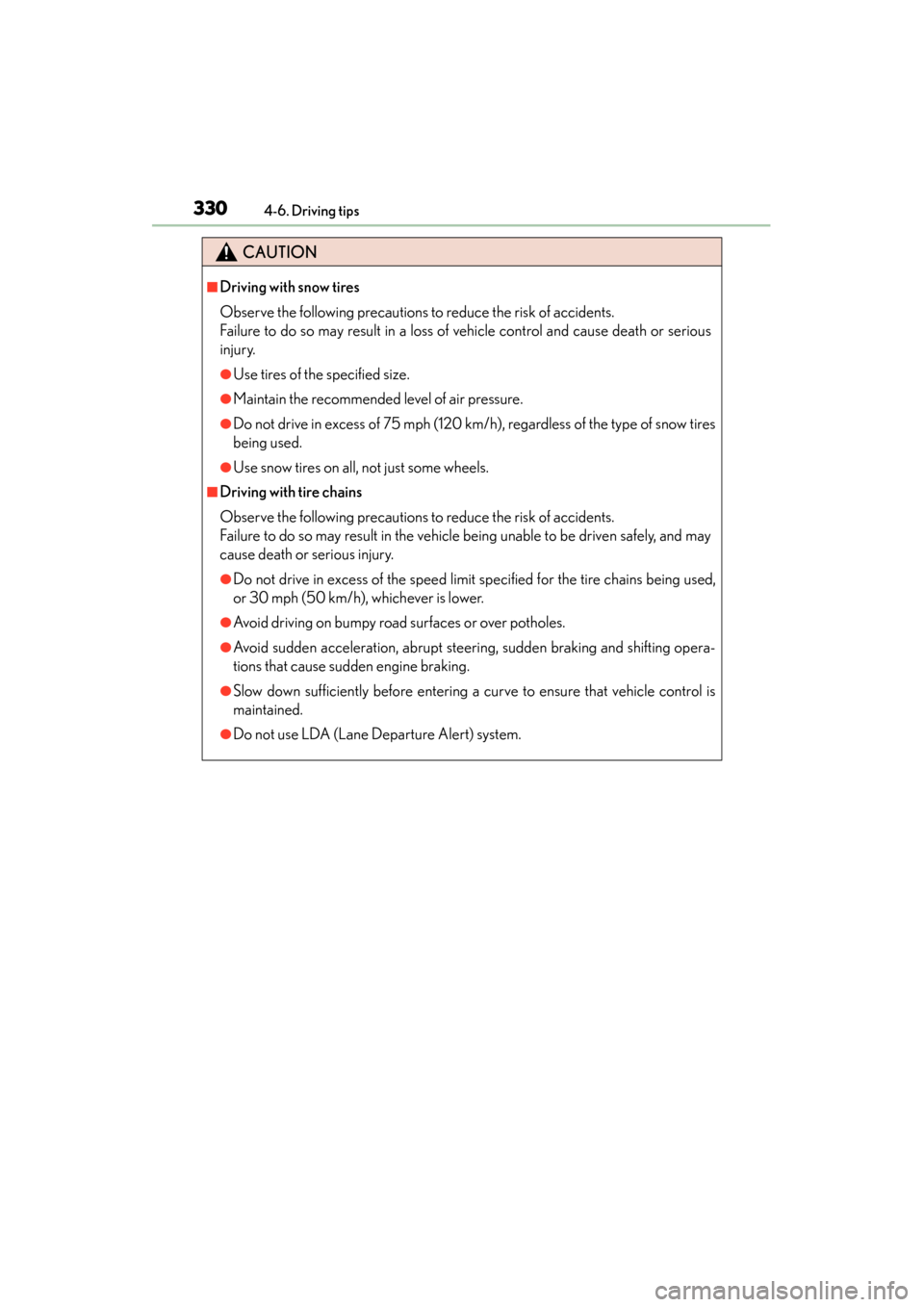
CAUTION
■Driving with snow tires
Observe the following precautions to reduce the risk of accidents.
Failure to do so may result in a loss of vehicle control and cause death or serious
injury.
●Use tires of the specified size.
●Maintain the recommended level of air pressure.
●Do not drive in excess of 75 mph (120 km/h), regardless of the type of snow tires
being used.
●Use snow tires on all, not just some wheels.
■Driving with tire chains
Observe the following precautions to reduce the risk of accidents.
Failure to do so may result in the vehicle being unable to be driven safely, and may
cause death or serious injury.
●Do not drive in excess of the speed limit specified for the tire chains being used,
or 30 mph (50 km/h), whichever is lower.
●Avoid driving on bumpy road surfaces or over potholes.
●Avoid sudden acceleration, abrupt steering, sudden braking and shifting opera-
tions that cause sudden engine braking.
●Slow down sufficiently before entering a curve to ensure that vehicle control is
maintained.
●Do not use LDA (Lane Departure Alert) system.
Page 332 of 910
ES350 300h_OM_OM33A01U_(U)
3314-6. Driving tips
4
Driving
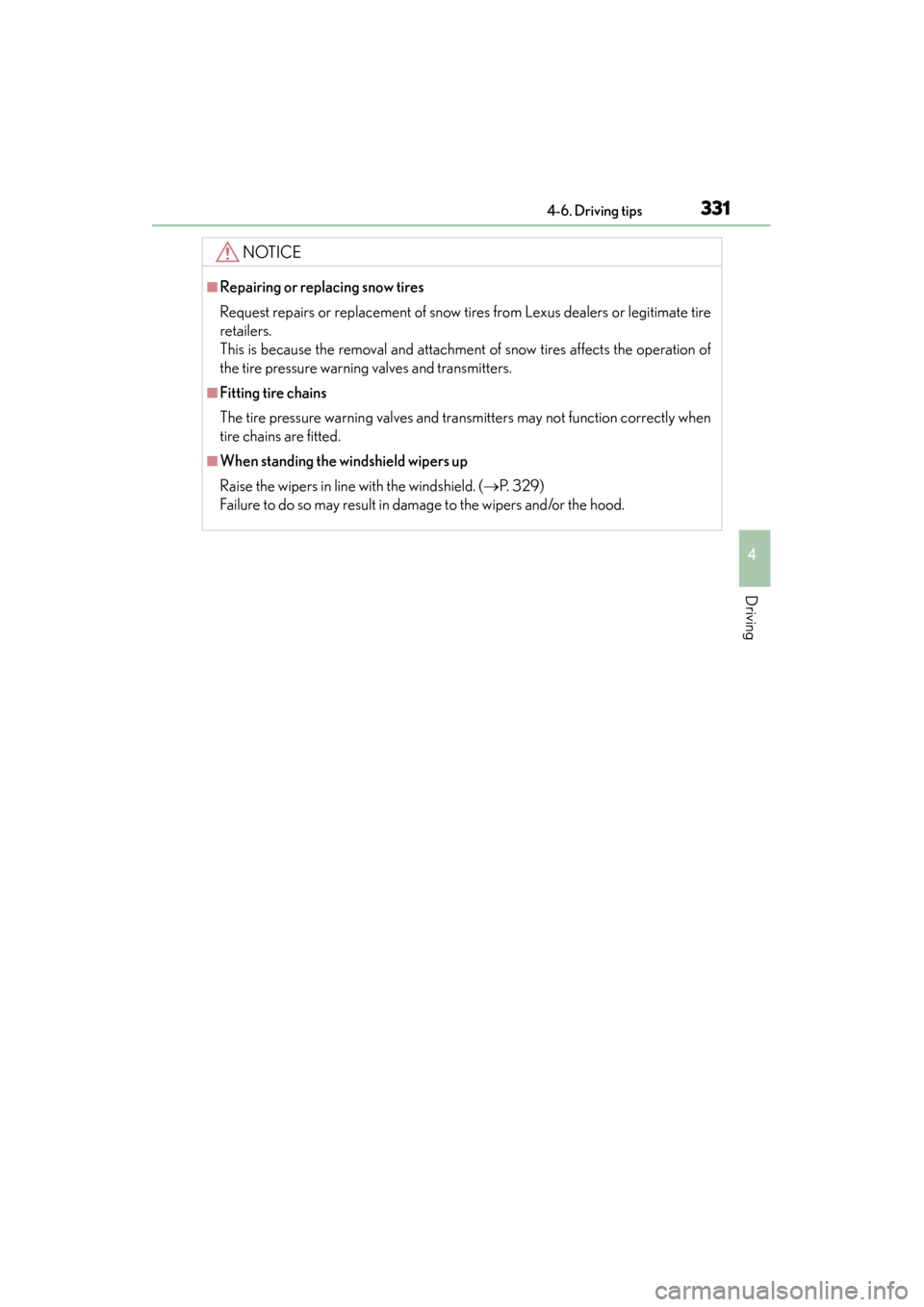
NOTICE
■Repairing or replacing snow tires
Request repairs or replacement of snow tires from Lexus dealers or legitimate tire
retailers.
This is because the removal and attachment of snow tires affects the operation of
the tire pressure warning valves and transmitters.
■Fitting tire chains
The tire pressure warning valves and transmitters may not function correctly when
tire chains are fitted.
■When standing the windshield wipers up
Raise the wipers in line with the windshield. (→P. 3 2 9 )
Failure to do so may result in damage to the wipers and/or the hood.
Page 650 of 910
649
ES350 300h_OM_OM33A01U_(U)
6Maintenance and care
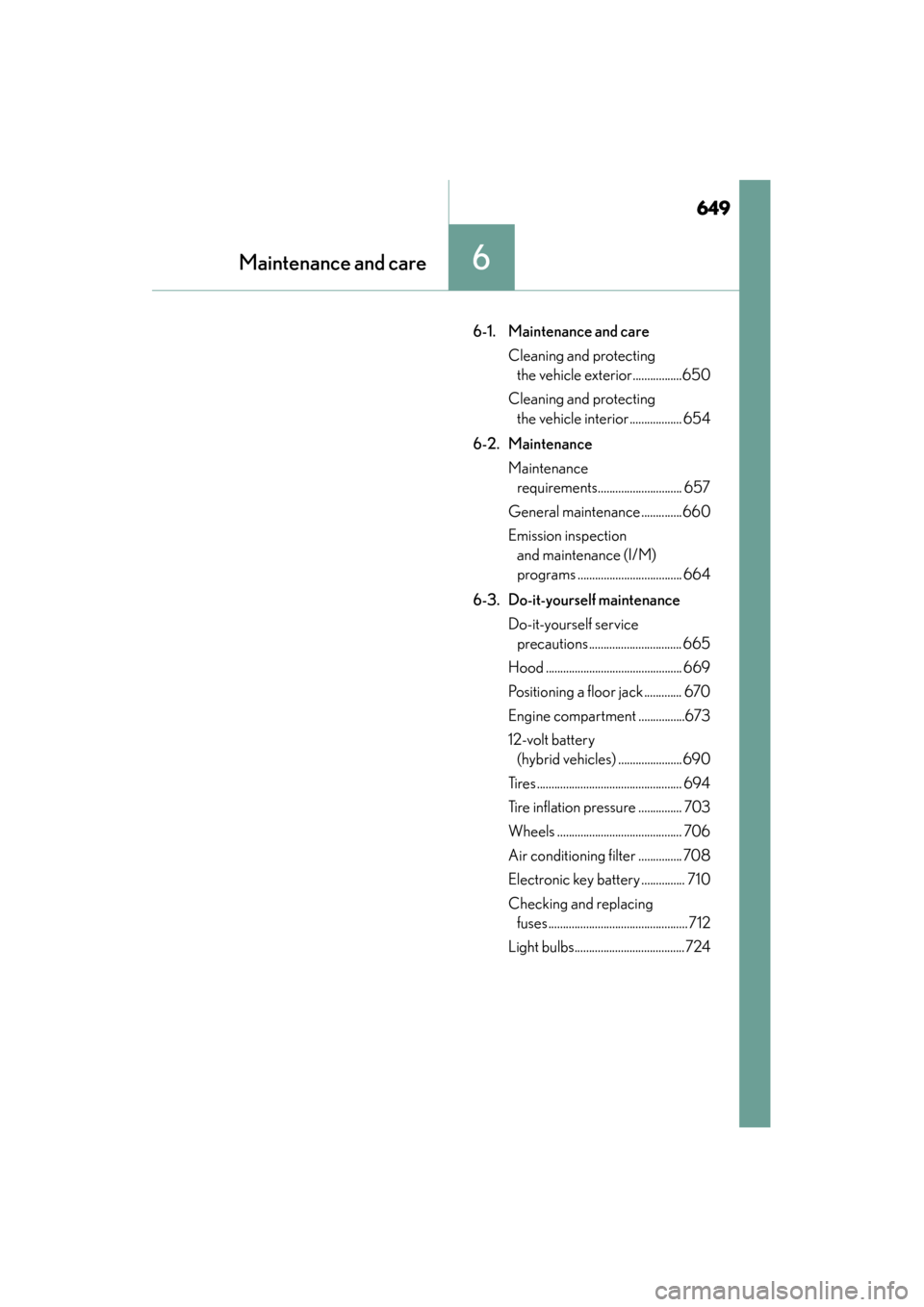
6-1. Maintenance and careCleaning and protecting the vehicle exterior.................650
Cleaning and protecting the vehicle interior .................. 654
6-2. Maintenance Maintenance requirements............................. 657
General maintenance ..............660
Emission inspection and maintenance (I/M)
programs .................................... 664
6-3. Do-it-yourself maintenance Do-it-yourself service precautions................................ 665
Hood ............................................... 669
Positioning a floor jack ............. 670
Engine compartment ................673
12-volt battery (hybrid vehicles) ......................690
Tires.................................................. 694
Tire inflation pressure ............... 703
Wheels ........................................... 706
Air conditioning filter ............... 708
Electronic key battery ............... 710
Checking and replacing fuses................................................712
Light bulbs......................................724
Page 664 of 910
ES350 300h_OM_OM33A01U_(U)
6636-2. Maintenance
6
Maintenance and care
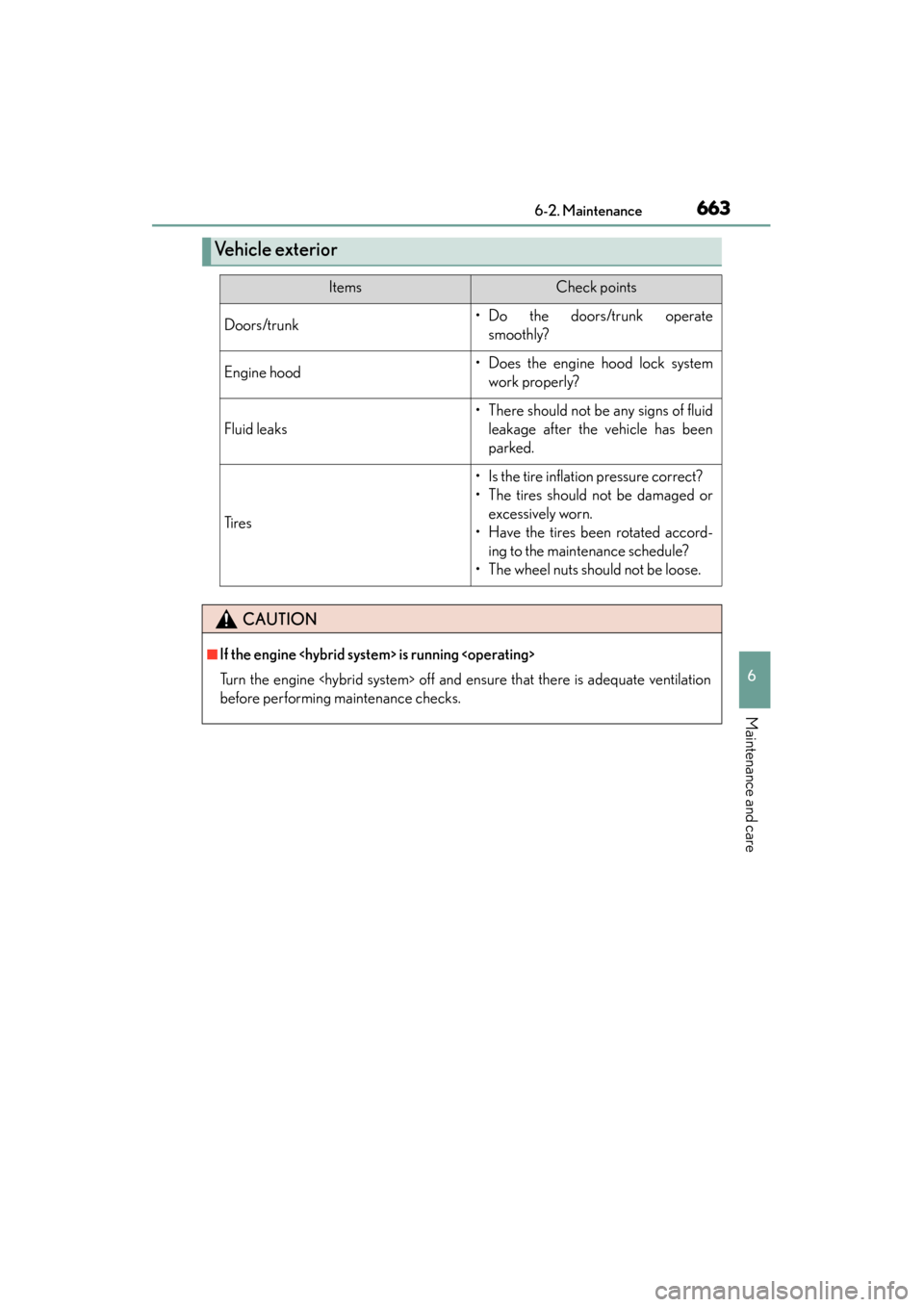
Ve h i c l e e x t e r i o r
ItemsCheck points
Doors/trunk• Do the doors/trunk operatesmoothly?
Engine hood• Does the engine hood lock systemwork properly?
Fluid leaks
• There should not be any signs of fluidleakage after the vehicle has been
parked.
Ti r e s
• Is the tire inflation pressure correct?
• The tires should not be damaged orexcessively worn.
• Have the tires been rotated accord- ing to the maintenance schedule?
• The wheel nuts should not be loose.
CAUTION
■If the engine
Turn the engine
before performing maintenance checks.
Page 667 of 910
666
ES350 300h_OM_OM33A01U_(U)
6-3. Do-it-yourself maintenance
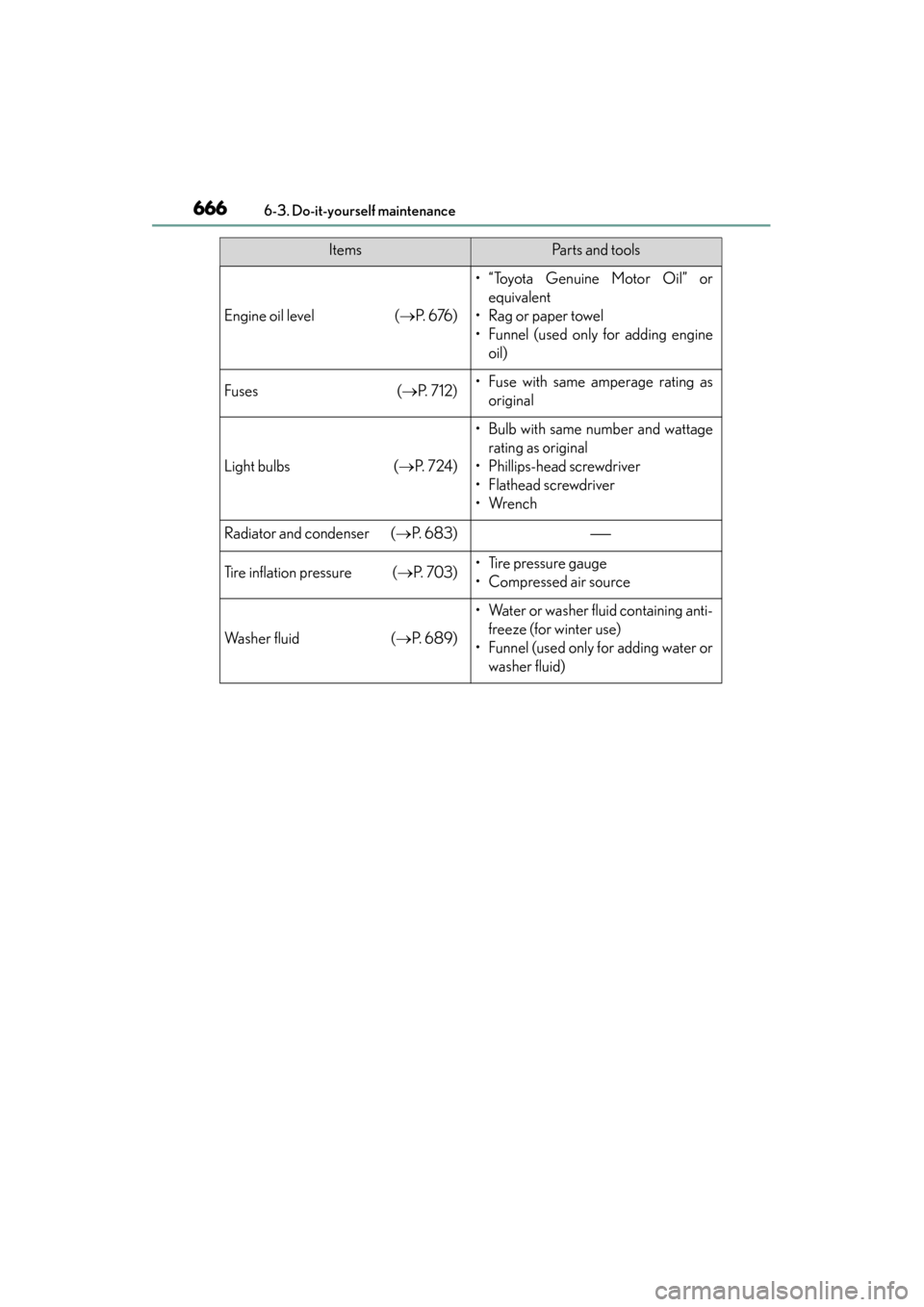
Engine oil level (→P. 6 76 )
• “Toyota Genuine Motor Oil” or
equivalent
• Rag or paper towel
• Funnel (used only for adding engine oil)
Fuses (→ P. 7 1 2 )• Fuse with same amperage rating as
original
Light bulbs (→ P. 7 2 4 )
• Bulb with same number and wattage
rating as original
• Phillips-head screwdriver
• Flathead screwdriver
•Wrench
Radiator and condenser ( →P. 6 8 3 )
Tire inflation pressure ( →P. 7 0 3 )• Tire pressure gauge
• Compressed air source
Wa s h e r f l u i d (→ P. 6 8 9 )
• Water or washer fluid containing anti-
freeze (for winter use)
• Funnel (used only for adding water or washer fluid)
ItemsPa r t s a n d t o o l s
Page 695 of 910
694
ES350 300h_OM_OM33A01U_(U)
6-3. Do-it-yourself maintenance
Tires
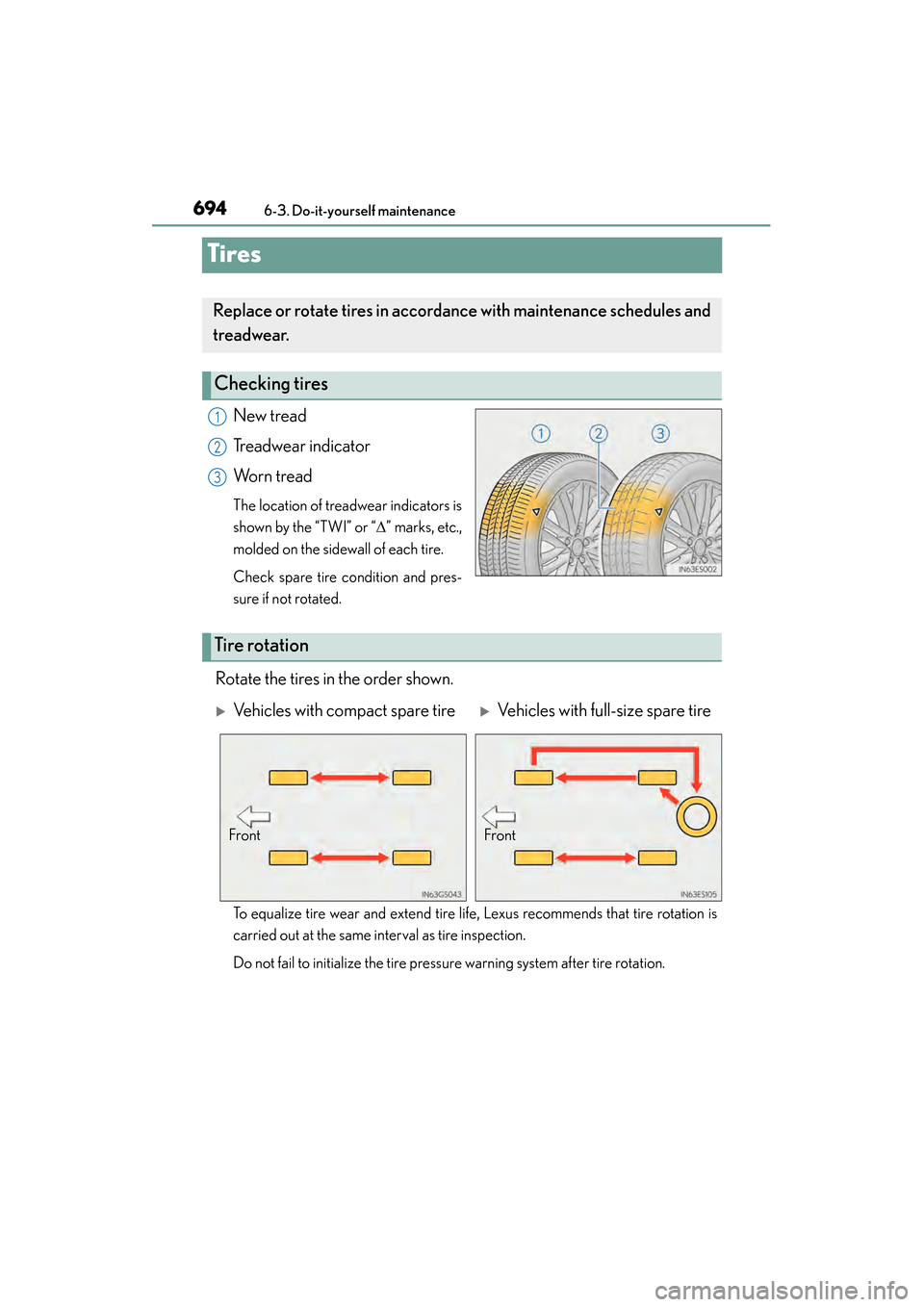
New tread
Treadwear indicator
Worn tread
The location of treadwear indicators is
shown by the “TWI” or “∆” marks, etc.,
molded on the sidewall of each tire.
Check spare tire condition and pres-
sure if not rotated.
Rotate the tires in the order shown.
To equalize tire wear and extend tire life, Lexus recommends that tire rotation is
carried out at the same interval as tire inspection.
Do not fail to initialize the tire pressure warning system after tire rotation.
Replace or rotate tires in accord ance with maintenance schedules and
treadwear.
Checking tires
1
2
3
Tire rotation
XVehicles with compact spare tireXVehicles with full-size spare tire
FrontFront
Page 696 of 910
ES350 300h_OM_OM33A01U_(U)
6956-3. Do-it-yourself maintenance
6
Maintenance and care
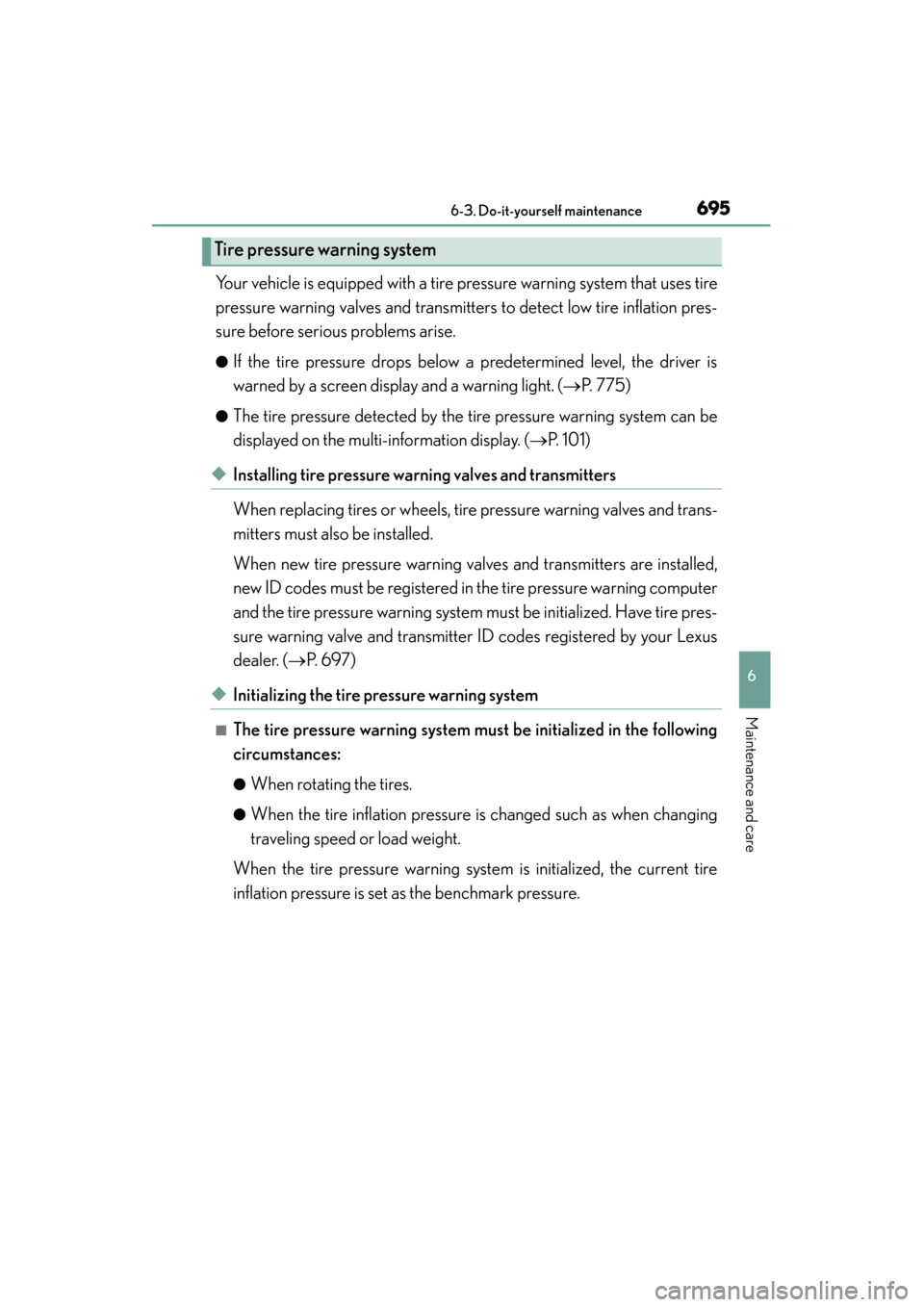
Your vehicle is equipped with a tire pressure warning system that uses tire
pressure warning valves and transmitters to detect low tire inflation pres-
sure before serious problems arise.
●If the tire pressure drops below a predetermined level, the driver is
warned by a screen display and a warning light. (→P. 775)
●The tire pressure detected by the tire pressure warning system can be
displayed on the multi-information display. ( →P. 1 0 1 )
◆Installing tire pressure wa rning valves and transmitters
When replacing tires or wheels, tire pressure warning valves and trans-
mitters must also be installed.
When new tire pressure warning valves and transmitters are installed,
new ID codes must be registered in the tire pressure warning computer
and the tire pressure warning system must be initialized. Have tire pres-
sure warning valve and transmitter ID codes registered by your Lexus
dealer. ( →P. 6 9 7 )
◆Initializing the tire pressure warning system
■The tire pressure warning system must be initialized in the following
circumstances:
●When rotating the tires.
●When the tire inflation pressure is changed such as when changing
traveling speed or load weight.
When the tire pressure warning system is initialized, the current tire
inflation pressure is set as the benchmark pressure.
Tire pressure warning system
Page 697 of 910
696
ES350 300h_OM_OM33A01U_(U)
6-3. Do-it-yourself maintenance
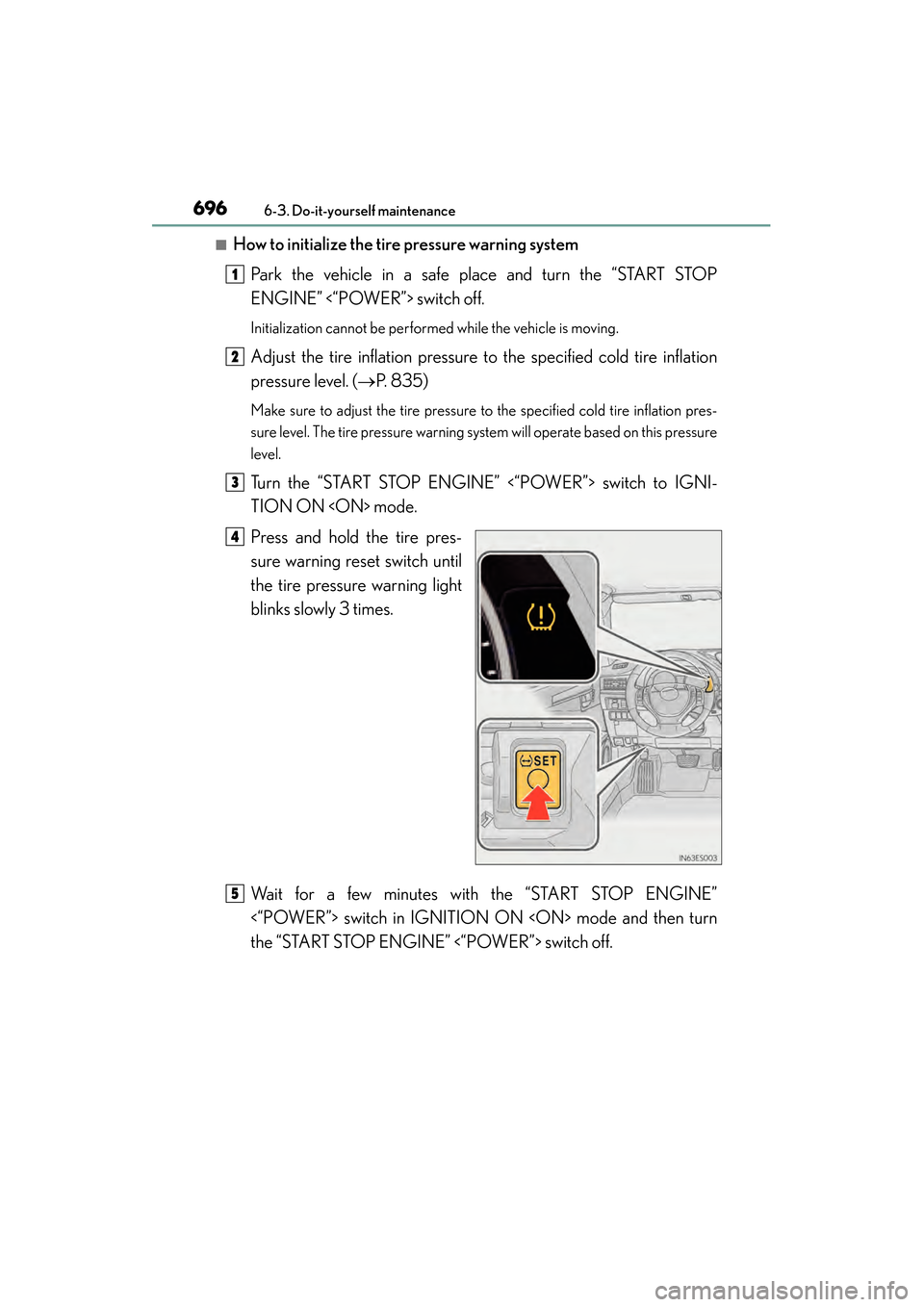
■How to initialize the tire pressure warning system
Park the vehicle in a safe place and turn the “START STOP
ENGINE” <“POWER”> switch off.
Initialization cannot be performed while the vehicle is moving.
Adjust the tire inflation pressure to the specified cold tire inflation
pressure level. ( →P. 835)
Make sure to adjust the tire pressure to the specified cold tire inflation pres-
sure level. The tire pressure warning system will operate based on this pressure
level.
Turn the “START STOP ENGINE” <“POWER”> switch to IGNI-
TION ON
Press and hold the tire pres-
sure warning reset switch until
the tire pressure warning light
blinks slowly 3 times.
Wait for a few minutes with the “START STOP ENGINE”
<“POWER”> switch in IGNITION ON
the “START STOP ENGINE” <“POWER”> switch off.
1
2
3
4
5
Page 698 of 910
ES350 300h_OM_OM33A01U_(U)
6976-3. Do-it-yourself maintenance
6
Maintenance and care
◆Registering ID codes
The tire pressure warning valve and transmitter is equipped with a
unique ID code. When replacing a tire pressure warning valve and
transmitter, it is necessary to register the ID code. Have the ID code
registered by your Lexus dealer.
■When to replace your vehicle’s tires
Tires should be replaced if:
●You have tire damage such as cuts, splits, cracks deep enough to expose the fabric,
and bulges indicating internal damage
●A tire goes flat repeatedly or cannot be properly repaired due to the size or loca-
tion of a cut or other damage
If you are not sure, consult with your Lexus dealer.
■Replacing tires and wheels
If the ID code of the tire pressure warning valve and transmitter is not registered, the
tire pressure warning system will not work properly. After driving for about 20 min-
utes, the tire pressure warning light blinks for 1 minute and stays on to indicate a sys-
tem malfunction.
■Tire life
Any tire over 6 years old must be checked by a qualified technician even if it has sel-
dom or never been used or damage is not obvious.
■Routine tire inflation pressure checks
The tire pressure warning system does not replace routine tire inflation pressure
checks. Make sure to check tire inflation pressure as part of your routine of daily
vehicle checks.
■When rotating the tires
Make sure that the “START STOP ENGINE” <“POWER”> switch is off. If the tires are
rotated while the “START STOP ENGINE” <“POWER”> switch is in IGNITION ON
If this accidentally occurs, either turn the “START STOP ENGINE” <“POWER”>
switch to off and then to IGNITION ON
checking that the tire pressure is properly adjusted.
Page 699 of 910
698
ES350 300h_OM_OM33A01U_(U)
6-3. Do-it-yourself maintenance
■Low profile tires (P225/45R18 tires)
Generally, low profile tires will wear more rapidly and tire grip performance will be
reduced on snowy and/or icy roads when compared to standard tires. Be sure to use
snow tires or tire chains on snowy and/or icy roads and drive carefully at a speed
appropriate for road and weather conditions.
■Maximum load of tire
Check that the maximum load of the replacement tire is greater than 1 /2 of the
Gross Axle Weight Ratings (GAWR) of either the front axle or the rear axle, which-
ever is greater.
■Tire types
●Summer tires
Summer tires are high-speed performance tires best suited to highway driving
under dry conditions. Since summer tires do not have the same traction perfor-
mance as snow tires, summer tires are inadequate for driving on snow-covered or
icy roads. For driving on snow-covered roads or icy roads, the use of snow tires is
recommended. When installing snow tires, be sure to replace all four tires.
●All season tires
All season tires are designed to provide better traction in snow and to be ade-
quate for driving in most winter conditions as well as for use year-round. All season
tires, however, do not have adequate traction performance compared with snow
tires in heavy or loose snow. Also, all season tires fall short in acceleration and han-
dling performance compared with summer tires in highway driving.
●Snow tires
For driving on snow-covered roads or icy roads, we recommend using snow tires.
If you need snow tires, select tires of the same size, construction and load capacity
as the originally installed tires. Since your vehicle has radial tires as original equip-
ment, make sure your snow tires also have radial construction. Do not install stud-
ded tires without first checking local regulations for possible restrictions. Snow
tires should be installed on all wheels. (→P. 3 2 6 )
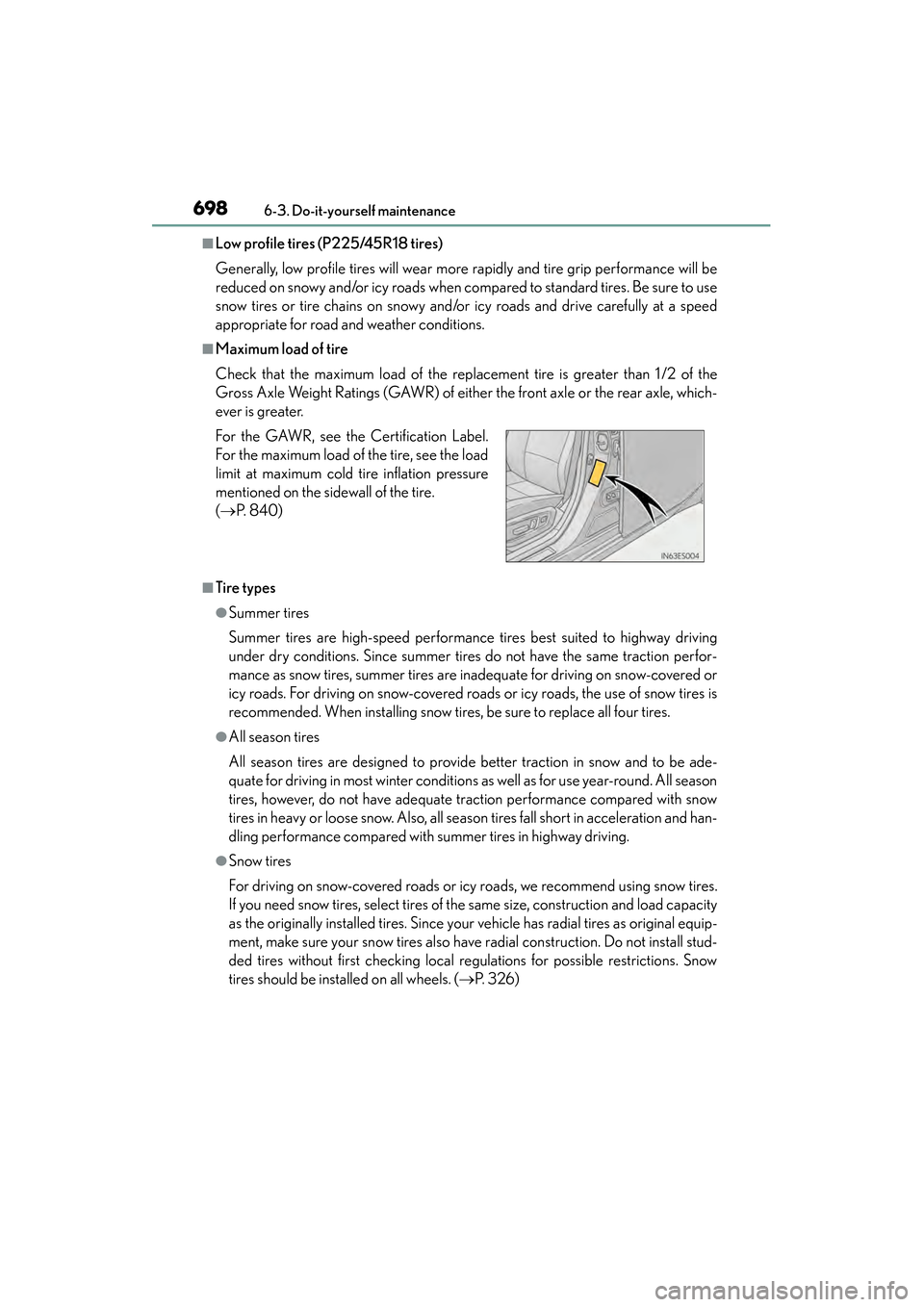
For the GAWR, see the Certification Label.
For the maximum load of the tire, see the load
limit at maximum cold tire inflation pressure
mentioned on the sidewall of the tire.
(
→ P. 8 4 0 )