radio Lexus ES300h 2013 Repair Manual
[x] Cancel search | Manufacturer: LEXUS, Model Year: 2013, Model line: ES300h, Model: Lexus ES300h 2013Pages: 910, PDF Size: 9.95 MB
Page 566 of 910
565
ES350 300h_OM_OM33A01U_(U)
5-4. Using the audio system
5
Interior features
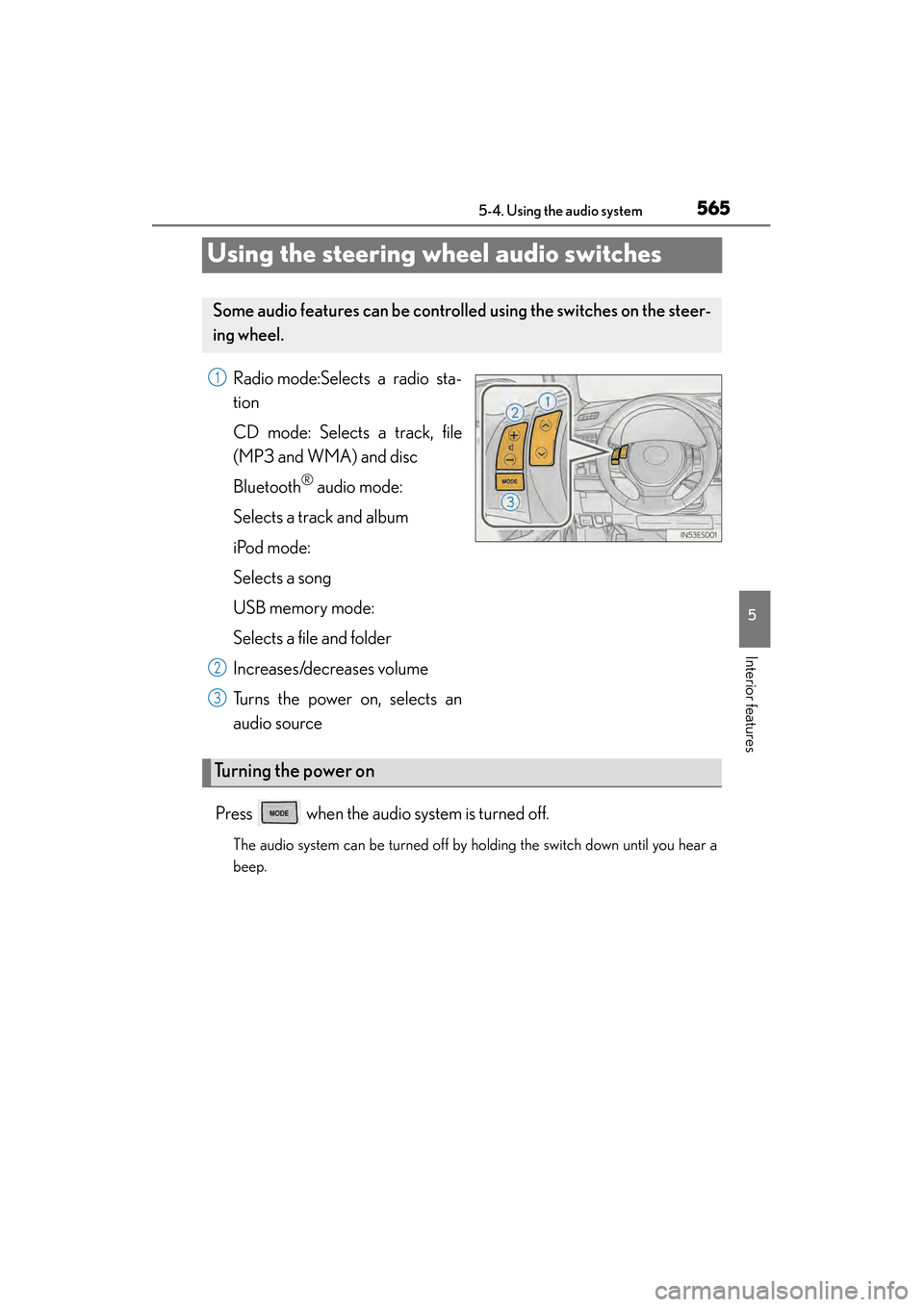
Using the steering wheel audio switches
Radio mode:Selects a radio sta-
tion
CD mode: Selects a track, file
(MP3 and WMA) and disc
Bluetooth
® audio mode:
Selects a track and album
iPod mode:
Selects a song
USB memory mode:
Selects a file and folder
Increases/decreases volume
Turns the power on, selects an
audio source
Press when the audio system is turned off.
The audio system can be turned off by holding the switch down until you hear a
beep.
Some audio features can be controll ed using the switches on the steer-
ing wheel.
1
2
3
Turning the power on
Page 567 of 910
566
ES350 300h_OM_OM33A01U_(U)
5-4. Using the audio system
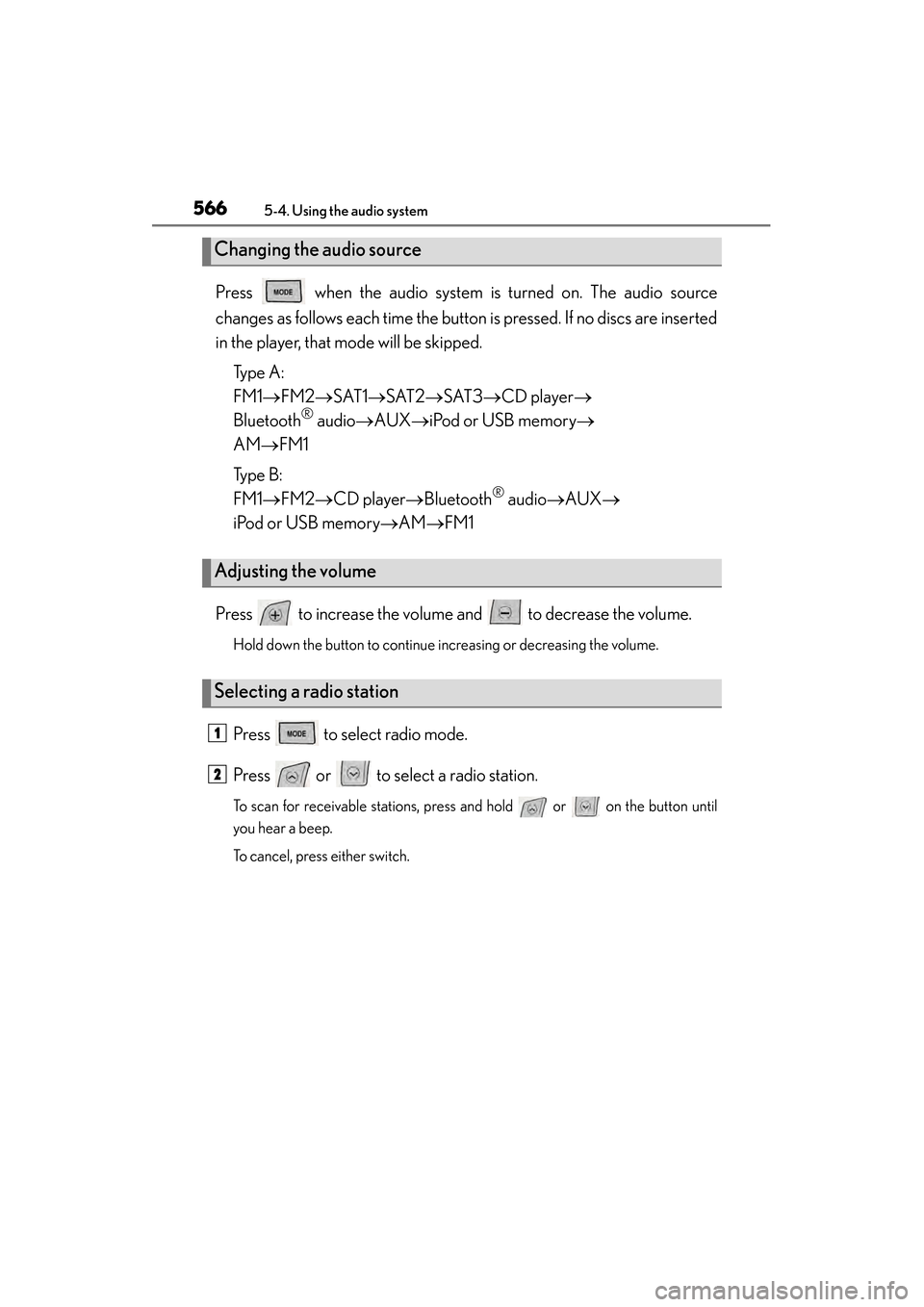
Press when the audio system is turned on. The audio source
changes as follows each time the button is pressed. If no discs are inserted
in the player, that mode will be skipped.Ty p e A :
FM1 →FM2 →SAT1 →SAT2 →SAT3 →CD player →
Bluetooth
® audio →AUX →iPod or USB memory →
AM →FM1
Ty p e B :
FM1 →FM2 →CD player →Bluetooth
® audio →AUX →
iPod or USB memory →AM →FM1
Press to increase the volume and to decrease the volume.
Hold down the button to continue increasing or decreasing the volume.
Press to select radio mode.
Press or to select a radio station.
To scan for receivable stations, press and hold or on the button until
you hear a beep.
To cancel, press either switch.
Changing the audio source
Adjusting the volume
Selecting a radio station
1
2
Page 571 of 910
570
ES350 300h_OM_OM33A01U_(U)
5-4. Using the audio system
■Certification for the hands-free system
FCC ID: AJDK018
IC ID: 775E-K018
This device complies with Part 15 of FCC Rules and Industry Canada licence-
exempt RSS standard(s). Operation is subject to the following two conditions: (1) this
device may not cause interference, and (2) this device must accept any interference,
including interference that may cause undesired operation of this device.
Le présent appareil est conforme aux la partie 15 des règles de la FCC et CNR
d’Industrie Canada applicables aux appareils radio exempts de licence. L’exploita-
tion est autorisée aux deux conditions suivantes : (1) l’appareil ne doit pas produire
de brouillage, et (2) l’utilisateur de l’appareil doit accepter tout brouillage radioélec-
trique subi, même si le brouillage est susceptible d’en compromettre le fonctionne-
ment.
Page 572 of 910
ES350 300h_OM_OM33A01U_(U)
5715-4. Using the audio system
5
Interior features
CAUTION
■FCC WARNING
This equipment complies with FCC/IC radiation exposure limits set forth for an
uncontrolled environment and meets the FCC radio frequency (RF) Exposure
Guidelines in Supplement C to OET65 and RSS-102 of the IC radio frequency
(RF) Exposure rules. This equipment has very low levels of RF energy that it
deemed to comply without maximum permissive exposure evaluation (MPE). But
it is desirable that it should be installed and operated keeping the radiator at least
20 cm or more away from person’s body (excluding extremities: hands, wrists, feet
and ankles).
Cet équipement est conforme aux limites d’exposition aux rayonnements énon-
cées pour un environnement non contrôlé et respecte les règles les radioélec-
triques (RF) de la FCC lignes directrices d’exposition dans le Supplément C à
OET65 et d’exposition aux fréquences radioélectriques (RF) CNR-102 de l’IC.
Cet équipement émet une énergie RF très faible qui est considérée conforme sans
évaluation de l’exposition maximale autorisée.
Cependant, cet équipement doit être installé et utilisé en gardant une distance de
20 cm ou plus entre le dispositif rayonnant et le corps (à l’exception des
extrémités : mains, poignets, pieds et chevilles).
XFor vehicles sold in the U.S.A.
Changes or modifications not expressly approved by the party responsible for
compliance could void the user’s authority to operate the equipment.
This transmitter must not be co-located or operated in conjunction with any other
antenna or transmitter.
XFor vehicles sold in Canada
Under Industry Canada regulations, this radio transmitter may only operate using
an antenna of a type and maximum (or lesser) gain approved for the transmitter by
Industry Canada. To reduce potential radio interference to other users, the
antenna type and its gain should be so chosen that the equivalent isotropically radi-
ated power (e.i.r.p.) is not more than that necessary for successful communication.
Conformément à la réglementation d’Industrie Canada, le présent émetteur radio
peut fonctionner avec une antenne d’un type et d’un gain maximal (ou inférieur)
approuvé pour l’émetteur par Industrie Canada. Dans le but de réduire les risques
de brouillage radioélectrique à l’intention des autres utilisateurs, il faut choisir le
type d’antenne et son gain de sorte que la puissance isotrope rayonnée équiva-
lente (p.i.r.e.) ne dépasse pas l’intensité nécessaire à l’établissement d’une commu-
nication satisfaisante.
Page 647 of 910
646
ES350 300h_OM_OM33A01U_(U)
5-7. Other interior features
Important! Read this information before using Safety Connect.
■Exposure to radio frequency signals
The Safety Connect system installed in your vehicle is a low-power
radio transmitter and receiver. It receives and also sends out radio fre-
quency (RF) signals.
In August 1996, the Federal Communications Commission (FCC)
adopted RF exposure guidelines with safety levels for mobile wireless
phones. Those guidelines are consistent with the safety standards previ-
ously set by the following U.S. and international standards bodies.
●ANSI (American National Standards Institute) C95.1 [1992]
●NCRP (National Council on Radiation Protection and Measure-
ment) Report 86 [1986]
●ICNIRP (International Commission on Non-Ionizing Radiation Pro-
tection) [1996]
Those standards were based on comprehensive and periodic evalua-
tions of the relevant scientific literature. Over 120 scientists, engineers,
and physicians from universities, and government health agencies and
industries reviewed the available body of research to develop the ANSI
Standard (C95.1).
The design of Safety Connect complies with the FCC guidelines in
addition to those standards.
Safety information for Safety Connect
Page 700 of 910
ES350 300h_OM_OM33A01U_(U)
6996-3. Do-it-yourself maintenance
6
Maintenance and care
■If the tread on snow tires wears down below 0.16 in. (4 mm)
The effectiveness of the tires as snow tires is lost.
■Situations in which the tire pressure warning system may not operate properly
●In the following cases, the tire pressure warning system may not operate properly.
• If non-genuine Lexus wheels are used.
• A tire has been replaced with a tire that is not an OE (Original Equipment) tire.
• A tire has been replaced with a tire that is not of the specified size.
• Tire chains etc. are equipped.
• Lock nuts are equipped.
• An auxiliary-supported run-flat tire is equipped.
• If a window tint that affects the radio wave signals is installed.
• If there is a lot of snow or ice on the vehicle, particularly around the wheels or wheel housings.
• If the tire inflation pressure is extremely higher than the specified level.
• If the spare tire is in a location subject to poor radio wave signal reception.
*
• If a large metallic object which can interfere with signal reception is put in the trunk.
*
*
: Vehicles with a full-size spare tire only
●Performance may be affected in the following situations.
• Near a TV tower, electric power plant, gas station, radio station, large display, airport or other facility that generates strong radio waves or electrical noise
• When carrying a portable radio, cellular phone, cordless phone or other wire- less communication device
If tire position information is not correctly displayed due to the radio wave condi-
tions, the display may be corrected by driving and changing the radio wave condi-
tions.
●When the vehicle is parked, the time taken for the warning to start or go off could
be extended.
●When tire inflation pressure declines rapidly for example when a tire has burst, the
warning may not function.
Page 702 of 910
ES350 300h_OM_OM33A01U_(U)
7016-3. Do-it-yourself maintenance
6
Maintenance and care
CAUTION
■When inspecting or replacing tires
Observe the following precautions to prevent accidents.
Failure to do so may cause damage to parts of the drive train as well as dangerous
handling characteristics, which may lead to an accident resulting in death or seri-
ous injury.
●Do not mix tires of different makes, models or tread patterns.
Also, do not mix tires of remarkably different treadwear.
●Do not use tire sizes other than those recommended by Lexus.
●Do not mix differently constructed tires (radial, bias-belted or bias-ply tires).
●Do not mix summer, all season and snow tires.
●Do not use tires that have been used on another vehicle.
Do not use tires if you do not know how they were used previously.
●Do not tow if your vehicle has a compact spare tire (if equipped) installed.
■When initializing the tire pressure warning system
Do not operate the tire pressure warning reset switch without first adjusting the tire
inflation pressure to the specified level. Otherwise, the tire pressure warning light
may not come on even if the tire inflation pressure is low, or it may come on when
the tire inflation pressure is actually normal.
■Caution regarding interference with electronic devices
●Users of any electrical medical device other than implanted pacemakers and
implanted cardiac defibrillators should consult the manufacturer of the device for
information about its operation under the influence of radio waves.
Radio waves could have unexpected effects on the operation of such medical
devices.
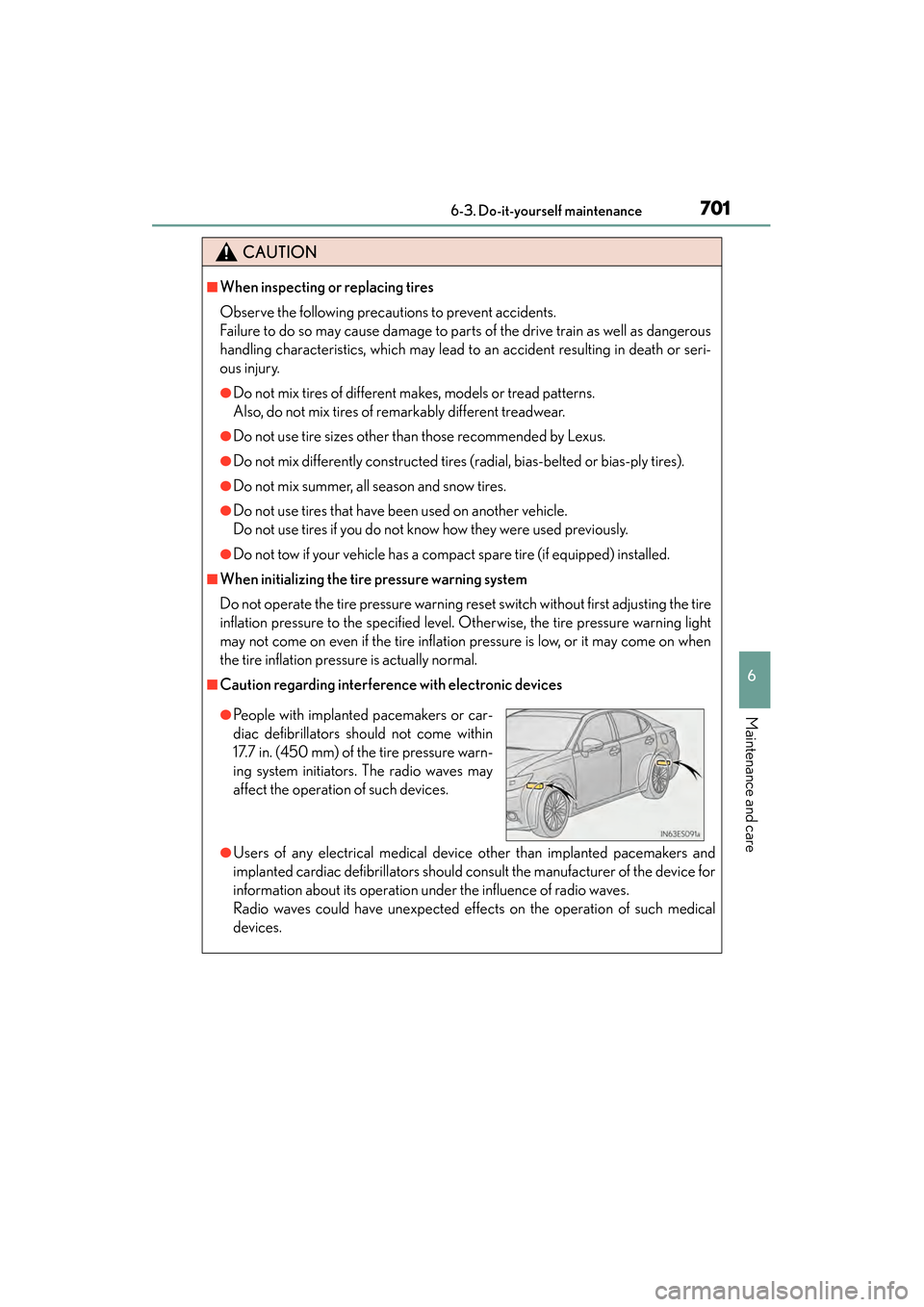
●People with implanted pacemakers or car-
diac defibrillators should not come within
17.7 in. (450 mm) of the tire pressure warn-
ing system initiators. The radio waves may
affect the operation of such devices.
Page 722 of 910
ES350 300h_OM_OM33A01U_(U)
7216-3. Do-it-yourself maintenance
6
Maintenance and care
12WIPER25Windshield wipers
13BKUP LP7. 5
Multiport fuel injection system, sequential
multiport fuel system, electronic controlled
transmission, audio system, navigation sys-
tem, back-up lights
14FUEL OPN10Fuel filler door opener
15EPS-IG110Electric power steering
16P/O U T L E T R R15Po w e r o u t l e t
17RADIO-ACC5Audio system, Remote Touch, multi-informa-
tion display, audio display, navigation system
18S / H T R & FA N F/ R10Seat heaters and ventilators
19S / H T R & FA N F/ L10Seat heaters and ventilators
20OBD7. 5On-Board diagnosis system
21ECU-B NO.210
Power window master switch, air condition-
ing system, smart access system with push-
button start, tire pressure warning system,
rear sunshade
22STRG HTR10Heated steering wheel
23PTL25Power trunk opener and closer ECU
24STOP7. 5
Power management system, multiport fuel
injection system, sequential multiport fuel
system, VSC, ABS, electronic controlled
transmission, driver support system, engine
room junction block assy, tail lights, high
mounted stoplight, smart access system with
push-button start, shift lock system
25P/ S E AT F/ L30Po w e r s e a t s
26A/C-B7. 5Air conditioning system
27S/ROOF10Moon roof
28P/ S E AT F/ R30Po w e r s e a t s
29PSB30Pre-collision seat belt
30D/L-A M120Main body ECU
FuseAmpereCircuit
Page 777 of 910

7767-2. Steps to take in an emergency
ES350 300h_OM_OM33A01U_(U)
*: Refer to the separate “Scheduled Maintenance” or “Owner’s Manual Supple-ment” for the maintenance interval applicable to your vehicle.
Warning messageDetailsCorrection procedure
Indicates that the tire
position information can-
not be recognized
Drive for a short while
and check if the display
updates. If the radio wave condi-
tions improve, the dis-
play may return to
normal. If the tire pres-
sure is still not dis-
played after driving for
several minutes, stop
the vehicle in a safe
place, turn the “START
STOP ENGINE”
<“POWER”> switch off
then on again, and start
driving.
If the tire pressure is still
not displayed even
after repeating this sev-
eral times, have the
vehicle inspected at
your Lexus dealer.
Indicates that the pre-col-
lision system is not cur-
rently functional because
the grille cover or the
sensor is dirtyThis message also
appears when the pre-
collision system is not
functional due to over-
heating.
• Check the grille coverand the sensor and
clean them if they are
dirty.
• In case of overheating, the system will become
functional once the sys-
tem cools down.
(Flashes)
(If equipped)
Page 848 of 910
ES350 300h_OM_OM33A01U_(U)
8478-1. Specifications
8
Vehicle specifications
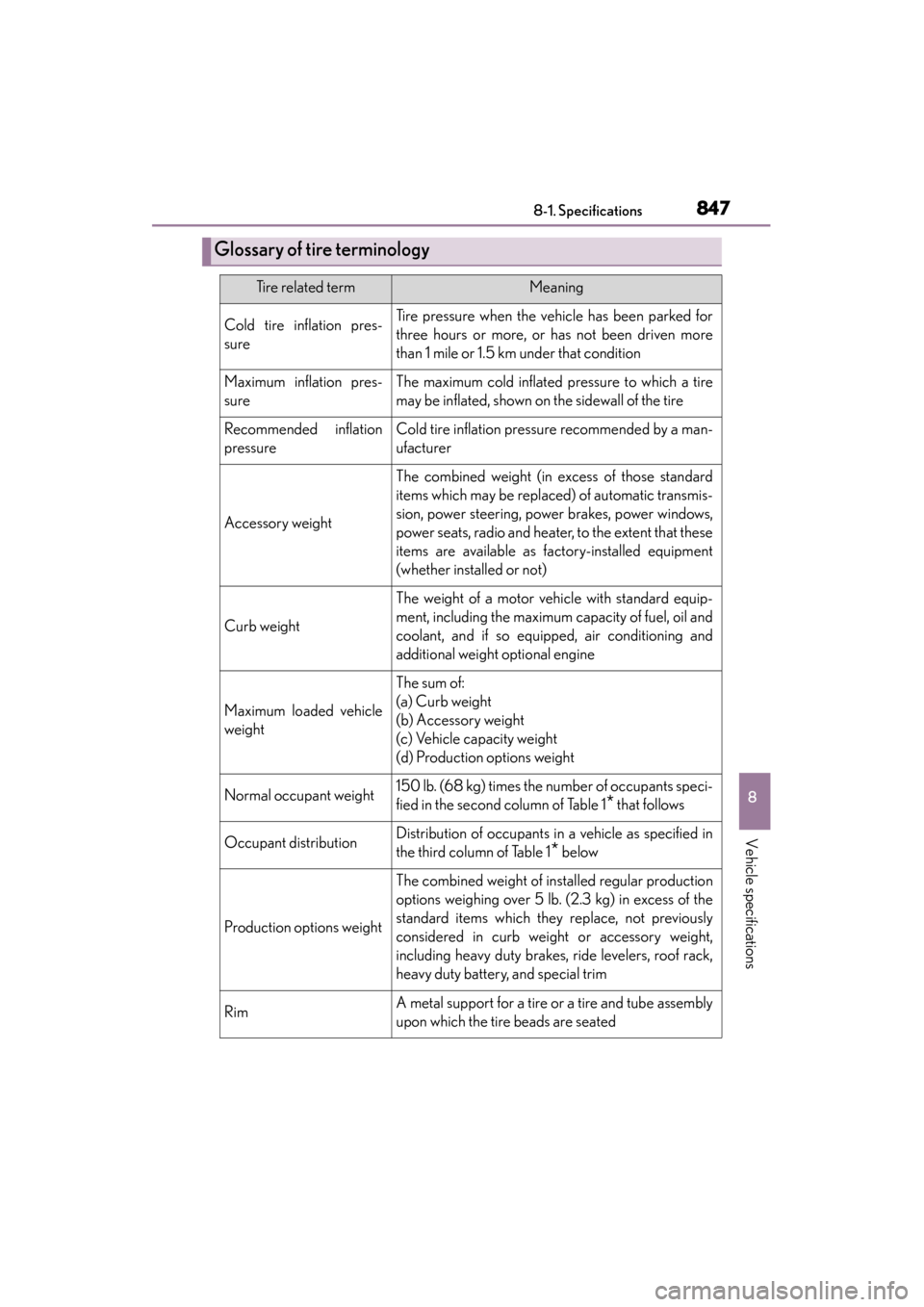
Glossary of tire terminology
Tire related termMeaning
Cold tire inflation pres-
sureTire pressure when the vehicle has been parked for
three hours or more, or has not been driven more
than 1 mile or 1.5 km under that condition
Maximum inflation pres-
sureThe maximum cold inflated pressure to which a tire
may be inflated, shown on the sidewall of the tire
Recommended inflation
pressureCold tire inflation pressure recommended by a man-
ufacturer
Accessory weight
The combined weight (in excess of those standard
items which may be replaced) of automatic transmis-
sion, power steering, power brakes, power windows,
power seats, radio and heater, to the extent that these
items are available as factory-installed equipment
(whether installed or not)
Curb weight
The weight of a motor vehicle with standard equip-
ment, including the maximum capacity of fuel, oil and
coolant, and if so equipped, air conditioning and
additional weight optional engine
Maximum loaded vehicle
weight
The sum of:
(a) Curb weight
(b) Accessory weight
(c) Vehicle capacity weight
(d) Production options weight
Normal occupant weight150 lb. (68 kg) times the number of occupants speci-
fied in the second column of Table 1
* that follows
Occupant distributionDistribution of occupants in a vehicle as specified in
the third column of Table 1
* below
Production options weight
The combined weight of installed regular production
options weighing over 5 lb. (2.3 kg) in excess of the
standard items which they replace, not previously
considered in curb weight or accessory weight,
including heavy duty brakes, ride levelers, roof rack,
heavy duty battery, and special trim
RimA metal support for a tire or a tire and tube assembly
upon which the tire beads are seated