air condition Lexus ES300h 2015 Owner's Guide
[x] Cancel search | Manufacturer: LEXUS, Model Year: 2015, Model line: ES300h, Model: Lexus ES300h 2015Pages: 786, PDF Size: 23.74 MB
Page 474 of 786
ES350_300h_OM_OM33B36U_(U)
4736-1. Using the air conditioning system and defogger
6
Interior features
■Using automatic mode
Fan speed is adjusted automatically according to the temperature setting and the
ambient conditions.
Therefore, the fan may stop for a while until warm or cool air is ready to flow immedi-
ately after the “AUTO” button is pressed or “AUTO” is selected.
■When the outside temperature exceeds 75 °F (24 °C) and the air conditioning sys-
tem is on
●In order to reduce the air conditioning power consumption, the air conditioning
system may switch to recirculated air mode automatically.
This may also reduce fuel consumption.
●Recirculated air mode is selected as a default mode when the “START STOP
ENGINE” <“POWER”> switch is turned to IGNITION ON
●It is possible to switch to outside air mode at any time by pressing .
■Fogging up of the windows
●The windows will easily fog up when the humidity in the vehicle is high. Selecting
“A/C” on the option control screen will dehumidify the air from the outlets and
defog the windshield effectively.
●If you turn “A/C” off, the windows may fog up more easily.
●The windows may fog up if the recirculated air mode is used.
■Windshield fog detection function (if equipped)
When automatic mode is set, the humidity sensor (→P. 476) detects fog on the
windshield and controls the air conditioning system to prevent fog.
■Outside/recirculated air mode
●When driving on dusty roads such as tunnels or in heavy traffic, set to
the recirculated air mode. This is effective in preventing outside air from entering
the vehicle interior. During cooling operation, setting the recirculated air mode will
also cool the vehicle interior effectively.
●Outside/recirculated air mode may automatically switch depending on the tem-
perature setting or the inside temperature.
■When the outside temperature is low
The dehumidification function may not operate even when “A/C” on the option con-
trol screen is selected.
Page 475 of 786
4746-1. Using the air conditioning system and defogger
ES350_300h_OM_OM33B36U_(U)
■Automatic mode for air intake control
In automatic mode, the system detects exhaust gas and other pollutants and auto-
matically switches between outside air and recirculated air modes.
When the dehumidification function is off, and the fan is operating, turning automatic
mode on will activate the dehumidification function.
■Micro dust and pollen filter
●In order to prevent the windshield from fogging up when the outside air is cold, the
following may occur:
• Outside air mode does not switch to (recirculated air) mode.
• The dehumidification function operates.
• The operation cancels after approximately 1 minute.
●In rainy weather, the windows may fog up. Press .
●In extremely humid weather, the windows may fog up.
●The pollens are filtered out even if the micro dust and pollen filter is turned off.
■Operation of the air conditioning system in Eco drive mode
●In the Eco drive mode, the air conditioning sy stem is controlled as follows to priori-
tize fuel efficiency
• Engine speed and compressor operation controlled to restrict heating/cooling capacity
• Fan speed restricted when automatic mode is selected
●To improve air conditioning performance, perform the following operations
• Adjust the fan speed
• Turn off Eco drive mode
■Ventilation and air conditioning odors
●To let fresh air in, set the air conditioning system to the outside air mode.
●During use, various odors from inside and outside the vehicle may enter into and
accumulate in the air conditioning system. This may then cause odor to be emitted
from the vents.
●To reduce potential odors from occurring:
• It is recommended that the air conditioning system be set to outside air mode prior to turning the vehicle off.
• The start timing of the blower may be delayed for a short period of time immedi- ately after the air conditioning system is started in automatic mode.
Page 476 of 786
ES350_300h_OM_OM33B36U_(U)
4756-1. Using the air conditioning system and defogger
6
Interior features
■Air conditioning filter
→P. 5 8 2
■Customization
Settings (e.g. A/C automatic mode switch operation) can be changed.
(Customizable features: → P. 7 3 9 )
CAUTION
■To prevent the windshield from fogging up
●Do not use during cool air operation in extremely humid weather. The dif-
ference between the temperature of the outside air and that of the windshield can
cause the outer surface of the windshield to fog up, blocking your vision.
■To prevent burns
●Do not touch the rear view mirror surfaces when the outside rear view mirror
defoggers are on.
●Do not touch the glass at lower part of the windshield or to the side of the front
pillars when the windshield wiper de-icer is on. (vehicles with windshield wiper
de-icer)
●Do not place anything on the instrument
panel which may cover the air outlets. Oth-
erwise, air flow may be obstructed, pre-
venting the windshield defoggers from
defogging.
Page 477 of 786
4766-1. Using the air conditioning system and defogger
ES350_300h_OM_OM33B36U_(U)
NOTICE
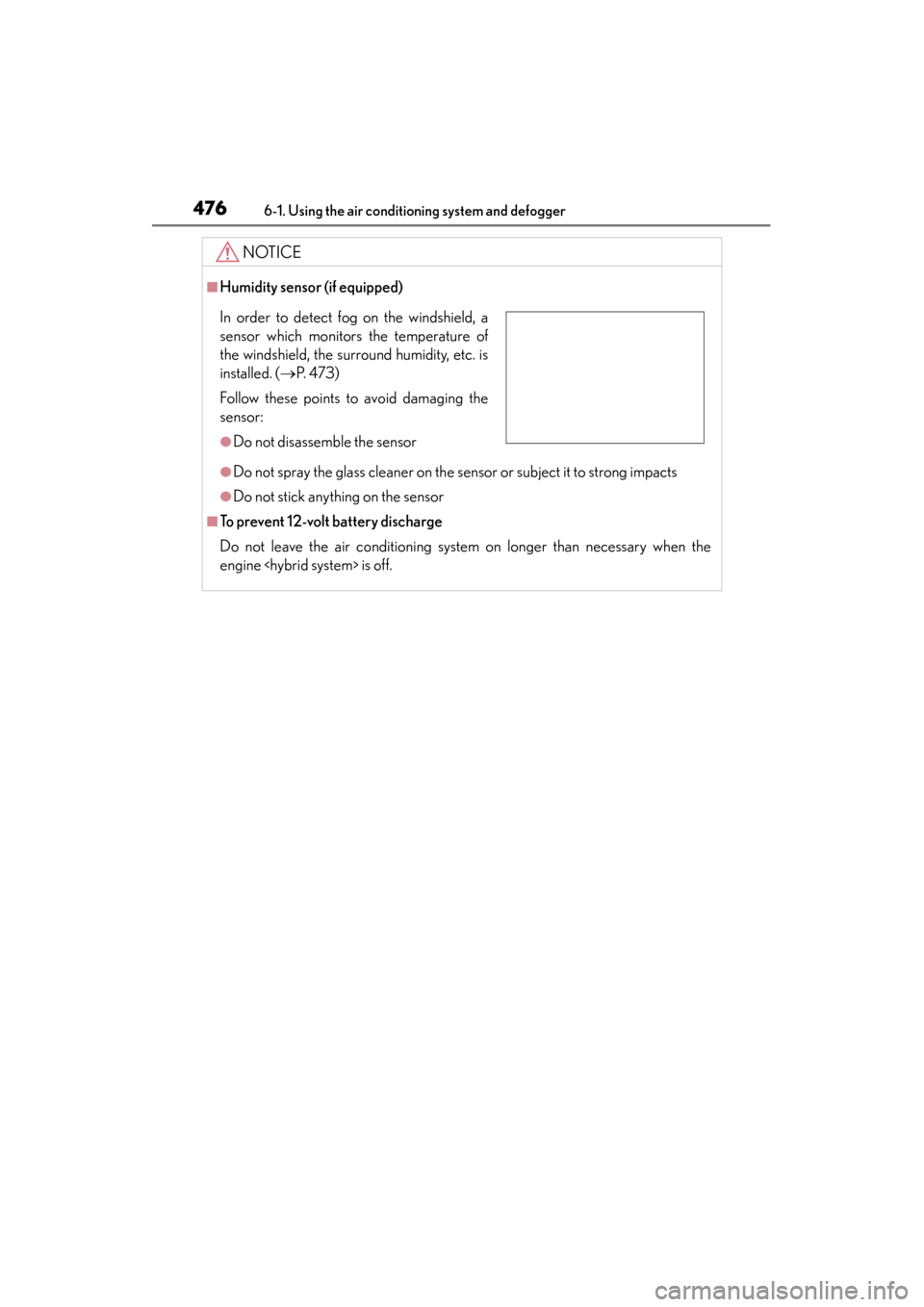
■Humidity sensor (if equipped)
●Do not spray the glass cleaner on the sensor or subject it to strong impacts
●Do not stick anything on the sensor
■To prevent 12-volt battery discharge
Do not leave the air conditioning system on longer than necessary when the
engine
In order to detect fog on the windshield, a
sensor which monitors the temperature of
the windshield, the surround humidity, etc. is
installed. ( →P. 4 7 3 )
Follow these points to avoid damaging the
sensor:
●Do not disassemble the sensor
Page 478 of 786
477
ES350_300h_OM_OM33B36U_(U)
6-1. Using the air conditioning system and defogger
6
Interior features
Heated steering wheel∗/seat heaters∗/
seat ventilators
∗
∗
: If equipped
Heated steering wheel and seat heaters heat the side grips of the steer-
ing wheel and seats, respectively. Seat ventilators maintain good air-
flow by blowing air from the seats.
CAUTION
●Care should be taken to prevent injury if anyone in the following categories
comes in contact with the steering wheel and seats when the heater is on:
• Babies, small children, the elderly, the sick and the physically challenged
• Persons with sensitive skin
• Persons who are fatigued
• Persons who have taken alcohol or drugs that induce sleep (sleeping drugs, cold remedies, etc.)
●Observe the following precautions to prevent minor burns or overheating:
• Do not cover the seat with a blanket or cushion when using the seat heater.
• Do not use seat heater more than necessary.
NOTICE
●Do not put heavy objects that have an uneven surface on the seat and do not stick
sharp objects (needles, nails, etc.) into the seat.
●To prevent 12-volt battery discharge, do not use the functions when the hybrid
system is off.
Page 479 of 786
4786-1. Using the air conditioning system and defogger
ES350_300h_OM_OM33B36U_(U)
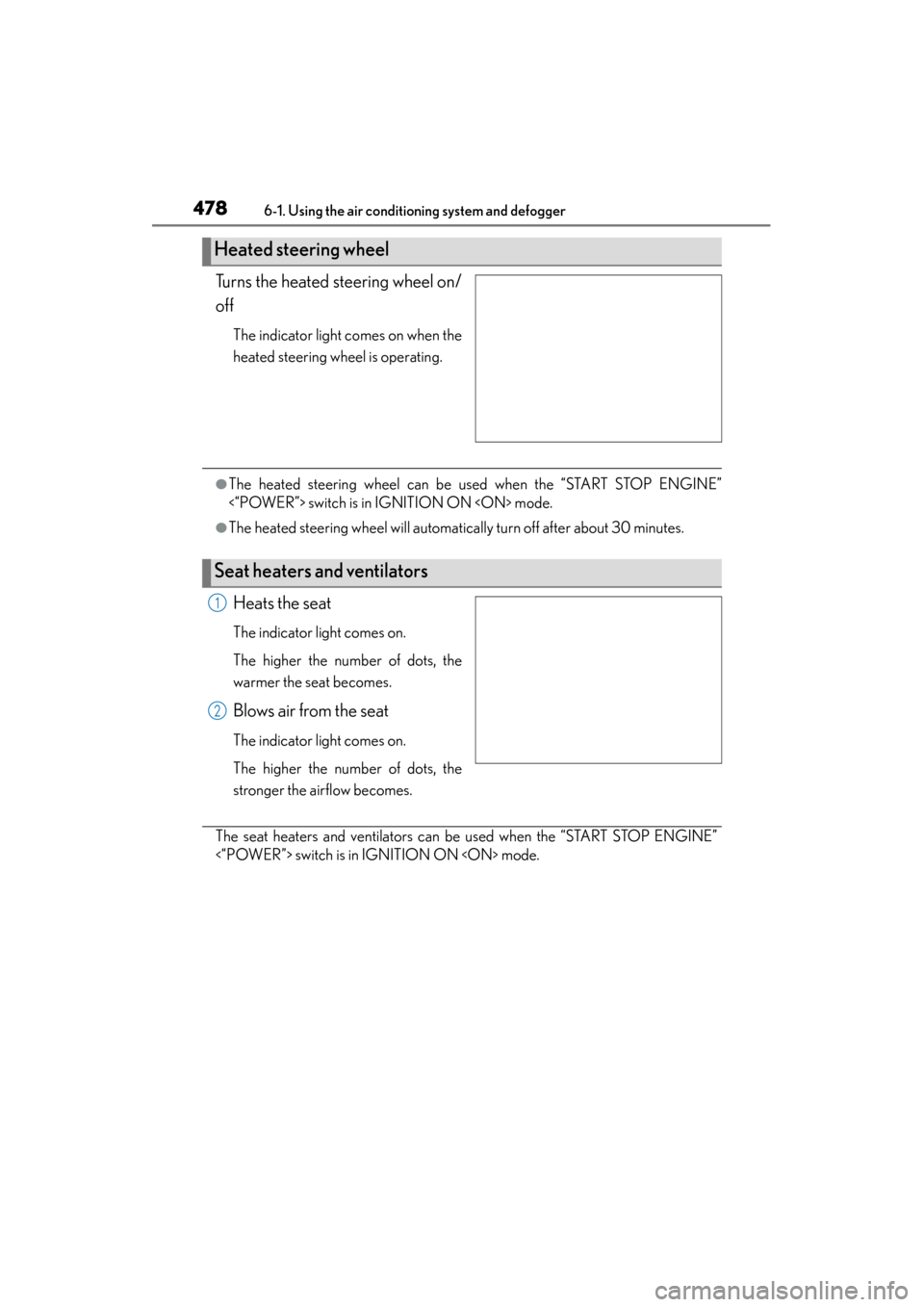
Turns the heated steering wheel on/
off
The indicator light comes on when the
heated steering wheel is operating.
●The heated steering wheel can be used when the “START STOP ENGINE”
<“POWER”> switch is in IGNITION ON
●The heated steering wheel will automatically turn off after about 30 minutes.
Heats the seat
The indicator light comes on.
The higher the number of dots, the
warmer the seat becomes.
Blows air from the seat
The indicator light comes on.
The higher the number of dots, the
stronger the airflow becomes.
The seat heaters and ventilators can be used when the “START STOP ENGINE”
<“POWER”> switch is in IGNITION ON
Heated steering wheel
Seat heaters and ventilators
1
2
Page 522 of 786

521
ES350_300h_OM_OM33B36U_(U)
7Maintenance and care
7-1. Maintenance and careCleaning and protecting the vehicle exterior................. 522
Cleaning and protecting the vehicle interior .................. 526
7-2. Maintenance Maintenance requirements............................. 529
General maintenance .............. 532
Emission inspection and maintenance (I/M)
programs .................................... 536
7-3. Do-it-yourself maintenance Do-it-yourself service precautions................................ 537
Hood ................................................ 541
Positioning a floor jack ............. 542
Engine compartment ............... 545
12-volt battery (hybrid vehicles) ...................... 562
Tires.................................................. 566
Tire inflation pressure ................577
Wheels .......................................... 580
Air conditioning filter ...............582
Electronic key battery ..............584
Checking and replacing fuses..............................................586
Light bulbs.....................................598
Page 541 of 786
540
ES350_300h_OM_OM33B36U_(U)
7-3. Do-it-yourself maintenance
CAUTION
■When working near the electric cooling fans or radiator grille
Be sure the “START STOP ENGINE” <“POWER”> switch is off.
With the “START STOP ENGINE” <“POWER”> switch in IGNITION ON
mode, the electric cooling fans may automatically start to run if the air conditioning
is on and/or the coolant temperature is high. (→P. 555)
■Safety glasses
Wear safety glasses to prevent flying or falling material, fluid spray, etc. from get-
ting in your eyes.
NOTICE
■If you remove the air cleaner filter
Driving with the air cleaner filter removed may cause excessive engine wear due to
dirt in the air.
Page 577 of 786
576
ES350_300h_OM_OM33B36U_(U)
7-3. Do-it-yourself maintenance
NOTICE
■Repairing or replacing tires, wheels, tire pressure warning valves, transmitters
and tire valve caps
●When removing or fitting the wheels, tires or the tire pressure warning valves and
transmitters, contact your Lexus dealer as the tire pressure warning valves and
transmitters may be damaged if not handled correctly.
●Make sure to install the tire valve caps. If the tire valve caps are not installed,
water could enter the tire pressure warning valves and the tire pressure warning
valves could be bound.
●When replacing tire valve caps, do not use tire valve caps other than those speci-
fied. The cap may become stuck.
■To avoid damage to the tire pressu re warning valves and transmitters
When a tire is repaired with liquid sealants, the tire pressure warning valve and
transmitter may not operate properly. If a liquid sealant is used, contact your Lexus
dealer or other qualified service shop as soon as possible. Make sure to replace
the tire pressure warning valve and transmitter when replacing the tire. ( →P. 5 6 7 )
■Driving on rough roads
Take particular care when driving on roads with loose surfaces or potholes.
These conditions may cause losses in tire inflation pressure, reducing the cushion-
ing ability of the tires. In addition, driving on rough roads may cause damage to the
tires themselves, as well as the vehicle’s wheels and body.
■Low profile tires (P225/45R18 tires)
Low profile tires may cause greater damage than usual to the tire wheel when sus-
taining impact from the road surface. Therefore, pay attention to the following:
●Be sure to use proper tire inflation pressure. If tires are under-inflated, they may
be damaged more severely.
●Avoid potholes, uneven pavement, curbs and other road hazards. Failure to do so
may lead to severe tire and wheel damage.
■If tire inflation pressure of each tire becomes low while driving
Do not continue driving, or your tires and/or wheels may be ruined.
Page 580 of 786
ES350_300h_OM_OM33B36U_(U)
5797-3. Do-it-yourself maintenance
7
Maintenance and care
■Instructions for checking tire inflation pressure
When checking tire inflation pressure, observe the following:
●Check only when the tires are cold.
If your vehicle has been parked for at least 3 hours or has not been driven for more
than 1 mile or 1.5 km, you will get an accurate cold tire inflation pressure reading.
●Always use a tire pressure gauge.
The appearance of the tire can be misleading. In addition, tire inflation pressure that
is even just a few pounds off can affect ride quality and handling.
●Do not reduce tire inflation pressure after driving. It is normal for tire inflation pres-
sure to be higher after driving.
●Never exceed the vehicle capacity weight.
Passengers and luggage weight should be placed so that the vehicle is balanced.
CAUTION
■Proper inflation is critical to save tire performance
Keep your tires properly inflated. Otherwise, the following conditions may occur
and result in an accident causing death or serious injury:
●Excessive wear
●Uneven wear
●Poor handling
●Possibility of blowouts resulting from overheated tires
●Poor sealing of the tire bead
●Wheel deformation and/or tire separation
●A greater possibility of tire damage from road hazards
NOTICE
■When inspecting and adjusting tire inflation pressure
Be sure to put the tire valve caps back on.
Without the valve caps, dirt or moisture could get into the valve and cause air leak-
age, which could result in an accident. If the caps are lost, replace them as soon as
possible.