tire size Lexus ES300h 2017 User Guide
[x] Cancel search | Manufacturer: LEXUS, Model Year: 2017, Model line: ES300h, Model: Lexus ES300h 2017Pages: 612, PDF Size: 14.05 MB
Page 474 of 612
472
ES300h_OM_OM33C75U_(U)7-3. Do-it-yourself maintenance
WA R N I N G
■When inspecting or replacing tires
Observe the following precautions to prevent accidents.
Failure to do so may cause damage to parts of the drive train as well as dangerous han-
dling characteristics, which may lead to an a
ccident resulting in death or serious injury.
●Make sure to install four tires that are of the specified size, and that all four tires are of
the same size, same brand, and same tread pattern.
●Do not use tire sizes other than those recommended by Lexus.
●Do not mix differently constructed tires (radial, bias-belted or bias-ply tires).
●If only two tires are replaced, the new tires should be placed on the rear of the vehicle.
●Do not mix summer, all season and snow tires.
●Do not use tires that have been used on another vehicle.
Do not use tires if you do not know how they were used previously.
●Do not tow if your vehicle has a compact spare tire installed.
■When initializing the tire pressure warning system
Do not operate the tire pressure warning reset switch without first adjusting the tire
inflation pressure to the specified level. Otherwise, the tire pressure warning light may
not come on even if the tire inflation pressu re is low, or it may come on when the tire
inflation pressure is actually normal.
■Caution regarding interference with electronic devices
●Users of any electrical medical device other than implantable cardiac pacemakers,
cardiac resynchronization therapy-pacemakers or implantable cardioverter defibril-
lators should consult the manufacturer of the device for information about its opera-
tion under the influence of radio waves.
Radio waves could have unexpected effects on the operation of such medical
devices.
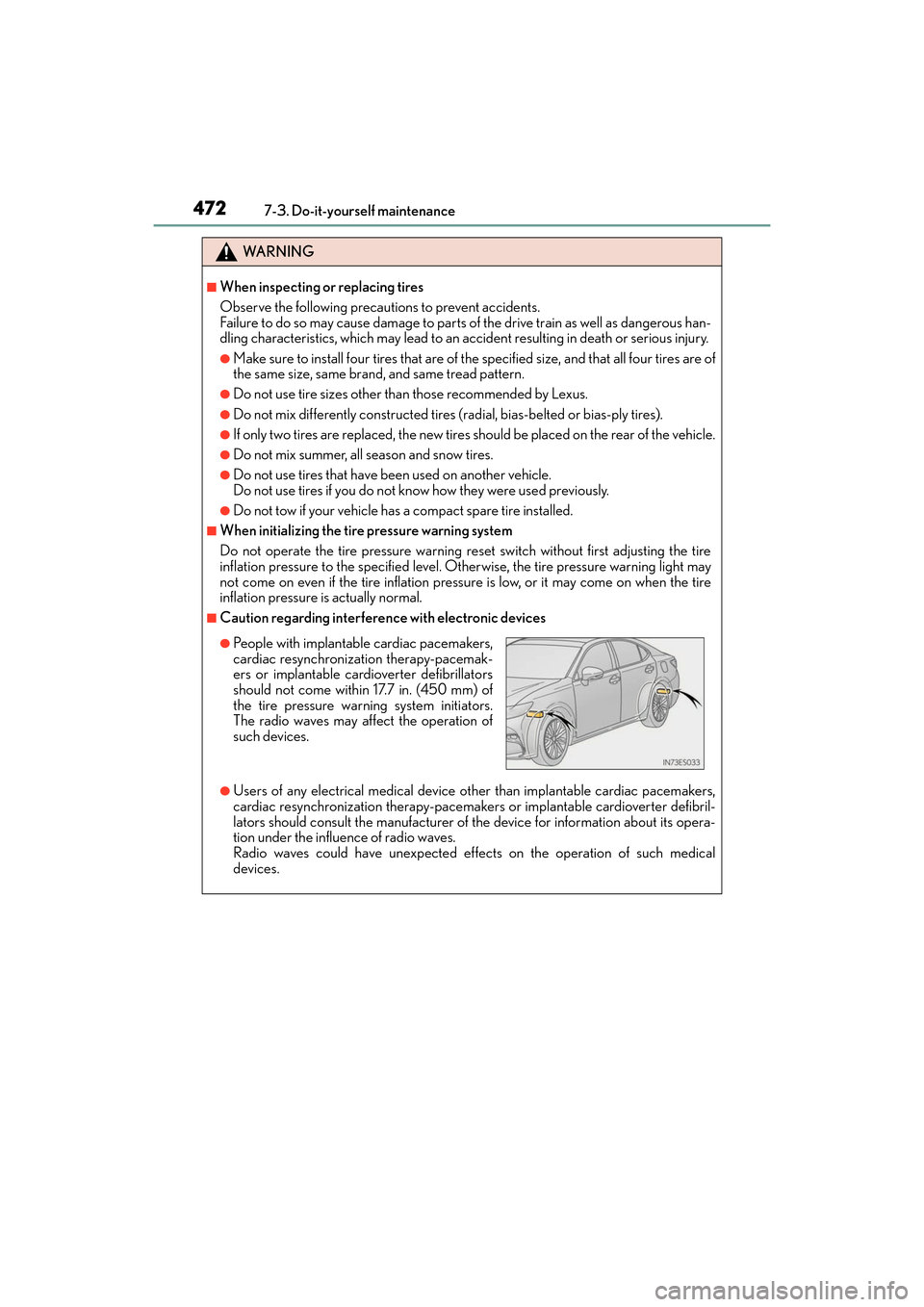
●People with implantable cardiac pacemakers,
cardiac resynchronization therapy-pacemak-
ers or implantable cardioverter defibrillators
should not come within 17.7 in. (450 mm) of
the tire pressure warning system initiators.
The radio waves may affect the operation of
such devices.
Page 476 of 612
474
ES300h_OM_OM33C75U_(U)7-3. Do-it-yourself maintenance
Tire inflation pressure
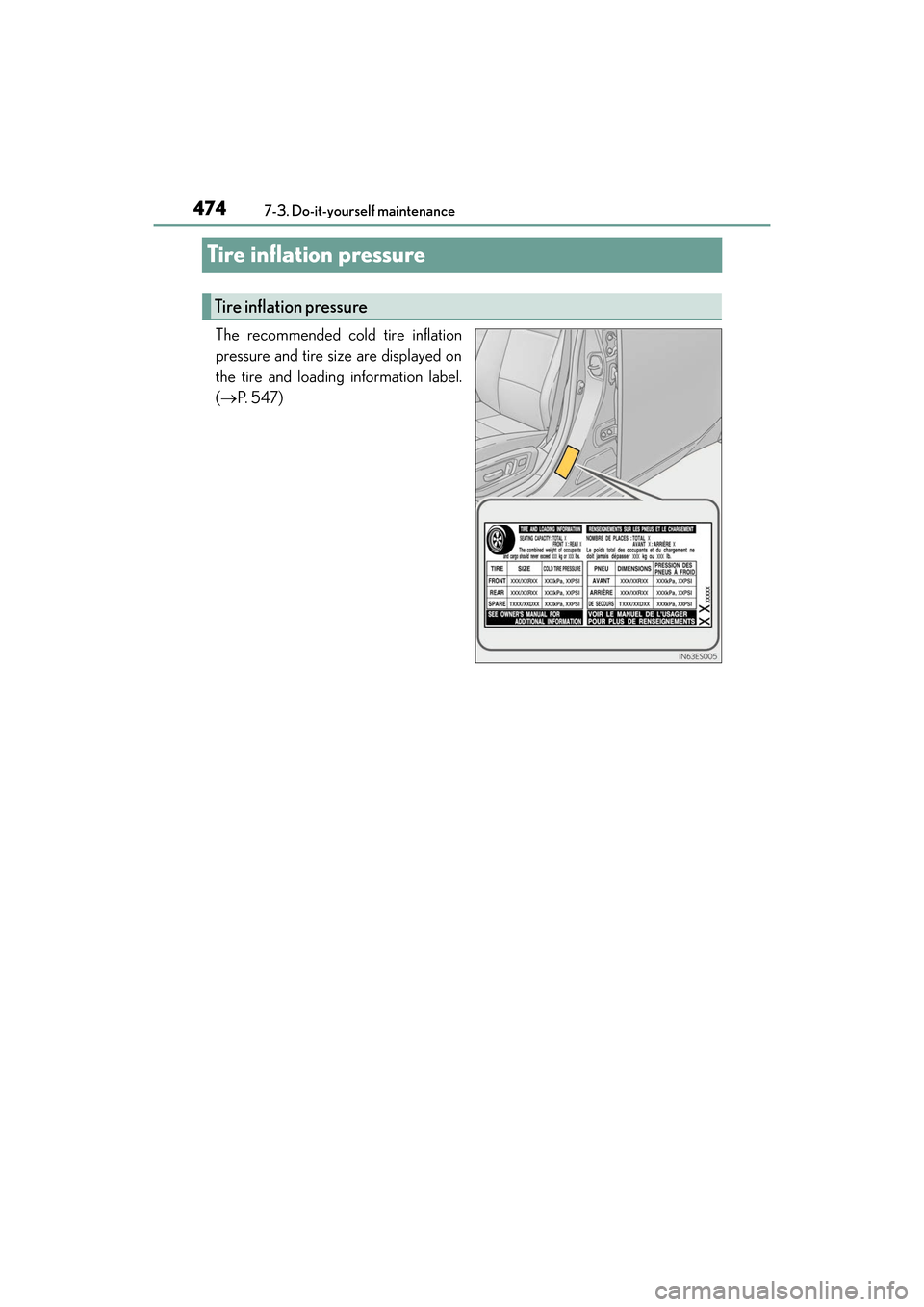
The recommended cold tire inflation
pressure and tire size are displayed on
the tire and loading information label.
(
→ P. 5 4 7 )
Tire inflation pressure
Page 479 of 612
477
ES300h_OM_OM33C75U_(U)7-3. Do-it-yourself maintenance
7
Maintenance and care
Wheels
When replacing wheels, care should be taken to ensure that they are equivalent
to those removed in load capacity, diameter, rim width and inset
*.
Replacement wheels are available at your Lexus dealer.
*: Conventionally referred to as “offset”.
Lexus does not recommend using the following:
●Wheels of different sizes or types
●Used wheels
●Bent wheels that have been straightened
●Use only Lexus wheel nuts and wrenches designed for use with your alumi-
num wheels.
●When rotating, repairing or changing your tires, check that the wheel nuts are
still tight after driving 1000 miles (1600 km).
●Be careful not to damage the aluminum wheels when using tire chains.
●Use only Lexus genuine balance weights or equivalent and a plastic or rubber
hammer when balancing your wheels.
■When replacing wheels
The wheels of your vehicle are equipped with tire pressure warning valves and transmit-
ters that allow the tire pressure warning system to provide advance warning in the event
of a loss in tire inflation pressure. Whenever wheels are replaced, tire pressure warning
valves and transmitters must be installed. ( →P. 4 6 6 )
If a wheel is bent, cracked or heavily corroded, it should be replaced. Other-
wise, the tire may separate from the wheel or cause a loss of handling control.
Wheel selection
Aluminum wheel precautions
Page 512 of 612
5108-2. Steps to take in an emergency
ES300h_OM_OM33C75U_(U)
WA R N I N G
■Maintenance of the tires
Each tire, including the spare (if provided), should be checked monthly when cold and
inflated to the inflation pressure recommended by the vehicle manufacturer on the
vehicle placard or tire inflation pressure label (tire and load information label). (If your
vehicle has tires of a different size than the size indicated on the vehicle placard or tire
inflation pressure label [tire and load in formation label], you should determine the
proper tire inflation pressure for those tires.)
As an added safety feature, your vehicle has been equipped with a tire pressure moni-
toring system (TPMS-tire pressure warning system) that illuminates a low tire pressure
telltale (tire pressure warning light) when on e or more of your tires is significantly
under-inflated. Accordingly, when the low ti re pressure telltale (tire pressure warning
light) illuminates, you should stop and check yo ur tires as soon as possible, and inflate
them to the proper pressure. Driving on a significantly under-inflated tire causes the
tire to overheat and can lead to tire failure. Under-inflation also reduces fuel efficiency
and tire tread life, and may affect the vehicle’s handling and stopping ability.
Please note that the TPMS (tire pressure warning system) is not a substitute for proper
tire maintenance, and it is the driver’s responsibility to maintain correct tire pressure,
even if under-inflation has not reached the level to trigger illumination of the TPMS low
tire pressure telltale (tire pressure warning light).
Your vehicle has also been equipped with a TPMS (tire pressure warning system) mal-
function indicator to indicate when the system is not operating properly. The TPMS
(tire pressure warning system) malfunction indicator is combined with the low tire pres-
sure telltale (tire pressure warning light). When the system detects a malfunction, the
telltale will flash for approximately one minu te and then remain continuously illumi-
nated. This sequence will continue upon su bsequent vehicle start-ups as long as the
malfunction exists. When the malfunction indicator is illuminated, the system may not
be able to detect or signal low tire pressure as intended.
TPMS (tire pressure warning system) malfunctions may occur for a variety of reasons,
including the installation of replacement or alternate tires or wheels on the vehicle that
prevent the TPMS (tire pressure warning system) from functioning properly. Always
check the TPMS (tire pressure warning syst em) malfunction telltale after replacing one
or more tires or wheels on your vehicle to ensure that the replacement or alternate
tires and wheels allow the TPMS (tire pressure warning system) to continue to function
properly.
NOTICE
■To ensure the tire pressure warning system operates properly
Do not install tires with different specifications or makers, as the tire pressure warning
system may not operate properly.
Page 549 of 612
ES300h_OM_OM33C75U_(U)
5479-1. Specifications
9
Vehicle specifications
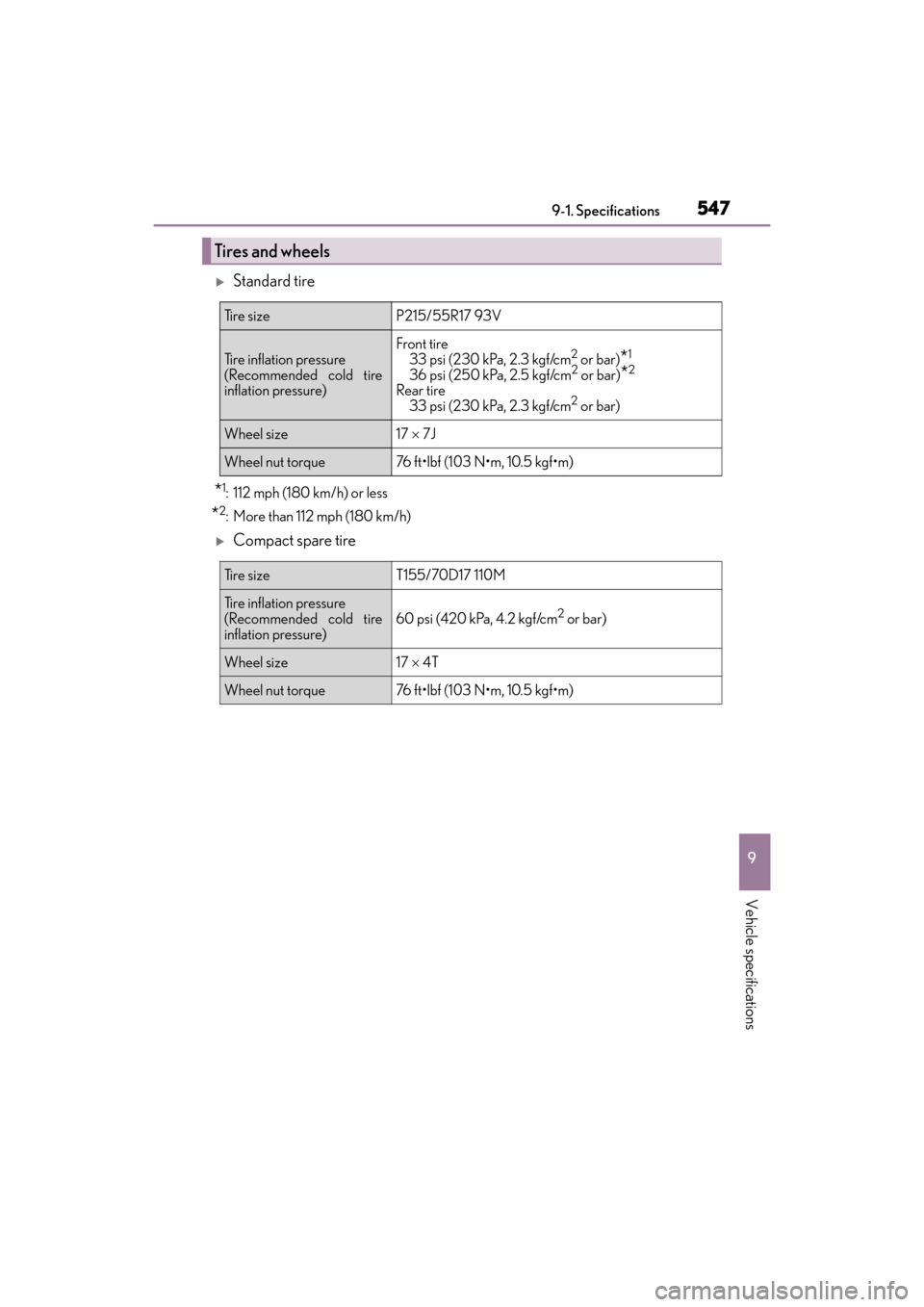
XStandard tire
*1: 112 mph (180 km/h) or less
*2: More than 112 mph (180 km/h)
XCompact spare tire
Tires and wheels
Ti r e s i z eP215/55R17 93V
Tire inflation pressure
(Recommended cold tire
inflation pressure)
Front tire33 psi (230 kPa, 2.3 kgf/cm2 or bar)*1
36 psi (250 kPa, 2.5 kgf/cm2 or bar)*2
Rear tire33 psi (230 kPa, 2.3 kgf/cm2 or bar)
Wheel size17 × 7J
Wheel nut torque76 ft•lbf (103 N•m, 10.5 kgf•m)
Ti r e s i z eT155/70D17 110M
Tire inflation pressure
(Recommended cold tire
inflation pressure)60 psi (420 kPa, 4.2 kgf/cm2 or bar)
Wheel size17 × 4T
Wheel nut torque76 ft•lbf (103 N•m, 10.5 kgf•m)
Page 554 of 612
552
ES300h_OM_OM33C75U_(U)9-1. Spec
ifications
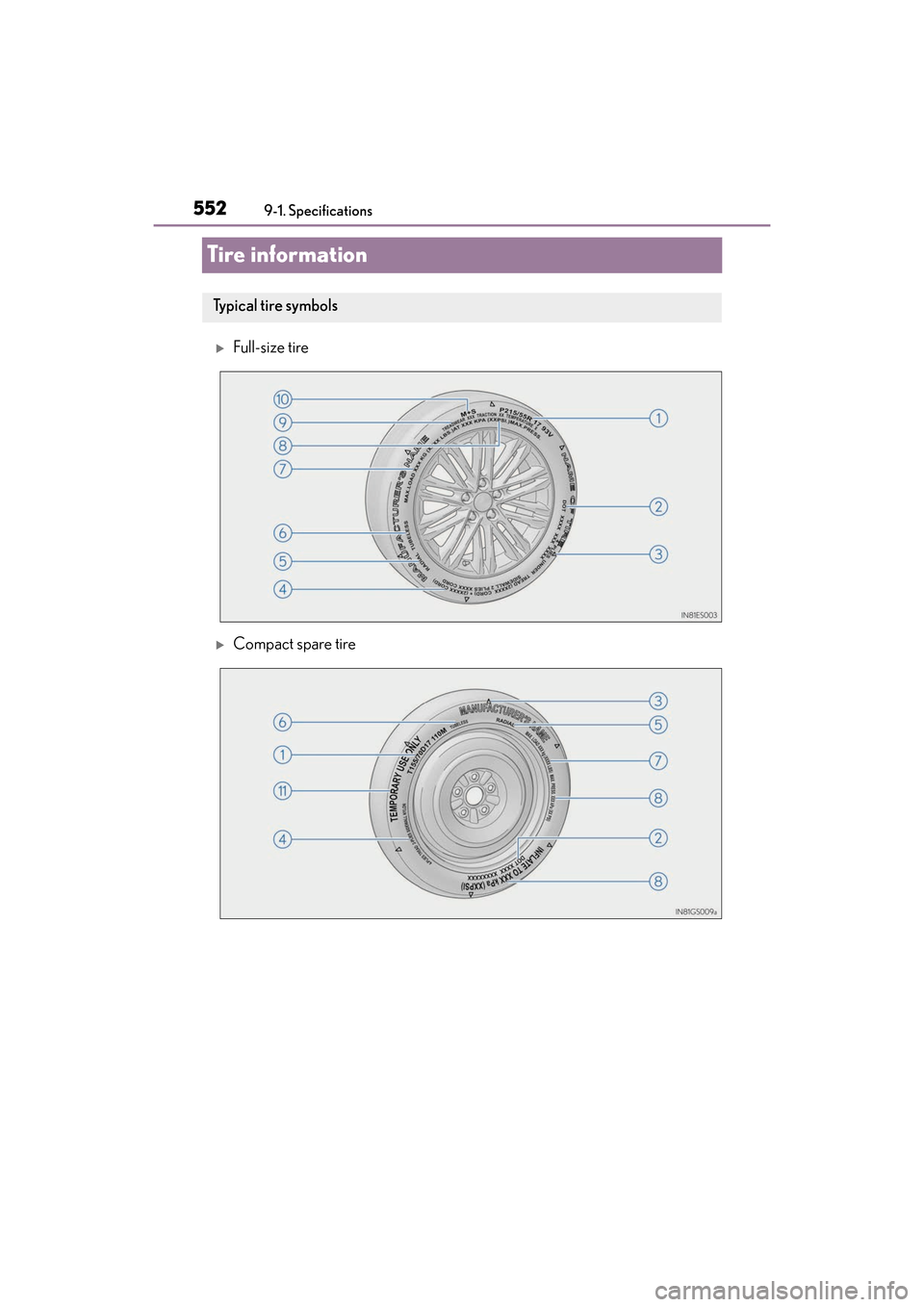
Tire information
XFull-size tire
XCompact spare tire
Ty p i c a l t i r e s y m b o l s
Page 557 of 612
ES300h_OM_OM33C75U_(U)
5559-1. Specifications
9
Vehicle specifications
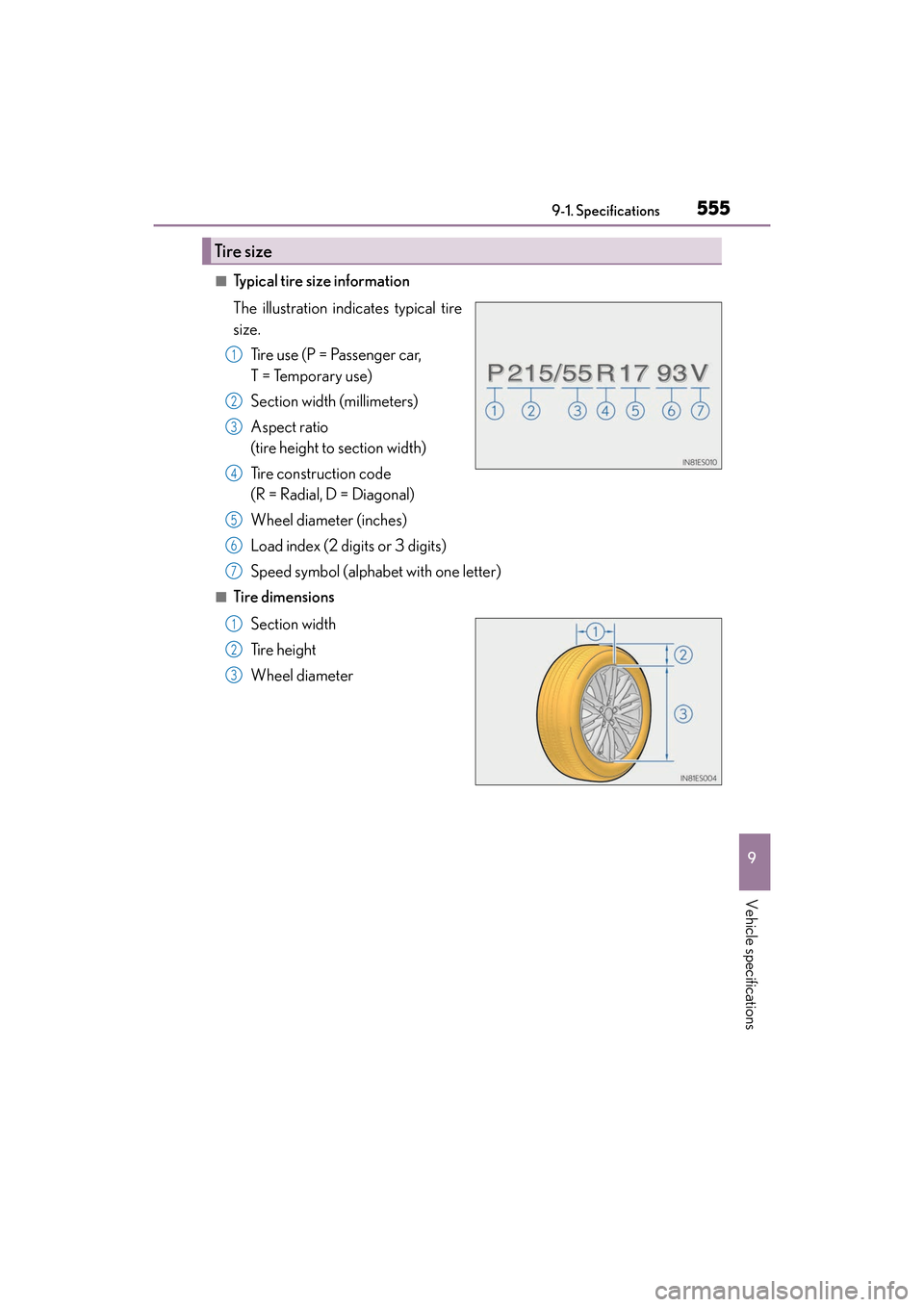
■Typical tire size information
The illustration indicates typical tire
size.Tire use (P = Passenger car,
T = Temporary use)
Section width (millimeters)
Aspect ratio
(tire height to section width)
Tire construction code
(R = Radial, D = Diagonal)
Wheel diameter (inches)
Load index (2 digits or 3 digits)
Speed symbol (alphabet with one letter)
■Tire dimensions
Section width
Tire height
Wheel diameter
Ti re si ze
1
2
3
4
5
6
7
1
2
3
Page 560 of 612
558
ES300h_OM_OM33C75U_(U)9-1. Spec
ifications
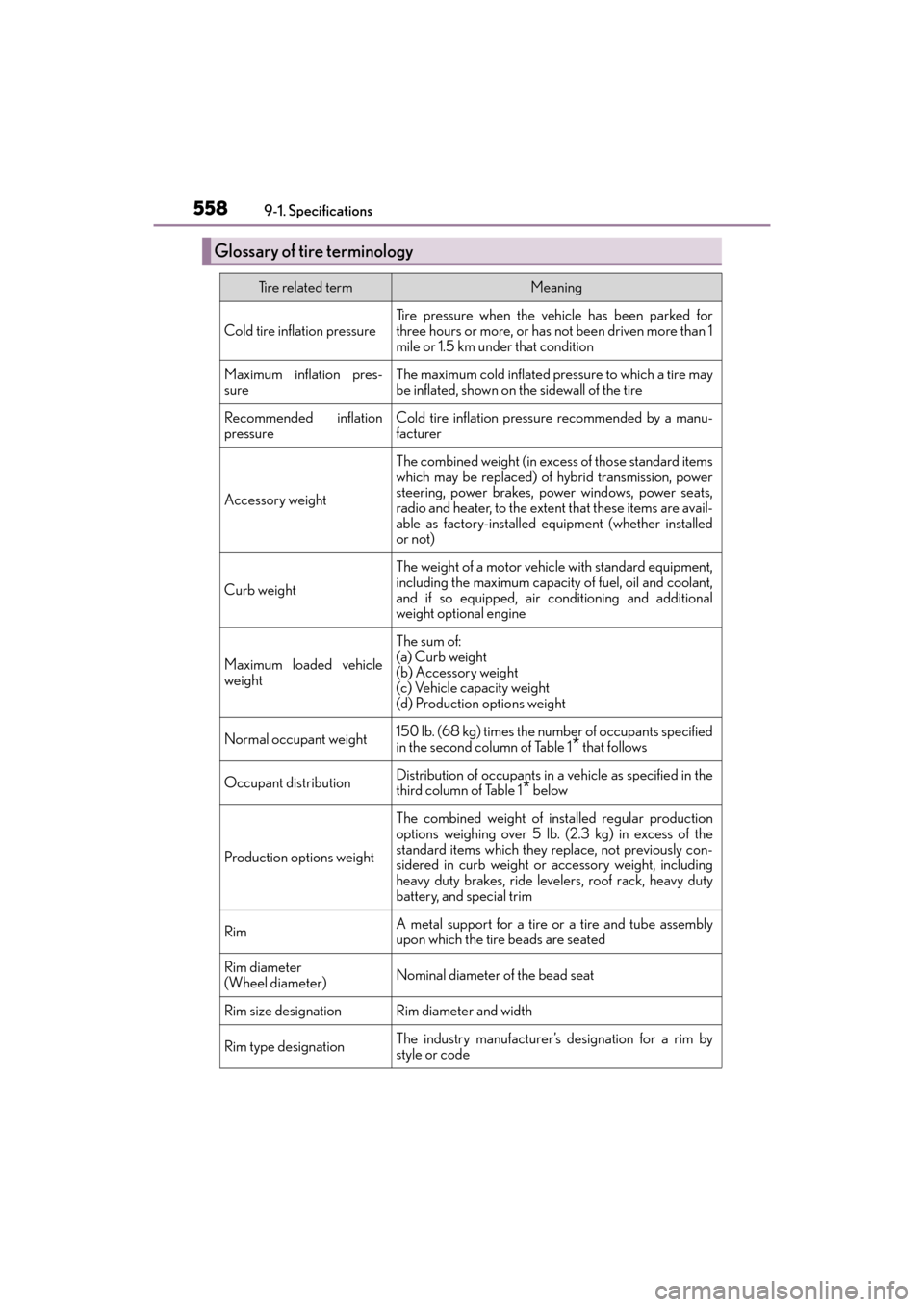
Glossary of tire terminology
Tire related termMeaning
Cold tire inflation pressure
Tire pressure when the vehicle has been parked for
three hours or more, or has not been driven more than 1
mile or 1.5 km under that condition
Maximum inflation pres-
sureThe maximum cold inflated pressure to which a tire may
be inflated, shown on the sidewall of the tire
Recommended inflation
pressureCold tire inflation pressure recommended by a manu-
facturer
Accessory weight
The combined weight (in excess of those standard items
which may be replaced) of hybrid transmission, power
steering, power brakes, power windows, power seats,
radio and heater, to the extent that these items are avail-
able as factory-installed equipment (whether installed
or not)
Curb weight
The weight of a motor vehicle with standard equipment,
including the maximum capacity of fuel, oil and coolant,
and if so equipped, air conditioning and additional
weight optional engine
Maximum loaded vehicle
weight
The sum of:
(a) Curb weight
(b) Accessory weight
(c) Vehicle capacity weight
(d) Production options weight
Normal occupant weight150 lb. (68 kg) times the number of occupants specified
in the second column of Table 1* that follows
Occupant distributionDistribution of occupants in a vehicle as specified in the
third column of Table 1* below
Production options weight
The combined weight of in stalled regular production
options weighing over 5 lb. (2.3 kg) in excess of the
standard items which they replace, not previously con-
sidered in curb weight or accessory weight, including
heavy duty brakes, ride levelers, roof rack, heavy duty
battery, and special trim
RimA metal support for a tire or a tire and tube assembly
upon which the tire beads are seated
Rim diameter
(Wheel diameter)Nominal diameter of the bead seat
Rim size designationRim diameter and width
Rim type designationThe industry manufacturer’s designation for a rim by
style or code
Page 606 of 612
604Alphabetical index
ES300h_OM_OM33C75U_(U)
Rear sunshade switch ........................412
Rear window and outside rear view mirror defoggers
switch.................................................... 392
Seat heater switches........................ 399
Seat ventilator switches ................. 399
“SOS” button........................................426
Talk switch
*......................................... 359
Telephone switches
*...................... 359
Tilt and telescopic
steering control switch ................. 138
Tire pressure warning reset
switch.................................................... 467
Trunk closer switch .............................. 115
Trunk opener switch ........................... 114
Trunk opener main switch................ 115
Vehicle-to-vehicle distance button ................................................... 226
VSC OFF switch ............................... 277
Window lock switch .......................... 145
Windshield wipers and washer switch .......................... 190 Tachometer ............................................... 86
Tail lights
Light switch.............................................182
Replacing light bulbs ....................... 495
Talk switch
*............................................ 359
Telephone switches
*.......................... 359
Theft deterrent system
Alarm .......................................................... 78
Immobilizer system...............................76
Tire inflation pressure Maintenance data.............................. 547
Tire inflation pressure display function................................................... 92
Warning light ....................................... 507
Tire information .................................... 552
Glossary................................................ 558
Size ...........................................................555
Tire identification number .............554
Uniform Tire Quality Grading ..............................................556
Tire pressure warning system
Function .................................................. 466
Initializing ............................................... 466
Installing tire pressure warning valves and transmitters................ 466
Registering ID codes ....................... 467
Tire pressure warning reset switch ................................................... 467
Warning light ....................................... 507
T
Page 607 of 612
605Alphabetical index
ES300h_OM_OM33C75U_(U)
TiresChains..................................................... 285
Checking............................................... 465
If you have a flat tire ........................... 515
Inflation pressure ................................ 547
Information ........................................... 552
Replacing ................................................ 515
Rotating tires ....................................... 465
Size ............................................................ 547
Snow tires ..............................................287
Spare tire ................................................. 515
Tire inflation pressure display
function ................................................... 92
Tire pressure warning system .... 466
Warning light ...................................... 507
Tools.............................................................516
Top tether strap........................................ 63
Total load capacity .................................165
Towing Dinghy towing .......................................167
Emergency towing ........................... 500
Towing eyelet...................................... 502
Trailer towing ........................................ 166
TRAC (Traction Control) ................. 276
Traction battery (hybrid battery) ........ 71
Traction motor (electric motor) .......... 71
Transmission Driving mode select switch ..........266
Hybrid transmission........................... 175
If the shift lever cannot be
shifted from P .................................... 178
Trip information........................................ 87
Trip meters ................................................. 86 Trunk
Internal trunk release lever .............. 116
Jam protection function..................... 116
Luggage security system.................. 115
Power trunk opener and closer .....114
Smart access system
with push-button start......................114
Trunk closer switch.............................. 115
Trunk easy closer ................................. 116
Trunk features...................................... 407
Trunk handle ........................................... 115
Trunk light................................................. 116
Trunk opener main switch ............... 115
Trunk opener switch ............................114
Wireless remote control................. 108
Trunk light
Trunk light................................................. 116
Wattage .................................................548
Turn signal lights Replacing light
bulbs ............................ 490, 493, 495
Turn signal lever .................................. 180
Wattage .................................................548
USB memory
*...................................... 299
U
*: For vehicles with navigation system, refer to the
“NAVIGATION SYSTEM OWNER’S MANUAL”.