tires Lexus ES300h 2017 Owner's Guide
[x] Cancel search | Manufacturer: LEXUS, Model Year: 2017, Model line: ES300h, Model: Lexus ES300h 2017Pages: 612, PDF Size: 14.05 MB
Page 512 of 612
5108-2. Steps to take in an emergency
ES300h_OM_OM33C75U_(U)
WA R N I N G
■Maintenance of the tires
Each tire, including the spare (if provided), should be checked monthly when cold and
inflated to the inflation pressure recommended by the vehicle manufacturer on the
vehicle placard or tire inflation pressure label (tire and load information label). (If your
vehicle has tires of a different size than the size indicated on the vehicle placard or tire
inflation pressure label [tire and load in formation label], you should determine the
proper tire inflation pressure for those tires.)
As an added safety feature, your vehicle has been equipped with a tire pressure moni-
toring system (TPMS-tire pressure warning system) that illuminates a low tire pressure
telltale (tire pressure warning light) when on e or more of your tires is significantly
under-inflated. Accordingly, when the low ti re pressure telltale (tire pressure warning
light) illuminates, you should stop and check yo ur tires as soon as possible, and inflate
them to the proper pressure. Driving on a significantly under-inflated tire causes the
tire to overheat and can lead to tire failure. Under-inflation also reduces fuel efficiency
and tire tread life, and may affect the vehicle’s handling and stopping ability.
Please note that the TPMS (tire pressure warning system) is not a substitute for proper
tire maintenance, and it is the driver’s responsibility to maintain correct tire pressure,
even if under-inflation has not reached the level to trigger illumination of the TPMS low
tire pressure telltale (tire pressure warning light).
Your vehicle has also been equipped with a TPMS (tire pressure warning system) mal-
function indicator to indicate when the system is not operating properly. The TPMS
(tire pressure warning system) malfunction indicator is combined with the low tire pres-
sure telltale (tire pressure warning light). When the system detects a malfunction, the
telltale will flash for approximately one minu te and then remain continuously illumi-
nated. This sequence will continue upon su bsequent vehicle start-ups as long as the
malfunction exists. When the malfunction indicator is illuminated, the system may not
be able to detect or signal low tire pressure as intended.
TPMS (tire pressure warning system) malfunctions may occur for a variety of reasons,
including the installation of replacement or alternate tires or wheels on the vehicle that
prevent the TPMS (tire pressure warning system) from functioning properly. Always
check the TPMS (tire pressure warning syst em) malfunction telltale after replacing one
or more tires or wheels on your vehicle to ensure that the replacement or alternate
tires and wheels allow the TPMS (tire pressure warning system) to continue to function
properly.
NOTICE
■To ensure the tire pressure warning system operates properly
Do not install tires with different specifications or makers, as the tire pressure warning
system may not operate properly.
Page 517 of 612
515
ES300h_OM_OM33C75U_(U)8-2. Steps to take in an emergency
8
When trouble arises
If you have a flat tire
●Stop the vehicle in a safe place on a hard, flat surface.
●Set the parking brake.
●Shift the shift lever to P.
●Stop the hybrid system.
●Turn on the emergency flashers. (
→P. 4 9 8 )
Your vehicle is equipped with a spare tire. The flat tire can be replaced with
the spare tire.
For details about tires: →P. 4 6 5
WA R N I N G
■If you have a flat tire
Do not continue driving with a flat tire.
Driving even a short distance with a flat tire can damage the tire and the wheel beyond
repair, which could result in an accident.
Before jacking up the vehicle
Page 519 of 612
5178-2. Steps to take in an emergency
ES300h_OM_OM33C75U_(U)
8
When trouble arises
WA R N I N G
■Using the tire jack
Observe the following precautions.
Improper use of the tire jack may cause the vehicle to suddenly fall off the jack, leading
to death or serious injury.
●Do not use the tire jack for any purpose ot her than replacing tires or installing and
removing tire chains.
●Only use the tire jack that comes with this vehicle for replacing a flat tire.
Do not use it on other vehicles, and do not use other tire jacks for replacing tires on
this vehicle.
●Put the jack properly in its jack point.
●Do not put any part of your body under the vehicle while it is supported by the jack.
●Do not start the hybrid system or drive the vehicle while the vehicle is supported by
the jack.
●Do not raise the vehicle while someone is inside.
●When raising the vehicle, do not put an object on or under the jack.
●Do not raise the vehicle to a height greater than that required to replace the tire.
●Use a jack stand if it is necessary to get under the vehicle.
●When lowering the vehicle, make sure that there is no-one near the vehicle. If there
are people nearby, warn them vocally before lowering.
Page 521 of 612
5198-2. Steps to take in an emergency
ES300h_OM_OM33C75U_(U)
8
When trouble arises
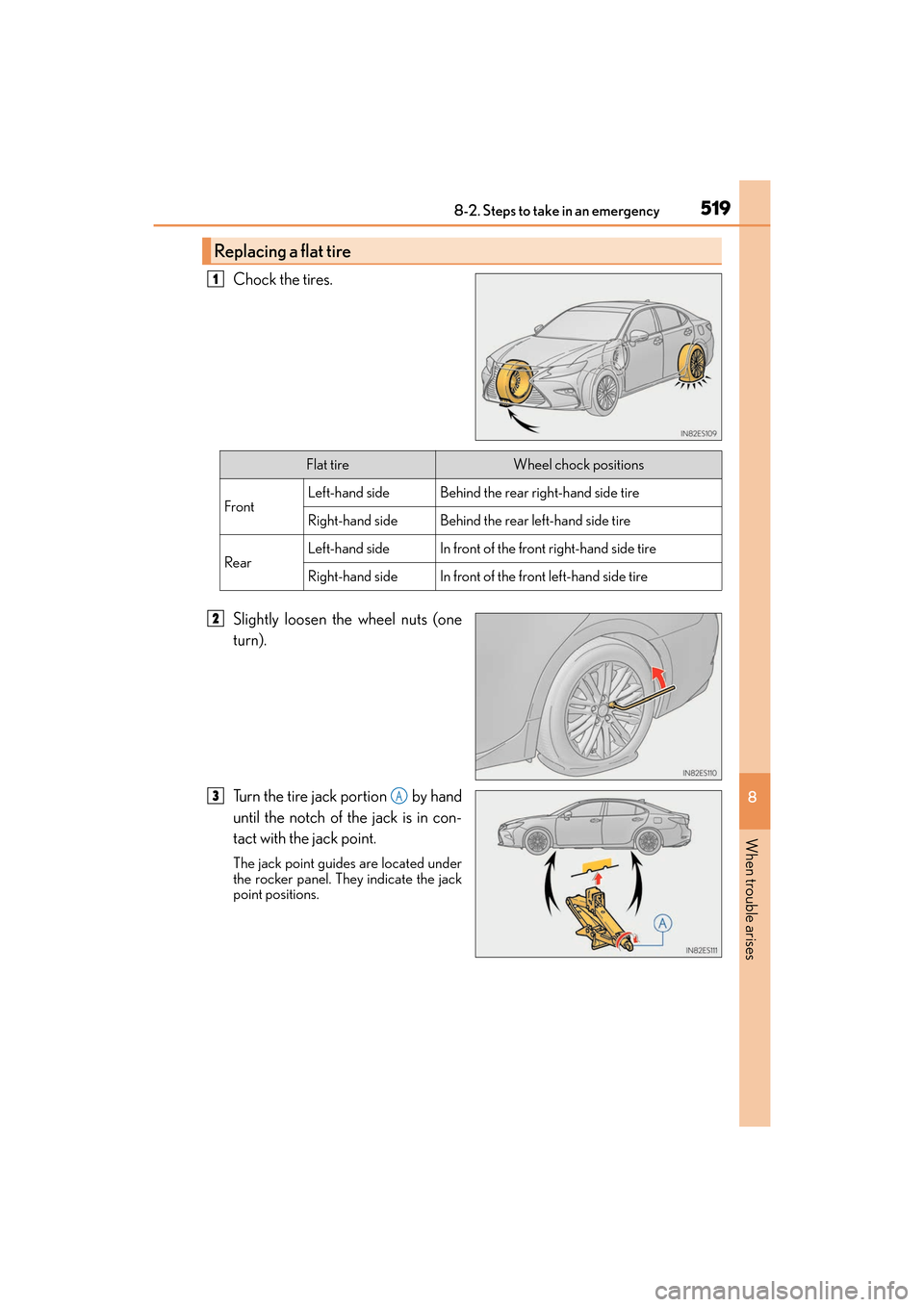
Chock the tires.
Slightly loosen the wheel nuts (one
turn).
Turn the tire jack portion by hand
until the notch of the jack is in con-
tact with the jack point.
The jack point guides are located under
the rocker panel. They indicate the jack
point positions.
Replacing a flat tire
1
Flat tireWheel chock positions
FrontLeft-hand sideBehind the rear right-hand side tire
Right-hand sideBehind the rear left-hand side tire
RearLeft-hand sideIn front of the front right-hand side tire
Right-hand sideIn front of the front left-hand side tire
2
3A
Page 525 of 612
5238-2. Steps to take in an emergency
ES300h_OM_OM33C75U_(U)
8
When trouble arises
■The compact spare tire
●The compact spare tire is identified by the label “TEMPORARY USE ONLY” on the
tire sidewall.
Use the compact spare tire temporarily, and only in an emergency.
●Make sure to check the tire inflation pressure of the compact spare tire. ( →P. 5 4 7 )
■When using the compact spare tire
As the compact spare tire is not equipped with a tire pressure warning valve and trans-
mitter, low inflation pressure of the spare tire will not be indicated by the tire pressure
warning system. Also, if you replace the compact spare tire after the tire pressure warn-
ing light comes on, the light remains on.
■When the compact spare tire is equipped
The vehicle becomes lower when driving with the compact spare tire compared to when
driving with standard tires.
■If you have a flat front tire on a road covered with snow or ice
Install the compact spare tire on one of the rear wheels of the vehicle. Perform the follow-
ing steps and fit tire chains to the front tires:
Replace a rear tire with the compact spare tire.
Replace the flat front tire with the tire removed from the rear of the vehicle.
Fit tire chains to the front tires.
1
2
3
Page 526 of 612
5248-2. Steps to take in an emergency
ES300h_OM_OM33C75U_(U)
WA R N I N G
■When using the compact spare tire
●Remember that the compact spare tire provided is specifically designed for use with
your vehicle. Do not use your compact spare tire on another vehicle.
●Do not use more than one compact spare tire simultaneously.
●Replace the compact spare tire with a standard tire as soon as possible.
●Avoid sudden acceleration, abrupt steering, sudden braking and shifting operations
that cause sudden engine braking.
■When the compact spare tire is attached
The vehicle speed may not be correctly detected, and the following systems may not
operate correctly:
■Speed limit when using the compact spare tire
Do not drive at speeds in excess of 50 mph (80 km/h) when a compact spare tire is
installed on the vehicle.
The compact spare tire is not designed for driving at high speeds. Failure to observe
this precaution may lead to an accident causing death or serious injury.
■After using the tools and jack
Before driving, make sure all the tools and jack are securely in place in their storage
location to reduce the possibility of personal injury during a collision or sudden brak-
ing.
NOTICE
■Driving with tire chains and the compact spare tire
Do not fit tire chains to the compact spare tire.
Tire chains may damage the vehicle body and adversely affect driving performance.
■When replacing the tires
When removing or fitting the wheels, tires or the tire pressure warning valve and trans-
mitter, contact your Lexus dealer as the tire pressure warning valve and transmitter
may be damaged if not handled correctly.
• ABS & Brake assist
•VSC
•TRAC
•Cruise control
• Dynamic radar cruise control (if equipped)
•PCS (if equipped) •EPS
• LDA (Lane Departure Alert with
steering control) (if equipped)
• Lexus parking assist monitor
• Intuitive parking assist (if equipped)
• Navigation system (if equipped)
Page 539 of 612
537
ES300h_OM_OM33C75U_(U)8-2. Steps to take in an emergency
8
When trouble arises
If the vehicle becomes stuck
Stop the hybrid system. Set the parking brake and shift the shift lever to P.
Remove the mud, snow or sand
from around the front wheels.
Place wood, stones or some other material under the front wheels to help pro-
vide traction.
Restart the hybrid system.
Shift the shift lever to D or R and rele ase the parking brake. Then, while exer-
cising caution, depress the accelerator pedal.
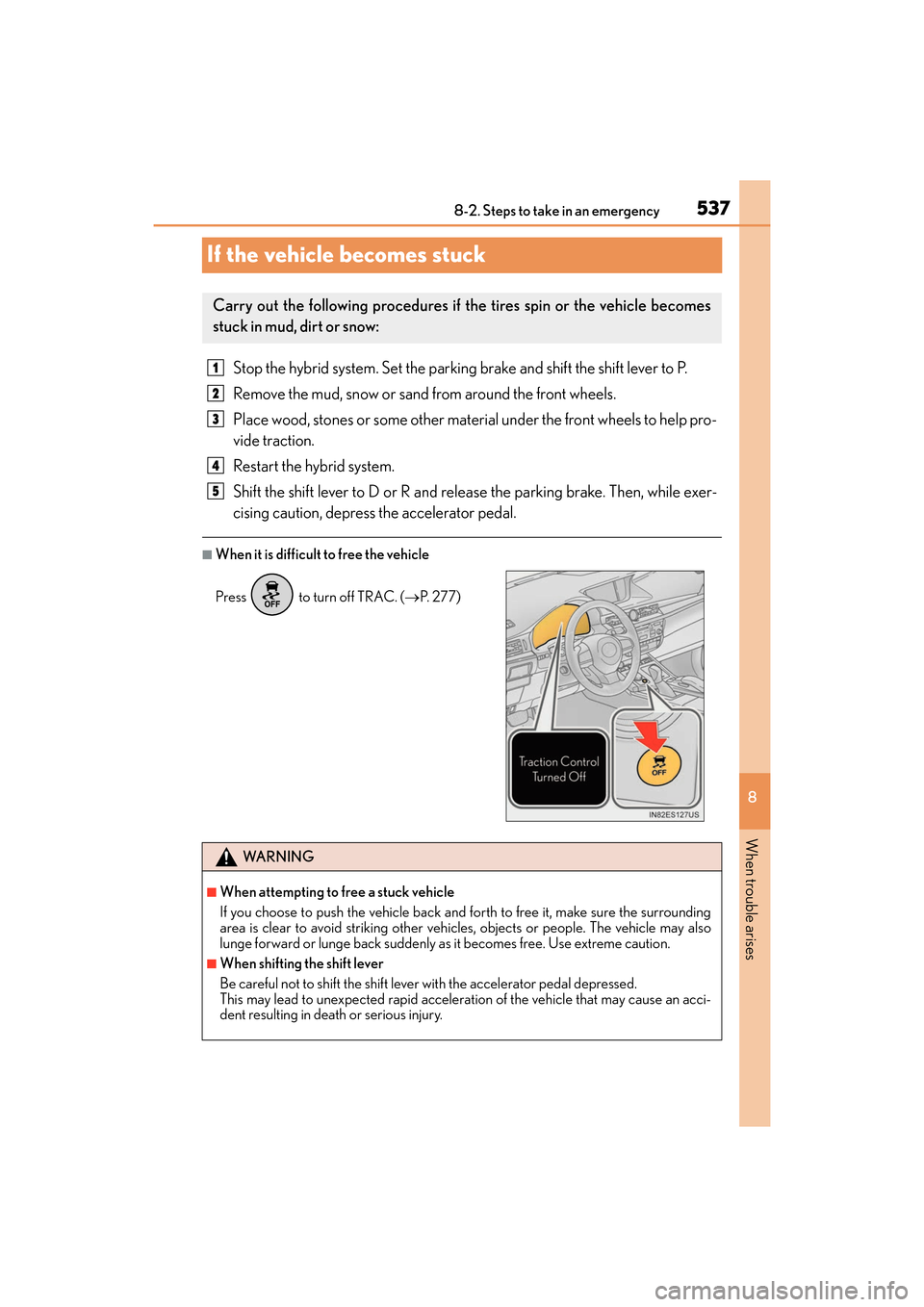
■When it is difficult to free the vehicle
Carry out the following procedures if the tires spin or the vehicle becomes
stuck in mud, dirt or snow:
Press to turn off TRAC. ( →P. 277)
WA R N I N G
■When attempting to free a stuck vehicle
If you choose to push the vehicle back and forth to free it, make sure the surrounding
area is clear to avoid striking other vehicles, objects or people. The vehicle may also
lunge forward or lunge back suddenly as it becomes free. Use extreme caution.
■When shifting the shift lever
Be careful not to shift the shift lever with the accelerator pedal depressed.
This may lead to unexpected rapid acceleration of the vehicle that may cause an acci-
dent resulting in death or serious injury.
1
2
3
4
5
Page 549 of 612
ES300h_OM_OM33C75U_(U)
5479-1. Specifications
9
Vehicle specifications
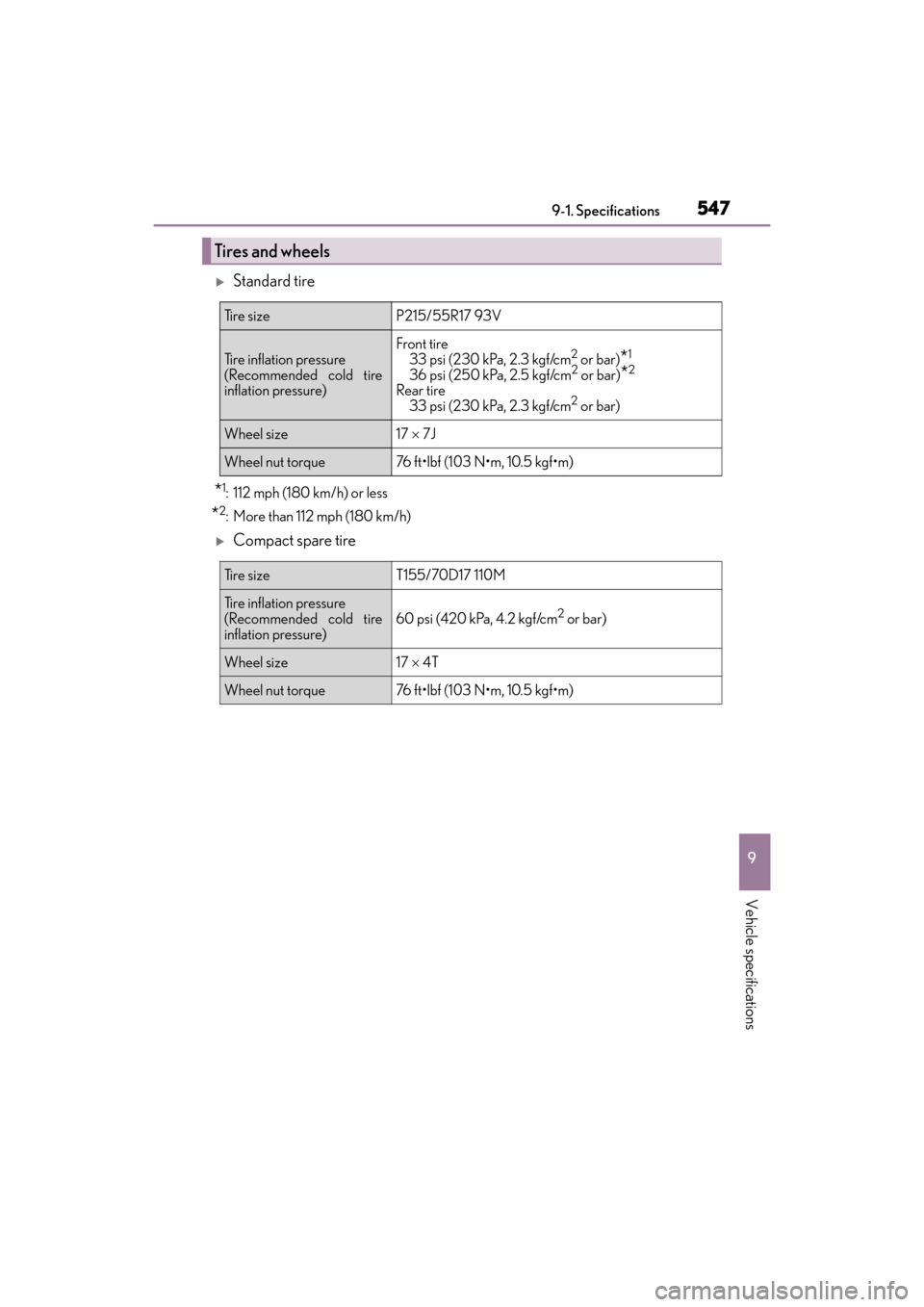
XStandard tire
*1: 112 mph (180 km/h) or less
*2: More than 112 mph (180 km/h)
XCompact spare tire
Tires and wheels
Ti r e s i z eP215/55R17 93V
Tire inflation pressure
(Recommended cold tire
inflation pressure)
Front tire33 psi (230 kPa, 2.3 kgf/cm2 or bar)*1
36 psi (250 kPa, 2.5 kgf/cm2 or bar)*2
Rear tire33 psi (230 kPa, 2.3 kgf/cm2 or bar)
Wheel size17 × 7J
Wheel nut torque76 ft•lbf (103 N•m, 10.5 kgf•m)
Ti r e s i z eT155/70D17 110M
Tire inflation pressure
(Recommended cold tire
inflation pressure)60 psi (420 kPa, 4.2 kgf/cm2 or bar)
Wheel size17 × 4T
Wheel nut torque76 ft•lbf (103 N•m, 10.5 kgf•m)
Page 555 of 612
ES300h_OM_OM33C75U_(U)
5539-1. Specifications
9
Vehicle specifications
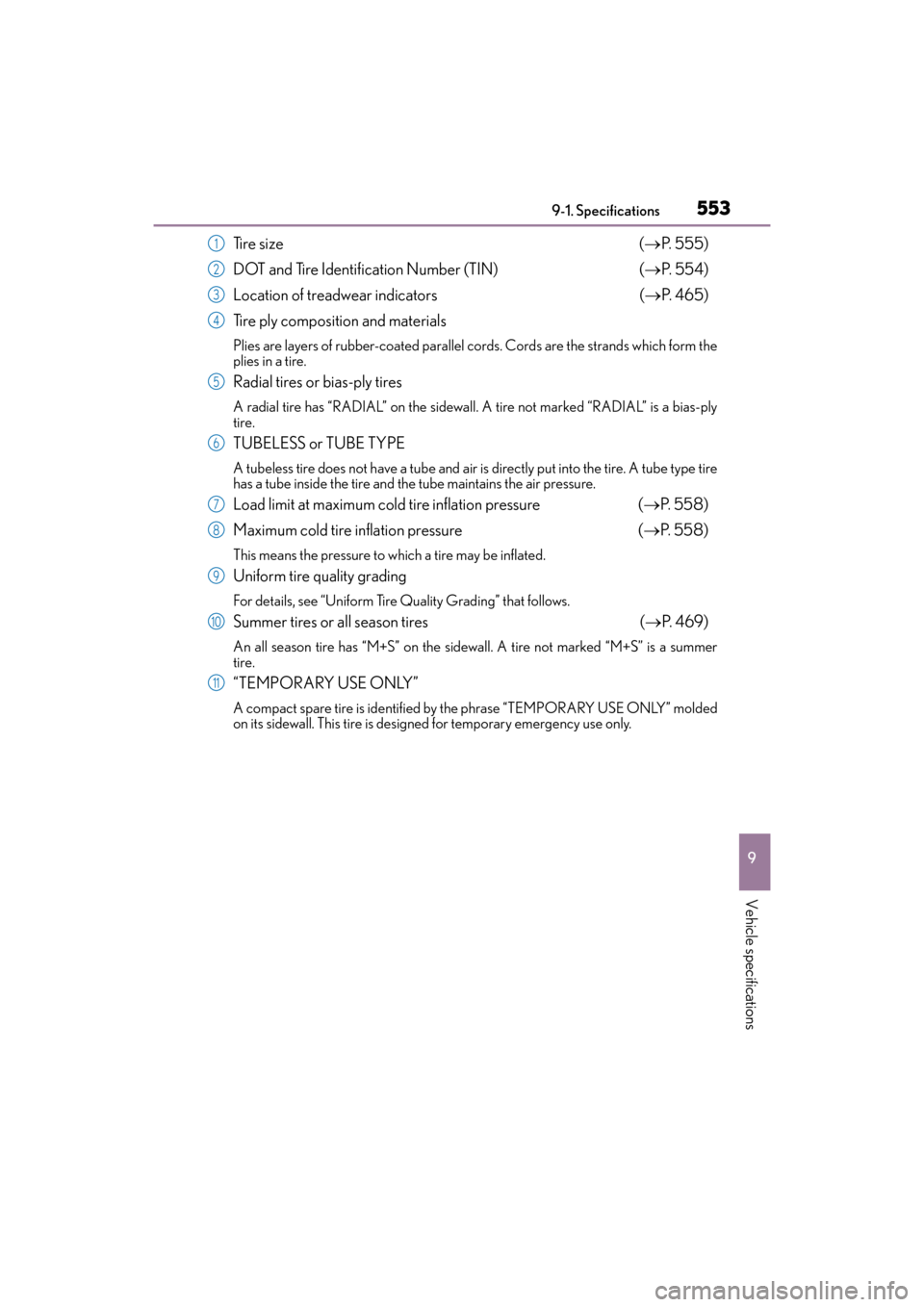
Ti r e s i z e (→ P. 5 5 5 )
DOT and Tire Identification Number (TIN) (→ P. 5 5 4 )
Location of treadwear indicators (→ P. 4 6 5 )
Tire ply composition and materials
Plies are layers of rubber-coated parallel cords. Cords are the strands which form the
plies in a tire.
Radial tires or bias-ply tires
A radial tire has “RADIAL” on the sidewall. A tire not marked “RADIAL” is a bias-ply
tire.
TUBELESS or TUBE TYPE
A tubeless tire does not have a tube and air is directly put into the tire. A tube type tire
has a tube inside the tire and the tube maintains the air pressure.
Load limit at maximum cold tire inflation pressure (→ P. 5 5 8 )
Maximum cold tire inflation pressure (→ P. 5 5 8 )
This means the pressure to which a tire may be inflated.
Uniform tire quality grading
For details, see “Uniform Tire Quality Grading” that follows.
Summer tires or all season tires (→ P. 4 6 9 )
An all season tire has “M+S” on the sidewall. A tire not marked “M+S” is a summer
tire.
“TEMPORARY USE ONLY”
A compact spare tire is identified by the phrase “TEMPORARY USE ONLY” molded
on its sidewall. This tire is designed for temporary emergency use only.
1
2
3
4
5
6
7
8
9
10
11
Page 558 of 612
556
ES300h_OM_OM33C75U_(U)9-1. Spec
ifications
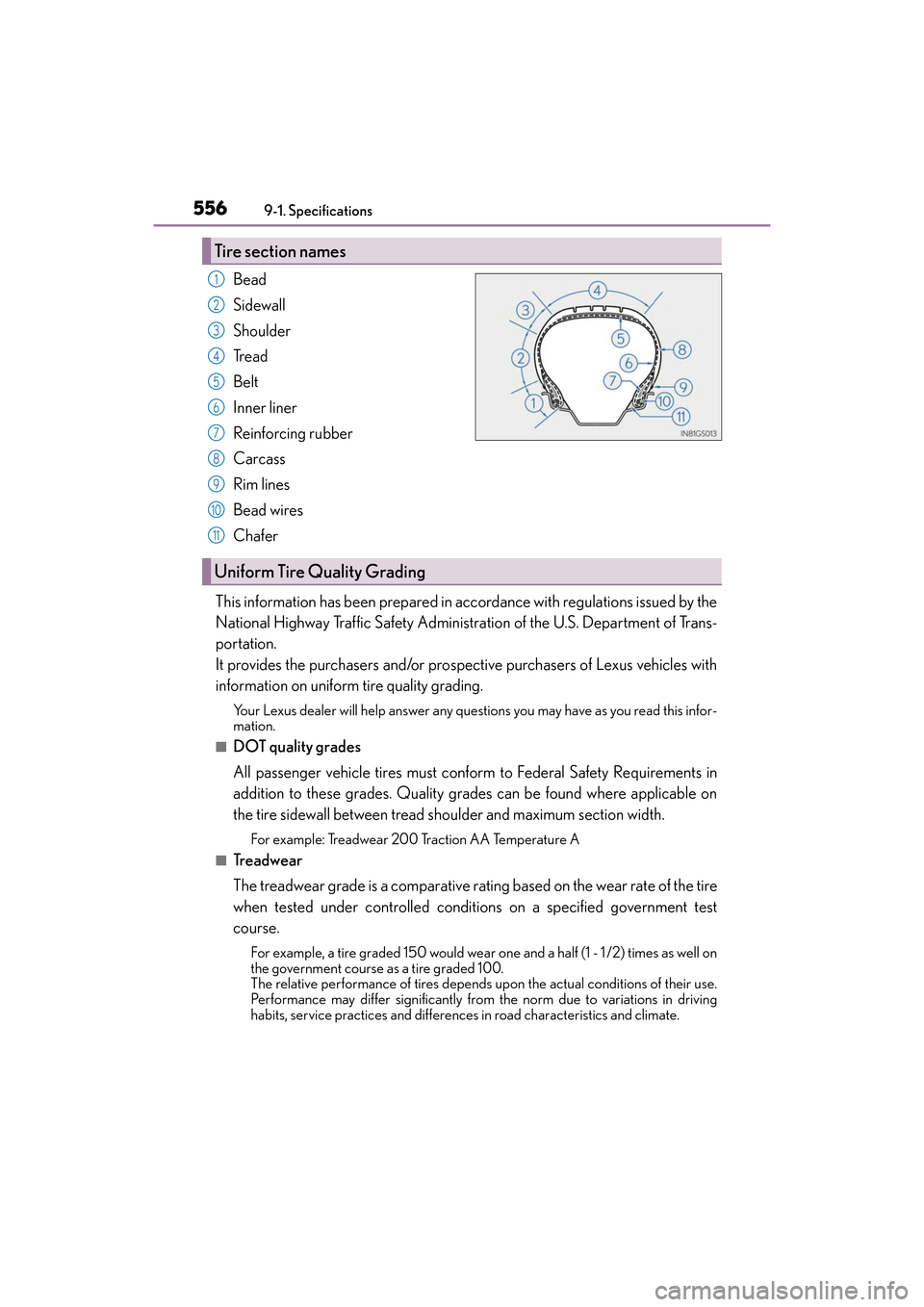
Bead
Sidewall
Shoulder
Tr e a d
Belt
Inner liner
Reinforcing rubber
Carcass
Rim lines
Bead wires
Chafer
This information has been prepared in accordance with regulations issued by the
National Highway Traffic Safety Administration of the U.S. Department of Trans-
portation.
It provides the purchasers and/or prospective purchasers of Lexus vehicles with
information on uniform tire quality grading.
Your Lexus dealer will help answer any questions you may have as you read this infor-
mation.
■DOT quality grades
All passenger vehicle tires must conform to Federal Safety Requirements in
addition to these grades. Quality grades can be found where applicable on
the tire sidewall between tread shoulder and maximum section width.
For example: Treadwear 200 Traction AA Temperature A
■Treadwear
The treadwear grade is a comparative rating based on the wear rate of the tire
when tested under controlled conditions on a specified government test
course.
For example, a tire graded 150 would wear one and a half (1 - 1 /2) times as well on
the government course as a tire graded 100.
The relative performance of tires depends upon the actual conditions of their use.
Performance may differ significantly from the norm due to variations in driving
habits, service practices and differences in road characteristics and climate.
Tire section names
1
2
3
4
5
6
7
Uniform Tire Quality Grading
8
9
10
11