brake light Lexus ES300h 2017 Owner's Manual
[x] Cancel search | Manufacturer: LEXUS, Model Year: 2017, Model line: ES300h, Model: Lexus ES300h 2017Pages: 612, PDF Size: 14.05 MB
Page 5 of 612
3
ES300h_OM_OM33C75U_(U)
1
9 8
7
6 4 3
2
10
5
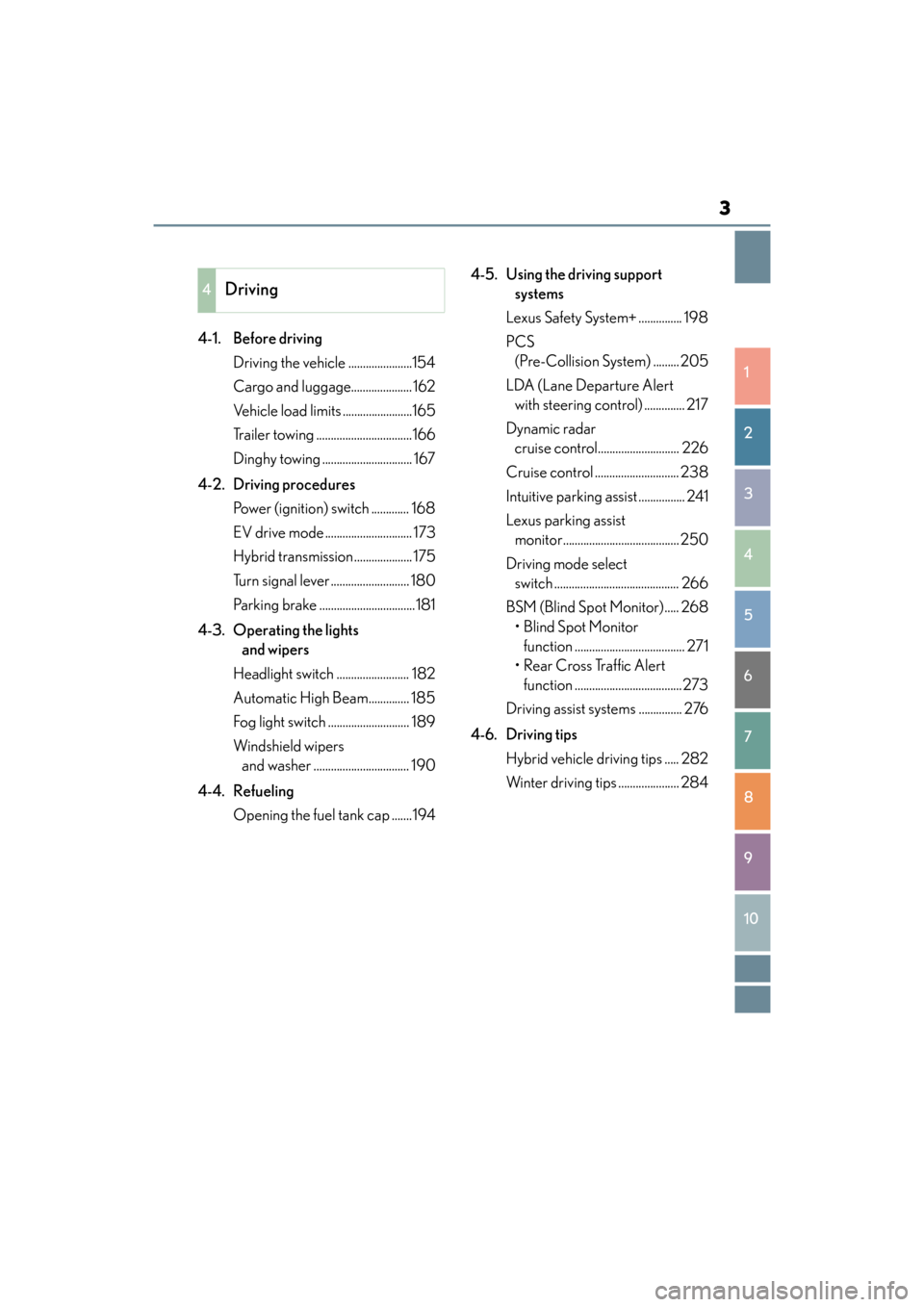
4-1. Before drivingDriving the vehicle ......................154
Cargo and luggage..................... 162
Vehicle load limits ........................165
Trailer towing .................................166
Dinghy towing ............................... 167
4-2. Driving procedures Power (ignition) switch ............. 168
EV drive mode .............................. 173
Hybrid transmission.................... 175
Turn signal lever ........................... 180
Parking brake .................................181
4-3. Operating the lights and wipers
Headlight switch ......................... 182
Automatic High Beam.............. 185
Fog light switch ............................ 189
Windshield wipers and washer ................................. 190
4-4. Refueling Opening the fuel tank cap .......194 4-5. Using the driving support
systems
Lexus Safety System+ ............... 198
PCS (Pre-Collision System) ......... 205
LDA (Lane Departure Alert with steering control) .............. 217
Dynamic radar cruise control............................ 226
Cruise control ............................. 238
Intuitive parking assist ................ 241
Lexus parking assist monitor........................................ 250
Driving mode select switch ........................................... 266
BSM (Blind Spot Monitor)..... 268 • Blind Spot Monitor function ...................................... 271
• Rear Cross Traffic Alert function .....................................273
Driving assist systems ............... 276
4-6. Driving tips Hybrid vehicle driving tips ..... 282
Winter driving tips ..................... 284
4Driving
Page 21 of 612
19Pictorial index
ES300h_OM_OM33C75U_(U)
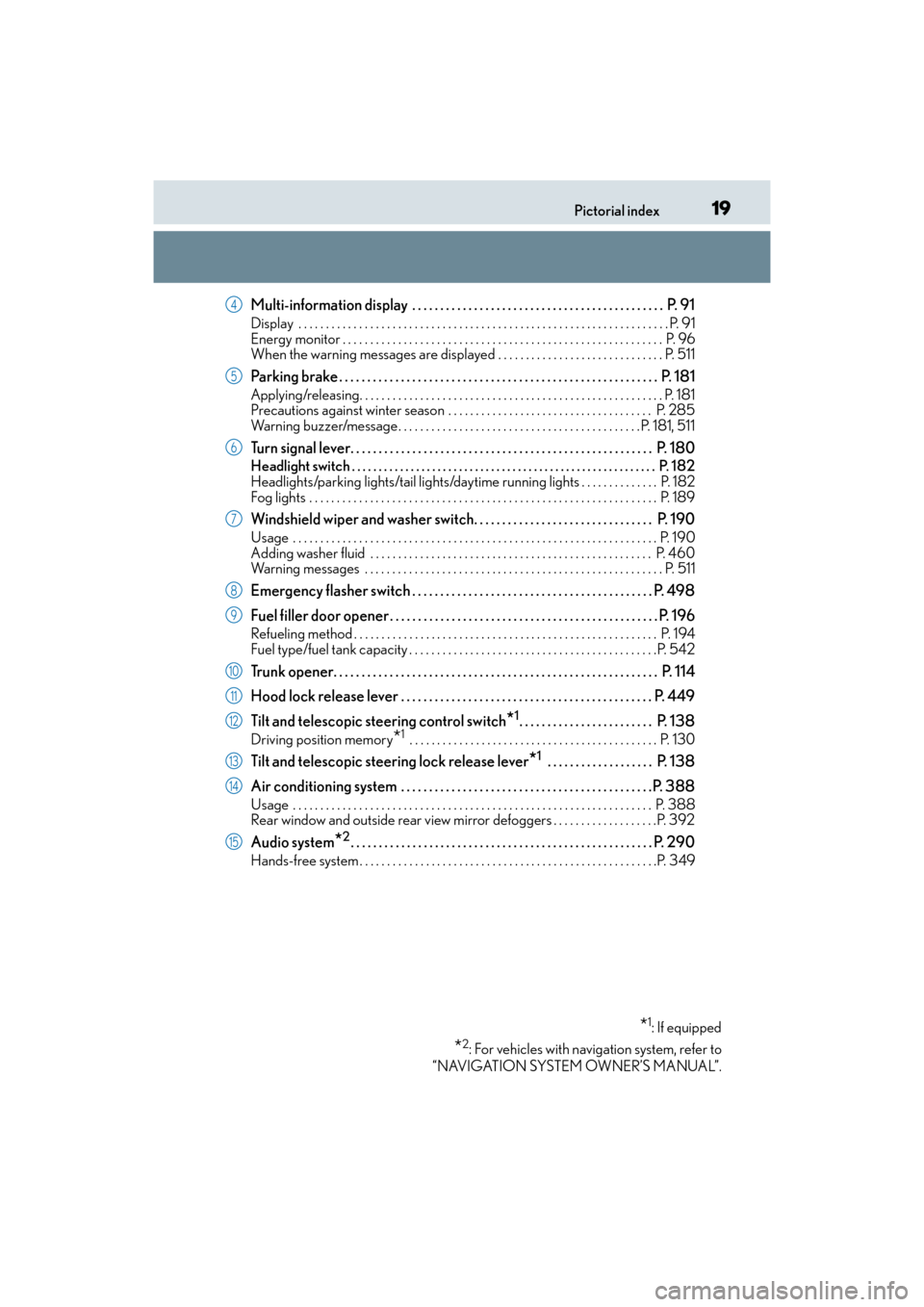
Multi-information display . . . . . . . . . . . . . . . . . . . . . . . . . . . . . . . . . . . . . . . . . . . . . P. 91
Display . . . . . . . . . . . . . . . . . . . . . . . . . . . . . . . . . . . . . . . . . . . . . . . . . . . . . . . . . . . . . . . . . . . P. 91
Energy monitor . . . . . . . . . . . . . . . . . . . . . . . . . . . . . . . . . . . . . . . . . . . . . . . . . . . . . . . . . . P. 96
When the warning messages are displayed . . . . . . . . . . . . . . . . . . . . . . . . . . . . . . P. 511
Parking brake . . . . . . . . . . . . . . . . . . . . . . . . . . . . . . . . . . . . . . . . . . . . . . . . . . . . . . . . . P. 1 8 1
Applying/releasing. . . . . . . . . . . . . . . . . . . . . . . . . . . . . . . . . . . . . . . . . . . . . . . . . . . . . . . P. 1 8 1
Precautions against winter season . . . . . . . . . . . . . . . . . . . . . . . . . . . . . . . . . . . . . P. 285
Warning buzzer/message. . . . . . . . . . . . . . . . . . . . . . . . . . . . . . . . . . . . . . . . . . . . P. 181, 511
Turn signal lever. . . . . . . . . . . . . . . . . . . . . . . . . . . . . . . . . . . . . . . . . . . . . . . . . . . . . . P. 180
Headlight switch . . . . . . . . . . . . . . . . . . . . . . . . . . . . . . . . . . . . . . . . . . . . . . . . . . . . . . . . . P. 182
Headlights/parking lights/tail lights/daytime running lights . . . . . . . . . . . . . . P. 182
Fog lights . . . . . . . . . . . . . . . . . . . . . . . . . . . . . . . . . . . . . . . . . . . . . . . . . . . . . . . . . . . . . . . P. 189
Windshield wiper and washer switch. . . . . . . . . . . . . . . . . . . . . . . . . . . . . . . . P. 190
Usage . . . . . . . . . . . . . . . . . . . . . . . . . . . . . . . . . . . . . . . . . . . . . . . . . . . . . . . . . . . . . . . . . . P. 190
Adding washer fluid . . . . . . . . . . . . . . . . . . . . . . . . . . . . . . . . . . . . . . . . . . . . . . . . . . . P. 46 0
Warning messages . . . . . . . . . . . . . . . . . . . . . . . . . . . . . . . . . . . . . . . . . . . . . . . . . . . . . . P. 511
Emergency flasher switch . . . . . . . . . . . . . . . . . . . . . . . . . . . . . . . . . . . . . . . . . . . P. 498
Fuel filler door opener . . . . . . . . . . . . . . . . . . . . . . . . . . . . . . . . . . . . . . . . . . . . . . . . P. 196
Refueling method . . . . . . . . . . . . . . . . . . . . . . . . . . . . . . . . . . . . . . . . . . . . . . . . . . . . . . . P. 194
Fuel type/fuel tank capacity . . . . . . . . . . . . . . . . . . . . . . . . . . . . . . . . . . . . . . . . . . . . .P. 542
Trunk opener. . . . . . . . . . . . . . . . . . . . . . . . . . . . . . . . . . . . . . . . . . . . . . . . . . . . . . . . . . P. 114
Hood lock release lever . . . . . . . . . . . . . . . . . . . . . . . . . . . . . . . . . . . . . . . . . . . . . P. 449
Tilt and telescopic steering control switch
*1. . . . . . . . . . . . . . . . . . . . . . . . P. 138
Driving position memory*1 . . . . . . . . . . . . . . . . . . . . . . . . . . . . . . . . . . . . . . . . . . . . . P. 130
Tilt and telescopic steering lock release lever*1 . . . . . . . . . . . . . . . . . . . P. 138
Air conditioning system . . . . . . . . . . . . . . . . . . . . . . . . . . . . . . . . . . . . . . . . . . . . .P. 388
Usage . . . . . . . . . . . . . . . . . . . . . . . . . . . . . . . . . . . . . . . . . . . . . . . . . . . . . . . . . . . . . . . . . P. 388
Rear window and outside rear view mirror defoggers . . . . . . . . . . . . . . . . . . .P. 392
Audio system*2. . . . . . . . . . . . . . . . . . . . . . . . . . . . . . . . . . . . . . . . . . . . . . . . . . . . . . P. 290
Hands-free system . . . . . . . . . . . . . . . . . . . . . . . . . . . . . . . . . . . . . . . . . . . . . . . . . . . . . .P. 349
*1: If equipped
*2: For vehicles with navigation system, refer to
“NAVIGATION SYSTEM OWNER’S MANUAL”.
4
5
6
7
8
9
10
11
12
13
14
15
Page 85 of 612
ES300h_OM_OM33C75U_(U)
832. Instrument cluster
2
Instrument cluster
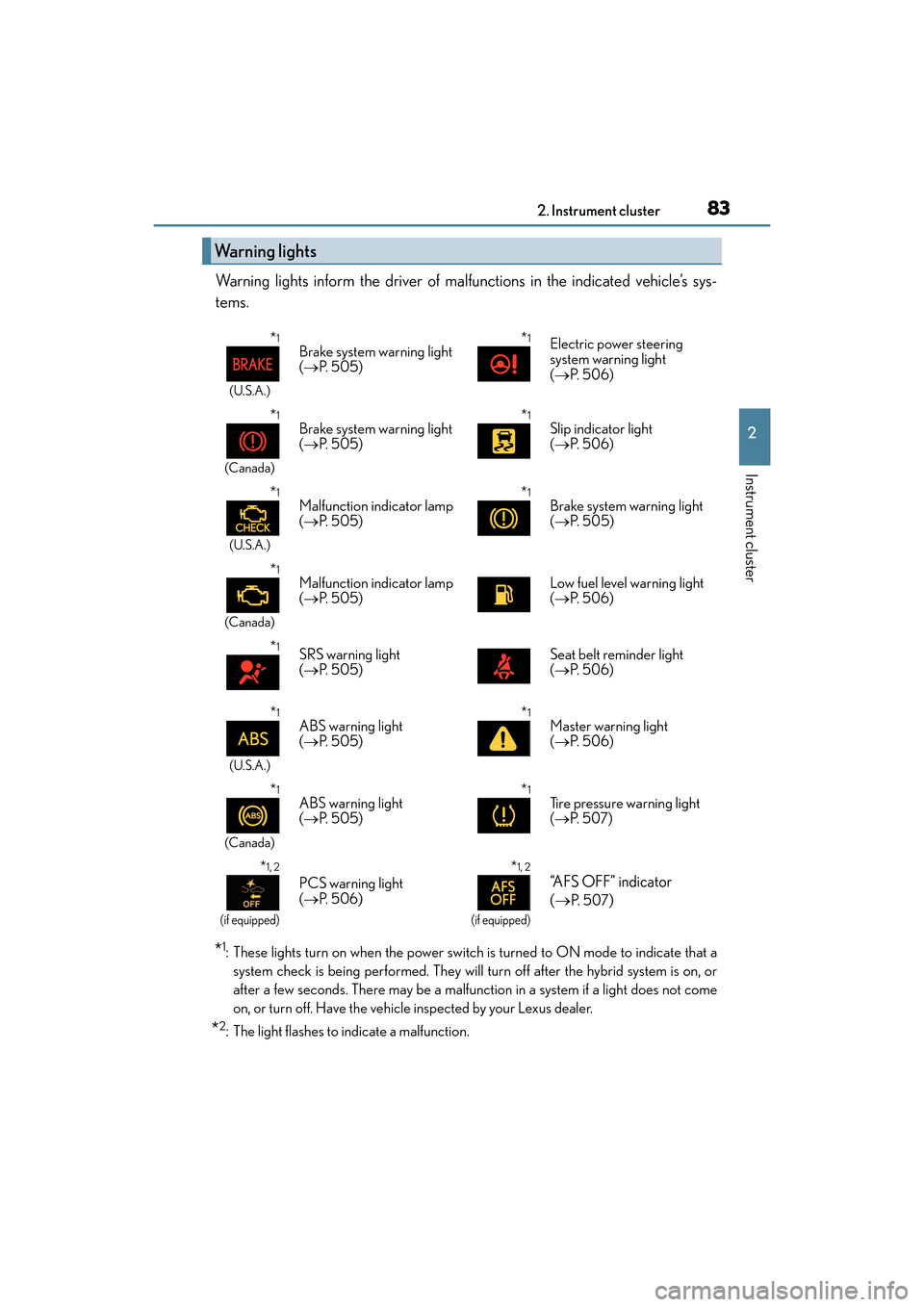
Warning lights inform the driver of malfunctions in the indicated vehicle’s sys-
tems.
*1: These lights turn on when the power switch is turned to ON mode to indicate that asystem check is being performe d. They will turn off after the hybrid system is on, or
after a few seconds. There may be a malfunction in a system if a light does not come
on, or turn off. Have the vehicle inspected by your Lexus dealer.
*2: The light flashes to indicate a malfunction.
Warning lights
*1
(U.S.A.)
Brake system warning light
( → P. 5 0 5 )*1Electric power steering
system warning light
(→ P. 5 0 6 )
*1
(Canada)
Brake system warning light
(→ P. 5 0 5 )*1Slip indicator light
(→ P. 5 0 6 )
*1
(U.S.A.)
Malfunction indicator lamp
(→ P. 5 0 5 )*1Brake system warning light
(→ P. 505)
*1
(Canada)
Malfunction indicator lamp
(→ P. 5 0 5 )Low fuel level warning light
(→ P. 5 0 6 )
*1SRS warning light
(→ P. 5 0 5 )Seat belt reminder light
(→ P. 5 0 6 )
*1
(U.S.A.)
ABS warning light
(→ P. 5 0 5 )*1Master warning light
(→ P. 5 0 6 )
*1
(Canada)
ABS warning light
(→ P. 5 0 5 )*1Tire pressure warning light
(→ P. 5 0 7 )
*1, 2
(if equipped)
PCS warning light
(→ P. 5 0 6 )
*1, 2
(if equipped)
“AFS OFF” indicator
(→
P. 5 0 7)
Page 86 of 612
84
ES300h_OM_OM33C75U_(U)2. Instrument cluster
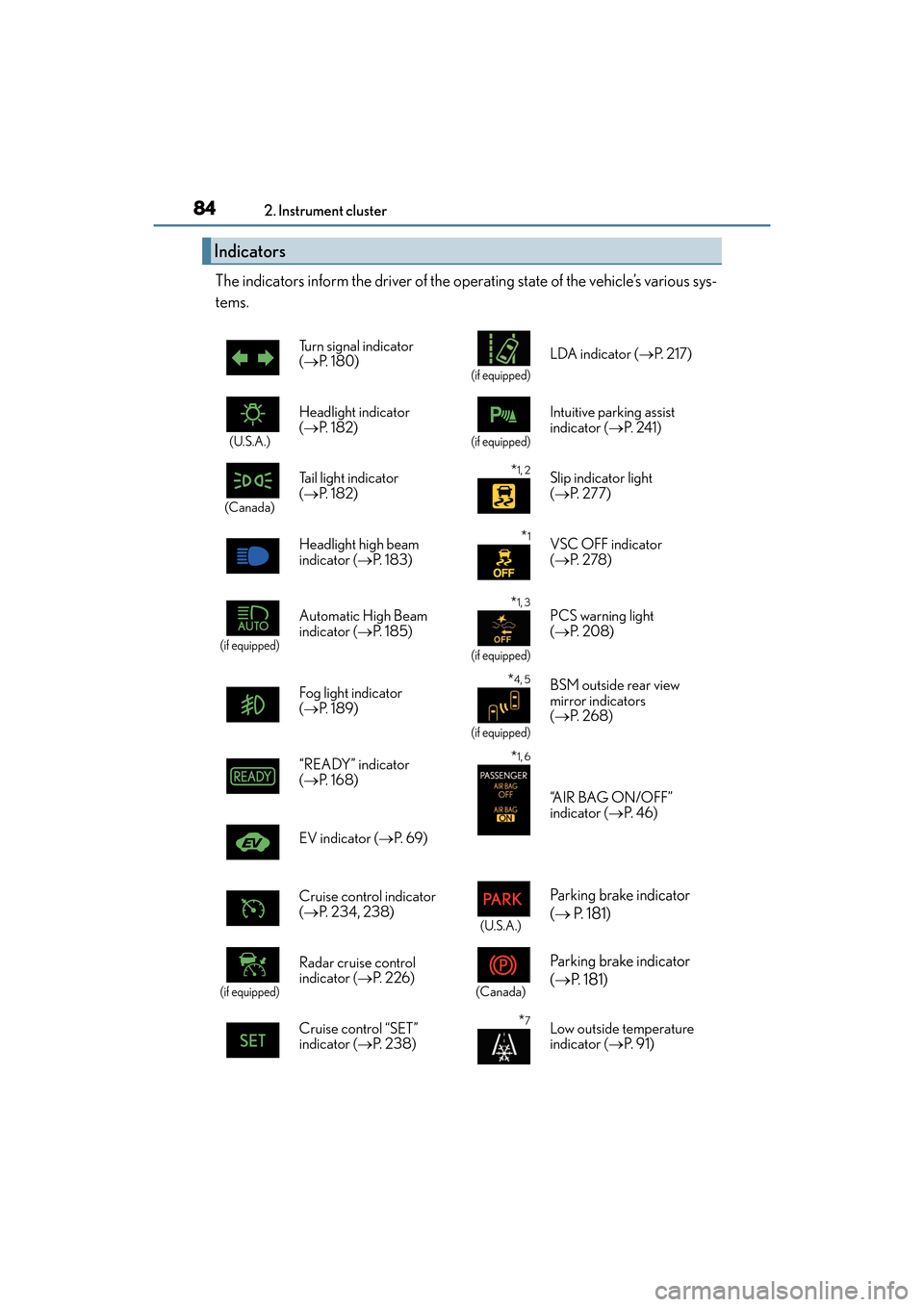
The indicators inform the driver of the operating state of the vehicle’s various sys-
tems.
Indicators
Turn signal indicator
(
→ P. 1 8 0 )
(if equipped)
LDA indicator ( →P. 2 1 7 )
(U.S.A.)
Headlight indicator
(→ P. 1 8 2 )
(if equipped)
Intuitive parking assist
indicator ( →P. 2 4 1 )
(Canada)
Tail light indicator
(→ P. 1 8 2 ) *1, 2Slip indicator light
(→ P. 277)
Headlight high beam
indicator ( →P. 1 8 3 )
*1VSC OFF indicator
(→ P. 2 7 8 )
(if equipped)
Automatic High Beam
indicator ( →P. 1 8 5 ) *1, 3
(if equipped)
PCS warning light
(→ P. 2 0 8 )
Fog light indicator
( → P. 1 8 9 )
*4, 5
(if equipped)
BSM outside rear view
mirror indicators
(→ P. 2 6 8 )
“READY” indicator
(→ P. 1 6 8 )*1, 6
“A I R B A G O N / O F F ”
indicator ( →P. 4 6 )
EV indicator ( →P. 6 9 )
Cruise control indicator
( → P. 2 3 4 , 2 3 8 )
(U.S.A.)
Parking brake indicator
(→ P. 181)
(if equipped)
Radar cruise control
indicator ( →P. 2 2 6 )
(Canada)
Parking brake indicator
(→ P. 1 8 1 )
Cruise control “SET”
indicator ( →P. 2 3 8 )*7Low outside temperature
indicator ( →P. 9 1 )
Page 155 of 612
153
ES300h_OM_OM33C75U_(U)
4Driving
4-1. Before drivingDriving the vehicle ...................... 154
Cargo and luggage .................... 162
Vehicle load limits ....................... 165
Trailer towing ................................. 166
Dinghy towing................................167
4-2. Driving procedures Power (ignition) switch.............. 168
EV drive mode ..............................173
Hybrid transmission ................... 175
Turn signal lever ...........................180
Parking brake ................................. 181
4-3. Operating the lights and wipers
Headlight switch .......................... 182
Automatic High Beam ..............185
Fog light switch............................. 189
Windshield wipers and washer..................................190
4-4. Refueling Opening the fuel tank cap ....... 194 4-5. Using the driving support
systems
Lexus Safety System+ ............... 198
PCS (Pre-Collision System)..........205
LDA (Lane Departure Alert with steering control) ..............217
Dynamic radar cruise control ............................ 226
Cruise control .............................238
Intuitive parking assist ................241
Lexus parking assist monitor ........................................250
Driving mode select switch ........................................... 266
BSM (Blind Spot Monitor) ..... 268 •Blind Spot Monitor function ...................................... 271
• Rear Cross Traffic Alert function .....................................273
Driving assist systems................ 276
4-6. Driving tips Hybrid vehicle driving tips...... 282
Winter driving tips ..................... 284
Page 159 of 612
ES300h_OM_OM33C75U_(U)
1574-1. Before driving
4
Driving
WA R N I N G
Observe the following precautions.
Failure to do so may result in death or serious injury.
■When starting the vehicle
Always keep your foot on the brake pedal while stopped with the “READY” indicator is
illuminated. This prevents the vehicle from creeping.
■When driving the vehicle
●Do not drive if you are unfamiliar with th e location of the brake and accelerator ped-
als to avoid depressing the wrong pedal.
• Accidentally depressing the accelerator pedal instead of the brake pedal will result in sudden acceleration that may lead to an accident.
• When backing up, you may twist your body around, leading to a difficulty in oper- ating the pedals. Make sure to operate the pedals properly.
• Make sure to keep a correct driving posture even when moving the vehicle only slightly. This allows you to depress the brake and accelerator pedals properly.
• Depress the brake pedal using your right foot. Depressing the brake pedal using
your left foot may delay response in an emergency, resulting in an accident.
●The driver should pay extra attention to pedestrians when the vehicle is powered only
by the electric motor (traction motor). As there is no engine noise, the pedestrians
may misjudge the vehicle’s movement. Even with the vehicle proximity notification
system active, people may not realize the vehicle is approaching when the surround-
ing area is noisy and so forth. Ther efore, take extra care while driving.
●Do not drive the vehicle over or stop the vehicle near flammable materials.
The exhaust system and exhaust gases can be extremely hot. These hot parts may
cause a fire if there is any flammable material nearby.
●During normal driving, do not turn off the hybrid system. Turning the hybrid system off
while driving will not cause loss of steering or braking control, however, power assist
to the steering will be lost. This will make it more difficult to steer smoothly, so you
should pull over and stop the vehicle as soon as it is safe to do so.
In the event of an emergency, such as if it becomes impossible to stop the vehicle in
the normal way: → P. 4 9 9
●Use engine braking (downshift) to maintain a safe speed when driving down a steep
hill.
Using the brakes continuously may cause the brakes to overheat and lose effective-
ness. (→P. 1 76 )
●Do not adjust the positions of the steering wheel, the seat, or the inside or outside rear
view mirrors while driving.
Doing so may result in a loss of vehicle control.
●Always check that all passengers’ arms, heads or other parts of their body are not
outside the vehicle.
●Do not drive in excess of the speed limit. Even if the legal speed limit permits it, do not
drive over 85 mph (140 km/h) unless your vehicle has high-speed capability tires.
Driving over 85 mph (140 km/h) may result in tire failure, loss of control and possible
injury. Be sure to consult a tire dealer to determine whether the tires on your vehicle
are high-speed capability tires or not before driving at such speeds.
Page 160 of 612
158
ES300h_OM_OM33C75U_(U)4-1. Before driving
WA R N I N G
Observe the following precautions.
Failure to do so may result in death or serious injury.
■When driving on slippery road surfaces
●Sudden braking, acceleration and steering may cause tire slippage and reduce your
ability to control the vehicle.
●Sudden acceleration, engine braking due to shifting, or changes in engine speed
could cause the vehicle to skid, resulting in an accident.
●After driving through a puddle, lightly depress the brake pedal to make sure that the
brakes are functioning properly. Wet brake pads may prevent the brakes from func-
tioning properly. If the brakes on only one side are wet and not functioning properly,
steering control may be affected.
■When shifting the shift lever
●Do not let the vehicle roll backward while the shift lever is in a driving position, or roll
forward while the shift lever is in R.
Doing so may result in an accident or damage to the vehicle.
●Do not shift the shift lever to P while the vehicle is moving.
Doing so can damage the transmission and may result in a loss of vehicle control.
●Do not shift the shift lever to R while the vehicle is moving forward.
Doing so can damage the transmission and may result in a loss of vehicle control.
●Do not shift the shift lever to a driving position while the vehicle is moving backward.
Doing so can damage the transmission and may result in a loss of vehicle control.
●Shifting the shift lever to N while the vehicle is moving will disengage the hybrid sys-
tem. Engine braking is not available when N is selected.
●Be careful not to shift the shift lever with the accelerator pedal depressed. Shifting the
shift lever to a gear other than P or N may lead to unexpected rapid acceleration of
the vehicle that may cause an accident and result in death or serious injury.
■If you hear a squealing or scraping noise (brake pad wear limit indicators)
Have the brake pads checked and replaced by your Lexus dealer as soon as possible.
Rotor damage may result if the pads are not replaced when needed.
It is dangerous to drive the vehicle when the wear limits of the brake pads and/or those
of the brake discs are exceeded.
■When the vehicle is stopped
●Do not depress the accelerator pedal unnecessarily.
If the shift lever is in any position other than P or N, the vehicle may accelerate sud-
denly and unexpectedly, causing an accident.
●In order to prevent accidents due to the vehicle rolling away, always keep depressing
the brake pedal while stopped with the “READY” indicator is illuminated, and apply
the parking brake as necessary.
●If the vehicle is stopped on an incline, in order to prevent accidents caused by the
vehicle rolling forward or backward, alwa ys depress the brake pedal and securely
apply the parking brake as needed.
●Avoid revving or racing the engine.
Running the engine at high speed while the vehicle is stopped may cause the exhaust
system to overheat, which could result in a fire if combustible material is nearby.
Page 161 of 612
ES300h_OM_OM33C75U_(U)
1594-1. Before driving
4
Driving
WA R N I N G
Observe the following precautions.
Failure to do so may result in death or serious injury.
■When the vehicle is parked
●Do not leave glasses, cigarette lighters, spray cans, or soft drink cans in the vehicle
when it is in the sun.
Doing so may result in the following:
• Gas may leak from a cigarette lighter or spray can, and may lead to a fire.
• The temperature inside the vehicle may cause the plastic lenses and plastic mate- rial of glasses to deform or crack.
• Soft drink cans may fracture, causing the contents to spray over the interior of the vehicle, and may also cause a short circuit in the vehicle’s electrical components.
●Do not leave cigarette lighters in the vehicle. If a cigarette lighter is in a place such as
the glove box or on the floor, it may be lit accidentally when luggage is loaded or the
seat is adjusted, causing a fire.
●Do not attach adhesive discs to the windshield or windows. Do not place containers
such as air fresheners on the instrument panel or dashboard. Adhesive discs or con-
tainers may act as lenses, causing a fire in the vehicle.
●Do not leave a door or window open if the curved glass is coated with a metallized
film such as a silver-colored one. Reflected sunlight may cause the glass to act as a
lens, causing a fire.
●Always apply the parking brake, shift the shif t lever to P, stop the hybrid system and
lock the vehicle.
Do not leave the vehicle unattended while the “READY” indicator is illuminated.
If the vehicle is parked with the shift lever in P but the parking brake is not set, the
vehicle may start to move, possibly leading to an accident.
●Do not touch the exhaust pipes while the “READY” indicator is illuminated or imme-
diately after turning the hybrid system off.
Doing so may cause burns.
■When taking a nap in the vehicle
Always turn the hybrid system off. Otherwise, if you accidentally move the shift lever or
depress the accelerator pedal, this could cause an accident or fire due to hybrid system
overheating. Additionally, if the vehicle is parked in a poorly ventilated area, exhaust
gases may collect and enter the vehicle, leading to death or a serious health hazard.
Page 185 of 612
ES300h_OM_OM33C75U_(U)
1834-3. Operating the lights and wipers
4
Driving
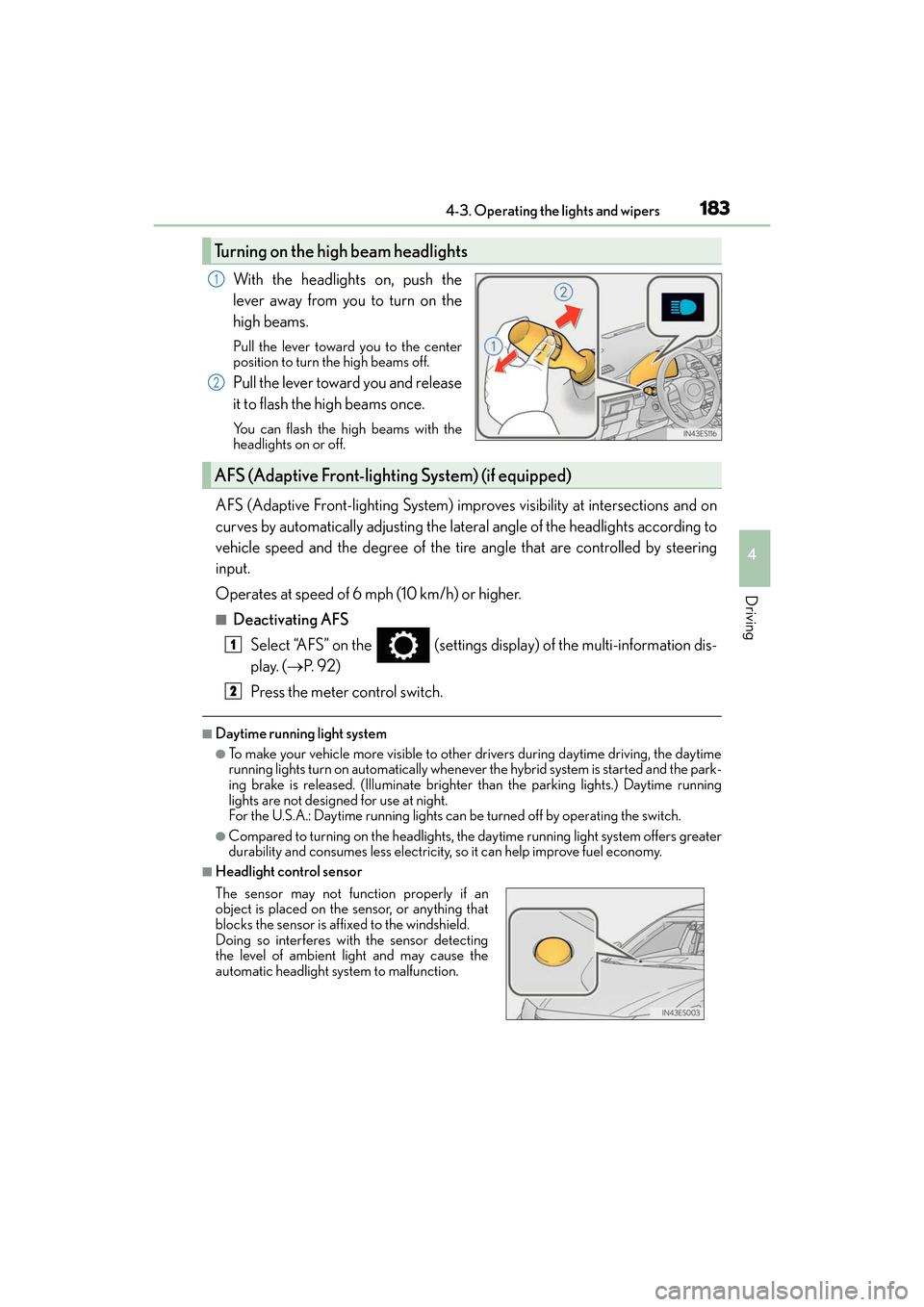
With the headlights on, push the
lever away from you to turn on the
high beams.
Pull the lever toward you to the center
position to turn the high beams off.
Pull the lever toward you and release
it to flash the high beams once.
You can flash the high beams with the
headlights on or off.
AFS (Adaptive Front-lighting System) improves visibility at intersections and on
curves by automatically adjusting the lateral angle of the headlights according to
vehicle speed and the degree of the tire angle that are controlled by steering
input.
Operates at speed of 6 mph (10 km/h) or higher.
■Deactivating AFSSelect “AFS” on the (settings display) of the multi-information dis-
play. ( →P. 9 2 )
Press the meter control switch.
■Daytime running light system
●To make your vehicle more visible to other drivers during daytime driving, the daytime
running lights turn on automatically whenever the hybrid system is started and the park-
ing brake is released. (Illuminate brighter than the parking lights.) Daytime running
lights are not designed for use at night.
For the U.S.A.: Daytime running lights can be turned off by operating the switch.
●Compared to turning on the headlights, the daytime running light system offers greater
durability and consumes less electricity, so it can help improve fuel economy.
■Headlight control sensor
Turning on the high beam headlights
1
2
AFS (Adaptive Front-lighting System) (if equipped)
The sensor may not function properly if an
object is placed on the sensor, or anything that
blocks the sensor is affixed to the windshield.
Doing so interferes with the sensor detecting
the level of ambient light and may cause the
automatic headlight system to malfunction.
1
2
Page 211 of 612
ES300h_OM_OM33C75U_(U)
2094-5. Using the driving support systems
4
Driving
■Operational conditions
Availability of the pedestrian detection function depends on the region in which the vehi-
cle was sold. (For specific countries/areas: →P. 2 0 5 )
Read the following for details:
XRegion A
(The pedestrian detection function is available)
The pre-collision system is enabled and the system determines that the possibility of a
frontal collision with a vehicle or pedestrian is high.
Each function is operational at the following speeds:
●Pre-collision warning:
• Vehicle speed is between approximately 7 and 110 mph (10 and 180 km/h). (For detecting a pedestrian, vehicle speed is between approximately 7 and 50 mph
[10 and 80 km/h].)
• The relative speed between your vehicle and the vehicle or pedestrian ahead is approximately 7 mph (10 km/h) or more.
●Pre-collision brake assist:
• Vehicle speed is between approximately 19 and 110 mph (30 and 180 km/h). (Fordetecting a pedestrian, vehicle speed is between approximately 19 and 50 mph
[30 and 80 km/h].)
• The relative speed between your vehicle and the vehicle or pedestrian ahead is approximately 19 mph (30 km/h) or more.
●Pre-collision braking:
• Vehicle speed is between approximately 7 and 110 mph (10 and 180 km/h). (For
detecting a pedestrian, vehicle speed is between approximately 7 and 50 mph
[10 and 80 km/h].)
• The relative speed between your vehicle and the vehicle or pedestrian ahead is
approximately 7 mph (10 km/h) or more.
The system may not operate in the following situations:
●If a battery terminal has been disconnected and reconnected and then the vehicle has
not been driven for a certain amount of time
●If the shift lever is in R
●If VSC is disabled (only the pre-collisi on warning function will be operational)
●If the PCS warning light is flashing or illuminated