weight Lexus ES350 2008 User Guide
[x] Cancel search | Manufacturer: LEXUS, Model Year: 2008, Model line: ES350, Model: Lexus ES350 2008Pages: 459, PDF Size: 5.93 MB
Page 266 of 459
264
3-6. Other interior features
ES350_U_(L/O_0708)
NOTICE
■To prevent seat heater damage
Do not put unevenly weighted objects on the seat and do not stick sharp objects
(needles, nails, etc.) into the seat.
■To prevent battery discharge
Set the dial to 0 when the engine is not running.
Page 320 of 459
318
4-3. Do-it-yourself maintenance
ES350_U_(L/O_0708)
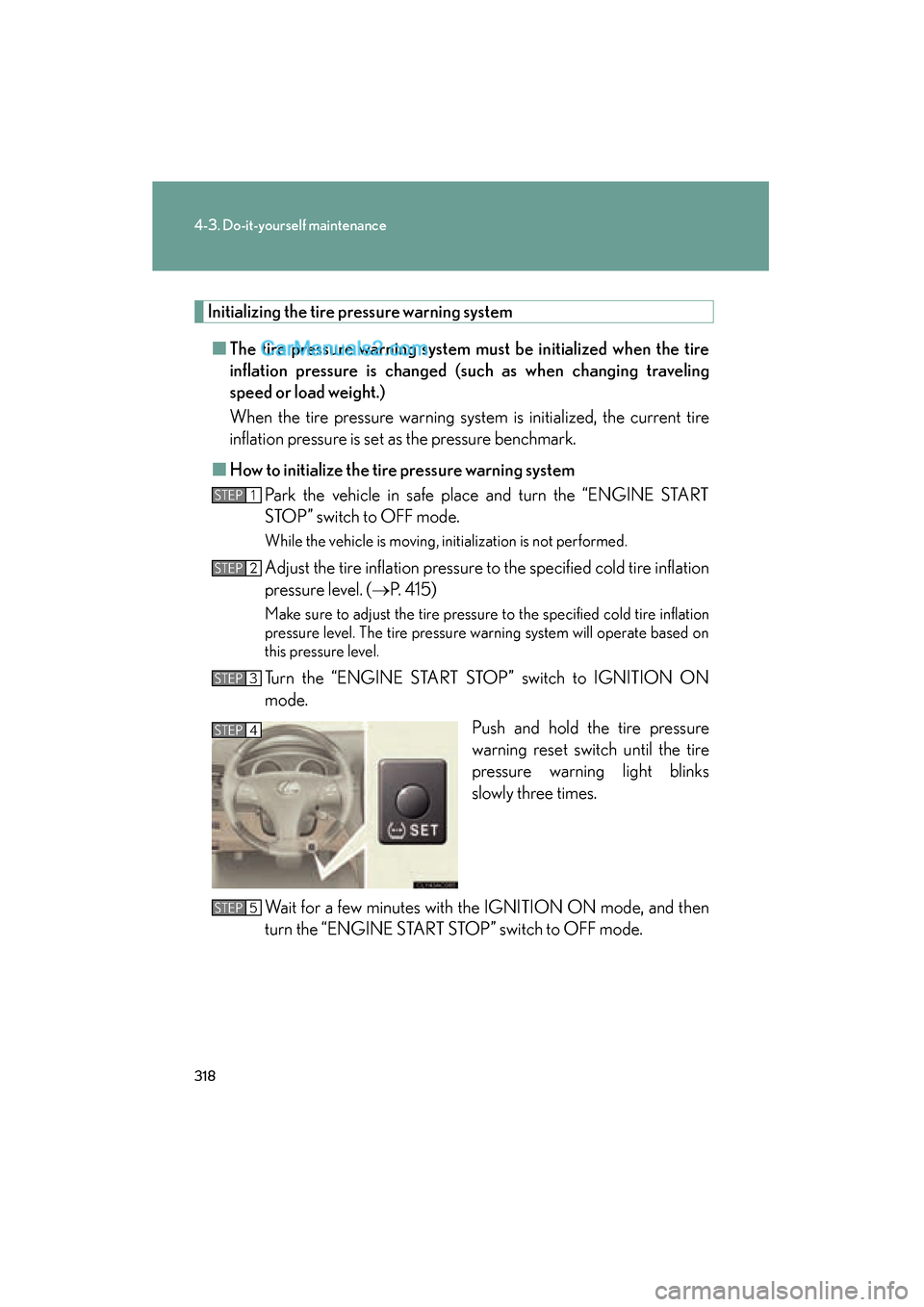
Initializing the tire pressure warning system■ The tire pressure warn ing system must be initialized when the tire
inflation pressure is changed (s uch as when changing traveling
speed or load weight.)
When the tire pressure warning system is initialized, the current tire
inflation pressure is set as the pressure benchmark.
■ How to initialize the tire pressure warning system
Park the vehicle in safe place and turn the “ENGINE START
STOP” switch to OFF mode.
While the vehicle is moving, initialization is not performed.
Adjust the tire inflation pressure to the specified cold tire inflation
pressure level. ( →P. 4 1 5 )
Make sure to adjust the tire pressure to the specified cold tire inflation
pressure level. The tire pressure warning system will operate based on
this pressure level.
Turn the “ENGINE START STOP” switch to IGNITION ON
mode.
Push and hold the tire pressure
warning reset switch until the tire
pressure warning light blinks
slowly three times.
Wait for a few minutes with the IGNITION ON mode, and then
turn the “ENGINE START STOP” switch to OFF mode.
STEP1
STEP2
STEP3
STEP4
STEP5
Page 322 of 459

320
4-3. Do-it-yourself maintenance
ES350_U_(L/O_0708)
■When to replace your vehicle’s tires
Tires should be replaced if:
●You have tire damage such as cuts, splits, cracks deep enough to expose the
fabric or bulges indicating internal damage
●A tire goes flat repeatedly or cannot be properly repaired due to the size or
location of a cut or other damage
If you are not sure, consult with your Lexus dealer.
■Replacing tires and wheels
If the ID code of the tire pressure warning valve and transmitter is not registered,
the tire pressure warning system will not work properly. After about 20 minutes, the
tire pressure warning light comes on after blinking for 1 minute to indicate a system
malfunction.
■Tire life
Any tire over 6 years old must be checked by a qualified technician even if they
have seldom or never been used or damage is not obvious.
■If the tread wears down below 0.16 in. (4 mm) on snow tires
The effectiveness of snow tires is lost.
■Maximum load of tire
Check that the maximum load of the replaced tire is greater than 1 /2 of the Gross
Axle Weight Ratings (GAWR) of either the front axle or the rear axle, whichever is
greater.
As for the maximum load of the tire, see the load limit at maximum cold tire inflation
pressure mentioned on the sidewall of the tire, and as for the Gross Axle Weight
Ratings (GAWR), see the Certification Label. (
→P. 324, 421).
Page 328 of 459
326
4-3. Do-it-yourself maintenance
ES350_U_(L/O_0708)
■Effects of incorrect tire inflation pressure
Driving with incorrect tire inflation pressure may result in the following:
●Reduced fuel efficiency
●Reduced driving comfort and tire life
●Reduced safety
●Damage to the drive train
If a tire needs frequent refilling, have it checked by your Lexus dealer.
■Instructions for checking tire inflation pressure
When checking tire inflation pressure, observe the following:
●Check only when the tires are cold.
If your vehicle has been parked for at least 3 hours and has not been driven for
more than 1 mile or 1.5 km, you will get an accurate cold tire inflation pressure
reading.
●Always use a tire pressure gauge.
The appearance of the tire can be misleading. In addition, tire inflation pressures
that are even just a few pounds off can degrade ride and handling.
●Do not bleed or reduce tire inflation pressure after driving. It is normal for the
tire inflation pressure to be higher after driving.
●Never exceed the vehicle capacity weight.
Passengers and luggage weight should be placed so that the vehicle is bal-
anced.
Page 330 of 459
328
4-3. Do-it-yourself maintenance
ES350_U_(L/O_0708)
Wheels
■When replacing wheels
The wheels of your Lexus are equipped with tire pressure warning valves and trans-
mitters that allow the tire pressure warning system to provide advanced warning in
the event of a loss in tire inflation pressure. Whenever wheels are replaced, the tire
pressure warning valves and transmitters must be switched over from the old
wheels. (→P. 3 1 8 )
If a wheel is bent, cracked or heavily corroded, it should be replaced. Oth-
erwise, the tire may separate from the wheel or cause loss of handling con-
trol.
■Wheel selection
When replacing wheels, care should be taken to ensure that they
are equivalent to those removed in load capacity, diameter, rim
width, and offset.
Replacement wheels are available at your Lexus dealer.
Lexus does not recommend using:
● Wheels of different sizes or types
● Used wheels
● Bent wheels that have been straightened
■ Aluminum wheel precautions
● Use only Lexus wheel nuts and wrenches designed for use with
your aluminum wheels.
● When rotating, repairing or changing your tires, check that the
wheel nuts are still tight after driving 1000 miles (1600 km).
● Be careful not to damage the aluminum wheels when using tire
chains.
● Use only Lexus genuine balance weights or equivalent and a
plastic or rubber hammer when balancing your wheels.
Page 369 of 459
5
When trouble arises
367
5-2. Steps to take in an emergency
ES350_U_(L/O_0708)
■SRS warning light
This warning light system monitors the following:
• The airbag sensor assembly
• The front airbag sensors
• The side and curtain shield airbag sensor assemblies
• The curtain shield airbag sensor assemblies
• The driver’s seat position sensor
• The driver’s seat belt buckle switch
• Occupant detection system (ECU and sensors)
• AIR BAG ON and AIR BAG OFF indicator lights
• Front passenger’s seat belt buckle switch
• The seat belt pretensioner assemblies
• The inflators
• The interconnecting wiring and power sources
■Front passenger detection sensor and passenger seat belt reminder
If luggage or other load is placed on the front passenger seat, depending on its
weight, the reminder light may flash and buzzer may sound.
■When the tire pressure warning light comes on
Check the tire inflation pressure and adjust to the appropriate level. Pushing the tire
pressure warning reset switch does not turn off the tire pressure warning light.
■The tire pressure warning light may turn on due to natural causes
The tire pressure warning light may turn on due to natural causes such as natural air
leaks or tire inflation pressure changes caused by temperature. In this case, adjust-
ing the tire inflation pressure will turn off the warning light (after a few minutes).
Page 410 of 459
408
ES350_U_(L/O_0708)
6-1. Specifications
Maintenance data (fuel, oil level, etc.)
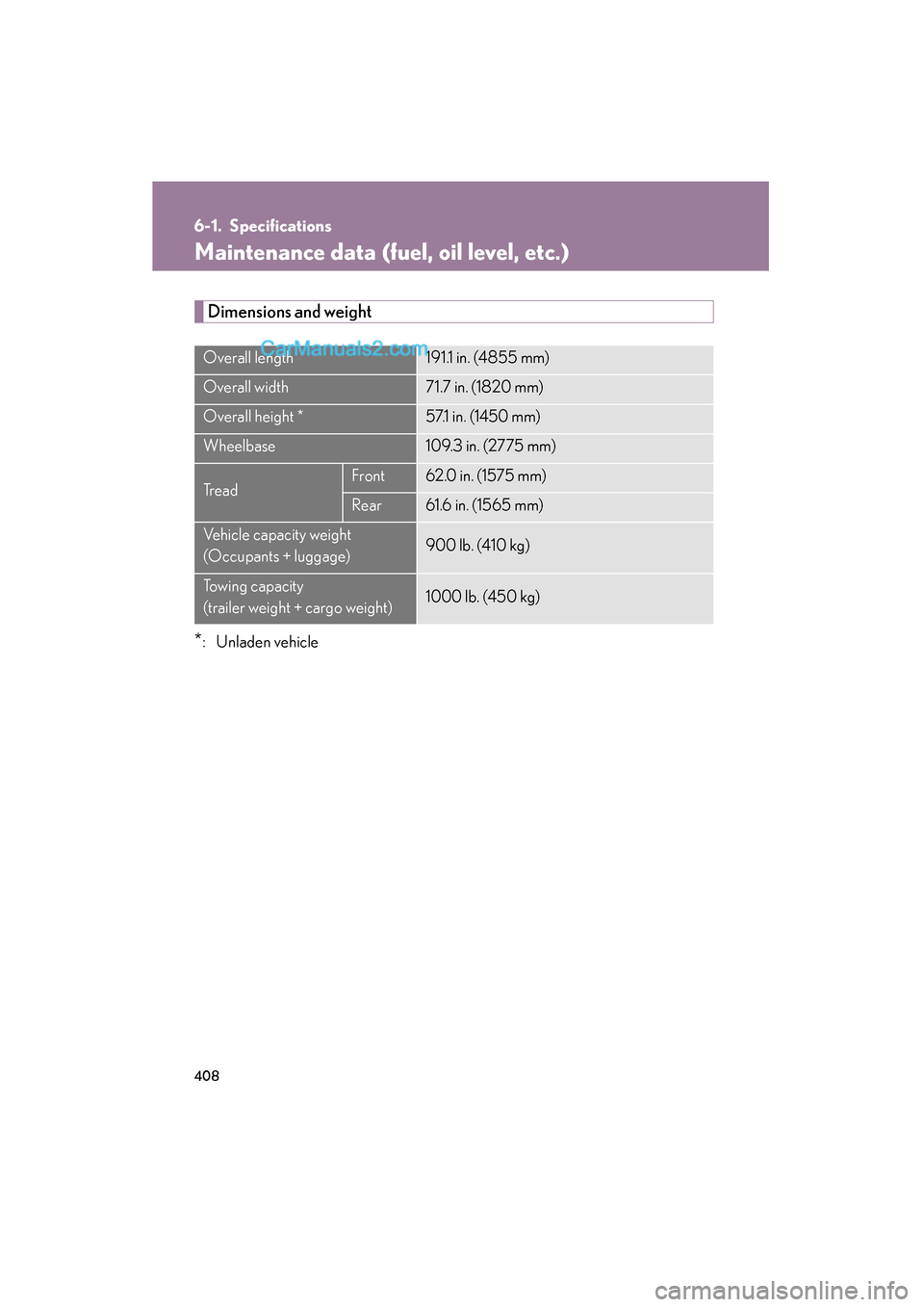
Dimensions and weight
*: Unladen vehicle
Overall length191.1 in. (4855 mm)
Overall width71.7 in. (1820 mm)
Overall height *57.1 in. (1450 mm)
Wheelbase109.3 in. (2775 mm)
Tr e a dFront62.0 in. (1575 mm)
Rear61.6 in. (1565 mm)
Vehicle capacity weight
(Occupants + luggage)900 lb. (410 kg)
Towing capacity
(trailer weight + cargo weight)1000 lb. (450 kg)
Page 428 of 459

426
6-1. Specifications
ES350_U_(L/O_0708)■
Temperature A, B, C
The temperature grades are A (the highest), B, and C, representing
the tire's resistance to the generation of heat and its ability to dissipate
heat when tested under controlled conditions on a specified indoor
laboratory test wheel.
Sustained high temperature can cause the material of the tire to degenerate
and reduce tire life, and excessive temperature can lead to sudden tire fail-
ure.
The grade C corresponds to a level of performance which all passenger car
tires must meet under the Federal Motor Vehicle Safety Standard No. 109.
Grades B and A represent higher levels of performance on the laboratory
test wheel than the minimum required by law.
Warning: The temperature grades for this tire are established for a tire that
is properly inflated and not overloaded.
Excessive speed, underinflation, or excessive loading, either separately or in
combination, can cause heat buildup and possible tire failure.
Glossary of tire terminology
Tire related termMeaning
Cold tire inflation pres-
sureTire pressure when the vehicle has been parked for
three hours or more, or has not been driven more
than 1 mile or 1.5 km under that condition
Maximum inflation pres-
sureThe maximum cold inflated pressure to which a tire
may be inflated, shown on the sidewall of the tire
Recommended inflation
pressureCold tire inflation pressure recommended by a man-
ufacturer
Accessory weight
The combined weight (in excess of those standard
items which may be replaced) of automatic transmis-
sion, power steering, power brakes, power windows,
power seats, radio and heater, to the extent that these
items are available as factory-installed equipment
(whether installed or not)
Page 429 of 459
427
6-1. Specifications
6
Vehicle specifications
ES350_U_(L/O_0708)
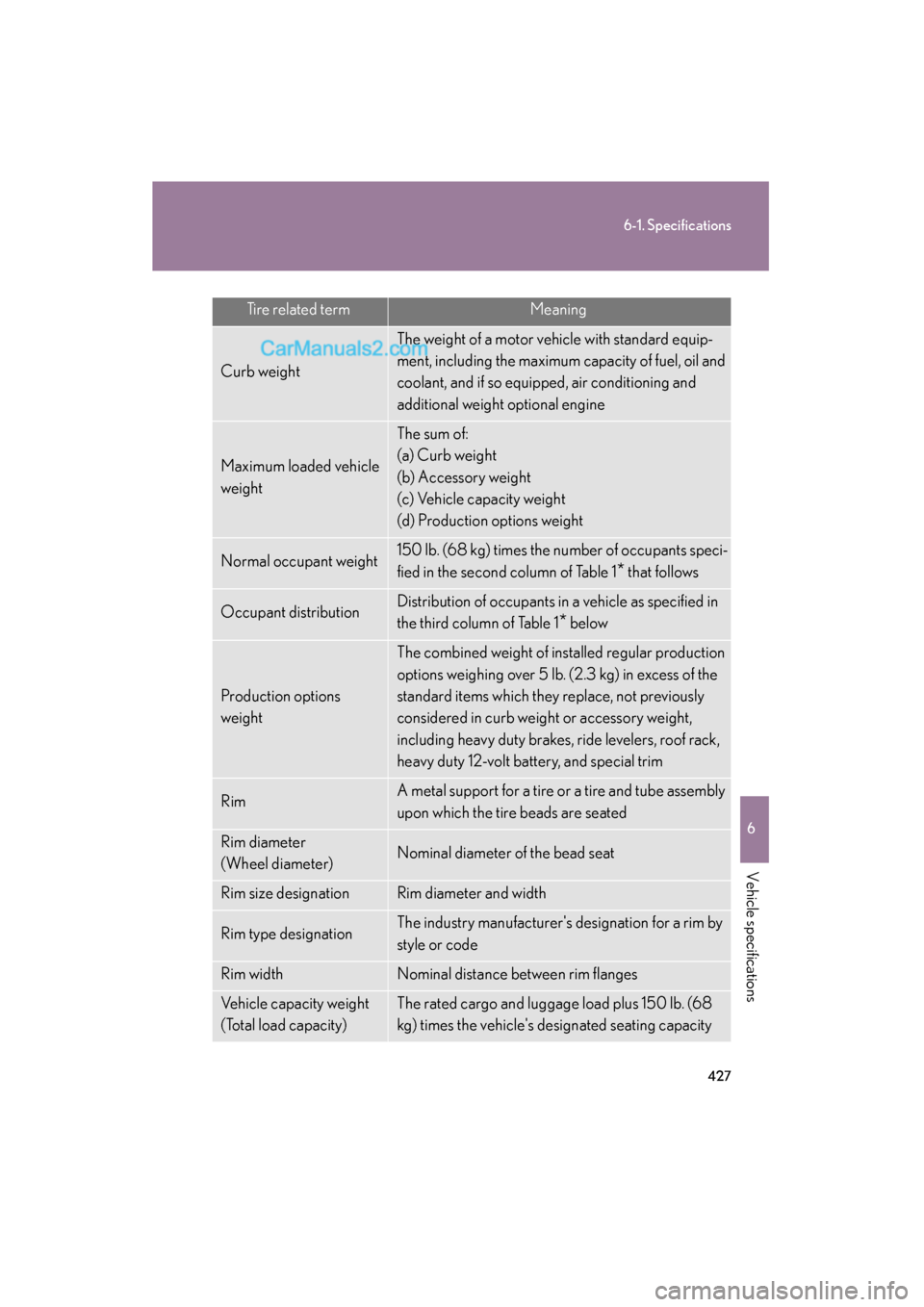
Curb weight
The weight of a motor vehicle with standard equip-
ment, including the maximum capacity of fuel, oil and
coolant, and if so equipped, air conditioning and
additional weight optional engine
Maximum loaded vehicle
weight
The sum of:
(a) Curb weight
(b) Accessory weight
(c) Vehicle capacity weight
(d) Production options weight
Normal occupant weight150 lb. (68 kg) times the number of occupants speci-
fied in the second column of Table 1
* that follows
Occupant distributionDistribution of occupants in a vehicle as specified in
the third column of Table 1
* below
Production options
weight
The combined weight of installed regular production
options weighing over 5 lb. (2.3 kg) in excess of the
standard items which they replace, not previously
considered in curb weight or accessory weight,
including heavy duty brakes, ride levelers, roof rack,
heavy duty 12-volt battery, and special trim
RimA metal support for a tire or a tire and tube assembly
upon which the tire beads are seated
Rim diameter
(Wheel diameter)Nominal diameter of the bead seat
Rim size designationRim diameter and width
Rim type designationThe industry manufacturer's designation for a rim by
style or code
Rim widthNominal distance between rim flanges
Vehicle capacity weight
(Total load capacity)The rated cargo and luggage load plus 150 lb. (68
kg) times the vehicle's designated seating capacity
Tire related termMeaning
Page 430 of 459
428
6-1. Specifications
ES350_U_(L/O_0708)
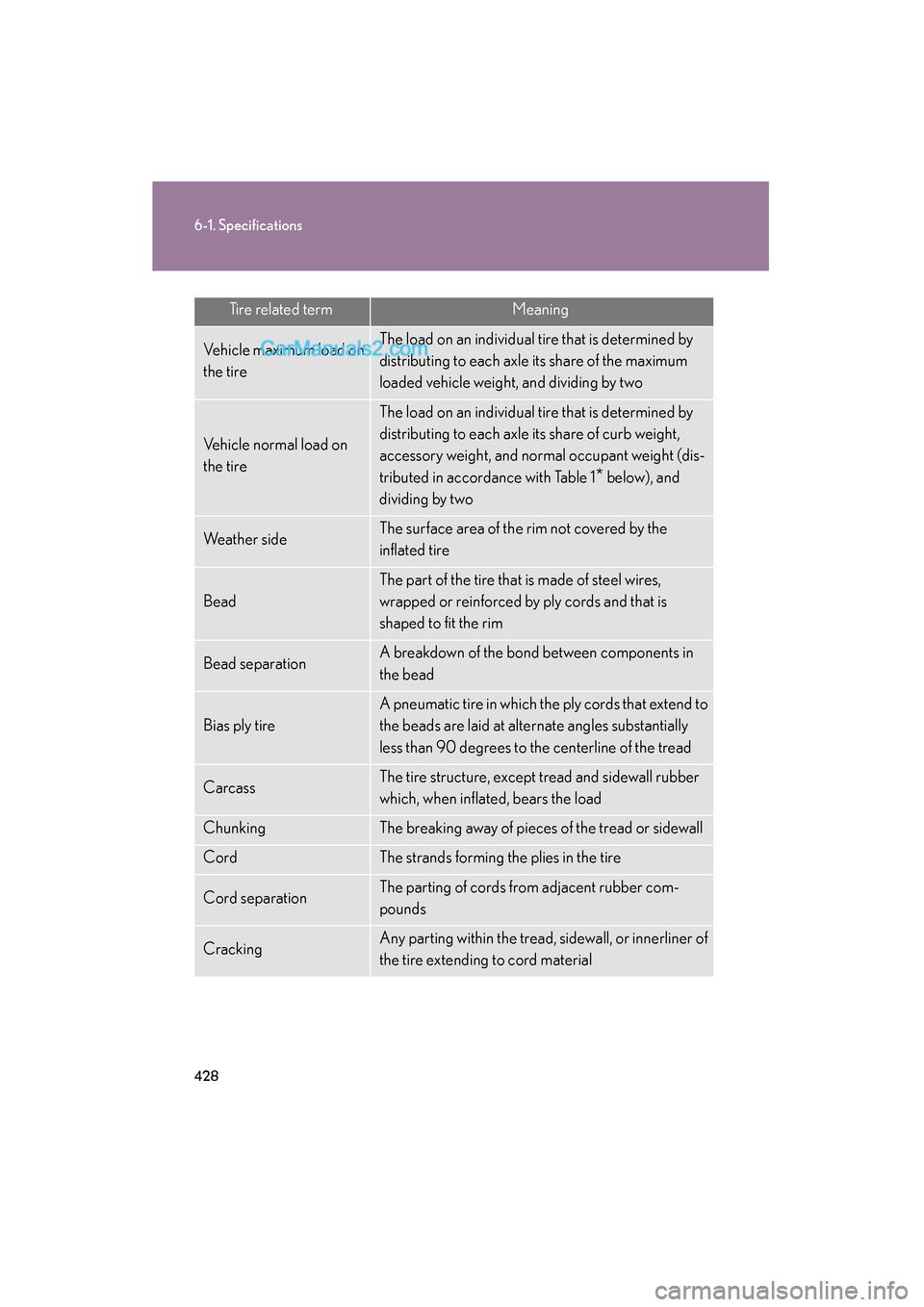
Vehicle maximum load on
the tireThe load on an individual tire that is determined by
distributing to each axle its share of the maximum
loaded vehicle weight, and dividing by two
Vehicle normal load on
the tire
The load on an individual tire that is determined by
distributing to each axle its share of curb weight,
accessory weight, and normal occupant weight (dis-
tributed in accordance with Table 1
* below), and
dividing by two
Weather sideThe surface area of the rim not covered by the
inflated tire
Bead
The part of the tire that is made of steel wires,
wrapped or reinforced by ply cords and that is
shaped to fit the rim
Bead separationA breakdown of the bond between components in
the bead
Bias ply tire
A pneumatic tire in which the ply cords that extend to
the beads are laid at alternate angles substantially
less than 90 degrees to the centerline of the tread
CarcassThe tire structure, except tread and sidewall rubber
which, when inflated, bears the load
ChunkingThe breaking away of pieces of the tread or sidewall
CordThe strands forming the plies in the tire
Cord separationThe parting of cords from adjacent rubber com-
pounds
CrackingAny parting within the tread, sidewall, or innerliner of
the tire extending to cord material
Tire related termMeaning