Gas Lexus ES350 2009 User Guide
[x] Cancel search | Manufacturer: LEXUS, Model Year: 2009, Model line: ES350, Model: Lexus ES350 2009Pages: 475, PDF Size: 6.2 MB
Page 325 of 475
323
4-3. Do-it-yourself maintenance
4
Maintenance and care
ES350_U_(L/O_0808)
■Before recharging
When recharging, the battery produces hydrogen gas which is flammable and
explosive. Therefore, before recharging:
●If recharging with the battery installed on the vehicle, be sure to disconnect the
ground cable.
●Make sure the power switch on the charger is off when connecting and discon-
necting the charger cables to the battery.
■After recharging the battery
The engine may not start. Follow the procedure below to initialize the system.
1. Shift the shift lever to P.
2. Open and close any of the doors.
3. Restart the engine.
Page 326 of 475
324
4-3. Do-it-yourself maintenance
ES350_U_(L/O_0808)
CAUTION
■Chemicals in the battery:
A battery contains poisonous and corrosive sulfuric acid and may produce hydro-
gen gas which is flammable and explosive. To reduce the risk of death or serious
injury, take the following precautions while working on or near battery:
●Do not cause sparks by touching the battery terminals with tools.
●Do not smoke or light a match near the battery.
●Avoid contact with eyes, skin and clothes.
●Never inhale or swallow electrolyte.
●Wear protective safety glasses when working near the battery.
●Keep children away from the battery.
■Where to safety charge the battery
Always charge the battery in an open area. Do not charge the battery in a garage or
closed room where there is not sufficient ventilation.
■How to recharge the battery
Only perform a slow charge (5 A or less). The battery may explode if charged at a
quicker rate.
■Emergency measures regarding electrolyte
●If electrolyte gets in your eyes
Flush your eyes with clean water for at least 15 minutes and get immediate medi-
cal attention. If possible, continue to apply water with a sponge or cloth while
traveling to the nearest medical facility.
●If electrolyte gets on your skin
Wash the affected area thoroughly. If you feel pain or burning, get medical atten-
tion immediately.
●If electrolyte gets on your clothes
It can soak through clothing on to your skin. Immediately take off the clothing and
follow the procedure above if necessary.
●If you accidentally swallow electrolyte
Drink a large quantity of water or milk. Follow with milk of magnesia, beaten raw
egg or vegetable oil. Get emergency medical attention immediately.
Page 354 of 475
352
4-3. Do-it-yourself maintenance
ES350_U_(L/O_0808)
Headlight aim (vehicles with discharge headlights)
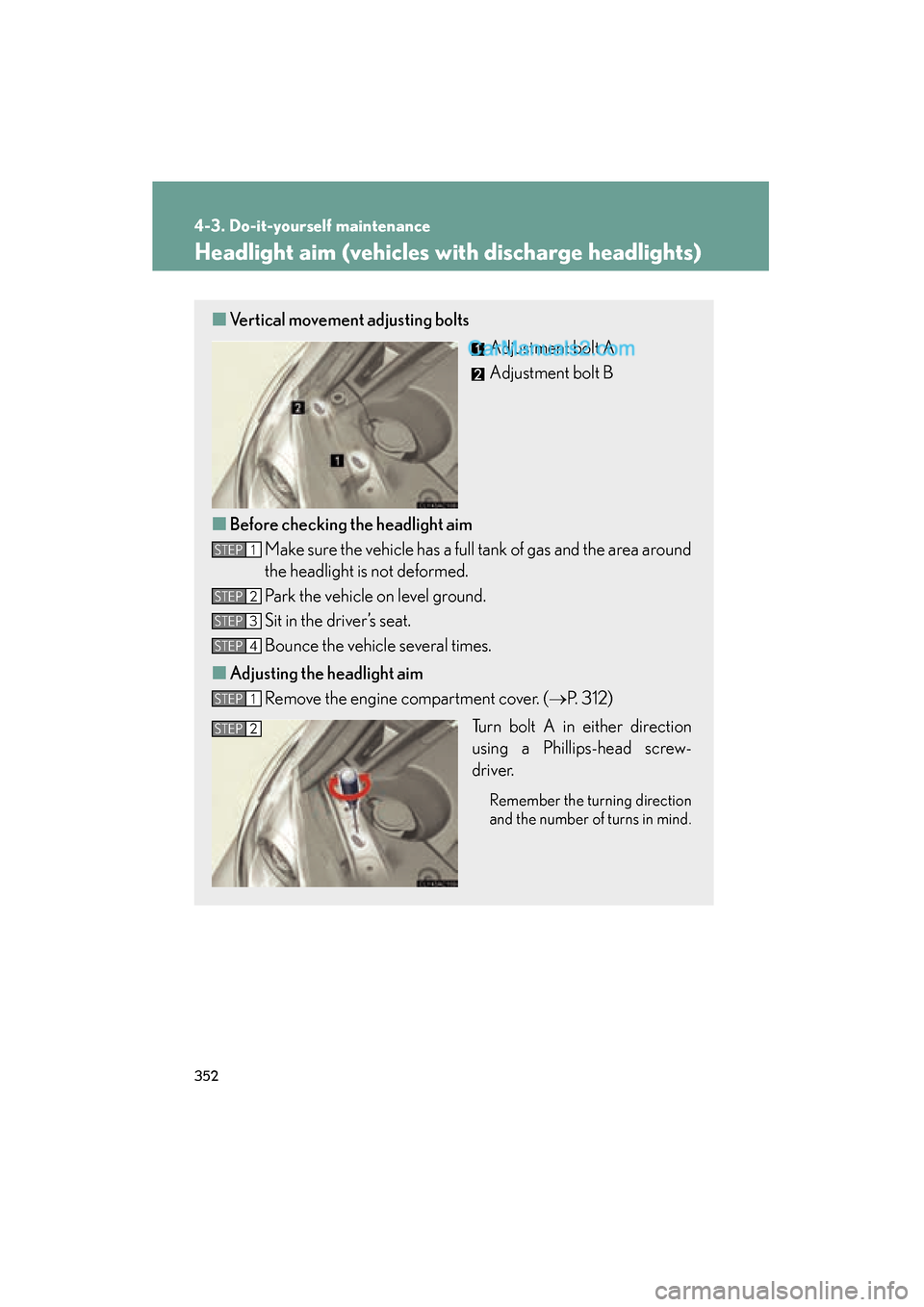
■Vertical movement adjusting bolts
Adjustment bolt A
Adjustment bolt B
■ Before checking the headlight aim
Make sure the vehicle has a full tank of gas and the area around
the headlight is not deformed.
Park the vehicle on level ground.
Sit in the driver’s seat.
Bounce the vehicle several times.
■ Adjusting the headlight aim
Remove the engine compartment cover. ( →P. 312)
Turn bolt A in either direction
using a Phillips-head screw-
driver.
Remember the turning direction
and the number of turns in mind.
STEP1
STEP2
STEP3
STEP4
STEP1
STEP2
Page 417 of 475
5
When trouble arises
415
5-2. Steps to take in an emergency
ES350_U_(L/O_0808)
CAUTION
■Avoiding battery fires or explosions
Observe the following precautions to prevent accidentally igniting the flammable
gas that may be emitted from the battery.
●Make sure the jumper cable is connected to the correct terminal and that it is not
unintentionally in contact with any part other than the intended terminal.
●Do not allow the jumper cables to come into contact with the “+” and “-” termi-
nals.
●Do not allow open flame or use matches, cigarette lighters or smoke near the
battery.
■Battery precautions
The battery contains poisonous and corrosive acidic electrolyte, while related parts
contain lead and lead compounds. Observe the following precautions when han-
dling the battery.
●When working with the battery, always wear safety glasses and take care not to
allow any battery fluids (acid) to come into contact with skin, clothing or the vehi-
cle body.
●Do not lean over the battery.
●In the event that battery fluid comes into contact with the skin or eyes, immedi-
ately wash the affected area with water and seek medical attention.
Place a wet sponge or cloth over the affected area until medical attention can be
received.
●Always wash your hands after handling the battery support, terminals, and other
battery-related parts.
●Do not allow children near the battery.
NOTICE
■When handling jumper cables
Be careful that the jumper cables do not become tangled in the cooling fan or any
of the belts when connecting or disconnecting them.
Page 426 of 475
424
6-1. Specifications
ES350_U_(L/O_0808)
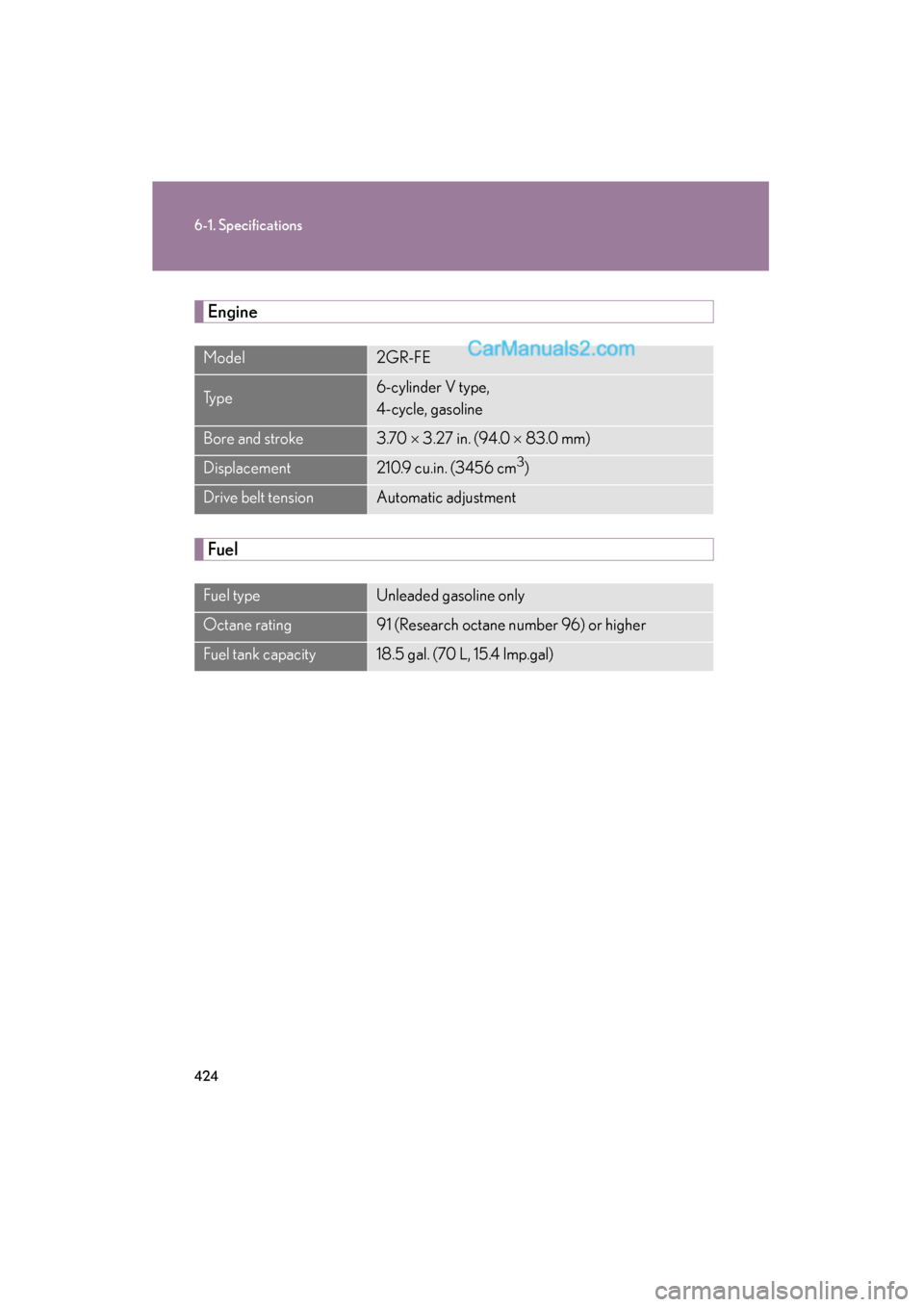
Engine
Fuel
Model2GR-FE
Ty p e6-cylinder V type,
4-cycle, gasoline
Bore and stroke3.70 × 3.27 in. (94.0 × 83.0 mm)
Displacement210.9 cu.in. (3456 cm3)
Drive belt tensionAutomatic adjustment
Fuel typeUnleaded gasoline only
Octane rating91 (Research octane number 96) or higher
Fuel tank capacity18.5 gal. (70 L, 15.4 lmp.gal)
Page 434 of 475
432
6-1. Specifications
ES350_U_(L/O_0808)
Fuel information
■Fuel tank opening for unleaded gasoline
To help prevent incorrect fueling, your Lexus has a fuel tank opening that only
accommodates the special nozzle on unleaded fuel pumps.
■If your engine knocks
●Consult your Lexus dealer.
●You may occasionally notice light knocking for a short time while accelerating
or driving uphill. This is normal and there is no need for concern.
■Gasoline quality
In very few cases, driveability problems may be caused by the brand of gasoline you
are using. If driveability problems persist, try changing the brand of gasoline. If this
does not correct the problem, consult your Lexus dealer.
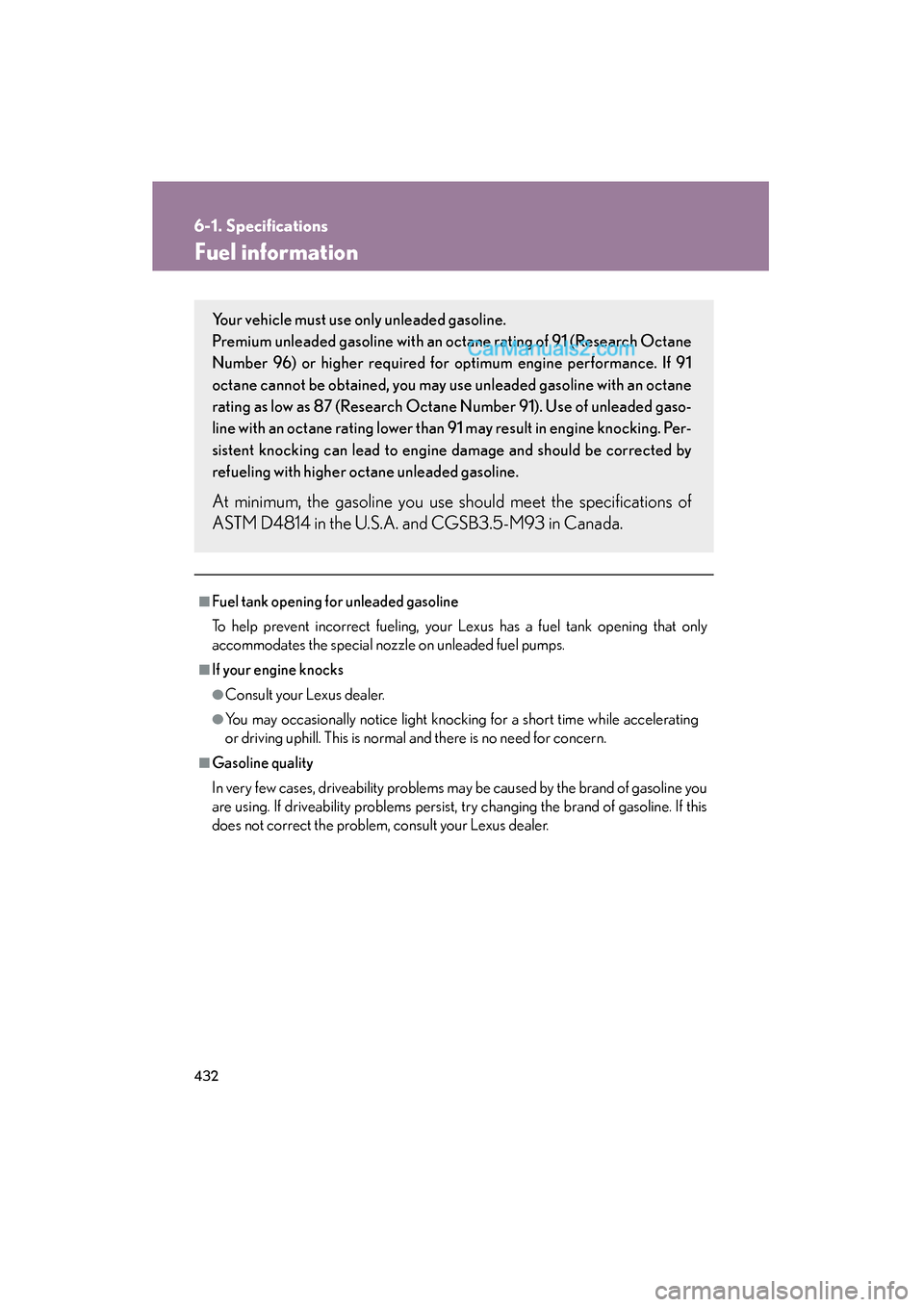
Your vehicle must use only unleaded gasoline.
Premium unleaded gasoline with an octane rating of 91 (Research Octane
Number 96) or higher required for optimum engine performance. If 91
octane cannot be obtained, you may use unleaded gasoline with an octane
rating as low as 87 (Research Octane Number 91). Use of unleaded gaso-
line with an octane rating lower than 91 may result in engine knocking. Per-
sistent knocking can lead to engine damage and should be corrected by
refueling with higher octane unleaded gasoline.
At minimum, the gasoline you use should meet the specifications of
ASTM D4814 in the U.S.A. and CGSB3.5-M93 in Canada.
Page 435 of 475
433
6-1. Specifications
6
Vehicle specifications
ES350_U_(L/O_0808)
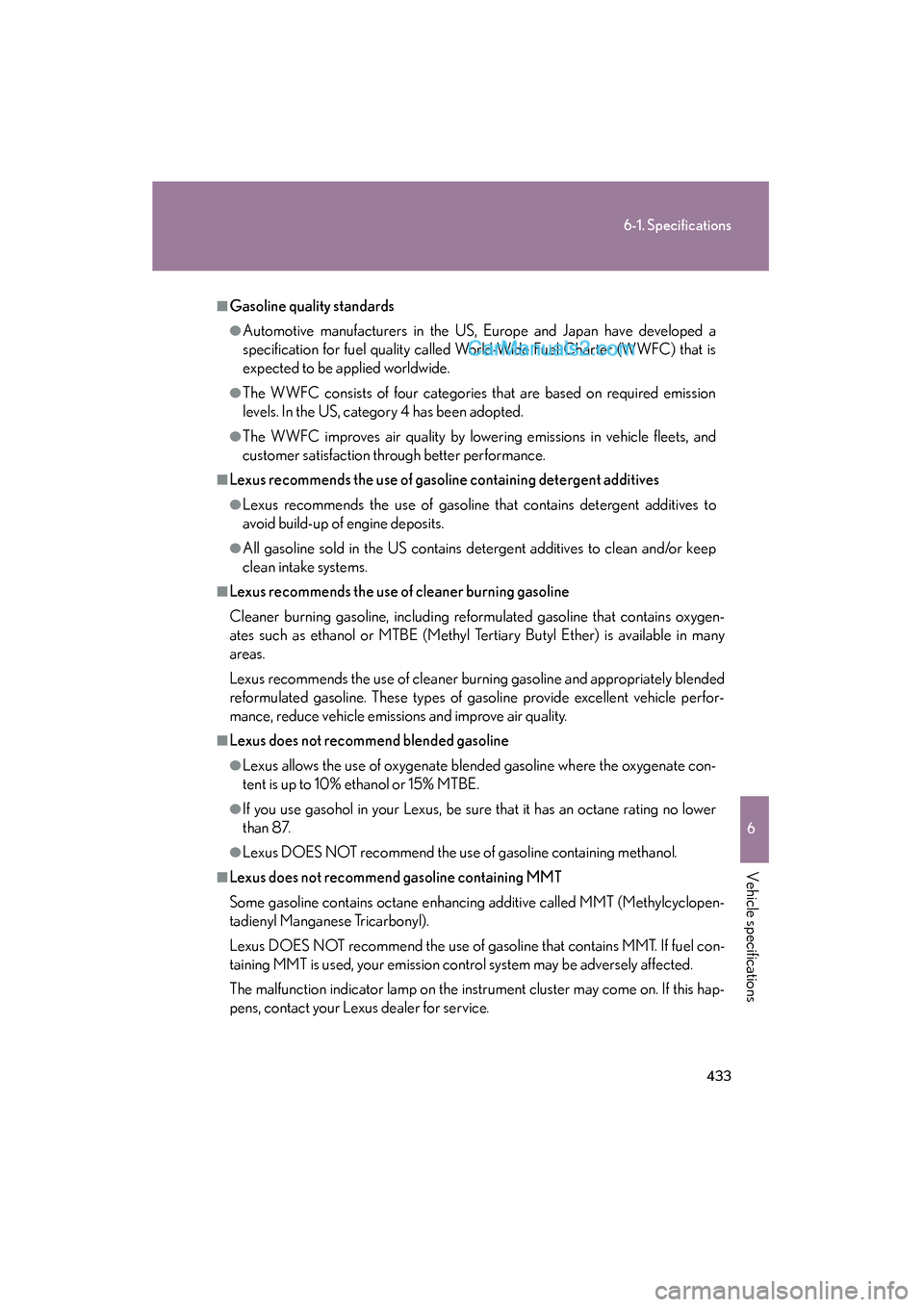
■Gasoline quality standards
●Automotive manufacturers in the US, Europe and Japan have developed a
specification for fuel quality called World-Wide Fuel Charter (WWFC) that is
expected to be applied worldwide.
●The WWFC consists of four categories that are based on required emission
levels. In the US, category 4 has been adopted.
●The WWFC improves air quality by lowering emissions in vehicle fleets, and
customer satisfaction through better performance.
■Lexus recommends the use of gasoline containing detergent additives
●Lexus recommends the use of gasoline that contains detergent additives to
avoid build-up of engine deposits.
●All gasoline sold in the US contains detergent additives to clean and/or keep
clean intake systems.
■Lexus recommends the use of cleaner burning gasoline
Cleaner burning gasoline, including reformulated gasoline that contains oxygen-
ates such as ethanol or MTBE (Methyl Tertiary Butyl Ether) is available in many
areas.
Lexus recommends the use of cleaner burning gasoline and appropriately blended
reformulated gasoline. These types of gasoline provide excellent vehicle perfor-
mance, reduce vehicle emissions and improve air quality.
■Lexus does not recommend blended gasoline
●Lexus allows the use of oxygenate blended gasoline where the oxygenate con-
tent is up to 10% ethanol or 15% MTBE.
●If you use gasohol in your Lexus, be sure that it has an octane rating no lower
t h a n 8 7.
●Lexus DOES NOT recommend the use of gasoline containing methanol.
■Lexus does not recommend gasoline containing MMT
Some gasoline contains octane enhancing additive called MMT (Methylcyclopen-
tadienyl Manganese Tricarbonyl).
Lexus DOES NOT recommend the use of gasoline that contains MMT. If fuel con-
taining MMT is used, your emission control system may be adversely affected.
The malfunction indicator lamp on the instrument cluster may come on. If this hap-
pens, contact your Lexus dealer for service.
Page 436 of 475
434
6-1. Specifications
ES350_U_(L/O_0808)
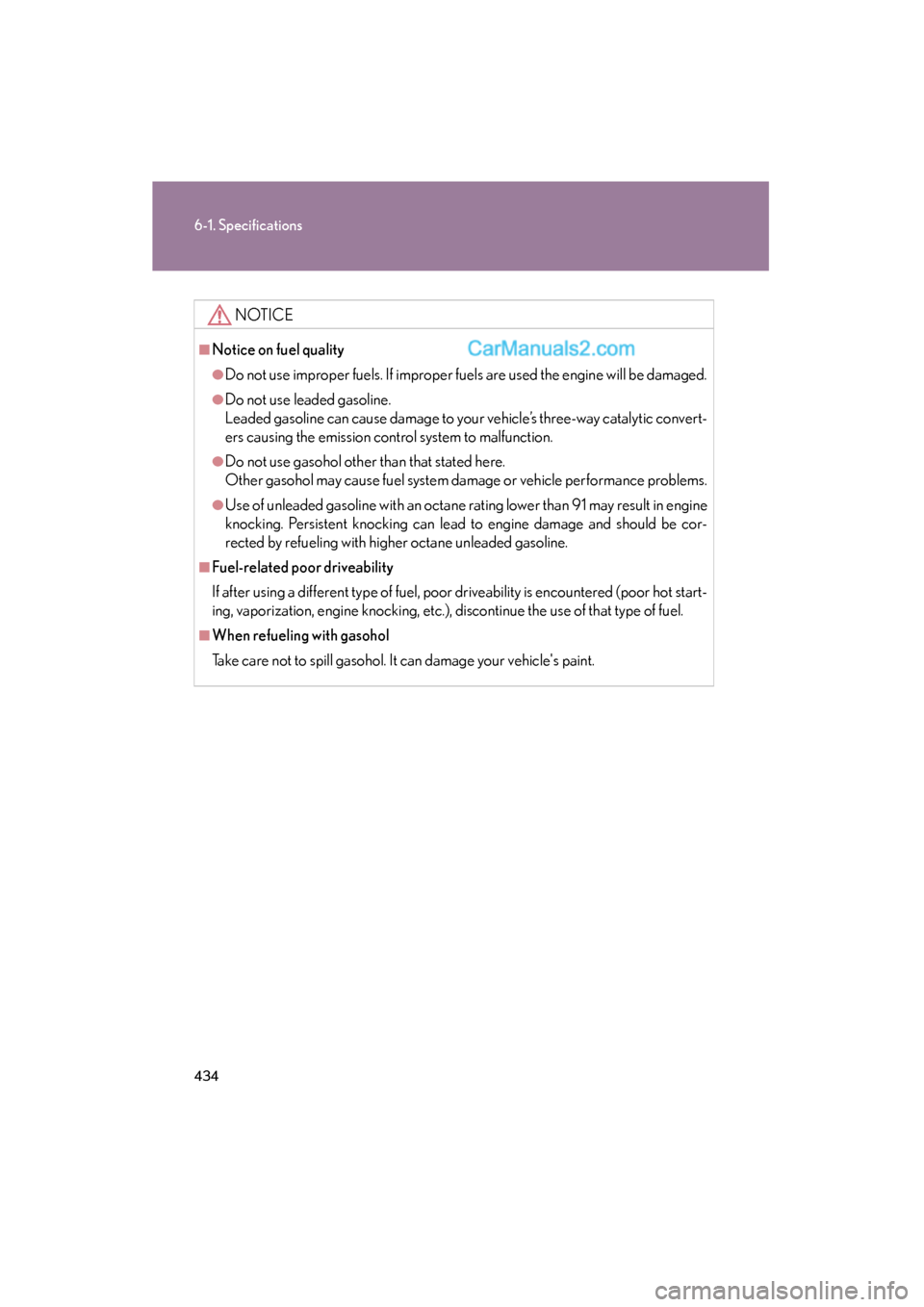
NOTICE
■Notice on fuel quality
●Do not use improper fuels. If improper fuels are used the engine will be damaged.
●Do not use leaded gasoline.
Leaded gasoline can cause damage to your vehicle’s three-way catalytic convert-
ers causing the emission control system to malfunction.
●Do not use gasohol other than that stated here.
Other gasohol may cause fuel system damage or vehicle performance problems.
●Use of unleaded gasoline with an octane rating lower than 91 may result in engine
knocking. Persistent knocking can lead to engine damage and should be cor-
rected by refueling with higher octane unleaded gasoline.
■Fuel-related poor driveability
If after using a different type of fuel, poor driveability is encountered (poor hot start-
ing, vaporization, engine knocking, etc.), discontinue the use of that type of fuel.
■When refueling with gasohol
Take care not to spill gasohol. It can damage your vehicle's paint.
Page 446 of 475

444
6-1. Specifications
ES350_U_(L/O_0808)
Measuring rimThe rim on which a tire is fitted for physical dimension
requirements
Open spliceAny parting at any junction of tread, sidewall, or
innerliner that extends to cord material
Outer diameterThe overall diameter of an inflated new tire
Overall width
The linear distance between the exteriors of the side-
walls of an inflated tire, including elevations due to
labeling, decorations, or protective bands or ribs
Passenger car tire
A tire intended for use on passenger cars, multipur-
pose passenger vehicles, and trucks, that have a
gross vehicle weight rating (GVWR) of 10,000 lb. or
less.
PlyA layer of rubber-coated parallel cords
Ply separationA parting of rubber compound between adjacent
plies
Pneumatic tire
A mechanical device made of rubber, chemicals, fab-
ric and steel or other materials, that, when mounted
on an automotive wheel, provides the traction and
contains the gas or fluid that sustains the load
Radial ply tire
A pneumatic tire in which the ply cords that extend to
the beads are laid at substantially 90 degrees to the
centerline of the tread
Reinforced tire
A tire designed to operate at higher loads and at
higher inflation pressures than the corresponding
standard tire
Section width
The linear distance between the exteriors of the side-
walls of an inflated tire, excluding elevations due to
labeling, decoration, or protective bands
SidewallThat portion of a tire between the tread and bead
Tire related termMeaning
Page 465 of 475
463
Alphabetical index
ES350_U_(L/O_0808)
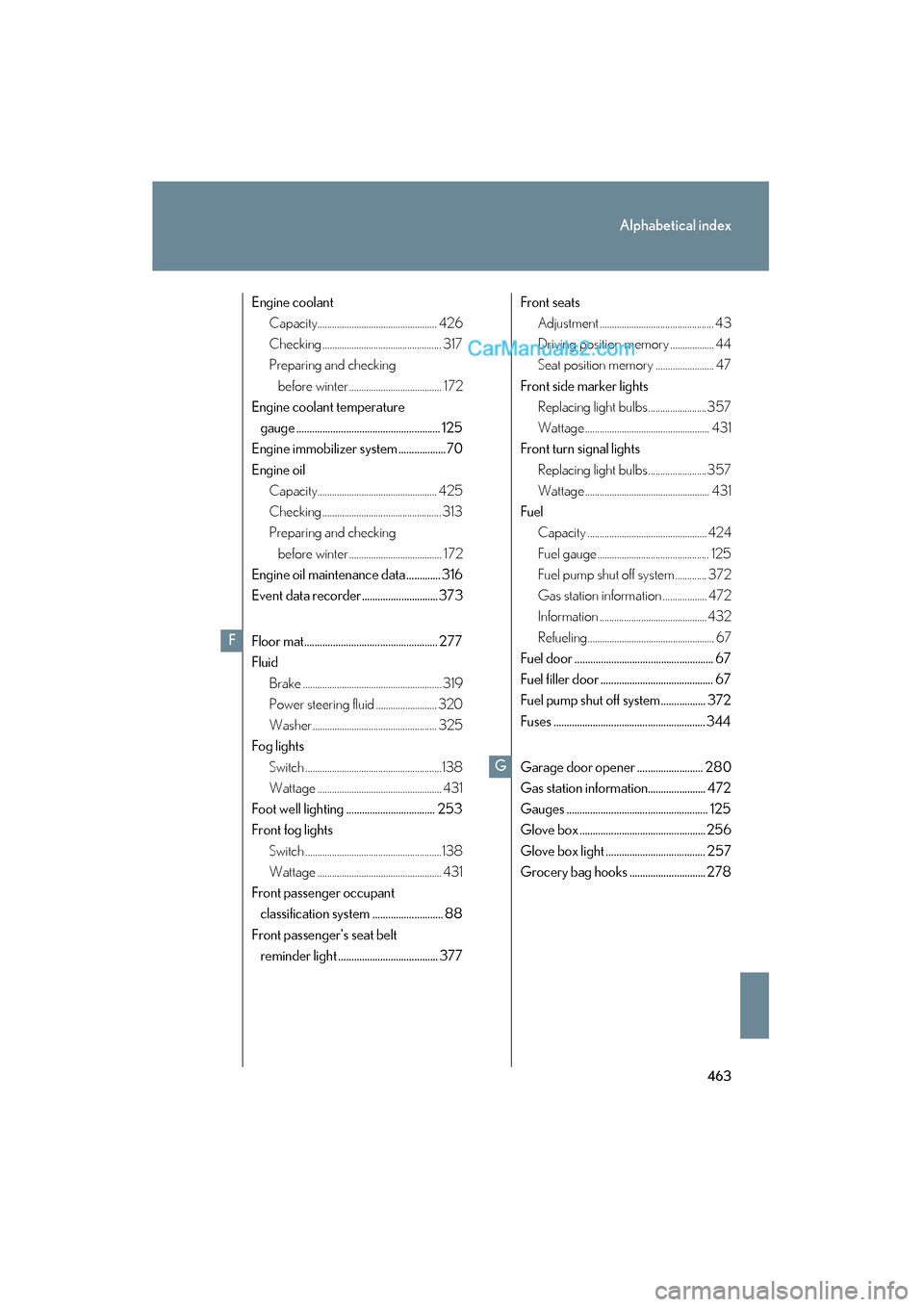
Engine coolantCapacity................................................. 426
Checking ................................................. 317
Preparing and checking
before winter ...................................... 172
Engine coolant temperature
gauge ....................................................... 125
Engine immobilizer system ..................70
Engine oil Capacity................................................. 425
Checking ................................................. 313
Preparing and checking
before winter ...................................... 172
Engine oil maintenance data ............. 316
Event data recorder.............................373
Floor mat................................................... 277
Fluid
Brake ......................................................... 319
Power steering fluid ......................... 320
Washer ................................................... 325
Fog lights
Switch ........................................................138
Wattage ................................................... 431
Foot well lighting .................................. 253
Front fog lights Switch ........................................................138
Wattage ................................................... 431
Front passenger occupant classification system ........................... 88
Front passenger's seat belt reminder light ...................................... 377 Front seats
Adjustment ............................................... 43
Driving position memory .................. 44
Seat position memory ........................ 47
Front side marker lights Replacing light bulbs ........................ 357
Wattage ................................................... 431
Front turn signal lights
Replacing light bulbs ........................ 357
Wattage ................................................... 431
Fuel Capacity ................................................. 424
Fuel gauge.............................................. 125
Fuel pump shut off system ............. 372
Gas station information .................. 472
Information ............................................ 432
Refueling.................................................... 67
Fuel door ..................................................... 67
Fuel filler door ........................................... 67
Fuel pump shut off system................. 372
Fuses .......................................................... 344
Garage door opener ......................... 280
Gas station information...................... 472
Gauges ...................................................... 125
Glove box ................................................ 256
Glove box light ...................................... 257
Grocery bag hooks ............................. 278
F
G