power steering Lexus ES350 2009 User Guide
[x] Cancel search | Manufacturer: LEXUS, Model Year: 2009, Model line: ES350, Model: Lexus ES350 2009Pages: 475, PDF Size: 6.2 MB
Page 307 of 475
305
4-3. Do-it-yourself maintenance
4
Maintenance and care
ES350_U_(L/O_0808)
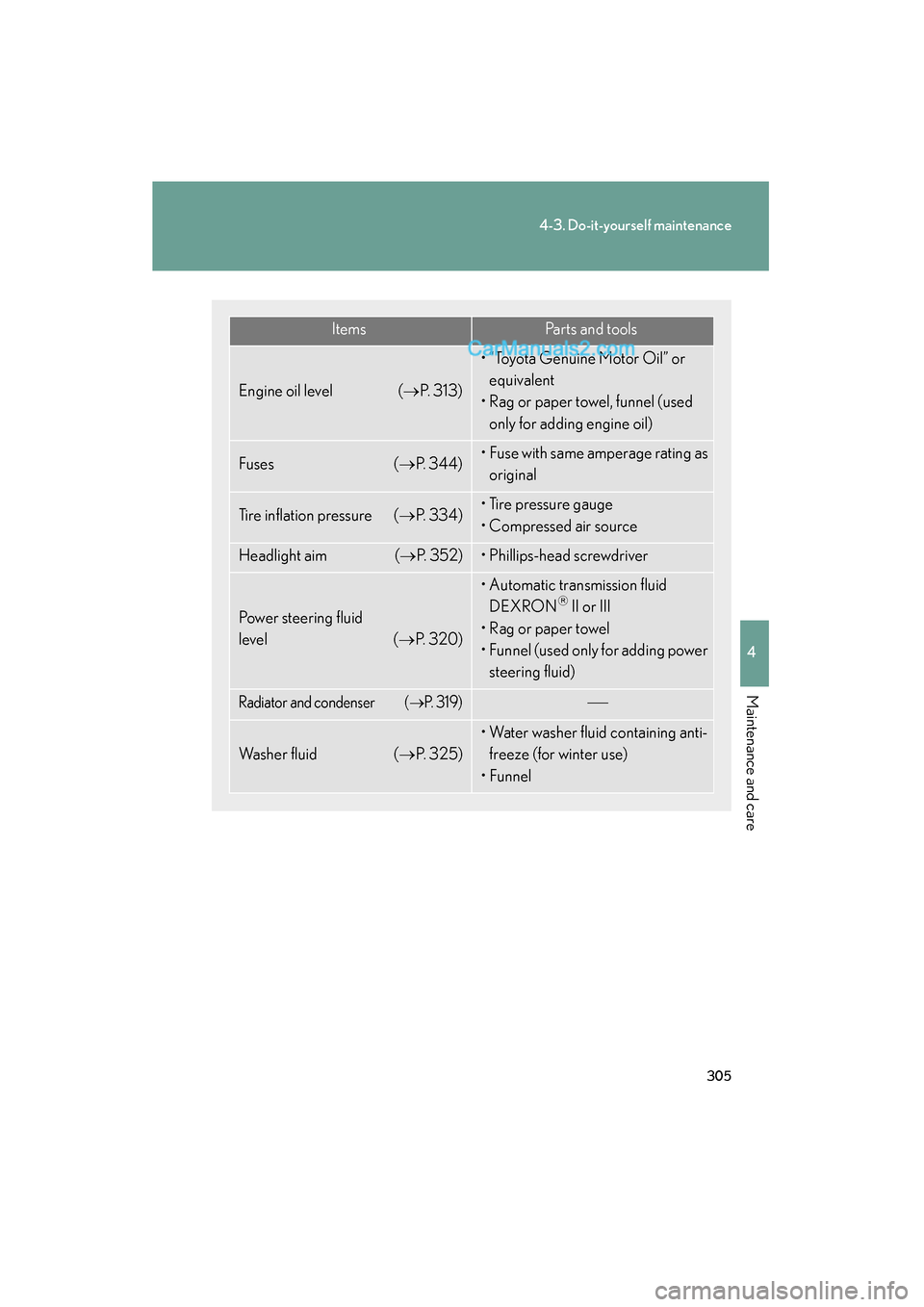
ItemsParts and tools
Engine oil level (→P. 313)
• “Toyota Genuine Motor Oil” or
equivalent
• Rag or paper towel, funnel (used
only for adding engine oil)
Fuses (→ P. 344)• Fuse with same amperage rating as
original
Tire inflation pressure ( →P. 3 3 4 )• Tire pressure gauge
• Compressed air source
Headlight aim ( →P. 3 5 2 )• Phillips-head screwdriver
Power steering fluid
level (→ P. 3 2 0 )
• Automatic transmission fluid
DEXRON II or III
• Rag or paper towel
• Funnel (used only for adding power steering fluid)
Radiator and condenser (→P. 3 1 9 )
Washer fluid ( →P. 3 2 5 )
• Water washer fluid containing anti-
freeze (for winter use)
• Funnel
Page 313 of 475
311
4-3. Do-it-yourself maintenance
4
Maintenance and care
ES350_U_(L/O_0808)
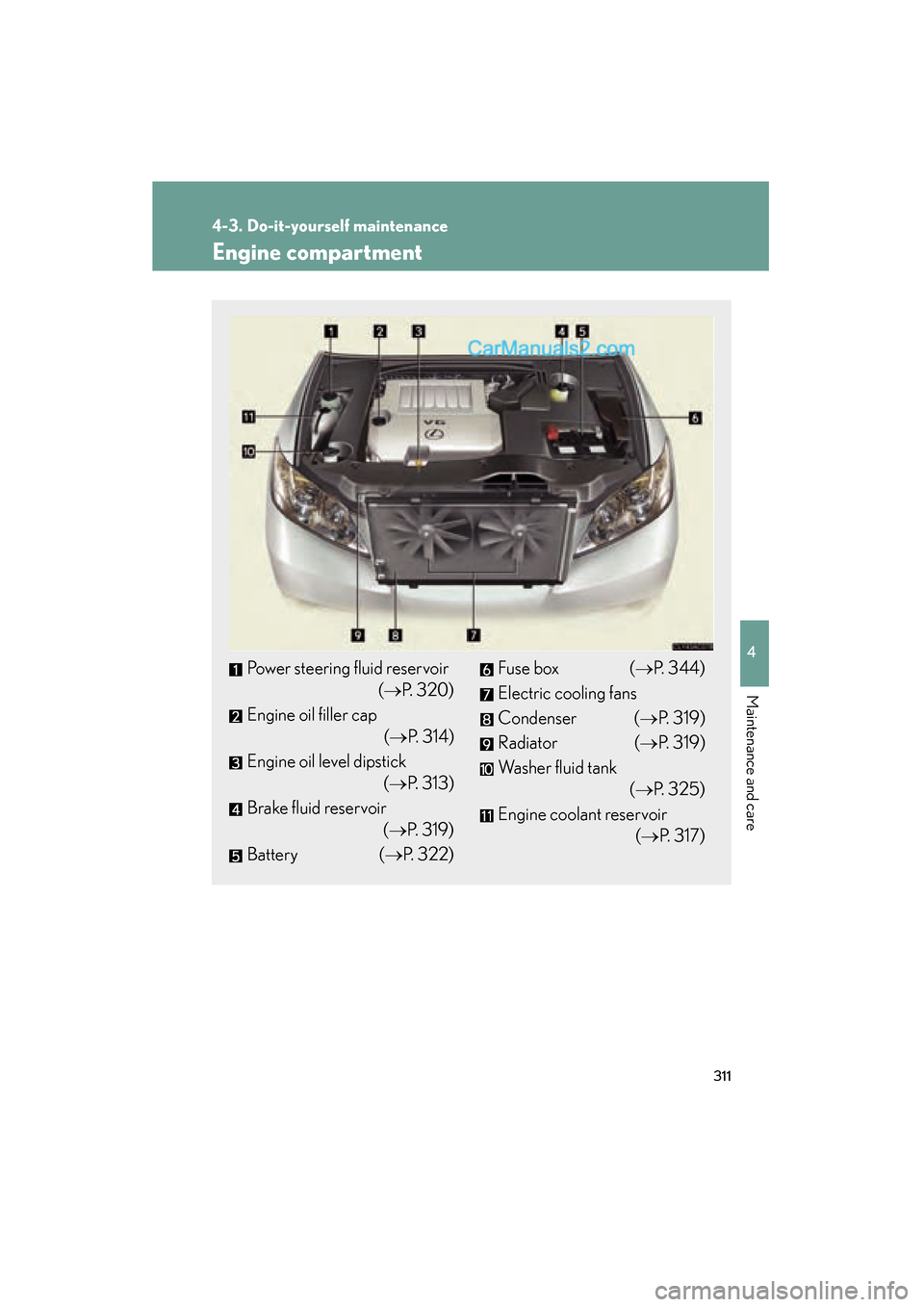
Engine compartment
Power steering fluid reservoir(→P. 320)
Engine oil filler cap (→P. 314)
Engine oil level dipstick (→P. 3 1 3 )
Brake fluid reservoir (→P. 319)
Battery ( →P. 322)Fuse box ( →P. 3 4 4 )
Electric cooling fans
Condenser ( →P. 319)
Radiator ( →P. 319)
Washer fluid tank (→P. 325)
Engine coolant reservoir (→P. 317)
Page 322 of 475
320
4-3. Do-it-yourself maintenance
ES350_U_(L/O_0808)
Power steering fluid■ Fluid level
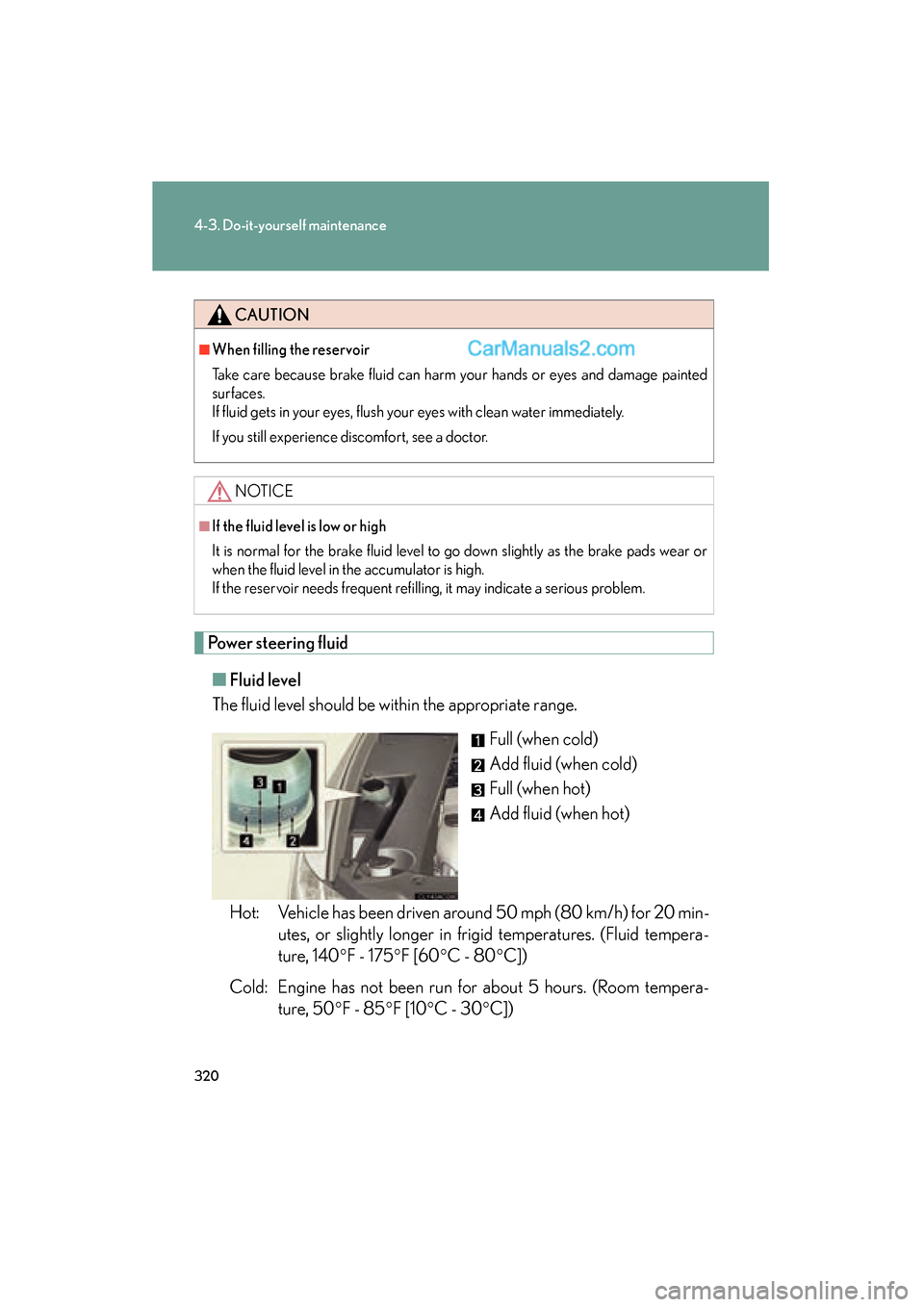
The fluid level should be within the appropriate range.
Full (when cold)
Add fluid (when cold)
Full (when hot)
Add fluid (when hot)
Hot: Vehicle has been driven around 50 mph (80 km/h) for 20 min- utes, or slightly longer in frigid temperatures. (Fluid tempera-
ture, 140 °F - 175 °F [60 °C - 80 °C])
Cold: Engine has not been run for about 5 hours. (Room tempera- ture, 50 °F - 85 °F [10 °C - 30 °C])
CAUTION
■When filling the reservoir
Take care because brake fluid can harm your hands or eyes and damage painted
surfaces.
If fluid gets in your eyes, flush your eyes with clean water immediately.
If you still experience discomfort, see a doctor.
NOTICE
■If the fluid level is low or high
It is normal for the brake fluid level to go down slightly as the brake pads wear or
when the fluid level in the accumulator is high.
If the reservoir needs frequent refilling, it may indicate a serious problem.
Page 323 of 475
321
4-3. Do-it-yourself maintenance
4
Maintenance and care
ES350_U_(L/O_0808)■
Checking the fluid level
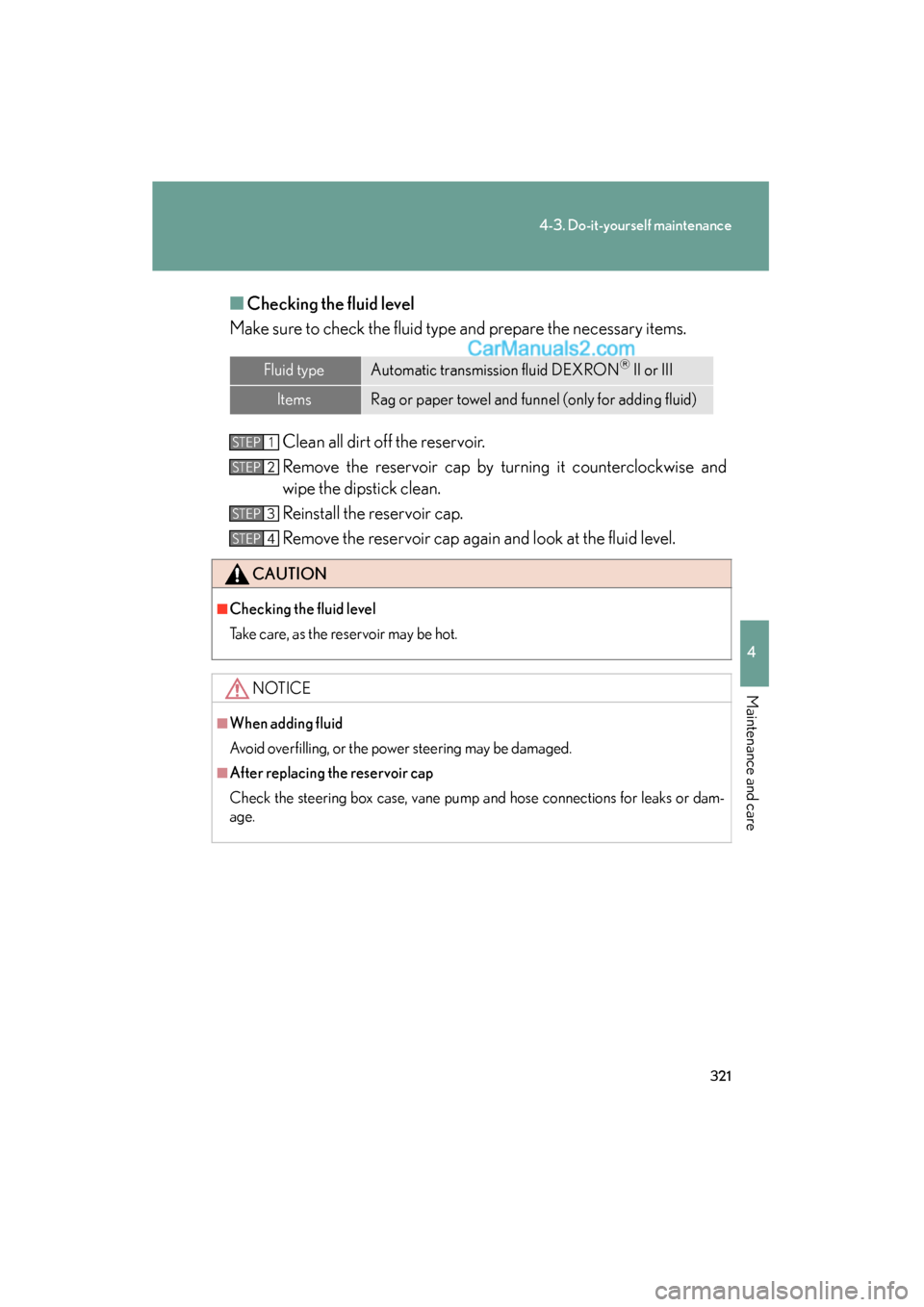
Make sure to check the fluid type and prepare the necessary items.
Clean all dirt off the reservoir.
Remove the reservoir cap by turning it counterclockwise and
wipe the dipstick clean.
Reinstall the reservoir cap.
Remove the reservoir cap again and look at the fluid level.
Fluid typeAutomatic transmission fluid DEXRON II or III
ItemsRag or paper towel and funnel (only for adding fluid)
CAUTION
■Checking the fluid level
Take care, as the reservoir may be hot.
NOTICE
■When adding fluid
Avoid overfilling, or the power steering may be damaged.
■After replacing the reservoir cap
Check the steering box case, vane pump and hose connections for leaks or dam-
age.
STEP1
STEP2
STEP3
STEP4
Page 349 of 475
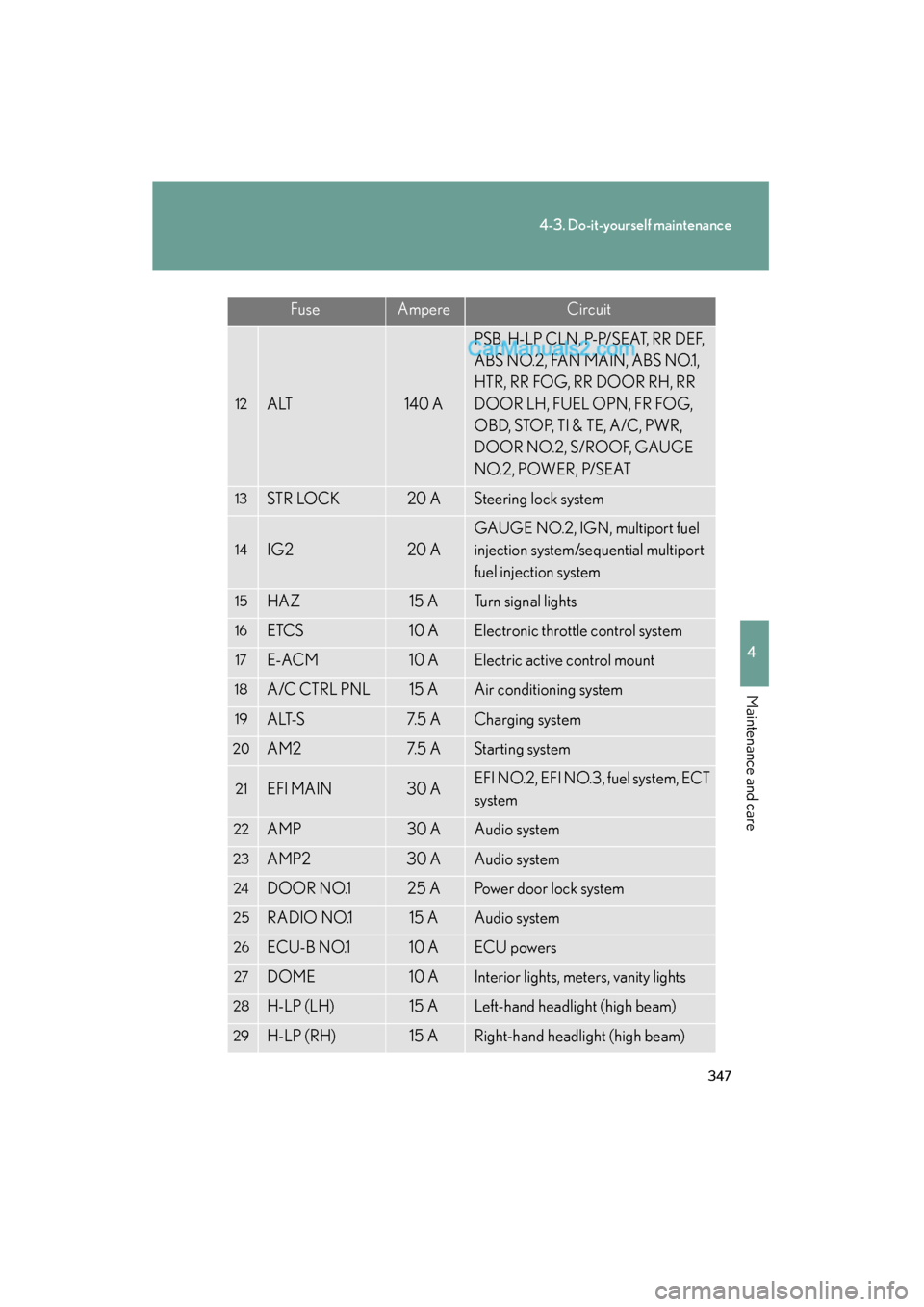
347
4-3. Do-it-yourself maintenance
4
Maintenance and care
ES350_U_(L/O_0808)
12A LT140 A
PSB, H-LP CLN, P-P/SEAT, RR DEF,
ABS NO.2, FAN MAIN, ABS NO.1,
HTR, RR FOG, RR DOOR RH, RR
DOOR LH, FUEL OPN, FR FOG,
OBD, STOP, TI & TE, A/C, PWR,
DOOR NO.2, S/ROOF, GAUGE
NO.2, POWER, P/SEAT
13STR LOCK20 ASteering lock system
14IG220 A
GAUGE NO.2, IGN, multiport fuel
injection system/sequential multiport
fuel injection system
15HAZ15 ATurn signal lights
16ETCS10 AElectronic throttle control system
17E-ACM10 AElectric active control mount
18A/C CTRL PNL15 AAir conditioning system
19A LT- S7. 5 ACharging system
20AM27. 5 AStarting system
21EFI MAIN30 AEFI NO.2, EFI NO.3, fuel system, ECT
system
22AMP30 AAudio system
23AMP230 AAudio system
24DOOR NO.125 APower door lock system
25R A D I O N O.115 AAudio system
26ECU-B NO.110 AECU powers
27DOME10 AInterior lights, meters, vanity lights
28H-LP (LH)15 ALeft-hand headlight (high beam)
29H-LP (RH)15 ARight-hand headlight (high beam)
FuseAmpereCircuit
Page 351 of 475
349
4-3. Do-it-yourself maintenance
4
Maintenance and care
ES350_U_(L/O_0808)■
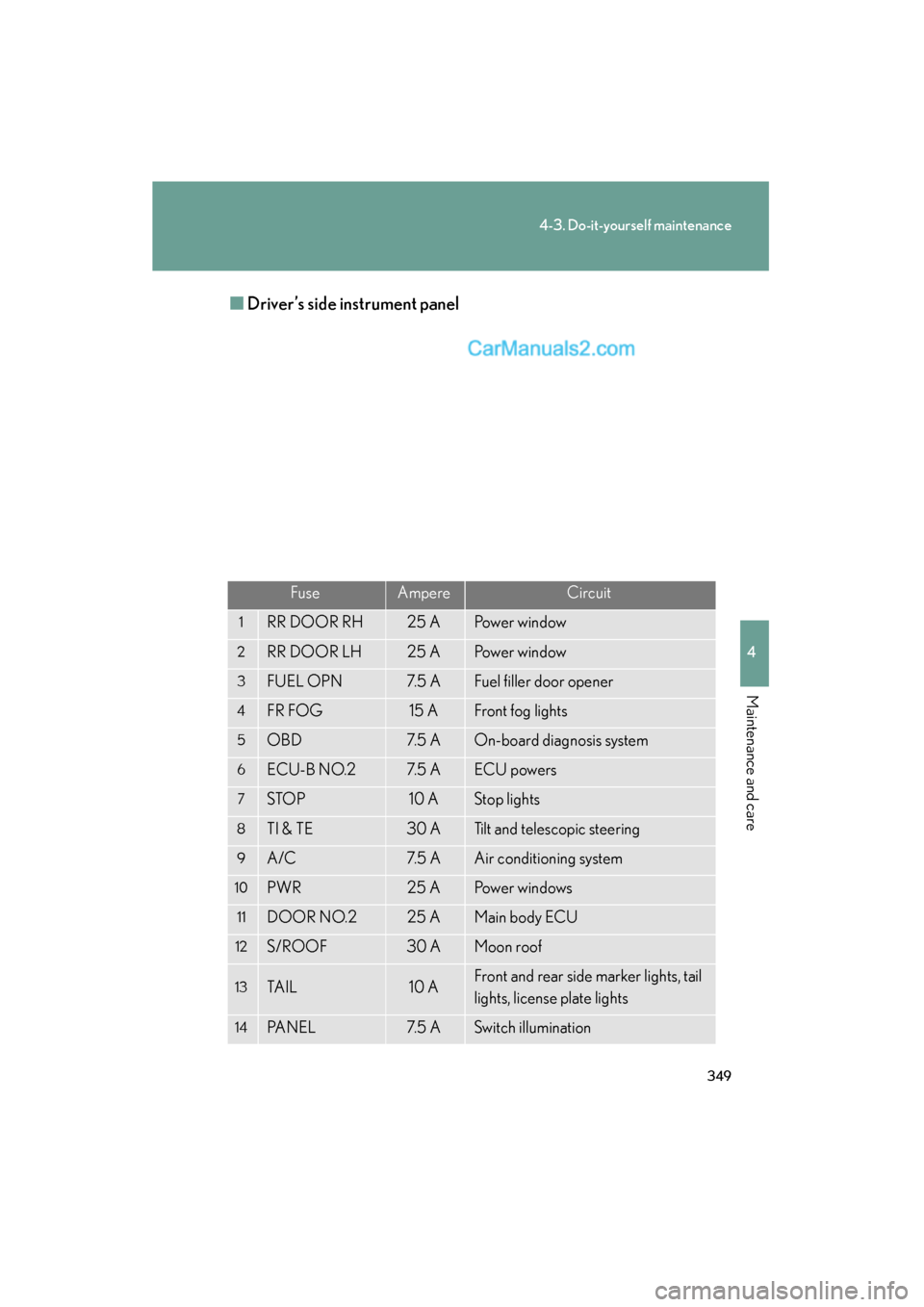
Driver’s side instrument panel
FuseAmpereCircuit
1RR DOOR RH25 APower window
2RR DOOR LH25 APower window
3FUEL OPN7. 5 AFuel filler door opener
4FR FOG15 AFront fog lights
5OBD7. 5 AOn-board diagnosis system
6ECU-B NO.27. 5 AECU powers
7STO P10 AStop lights
8TI & TE30 ATilt and telescopic steering
9A/C7. 5 AAir conditioning system
10PWR25 APower windows
11DOOR NO.225 AMain body ECU
12S/ROOF30 AMoon roof
13TA I L10 AFront and rear side marker lights, tail
lights, license plate lights
14PA N E L7. 5 ASwitch illumination
Page 352 of 475
350
4-3. Do-it-yourself maintenance
ES350_U_(L/O_0808)
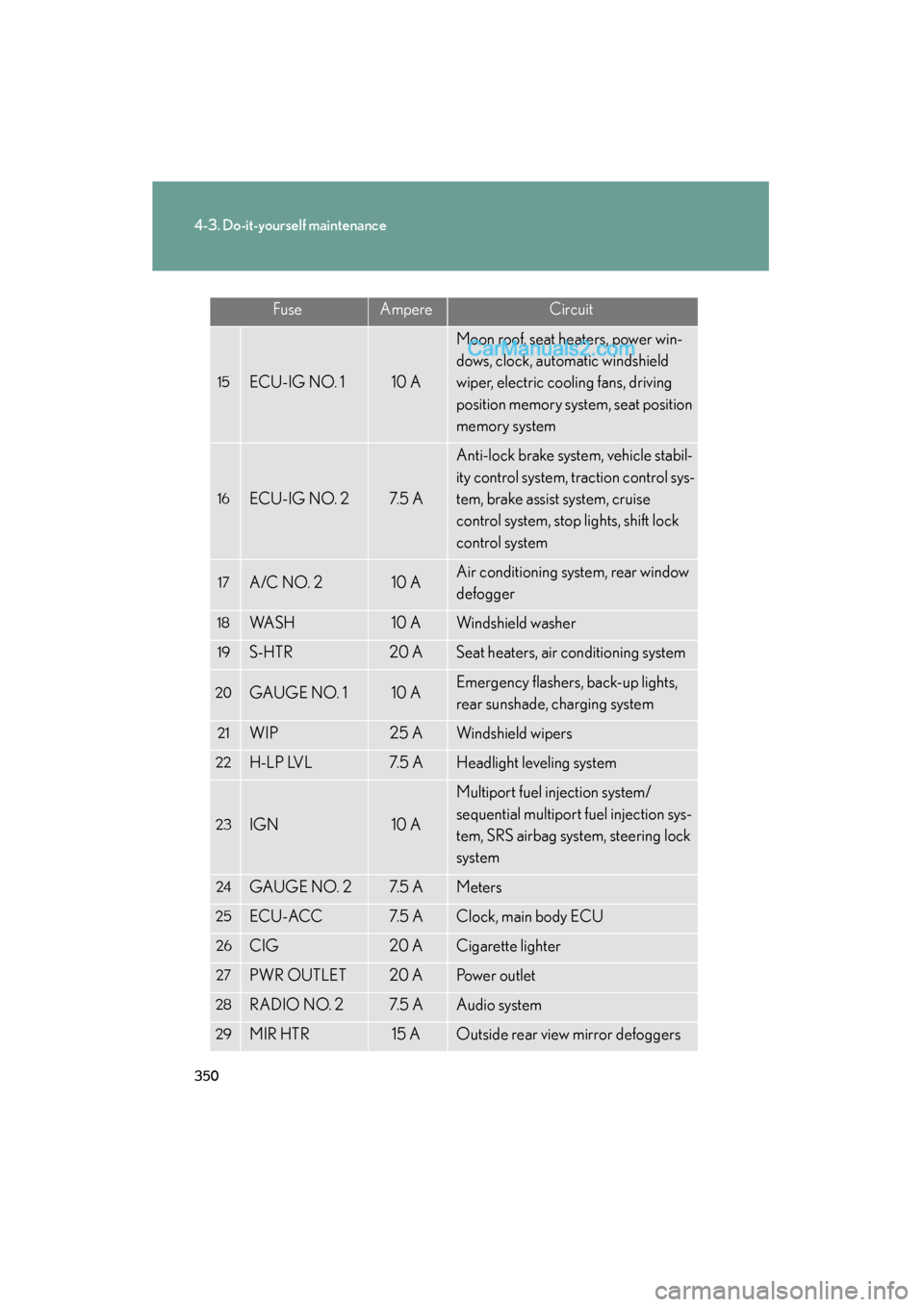
15ECU-IG NO. 110 A
Moon roof, seat heaters, power win-
dows, clock, automatic windshield
wiper, electric cooling fans, driving
position memory system, seat position
memory system
16ECU-IG NO. 27. 5 A
Anti-lock brake system, vehicle stabil-
ity control system, traction control sys-
tem, brake assist system, cruise
control system, stop lights, shift lock
control system
17A/C NO. 210 AAir conditioning system, rear window
defogger
18WA S H10 AWindshield washer
19S-HTR20 ASeat heaters, air conditioning system
20GAUGE NO. 110 AEmergency flashers, back-up lights,
rear sunshade, charging system
21WIP25 AWindshield wipers
22H - L P LV L7. 5 AHeadlight leveling system
23IGN10 A
Multiport fuel injection system/
sequential multiport fuel injection sys-
tem, SRS airbag system, steering lock
system
24GAUGE NO. 27. 5 AMeters
25ECU-ACC7. 5 AClock, main body ECU
26CIG20 ACigarette lighter
27PWR OUTLET20 APower outlet
28RADIO NO. 27. 5 AAudio system
29MIR HTR15 AOutside rear view mirror defoggers
FuseAmpereCircuit
Page 368 of 475
366
5-1. Essential information
ES350_U_(L/O_0808)
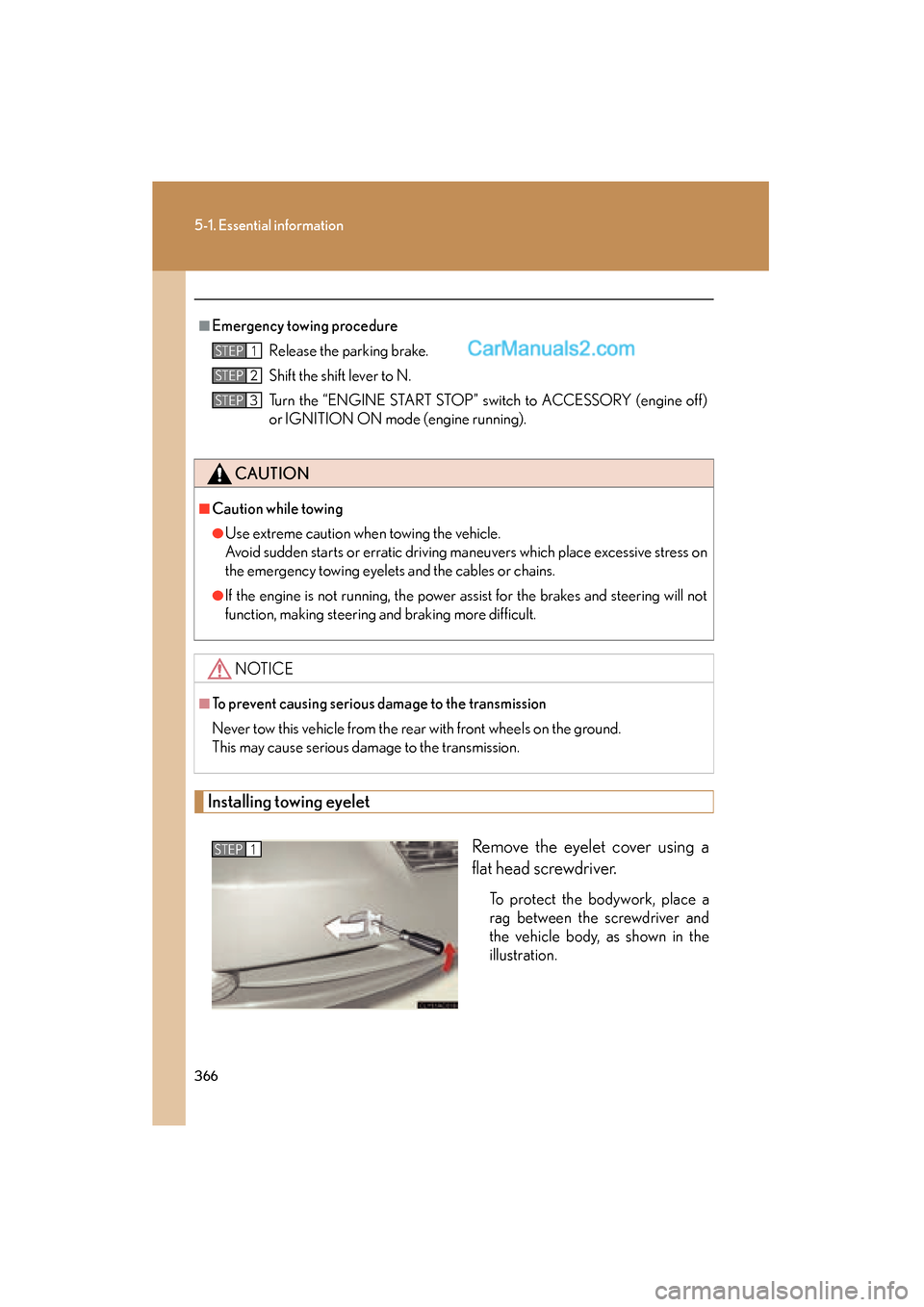
Installing towing eyeletRemove the eyelet cover using a
flat head screwdriver.
To protect the bodywork, place a
rag between the screwdriver and
the vehicle body, as shown in the
illustration.
■Emergency towing procedureRelease the parking brake.
Shift the shift lever to N.
Turn the “ENGINE START STOP” switch to ACCESSORY (engine off)
or IGNITION ON mode (engine running).
CAUTION
■Caution while towing
●Use extreme caution when towing the vehicle.
Avoid sudden starts or erratic driving maneuvers which place excessive stress on
the emergency towing eyelets and the cables or chains.
●If the engine is not running, the power assist for the brakes and steering will not
function, making steering and braking more difficult.
NOTICE
■To prevent causing serious da mage to the transmission
Never tow this vehicle from the rear with front wheels on the ground.
This may cause serious damage to the transmission.
STEP1
STEP2
STEP3
STEP1
Page 430 of 475
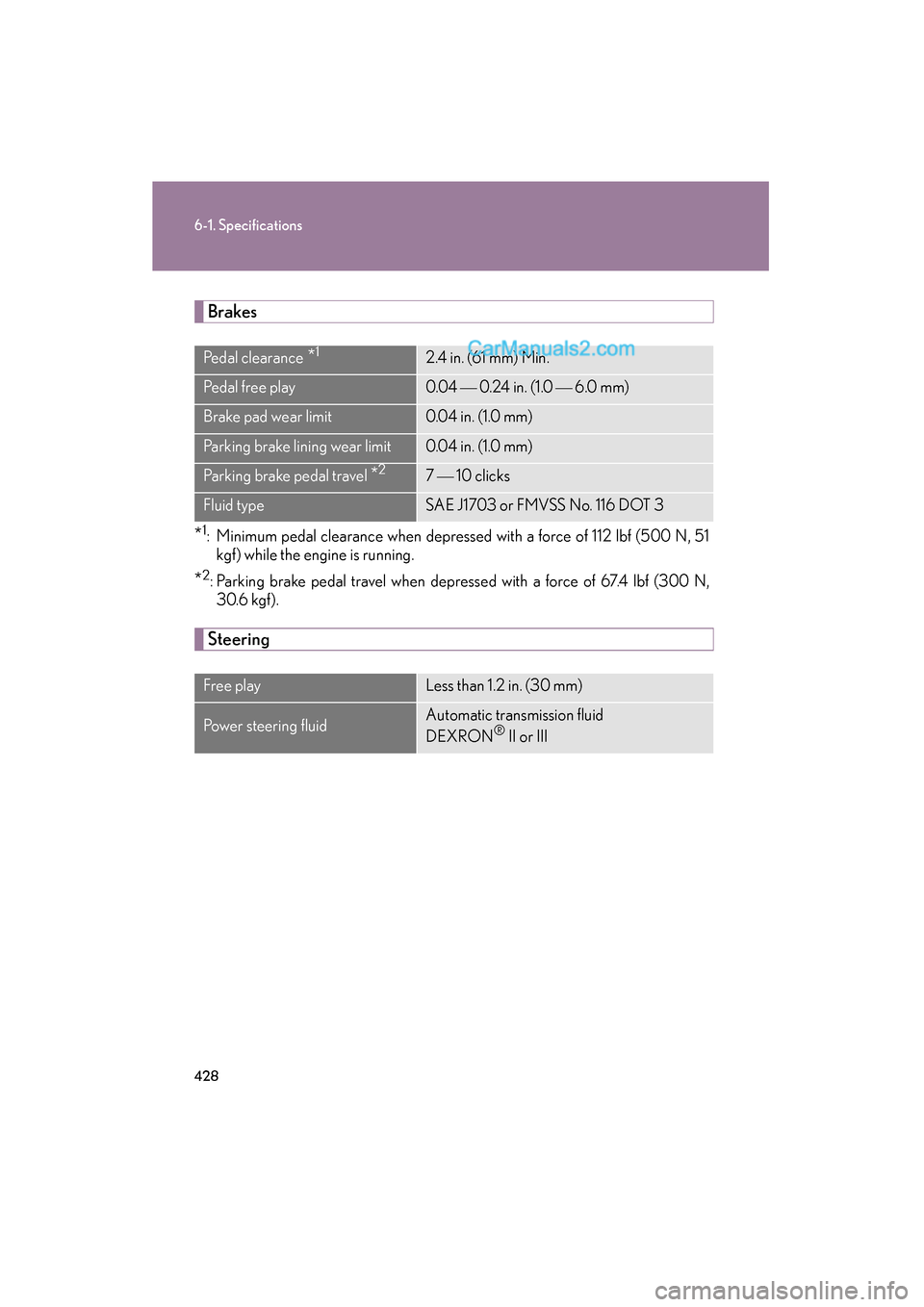
428
6-1. Specifications
ES350_U_(L/O_0808)
Brakes
*1: Minimum pedal clearance when depressed with a force of 112 lbf (500 N, 51
kgf) while the engine is running.
*2: Parking brake pedal travel when depressed with a force of 67.4 lbf (300 N,3 0.6 kg f ) .
Steering
Pedal clearance *12.4 in. (61 mm) Min.
Pedal free play0.04 0.24 in. (1.0 6.0 mm)
Brake pad wear limit0.04 in. (1.0 mm)
Parking brake lining wear limit0.04 in. (1.0 mm)
Parking brake pedal travel *27 10 clicks
Fluid typeSAE J1703 or FMVSS No. 116 DOT 3
Free playLess than 1.2 in. (30 mm)
Power steering fluidAutomatic transmission fluid
DEXRON® II or III
Page 442 of 475

440
6-1. Specifications
ES350_U_(L/O_0808)■
Temperature A, B, C
The temperature grades are A (the highest), B, and C, representing
the tire's resistance to the generation of heat and its ability to dissipate
heat when tested under controlled conditions on a specified indoor
laboratory test wheel.
Sustained high temperature can cause the material of the tire to degenerate
and reduce tire life, and excessive temperature can lead to sudden tire fail-
ure.
The grade C corresponds to a level of performance which all passenger car
tires must meet under the Federal Motor Vehicle Safety Standard No. 109.
Grades B and A represent higher levels of performance on the laboratory
test wheel than the minimum required by law.
Warning: The temperature grades for this tire are established for a tire that
is properly inflated and not overloaded.
Excessive speed, underinflation, or excessive loading, either separately or in
combination, can cause heat buildup and possible tire failure.
Glossary of tire terminology
Tire related termMeaning
Cold tire inflation pres-
sureTire pressure when the vehicle has been parked for
three hours or more, or has not been driven more
than 1 mile or 1.5 km under that condition
Maximum inflation pres-
sureThe maximum cold inflated pressure to which a tire
may be inflated, shown on the sidewall of the tire
Recommended inflation
pressureCold tire inflation pressure recommended by a man-
ufacturer
Accessory weight
The combined weight (in excess of those standard
items which may be replaced) of automatic transmis-
sion, power steering, power brakes, power windows,
power seats, radio and heater, to the extent that these
items are available as factory-installed equipment
(whether installed or not)