trunk Lexus ES350 2009 Owner's Guide
[x] Cancel search | Manufacturer: LEXUS, Model Year: 2009, Model line: ES350, Model: Lexus ES350 2009Pages: 475, PDF Size: 6.2 MB
Page 112 of 475
110
2-1. Driving procedures
ES350_U_(L/O_0808)
CAUTION
■When starting the vehicle
Always keep your foot on the brake pedal while stopped with the engine running.
This prevents the vehicle from creeping.
■When driving the vehicle
●Do not drive if you are unfamiliar with the location of the brake and accelerator
pedals to avoid depressing the wrong pedal.
• Accidentally depressing the accelerator pedal instead of the brake pedal willresult in sudden acceleration that may lead to an accident that could result in
death or serious injury.
• When backing up, you may twist your body around, leading to a difficulty in operating the pedals. Make sure to operate the pedals properly.
• Make sure to keep a correct driving posture even when moving the vehicle only slightly, allowing you to depress the brake and accelerator pedals prop-
erly.
• Depress the brake pedal using your right foot. Depressing the brake pedal using your left foot may delay response in an emergency, resulting in an acci-
dent.
●Do not drive the vehicle over or stop the vehicle near flammable materials.
●Do not let the vehicle roll backwards while the shift lever is in a driving position, or
roll forward while the shift lever is in R.
Doing so may cause the engine to stall or lead to poor brake and steering perfor-
mance, resulting in an accident or damage to the vehicle.
●If the smell of exhaust is noticed inside the vehicle, open the windows and check
that the trunk is closed. Large amounts of exhaust in the vehicle can cause driver
drowsiness and an accident, resulting in death or a serious health hazard. Have
the vehicle inspected by your Lexus dealer immediately.
●Do not under any circumstances shift the shift lever to P, R or N while the vehicle
is moving.
Doing so can cause significant damage to the transmission system and may result
in a loss of vehicle control.
●Do not shift the shift lever to N while the vehicle is moving.
Doing so may cause the engine brake to not operate properly and lead to an
accident.
Page 156 of 475
154
2-4. Using other driving systems
ES350_U_(L/O_0808)
CAUTION
■When the radar sensor may not be correctly detecting the vehicle ahead
Apply the brakes as necessary when any of the following types of vehicles are in
front of you.
As the sensor may not be able to correctly detect these types of vehicles, the prox-
imity alarm (→P. 386) will not be activated, and an accident may result.
●Vehicles that cut in suddenly
●Vehicles traveling at low speeds
●Vehicles that are not moving
●Vehicles with small rear ends (trailers with no load on board etc.)
●Motorcycles traveling in the same lane
■Conditions under which the vehicle-to-vehicle distance control may not function
correctly
Apply the brakes as necessary in the following conditions as the radar sensor may
not be able to correctly detect vehicles ahead, and an accident may result.
●When water or snow thrown up by the surrounding vehicles hinders the function-
ing of the sensor
●When your vehicle is pointing upwards (caused by a heavy load in the trunk, etc.)
●When the road curves or when the lanes are narrow
●When steering wheel operation or your position in the lane is unstable
■To ensure the radar sensor functions correctly
Do not do the following to the sensor or grille cover as doing so may cause the sen-
sor not to function correctly and could result in an accident.
●Stick or attach anything to them
●Leave them dirty
●Disassemble, subject them to strong shocks
●Modify or paint them
●Replace them with non-genuine parts
Page 170 of 475
168
ES350_U_(L/O_0808)
2-5. Driving information
Cargo and luggage
Capacity and distributionCargo capacity depends on the total weight of the occupants.
(Cargo capacity) = (Total load capacity) — (Total weight of occupants)
Steps for Determining Correct Load Limit
(1) Locate the statement “The comb ined weight of occupants and cargo
should never exceed XXX kg or XXX lbs.” on your vehicle’s placard.
(2) Determine the combined weight of the driver and passengers that will be riding in your vehicle.
(3) Subtract the combined weight of the driver and passengers from XXX kg or XXX lbs.
(4) The resulting figure equals the available amount of cargo and lug- gage load capacity.
For example, if the XXX amount equa ls 1400 lbs. and there will be
five 150 lb. passengers in your vehicle, the amount of available cargo
and luggage load capacity is 650 lbs. (1400 − 750 (150 × 5) = 650
lbs.)
(5) Determine the combined weight of luggage and cargo being loaded on the vehicle. That weight may not safely exceed the available cargo
and luggage load capacity calculated in Step 4.
Take notice of the following information about storage precautions, cargo
capacity and load.
●Stow cargo and luggage in the trunk whenever possible. Be sure
all items are secured in place.
● Be careful to keep the vehicle level. Placing the weight as far for-
ward as possible helps maintain vehicle balance.
● For better fuel economy, do not carry unnecessary weight.
Page 189 of 475
Interior features3
187
ES350_U_(L/O_0808)
3-1. Using the air conditioning system and defogger
Automatic air conditioning system ..................................... 188
Rear window and outside rear view mirror
defoggers ............................... 195
3-2. Using the audio system Audio system type................... 196
Using the radio......................... 198
Using the CD player ............ 205
Playing back MP3 and
WMA discs.............................. 211
Optimal use of the audio system ...................................... 219
Using the AUX adapter ....... 222
Using the steering wheel audio switches ..................... 223
3-3. Using the hands-free phone system
(for cellular phone)
Hands-free phone system features
(for cellular phone) ............. 225
Using the hands-free phone system
(for cellular phone) ............ 228
Making a phone call .............. 236
Setting a cellular phone ....... 240
Security and system setup ... 244
Using the phone book........... 247 3-4. Using the interior lights
Interior lights list .................... 253
• Interior lights ........................ 255
• Personal lights ..................... 255
3-5. Using the storage features List of storage features......... 256
• Glove box .............................. 256
• Console box ......................... 257
• Overhead console.............. 259
• Cup holders .......................... 260
• Auxiliary box ........................ 262
3-6. Other interior features Sun visors ................................. 263
Vanity mirror ........................... 264
Clock ......................................... 265
Ashtray ..................................... 266
Cigarette lighter ..................... 267
Power outlet ............................ 268
Seat heaters ............................ 269
Seat heaters and ventilators ............................... 271
Armrest .................................... 273
Rear sunshade ......................... 274
Extended trunk........................ 276
Floor mat ................................... 277
Trunk features ......................... 278
Garage door opener ............ 280
Compass .................................. 286
Page 259 of 475
257
3-5. Using the storage features
3
Interior features
ES350_U_(L/O_0808)
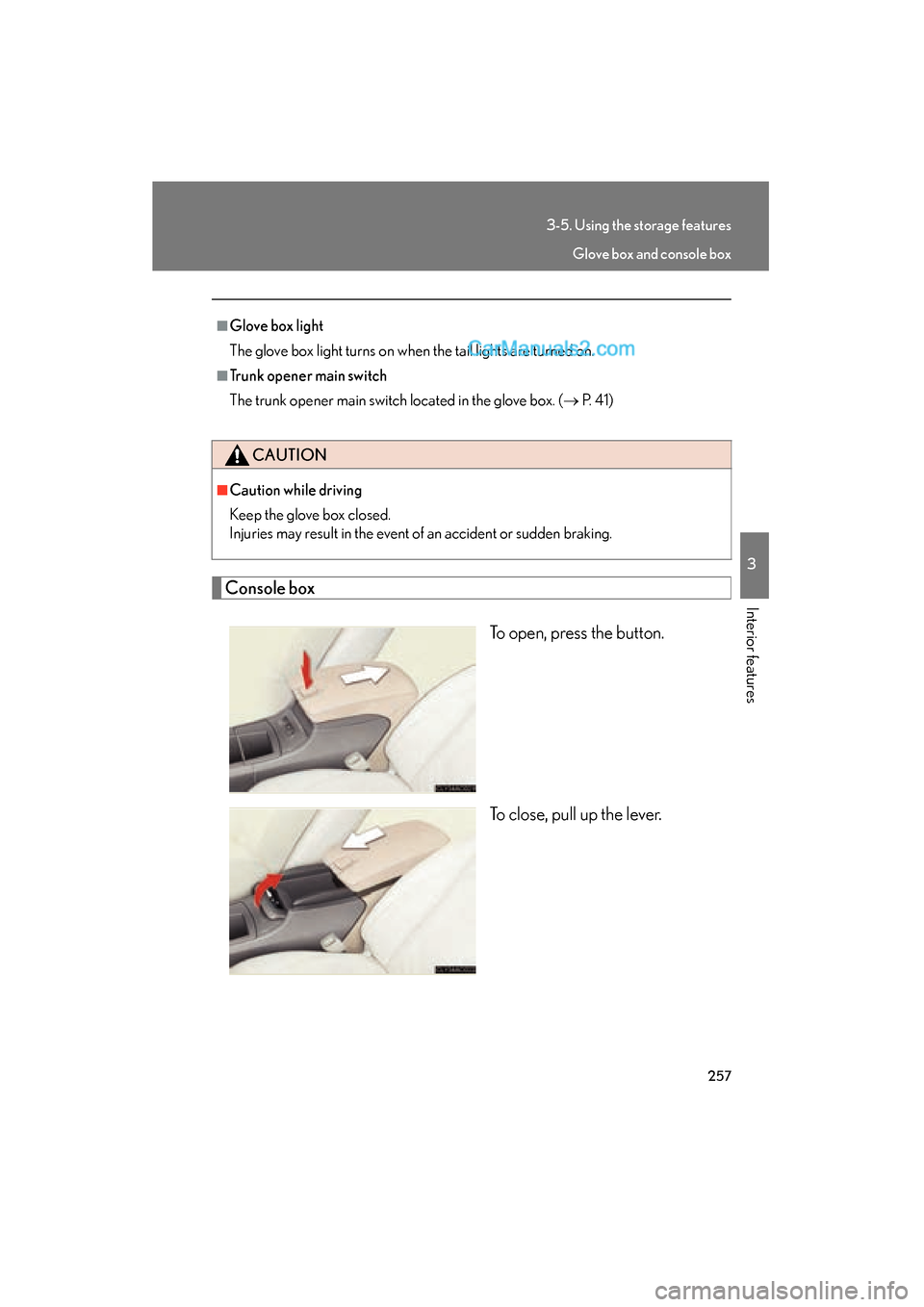
Console boxTo open, press the button.
To close, pull up the lever.
■Glove box light
The glove box light turns on when the tail lights are turned on.
■Trunk opener main switch
The trunk opener main switch located in the glove box. ( → P. 4 1 )
CAUTION
■Caution while driving
Keep the glove box closed.
Injuries may result in the event of an accident or sudden braking.
Glove box and console box
Page 278 of 475
276
3-6. Other interior features
ES350_U_(L/O_0808)
Extended trunk
CAUTION
■When not in use
Ensure that the armrest door is closed.
In the event of sudden braking, items stored in the trunk may be thrown forward into
the cabin, resulting in injury.
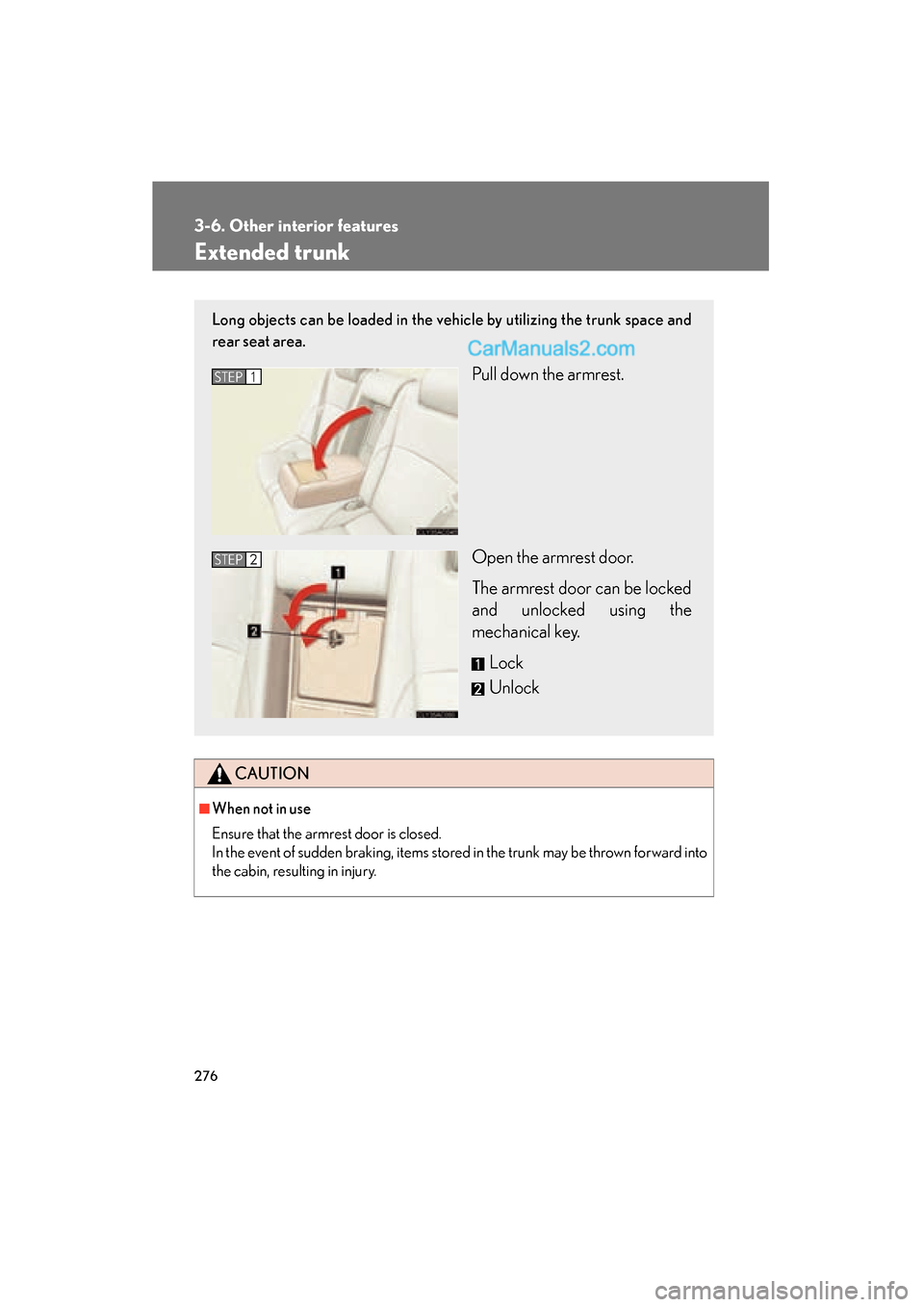
Long objects can be loaded in the vehicle by utilizing the trunk space and
rear seat area.
Pull down the armrest.
Open the armrest door.
The armrest door can be locked
and unlocked using the
mechanical key.Lock
UnlockSTEP1
STEP2
Page 280 of 475
278
3-6. Other interior features
ES350_U_(L/O_0808)
Trunk features
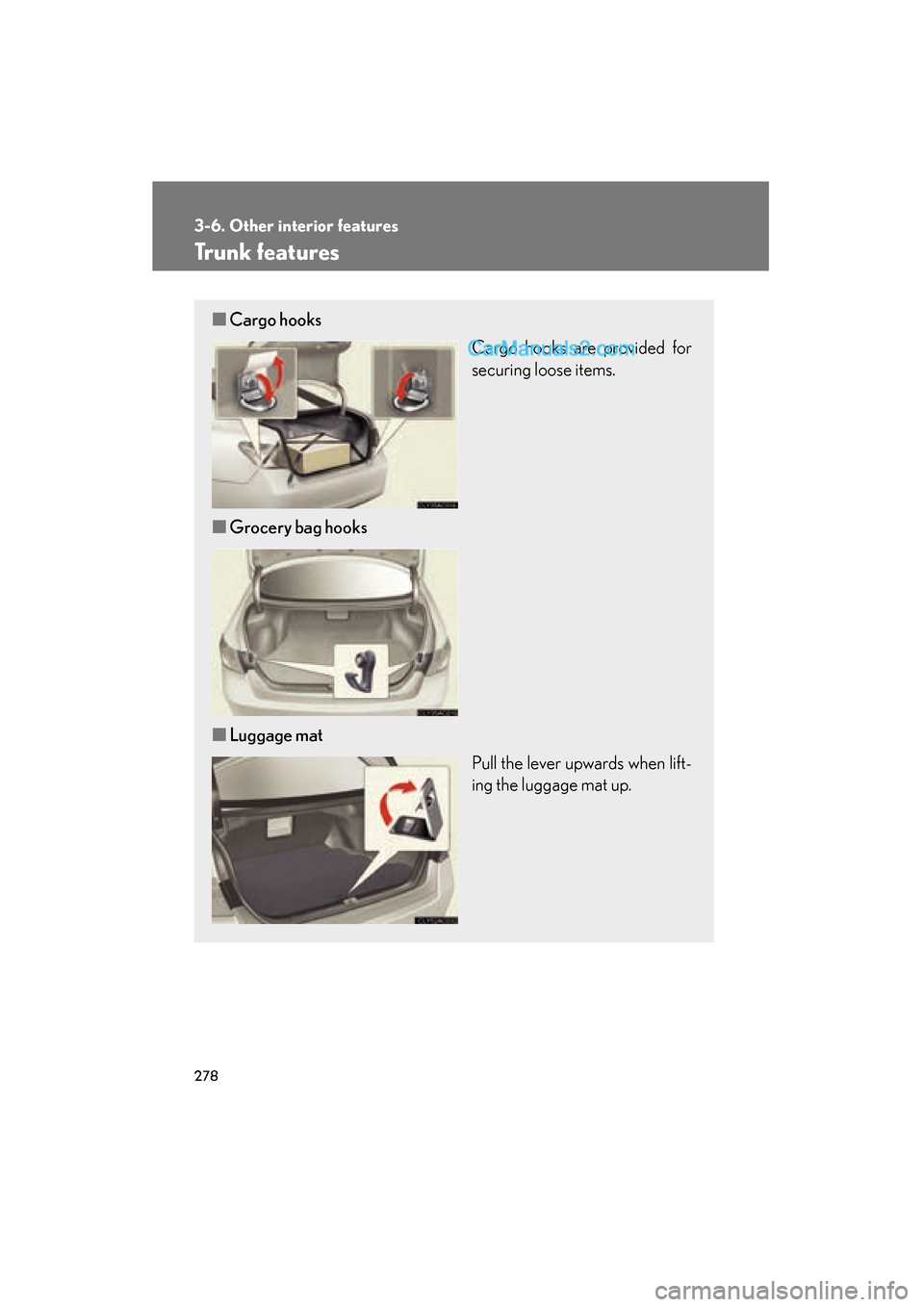
■Cargo hooks
Cargo hooks are provided for
securing loose items.
■ Grocery bag hooks
■ Luggage mat
Pull the lever upwards when lift-
ing the luggage mat up.
Page 281 of 475
279
3-6. Other interior features
3
Interior features
ES350_U_(L/O_0808)
CAUTION
■When the cargo hooks are not in use
To avoid injury, always return the cargo hooks to their positions when they are not in
use.
NOTICE
■When closing the trunk
Do not leave the luggage mat lever hooked on the edge of the trunk.
The luggage mat may get damaged.
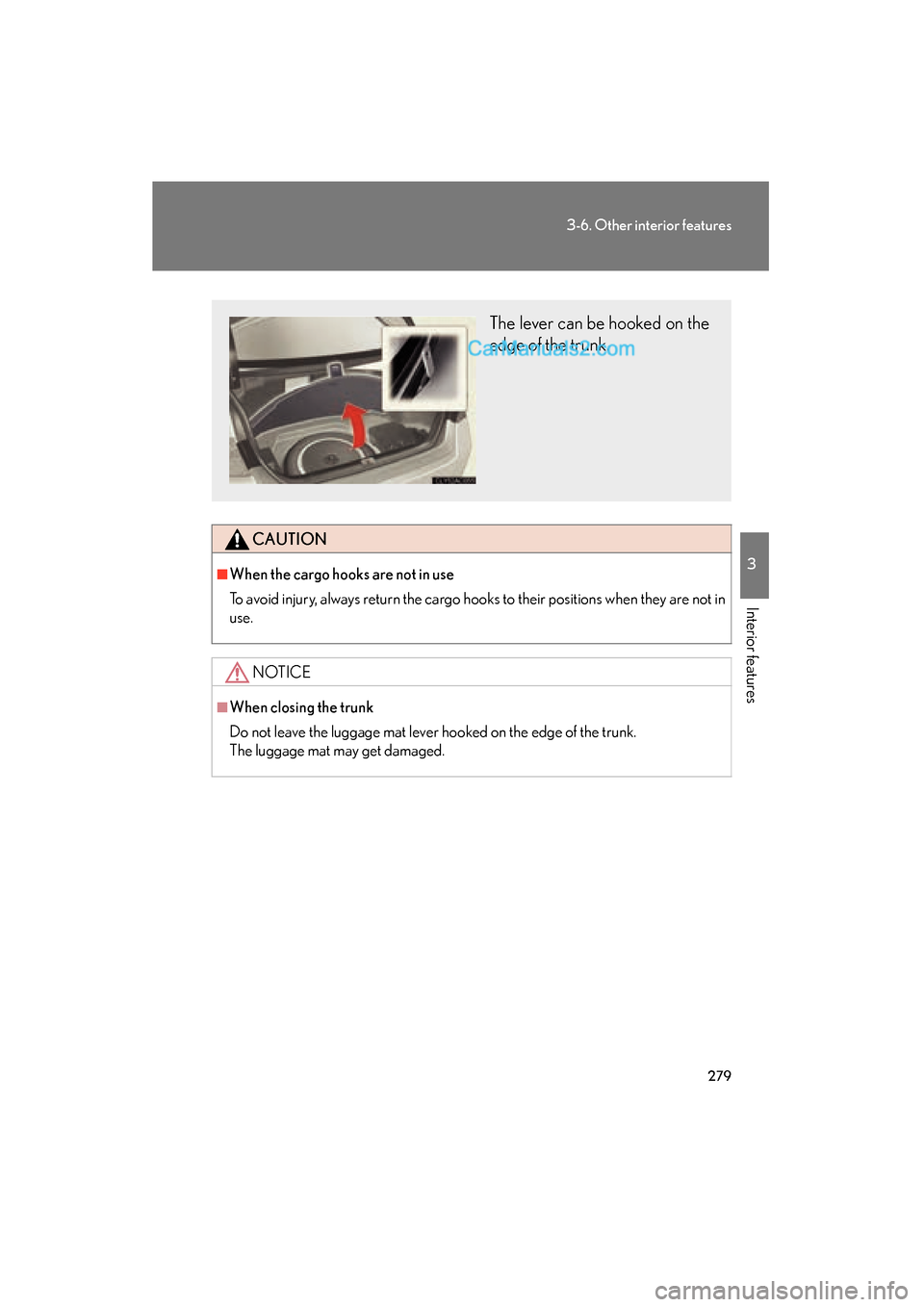
The lever can be hooked on the
edge of the trunk.
Page 304 of 475
302
4-2. Maintenance
ES350_U_(L/O_0808)
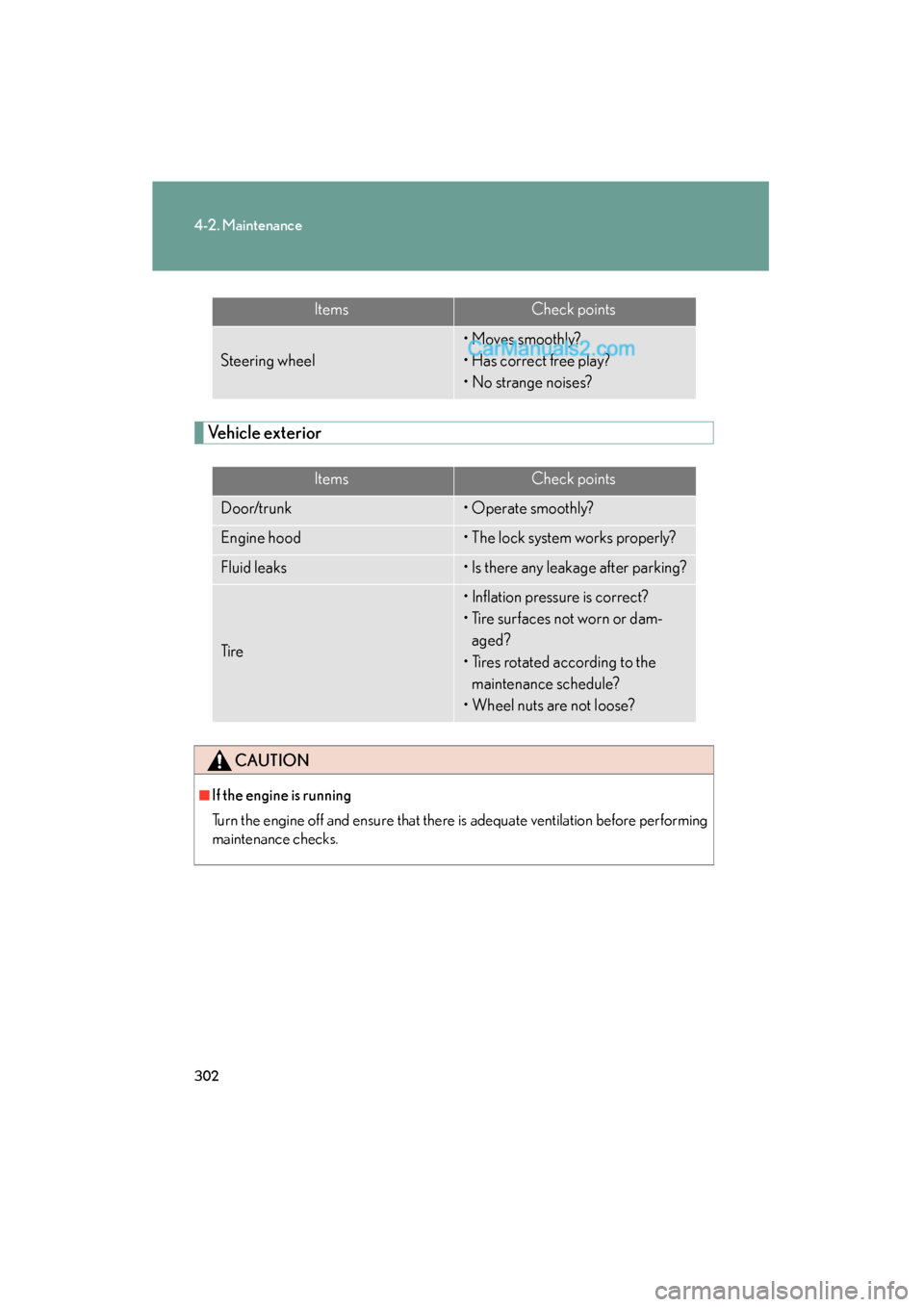
Vehicle exterior
ItemsCheck points
Steering wheel
• Moves smoothly?
• Has correct free play?
• No strange noises?
ItemsCheck points
Door/trunk• Operate smoothly?
Engine hood• The lock system works properly?
Fluid leaks• Is there any leakage after parking?
Ti r e
• Inflation pressure is correct?
• Tire surfaces not worn or dam-aged?
• Tires rotated according to the maintenance schedule?
• Wheel nuts are not loose?
CAUTION
■If the engine is running
Turn the engine off and ensure that there is adequate ventilation before performing
maintenance checks.
Page 360 of 475
358
4-3. Do-it-yourself maintenance
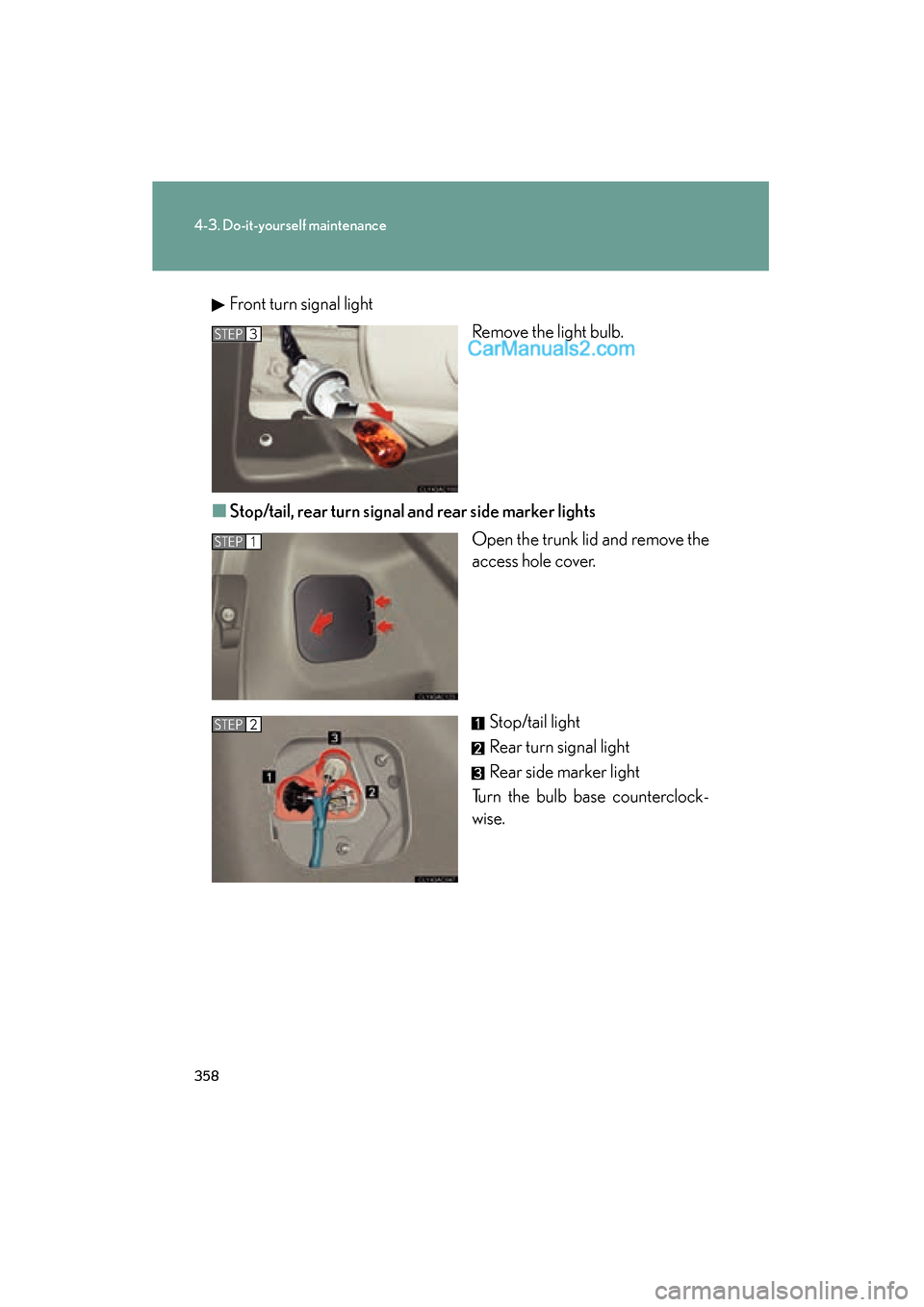
ES350_U_(L/O_0808)Front turn signal light
Remove the light bulb.
■ Stop/tail, rear turn signal and rear side marker lights
Open the trunk lid and remove the
access hole cover.
Stop/tail light
Rear turn signal light
Rear side marker light
Turn the bulb base counterclock-
wise.
STEP3
STEP1
STEP2