light Lexus ES350 2011 Owner's Manuals
[x] Cancel search | Manufacturer: LEXUS, Model Year: 2011, Model line: ES350, Model: Lexus ES350 2011Pages: 563, PDF Size: 6.72 MB
Page 452 of 563
450
5-2. Steps to take in an emergency
ES350_U
■Front passenger detection sensor and passenger seat belt reminder
If luggage or other load is placed on the front passenger seat, depending on its
weight, the reminder light may flash and buzzer may sound.
■When the tire pressure warning light comes on
Check the tire inflation pressure and adjust to the appropriate level. Pushing the tire
pressure warning reset switch does not turn off the tire pressure warning light.
■The tire pressure warning light may turn on due to natural causes
The tire pressure warning light may turn on due to natural causes such as natural air
leaks or tire inflation pressure changes caused by temperature. In this case, adjust-
ing the tire inflation pressure will turn off the warning light (after a few minutes).
■When a tire is replaced with a spare tire Full-size spare tire
The spare tire is also equipped with the tire pressure warning valve and transmitter.
The tire pressure warning light will turn on if the tire inflation pressure of the spare
tire is low. If a tire goes flat, even though the flat tire is replaced with the spare tire,
the tire pressure warning light does not turn off. Replace the spare tire with the
repaired tire and adjust the proper tire inflation pressure. The tire pressure warning
light will turn off after a few minutes. Compact spare tire
The compact spare tire is not equipped with the tire pressure warning valve and
transmitter. If a tire goes flat, the tire pressure warning light will not turn off even
though the flat tire is replaced with the spare tire. Replace the spare tire with the
repaired tire and adjust the proper tire inflation pressure. The tire pressure warning
light will turn off after a few minutes.
Page 454 of 563
452
5-2. Steps to take in an emergency
ES350_U
■If the tire pressure warning light frequently comes on after blinking for 1 minute
If the tire pressure warning light frequently comes on after blinking for 1 minute
when the “ENGINE START STOP” switch is turned to IGNITION ON mode, have
it checked by your Lexus dealer.
■Customization that can be configured at Lexus dealer
The vehicle speed linked seat belt reminder buzzer can be disabled.
(Customizable features →P. 5 1 7 )
CAUTION
■If the tire pressure warning light comes on
Be sure to observe the following precautions. Failure to do so could cause loss of
vehicle control and result in death or serious injury.
●Stop your vehicle in a safe place as soon as possible. Adjust the tire inflation pres-
sure immediately.
●If the tire pressure warning light comes on even after tire inflation pressure adjust-
ment, it is probable that you have a flat tire. Check the tires. If the tire is flat,
change to the spare tire and have the flat tire repaired by the nearest Lexus
dealer.
●Avoid abrupt maneuvering and braking. If the vehicle tires deteriorate, you could
lose control of the steering wheel or the brakes.
■If a blowout or sudden air leakage should occur
The tire pressure warning system may not activate immediately.
Page 455 of 563
5
When trouble arises
453
5-2. Steps to take in an emergency
ES350_U
CAUTION
■Maintenance of the tires
Each tire, including the spare (if provided), should be checked monthly when cold
and inflated to the inflation pressure recommended by the vehicle manufacturer on
the vehicle placard or tire inflation pressure label (tire and load information label).
(If your vehicle has tires of a different size than the size indicated on the vehicle
placard or tire inflation pressure label [tire and load information label], you should
determine the proper tire inflation pressure for those tires.)
As an added safety feature, your vehicle has been equipped with a tire pressure
monitoring system (TPMS-tire pressure warning system) that illuminates a low tire
pressure telltale (tire pressure warning light) when one or more of your tires is sig-
nificantly under-inflated. Accordingly, when the low tire pressure telltale (tire pres-
sure warning light) illuminates, you should stop and check your tires as soon as
possible, and inflate them to the proper pressure. Driving on a significantly under-
inflated tire causes the tire to overheat and can lead to tire failure. Under-inflation
also reduces fuel efficiency and tire tread life, and may affect the vehicle's handling
and stopping ability.
Please note that the TPMS (tire pressure warning system) is not a substitute for
proper tire maintenance, and it is the driver's responsibility to maintain correct tire
pressure, even if under-inflation has not reached the level to trigger illumination of
the TPMS low tire pressure telltale (tire pressure warning light).
Your vehicle has also been equipped with a TPMS (tire pressure warning system)
malfunction indicator to indicate when the system is not operating properly. The
TPMS (tire pressure warning system) malfunction indicator is combined with the
low tire pressure telltale (tire pressure warning light). When the system detects a
malfunction, the telltale will flash for approximately one minute and then remain
continuously illuminated. This sequence will continue upon subsequent vehicle
start-ups as long as the malfunction exists. When the malfunction indicator is illumi-
nated, the system may not be able to detect or signal low tire pressure as intended.
TPMS (tire pressure warning system) malfunctions may occur for a variety of rea-
sons, including the installation of replacement or alternate tires or wheels on the
vehicle that prevent the TPMS (tire pressure warning system) from functioning
properly. Always check the TPMS (tire pressure warning system) malfunction tell-
tale after replacing one or more tires or wheels on your vehicle to ensure that the
replacement or alternate tires and wheels allow the TPMS (tire pressure warning
system) to continue to function properly.
Page 457 of 563

5
When trouble arises
455
5-2. Steps to take in an emergency
ES350_U
If a warning message is displayed
Stop the vehicle immediately.The following warnings indicate the possibility of damage to the vehicle
that may lead to an accident. Immediately stop the vehicle in a safe place
and contact your Lexus dealer.
Warning messageDetails
(U.S.A)
(Canada) (Flashing)
Indicates an abnormal engine oil pressure.A buzzer also sounds.
If a warning is shown on the multi-information display, stay calm and per-
form the following actions:
Master warning light
The master warning light also
comes on or flashes in order to
indicate that a message is cur-
rently being displayed on the
multi-information display.
Multi-information display
If any of the warning message turns on again after performing the fol-
lowing actions, contact your Lexus dealer.
Page 464 of 563
462
5-2. Steps to take in an emergency
ES350_U
Warning messageDetailsCorrection procedure
(Flashing and then con-tinuously on)
(Flashing)
(If equipped)
Indicates that the radar
cruise control system is
unable to judge vehicle-
to-vehicle distance
because the windshield
wipers are set at high
speed operation mode. A buzzer also sounds.
Turn them off or set them
to either the intermittent
or the slow mode.
(Flashing)
(If equipped)
Indicates that your vehi-
cle is nearing the vehicle
ahead (in radar cruise
mode). A buzzer also sounds.
Slow the vehicle by apply-
ing the brakes.
Indicates one or more
stop lights are burned
out.Have the defective bulbs
replaced by your Lexus
dealer.
Page 465 of 563
5
When trouble arises
463
5-2. Steps to take in an emergency
ES350_U
■Changing the engine oil (USA only)
Make sure to reset the oil change system. (→P. 383)
■Warning light display in radar cruise mode
In the following cases, the warning light may not be displayed even if vehicle-to-
vehicle distance closes.
●When your vehicle and the vehicle ahead are traveling at the same speed or the
vehicle ahead is traveling more quickly than your vehicle
●When the vehicle ahead is traveling at a very low speed
●Immediately after cruise control speed is set
●At the instant the accelerator pedal is depressed
Page 472 of 563
470
5-2. Steps to take in an emergency
ES350_U
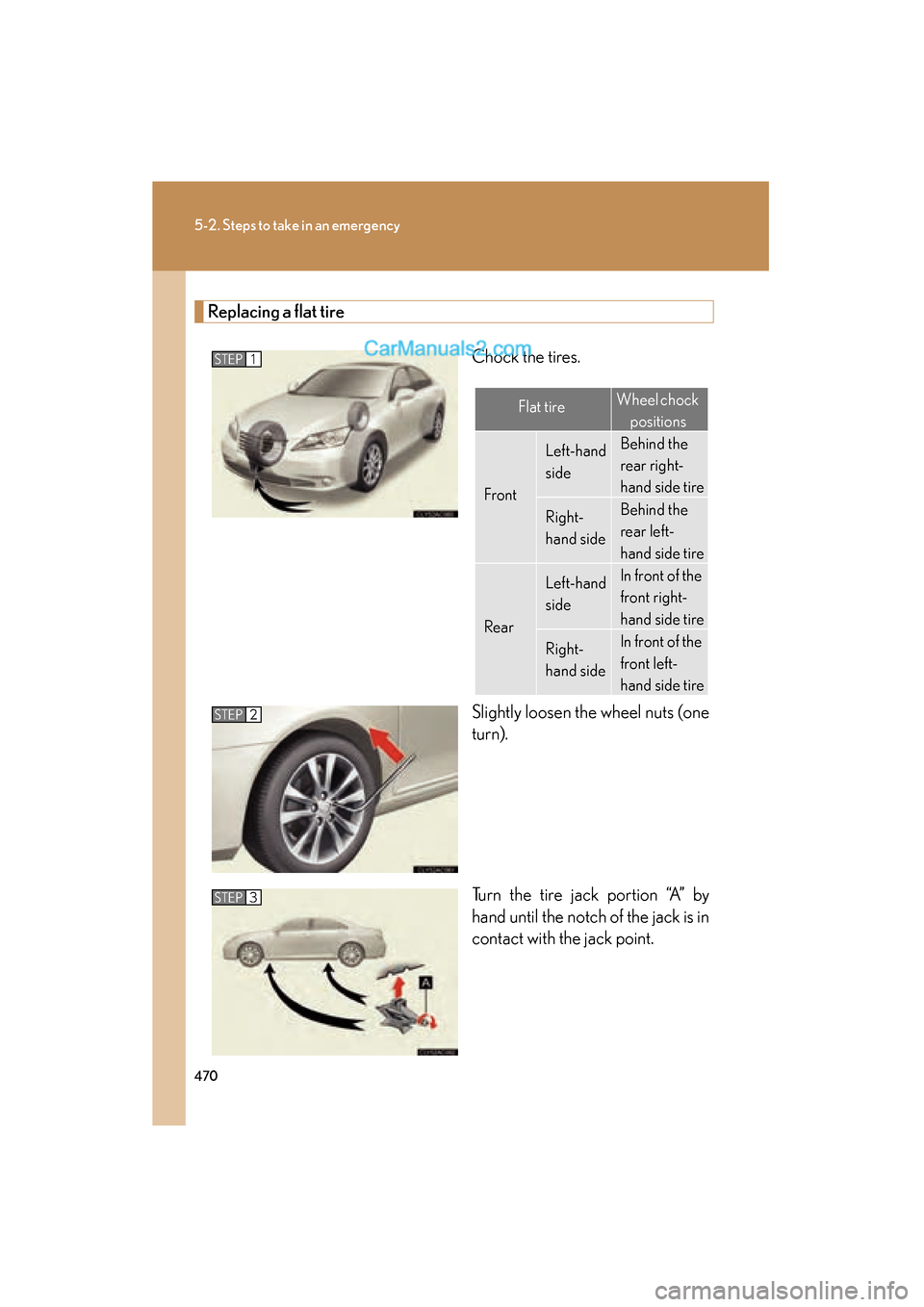
Replacing a flat tireChock the tires.
Slightly loosen the wheel nuts (one
turn).
Turn the tire jack portion “A” by
hand until the notch of the jack is in
contact with the jack point.
STEP1
Flat tireWheel chock positions
Front
Left-hand
sideBehind the
rear right-
hand side tire
Right-
hand sideBehind the
rear left-
hand side tire
Rear
Left-hand
sideIn front of the
front right-
hand side tire
Right-
hand sideIn front of the
front left-
hand side tire
STEP2
STEP3
Page 473 of 563
5
When trouble arises
471
5-2. Steps to take in an emergency
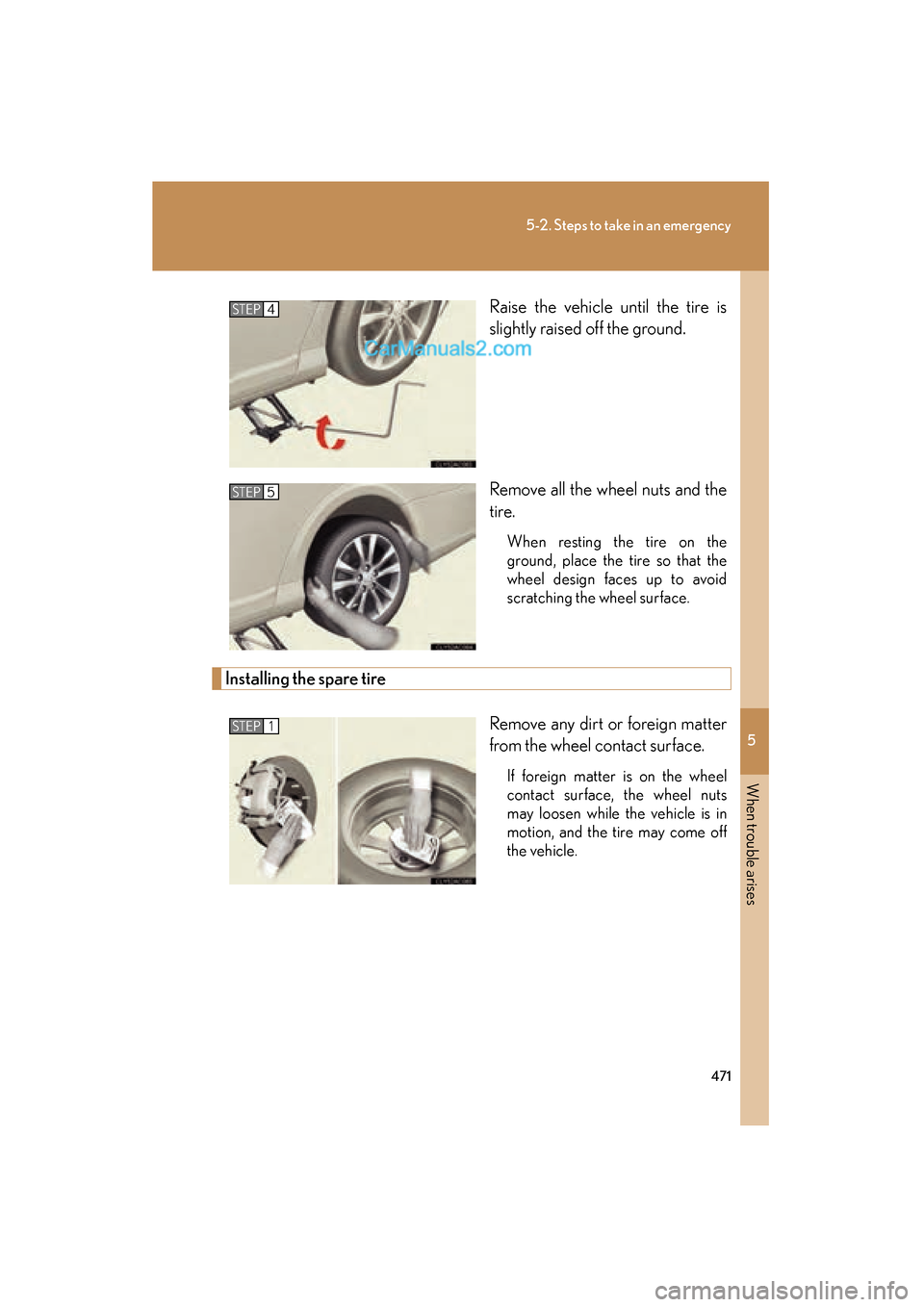
ES350_URaise the vehicle until the tire is
slightly raised off the ground.
Remove all the wheel nuts and the
tire.
When resting the tire on the
ground, place the tire so that the
wheel design faces up to avoid
scratching the wheel surface.
Installing the spare tire
Remove any dirt or foreign matter
from the wheel contact surface.
If foreign matter is on the wheel
contact surface, the wheel nuts
may loosen while the vehicle is in
motion, and the tire may come off
the vehicle.
STEP4
STEP5
STEP1
Page 475 of 563
5
When trouble arises
473
5-2. Steps to take in an emergency
ES350_U
■When using the compact spare tire
As the compact spare tire is not equipped with the tire pressure warning valve and
transmitter, low inflation pressure of the spare tire will not be warned. Also, if you
replace the compact spare tire after the tire pressure warning light comes on, the
light remains on.
■If you have a flat front tire on a road covered with snow or ice (vehicles with com-
pact spare tire)
Install the compact spare tire on the rear of the vehicle. Perform the following steps
and fit tire chains to the front tires.Replace a rear tire with the compact spare tire.
Replace the flat front tire with the tire removed from the rear of the vehi-
cle.
Fit tire chains to the front tires.
■After completing the tire change
The tire pressure warning system must be reset. ( →P. 396)
CAUTION
■Using the tire jack
Improper use of the tire jack may lead to death or serious injuries due to the vehicle
suddenly falling off the jack.
●Do not use the tire jack for any purpose other than replacing tires or installing and
removing tire chains.
●Only use the tire jack that comes with this vehicle for replacing a flat tire.
Do not use it on other vehicles, and do not use other tire jacks for replacing tires
on this vehicle.
●Always check that the tire jack is securely set to the jack point.
●Do not put any part of your body under the vehicle supported by a jack.
●Do not start or run the engine while your vehicle is supported by the jack.
●Do not raise the vehicle while someone is in it.
●When raising the vehicle, do not put an object on or under the jack.
STEP1
STEP2
STEP3
Page 478 of 563
476
5-2. Steps to take in an emergency
ES350_U
If the engine will not start
If the engine will not start, even though correct starting procedures are
being followed (
→P. 126), consider each of the following points.
■The engine will not start even when the starter motor operates
normally.
One of the following may be the cause of the problem.
● There may not be sufficient fuel in the vehicle’s tank.
Add fuel to the vehicle.
● The engine may be flooded.
Try to restart the engine once more following correct starting
procedures. ( →P. 1 2 6 )
● There may be a malfunction in the engine immobilizer system.
(→ P. 7 9 )
■ The starter motor turns over slowly, the interior lights and head-
lights are dim, or the horn does not sound or sounds at a low vol-
ume.
One of the following may be the cause of the problem.
● The battery may be discharged. ( →P. 4 8 3 )
● The battery terminal connections may be loose or corroded.
■ The starter motor does not turn over
One of the following may be the cause of the problem.
● The engine starting system may be malfunctioning due to an elec-
trical problem such as an open circuit or a blown fuse. However,
an interim measure is available to start the engine. ( →P. 4 7 7 )