brakes Lexus ES350 2011 s Owner's Guide
[x] Cancel search | Manufacturer: LEXUS, Model Year: 2011, Model line: ES350, Model: Lexus ES350 2011Pages: 563, PDF Size: 6.72 MB
Page 438 of 563
436
5-1. Essential information
ES350_U
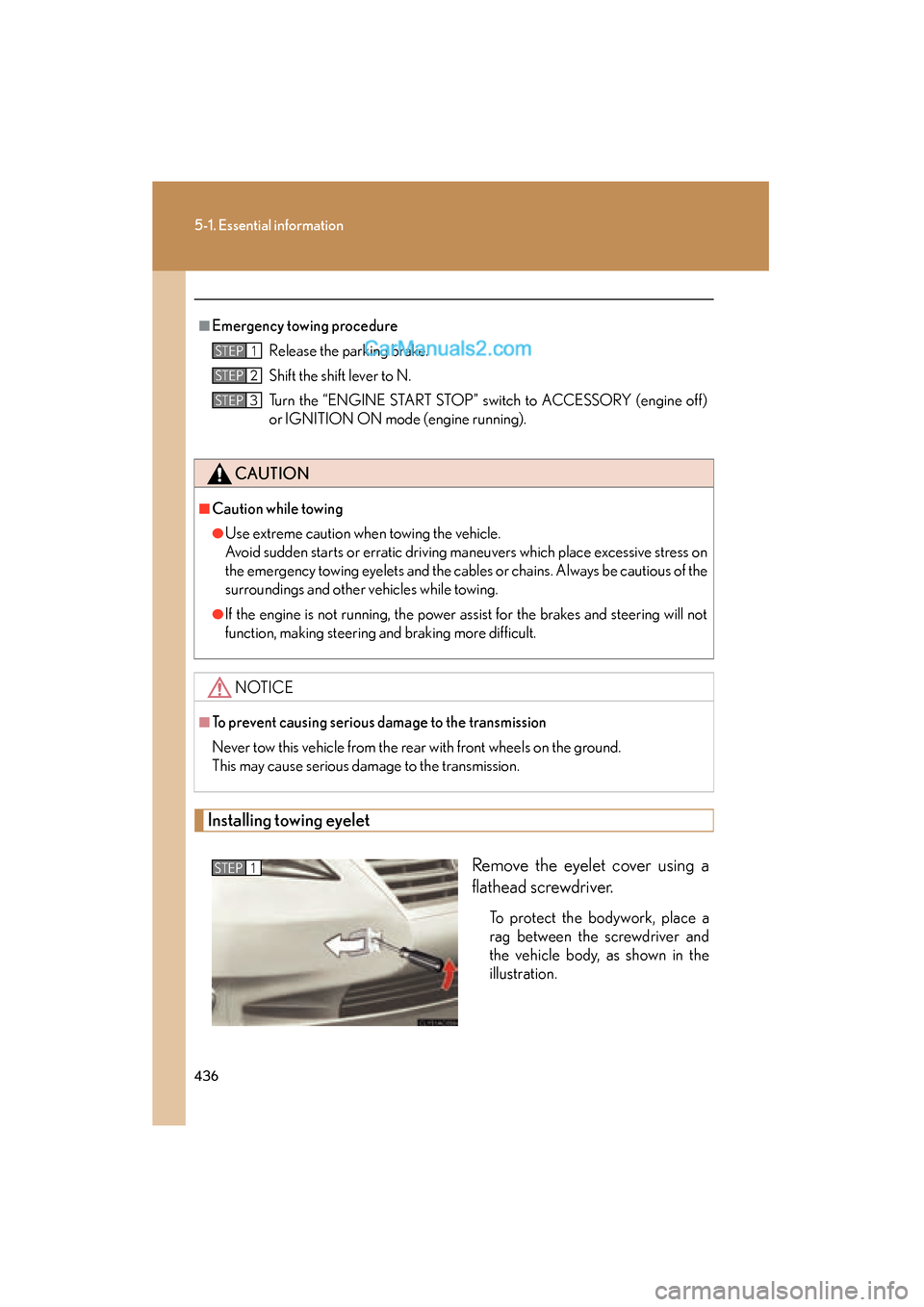
Installing towing eyeletRemove the eyelet cover using a
flathead screwdriver.
To protect the bodywork, place a
rag between the screwdriver and
the vehicle body, as shown in the
illustration.
■Emergency towing procedureRelease the parking brake.
Shift the shift lever to N.
Turn the “ENGINE START STOP” switch to ACCESSORY (engine off)
or IGNITION ON mode (engine running).
CAUTION
■Caution while towing
●Use extreme caution when towing the vehicle.
Avoid sudden starts or erratic driving maneuvers which place excessive stress on
the emergency towing eyelets and the cables or chains. Always be cautious of the
surroundings and other vehicles while towing.
●If the engine is not running, the power assist for the brakes and steering will not
function, making steering and braking more difficult.
NOTICE
■To prevent causing serious da mage to the transmission
Never tow this vehicle from the rear with front wheels on the ground.
This may cause serious damage to the transmission.
STEP1
STEP2
STEP3
STEP1
Page 454 of 563
452
5-2. Steps to take in an emergency
ES350_U
■If the tire pressure warning light frequently comes on after blinking for 1 minute
If the tire pressure warning light frequently comes on after blinking for 1 minute
when the “ENGINE START STOP” switch is turned to IGNITION ON mode, have
it checked by your Lexus dealer.
■Customization that can be configured at Lexus dealer
The vehicle speed linked seat belt reminder buzzer can be disabled.
(Customizable features →P. 5 1 7 )
CAUTION
■If the tire pressure warning light comes on
Be sure to observe the following precautions. Failure to do so could cause loss of
vehicle control and result in death or serious injury.
●Stop your vehicle in a safe place as soon as possible. Adjust the tire inflation pres-
sure immediately.
●If the tire pressure warning light comes on even after tire inflation pressure adjust-
ment, it is probable that you have a flat tire. Check the tires. If the tire is flat,
change to the spare tire and have the flat tire repaired by the nearest Lexus
dealer.
●Avoid abrupt maneuvering and braking. If the vehicle tires deteriorate, you could
lose control of the steering wheel or the brakes.
■If a blowout or sudden air leakage should occur
The tire pressure warning system may not activate immediately.
Page 464 of 563
462
5-2. Steps to take in an emergency
ES350_U
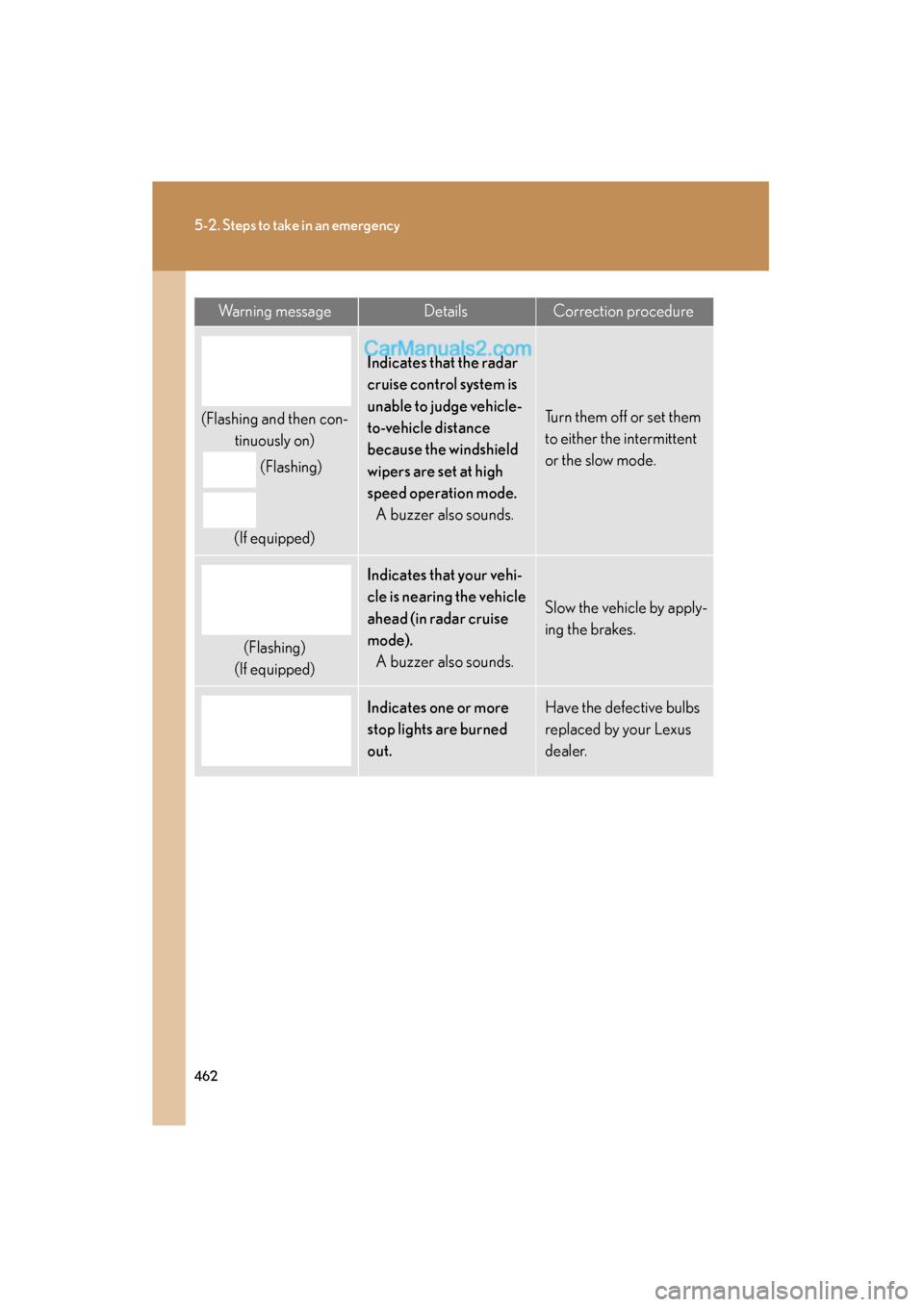
Warning messageDetailsCorrection procedure
(Flashing and then con-tinuously on)
(Flashing)
(If equipped)
Indicates that the radar
cruise control system is
unable to judge vehicle-
to-vehicle distance
because the windshield
wipers are set at high
speed operation mode. A buzzer also sounds.
Turn them off or set them
to either the intermittent
or the slow mode.
(Flashing)
(If equipped)
Indicates that your vehi-
cle is nearing the vehicle
ahead (in radar cruise
mode). A buzzer also sounds.
Slow the vehicle by apply-
ing the brakes.
Indicates one or more
stop lights are burned
out.Have the defective bulbs
replaced by your Lexus
dealer.
Page 468 of 563
466
5-2. Steps to take in an emergency
ES350_U*: If the engine does not start when the electronic key is inside the vehicle,
the electronic key battery may be de pleted or there may be difficulties
receiving the signal from the key. ( →P. 30)
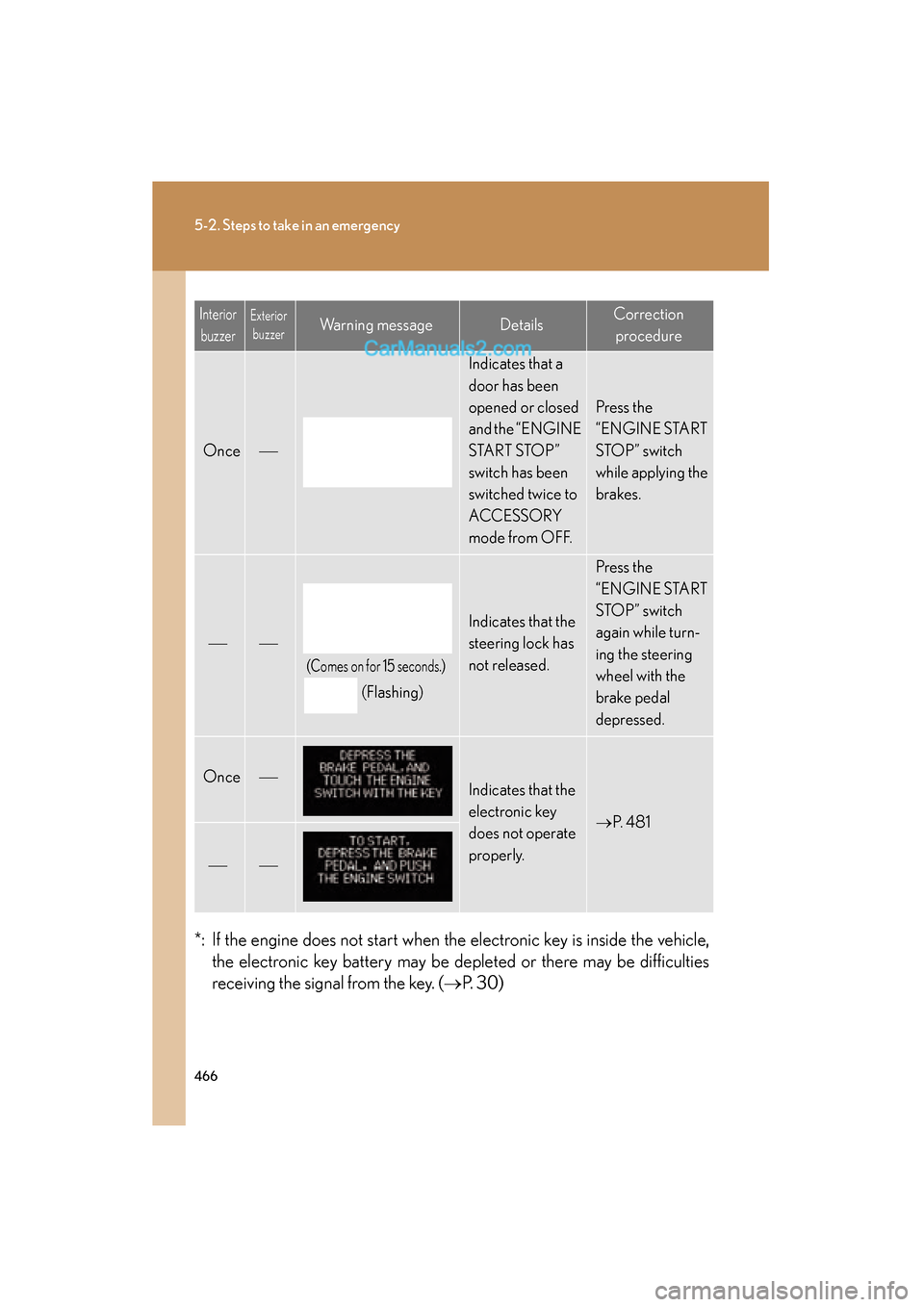
Interior
buzzerExterior buzzerWarning messageDetailsCorrection
procedure
Once
Indicates that a
door has been
opened or closed
and the “ENGINE
S TA R T S TO P ”
switch has been
switched twice to
ACCESSORY
mode from OFF.
Press the
“ENGINE START
STOP” switch
while applying the
brakes.
(Comes on for 15 seconds.)
(Flashing)
Indicates that the
steering lock has
not released.
Press the
“ENGINE START
STOP” switch
again while turn-
ing the steering
wheel with the
brake pedal
depressed.
OnceIndicates that the
electronic key
does not operate
properly.
→ P. 4 8 1
Page 483 of 563
5
When trouble arises
481
5-2. Steps to take in an emergency
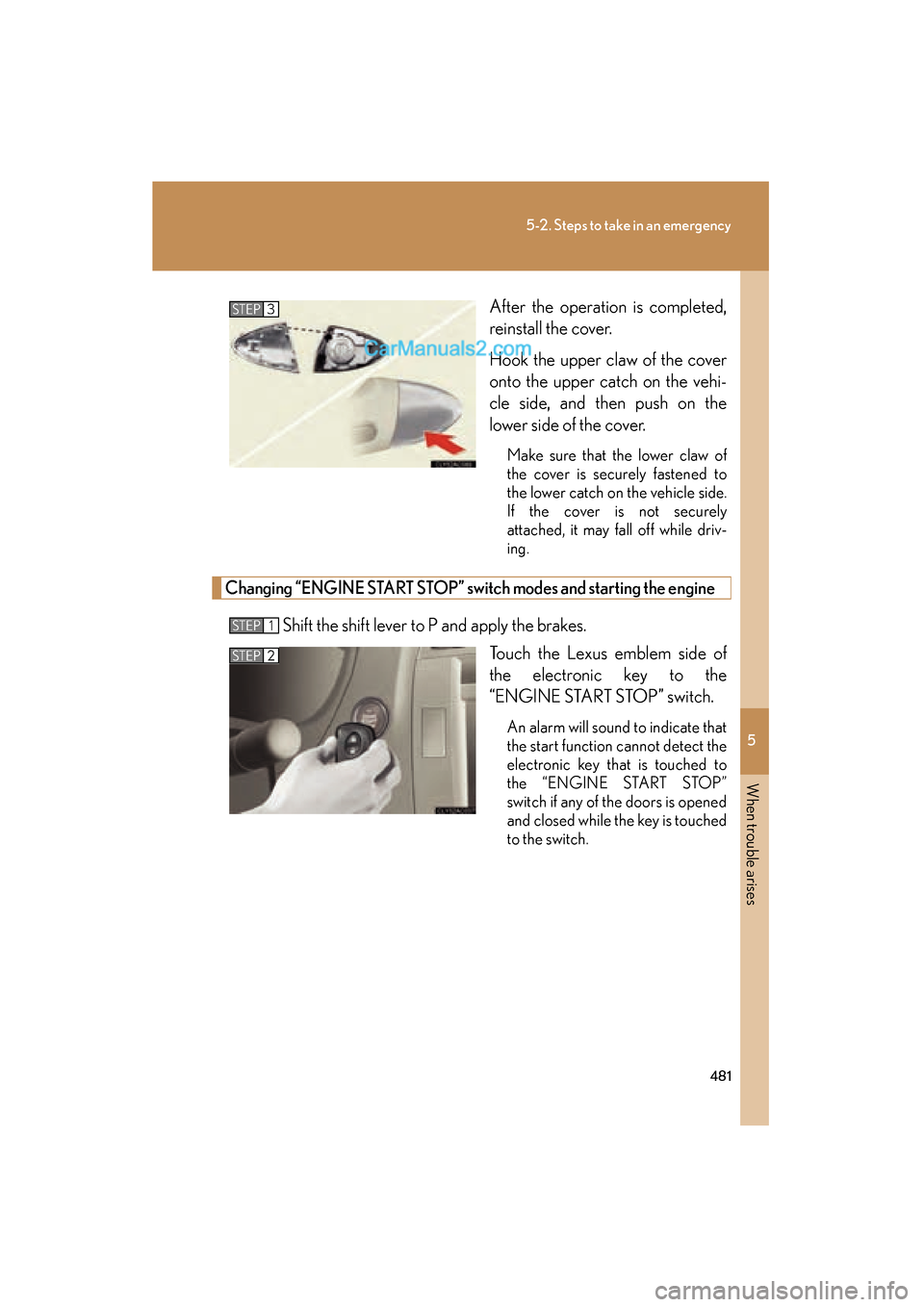
ES350_UAfter the operation is completed,
reinstall the cover.
Hook the upper claw of the cover
onto the upper catch on the vehi-
cle side, and then push on the
lower side of the cover.
Make sure that the lower claw of
the cover is securely fastened to
the lower catch on the vehicle side.
If the cover is not securely
attached, it may fall off while driv-
ing.
Changing “ENGINE START STOP” switch modes and starting the engine
Shift the shift lever to P and apply the brakes.
Touch the Lexus emblem side of
the electronic key to the
“ENGINE START STOP” switch.
An alarm will sound to indicate that
the start function cannot detect the
electronic key that is touched to
the “ENGINE START STOP”
switch if any of the doors is opened
and closed while the key is touched
to the switch.
STEP3
STEP1
STEP2
Page 492 of 563
490
5-2. Steps to take in an emergency
ES350_U
If your vehicle has to be stopped in an emergency
CAUTION
■If the engine has to be turned off while driving
Power assist for the brakes and steering wheel will be lost, making the brake pedal
harder to depress and the steering wheel heavier to turn. Decelerate as much as
possible before turning off the engine.
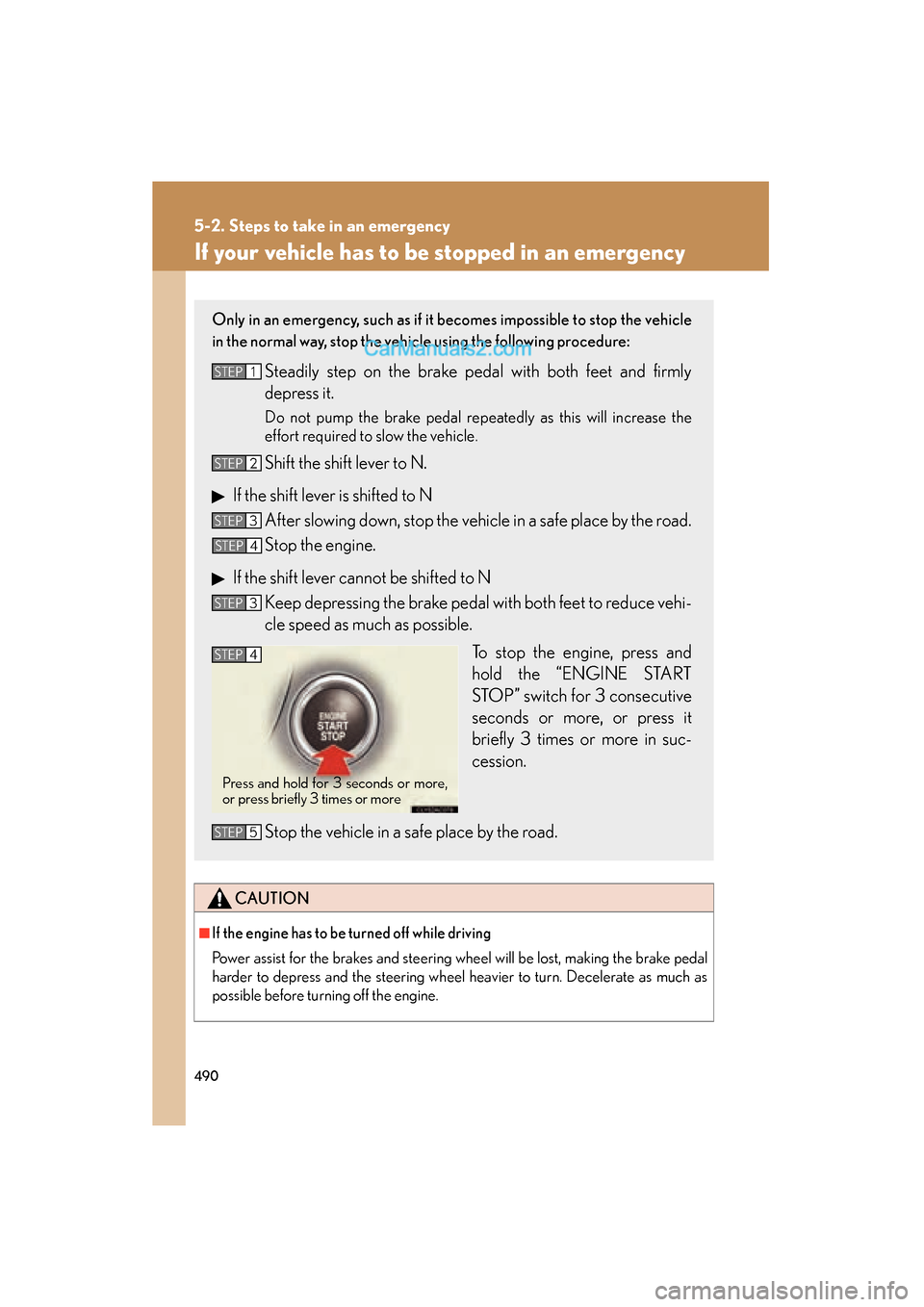
Only in an emergency, such as if it becomes impossible to stop the vehicle
in the normal way, stop the vehicle using the following procedure:
Steadily step on the brake pedal with both feet and firmly
depress it.
Do not pump the brake pedal repeatedly as this will increase the
effort required to slow the vehicle.
Shift the shift lever to N.
If the shift lever is shifted to N After slowing down, stop the vehicle in a safe place by the road.
Stop the engine.
If the shift lever cannot be shifted to N Keep depressing the brake pedal with both feet to reduce vehi-
cle speed as much as possible.
To stop the engine, press and
hold the “ENGINE START
STOP” switch for 3 consecutive
seconds or more, or press it
briefly 3 times or more in suc-
cession.
Stop the vehicle in a safe place by the road.
STEP1
STEP2
STEP3
STEP4
STEP3
STEP4
Press and hold for 3 seconds or more,
or press briefly 3 times or more
STEP5
Page 500 of 563
498
6-1. Specifications
ES350_U
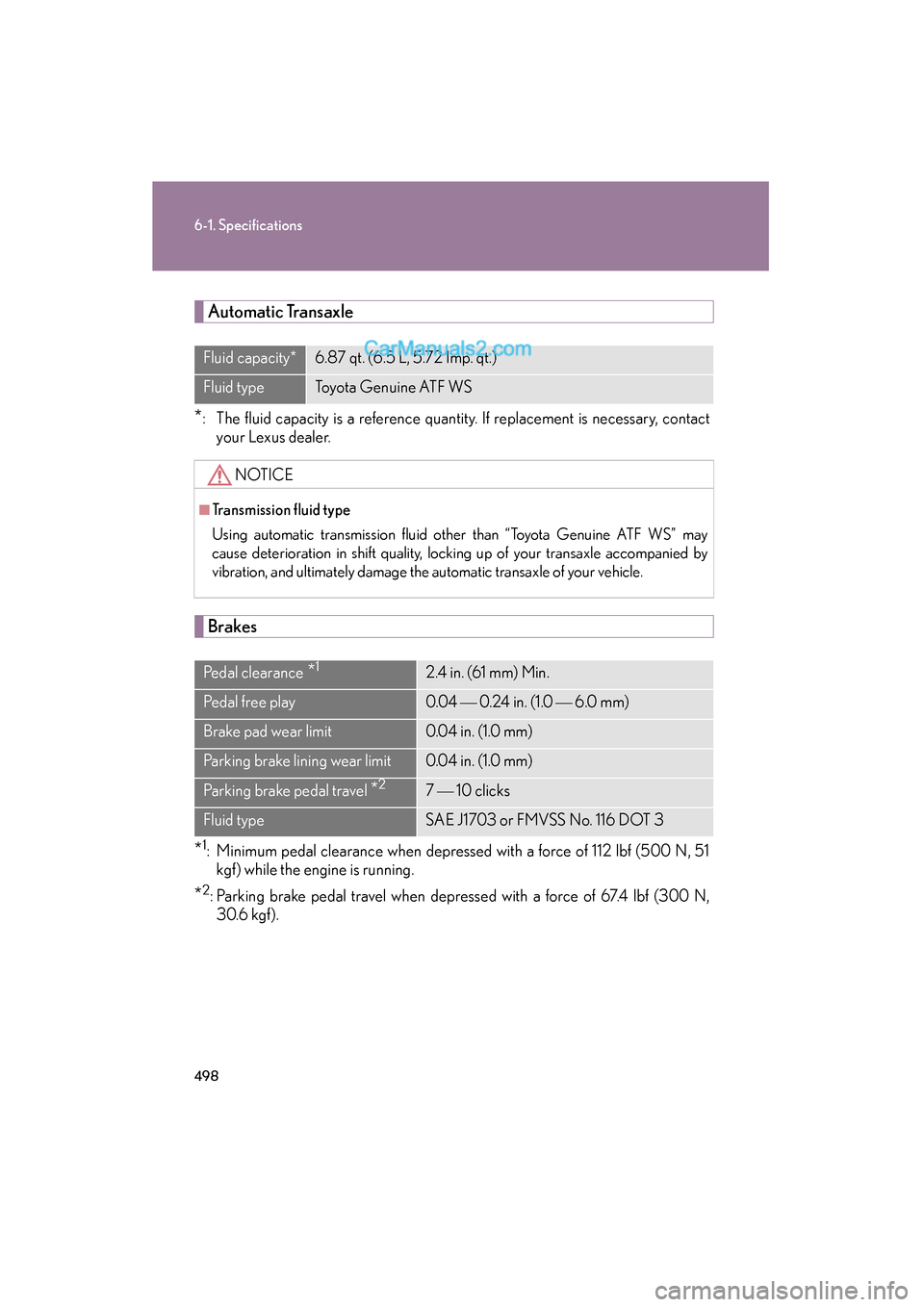
Automatic Transaxle
*: The fluid capacity is a reference quantity. If replacement is necessary, contact
your Lexus dealer.
Brakes
*1: Minimum pedal clearance when depressed with a force of 112 lbf (500 N, 51kgf) while the engine is running.
*2: Parking brake pedal travel when depressed with a force of 67.4 lbf (300 N,3 0.6 kg f ) .
Fluid capacity*6.87 qt. (6.5 L, 5.72 Imp. qt.)
Fluid typeToyota Genuine ATF WS
NOTICE
■Transmission fluid type
Using automatic transmission fluid other than “Toyota Genuine ATF WS” may
cause deterioration in shift quality, locking up of your transaxle accompanied by
vibration, and ultimately damage the automatic transaxle of your vehicle.
Pedal clearance *12.4 in. (61 mm) Min.
Pedal free play0.04 0.24 in. (1.0 6.0 mm)
Brake pad wear limit0.04 in. (1.0 mm)
Parking brake lining wear limit0.04 in. (1.0 mm)
Parking brake pedal travel *27 10 clicks
Fluid typeSAE J1703 or FMVSS No. 116 DOT 3
Page 512 of 563
510
6-1. Specifications
ES350_U■
Temperature A, B, C
The temperature grades are A (the highest), B, and C, representing
the tire's resistance to the generation of heat and its ability to dissipate
heat when tested under controlled conditions on a specified indoor
laboratory test wheel.
Sustained high temperature can cause the material of the tire to degenerate
and reduce tire life, and excessive temperature can lead to sudden tire fail-
ure.
The grade C corresponds to a level of performance which all passenger car
tires must meet under the Federal Motor Vehicle Safety Standard No. 109.
Grades B and A represent higher levels of performance on the laboratory
test wheel than the minimum required by law.
Warning: The temperature grades for this tire are established for a tire that
is properly inflated and not overloaded.
Excessive speed, underinflation, or excessive loading, either separately or in
combination, can cause heat buildup and possible tire failure.
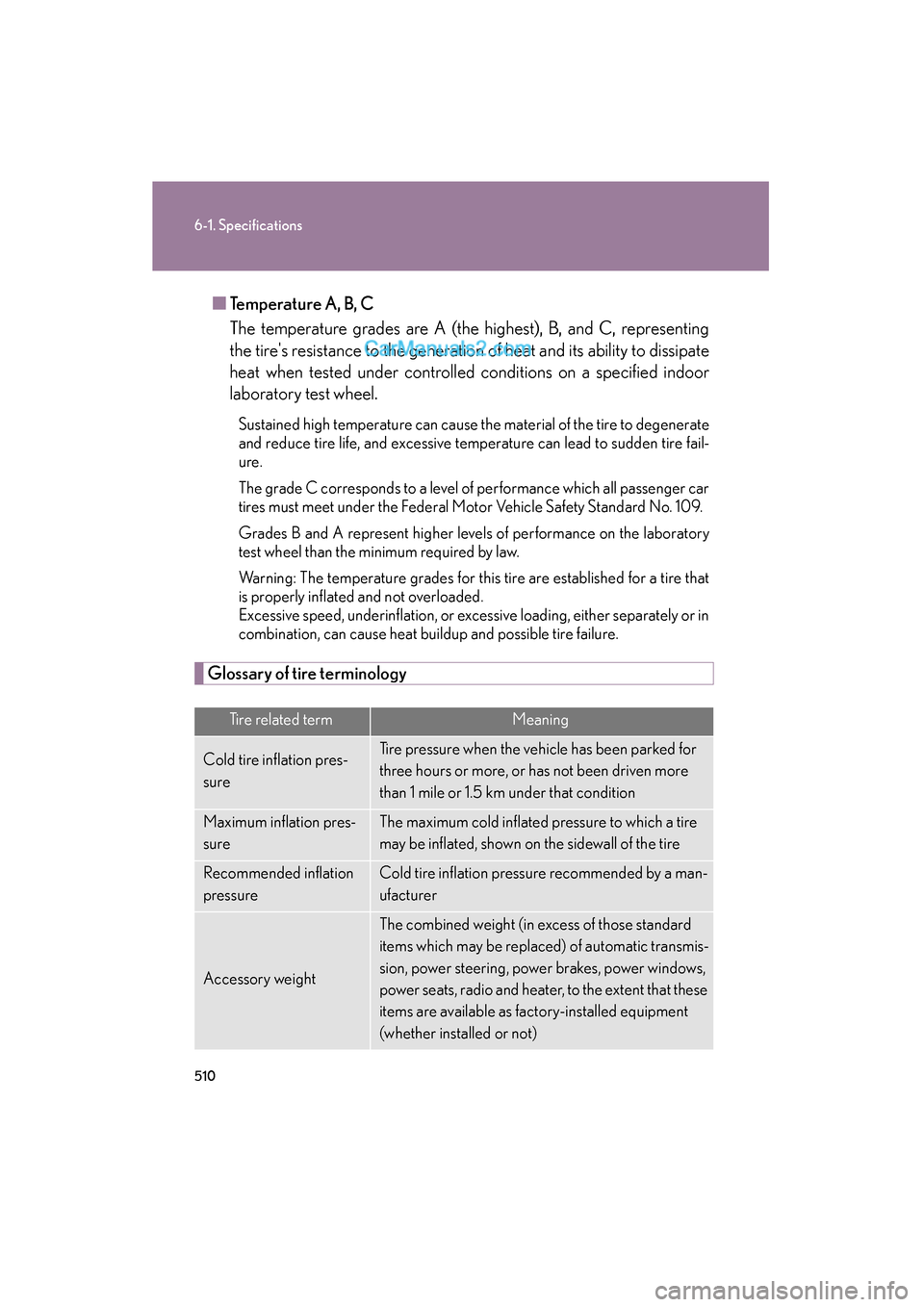
Glossary of tire terminology
Tire related termMeaning
Cold tire inflation pres-
sureTire pressure when the vehicle has been parked for
three hours or more, or has not been driven more
than 1 mile or 1.5 km under that condition
Maximum inflation pres-
sureThe maximum cold inflated pressure to which a tire
may be inflated, shown on the sidewall of the tire
Recommended inflation
pressureCold tire inflation pressure recommended by a man-
ufacturer
Accessory weight
The combined weight (in excess of those standard
items which may be replaced) of automatic transmis-
sion, power steering, power brakes, power windows,
power seats, radio and heater, to the extent that these
items are available as factory-installed equipment
(whether installed or not)
Page 513 of 563
511
6-1. Specifications
6
Vehicle specifications
ES350_U
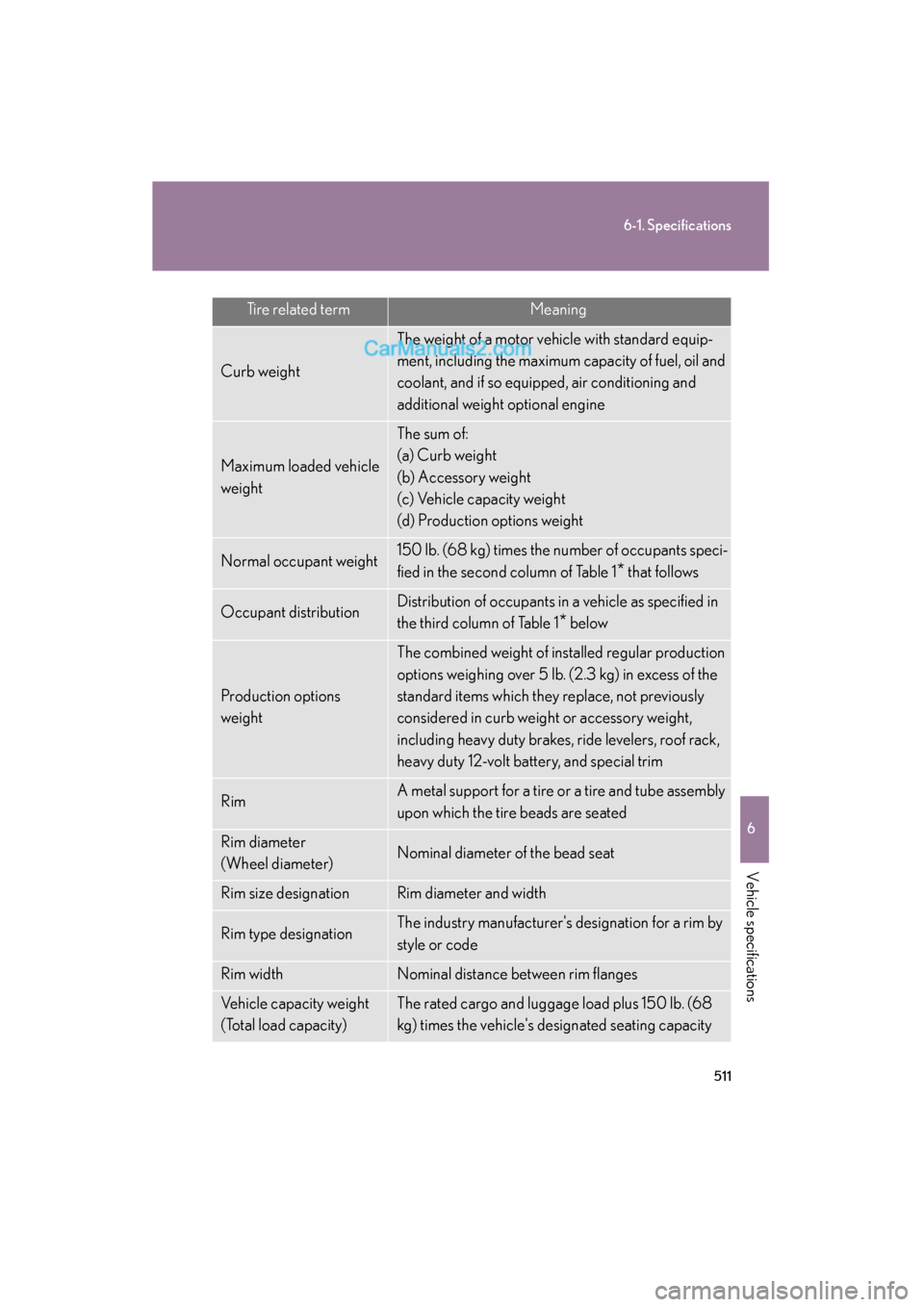
Curb weight
The weight of a motor vehicle with standard equip-
ment, including the maximum capacity of fuel, oil and
coolant, and if so equipped, air conditioning and
additional weight optional engine
Maximum loaded vehicle
weight
The sum of:
(a) Curb weight
(b) Accessory weight
(c) Vehicle capacity weight
(d) Production options weight
Normal occupant weight150 lb. (68 kg) times the number of occupants speci-
fied in the second column of Table 1
* that follows
Occupant distributionDistribution of occupants in a vehicle as specified in
the third column of Table 1
* below
Production options
weight
The combined weight of installed regular production
options weighing over 5 lb. (2.3 kg) in excess of the
standard items which they replace, not previously
considered in curb weight or accessory weight,
including heavy duty brakes, ride levelers, roof rack,
heavy duty 12-volt battery, and special trim
RimA metal support for a tire or a tire and tube assembly
upon which the tire beads are seated
Rim diameter
(Wheel diameter)Nominal diameter of the bead seat
Rim size designationRim diameter and width
Rim type designationThe industry manufacturer's designation for a rim by
style or code
Rim widthNominal distance between rim flanges
Vehicle capacity weight
(Total load capacity)The rated cargo and luggage load plus 150 lb. (68
kg) times the vehicle's designated seating capacity
Tire related termMeaning