warning lights Lexus ES350 2011 Owner's Manuals
[x] Cancel search | Manufacturer: LEXUS, Model Year: 2011, Model line: ES350, Model: Lexus ES350 2011Pages: 563, PDF Size: 6.72 MB
Page 5 of 563
1
2
3
4
5
6
7
ES350_U
3
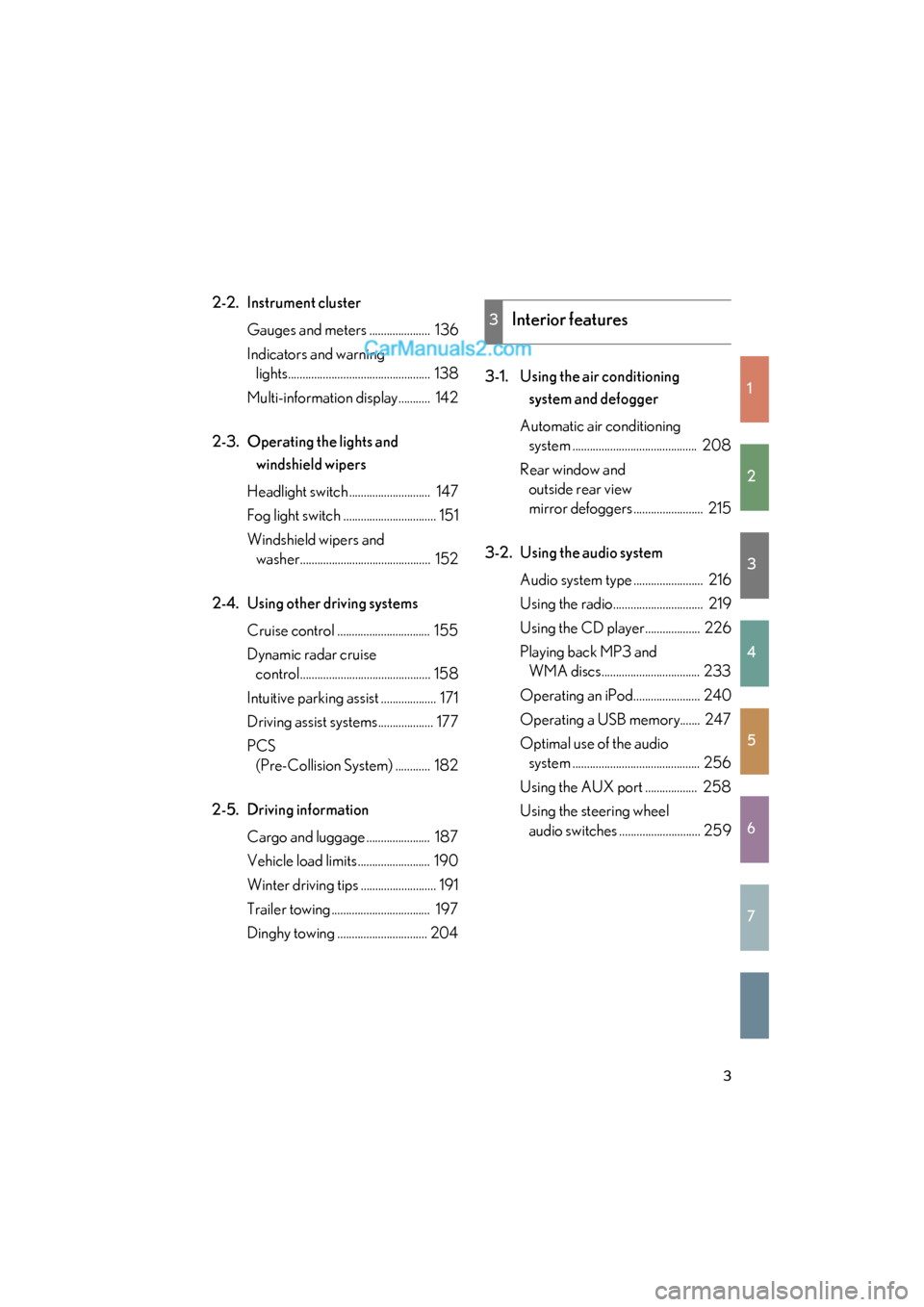
2-2. Instrument clusterGauges and meters ..................... 136
Indicators and warning lights................................................. 138
Multi-information display........... 142
2-3. Operating the lights and windshield wipers
Headlight switch ............................ 147
Fog light switch ................................ 151
Windshield wipers and washer............................................. 152
2-4. Using other driving systems Cruise control ................................ 155
Dynamic radar cruise control............................................. 158
Intuitive parking assist ................... 171
Driving assist systems................... 177
PCS (Pre-Collision System) ............ 182
2-5. Driving information Cargo and luggage ...................... 187
Vehicle load limits ......................... 190
Winter driving tips .......................... 191
Trailer towing .................................. 197
Dinghy towing ............................... 204 3-1. Using the air conditioning
system and defogger
Automatic air conditioning system ........................................... 208
Rear window and outside rear view
mirror defoggers ........................ 215
3-2. Using the audio system Audio system type ........................ 216
Using the radio............................... 219
Using the CD player................... 226
Playing back MP3 and WMA discs.................................. 233
Operating an iPod....................... 240
Operating a USB memory....... 247
Optimal use of the audio system ............................................ 256
Using the AUX port .................. 258
Using the steering wheel audio switches ............................ 259
3Interior features
Page 7 of 563
1
2
3
4
5
6
7
ES350_U
5
4-1. Maintenance and careCleaning and protecting the vehicle exterior................... 362
Cleaning and protecting the vehicle interior .................... 365
4-2. Maintenance Maintenance requirements .... 368
General maintenance ................ 370
Emission inspection and maintenance (I/M)
programs ...................................... 373
4-3. Do-it-yourself maintenance Do-it-yourself service precautions .................................. 374
Hood.................................................. 378
Positioning a floor jack............... 379
Engine compartment................... 381
Tires ................................................... 394
Tire inflation pressure................ 403
Wheels.............................................. 407
Air conditioning filter................. 409
Electronic key battery ................... 411
Checking and replacing fuses ................................................. 413
Headlight aim (vehicles with discharge headlights) .............. 422
Light bulbs ....................................... 424 5-1. Essential information
Emergency flashers .................... 434
If your vehicle needs to be towed ............................................. 435
If you think something is wrong .............................................. 441
Fuel pump shut off system ........ 442
Event data recorder.................... 443
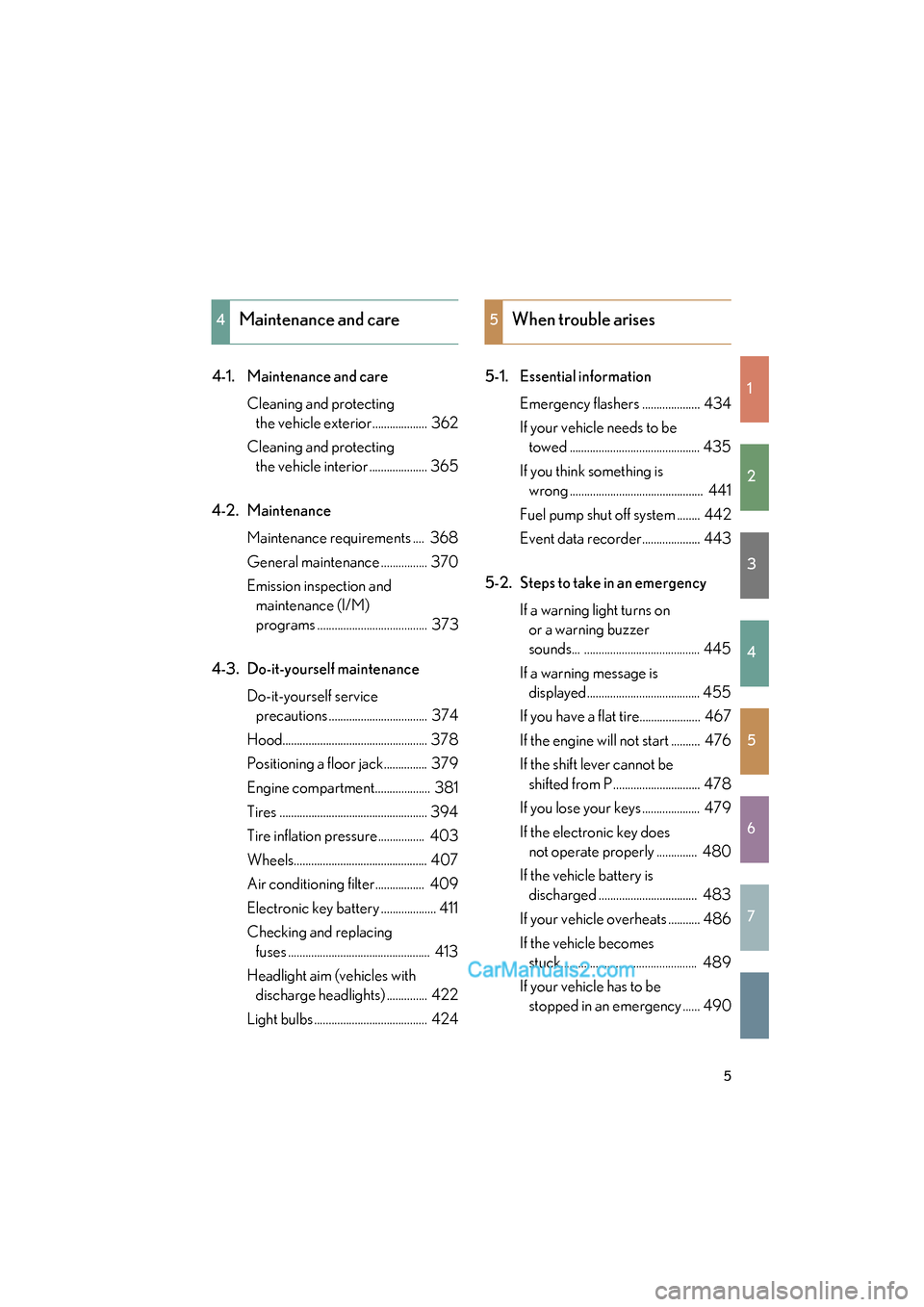
5-2. Steps to take in an emergency If a warning light turns on or a warning buzzer
sounds... ........................................ 445
If a warning message is displayed....................................... 455
If you have a flat tire..................... 467
If the engine will not start .......... 476
If the shift lever cannot be shifted from P .............................. 478
If you lose your keys .................... 479
If the electronic key does not operate properly .............. 480
If the vehicle battery is discharged .................................. 483
If your vehicle overheats ........... 486
If the vehicle becomes stuck............................................... 489
If your vehicle has to be stopped in an emergency ...... 490
4Maintenance and care5When trouble arises
Page 89 of 563
87
1-7. Safety information
1
Before driving
ES350_U
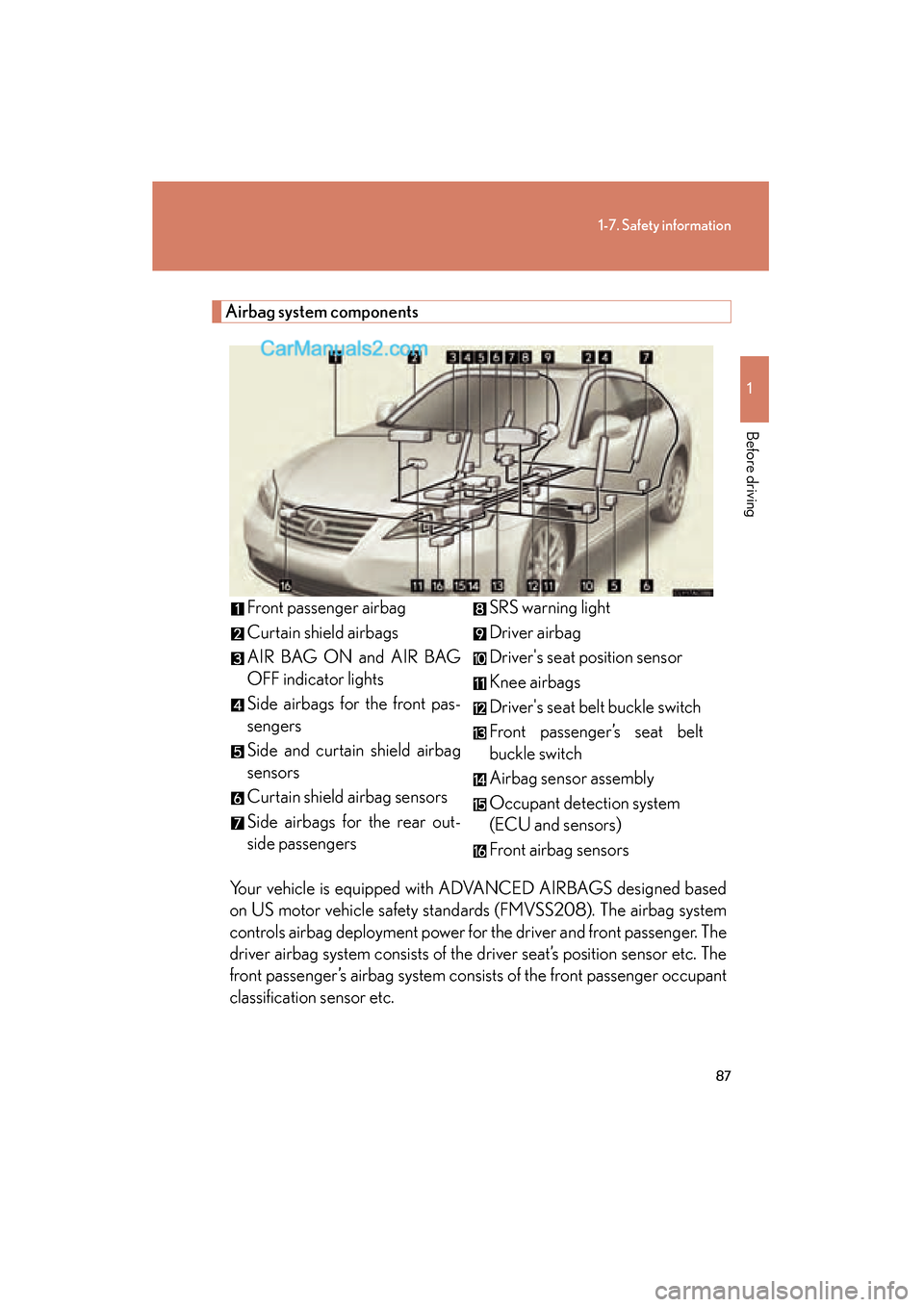
Airbag system componentsYour vehicle is equipped with ADVANCED AIRBAGS designed based
on US motor vehicle safety standards (FMVSS208). The airbag system
controls airbag deployment power for the driver and front passenger. The
driver airbag system consists of the driver seat’s position sensor etc. The
front passenger’s airbag system consists of the front passenger occupant
classification sensor etc. Front passenger airbag
Curtain shield airbags
AIR BAG ON and AIR BAG
OFF indicator lights
Side airbags for the front pas-
sengers
Side and curtain shield airbag
sensors
Curtain shield airbag sensors
Side airbags for the rear out-
side passengers
SRS warning light
Driver airbag
Driver's seat position sensor
Knee airbags
Driver's seat belt buckle switch
Front passenger’s seat belt
buckle switch
Airbag sensor assembly
Occupant detection system
(ECU and sensors)
Front airbag sensors
Page 100 of 563
98
1-7. Safety information
ES350_U
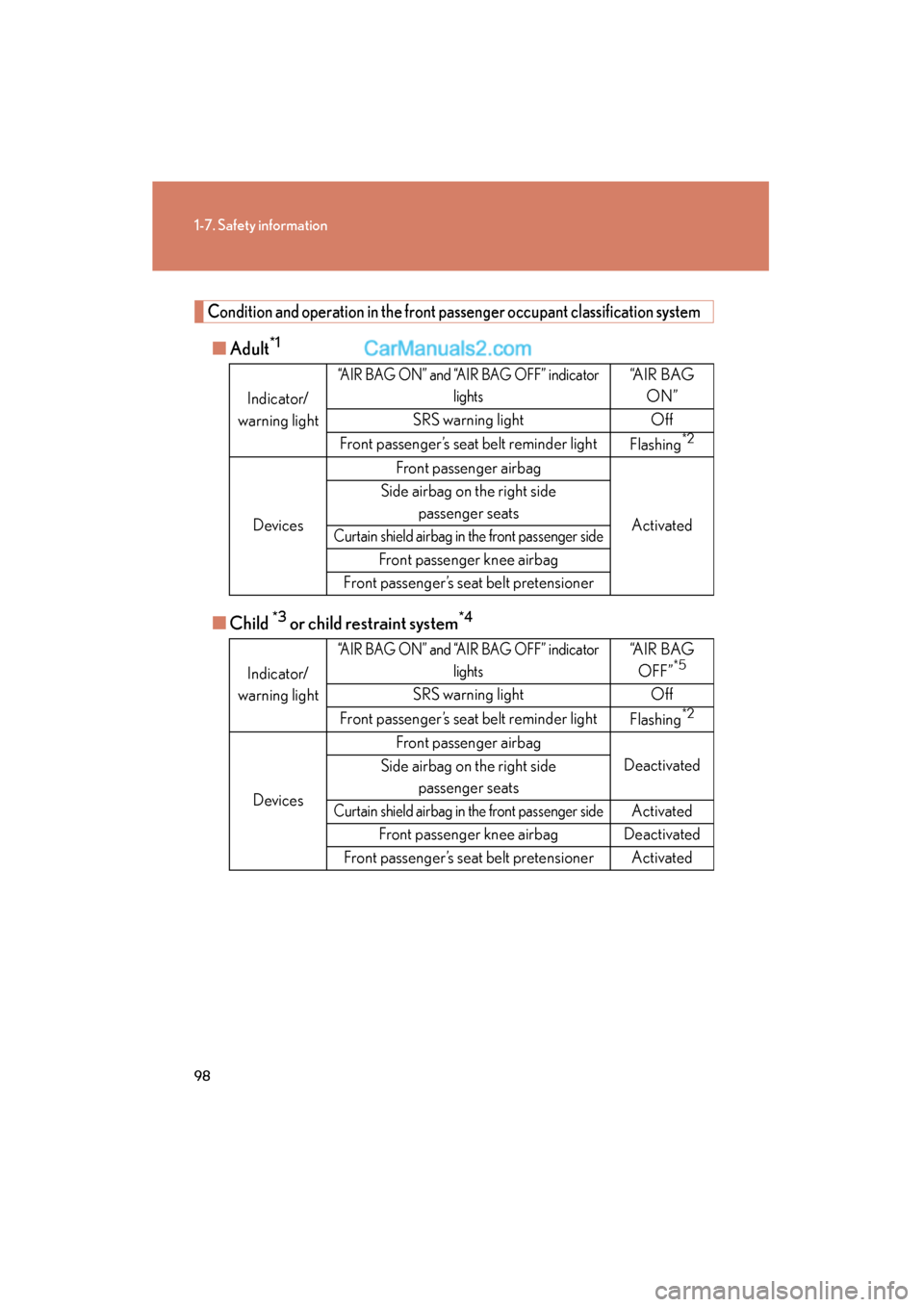
Condition and operation in the front passenger occupant classification system
■Adult*1
■Child *3 or child restraint system*4
Indicator/
warning light
“AIR BAG ON” and “AIR BAG OFF” indicator lights“A I R B A G ON”
SRS warning light Off
Front passenger’s seat belt reminder light Flashing
*2
DevicesFront passenger airbag
Activated
Side airbag on the right side
passenger seatsCurtain shield airbag in the front passenger side
Front passenger knee airbag
Front passenger’s seat belt pretensioner
Indicator/
warning light
“AIR BAG ON” and “AIR BAG OFF” indicator lights“A I R B A G OFF”*5
SRS warning light Off
Front passenger’s seat belt reminder light Flashing
*2
DevicesFront passenger airbag
Deactivated
Side airbag on the right side
passenger seatsCurtain shield airbag in the front passenger sideActivated
Front passenger knee airbag Deactivated
Front passenger’s seat belt pretensioner Activated
Page 101 of 563
99
1-7. Safety information
1
Before driving
ES350_U■
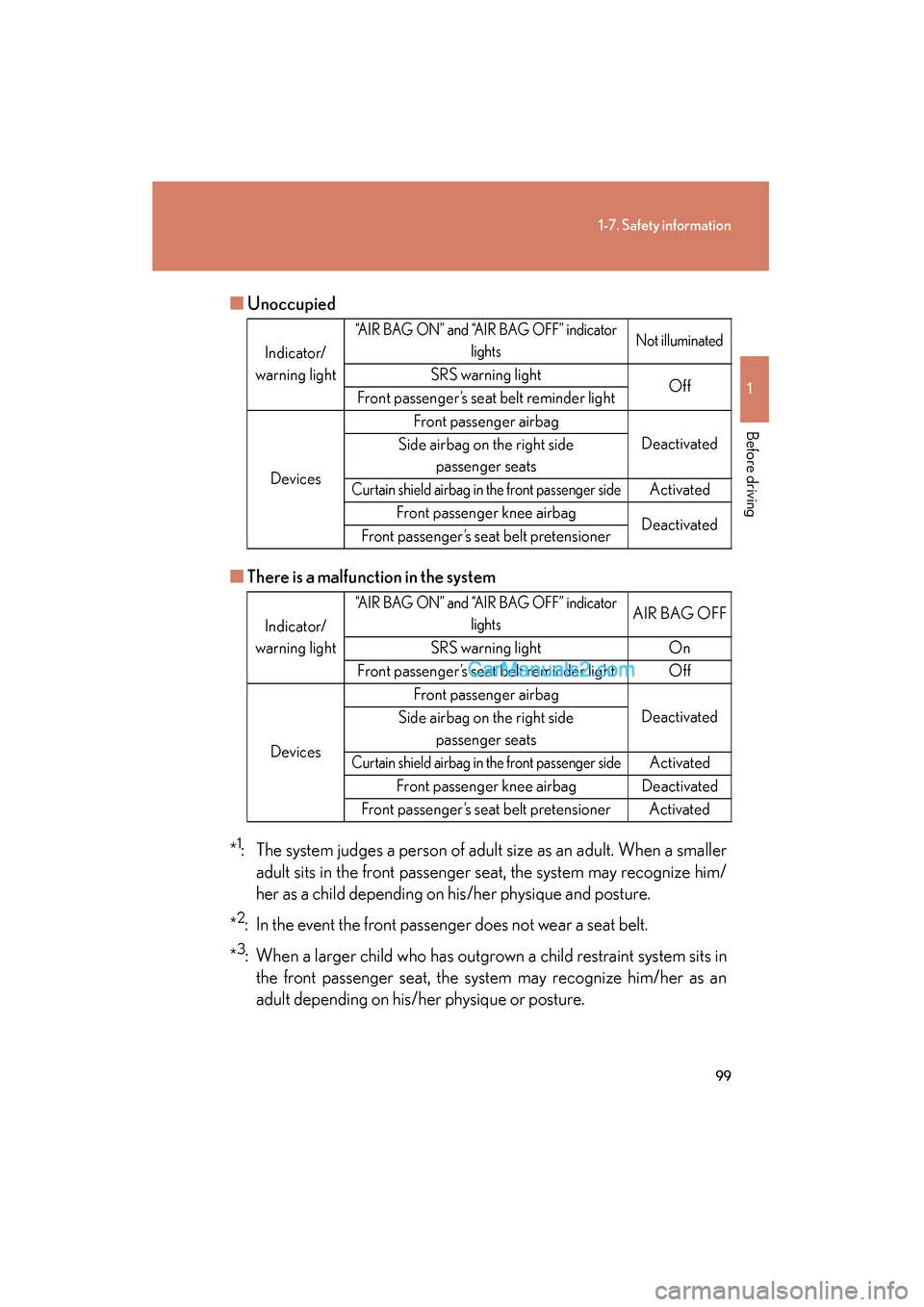
Unoccupied
■ There is a malfunction in the system
*
1: The system judges a person of adult size as an adult. When a smaller adult sits in the front passenger seat, the system may recognize him/
her as a child depending on his/her physique and posture.
*
2: In the event the front passenger does not wear a seat belt.
*
3: When a larger child who has outgrown a child restraint system sits in the front passenger seat, the system may recognize him/her as an
adult depending on his/her physique or posture.
Indicator/
warning light
“AIR BAG ON” and “AIR BAG OFF” indicator lights Not illuminated
SRS warning light
Off
Front passenger’s seat belt reminder light
Devices Front passenger airbag
Deactivated
Side airbag on the right side
passenger seats
Curtain shield airbag in the front passenger sideActivated
Front passenger knee airbag Deactivated
Front passenger’s seat belt pretensioner
Indicator/
warning light
“AIR BAG ON” and “AIR BAG OFF” indicator lightsAIR BAG OFF
SRS warning light On
Front passenger’s seat belt reminder light Off
Devices Front passenger airbag
Deactivated
Side airbag on the right side
passenger seats
Curtain shield airbag in the front passenger sideActivated
Front passenger knee airbag Deactivated
Front passenger’s seat belt pretensioner Activated
Page 119 of 563
When driving2
117
ES350_U
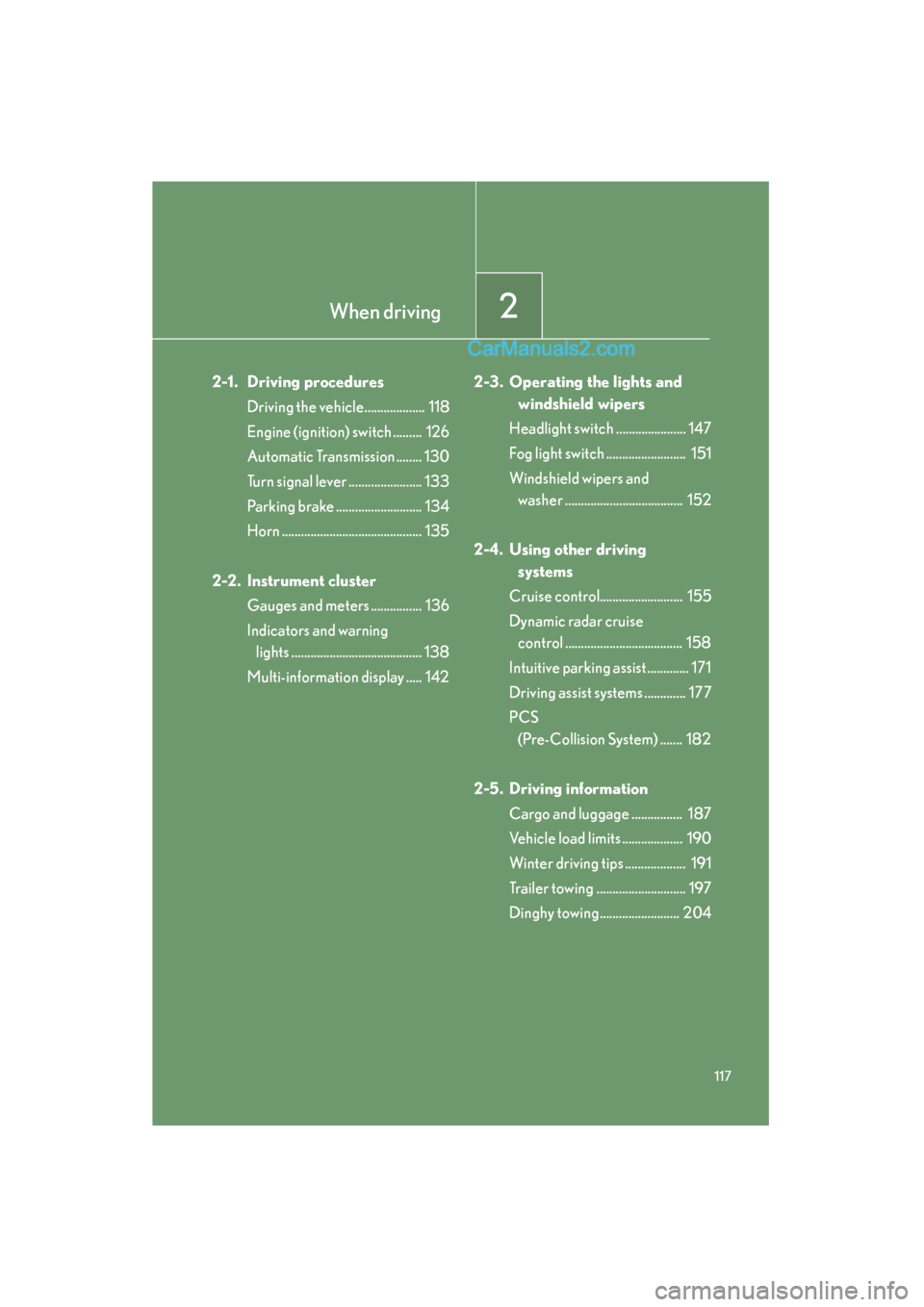
2-1. Driving proceduresDriving the vehicle................... 118
Engine (ignition) switch ......... 126
Automatic Transmission ........ 130
Turn signal lever ....................... 133
Parking brake ........................... 134
Horn ............................................ 135
2-2. Instrument cluster Gauges and meters ................ 136
Indicators and warning lights ......................................... 138
Multi-information display ..... 142 2-3. Operating the lights and
windshield wipers
Headlight switch ...................... 147
Fog light switch ......................... 151
Windshield wipers and washer ..................................... 152
2-4. Using other driving systems
Cruise control.......................... 155
Dynamic radar cruise control ..................................... 158
Intuitive parking assist ............. 171
Driving assist systems ............. 177
PCS (Pre-Collision System) ....... 182
2-5. Driving information Cargo and luggage ................ 187
Vehicle load limits ................... 190
Winter driving tips ................... 191
Trailer towing ............................ 197
Dinghy towing......................... 204
Page 140 of 563
138
2-2. Instrument cluster
ES350_U
Indicators and warning lights
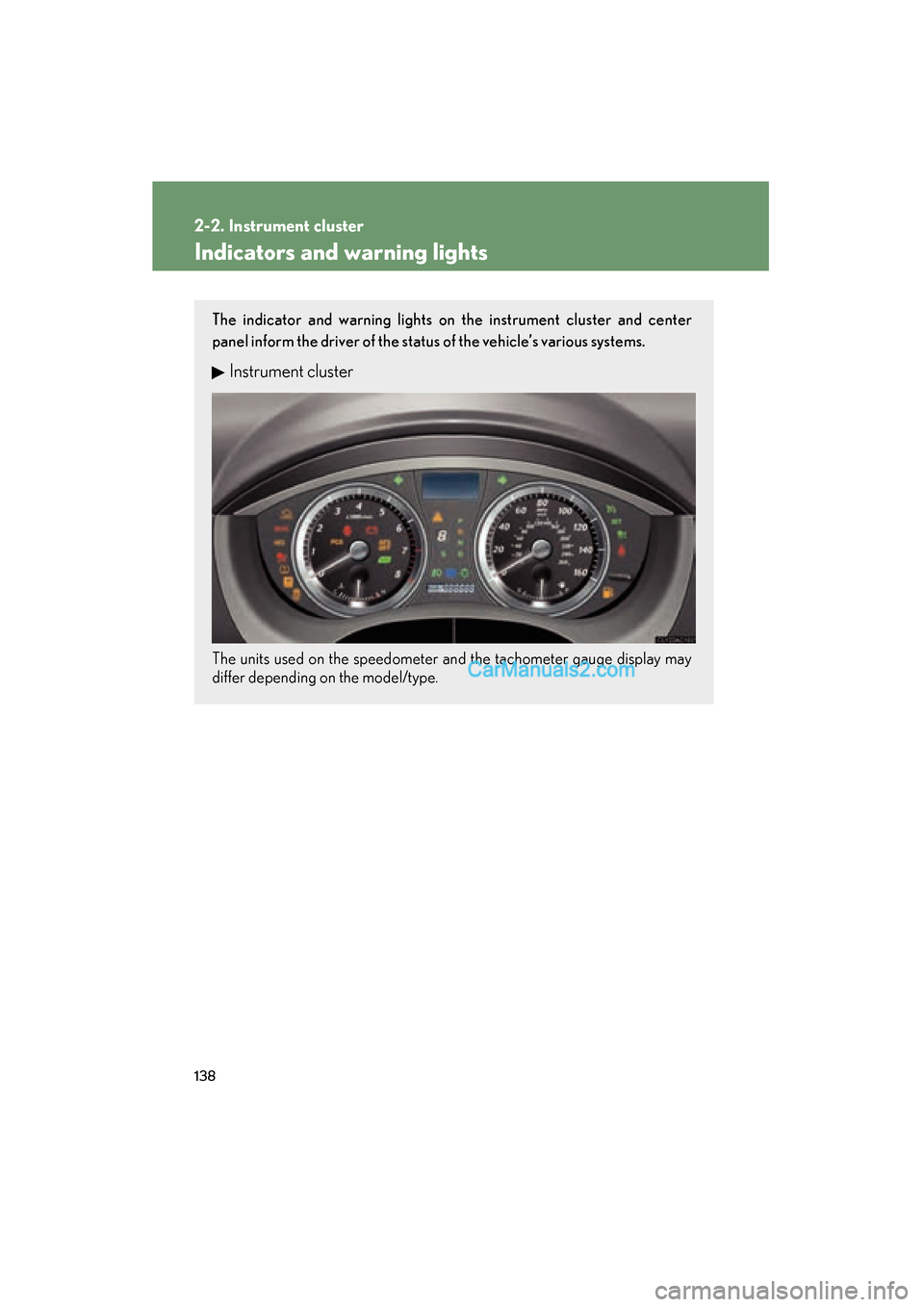
The indicator and warning lights on the instrument cluster and center
panel inform the driver of the status of the vehicle’s various systems.
Instrument cluster
The units used on the speedometer and the tachometer gauge display may
differ depending on the model/type.
Page 143 of 563

141
2-2. Instrument cluster
2
When driving
ES350_U
CAUTION
■If a safety system warning light does not come on
Should a safety system light such as the ABS and SRS airbag warning lights not
come on when you start the engine, this could mean that these systems are not
available to help protect you in an accident, which could result in death or serious
injury. Have the vehicle inspected by your Lexus dealer immediately if this occurs.
■Warning lights
Warning lights inform the driver of malfunctions or suspected prob-
lem in any of the vehicle’s systems. ( →P. 4 4 5 )
*: These lights turn on when the “ENGINE START STOP” switch is turned
to IGNITION ON mode to indicate that a system check is being per-
formed. They will turn off after the engine is started, or after a few sec-
onds. There may be a malfunction in a system if a light does not come on,
or if the lights do not turn off. Have the vehicle inspected by your Lexus
dealer.
(USA)(Canada)(USA)(Canada)
(USA)(Canada)(if equipped)(without
navigation system)(with naviga-
tion system)
******
*****
Page 169 of 563

167
2-4. Using other driving systems
2
When driving
ES350_U
■Warning lights, messages and buzzers for dynamic radar cruise control
Warning lights, messages and buzzers are used to indicate a system malfunction or
to inform the driver of the need for caution while driving. (→P. 455)
■Approach warning
In the following instances, there is a possibility that the warnings will not occur:
●When the speed of the vehicle ahead matches or exceeds your vehicle speed
●When the vehicle ahead is traveling at an extremely slow speed
●Immediately after the cruise control speed was set
●At the instant the accelerator is applied
■Certification
For vehicles sold in U.S.A.
FCC ID: HYQDNMWR005
This device complies with Part 15 of the FCC Rules. Operation is subject to the fol-
lowing two conditions;
(1) This device may not cause harmful interference, and
(2) This device must accept any interference received, including interference that
may cause undesired operation.
FCC WARNING:
Changes or modifications not expressly approved by the party responsible for
compliance could void the user's authority to operate the equipment.
Radio frequency radiation exposure Information:
This equipment complies with FCC radiatio n exposure limits set forth for an uncon-
trolled environment.
This equipment should be installed and operated with minimum distance of 20 cm
between the radiator and your body.
This transmitter must not be co-located or operating in conjunction with any other
antenna or transmitter
For vehicles sold in Canada
Operation is subject to the following two conditions;
(1) This device may not cause interference, and
(2) This device must accept any interference, including interference that may cause
undesired operation of the device.
Page 186 of 563
184
2-4. Using other driving systems
ES350_U
●When climbing a steep hill causes an overhead billboard or other metallic struc-
ture to appear directly in the vehicle's line of travel.
●When an extreme change in vehicle height occurs
●When the axis of the radar is out of adjustment
●When passing through certain toll gates
When the system is activated in the situations described above there is also a possi-
bility that the seat belts will retract quickly and the brakes will be applied with a force
greater than normal. When the seat belt is locked in the retracted position, stop the
vehicle in a safe place, release the seat belt and refasten.
■Situations in which the pre-collision system does not function properly
The system may not function effectively in situations such as the following:
●On roads with sharp bends or uneven surfaces
●On slippery roads such as those covered with ice or snow
●If a vehicle suddenly moves in front of your vehicle, such as at an intersection
●If a vehicle suddenly cuts in front of your vehicle, such as when overtaking
●In inclement weather such as heavy rain, fog, snow or sand storms
■Automatic cancelation of the pre-collision system
When a malfunction occurs due to sensor contamination, etc. that results in the
sensors being unable to detect obstacles, the pre-collision system will be automati-
cally disabled. In this case, the system will not activate even if there is a collision pos-
sibility.
■When there is a malfunction in the system
Warning lights and/or warning messages will turn on or flash. ( →P. 445, 455)