ECT Lexus ES350 2012 Owner's Manual
[x] Cancel search | Manufacturer: LEXUS, Model Year: 2012, Model line: ES350, Model: Lexus ES350 2012Pages: 554, PDF Size: 6.43 MB
Page 384 of 554
383
4-3. Do-it-yourself maintenance
4
Maintenance and care
ES350_U
■If the coolant level drops within a short time after replenishing
Visually check the radiator, hoses, engine coolant filler cap, radiator cap, drain cock
and water pump.
If you cannot find a leak, have your Lexus dealer pressure test the cap and check for
leaks in the cooling system.
■Coolant selection
Only use “Toyota Super Long Life Coolant” or similar high quality ethylene glycol
based non-silicate, non-amine, non-nitrite, and non-borate coolant with long-life
hybrid organic acid technology.USA: “Toyota Super Long Life Coolant” is a mixture of 50% coolant and 50% deionized water. (Enabled: -31 °F [-35 °C])
Canada: “Toyota Super Long Life Coolant” is a mixture of 55% coolant and 45%
deionized water. (Enabled: -44 °F [-42 °C])
For more details about engine coolant, contact your Lexus dealer.
CAUTION
■When the engine is hot
Do not remove the radiator cap.
The cooling system may be under pressure and may spray hot coolant if the cap is
removed, causing serious injuries, such as burns.
NOTICE
■When adding engine coolant
Coolant is neither plain water not straight antifreeze. The correct mixture of water
and anti freeze must be used to provide proper lubrication, corrosion protection
and cooling. Be sure to read the antifreeze or coolant label.
■If you spill coolant
Be sure to wash it off with water to prevent damage to parts or paint.
Page 385 of 554
384
4-3. Do-it-yourself maintenance
ES350_U
Radiator and condenserCheck the radiator and condenser and clear any foreign objects.
If either of the above parts are extremely dirty or you are not sure of their
condition, have your vehicle checked by your Lexus dealer.
Brake fluid■ Checking fluid level
The brake fluid level should be
between the “MAX” and “MIN”
lines on the tank.
Make sure to check the fluid type and prepare the necessary items.
■ Adding fluid
CAUTION
■When the engine is hot
Do not touch the radiator or condenser as they may be hot and cause serious inju-
ries, such as burns.
Fluid typeFMVSS No.116 DOT 3 or SAE J1703 brake fluid
ItemsClean funnel
■Brake fluid can absorb moisture from the air
Excess moisture in the fluid can cause a dangerous loss of braking efficiency. Use
only newly opened brake fluid.
Page 387 of 554
386
4-3. Do-it-yourself maintenance
ES350_U■
Checking the fluid level
Make sure to check the fluid type and prepare the necessary items.
Clean all dirt off the reservoir.
Remove the reservoir cap by turning it counterclockwise and
wipe the dipstick clean.
Reinstall the reservoir cap.
Remove the reservoir cap again and look at the fluid level.
Fluid typeAutomatic transmission fluid DEXRON II or III
ItemsRag or paper towel and funnel (only for adding fluid)
CAUTION
■Checking the fluid level
Take care, as the reservoir may be hot.
NOTICE
■When adding fluid
Avoid overfilling, or the power steering may be damaged.
■After replacing the reservoir cap
Check the steering box case, vane pump and hose connections for leaks or dam-
age.
STEP1
STEP2
STEP3
STEP4
Page 388 of 554
387
4-3. Do-it-yourself maintenance
4
Maintenance and care
ES350_U
BatteryCheck the battery as follows.
■ Battery exterior
Make sure that the battery terminals are not corroded and that there
are no loose connections, cracks, or loose clamps.
Te r m i n a l s
Hold-down clamp
■Before recharging
When recharging, the battery produces hydrogen gas which is flammable and
explosive. Therefore, before recharging:
●If recharging with the battery installed on the vehicle, be sure to disconnect the
ground cable.
●Make sure the power switch on the charger is off when connecting and discon-
necting the charger cables to the battery.
■After recharging the battery
The engine may not start. Follow the procedure below to initialize the system.Shift the shift lever to P.
Open and close any of the doors.
Restart the engine.
STEP1
STEP2
STEP3
Page 389 of 554
388
4-3. Do-it-yourself maintenance
ES350_U
CAUTION
■Chemicals in the battery
A battery contains poisonous and corrosive sulfuric acid and may produce hydro-
gen gas which is flammable and explosive. To reduce the risk of death or serious
injury, take the following precautions while working on or near battery:
●Do not cause sparks by touching the battery terminals with tools.
●Do not smoke or light a match near the battery.
●Avoid contact with eyes, skin and clothes.
●Never inhale or swallow electrolyte.
●Wear protective safety glasses when working near the battery.
●Keep children away from the battery.
■Where to safely charge the battery
Always charge the battery in an open area. Do not charge the battery in a garage or
closed room where there is not sufficient ventilation.
■How to recharge the battery
Only perform a slow charge (5 A or less). The battery may explode if charged at a
quicker rate.
■Emergency measures regarding electrolyte
●If electrolyte gets in your eyes
Flush your eyes with clean water for at least 15 minutes and get immediate medi-
cal attention. If possible, continue to apply water with a sponge or cloth while
traveling to the nearest medical facility.
●If electrolyte gets on your skin
Wash the affected area thoroughly. If you feel pain or burning, get medical atten-
tion immediately.
●If electrolyte gets on your clothes
It can soak through clothing on to your skin. Immediately take off the clothing and
follow the procedure above if necessary.
●If you accidentally swallow electrolyte
Drink a large quantity of water or milk. Get emergency medical attention imme-
diately.
Page 391 of 554
390
4-3. Do-it-yourself maintenance
ES350_U
Tires
Replace or rotate tires in accordance with maintenance schedules and
treadwear.
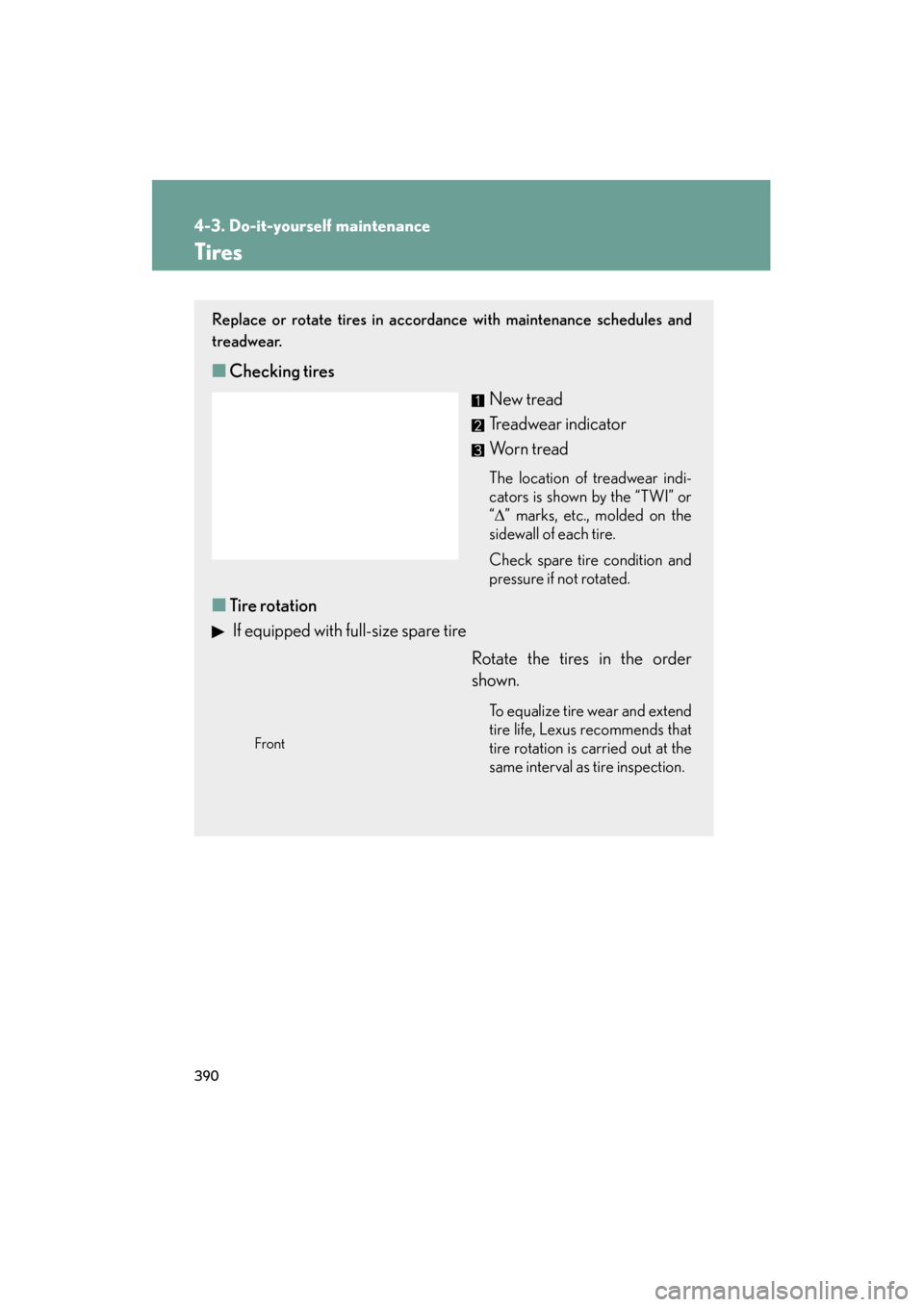
■Checking tires
New tread
Treadwear indicator
Worn tread
The location of treadwear indi-
cators is shown by the “TWI” or
“∆ ” marks, etc., molded on the
sidewall of each tire.
Check spare tire condition and
pressure if not rotated.
■ Tire rotation
If equipped with full-size spare tire
Rotate the tires in the order
shown.
To equalize tire wear and extend
tire life, Lexus recommends that
tire rotation is carried out at the
same interval as tire inspection.
Front
Page 392 of 554
391
4-3. Do-it-yourself maintenance
4
Maintenance and care
ES350_U
Installing tire pressure warning valves and transmitters
When replacing tires or wheels, tire pressure warning valves and trans-
mitters must also be installed.
When new tire pressure warning valves and transmitters are installed,
new tire pressure warning valve and transmitter ID codes must be regis-
tered in the tire pressure warning computer and tire pressure warning
system must be initialized. Have tire pressure warning valve and transmit-
ter ID codes registered by your Lexus dealer. ( →P. 393)
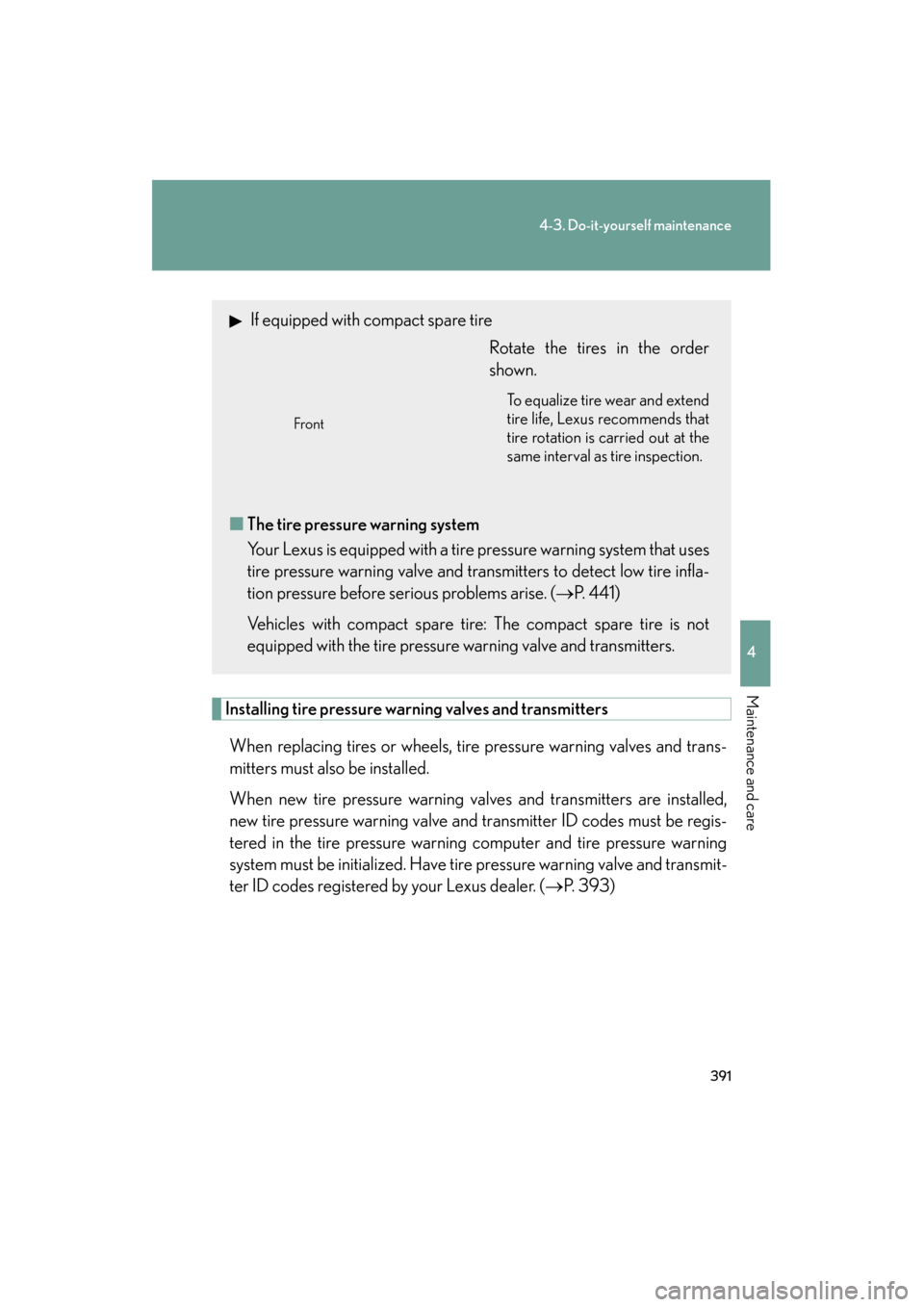
If equipped with compact spare tire
Rotate the tires in the order
shown.
To equalize tire wear and extend
tire life, Lexus recommends that
tire rotation is carried out at the
same interval as tire inspection.
■The tire pressure warning system
Your Lexus is equipped with a tire pressure warning system that uses
tire pressure warning valve and transmitters to detect low tire infla-
tion pressure before serious problems arise. ( →P. 441)
Vehicles with compact spare tire: The compact spare tire is not
equipped with the tire pressure warning valve and transmitters.
Front
Page 394 of 554
393
4-3. Do-it-yourself maintenance
4
Maintenance and care
ES350_U
Registering and selecting ID codes
■ Registering ID codes
2 sets of tire pressure warning valve and transmitter ID codes can be
registered. Once a second set of tires is registered at “2nd”, you can
switch between tire set settings simply by pressing the tire pressure
warning select switch.
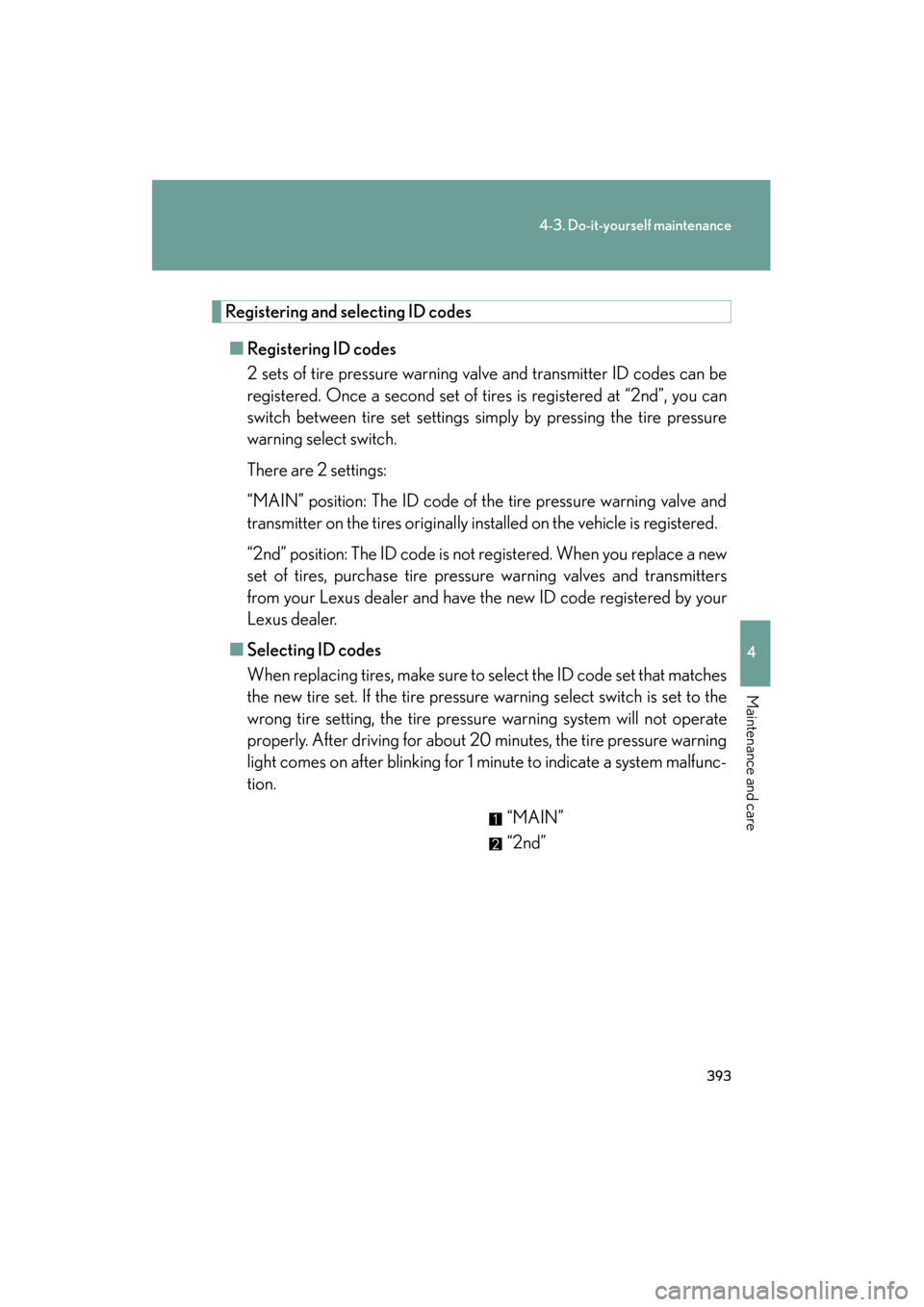
There are 2 settings:
“MAIN” position: The ID code of the tire pressure warning valve and
transmitter on the tires originally installed on the vehicle is registered.
“2nd” position: The ID code is not registered. When you replace a new
set of tires, purchase tire pressure warning valves and transmitters
from your Lexus dealer and have the new ID code registered by your
Lexus dealer.
■ Selecting ID codes
When replacing tires, make sure to select the ID code set that matches
the new tire set. If the tire pressure warning select switch is set to the
wrong tire setting, the tire pressure warning system will not operate
properly. After driving for about 20 minutes, the tire pressure warning
light comes on after blinking for 1 minute to indicate a system malfunc-
tion.
“MAIN”
“2nd”
Page 395 of 554
394
4-3. Do-it-yourself maintenance
ES350_U
■When to replace your vehicle’s tires
Tires should be replaced if:
●You have tire damage such as cuts, splits, cracks deep enough to expose the
fabric or bulges indicating internal damage
●A tire goes flat repeatedly or cannot be properly repaired due to the size or
location of a cut or other damage
If you are not sure, consult with your Lexus dealer.
■Replacing tires and wheels
If the ID code of the tire pressure warning valve and transmitter is not registered,
the tire pressure warning system will not work properly. After driving for about 20
minutes, the tire pressure warning light come s on after blinking for 1 minute to indi-
cate a system malfunction.
■Tire lif e
Any tire over 6 years old must be checked by a qualified technician even if they
have seldom or never been used or damage is not obvious.
■If the tread wears down below 0.16 in. (4 mm) on snow tires
The effectiveness of snow tires is lost.
■Maximum load of tire
Check that the maximum load of the replacement tire is greater than 1 /2 of the
Gross Axle Weight Ratings (GAWR) of either the front axle or the rear axle, which-
ever is greater.
For the GAWR, see the Certification Label.
For the maximum load of the tire, see the load
limit at maximum cold tire inflation pressure
mentioned on the sidewall of the tire.
(
→P. 499).
Page 396 of 554
395
4-3. Do-it-yourself maintenance
4
Maintenance and care
ES350_U
■Tire types
1 Summer tiresSummer tires are high-speed performance tires best suited to highway driving
under dry conditions. Since summer tires do not have the same traction perfor-
mance as snow tires, summer tires are inadequate for driving on snow-covered
or icy roads. For driving on snow-covered roads or icy roads, the use of snow tires
is recommended. When installing snow tires, be sure to replace all four tires.
2 All season tires All season tires are designed to provide better traction in snow and to be ade-
quate for driving in most winter conditions, as well as for use year round. All sea-
son tires, however, do not have adequate traction performance compared with
snow tires in heavy or loose snow. Also, all season tires fall short in acceleration
and handling performance compared wi th summer tires in highway driving.
3Snow tires For driving on snow-covered roads or icy roads, we recommend using snow tires.
If you need snow tires, select tires of the same size, construction and load capac-
ity as the originally installed tires. Since your vehicle has radial tires as original
equipment, make sure your snow tires also have radial construction. Do not install
studded tires without first checking lo cal regulations for possible restriction.
Snow tires should be installed on all wheels. ( →P. 1 9 6 )
■Initializing the tire pressure warning system
Initialize the tire pressure warning system with the tire inflation pressure adjusted to
the specified level.
■If you push the tire pressure reset switch accidentally
If initialization is performed, adjust the tire inflation pressure to the specified level
and initialize the tire pressure warning system again.
■When the initialization of the tire pressure warning system has failed
Initialization can be completed in a few minutes. However, in the following cases,
the settings have not been recorded and the system will not operate properly. If
repeated attempts to record tire inflation pressure settings are unsuccessful, have
the vehicle inspected by your Lexus dealer.
●When operating the tire pressure warning reset switch, the tire pressure warning
light does not blink 3 times.
●After carrying out the initialization procedure, the tire pressure warning light
blinks for 1 minute then stays on after driving for about 20 minutes.