belt Lexus ES350 2012 Service Manual
[x] Cancel search | Manufacturer: LEXUS, Model Year: 2012, Model line: ES350, Model: Lexus ES350 2012Pages: 554, PDF Size: 6.43 MB
Page 188 of 554
187
2-4. Using other driving systems
2
When driving
ES350_U
PCS (Pre-Collision System)∗
Radar sensorDetects vehicles or other obsta-
cles on or near the road ahead and
determines whether a collision is
imminent based on the position,
speed, and heading of the obsta-
cles. Grille cover
Radar sensor
When the radar sensor detects possibility of a frontal collision, the pre-col-
lision system such as the brake assi st and seat belts are automatically
engaged to lessen impact and injuries to occupants as well as vehicle dam-
age.
■ Pre-collision seat belts
If the pre-collision sensor detects that a collision is unavoidable, the pre-
collision system will retract the seat belt before the collision occurs.
The same will happen if the driver makes an emergency braking or loses
control of the vehicle. ( →P. 6 1 )
However, when the VSC systems are disabled, the system will not operate
in the event of skidding.
■ Pre-collision brake assist
When there is a high possibility of a frontal collision, the system applies
greater braking force in relation to how strongly the brake pedal is
depressed.
∗: If equipped
Page 189 of 554
188
2-4. Using other driving systems
ES350_U
■Obstacles not detected
The sensor cannot detect plastic obstacles such as pylons. There may also be occa-
sions when the sensor cannot detect pedestrians, animals, bicycles, motorcycles,
trees, or snowdrifts.
■The pre-collision system is operational when
●Pre-collision seat belt (type A)
• Vehicle speed is above 4 mph (5 km/h).
• The speed at which your vehicle is approaching the obstacle or oncomingvehicle exceeds 19 mph (30 km/h).
• The front occupants are wearing a seat belt.
●Pre-collision seat belts (type B)
• Vehicle speed is above 19 mph (30 km/h).
• The system detects sudden braking or skidding.
• The front occupants are wearing a seat belt.
●Pre-collision brake assist
• Vehicle speed is above 19 mph (30 km/h).
• The speed at which your vehicle is approaching the obstacle or the vehicle is greater than about 19 mph (30 km/h).
• The brake pedal is depressed.
■Conditions that may trigger the system even if there is no possibility of co llision
●When there is an object by the roadside at the entrance to a curve
●When passing an oncoming vehicle on a curve
●When driving over a narrow iron bridge
●When there is a metal object on the road surface
●When there is a metal plate in the road in front of the vehicle on a downhill slope
●When there is a metal object such as a sign board in front of the vehicle on an
uphill slope
●When driving on an uneven road surface
●When passing an oncoming vehicle on a left-turn
●When your vehicle rapidly closes on the vehicle in front
●When a grade separation/interchange, sign, billboard, or other structure
appears to be directly in the vehicle's line of travel.
Page 190 of 554
189
2-4. Using other driving systems
2
When driving
ES350_U
●When climbing a steep hill causes an overhead billboard or other metallic struc-
ture to appear directly in the vehicle's line of travel.
●When an extreme change in vehicle height occurs
●When the axis of the radar is out of adjustment
●When passing through certain toll gates
When the system is activated in the situations described above there is also a possi-
bility that the seat belts will retract quickly and the brakes will be applied with a force
greater than normal. When the seat belt is locked in the retracted position, stop the
vehicle in a safe place, release the seat belt and refasten.
■Situations in which the pre-collision system does not function properly
The system may not function effectively in situations such as the following:
●On roads with sharp bends or uneven surfaces
●On slippery roads such as those covered with ice or snow
●If a vehicle suddenly moves in front of your vehicle, such as at an intersection
●If a vehicle suddenly cuts in front of your vehicle, such as when overtaking
●In inclement weather such as heavy rain, fog, snow or sand storms
■Automatic cancelation of the pre-collision system
When a malfunction occurs due to sensor contamination, etc. that results in the
sensors being unable to detect obstacles, the pre-collision system will be automati-
cally disabled. In this case, the system will not activate even if there is a collision pos-
sibility.
■When there is a malfunction in the system
Warning lights and/or warning messages will turn on or flash. ( →P. 439, 449)
Page 363 of 554
362
4-1. Maintenance and care
ES350_U
■Caring for leather areas
Lexus recommends cleaning the interior of the vehicle at least twice a year to main-
tain the quality of the vehicle’s interior.
■Shampooing the carpets
There are several commercial foaming-type cleaners available. Use a sponge or
brush to apply the foam. Rub in overlapping circles. Do not apply water. The excel-
lent results are obtained by keeping the carpet as dry as possible.
■Seat belts
Clean with mild soap and lukewarm water using a cloth or sponge. Also check the
belts periodically for excessive wear, fraying or cuts.
CAUTION
■Water in the vehicle
●Do not splash or spill liquid in the vehicle.
Doing so may cause electrical components etc. to malfunction or catch fire.
●Do not get any of the SRS components or wiring in the vehicle interior wet.
(→ P. 8 8 )
Electrical malfunction may cause the airbags to deploy or not function properly,
resulting in death or severe injury.
■Cleaning the interior (especially instrument panel)
Do not use polish wax or polish cleaner. The instrument panel may reflect off the
windshield, obstructing the driver's view and leading to an accident, resulting in
death or serious injury.
Page 368 of 554
367
4-2. Maintenance
4
Maintenance and care
ES350_U
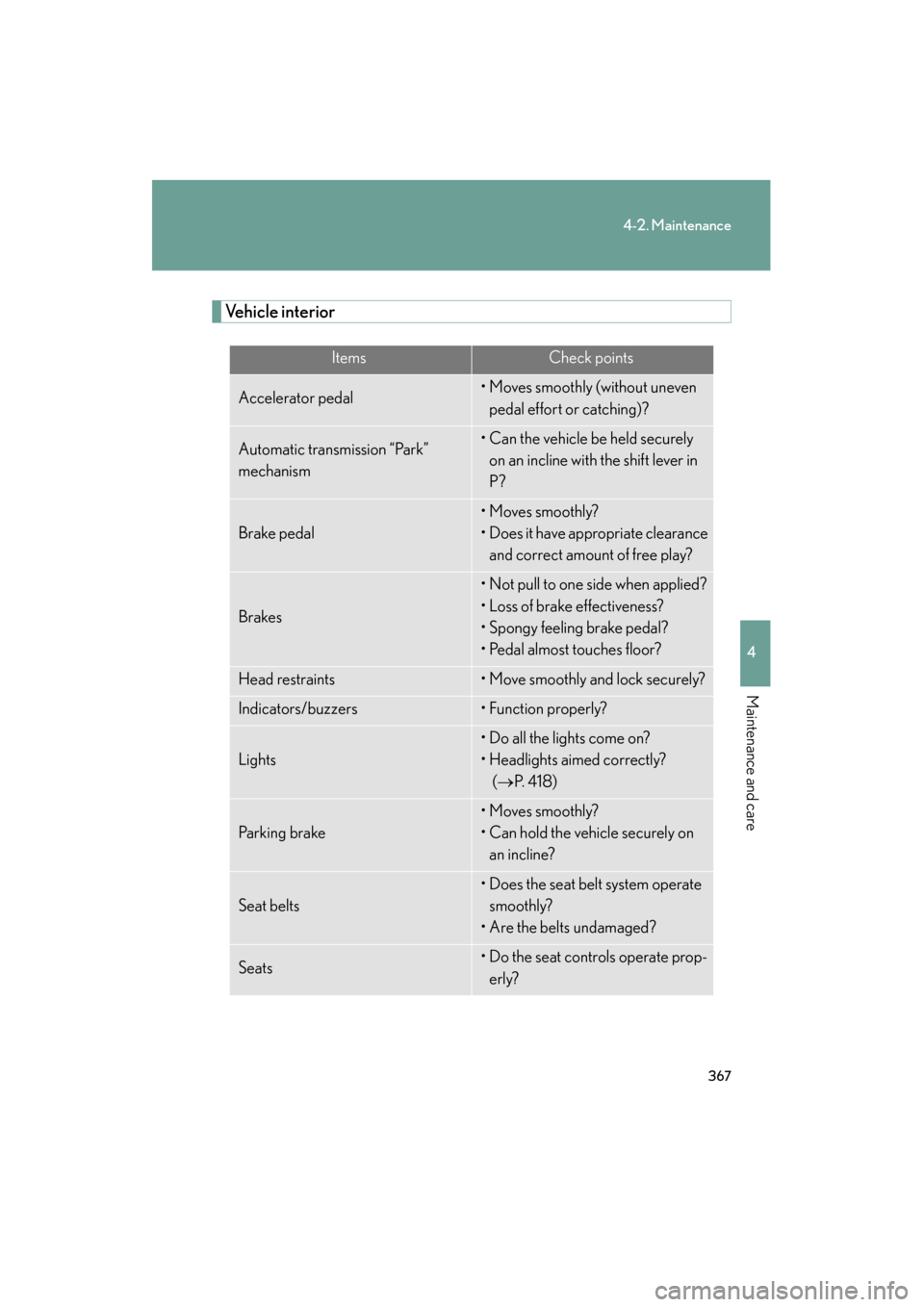
Vehicle interior
ItemsCheck points
Accelerator pedal• Moves smoothly (without uneven pedal effort or catching)?
Automatic transmission “Park”
mechanism• Can the vehicle be held securely on an incline with the shift lever in
P?
Brake pedal
• Moves smoothly?
• Does it have appropriate clearance and correct amount of free play?
Brakes
• Not pull to one side when applied?
• Loss of brake effectiveness?
• Spongy feeling brake pedal?
• Pedal almost touches floor?
Head restraints• Move smoothly and lock securely?
Indicators/buzzers•Function properly?
Lights
• Do all the lights come on?
• Headlights aimed correctly? (→ P. 4 1 8 )
Pa r k i n g b r a ke
• Moves smoothly?
• Can hold the vehicle securely on
an incline?
Seat belts
• Does the seat belt system operate smoothly?
• Are the belts undamaged?
Seats• Do the seat controls operate prop- erly?
Page 373 of 554
372
4-3. Do-it-yourself maintenance
ES350_U
CAUTION
The engine compartment contains many mechanisms and fluids that may move sud-
denly, become hot, or become electrically energized. To avoid death or serious injury.
■When working on the engine compartment:
●Keep hands, clothing, and tools away from the moving fan and engine drive belt.
●Be careful not to touch the engine, radiator, exhaust manifold, etc. right after driv-
ing as they may be hot. Oil and other fluids may also be hot.
●Do not leave anything that may burn easily, such as paper or rags, in the engine
compartment.
●Do not smoke, cause sparks or expose an open flame to fuel or the battery. Fuel
and battery fumes are flammable.
●Be extremely cautious when working on the battery. It contains poisonous and
corrosive sulfuric acid.
●Take care because brake fluid can harm your hands or eyes and damage painted
surfaces.
If fluid gets on your hands or in your eyes, flush the affected area with clean water
immediately.
If you still experience discomfort, see a doctor.
■When working near the electric cooling fan or radiator grille:
Be sure the “ENGINE START STOP” switch is OFF.
With the “ENGINE START STOP” switch in IGNITION ON mode, the electric
cooling fan may automatically start to run if the air conditioning is on and/or the
coolant temperature is high. (→P. 3 8 4 )
■Safety glasses
Wear safety glasses to prevent flying or falling material, fluid spray, etc. from getting
in the eyes.
Page 398 of 554
397
4-3. Do-it-yourself maintenance
4
Maintenance and care
ES350_U
CAUTION
■When inspecting or replacing tires
Observe the following precautions to prevent accidents.
Failure to do so may cause damage to parts of the drive train, as well as dangerous
handling characteristics, which may lead to an accident resulting in death or serious
injury.
●Do not mix tires of different makes, models or tread patterns. Also, do not mix
tires of remarkably different treadwear.
●Do not use tire sizes other than those recommended by Lexus.
●Do not mix differently constructed tires (radial, bias-belted or bias-ply tires).
●Do not mix summer, all season and winter tires.
●Do not tow the vehicle with the compact spare tire installed.
■When initializing the tire pressure warning system
Do not push the tire pressure warning reset switch without first adjusting the tire
inflation pressure to the specified level. Otherwise, the tire pressure warning light
may not come on even if the tire inflation pressure is low, or it may come on when
the tire inflation pressure is actually normal.
Page 413 of 554
412
4-3. Do-it-yourself maintenance
ES350_U
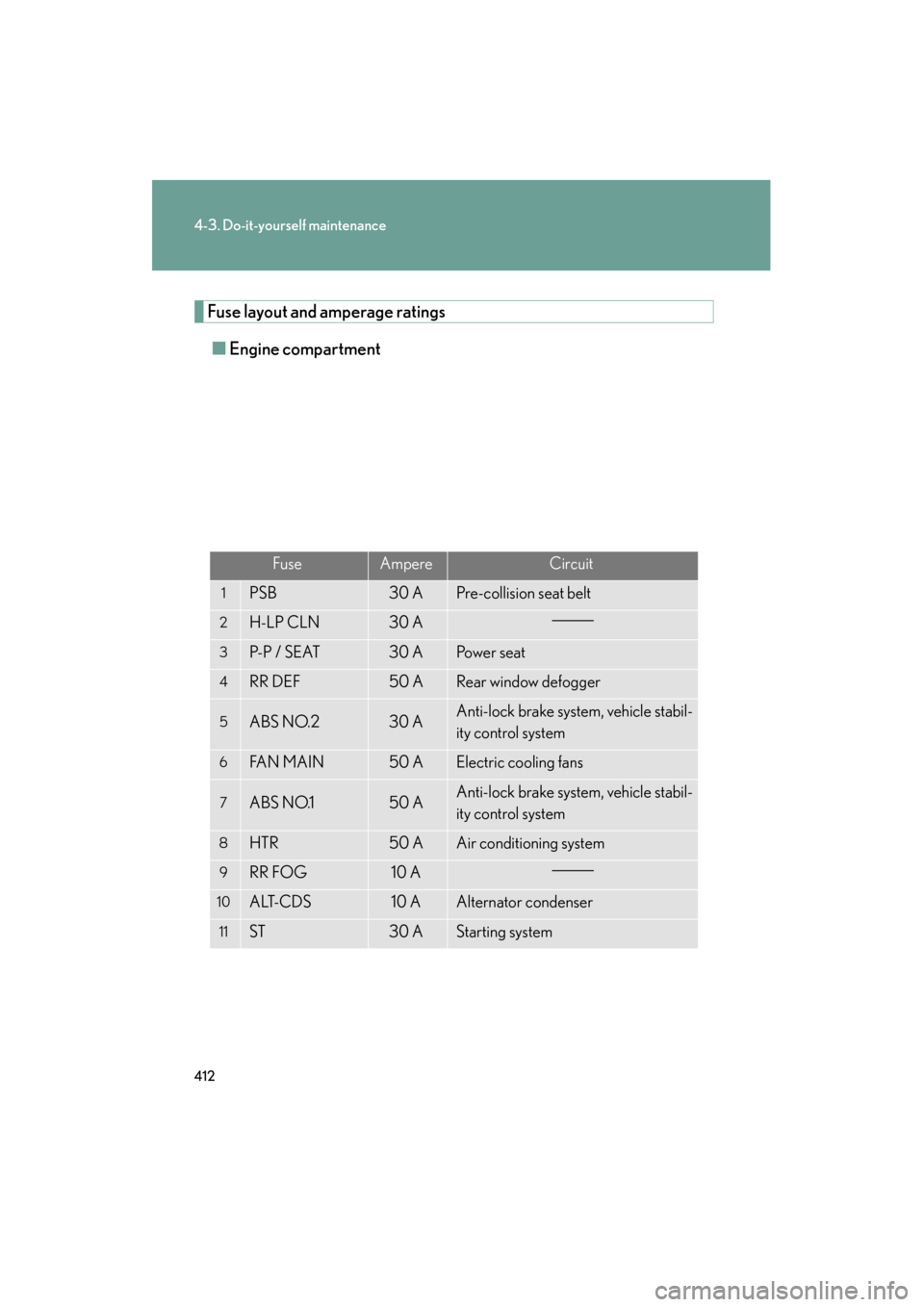
Fuse layout and amperage ratings■ Engine compartment
FuseAmpereCircuit
1PSB30 APre-collision seat belt
2H-LP CLN30 A
3P- P / S E AT30 APo w e r s e a t
4RR DEF50 ARear window defogger
5ABS NO.230 AAnti-lock brake system, vehicle stabil-
ity control system
6FA N M A I N50 AElectric cooling fans
7ABS NO.150 AAnti-lock brake system, vehicle stabil-
ity control system
8HTR50 AAir conditioning system
9RR FOG10 A
10ALT-CDS10 AAlternator condenser
11ST30 AStarting system
Page 441 of 554
440
5-2. Steps to take in an emergency
ES350_U
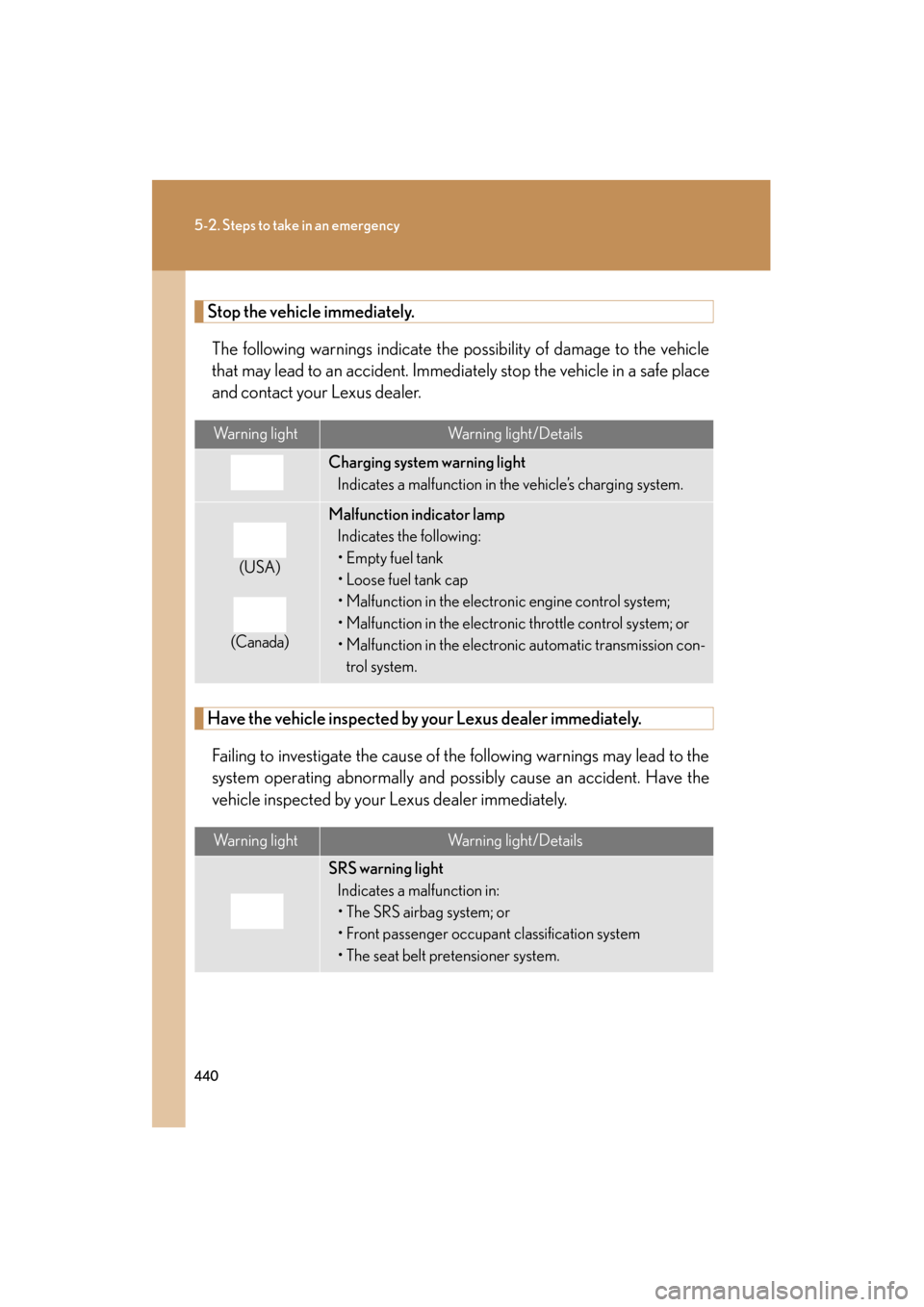
Stop the vehicle immediately.
The following warnings indicate the possibility of damage to the vehicle
that may lead to an accident. Immediately stop the vehicle in a safe place
and contact your Lexus dealer.
Have the vehicle inspected by your Lexus dealer immediately. Failing to investigate the cause of the following warnings may lead to the
system operating abnormally and possibly cause an accident. Have the
vehicle inspected by your Lexus dealer immediately.
Warning lightWarning light/Details
Charging system warning light Indicates a malfunction in the vehicle’s charging system.
(USA)
(Canada)
Malfunction indicator lampIndicates the following:
•Empty fuel tank
• Loose fuel tank cap
• Malfunction in the electronic engine control system;
• Malfunction in the electronic throttle control system; or
• Malfunction in the electronic automatic transmission con-trol system.
Warning lightWarning light/Details
SRS warning light Indicates a malfunction in:
• The SRS airbag system; or
• Front passenger occupant classification system
• The seat belt pretensioner system.
Page 442 of 554
5
When trouble arises
441
5-2. Steps to take in an emergency
ES350_U
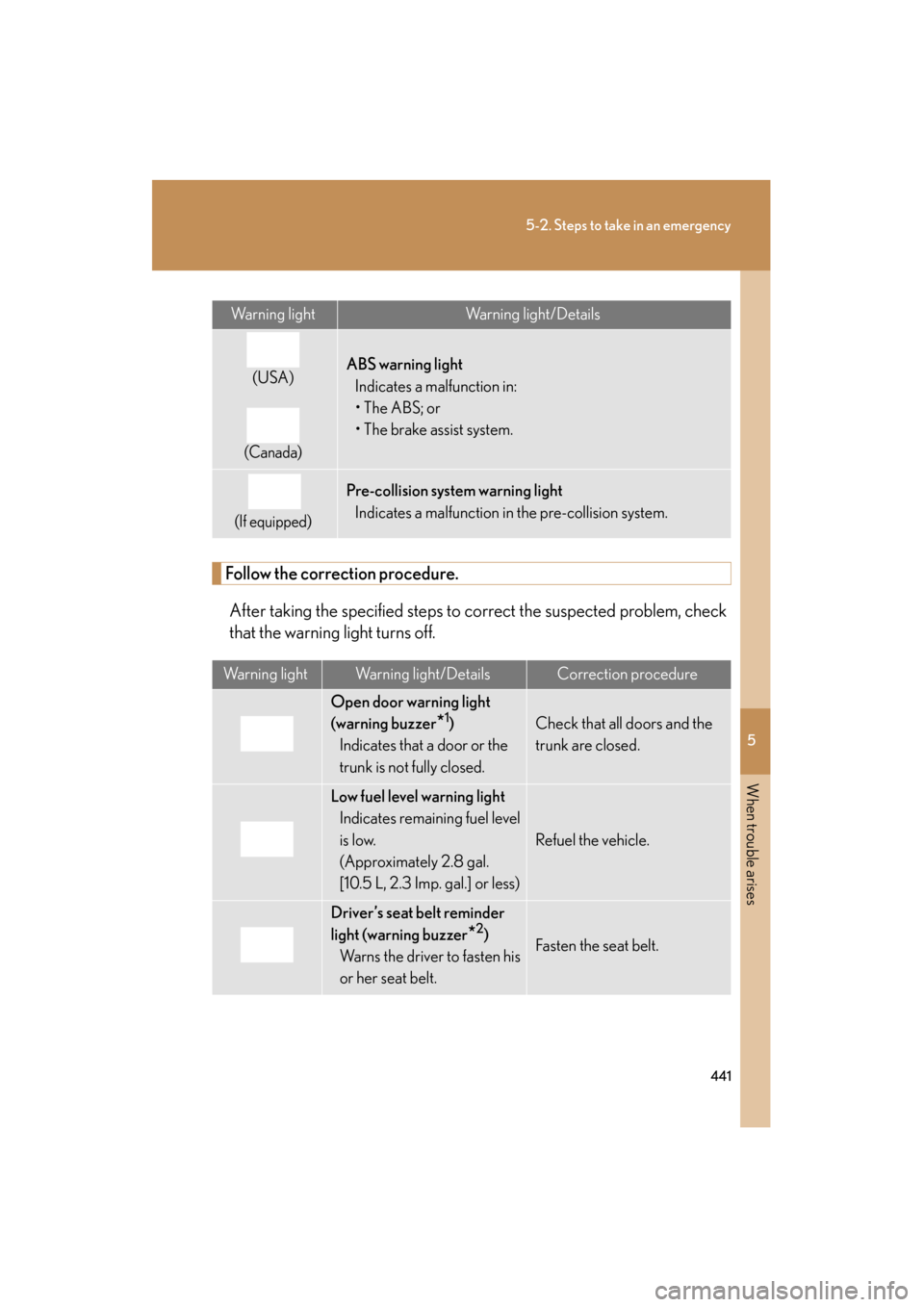
Follow the correction procedure.After taking the specified steps to co rrect the suspected problem, check
that the warning light turns off.
Warning lightWarning light/Details
(USA)
(Canada)
ABS warning light
Indicates a malfunction in:
•The ABS; or
• The brake assist system.
(If equipped)
Pre-collision system warning lightIndicates a malfunction in the pre-collision system.
Warning lightWarning light/DetailsCorrection procedure
Open door warning light
(warning buzzer
*1)
Indicates that a door or the
trunk is not fully closed.Check that all doors and the
trunk are closed.
Low fuel level warning light
Indicates remaining fuel level
is low.
(Approximately 2.8 gal.
[10.5 L, 2.3 Imp. gal.] or less)
Refuel the vehicle.
Driver’s seat belt reminder
light (warning buzzer
*2)
Warns the driver to fasten his
or her seat belt.Fasten the seat belt.