brake Lexus ES350 2015 Repair Manual
[x] Cancel search | Manufacturer: LEXUS, Model Year: 2015, Model line: ES350, Model: Lexus ES350 2015Pages: 784, PDF Size: 11.04 MB
Page 544 of 784
544
ES350_300h_OM_OM33B99U_(U)
7-3. Do-it-yourself maintenance
CAUTION
■When raising your vehicle
Make sure to observe the following precautions to reduce the possibility of death
or serious injury:
●When using a floor jack, follow the instructions of the manual provided with the
jack.
●Do not use the jack that was supplied with your vehicle.
●Do not put any part of your body underneath the vehicle when it is supported
only by the floor jack.
●Always use floor jack and/or automotive jack stands on a solid, flat, level surface.
●Do not start the engine
jack.
●Stop the vehicle on level, firm ground, firmly set the parking brake and shift the
shift lever to P.
●Make sure to set the floor jack properly at the jack point.
Raising the vehicle with an improperly positioned floor jack will damage the vehi-
cle and may cause the vehicle to fall off the floor jack.
●Do not raise the vehicle while someone is in the vehicle.
●When raising the vehicle, do not place any object on top of or underneath the
floor jack.
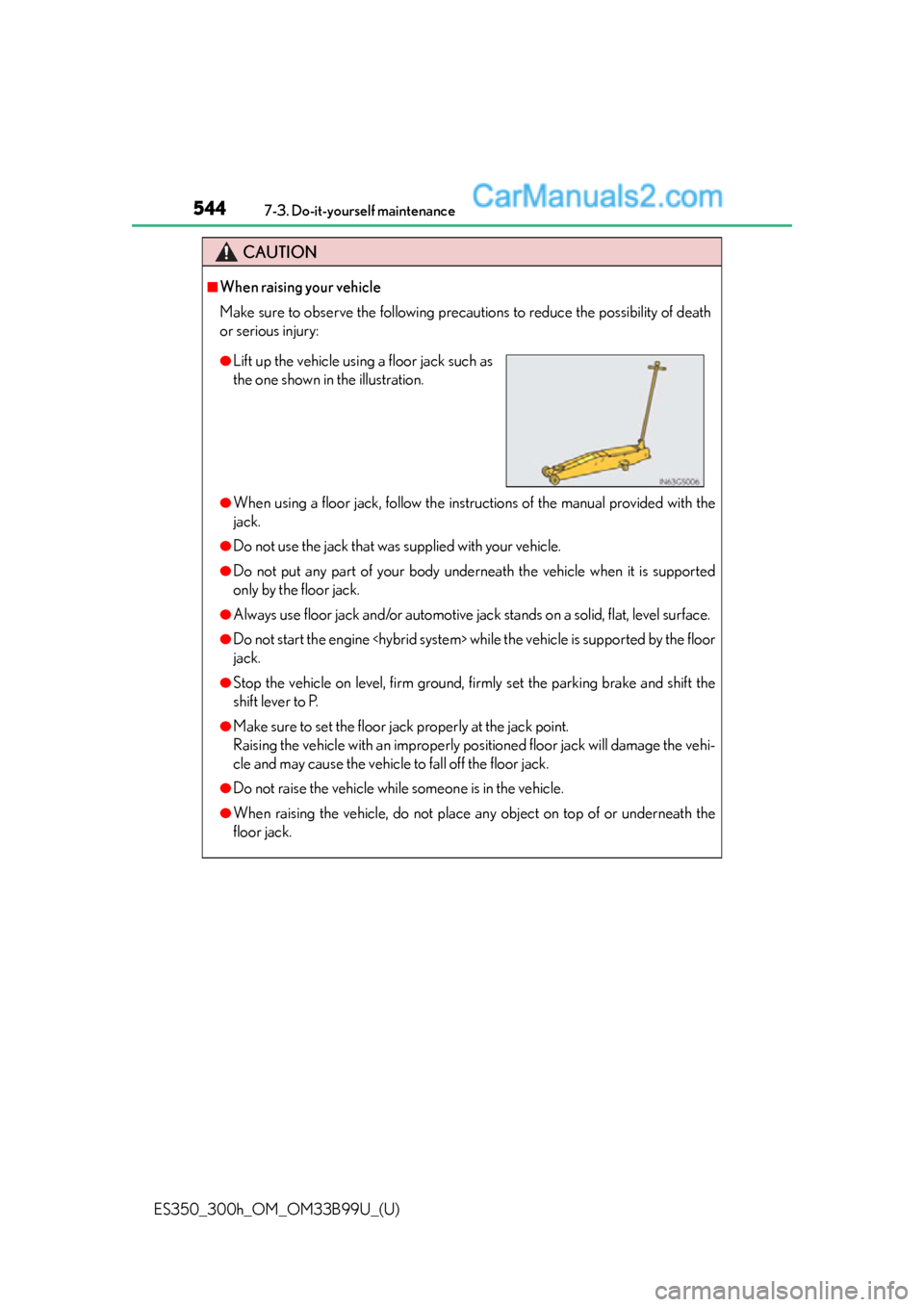
●Lift up the vehicle using a floor jack such as
the one shown in the illustration.
Page 545 of 784
545
ES350_300h_OM_OM33B99U_(U)
7-3. Do-it-yourself maintenance
7
Maintenance and care
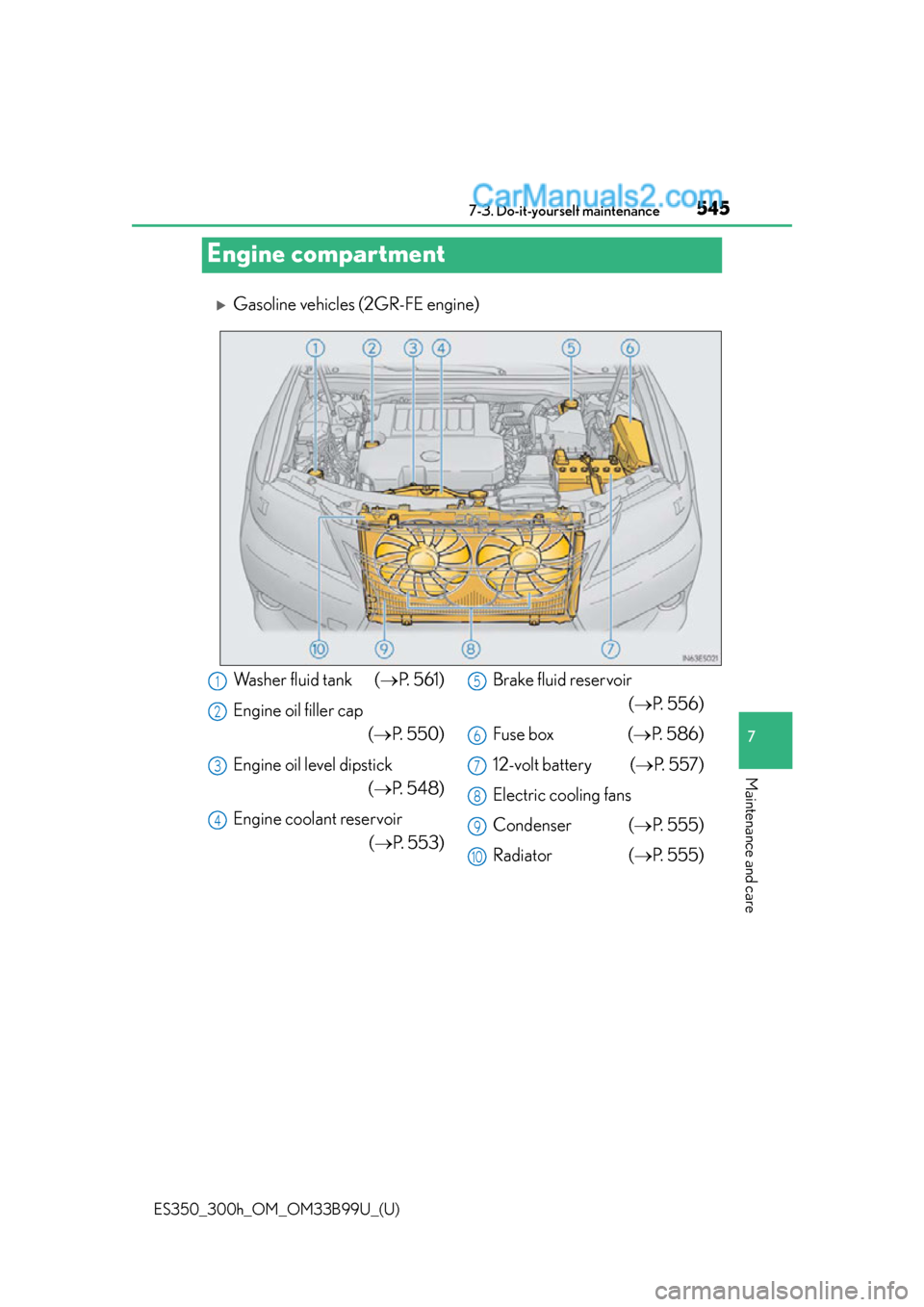
Engine compartment
Gasoline vehicles (2GR-FE engine)
Washer fluid tank (P. 561)
Engine oil filler cap (P. 550)
Engine oil level dipstick (P. 548)
Engine coolant reservoir (P. 553) Brake fluid reservoir
(P. 5 5 6 )
Fuse box ( P. 586)
12-volt battery ( P. 5 5 7 )
Electric cooling fans
Condenser ( P. 555)
Radiator ( P. 555)1
2
3
4
5
6
7
8
9
10
Page 546 of 784
546
ES350_300h_OM_OM33B99U_(U)
7-3. Do-it-yourself maintenance
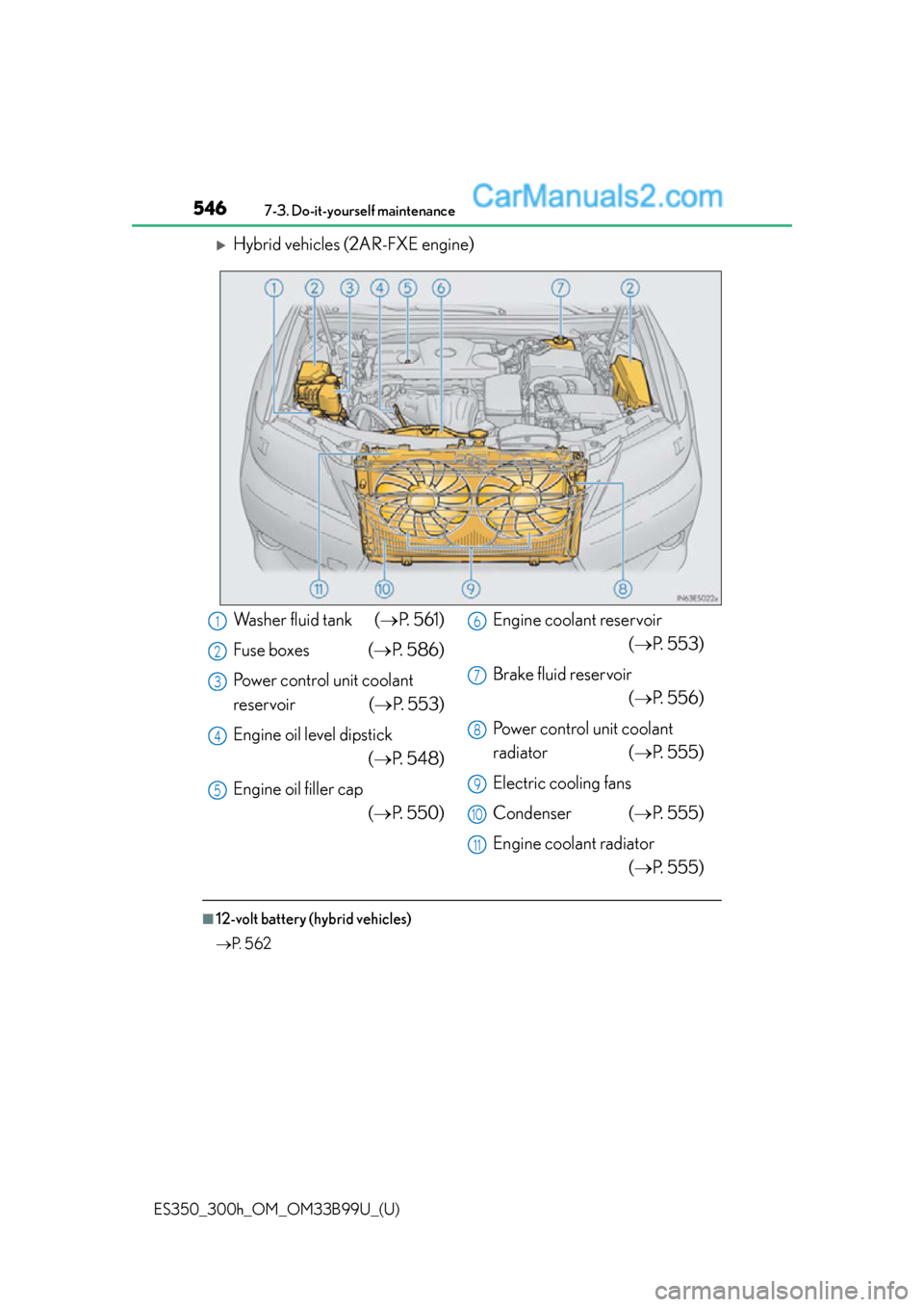
Hybrid vehicles (2AR-FXE engine)
■12-volt battery (hybrid vehicles)
P. 5 6 2
Washer fluid tank ( P. 561)
Fuse boxes ( P. 586)
Power control unit coolant
reservoir ( P. 553)
Engine oil level dipstick (P. 548)
Engine oil filler cap (P. 550) Engine coolant reservoir
(P. 553)
Brake fluid reservoir (P. 5 5 6 )
Power control unit coolant
radiator ( P. 555)
Electric cooling fans
Condenser ( P. 555)
Engine coolant radiator (P. 555)1
2
3
4
5
6
7
8
9
10
11
Page 556 of 784
556
ES350_300h_OM_OM33B99U_(U)
7-3. Do-it-yourself maintenance
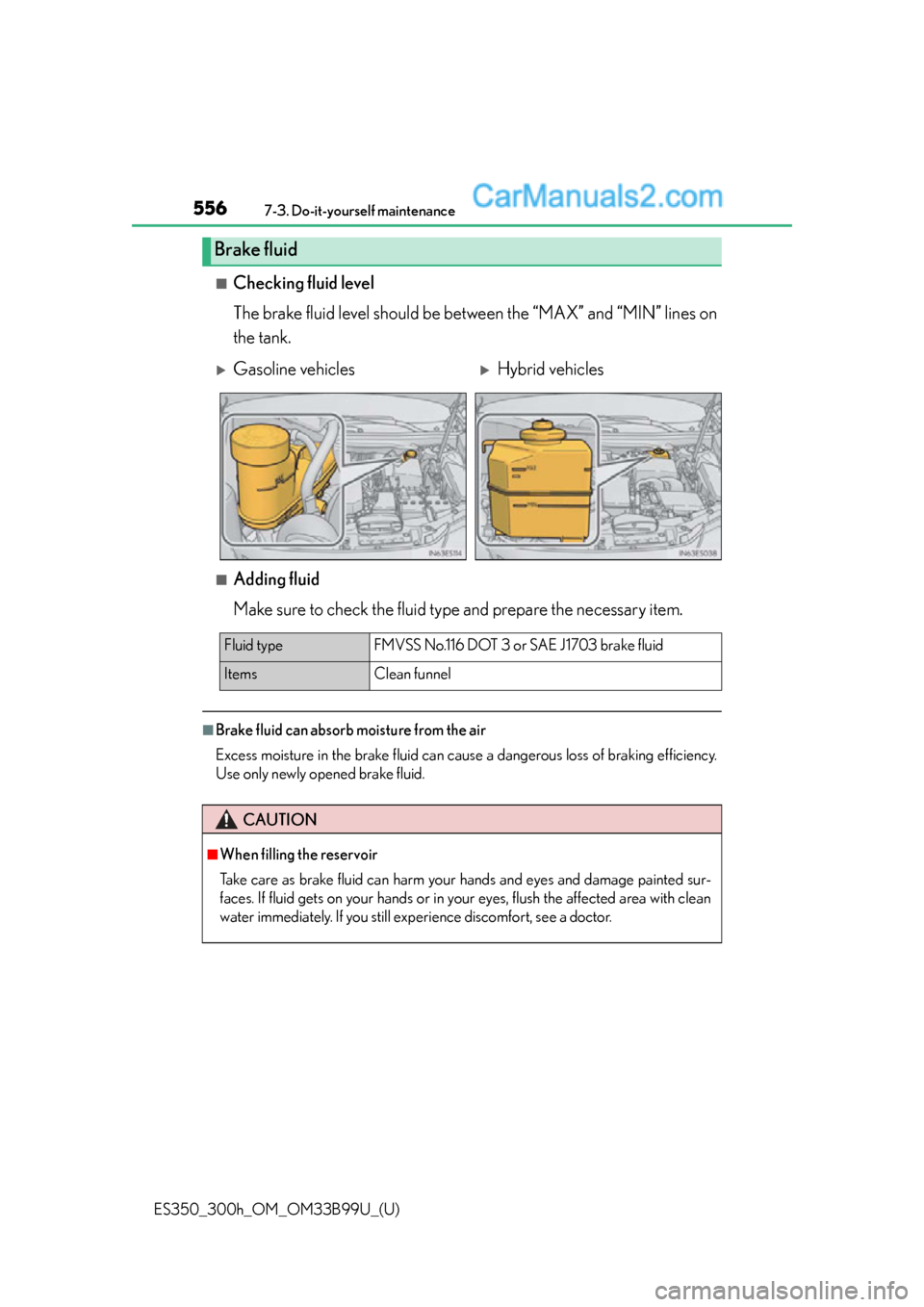
■Checking fluid level
The brake fluid level should be between the “MAX” and “MIN” lines on
the tank.
■Adding fluid
Make sure to check the fluid type and prepare the necessary item.
■Brake fluid can absorb moisture from the air
Excess moisture in the brake fluid can cause a dangerous loss of braking efficiency.
Use only newly opened brake fluid.
Brake fluid
Gasoline vehiclesHybrid vehicles
Fluid type FMVSS No.116 DOT 3 or SAE J1703 brake fluid
ItemsClean funnel
CAUTION
■When filling the reservoir
Take care as brake fluid can harm your hands and eyes and damage painted sur-
faces. If fluid gets on your hands or in your eyes, flush the affected area with clean
water immediately. If you still experience discomfort, see a doctor.
Page 557 of 784
ES350_300h_OM_OM33B99U_(U)
5577-3. Do-it-yourself maintenance
7
Maintenance and care
Check the 12-volt battery as follows.
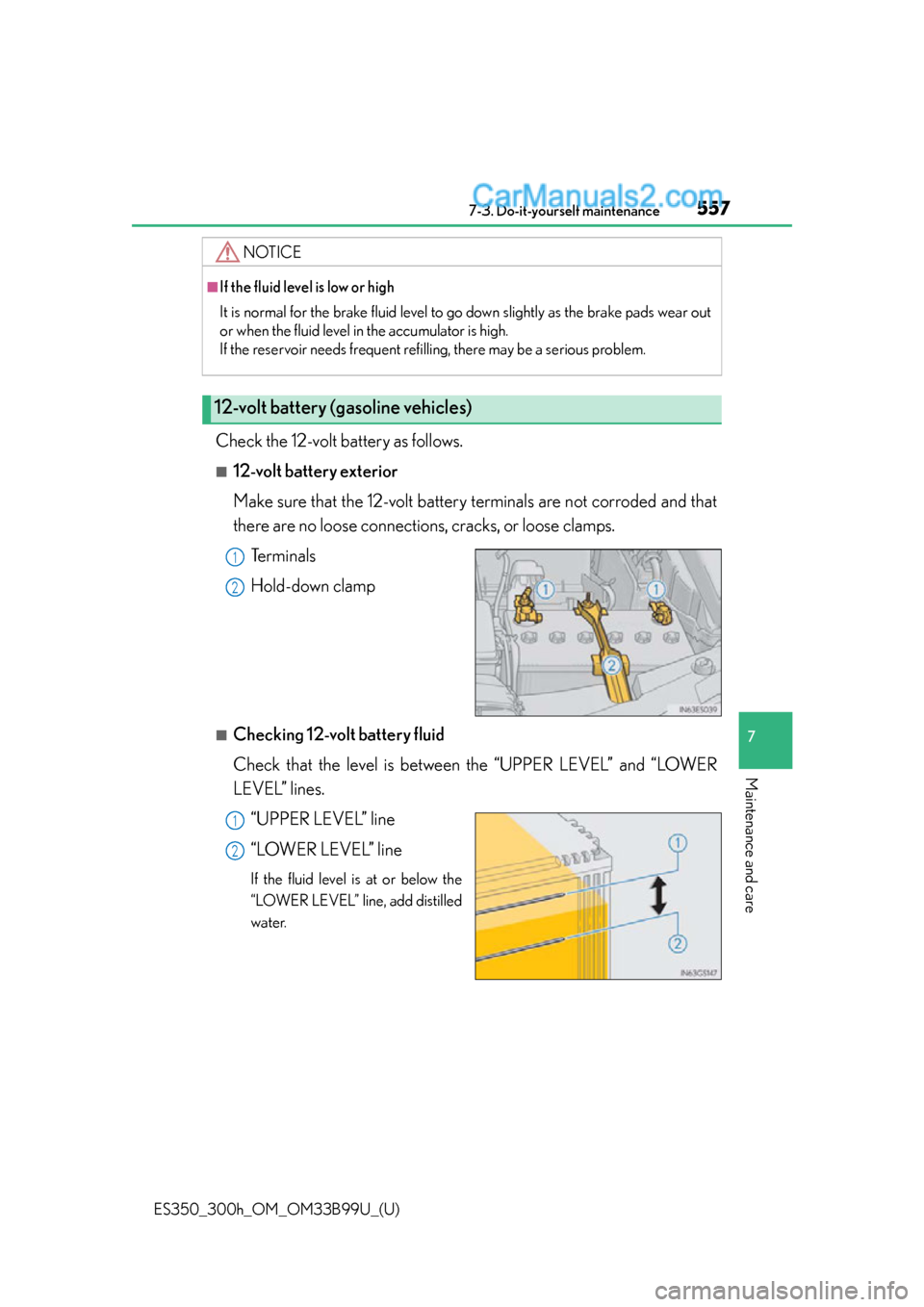
■12-volt battery exterior
Make sure that the 12-volt battery terminals are not corroded and that
there are no loose connections , cracks, or loose clamps.
Terminals
Hold-down clamp
■Checking 12-volt battery fluid
Check that the level is between the “UPPER LEVEL” and “LOWER
LEVEL” lines.
“UPPER LEVEL” line
“LOWER LEVEL” line
If the fluid level is at or below the
“LOWER LEVEL” line, add distilled
water.
NOTICE
■If the fluid level is low or high
It is normal for the brake fluid level to go down slightly as the brake pads wear out
or when the fluid level in the accumulator is high.
If the reservoir needs frequent refil ling, there may be a serious problem.
12-volt battery (gasoline vehicles)
1
2
1
2
Page 615 of 784
615
ES350_300h_OM_OM33B99U_(U)
8-1. Essential information
8
When trouble arises
If your vehicle has to be stopped in an emergency
Steadily step on the brake pedal with both feet and firmly depress it.
Do not pump the brake pedal repeatedly as this will increase the effort required to
slow the vehicle.
Shift the shift lever to N.
If the shift lever is shifted to N
After slowing down, stop the vehicle in a safe place by the road.
Stop the engine
If the shift lever cannot be shifted to N
Keep depressing the brake pedal wi th both feet to reduce vehicle
speed as much as possible.
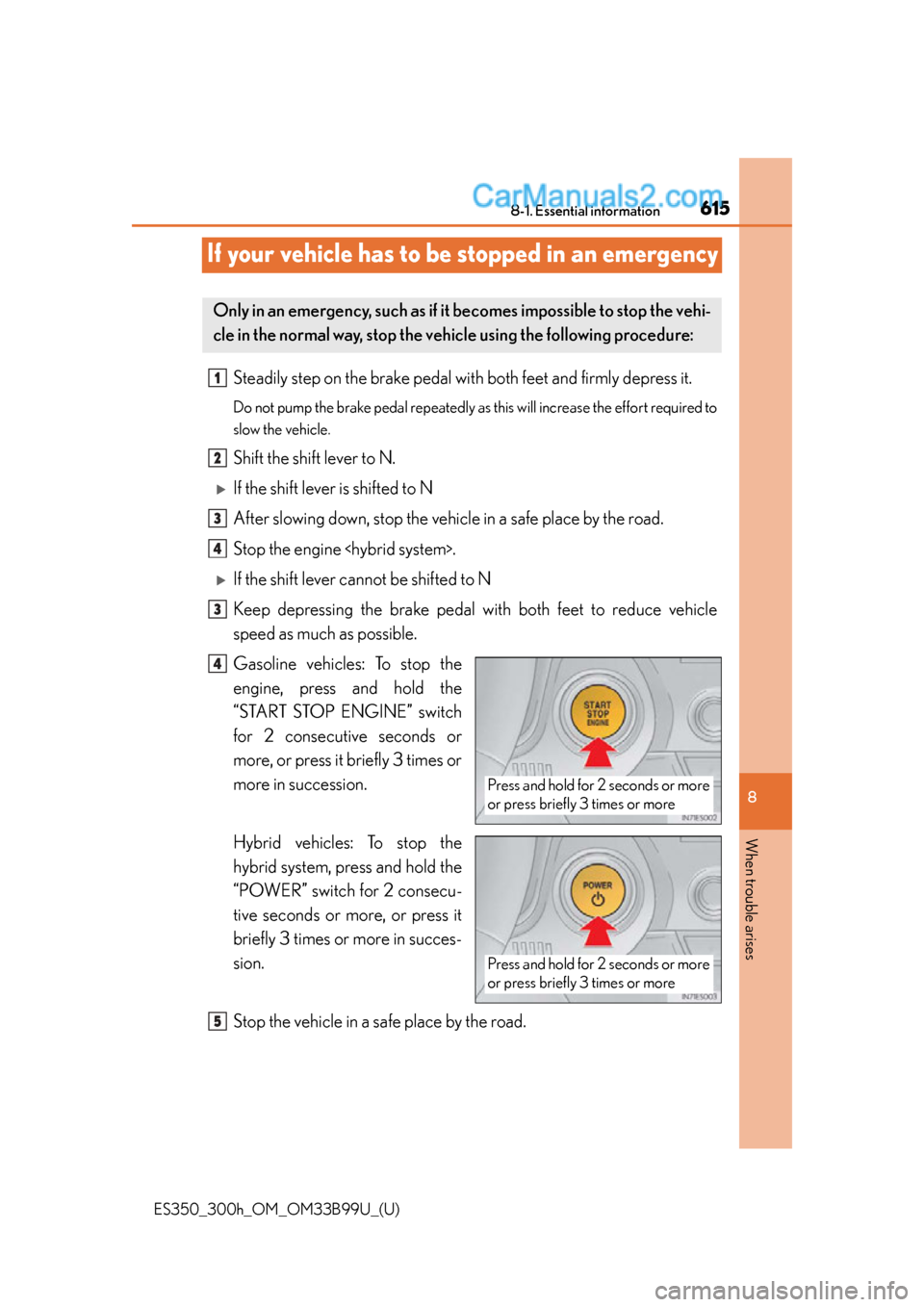
Gasoline vehicles: To stop the
engine, press and hold the
“START STOP ENGINE” switch
for 2 consecutive seconds or
more, or press it briefly 3 times or
more in succession.
Hybrid vehicles: To stop the
hybrid system, press and hold the
“POWER” switch for 2 consecu-
tive seconds or more, or press it
briefly 3 times or more in succes-
sion.
Stop the vehicle in a safe place by the road.
Only in an emergency, such as if it becomes impossible to stop the vehi-
cle in the normal way, stop the vehicle using the following procedure:
1
2
3
4
3
Press and hold for 2 seconds or more
or press briefly 3 times or more
4
Press and hold for 2 seconds or more
or press briefly 3 times or more
5
Page 618 of 784
6188-2. Steps to take in an emergency
ES350_300h_OM_OM33B99U_(U)
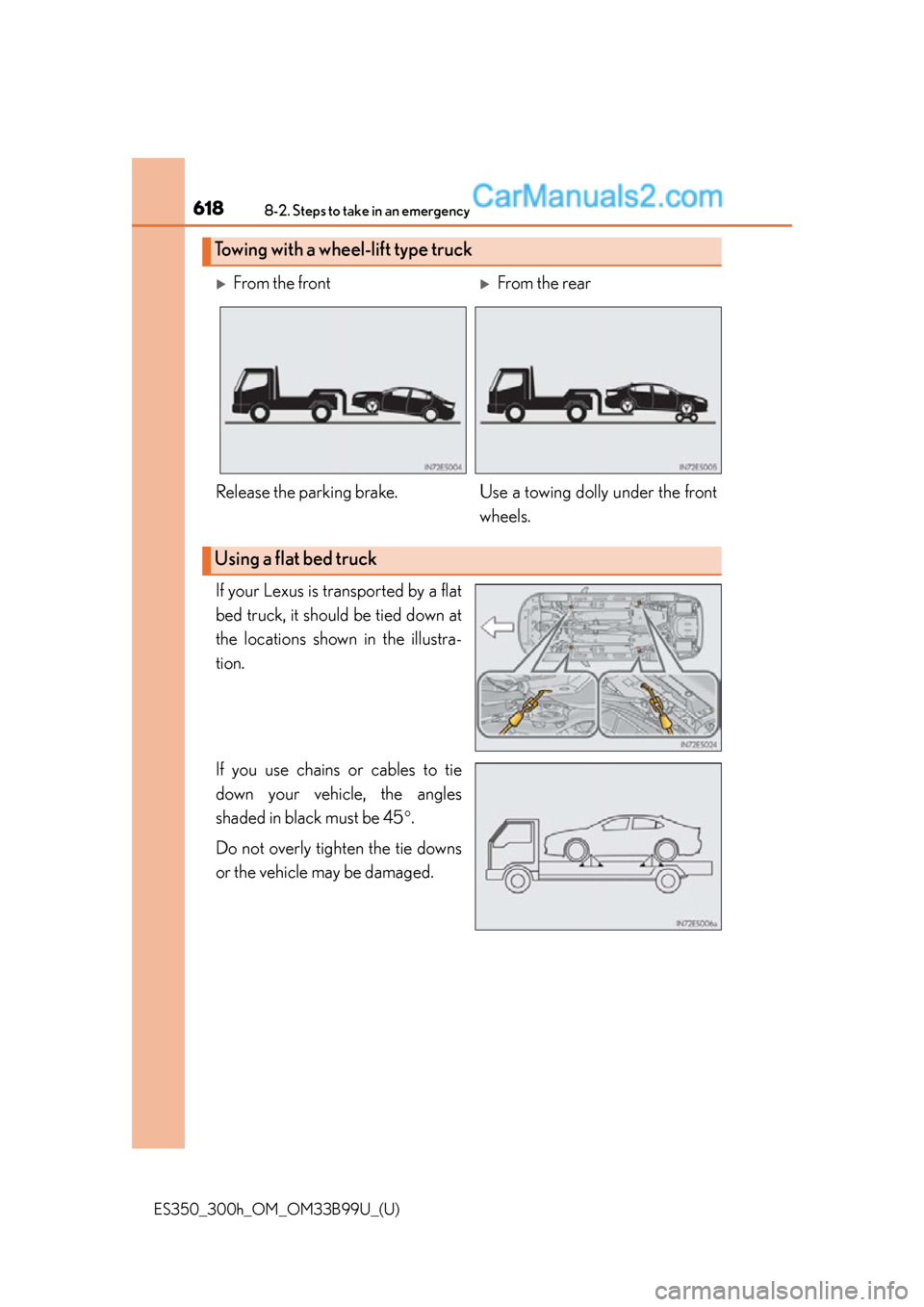
If your Lexus is transported by a flat
bed truck, it should be tied down at
the locations shown in the illustra-
tion.
If you use chains or cables to tie
down your vehicle, the angles
shaded in black must be 45 .
Do not overly tighten the tie downs
or the vehicle may be damaged.
Towing with a wheel -lift type truck
From the frontFrom the rear
Release the parking brake. Use a towing dolly under the front wheels.
Using a flat bed truck
Page 619 of 784
6198-2. Steps to take in an emergency
ES350_300h_OM_OM33B99U_(U)
8
When trouble arises
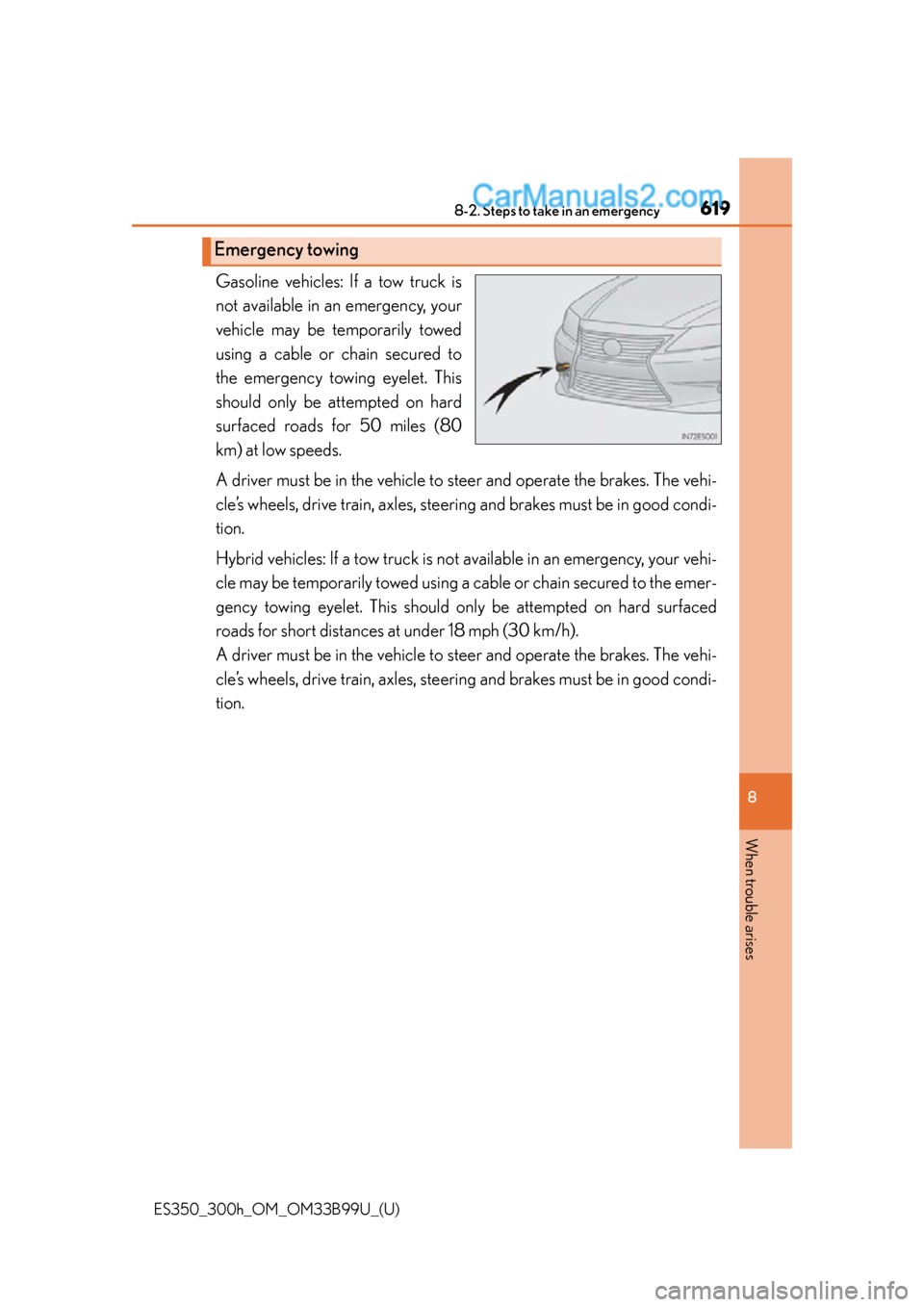
Gasoline vehicles: If a tow truck is
not available in an emergency, your
vehicle may be temporarily towed
using a cable or chain secured to
the emergency towing eyelet. This
should only be attempted on hard
surfaced roads for 50 miles (80
km) at low speeds.
A driver must be in the vehicle to steer and operate the brakes. The vehi-
cle’s wheels, drive train, axles, steeri ng and brakes must be in good condi-
tion.
Hybrid vehicles: If a tow truck is not available in an emergency, your vehi-
cle may be temporarily towed using a cable or chain secured to the emer-
gency towing eyelet. This should only be attempted on hard surfaced
roads for short distances at under 18 mph (30 km/h).
A driver must be in the vehicle to steer and operate the brakes. The vehi-
cle’s wheels, drive train, axles, steeri ng and brakes must be in good condi-
tion.
Emergency towing
Page 621 of 784
6218-2. Steps to take in an emergency
ES350_300h_OM_OM33B99U_(U)
8
When trouble arises
Gasoline vehicles: Enter the vehicle being towed and start the engine.
If the engine does not start, turn the “START STOP ENGINE” switch to IGNI-
TION ON mode
Hybrid vehicles: Enter the vehicle being towed and start the hybrid sys-
tem.
If the hybrid system does not start, turn the “POWER” switch to ON mode.
Shift the shift position to N and release the parking brake.
When the shift lever cannot be shifted: P. 6 76
■While towing
If the engine is not running
and steering will not func tion, making steering and braking more difficult.
■Wheel nut wrench
Wheel nut wrench is installed in luggage compartment. ( P. 6 6 0 )
6
7
Page 624 of 784

624
ES350_300h_OM_OM33B99U_(U)
8-2. Steps to take in an emergency
If you think something is wrong
●Fluid leaks under the vehicle.
(Water dripping from the air conditioning after use is normal.)
●Flat-looking tires or uneven tire wear
●Engine coolant temperature gauge needle continually points higher
than normal.
●Changes in exhaust sound
●Excessive tire squeal when cornering
●Strange noises related to the suspension system
●Pinging or other noises related to the engine
●Engine missing, stumbling or running roughly
●Appreciable loss of power
●Vehicle pulls heavily to one side when braking
●Vehicle pulls heavily to one side when driving on a level road
●Loss of brake effectiveness, spongy feeling, pedal almost touches the
floor
If you notice any of the following symptoms, your vehicle probably
needs adjustment or repair. Contact your Lexus dealer as soon as pos-
sible.
Visible symptoms
Audible symptoms
Operational symptoms