trailer Lexus ES350 2017 Owner's Manuals
[x] Cancel search | Manufacturer: LEXUS, Model Year: 2017, Model line: ES350, Model: Lexus ES350 2017Pages: 584, PDF Size: 13.96 MB
Page 5 of 584
3
ES350_OM_OM33C68U_(U)
1
9 8
7 4 3
2
10
5
6
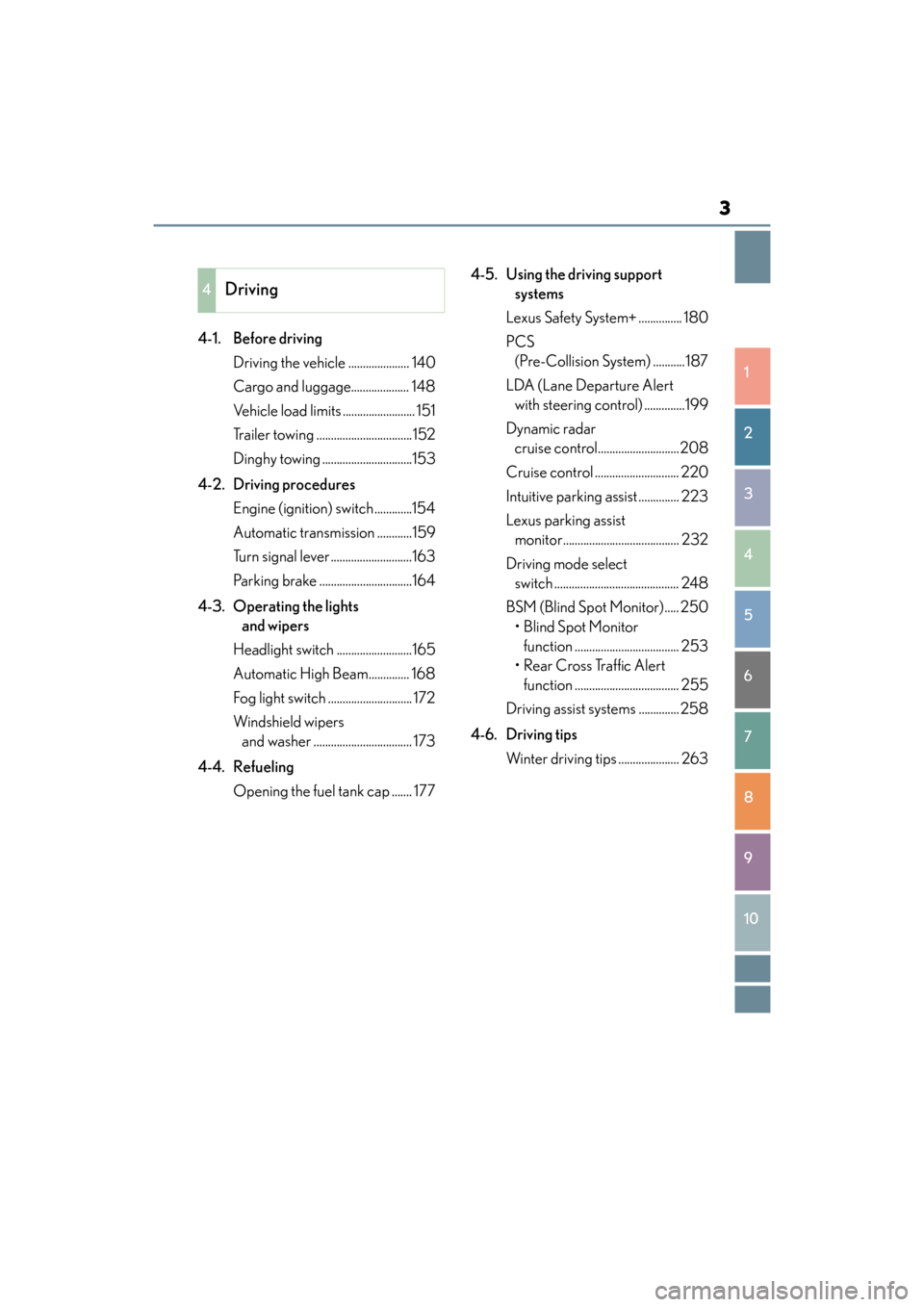
4-1. Before drivingDriving the vehicle ..................... 140
Cargo and luggage.................... 148
Vehicle load limits ......................... 151
Trailer towing .................................152
Dinghy towing ...............................153
4-2. Driving procedures Engine (ignition) switch .............154
Automatic transmission ............159
Turn signal lever ............................163
Parking brake ................................164
4-3. Operating the lights and wipers
Headlight switch ..........................165
Automatic High Beam.............. 168
Fog light switch ............................. 172
Windshield wipers and washer .................................. 173
4-4. Refueling Opening the fuel tank cap ....... 177 4-5. Using the driving support
systems
Lexus Safety System+ ............... 180
PCS (Pre-Collision System) ...........187
LDA (Lane Departure Alert with steering control) ..............199
Dynamic radar cruise control............................208
Cruise control ............................. 220
Intuitive parking assist .............. 223
Lexus parking assist monitor........................................ 232
Driving mode select switch ........................................... 248
BSM (Blind Spot Monitor)..... 250 • Blind Spot Monitor function .................................... 253
• Rear Cross Traffic Alert function .................................... 255
Driving assist systems .............. 258
4-6. Driving tips Winter driving tips ..................... 263
4Driving
Page 141 of 584
139
ES350_OM_OM33C68U_(U)
4Driving
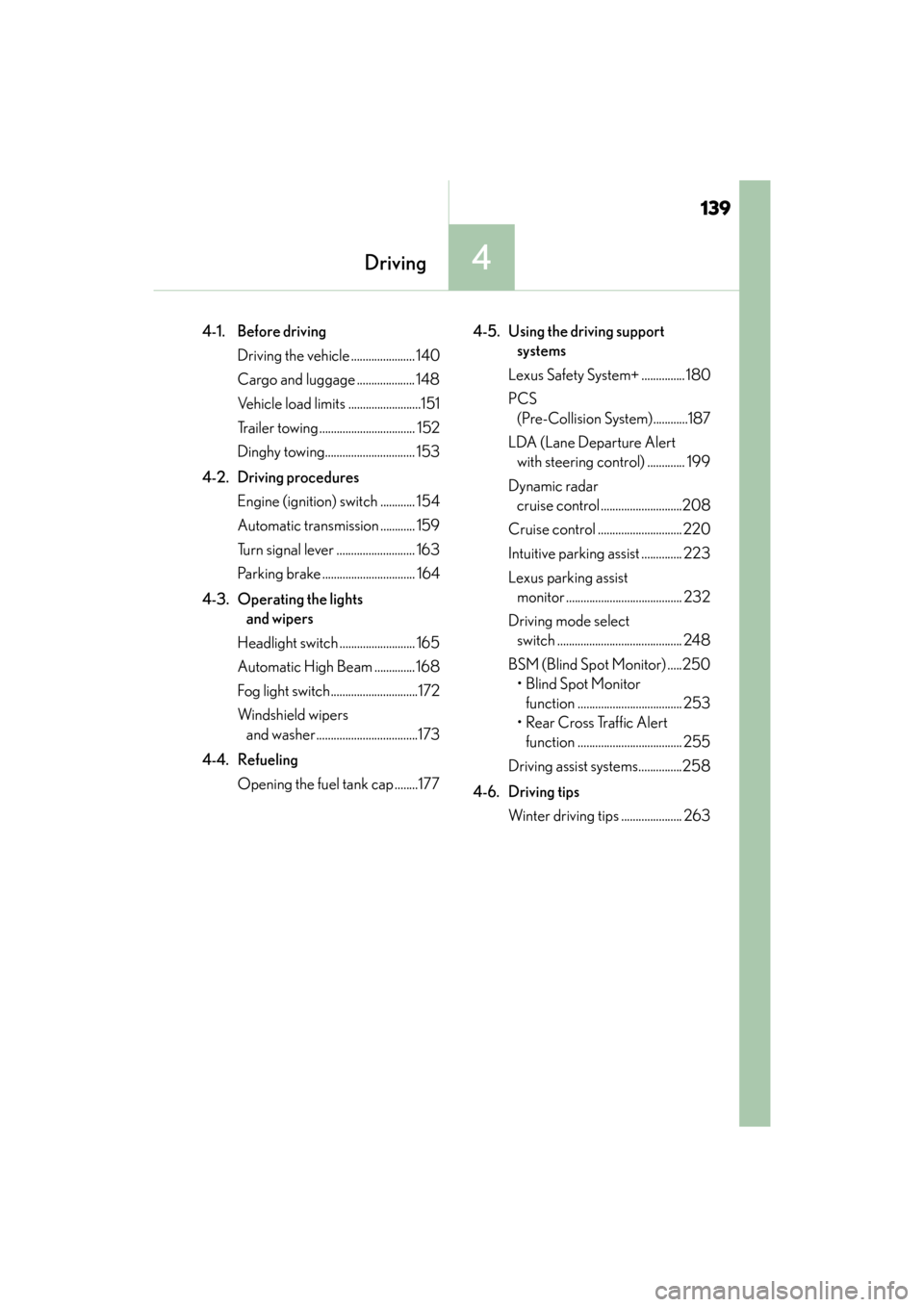
4-1. Before drivingDriving the vehicle ...................... 140
Cargo and luggage .................... 148
Vehicle load limits .........................151
Trailer towing ................................. 152
Dinghy towing............................... 153
4-2. Driving procedures Engine (ignition) switch ............ 154
Automatic transmission ............ 159
Turn signal lever ........................... 163
Parking brake ................................ 164
4-3. Operating the lights and wipers
Headlight switch .......................... 165
Automatic High Beam .............. 168
Fog light switch..............................172
Windshield wipers and washer...................................173
4-4. Refueling Opening the fuel tank cap ........177 4-5. Using the driving support
systems
Lexus Safety System+ ............... 180
PCS (Pre-Collision System)............187
LDA (Lane Departure Alert with steering control) ............. 199
Dynamic radar cruise control ............................208
Cruise control ............................. 220
Intuitive parking assist .............. 223
Lexus parking assist monitor ........................................ 232
Driving mode select switch ........................................... 248
BSM (Blind Spot Monitor) .....250 •Blind Spot Monitor function .................................... 253
• Rear Cross Traffic Alert function .................................... 255
Driving assist systems...............258
4-6. Driving tips Winter driving tips ..................... 263
Page 150 of 584
148
ES350_OM_OM33C68U_(U)4-1. Before driving
Cargo and luggage
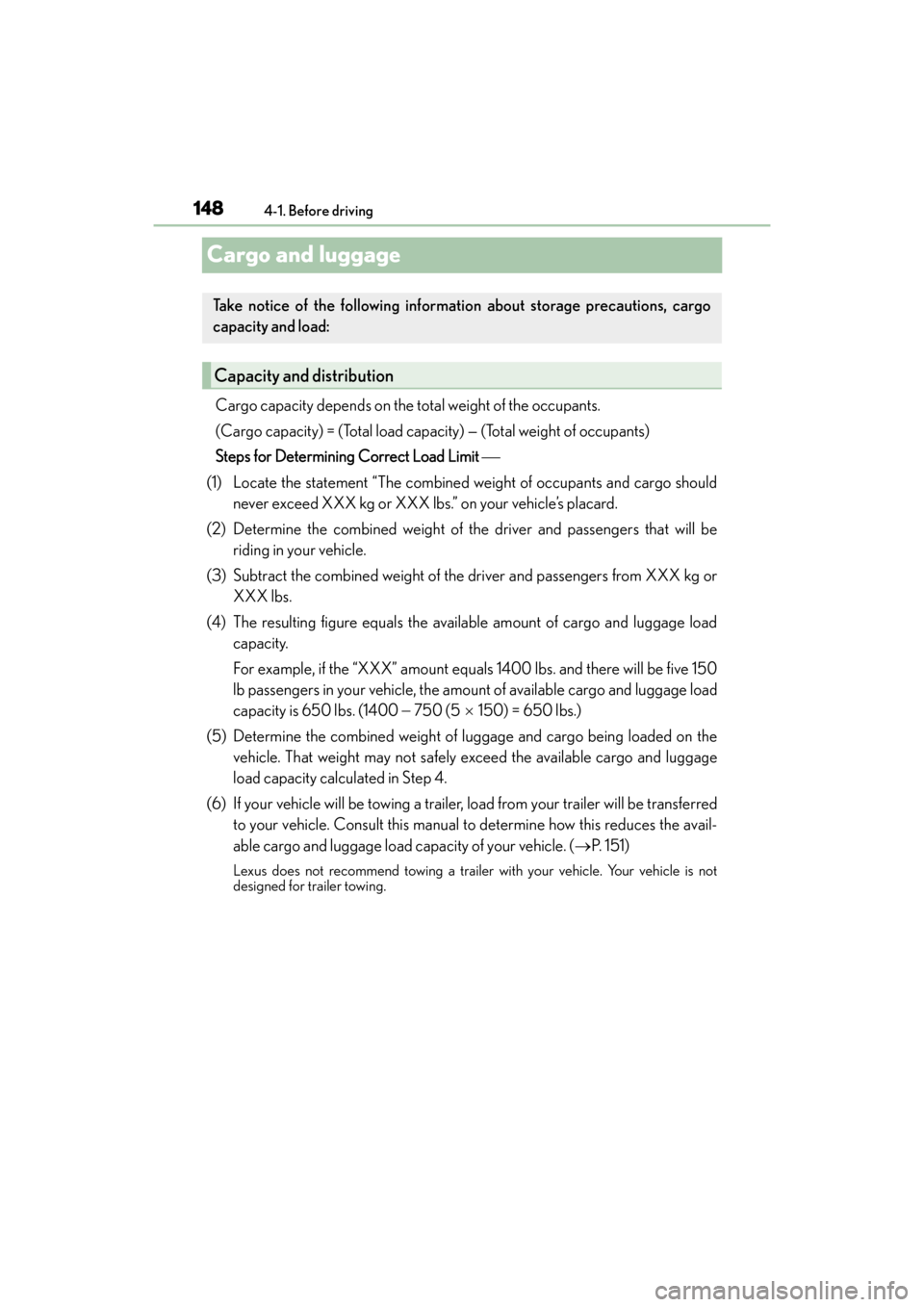
Cargo capacity depends on the total weight of the occupants.
(Cargo capacity) = (Total load capacity) — (Total weight of occupants)
Steps for Determining Correct Load Limit
(1) Locate the statement “The combined weight of occupants and cargo should never exceed XXX kg or XXX lbs.” on your vehicle’s placard.
(2) Determine the combined weight of the driver and passengers that will be riding in your vehicle.
(3) Subtract the combined weight of the driver and passengers from XXX kg or XXX lbs.
(4) The resulting figure equals the available amount of cargo and luggage load capacity.
For example, if the “XXX” amount equals 1400 lbs. and there will be five 150
lb passengers in your vehicle, the amount of available cargo and luggage load
capacity is 650 lbs. (1400 − 750 (5 × 150) = 650 lbs.)
(5) Determine the combined weight of luggage and cargo being loaded on the vehicle. That weight may not safely exceed the available cargo and luggage
load capacity calculated in Step 4.
(6) If your vehicle will be towing a trailer, load from your trailer will be transferred to your vehicle. Consult this manual to determine how this reduces the avail-
able cargo and luggage load capacity of your vehicle. ( →P. 1 5 1 )
Lexus does not recommend towing a trailer with your vehicle. Your vehicle is not
designed for trailer towing.
Take notice of the following information about storage precautions, cargo
capacity and load:
Capacity and distribution
Page 153 of 584
151
ES350_OM_OM33C68U_(U)4-1. Before driving
4
Driving
Vehicle load limits
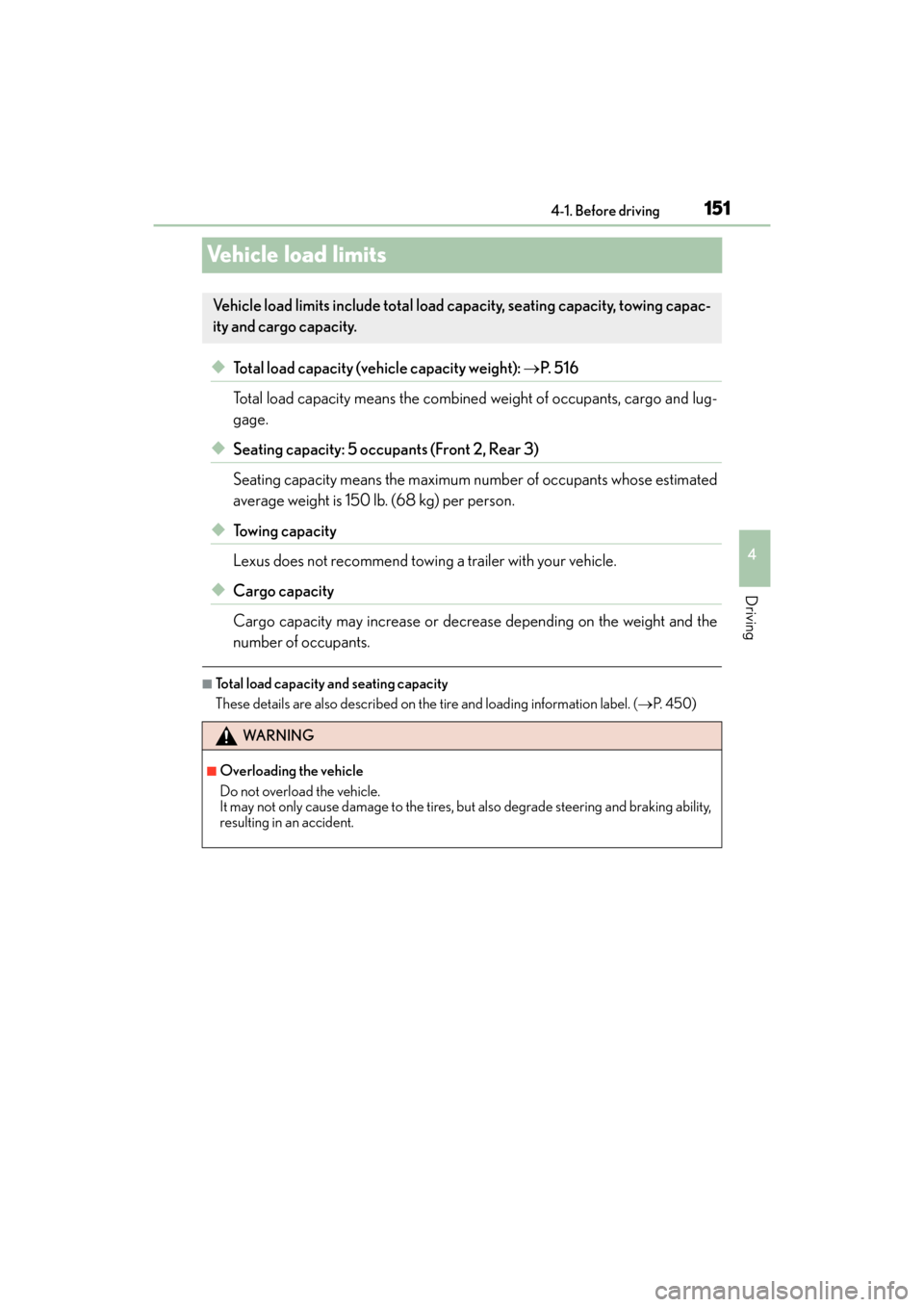
◆Total load capacity (vehicle capacity weight):
→P. 5 1 6
Total load capacity means the combined weight of occupants, cargo and lug-
gage.
◆Seating capacity: 5 occupants (Front 2, Rear 3)
Seating capacity means the maximum number of occupants whose estimated
average weight is 150 lb. (68 kg) per person.
◆Towing capacity
Lexus does not recommend towing a trailer with your vehicle.
◆Cargo capacity
Cargo capacity may increase or decrease depending on the weight and the
number of occupants.
■Total load capacity and seating capacity
These details are also described on the tire and loading information label. (→P. 4 5 0 )
Vehicle load limits include total load capacity, seating capacity, towing capac-
ity and cargo capacity.
WA R N I N G
■Overloading the vehicle
Do not overload the vehicle.
It may not only cause damage to the tires, but also degrade steering and braking ability,
resulting in an accident.
Page 154 of 584
152
ES350_OM_OM33C68U_(U)4-1. Before driving
Trailer towing
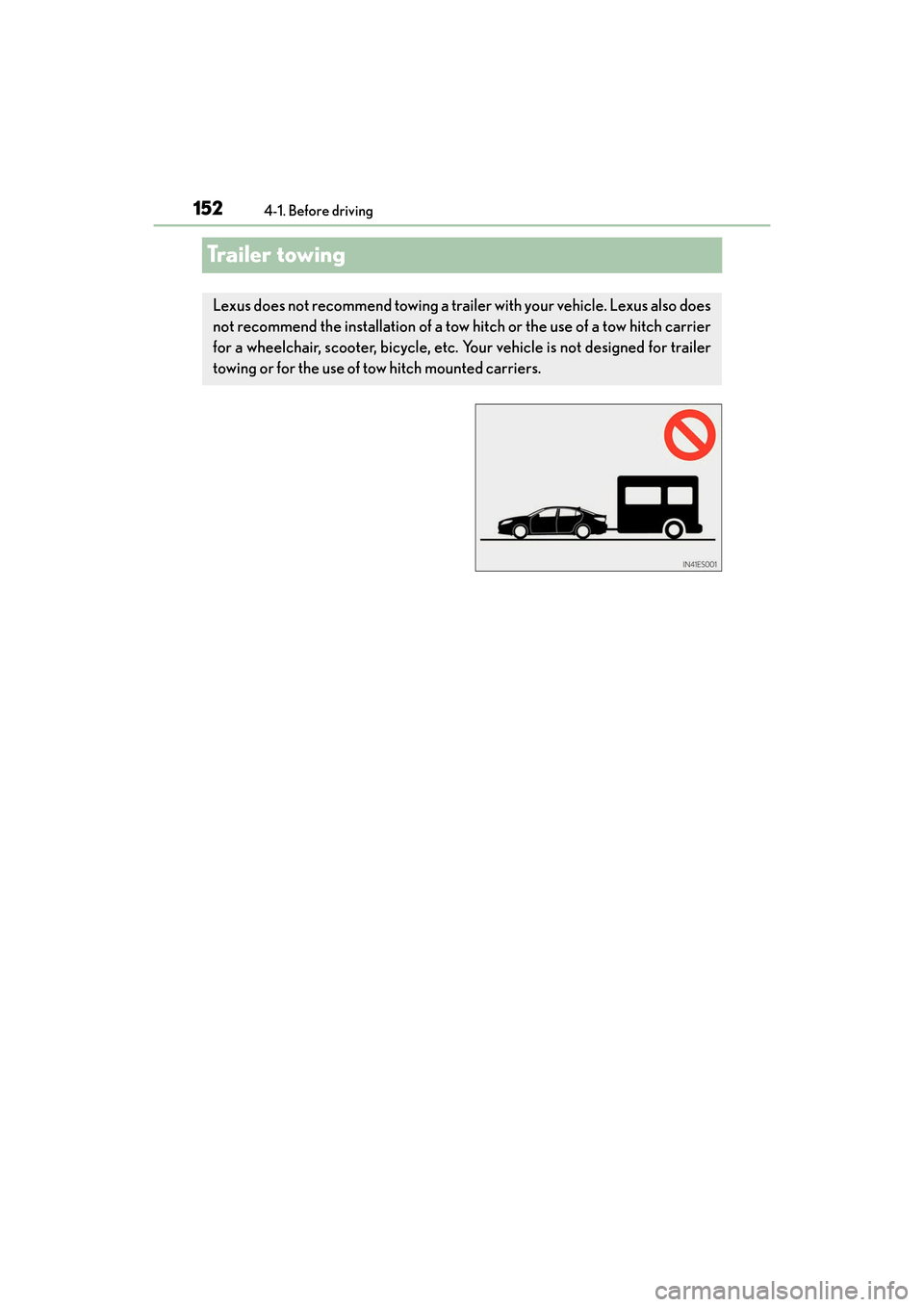
Lexus does not recommend towing a trailer with your vehicle. Lexus also does
not recommend the installation of a tow hitch or the use of a tow hitch carrier
for a wheelchair, scooter, bicycle, etc. Your vehicle is not designed for trailer
towing or for the use of tow hitch mounted carriers.
Page 172 of 584
170
ES350_OM_OM33C68U_(U)4-3. Operating the lights and wipers
■Camera sensor detection information
●The high beam may not be automatically
turned off in the following situations:
• When oncoming vehicles suddenly appear from a curve
• When the vehicle is cut in front of by another vehicle
• When vehicles ahead are hidden from sight due to repeated curves, road dividers or roadside trees
• When vehicles ahead appear from the faraway lane on wide road
• When vehicles ahead have no lights
●The high beam may be turned off if a vehicle ahead that is using fog lights without using
the headlights is detected.
●House lights, street lights, traffic signals, and illuminated billboards or signs may cause
the high beam to switch to the low beams, or the low beams to remain on.
●The following factors may affect the amount of time taken to turn the high beam on or
off:
• The brightness of headlights, fog lights, and tail lights of vehicles ahead
• The movement and direction of vehicles ahead
• When a vehicle ahead only has operational lights on one side
• When a vehicle ahead is a two-wheeled vehicle
• The condition of the road (gradient, curve, condition of the road surface etc.)
• The number of passengers and amount of luggage
●The high beam may be turned on or off when the driver does not expect it.
●Bicycles or similar objects may not be detected.
●In the situations shown below, the system may not be able to accurately detect sur-
rounding brightness levels. This may cause the low beams to remain on or the high
beams to cause problems for pedestrians, ve hicles ahead or other parties. In these
cases, manually switch between the high and low beams.
• In bad weather (rain, snow, fog, sandstorms etc.)
• The windshield is obscured by fog, mist, ice, dirt etc.
• The windshield is cracked or damaged.
• The camera sensor is deformed or dirty.
• The camera sensor temperature is extremely high.
• Surrounding brightness levels are equal to those of headlights, tail lights or fog lights.
• Vehicles ahead have headlights or tail lights that are either switched off, dirty, are changing color, or are not aimed properly.
• When driving through an area of intermit tently changing brightness and darkness.
• When frequently and repeated ly driving ascending/descending roads, or roads with
rough, bumpy or uneven surfaces (such as stone-paved roads, gravel tracks etc.).
• When frequently and repeatedly taking curves or driving on a winding road.
• There is a highly reflective object ahead of the vehicle, such as a sign or a mirror.
• The back of a vehicle ahead is highly reflective, such as a container on a truck.
• The vehicle’s headlights are damaged or dirty, or are not aimed properly.
• The vehicle is listing or tilting due to a flat tire, a trailer being towed, etc.
• The high beam and low beam are repeatedly being switched between in an abnor-
mal manner.
• The driver believes that the high beam may be causing problems or distress to other
drivers or pedestrians nearby.
Page 198 of 584
196
ES350_OM_OM33C68U_(U)4-5. Using the driving support systems
■Situations in which the system may not operate properly
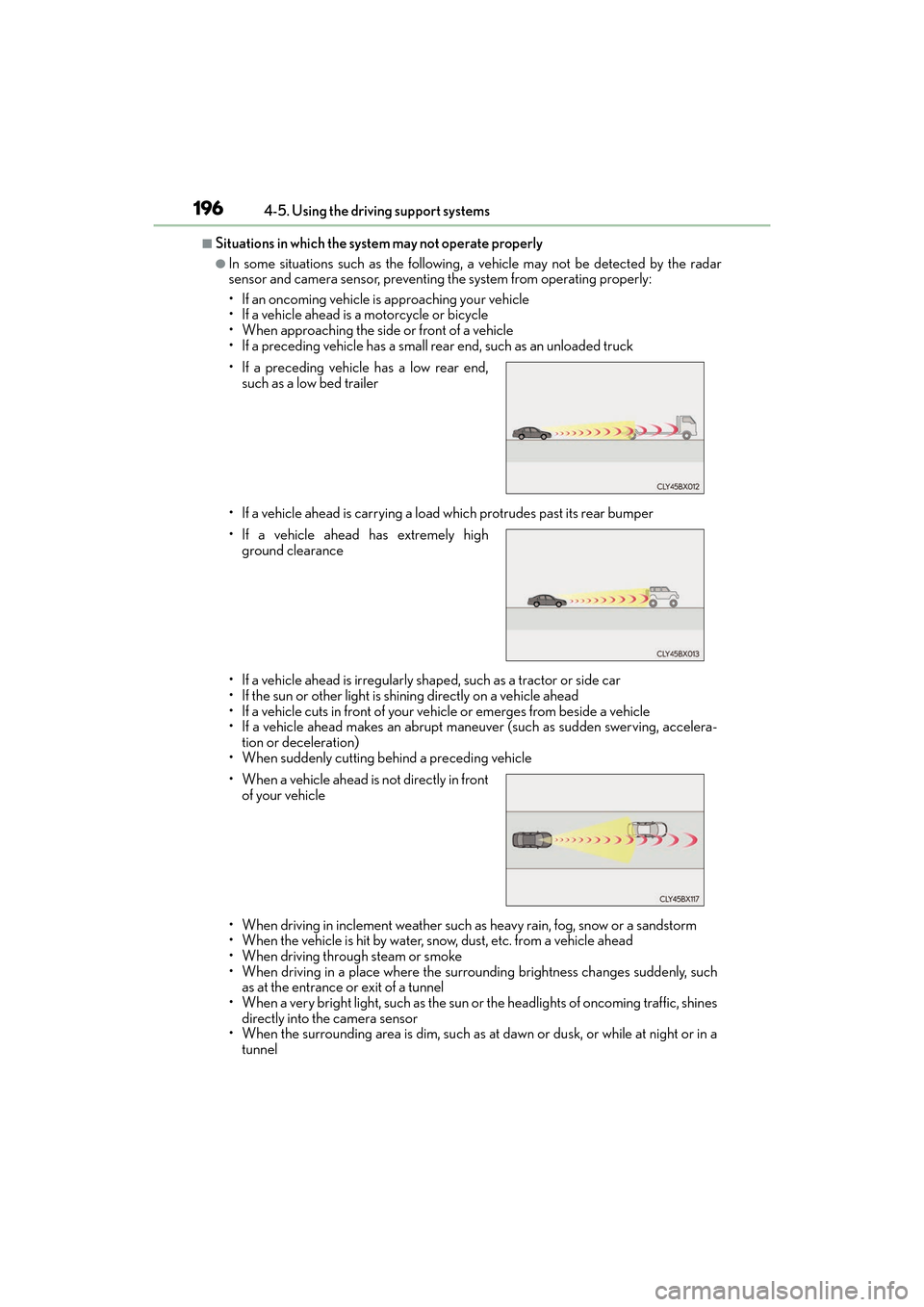
●In some situations such as the following, a vehicle may not be detected by the radar
sensor and camera sensor, preventing the system from operating properly:
• If an oncoming vehicle is approaching your vehicle
• If a vehicle ahead is a motorcycle or bicycle
• When approaching the side or front of a vehicle
• If a preceding vehicle has a small rear end, such as an unloaded truck
• If a vehicle ahead is carrying a load which protrudes past its rear bumper
• If a vehicle ahead is irregularly shaped, such as a tractor or side car
• If the sun or other light is shining directly on a vehicle ahead
• If a vehicle cuts in front of your vehicle or emerges from beside a vehicle
• If a vehicle ahead makes an abrupt maneuver (such as sudden swerving, accelera-
tion or deceleration)
• When suddenly cutting behind a preceding vehicle
• When driving in inclement weather such as heavy rain, fog, snow or a sandstorm
• When the vehicle is hit by water, snow, dust, etc. from a vehicle ahead
• When driving through steam or smoke
• When driving in a place where the surrou nding brightness changes suddenly, such
as at the entrance or exit of a tunnel
• When a very bright light, such as the sun or the headlights of oncoming traffic, shines directly into the camera sensor
• When the surrounding area is dim, such as at dawn or dusk, or while at night or in a
tunnel
• If a preceding vehicle has a low rear end,
such as a low bed trailer
• If a vehicle ahead has extremely high ground clearance
• When a vehicle ahead is not directly in front of your vehicle
Page 203 of 584
ES350_OM_OM33C68U_(U)
2014-5. Using the driving support systems
4
Driving
WA R N I N G
■Before using LDA system
Do not rely solely upon the LDA system. The LDA system does not automatically drive
the vehicle or reduce the amount of attention that must be paid to the area in front of
the vehicle. The driver must always assume full responsibility for driving safely by pay-
ing careful attention to the surrounding cond itions and operating the steering wheel to
correct the path of the vehicle. Also, the driver must take adequate breaks when
fatigued, such as from driving for a long period of time.
Failure to perform appropriate driving operat ions and pay careful attention may lead to
an accident, resulting in death or serious injury.
■To avoid operating LDA system by mistake
When not using the LDA system, use the LDA switch to turn the system off.
■Situations unsuitable for LDA system
Do not use the LDA system in the following situations.
The system may not operate properly and lead to an accident, resulting in death or
serious injury.
●A spare tire, tire chains, etc. are equipped.
●When the tires have been excessively worn, or when the tire inflation pressure is low.
●Tires which differ by structure, manufacturer, brand or tread pattern are used.
●Objects or patterns that could be mistaken for white (yellow) lines are present on the
side of the road (guardrails, curbs, reflective poles, etc.).
●Vehicle is driven on a snow-covered road.
●White (yellow) lines are difficult to see due to rain, snow, fog, dust, etc.
●Asphalt repair marks, white (yellow) line marks, etc. are present due to road repair.
●Vehicle is driven in a temporary lane or restricted lane due to construction work.
●Vehicle is driven on a road surface which is slippery due to rainy weather, fallen snow,
freezing, etc.
●Vehicle is driven in traffic lanes other than on highways and freeways.
●Vehicle is driven in a construction zone.
●Vehicle is towing a trailer or another vehicle.
■Preventing LDA system malfunctions and operations performed by mistake
●Do not modify the headlights or place stickers, etc. on the surface of the lights.
●Do not modify the suspension etc. If the suspension etc. needs to be replaced, con-
tact your Lexus dealer.
●Do not install or place anything on the hood or grille. Also, do not install a grille guard
(bull bars, kangaroo bar, etc.).
●If your windshield needs repairs, contact your Lexus dealer.
Page 220 of 584
218
ES350_OM_OM33C68U_(U)4-5. Using the driving support systems
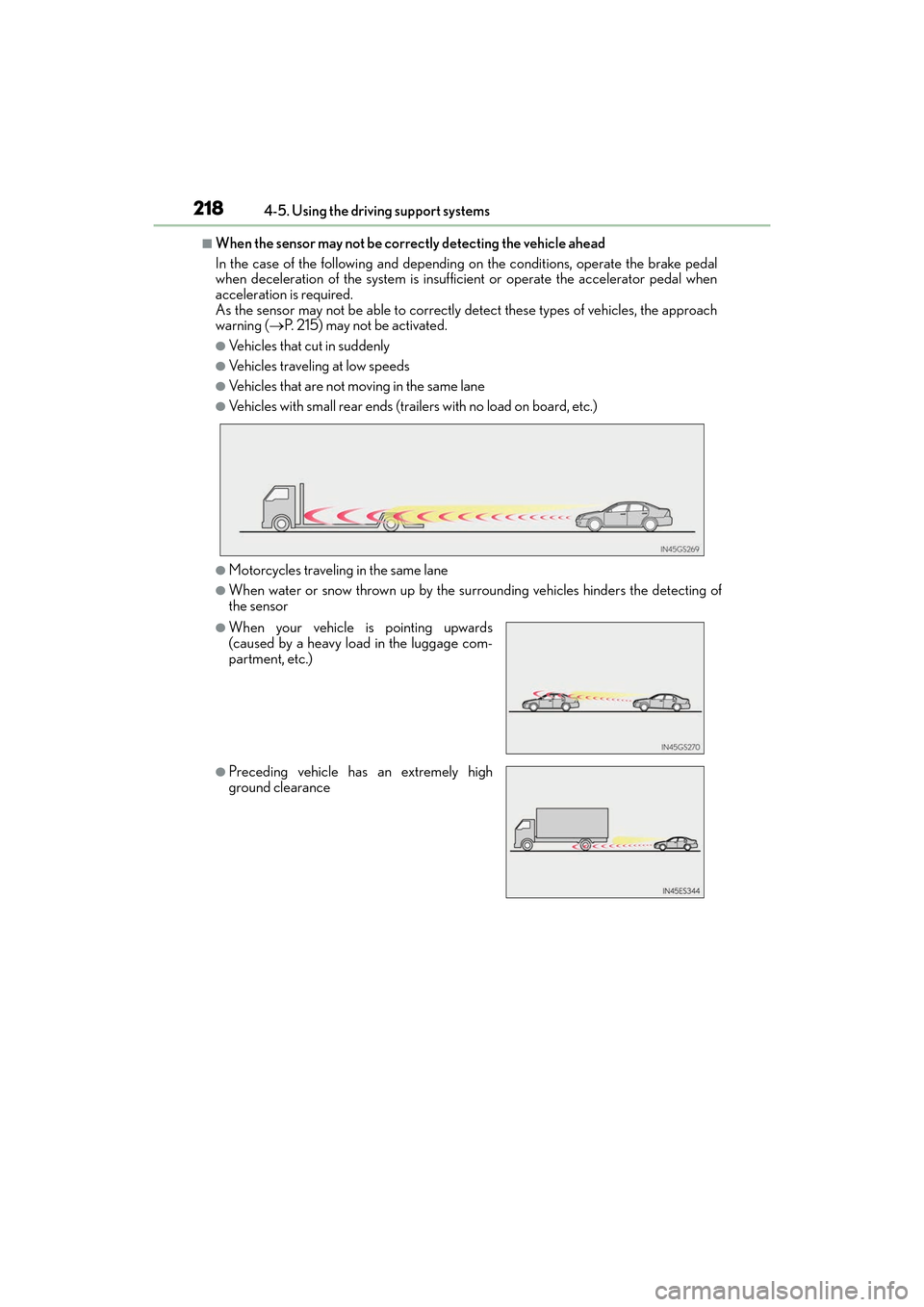
■When the sensor may not be correctly detecting the vehicle ahead
In the case of the following and depending on the conditions, operate the brake pedal
when deceleration of the system is insufficient or operate the accelerator pedal when
acceleration is required.
As the sensor may not be able to correctly detect these types of vehicles, the approach
warning (
→P. 215) may not be activated.
●Vehicles that cut in suddenly
●Vehicles traveling at low speeds
●Vehicles that are not moving in the same lane
●Vehicles with small rear ends (trailers with no load on board, etc.)
●Motorcycles traveling in the same lane
●When water or snow thrown up by the surrounding vehicles hinders the detecting of
the sensor
●When your vehicle is pointing upwards
(caused by a heavy load in the luggage com-
partment, etc.)
●Preceding vehicle has an extremely high
ground clearance
Page 578 of 584
576Alphabetical index
ES350_OM_OM33C68U_(U)
Tire inflation pressureMaintenance data .............................. 522
Tire inflation pressure display function .................................................... 81
Warning light ...................................... 484
Tire information ..................................... 528
Glossary .................................................534
Size ............................................................. 531
Tire identification number............. 530
Uniform Tire Quality Grading...............................................532
Tire pressure warning system
Function ..................................................443
Initializing ................................................443
Installing tire pressure warning valves and transmitters ................443
Registering ID codes ....................... 444
Tire pressure warning reset switch.................................................... 444
Warning light ...................................... 484
Tires Chains...................................................... 264
Checking................................................ 442
If you have a flat tire ........................... 491
Inflation pressure ................................ 522
Information ........................................... 528
Replacing ................................................ 491
Rotating tires ........................................ 442
Size ............................................................ 522
Snow tires ..............................................266
Spare tire ................................................. 491
Tire inflation pressure display
function .................................................... 81
Tire pressure warning system .....443
Warning light ...................................... 484 Tools ...........................................................492
Top tether strap ......................................... 61
Total load capacity.................................. 151
Towing
Dinghy towing .......................................153
Emergency towing ........................... 476
Towing eyelet ...................................... 478
Trailer towing.........................................152
TRAC (Traction Control)................. 258
Transmission Automatic transmission ....................159
Driving mode select switch .......... 248
If the shift lever cannot be shifted from P ..................................... 162
Trip information ........................................87
Trip meters.................................................. 76
Trunk Internal trunk release lever ............ 103
Jam protection function................... 103
Luggage security system.................102
Power trunk opener and closer .... 101
Smart access system
with push-button start................... 108
Trunk closer switch.............................102
Trunk easy closer ............................... 103
Trunk features......................................386
Trunk handle ..........................................102
Trunk light............................................... 103
Trunk opener main switch ..............102
Trunk opener switch ........................... 101
Trunk storage extension ................ 393
Wireless remote control................... 95
Trunk light Trunk light............................................... 103
Wattage ................................................. 524