tow Lexus ES350 2018 s / LEXUS 2018 ES350 (OM06134U) Owner's Guide
[x] Cancel search | Manufacturer: LEXUS, Model Year: 2018, Model line: ES350, Model: Lexus ES350 2018Pages: 580, PDF Size: 10.39 MB
Page 383 of 580
ES350_OM_OM06134U_(U)
3836-3. Using the storage features
6
Interior features
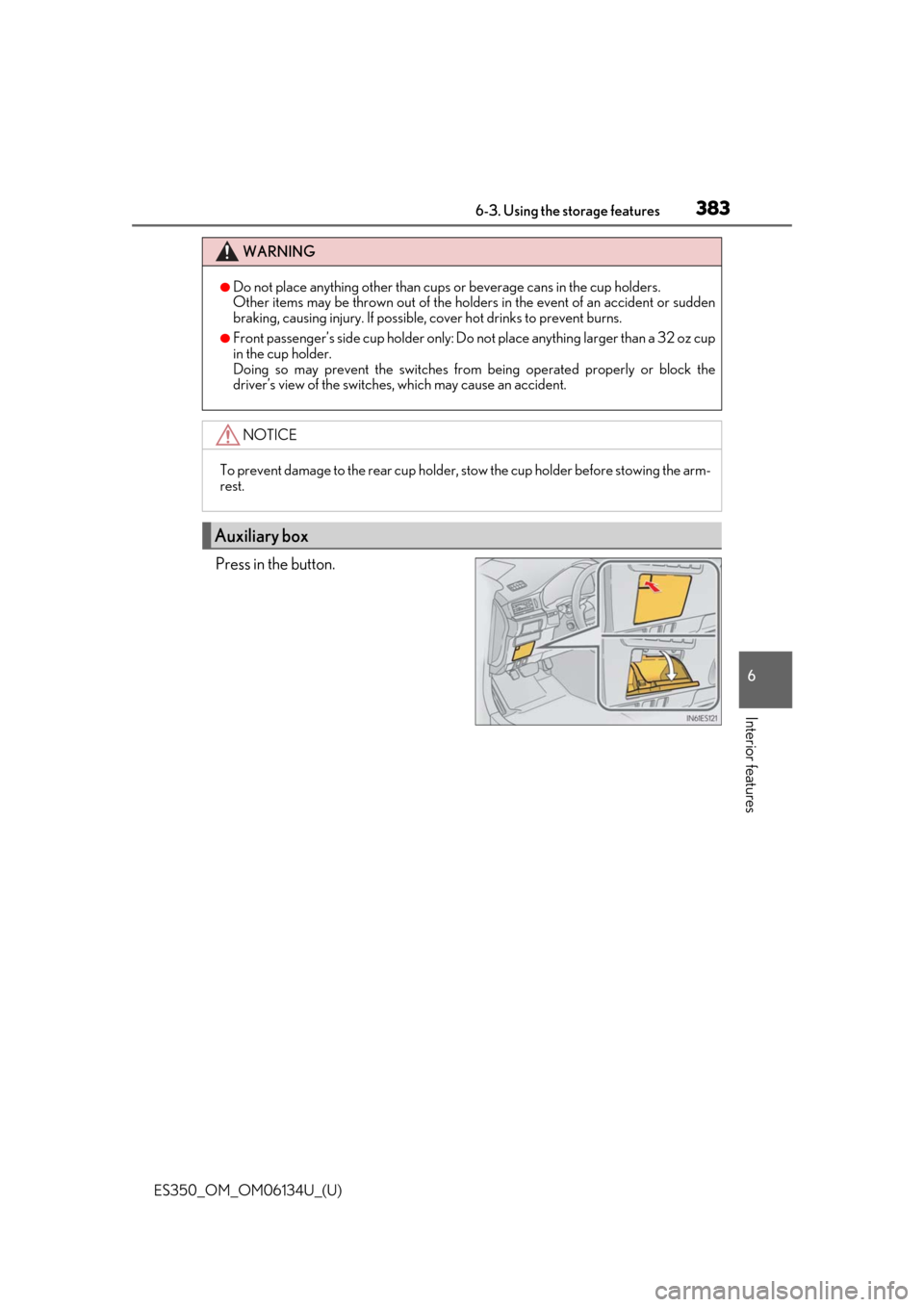
Press in the button.
WARNING
●Do not place anything other than cups or beverage cans in the cup holders.
Other items may be thrown out of the holders in the event of an accident or sudden
braking, causing injury. If possible, cover hot drinks to prevent burns.
●Front passenger’s side cup holder only: Do not place anything larger than a 32 oz cup
in the cup holder.
Doing so may prevent the switches from being operated properly or block the
driver’s view of the switches, which may cause an accident.
NOTICE
To prevent damage to the rear cup holder, stow the cup holder before stowing the arm-
rest.
Auxiliary box
Page 384 of 580

384
ES350_OM_OM06134U_(U)6-3. Using the storage features
Trunk features
Raise the hooks when needed.
The cargo hooks are provided for
securing loose items.
Cargo hooks
WARNING
To avoid injury, always return
the cargo hooks to their stow ed positions when not in use.
Grocery bag hooks
Page 402 of 580
402
ES350_OM_OM06134U_(U)6-4. Using the other interior features
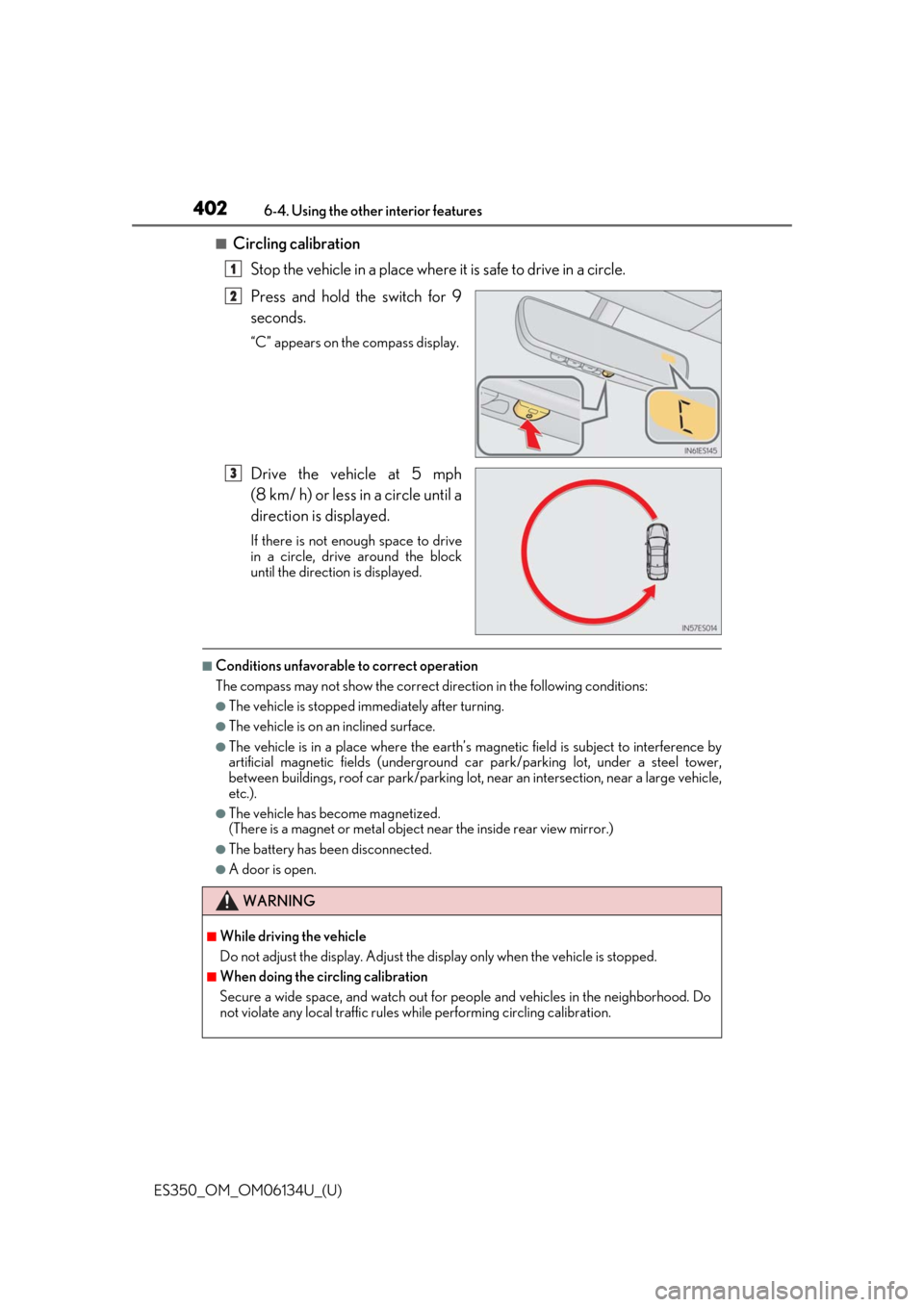
■Circling calibration
Stop the vehicle in a place where it is safe to drive in a circle.
Press and hold the switch for 9
seconds.
“C” appears on the compass display.
Drive the vehicle at 5 mph
(8 km/ h) or less in a circle until a
direction is displayed.
If there is not enough space to drive
in a circle, drive around the block
until the direction is displayed.
■Conditions unfavorable to correct operation
The compass may not show the correct di rection in the following conditions:
●The vehicle is stopped immediately after turning.
●The vehicle is on an inclined surface.
●The vehicle is in a place where the earth’s magnetic field is subject to interference by
artificial magnetic fields (underground car park/parking lot, under a steel tower,
between buildings, roof car park/parking lot, near an intersection, near a large vehicle,
etc.).
●The vehicle has become magnetized.
(There is a magnet or metal object near the inside rear view mirror.)
●The battery has been disconnected.
●A door is open.
1
2
3
WARNING
■While driving the vehicle
Do not adjust the display. Adjust the di splay only when the vehicle is stopped.
■When doing the circling calibration
Secure a wide space, and watch out for pe ople and vehicles in the neighborhood. Do
not violate any local traffic rules wh ile performing circling calibration.
Page 407 of 580
ES350_OM_OM06134U_(U)
4076-4. Using the other interior features
6
Interior features
■Enhanced Roadside Assistance
Enhanced Roadside Assistance adds GPS data to the already included war-
ranty-based Lexus roadside service.
Subscribers can press the “SOS” button to reach a Safety Connect response-
center agent, who can help with a wide range of needs, such as: towing, flat
tire, fuel delivery, etc. For a descript ion of the Roadside Assistance services
and their limitations, please see the Safety Connect Terms and Conditions,
which are available at Lexus.com.
Important! Read this informatio n before using Safety Connect.
■Exposure to radio frequency signals
The Safety Connect system installed in your vehicle is a low-power radio\
transmitter and receiver. It receives and also sends out radio frequency (RF)
signals.
In August 1996, the Federal Commu nications Commission (FCC) adopted
RF exposure guidelines with safety levels for mobile wireless phones. Those
guidelines are consistent with the safe ty standards previously set by the fol-
lowing U.S. and internat ional standards bodies.
●ANSI (American National Stan dards Institute) C95.1 [1992]
●NCRP (National Council on Radiation Protection and Measurement)
Report 86 [1986]
●ICNIRP (International Commission on Non-Ionizing Radiation Protection)
[1996]
Those standards were based on comprehensive and periodic evaluations of
the relevant scientific literature. Over 120 scientists, engineers, and physi-
cians from universities, and governme nt health agencies and industries
reviewed the available body of rese arch to develop the ANSI Standard
(C95.1).
The design of Safety Connect complies wi th the FCC guidelines in addition to
those standards.
Safety information for Safety Connect
Page 425 of 580
425
ES350_OM_OM06134U_(U)7-3. Do-it-yourself maintenance
7
Maintenance and care
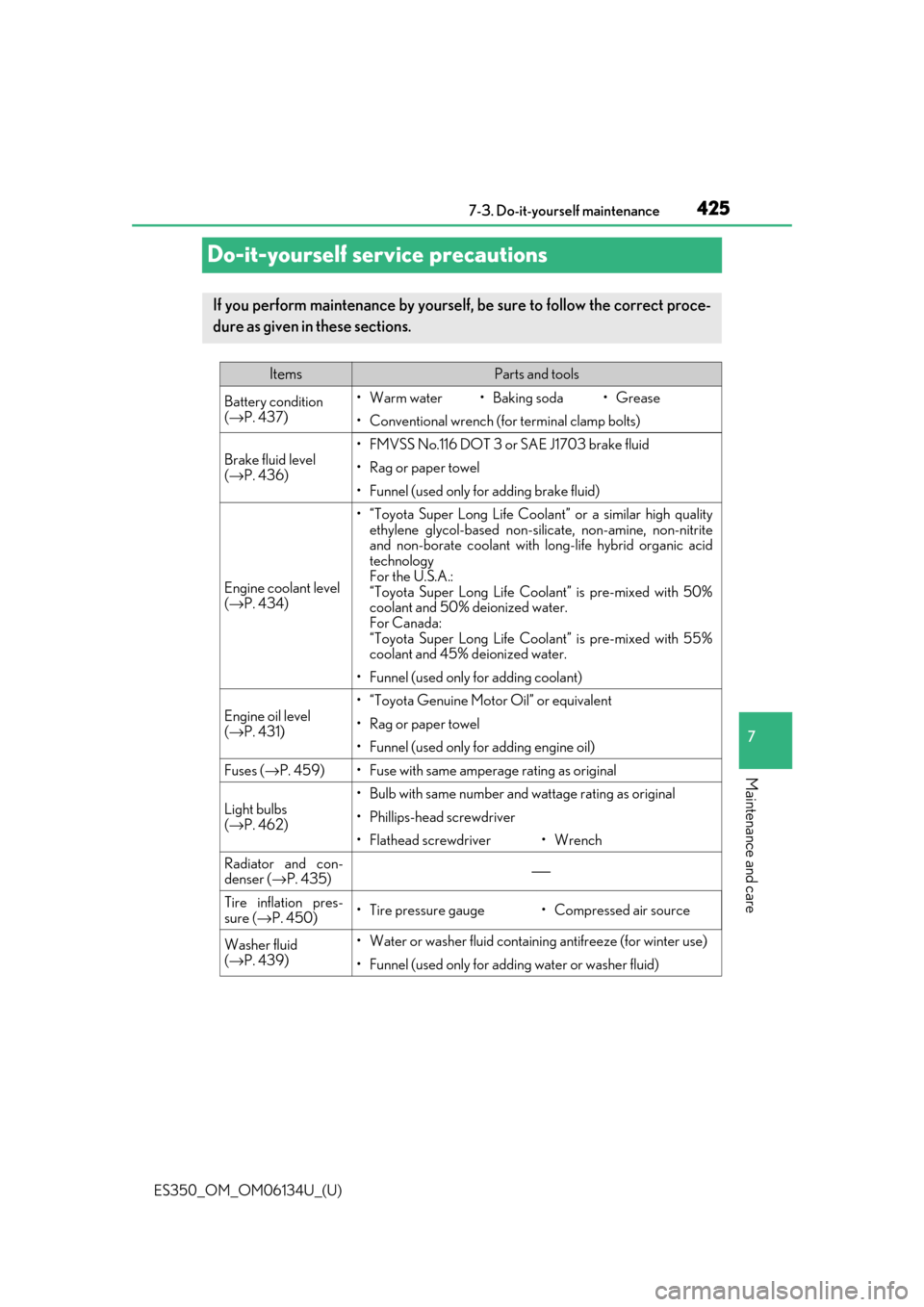
Do-it-yourself service precautions
If you perform maintenance by yourself, be sure to follow the correct proce-
dure as given in these sections.
ItemsParts and tools
Battery condition
(
→ P. 437)•Warm water• Baking soda•Grease
• Conventional wrench (for terminal clamp bolts)
Brake fluid level
(→ P. 436)
• FMVSS No.116 DOT 3 or SAE J1703 brake fluid
• Rag or paper towel
• Funnel (used only for adding brake fluid)
Engine coolant level
(→ P. 434)
• “Toyota Super Long Life Coolan t” or a similar high quality
ethylene glycol-based non-silicate, non-amine, non-nitrite
and non-borate coolant with long-life hybrid organic acid
technology
For the U.S.A.:
“Toyota Super Long Life Coolant” is pre-mixed with 50%
coolant and 50% deionized water.
For Canada:
“Toyota Super Long Life Cool ant” is pre-mixed with 55%
coolant and 45% deionized water.
• Funnel (used only for adding coolant)
Engine oil level
( → P. 431)
• “Toyota Genuine Motor Oil” or equivalent
• Rag or paper towel
• Funnel (used only for adding engine oil)
Fuses ( →P. 459)• Fuse with same amperage rating as original
Light bulbs
(→ P. 462)
• Bulb with same number and wattage rating as original
• Phillips-head screwdriver
• Flathead screwdriver•Wrench
Radiator and con-
denser (→ P. 435)⎯
Tire inflation pres-
sure (→P. 450)• Tire pressure gauge• Compressed air source
Washer fluid
(→ P. 439)• Water or washer fluid containing antifreeze (for winter use)
• Funnel (used only for adding water or washer fluid)
Page 444 of 580
444
ES350_OM_OM06134U_(U)7-3. Do-it-yourself maintenance
■Tire types
●Summer tires
Summer tires are high-speed performance ti
res best suited to highway driving under
dry conditions. Since summer tires do not have the same traction performance as
snow tires, summer tires are inadequate for driving on snow-covered or icy roads. For
driving on snow-covered roads or icy road s, the use of snow tires is recommended.
When installing snow tires, be sure to replace all four tires.
●All season tires
All season tires are designed to provide better traction in snow and to be adequate for
driving in most winter conditions as well as for use year-round. All season tires, how-
ever, do not have adequate traction perfor mance compared with snow tires in heavy
or loose snow. Also, all season tires fall short in acceleration and handling perfor-
mance compared with summer tires in highway driving.
●Snow tires
For driving on snow-covered roads or icy roads, we recommend using snow tires. If
you need snow tires, select ti res of the same size, construction and load capacity as the
originally installed tires. Since your vehicle has radial tires as original equipment, make
sure your snow tires also have radial cons truction. Do not install studded tires without
first checking local regulations for possible restrictions. Snow tires should be installed
on all wheels. ( →P. 262)
■If the tread on snow tires wears down below 0.16 in. (4 mm)
The effectiveness of the tire s as snow tires is lost.
■Situations in which the tire pressure warning system may not operate properly
●In the following cases, the tire pressure warning system may not operate properly.
• If non-genuine Lexus wheels are used.
• A tire has been replaced with a tire that is not an OE (Original Equipment) tire.
• A tire has been replaced with a tire that is not of the specified size.
• Tire chains etc. are equipped.
• An auxiliary-supported run-flat tire is equipped.
• If a window tint that affects th e radio wave signals is installed.
• If there is a lot of snow or ice on the vehi cle, particularly around the wheels or wheel
housings.
• If the tire inflation pressure is extr emely higher than the specified level.
●Performance may be affected in the following situations.
• Near a TV tower, electric power plant, gas station, radio station, large display, air-
port or other facility that generates st rong radio waves or electrical noise
• When carrying a portable radio, cellular phone, cordless phone or other wireless
communication device
If tire position information is not correctl y displayed due to the radio wave conditions,
the display may be corrected by driving and changing the radio wave conditions.
●When the vehicle is parked, the time taken for the warning to start or go off could be
extended.
●When tire inflation pressure declines rapidly for example when a tire has burst, the
warning may not function.
Page 448 of 580

448
ES350_OM_OM06134U_(U)7-3. Do-it-yourself maintenance
WARNING
■When inspecting or replacing tires
Observe the following precautions to prevent accidents.
Failure to do so may cause damage to parts
of the drive train as well as dangerous han-
dling characteristics, which may lead to an accident resulting in death or serious injury.
●Make sure to install four tire s that are of the specified size, and that all four tires are of
the same size, same brand, and same tread pattern.
●Do not use tire sizes other than those recommended by Lexus.
●Do not mix differently constructed tires (radial, bias-belted or bias-ply tires).
●If only two tires are replaced, the new tires sh ould be placed on the rear of the vehicle.
●Do not mix summer, all season and snow tires.
●Do not use tires that have been used on another vehicle.
Do not use tires if you do not know how they were used previously.
●Do not tow if your vehicle has a compact spare tire installed.
■When initializing the tire pressure warning system
Do not operate the tire pressure warning reset switch without first adjusting the tire
inflation pressure to the spec ified level. Otherwise, the tire pressure warning light may
not come on even if the tire inflation pressu re is low, or it may come on when the tire
inflation pressure is actually normal.
■Caution regarding interference with electronic devices
●Users of any electrical medical device ot her than implantable cardiac pacemakers,
cardiac resynchronization th erapy-pacemakers or implantable cardioverter defibril-
lators should consult the manufacturer of the device for information about its opera-
tion under the influence of radio waves.
Radio waves could have unexpected effects on the operation of such medical
devices.
●People with implantabl e cardiac pacemakers,
cardiac resynchronization therapy-pacemak-
ers or implantable cardioverter defibrillators
should not come within 17.7 in. (450 mm) of
the tire pressure warn ing system initiators.
The radio waves may affect the operation of
such devices.
Page 473 of 580

473
ES350_OM_OM06134U_(U)
8When trouble arises
8-1. Essential informationEmergency flashers .................. 474
If your vehicle has to be stopped in an emergency.... 475
8-2. Steps to take in an emergency If your vehicle needs to be towed................................ 476
If you think something is wrong ............... 480
Fuel pump shut off system ....... 481
If a warning light turns on or a warning buzzer sounds..... 482
If a warning message is displayed ............................... 488
If you have a flat tire ................... 491
If the engine will not start ........502
If the electronic key does not operate properly .....................504
If the battery is discharged .....506
If your vehicle overheats .......... 510
If the vehicle becomes stuck .............................................. 513
Page 476 of 580
476
ES350_OM_OM06134U_(U)8-2. Steps to take in an emergency
If your vehicle needs to be towed
The following may indicate a problem wi
th your transmission. Contact your
Lexus dealer or commercial to wing service before towing.
●The engine is running but the vehicle does not move.
●The vehicle makes an abnormal sound.
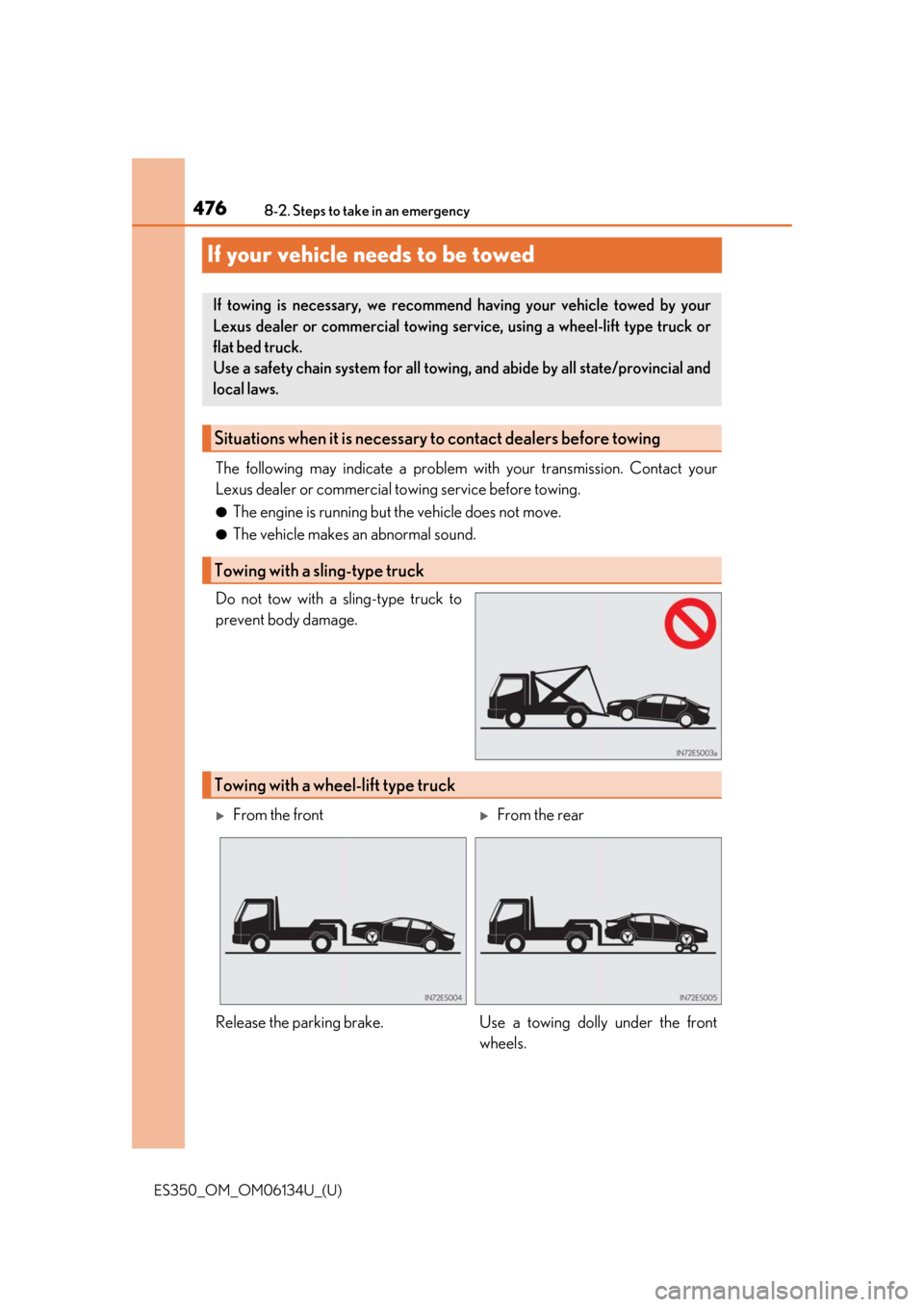
Do not tow with a sling-type truck to
prevent body damage.
If towing is necessary, we recommend having your vehicle towed by your
Lexus dealer or commercial towing se rvice, using a wheel-lift type truck or
flat bed truck.
Use a safety chain system for all towing, and abide by all state/provincial and
local laws.
Situations when it is necessary to contact dealers before towing
Towing with a sling-type truck
Towing with a wheel-lift type truck
From the frontFrom the rear
Release the parking brake. Use a towing dolly under the front wheels.
Page 477 of 580
4778-2. Steps to take in an emergency
ES350_OM_OM06134U_(U)
8
When trouble arises
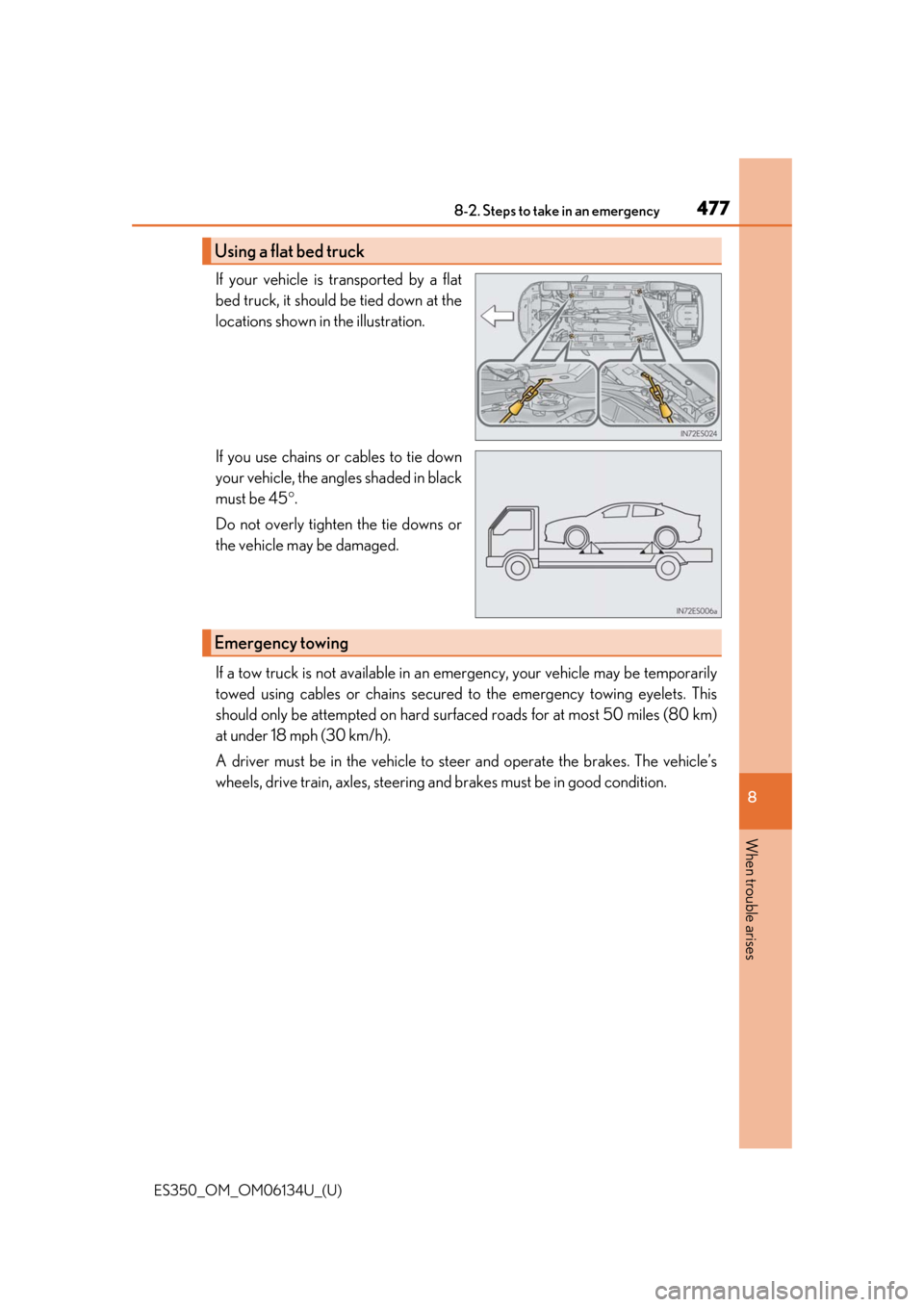
If your vehicle is transported by a flat
bed truck, it should be tied down at the
locations shown in the illustration.
If you use chains or cables to tie down
your vehicle, the angles shaded in black
must be 45 °.
Do not overly tighten the tie downs or
the vehicle may be damaged.
If a tow truck is not available in an em ergency, your vehicle may be temporarily
towed using cables or chains secured to the emergency towing eyelets. This
should only be attempted on hard surf aced roads for at most 50 miles (80 km)
at under 18 mph (30 km/h).
A driver must be in the vehicle to st eer and operate the brakes. The vehicle’s
wheels, drive train, axles, steering an d brakes must be in good condition.
Using a flat bed truck
Emergency towing