oil level Lexus ES350 2020 Owner's Manuals / LEXUS 2020 ES350 THROUGH SEPT. 2019 PROD. OWNER'S MANUAL (OM06174U)
[x] Cancel search | Manufacturer: LEXUS, Model Year: 2020, Model line: ES350, Model: Lexus ES350 2020Pages: 448, PDF Size: 9.77 MB
Page 4 of 448
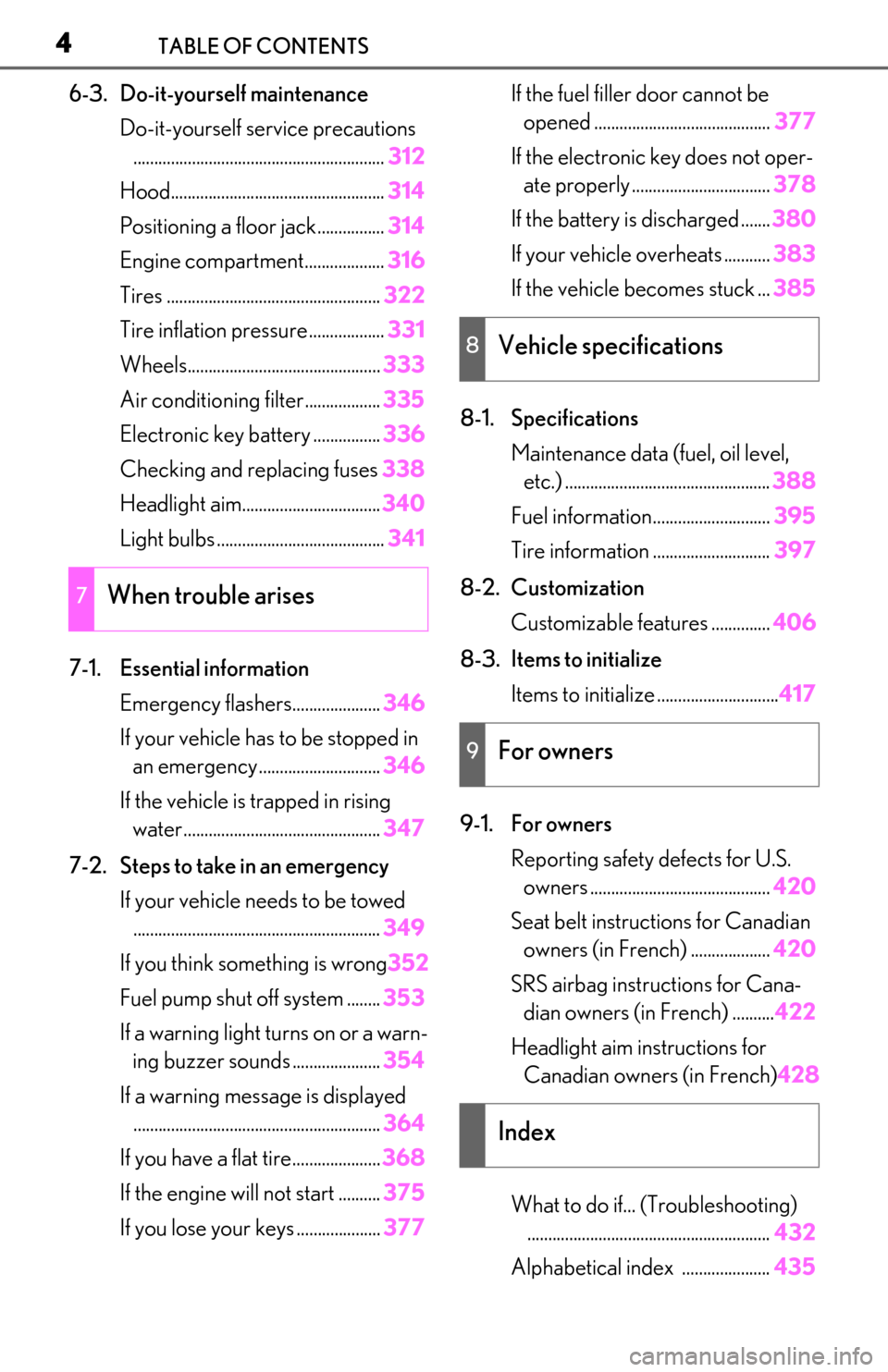
4TABLE OF CONTENTS
6-3. Do-it-yourself maintenanceDo-it-yourself service precautions............................................................ 312
Hood................................................... 314
Positioning a floor jack................ 314
Engine compartment................... 316
Tires ................................................... 322
Tire inflation pressure .................. 331
Wheels.............................................. 333
Air conditioning filter..................335
Electronic key battery ................ 336
Checking and replacing fuses 338
Headlight aim................................. 340
Light bulbs ........................................ 341
7-1. Essential information Emergency flashers..................... 346
If your vehicle has to be stopped in an emergency ............................. 346
If the vehicle is trapped in rising water............................................... 347
7-2. Steps to take in an emergency If your vehicle needs to be towed........................................................... 349
If you think something is wrong 352
Fuel pump shut off system ........ 353
If a warning light turns on or a warn- ing buzzer sounds ..................... 354
If a warning message is displayed ........................................................... 364
If you have a flat tire..................... 368
If the engine wi ll not start .......... 375
If you lose your keys .................... 377If the fuel filler door cannot be
opened .......................................... 377
If the electronic key does not oper- ate properly ................................. 378
If the battery is discharged ....... 380
If your vehicle overheats ........... 383
If the vehicle becomes stuck ... 385
8-1. Specifications Maintenance data (fuel, oil level, etc.) ................................................. 388
Fuel information............................ 395
Tire information ............................ 397
8-2. Customization Customizable features .............. 406
8-3. Items to initialize Items to initialize ............................. 417
9-1. For owners Reporting safety defects for U.S. owners ........................................... 420
Seat belt instructions for Canadian owners (in French) ................... 420
SRS airbag instructions for Cana- dian owners (in French) .......... 422
Headlight aim instructions for Canadian owners (in French) 428
What to do if... (Troubleshooting) .......................................................... 432
Alphabetical index ..................... 435
7When trouble arises
8Vehicle specifications
9For owners
Index
Page 67 of 448
672-1. Instrument cluster
2
Vehicle status information and indicators
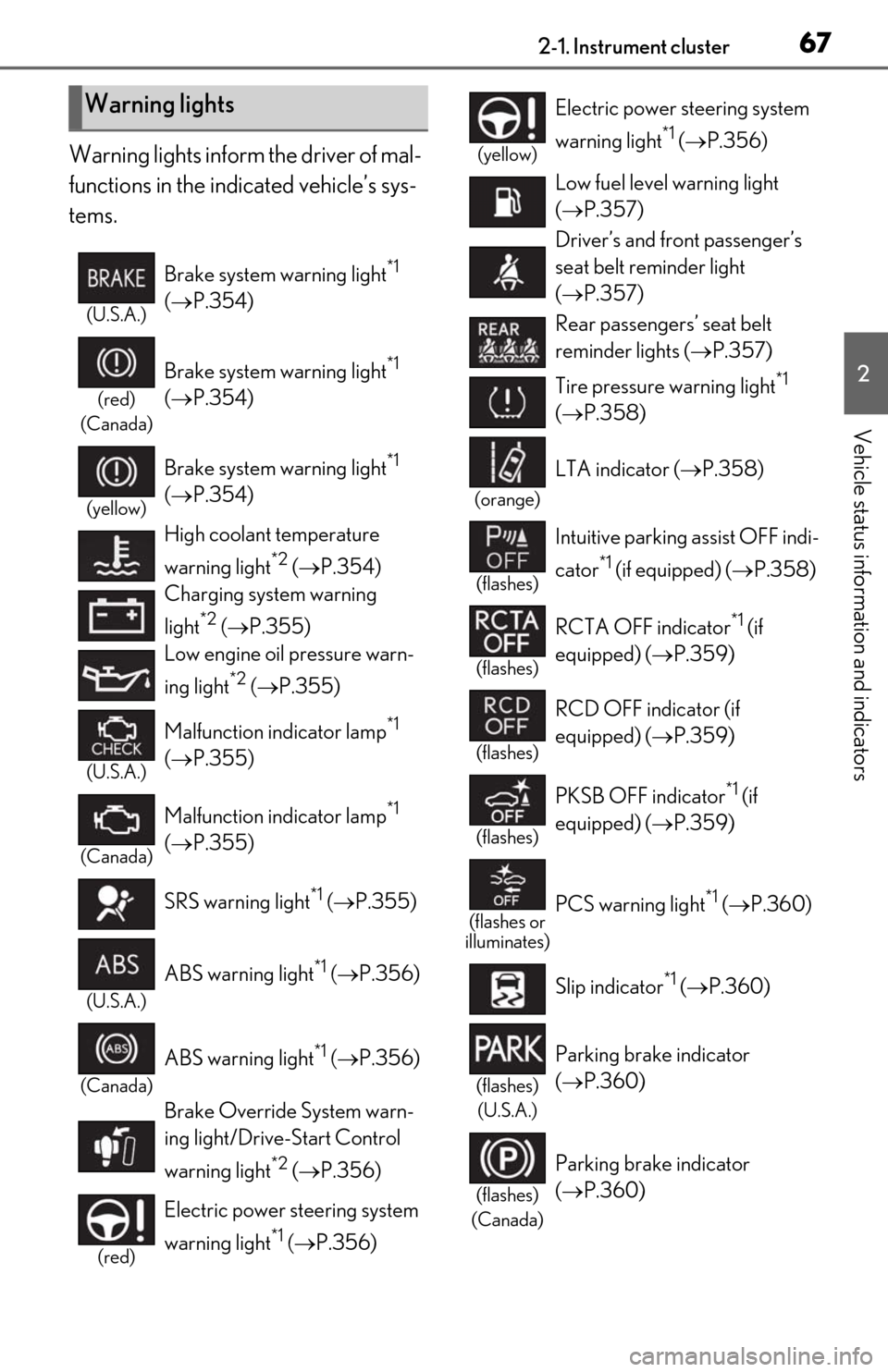
Warning lights inform the driver of mal-
functions in the indicated vehicle’s sys-
tems.
Warning lights
(U.S.A.)
Brake system warning light*1
( P.354)
(red)
(Canada)
Brake system warning light*1
( P.354)
(yellow)
Brake system warning light*1
( P.354)
High coolant temperature
warning light
*2 ( P.354)
Charging system warning
light
*2 ( P.355)
Low engine oil pressure warn-
ing light
*2 ( P.355)
(U.S.A.)
Malfunction indicator lamp*1
( P.355)
(Canada)
Malfunction indicator lamp*1
( P.355)
SRS warning light
*1 ( P.355)
(U.S.A.)
ABS warning light*1 ( P.356)
(Canada)
ABS warning light*1 ( P.356)
Brake Override System warn-
ing light/Drive-Start Control
warning light
*2 ( P.356)
(red)
Electric power st eering system
warning light
*1 ( P.356)
(yellow)
Electric power steering system
warning light
*1 ( P.356)
Low fuel level warning light
( P.357)
Driver’s and front passenger’s
seat belt re minder light
( P.357)
Rear passengers’ seat belt
reminder lights ( P.357)
Tire pressure warning light
*1
( P.358)
(orange)
LTA indicator ( P.358)
(flashes)
Intuitive parking assist OFF indi-
cator
*1 (if equipped) (P.358)
(flashes)
RCTA OFF indicator*1 (if
equipped) ( P.359)
(flashes)
RCD OFF indicator (if
equipped) (P.359)
(flashes)
PKSB OFF indicator*1 (if
equipped) ( P.359)
(flashes or
illuminates)PCS warning light*1 ( P.360)
Slip indicator
*1 ( P.360)
(flashes)
(U.S.A.)
Parking brake indicator
( P.360)
(flashes)
(Canada)
Parking brake indicator
( P.360)
Page 188 of 448
1884-5. Using the driving support systems
play is switched to the driving assist system
information screen.
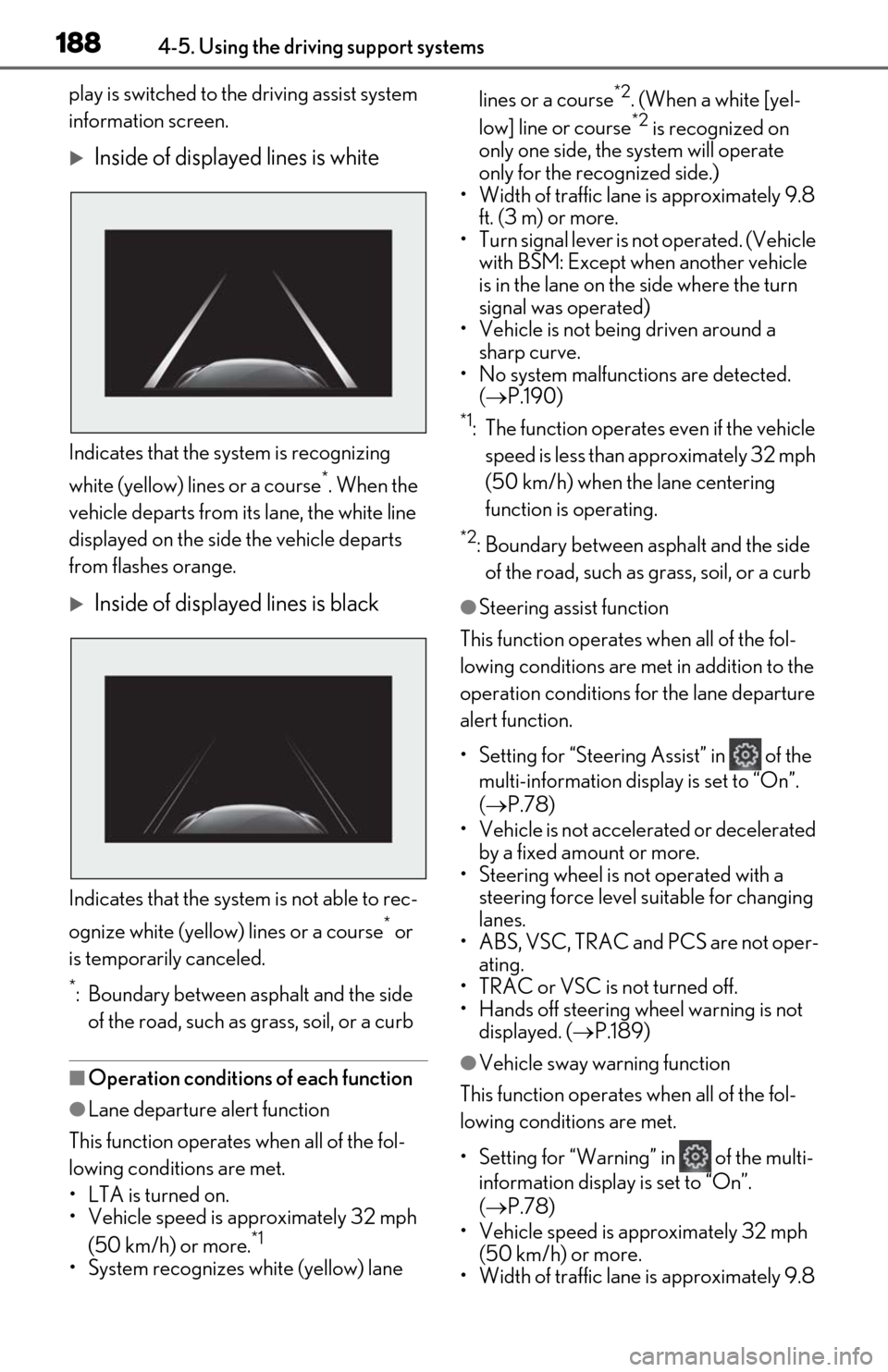
Inside of displayed lines is white
Indicates that the system is recognizing
white (yellow) lines or a course
*. When the
vehicle departs from it s lane, the white line
displayed on the side the vehicle departs
from flashes orange.
Inside of displayed lines is black
Indicates that the system is not able to rec-
ognize white (yellow) lines or a course
* or
is temporarily canceled.
*: Boundary between asphalt and the side of the road, such as grass, soil, or a curb
■Operation conditions of each function
●Lane departure alert function
This function operates when all of the fol-
lowing conditions are met.
• LTA is turned on.
• Vehicle speed is approximately 32 mph (50 km/h) or more.
*1
•System recognizes wh ite (yellow) lane lines or a course
*2. (When a white [yel-
low] line or course*2 is recognized on
only one side, the system will operate
only for the recognized side.)
• Width of traffic lane is approximately 9.8 ft. (3 m) or more.
• Turn signal lever is not operated. (Vehicle
with BSM: Except when another vehicle
is in the lane on the side where the turn
signal was operated)
• Vehicle is not being driven around a sharp curve.
• No system malfunctions are detected.
( P.190)
*1: The function operates even if the vehicle
speed is less than ap proximately 32 mph
(50 km/h) when the lane centering
function is operating.
*2: Boundary between asphalt and the side of the road, such as grass, soil, or a curb
●Steering assist function
This function operates when all of the fol-
lowing conditions are met in addition to the
operation conditions for the lane departure
alert function.
• Setting for “Steering Assist” in of the multi-information display is set to “On”.
( P.78)
• Vehicle is not acceler ated or decelerated
by a fixed amount or more.
• Steering wheel is not operated with a steering force level su itable for changing
lanes.
• ABS, VSC, TRAC and PCS are not oper- ating.
• TRAC or VSC is not turned off.
• Hands off steering wheel warning is not
displayed. ( P.189)
●Vehicle sway warning function
This function operates when all of the fol-
lowing conditions are met.
• Setting for “Warning” in of the multi- information display is set to “On”.
( P.78)
• Vehicle speed is ap proximately 32 mph
(50 km/h) or more.
• Width of traffic lane is approximately 9.8
Page 189 of 448
1894-5. Using the driving support systems
4
Driving
ft. (3 m) or more.
• No system malfunctions are detected. ( P.190)
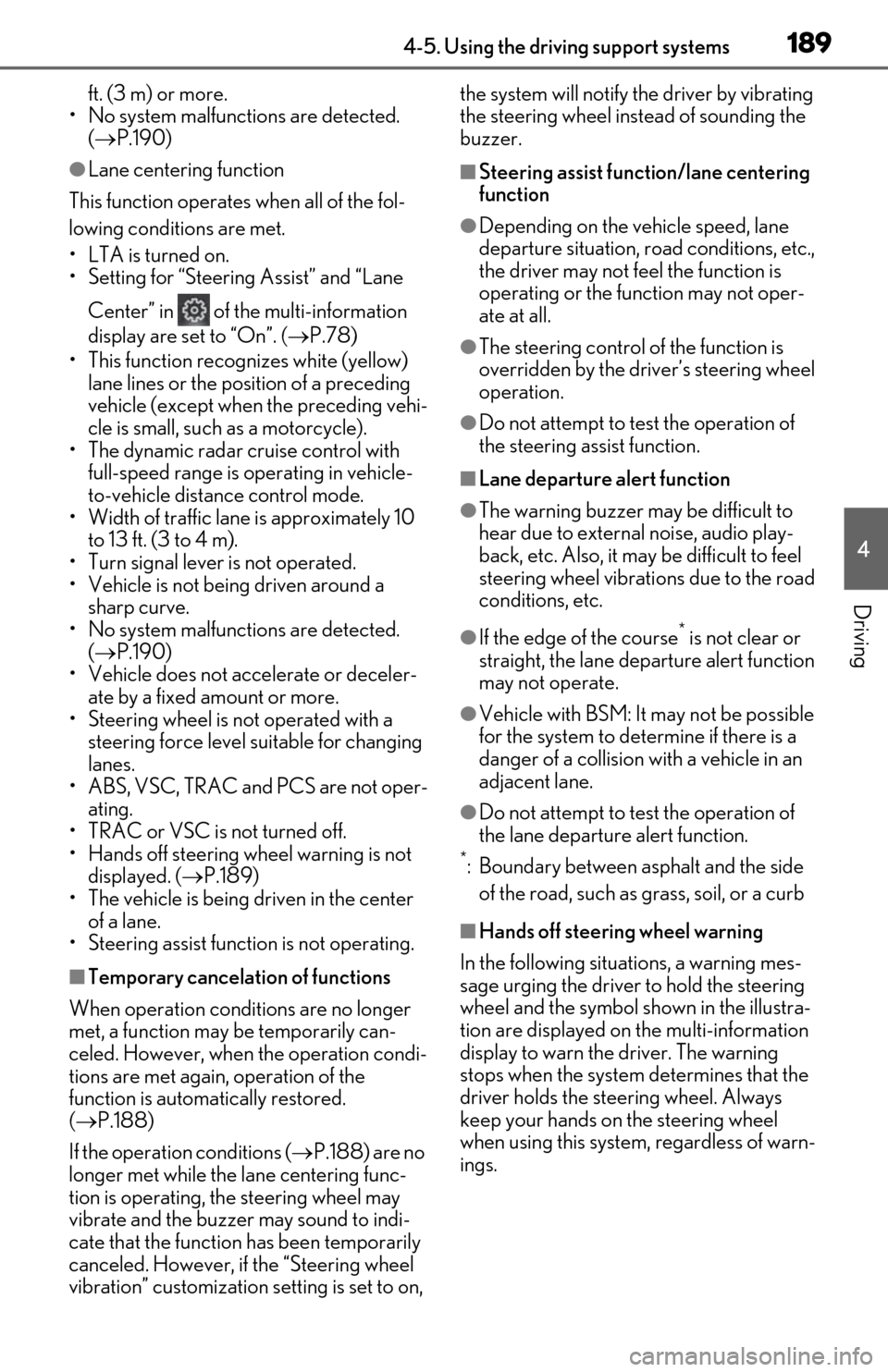
●Lane centering function
This function operates when all of the fol-
lowing conditions are met.
• LTA is turned on.
• Setting for “Steering Assist” and “Lane
Center” in of th e multi-information
display are set to “On”. ( P.78)
• This function recognizes white (yellow) lane lines or the position of a preceding
vehicle (except when the preceding vehi-
cle is small, such as a motorcycle).
• The dynamic radar cruise control with
full-speed range is operating in vehicle-
to-vehicle distance control mode.
• Width of traffic lane is approximately 10
to 13 ft. (3 to 4 m).
• Turn signal lever is not operated.
• Vehicle is not being driven around a sharp curve.
• No system malfunctions are detected. ( P.190)
• Vehicle does not acc elerate or deceler-
ate by a fixed amount or more.
• Steering wheel is not operated with a
steering force level su itable for changing
lanes.
• ABS, VSC, TRAC and PCS are not oper-
ating.
• TRAC or VSC is not turned off.
• Hands off steering wheel warning is not displayed. ( P.189)
• The vehicle is being driven in the center of a lane.
• Steering assist function is not operating.
■Temporary cancelation of functions
When operation conditions are no longer
met, a function may be temporarily can-
celed. However, when the operation condi-
tions are met again, operation of the
function is automatically restored.
( P.188)
If the operation conditions ( P.188) are no
longer met while the lane centering func-
tion is operating, th e steering wheel may
vibrate and the buzzer may sound to indi-
cate that the function has been temporarily
canceled. However, if the “Steering wheel
vibration” customization setting is set to on, the system will notify the driver by vibrating
the steering wheel instead of sounding the
buzzer.
■Steering assist function/lane centering
function
●Depending on the vehicle speed, lane
departure situation, road conditions, etc.,
the driver may not feel the function is
operating or the function may not oper-
ate at all.
●The steering control of the function is
overridden by the driver’s steering wheel
operation.
●Do not attempt to test the operation of
the steering assist function.
■Lane departure alert function
●The warning buzzer may be difficult to
hear due to external noise, audio play-
back, etc. Also, it may be difficult to feel
steering wheel vibrations due to the road
conditions, etc.
●If the edge of the course* is not clear or
straight, the lane departure alert function
may not operate.
●Vehicle with BSM: It may not be possible
for the system to determine if there is a
danger of a collision with a vehicle in an
adjacent lane.
●Do not attempt to test the operation of
the lane departure alert function.
*: Boundary between asphalt and the side
of the road, such as grass, soil, or a curb
■Hands off steering wheel warning
In the following situations, a warning mes-
sage urging the driver to hold the steering
wheel and the symbol sh own in the illustra-
tion are displayed on the multi-information
display to warn the driver. The warning
stops when the system determines that the
driver holds the steering wheel. Always
keep your hands on the steering wheel
when using this system , regardless of warn-
ings.
Page 249 of 448
2494-6. Driving tips
4
Driving
4-6.Driving tips
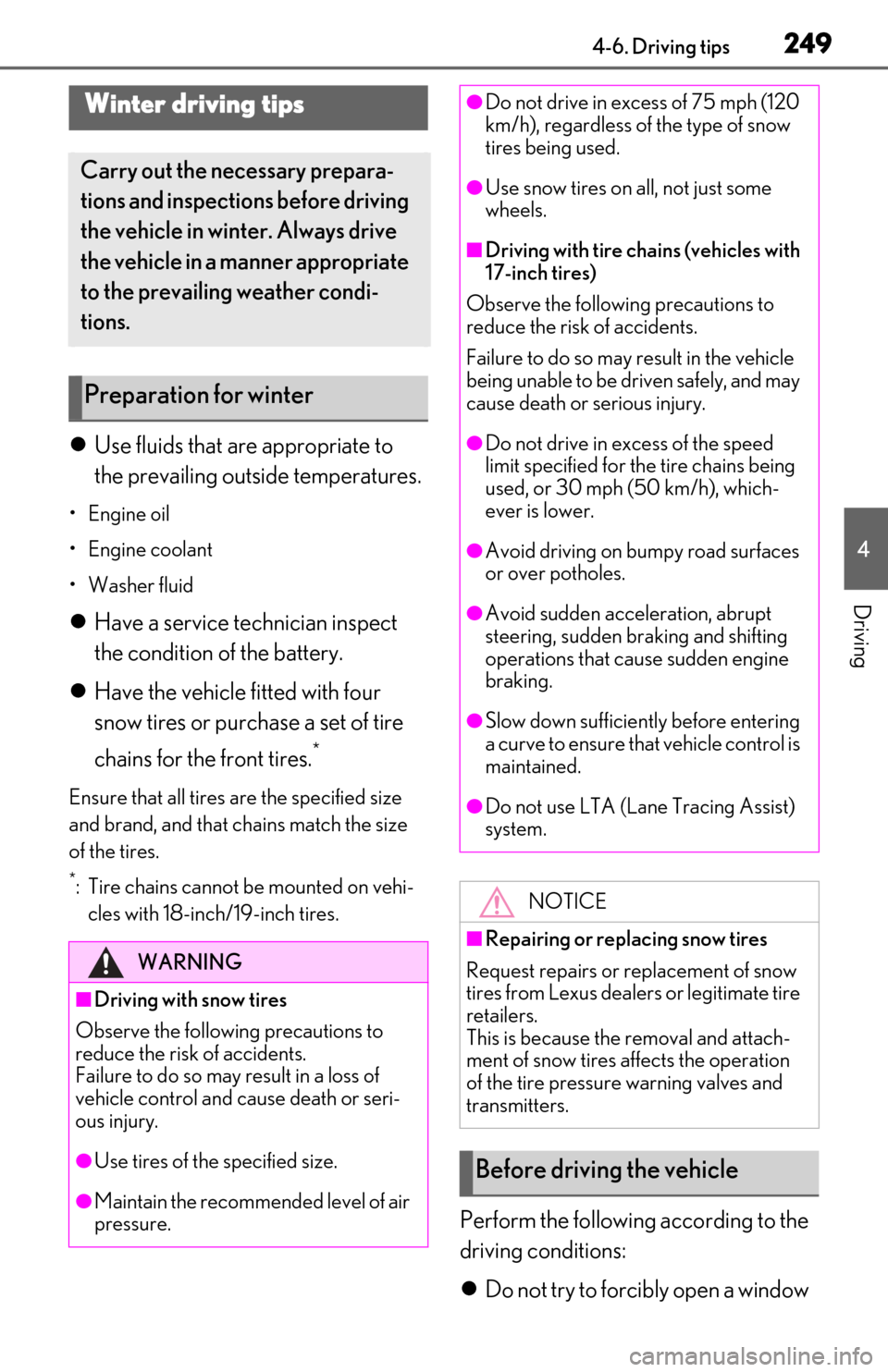
Use fluids that are appropriate to
the prevailing outside temperatures.
• Engine oil
• Engine coolant
• Washer fluid
Have a service technician inspect
the condition of the battery.
Have the vehicle fitted with four
snow tires or purchase a set of tire
chains for the front tires.
*
Ensure that all tires are the specified size
and brand, and that chains match the size
of the tires.
*: Tire chains cannot be mounted on vehi-
cles with 18-inch/19-inch tires.
Perform the following according to the
driving conditions:
Do not try to forcibly open a window
Winter driving tips
Carry out the necessary prepara-
tions and inspections before driving
the vehicle in winter. Always drive
the vehicle in a manner appropriate
to the prevailing weather condi-
tions.
Preparation for winter
WARNING
■Driving with snow tires
Observe the following precautions to
reduce the risk of accidents.
Failure to do so may result in a loss of
vehicle control and cause death or seri-
ous injury.
●Use tires of the specified size.
●Maintain the recommended level of air
pressure.
●Do not drive in excess of 75 mph (120
km/h), regardless of the type of snow
tires being used.
●Use snow tires on all, not just some
wheels.
■Driving with tire chains (vehicles with
17-inch tires)
Observe the following precautions to
reduce the risk of accidents.
Failure to do so may result in the vehicle
being unable to be driven safely, and may
cause death or serious injury.
●Do not drive in excess of the speed
limit specified for the tire chains being
used, or 30 mph (50 km/h), which-
ever is lower.
●Avoid driving on bumpy road surfaces
or over potholes.
●Avoid sudden acceleration, abrupt
steering, sudden braking and shifting
operations that cause sudden engine
braking.
●Slow down sufficiently before entering
a curve to ensure that vehicle control is
maintained.
●Do not use LTA (Lane Tracing Assist)
system.
NOTICE
■Repairing or replacing snow tires
Request repairs or replacement of snow
tires from Lexus dealers or legitimate tire
retailers.
This is because the removal and attach-
ment of snow tires affects the operation
of the tire pressure warning valves and
transmitters.
Before driving the vehicle
Page 308 of 448
3086-2. Maintenance
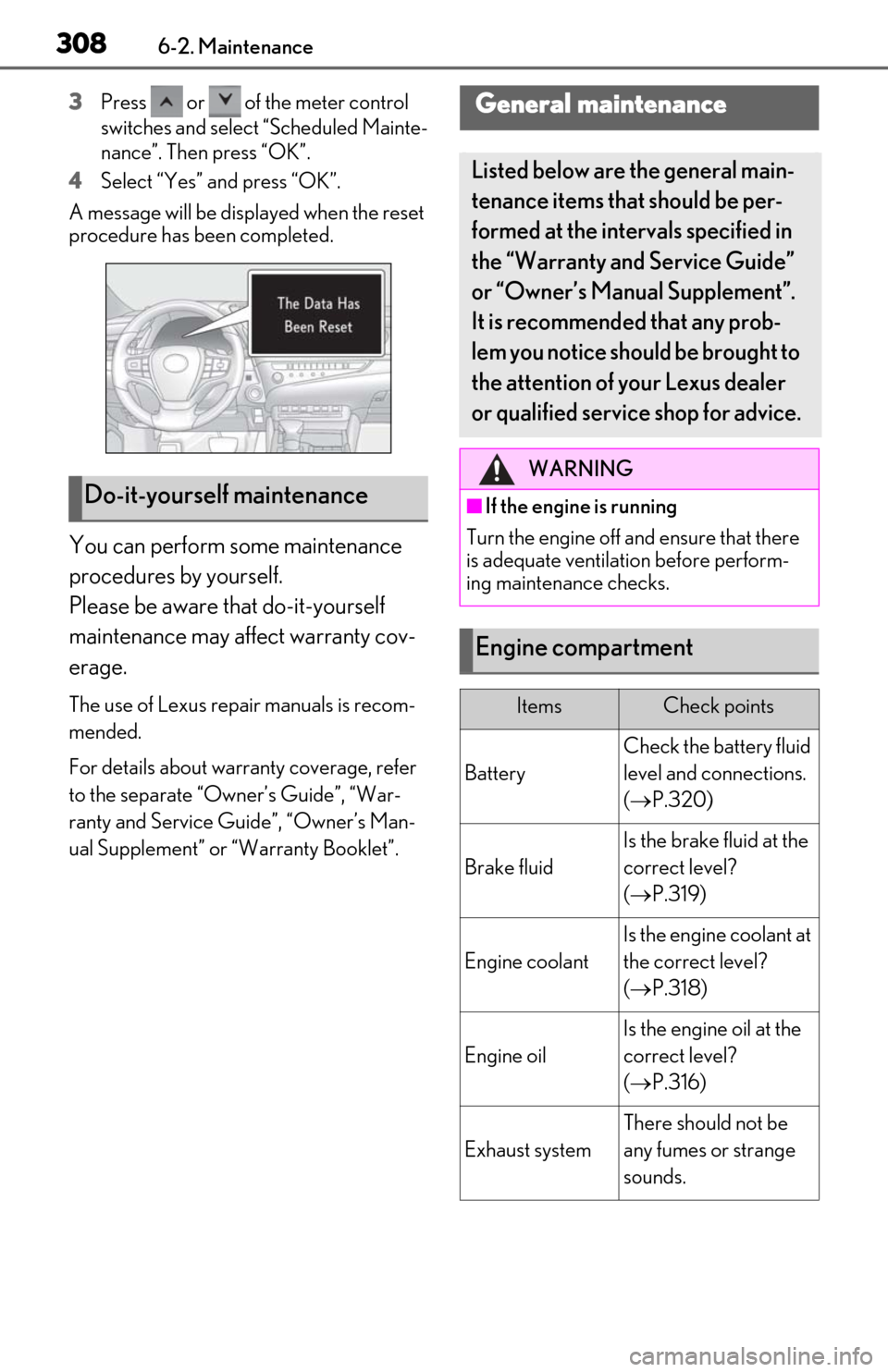
3Press or of the meter control
switches and select “Scheduled Mainte-
nance”. Then press “OK”.
4
Select “Yes” and press “OK”.
A message will be disp layed when the reset
procedure has been completed.
You can perform some maintenance
procedures by yourself.
Please be aware that do-it-yourself
maintenance may affect warranty cov-
erage.
The use of Lexus repair manuals is recom-
mended.
For details about warranty coverage, refer
to the separate “Owner’s Guide”, “War-
ranty and Service Guide”, “Owner’s Man-
ual Supplement” or “Warranty Booklet”.
Do-it-yourself maintenance
General maintenance
Listed below are the general main-
tenance items that should be per-
formed at the intervals specified in
the “Warranty and Service Guide”
or “Owner’s Manual Supplement”.
It is recommended that any prob-
lem you notice should be brought to
the attention of your Lexus dealer
or qualified service shop for advice.
WARNING
■If the engine is running
Turn the engine off and ensure that there
is adequate ventilati on before perform-
ing maintenance checks.
Engine compartment
ItemsCheck points
Battery
Check the battery fluid
level and connections.
( P.320)
Brake fluid
Is the brake fluid at the
correct level?
( P.319)
Engine coolant
Is the engine coolant at
the correct level?
( P.318)
Engine oil
Is the engine oil at the
correct level?
( P.316)
Exhaust system
There should not be
any fumes or strange
sounds.
Page 312 of 448
3126-3. Do-it-yourself maintenance
6-3.Do-it-yourself maintenance
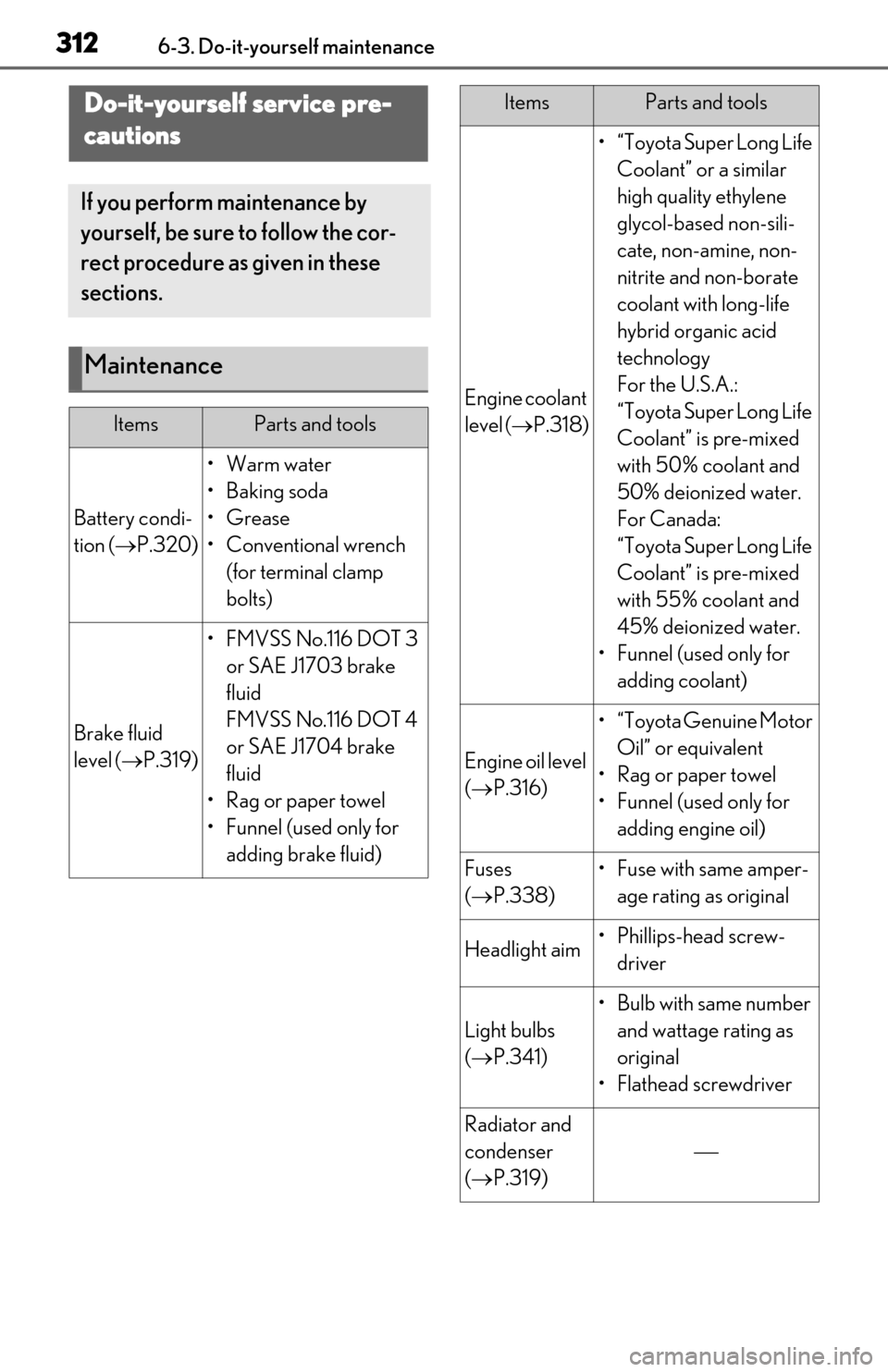
Do-it-yourself service pre-
cautions
If you perform maintenance by
yourself, be sure to follow the cor-
rect procedure as given in these
sections.
Maintenance
ItemsParts and tools
Battery condi-
tion (P.320)
•Warm water
•Baking soda
•Grease
• Conventional wrench
(for terminal clamp
bolts)
Brake fluid
level ( P.319)
• FMVSS No.116 DOT 3
or SAE J1703 brake
fluid
FMVSS No.116 DOT 4
or SAE J1704 brake
fluid
• Rag or paper towel
• Funnel (used only for adding brake fluid)
Engine coolant
level ( P.318)
•“Toyota Super Long Life
Coolant” or a similar
high quality ethylene
glycol-based non-sili-
cate, non-amine, non-
nitrite and non-borate
coolant with long-life
hybrid organic acid
technology
For the U.S.A.:
“Toyota Super Long Life
Coolant” is pre-mixed
with 50% coolant and
50% deionized water.
For Canada:
“Toyota Super Long Life
Coolant” is pre-mixed
with 55% coolant and
45% deionized water.
• Funnel (used only for adding coolant)
Engine oil level
( P.316)
•“Toyota Genuine Motor
Oil” or equivalent
•Rag or paper towel
• Funnel (used only for adding engine oil)
Fuses
( P.338)• Fuse with same amper-
age rating as original
Headlight aim• Phillips-head screw-driver
Light bulbs
( P.341)
•Bulb with same number
and wattage rating as
original
• Flathead sc rewdriver
Radiator and
condenser
( P.319)
ItemsParts and tools
Page 316 of 448
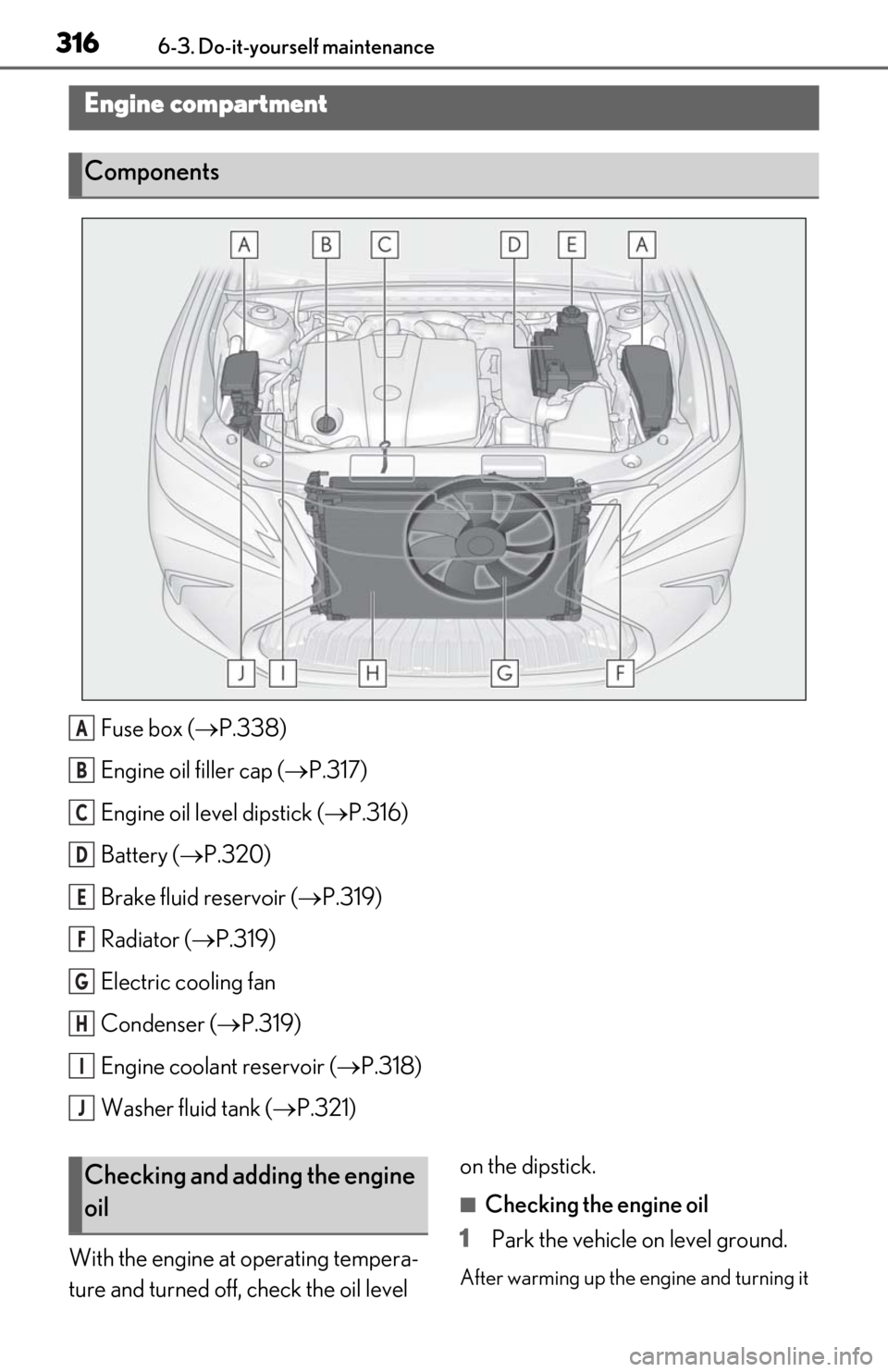
3166-3. Do-it-yourself maintenance
Fuse box (P.338)
Engine oil filler cap ( P.317)
Engine oil level dipstick ( P.316)
Battery ( P.320)
Brake fluid reservoir ( P.319)
Radiator ( P.319)
Electric cooling fan
Condenser ( P.319)
Engine coolant reservoir ( P.318)
Washer fluid tank ( P.321)
With the engine at operating tempera-
ture and turned off, check the oil level on the dipstick.
■Checking the engine oil
1 Park the vehicle on level ground.
After warming up the engine and turning it
Engine compartment
Components
A
B
C
D
E
F
G
H
I
J
Checking and adding the engine
oil
Page 317 of 448
3176-3. Do-it-yourself maintenance
6
Maintenance and care
off, wait more than 5 minutes for the oil to
drain back into the bottom of the engine.
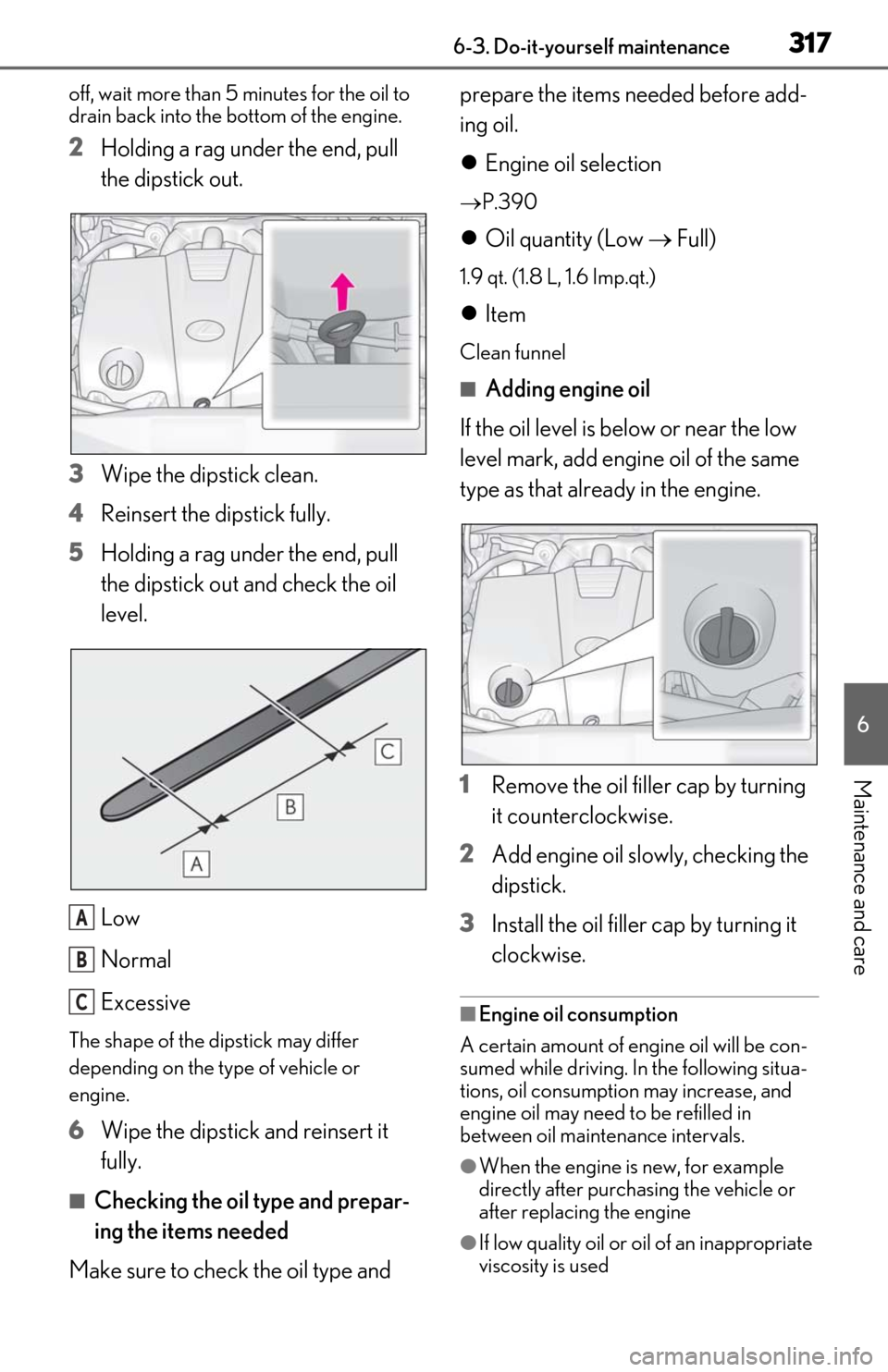
2Holding a rag under the end, pull
the dipstick out.
3 Wipe the dipstick clean.
4 Reinsert the dipstick fully.
5 Holding a rag under the end, pull
the dipstick out and check the oil
level.
Low
Normal
Excessive
The shape of the dipstick may differ
depending on the type of vehicle or
engine.
6Wipe the dipstick and reinsert it
fully.
■Checking the oil type and prepar-
ing the items needed
Make sure to check the oil type and prepare the items needed before add-
ing oil.
Engine oil selection
P.390
Oil quantity (Low Full)
1.9 qt. (1.8 L, 1.6 Imp.qt.)
Item
Clean funnel
■Adding engine oil
If the oil level is below or near the low
level mark, add engine oil of the same
type as that already in the engine.
1 Remove the oil filler cap by turning
it counterclockwise.
2 Add engine oil slowly, checking the
dipstick.
3 Install the oil filler cap by turning it
clockwise.
■Engine oil consumption
A certain amount of engine oil will be con-
sumed while driving. In the following situa-
tions, oil consumption may increase, and
engine oil may need to be refilled in
between oil maintenance intervals.
●When the engine is new, for example
directly after purchasing the vehicle or
after replacing the engine
●If low quality oil or oil of an inappropriate
viscosity is used
A
B
C
Page 318 of 448
3186-3. Do-it-yourself maintenance
●When driving at high engine speeds or
with a heavy load, or when driving while
accelerating or decelerating frequently
●When leaving the engine idling for a long
time, or when driving frequently through
heavy traffic
■After changing the engine oil
The engine oil maintenance data should be
reset. Perform the following procedures:
1
While the vehicle is stopped, press
of the meter control switches.
2
Press or of the meter control
switches, and select .
3
Press or of the meter control
switches, select “Veh icle Settings”, and
then press “OK”.
4
Press or of the meter control
switches, select “Oil Maintenance”, and
then press “OK”.
5
Select “Yes” and then press “OK”.
A message will be displayed on the multi-
information display.
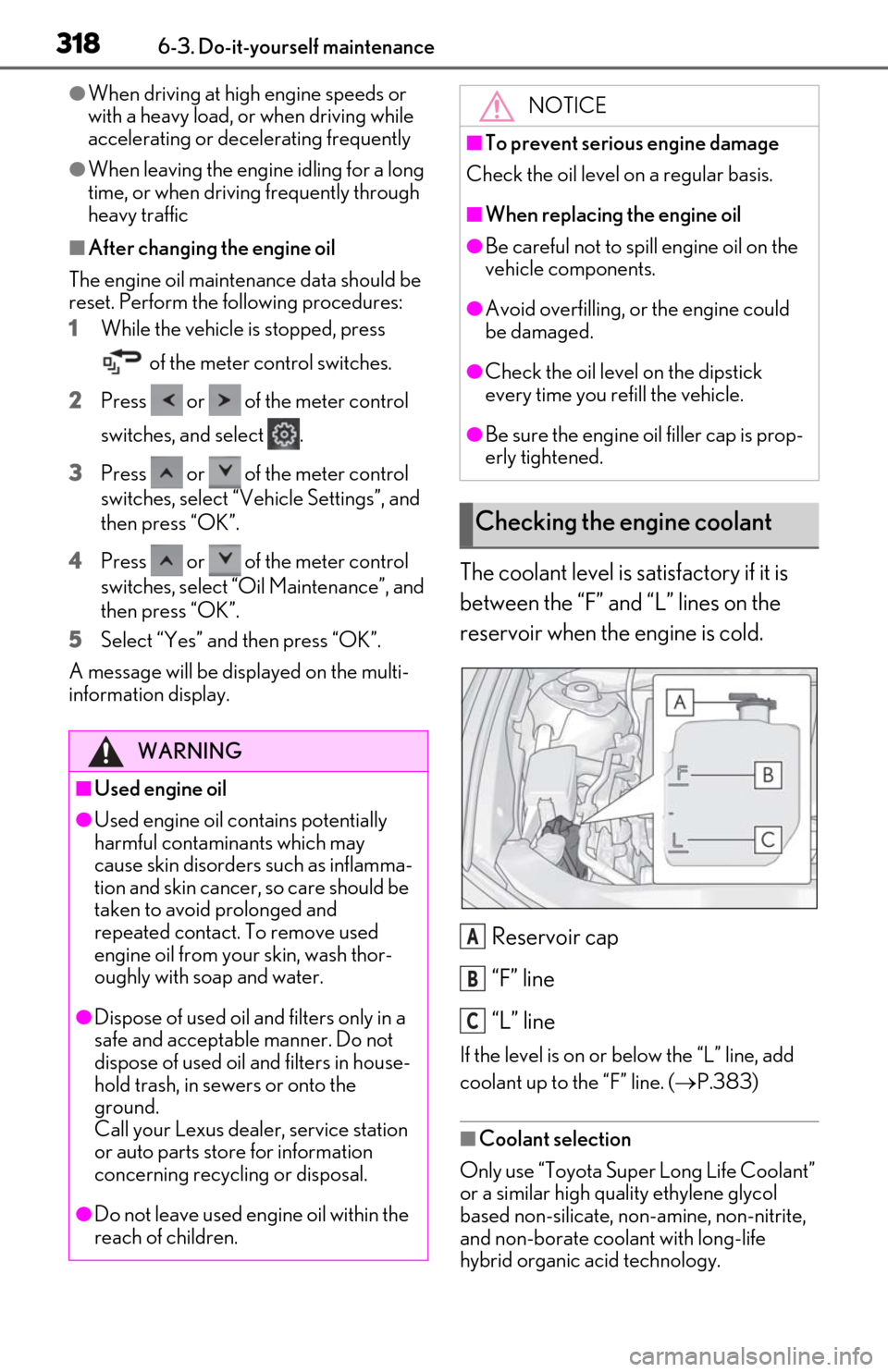
The coolant level is satisfactory if it is
between the “F” and “L” lines on the
reservoir when the engine is cold.
Reservoir cap
“F” line
“L” line
If the level is on or below the “L” line, add
coolant up to the “F” line. ( P.383)
■Coolant selection
Only use “Toyota Super Long Life Coolant”
or a similar high qua lity ethylene glycol
based non-silicate, non-amine, non-nitrite,
and non-borate coolant with long-life
hybrid organic acid technology.
WARNING
■Used engine oil
●Used engine oil contains potentially
harmful contaminants which may
cause skin disorders such as inflamma-
tion and skin cancer, so care should be
taken to avoid prolonged and
repeated contact. To remove used
engine oil from your skin, wash thor-
oughly with soap and water.
●Dispose of used oil and filters only in a
safe and acceptable manner. Do not
dispose of used oil and filters in house-
hold trash, in sewers or onto the
ground.
Call your Lexus dealer, service station
or auto parts store for information
concerning recycling or disposal.
●Do not leave used engine oil within the
reach of children.
NOTICE
■To prevent serious engine damage
Check the oil level on a regular basis.
■When replacing the engine oil
●Be careful not to spill engine oil on the
vehicle components.
●Avoid overfilling, or the engine could
be damaged.
●Check the oil level on the dipstick
every time you refill the vehicle.
●Be sure the engine o il filler cap is prop-
erly tightened.
Checking the engine coolant
A
B
C