seats LEXUS ES350 2021 User Guide
[x] Cancel search | Manufacturer: LEXUS, Model Year: 2021, Model line: ES350, Model: LEXUS ES350 2021Pages: 464, PDF Size: 9.61 MB
Page 34 of 464

341-1. For safe use
WARNING
●If the seat belt extender has been con-
nected to the driver’s seat belt buckle
but the seat belt extender has not also
been fastened to the latch plate of the
driver’s seat belt, the SRS front airbags
for the driver will judge that the driver
is wearing the seat belt even though
the seat belt has not been connected.
In this case, the SRS front airbags for
the driver may not activate correctly in
a collision, resulting in death or serious
injury in the event of a collision. Be
sure to wear the seat belt with the seat
belt extender.
●The SRS front passenger airbag also
deploys with considerable force, and
can cause death or serious injury
especially if the front passenger is very
close to the airbag. The front passen-
ger seat should be as far from the air-
bag as possible with the seatback
adjusted, so the front passenger sits
upright.
●Improperly seated and/or restrained
infants and children can be killed or
seriously injured by a deploying air-
bag. An infant or child who is too small
to use a seat belt should be properly
secured using a child restraint system.
Lexus strongly recommends that all
infants and children be placed in the
rear seats of the vehicle and properly
restrained. The rear seats are safer for
infants and children than the front pas-
senger seat. ( P.43)
●Do not sit on the edge of the seat or
lean against the dashboard.
●Do not allow a child to stand in front of
the SRS front passenger airbag unit or
sit on the knees of a front passenger.
●Do not allow the front seat occupants
to hold items on their knees.
●Do not lean against the door, the roof
side rail or the front, side and rear pil-
lars.
●Do not allow anyone to kneel on the
passenger seats toward the door or
put their head or hands outside the
vehicle.
Page 35 of 464
351-1. For safe use
1
For safety and security
WARNING
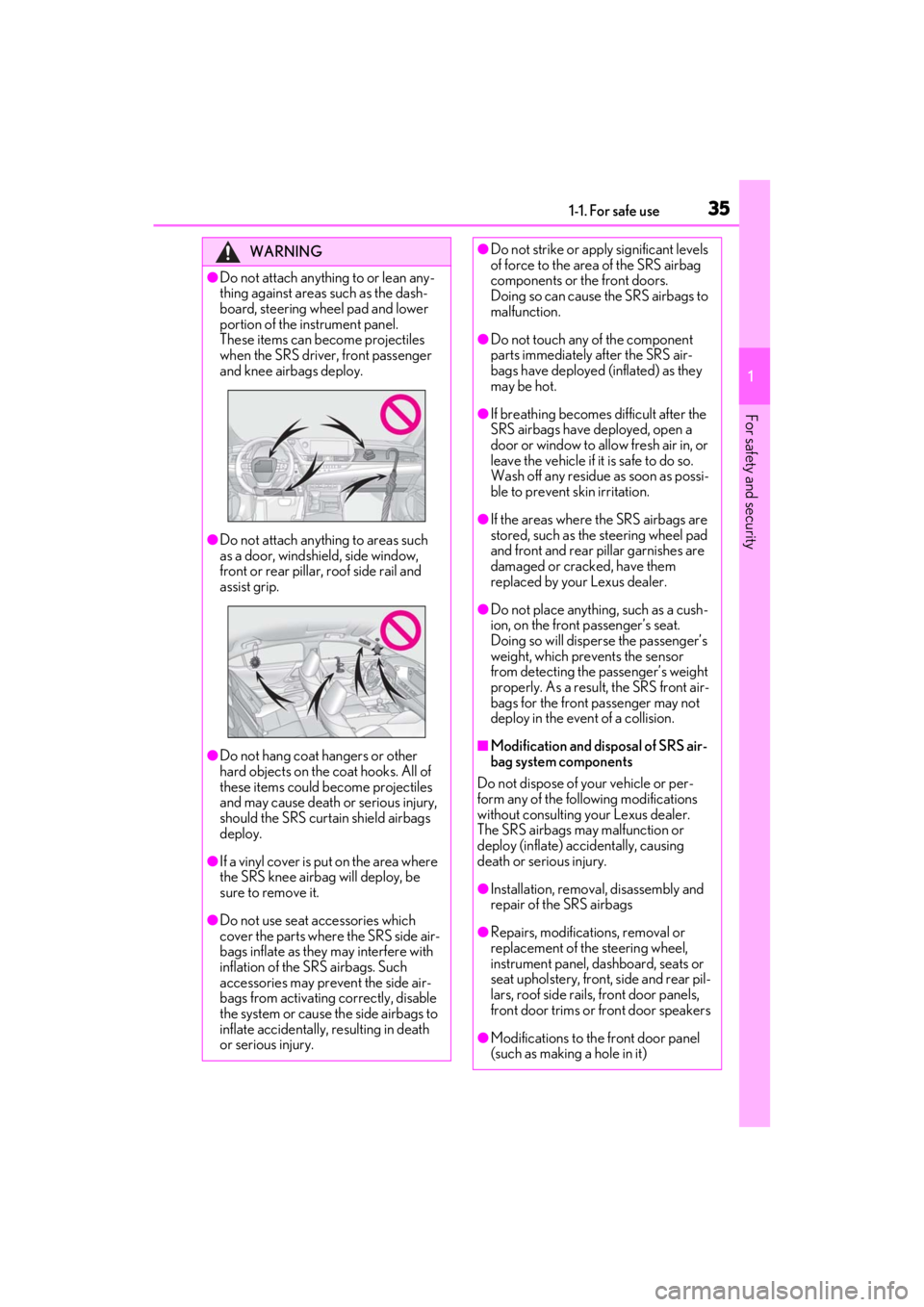
●Do not attach anything to or lean any-
thing against areas such as the dash-
board, steering wheel pad and lower
portion of the instrument panel.
These items can become projectiles
when the SRS driver, front passenger
and knee airbags deploy.
●Do not attach anything to areas such
as a door, windshield, side window,
front or rear pillar, roof side rail and
assist grip.
●Do not hang coat hangers or other
hard objects on the coat hooks. All of
these items could become projectiles
and may cause death or serious injury,
should the SRS curtain shield airbags
deploy.
●If a vinyl cover is put on the area where
the SRS knee airbag will deploy, be
sure to remove it.
●Do not use seat accessories which
cover the parts where the SRS side air-
bags inflate as they may interfere with
inflation of the SRS airbags. Such
accessories may prevent the side air-
bags from activating correctly, disable
the system or cause the side airbags to
inflate accidentally, resulting in death
or serious injury.
●Do not strike or apply significant levels
of force to the area of the SRS airbag
components or the front doors.
Doing so can cause the SRS airbags to
malfunction.
●Do not touch any of the component
parts immediately after the SRS air-
bags have deployed (inflated) as they
may be hot.
●If breathing becomes difficult after the
SRS airbags have deployed, open a
door or window to allow fresh air in, or
leave the vehicle if it is safe to do so.
Wash off any residue as soon as possi-
ble to prevent skin irritation.
●If the areas where the SRS airbags are
stored, such as the steering wheel pad
and front and rear pillar garnishes are
damaged or cracked, have them
replaced by your Lexus dealer.
●Do not place anything, such as a cush-
ion, on the front passenger’s seat.
Doing so will disperse the passenger’s
weight, which prevents the sensor
from detecting the passenger’s weight
properly. As a result, the SRS front air-
bags for the front passenger may not
deploy in the event of a collision.
■Modification and disposal of SRS air-
bag system components
Do not dispose of your vehicle or per-
form any of the following modifications
without consulting your Lexus dealer.
The SRS airbags may malfunction or
deploy (inflate) accidentally, causing
death or serious injury.
●Installation, remova l, disassembly and
repair of the SRS airbags
●Repairs, modifications, removal or
replacement of the steering wheel,
instrument panel, dashboard, seats or
seat upholstery, front, side and rear pil-
lars, roof side rails, front door panels,
front door trims or front door speakers
●Modifications to the front door panel
(such as making a hole in it)
Page 38 of 464
381-1. For safe use
WARNING
■Front passenger occupant classifica-
tion system precautions
Observe the following precautions
regarding the front passenger occupant
classification system.
Failure to do so may cause death or seri-
ous injury.
●Wear the seat belt properly.
●Make sure the fron t passenger’s seat
belt plate has not been left inserted
into the buckle before someone sits in
the front passenger seat.
●Make sure the “AIR BAG OFF” indi-
cator light is not illuminated when
using the seat belt extender for the
front passenger seat. If the “AIR BAG
OFF” indicator light is illuminated, dis-
connect the extender tongue from the
seat belt buckle, and reconnect the
seat belt. Reconnect the seat belt
extender after making sure the “AIR
BAG ON” indicator light is illumi-
nated. If you use the seat belt extender
while the “AIR BAG OFF” indicator
light is illuminated, the SRS airbags for
the front passenger will not activate,
which could cause death or serious
injury in the event of a collision.
●Do not apply a heavy load to the front
passenger seat or equipment (e.g.
seatback pocket).
●Do not put weight on the front passen-
ger seat by putting your hands or feet
on the front passenger seat seatback
from the rear passenger seat.
●Do not let a rear passenger lift the
front passenger seat with their feet or
press on the seatback with their legs.
●Do not put objects under the front pas-
senger seat.
●Do not recline the front passenger
seatback so far that it touches a rear
seat. This may cause the “AIR BAG
OFF” indicator light to be illuminated,
which indicates that the SRS airbags
for the front passenger will not activate
in the event of a severe accident. If the
seatback touches the rear seat, return
the seatback to a position where it
does not touch the rear seat. Keep the
front passenger seatback as upright as
possible when the vehicle is moving.
Reclining the seatback excessively
may lessen the effectiveness of the
seat belt system.
●If an adult sits in the front passenger
seat, the “AIR BAG ON” indicator
light is illuminated. If the “AIR BAG
OFF” indicator is illuminated, ask the
passenger to sit up straight, well back
in the seat, feet on the floor, and with
the seat belt worn co rrectly. If the “AIR
BAG OFF” indicator still remains illu-
minated, either ask the passenger to
move to the rear seat, or if that is not
possible, move the front passenger
seat fully rearward.
●When it is unavoidable to install a for-
ward-facing child re straint system on
the front passenger seat, install the
child restraint system on the front pas-
senger seat in the proper order.
( P.45)
●Do not modify or remove the front
seats.
●Do not kick the front passenger seat or
subject it to severe impact. Otherwise,
the SRS warning light may come on to
indicate a malfunction of the front pas-
senger occupant clas sification system.
In this case, contact your Lexus dealer
immediately.
●Child restraint systems installed on the
rear seat should not contact the front
seatbacks.
●Do not use a seat accessory, such as a
cushion and seat cover, that covers the
seat cushion surface.
Page 43 of 464
431-2. Child safety
1
For safety and security
1-2.Child safety
Points to remember: P.43
Child restraint system: P.44
When using a child restraint system:
P.45
Child restraint system installation
method
• Fixed with a seat belt: P.47
• Fixed with a child restraint LATCH anchor: P.50
• Using an anchor bracket (for top tether strap): P.53
The laws of all 50 states of the U.S.A.
as well as Canada now require the use
of child restraint systems.
Prioritize and observe the warnings,
as well as the laws and regulations
Riding with children
Observe the following precautions
when children are in the vehicle.
Use a child restraint system appro-
priate for the child , until the child
becomes large enough to properly
wear the vehicle’s seat belt.
It is recommended that children
sit in the rear seats to avoid acci-
dental contact with the shift lever,
wiper switch, etc.
Use the rear door child-protector
lock or the window lock switch to
avoid children opening the door
while driving or operating the
power window accidentally.
( P.98, 125)
Do not let small children operate
equipment which may catch or
pinch body parts, such as the
power window, hood, trunk, seats
etc.
WARNING
■When children are in the vehicle
Never leave children unattended in the
vehicle, and never allow children to have
or use the key.
Children may be able to start the vehicle
or shift the vehicle into neutral. There is
also a danger that children may injure
themselves by playing with the windows,
the moon roof (if equipped), panoramic
moon roof (if equipped), or other fea-
tures of the vehicle. In addition, heat
build-up or extremely cold tempera-
tures inside the vehicle can be fatal to
children.
Child restraint systems
Before installing a child restraint
system in the vehicle, there are pre-
cautions that need to be observed,
different types of child restraint sys-
tems, as well as installation meth-
ods, etc., written in this manual.
Use a child restraint system when
riding with a small child that cannot
properly use a seat belt. For the
child’s safety, install the child
restraint system to a rear seat. Be
sure to follow the installation method
that is in the operation manual
enclosed with the restraint system.
Table of contents
Points to remember
Page 45 of 464
451-2. Child safety
1
For safety and security
■When installing a child restraint
system to a front passenger seat
For the safety of a child, install child
restraint systems to a rear seats. When
installing child restraint system to a
front passenger seat is unavoidable,
adjust the seat as follows and install the
child restraint system.
Move the front seat fully rearward.
Adjust the seatback angle to the
most upright position.When installing a forward-facing child
seat, if there is a gap between the child seat
and the seatback, adjust the seatback
angle until good contact is achieved.
Adjust the front of the seat cushion
to the uppermost position.
Adjust the seat height to the upper-
most position.
Installation methodPage
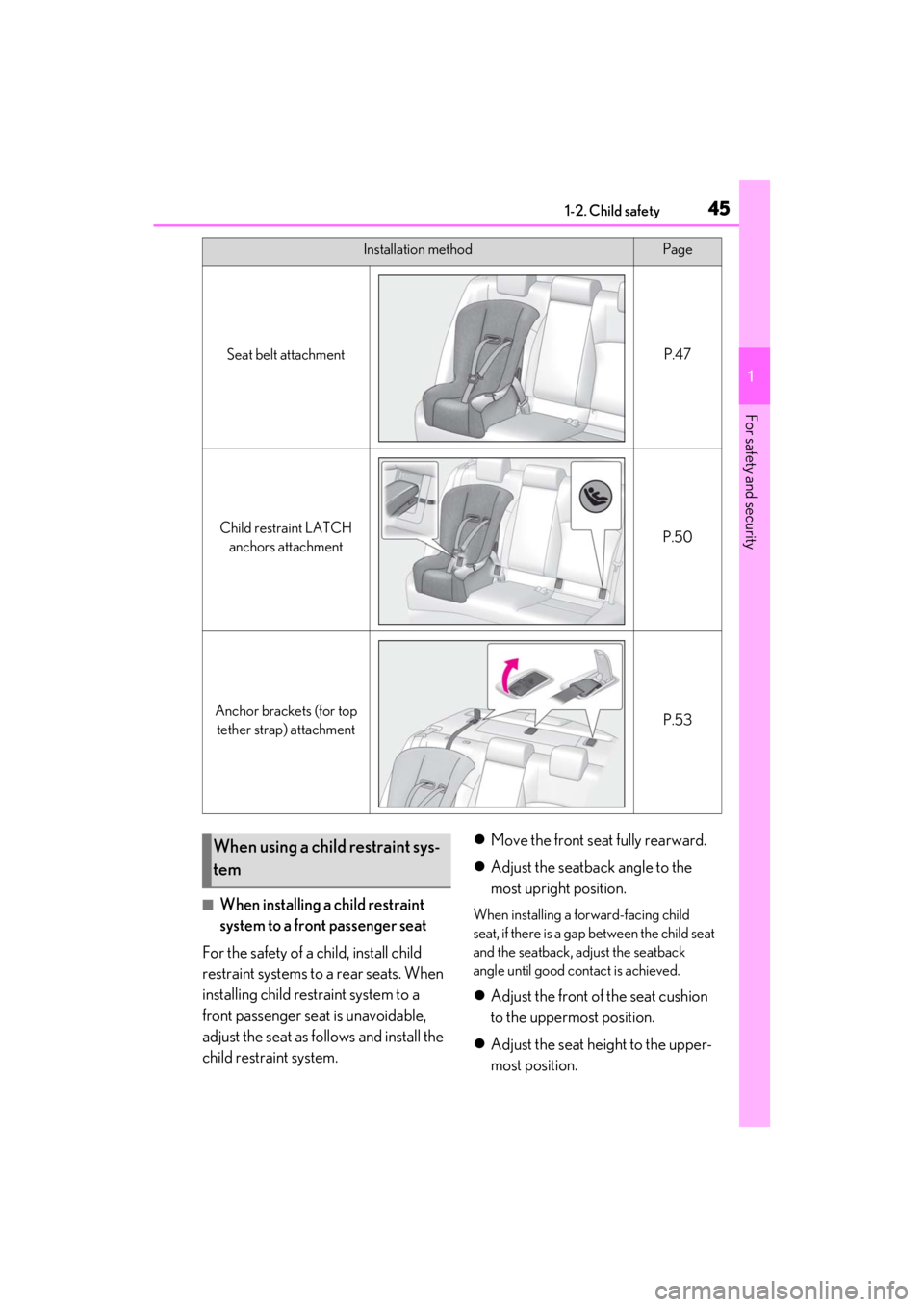
Seat belt attachmentP.47
Child restraint LATCH
anchors attachmentP.50
Anchor brackets (for top tether strap) attachmentP.53
When using a child restraint sys-
tem
Page 50 of 464
501-2. Child safety
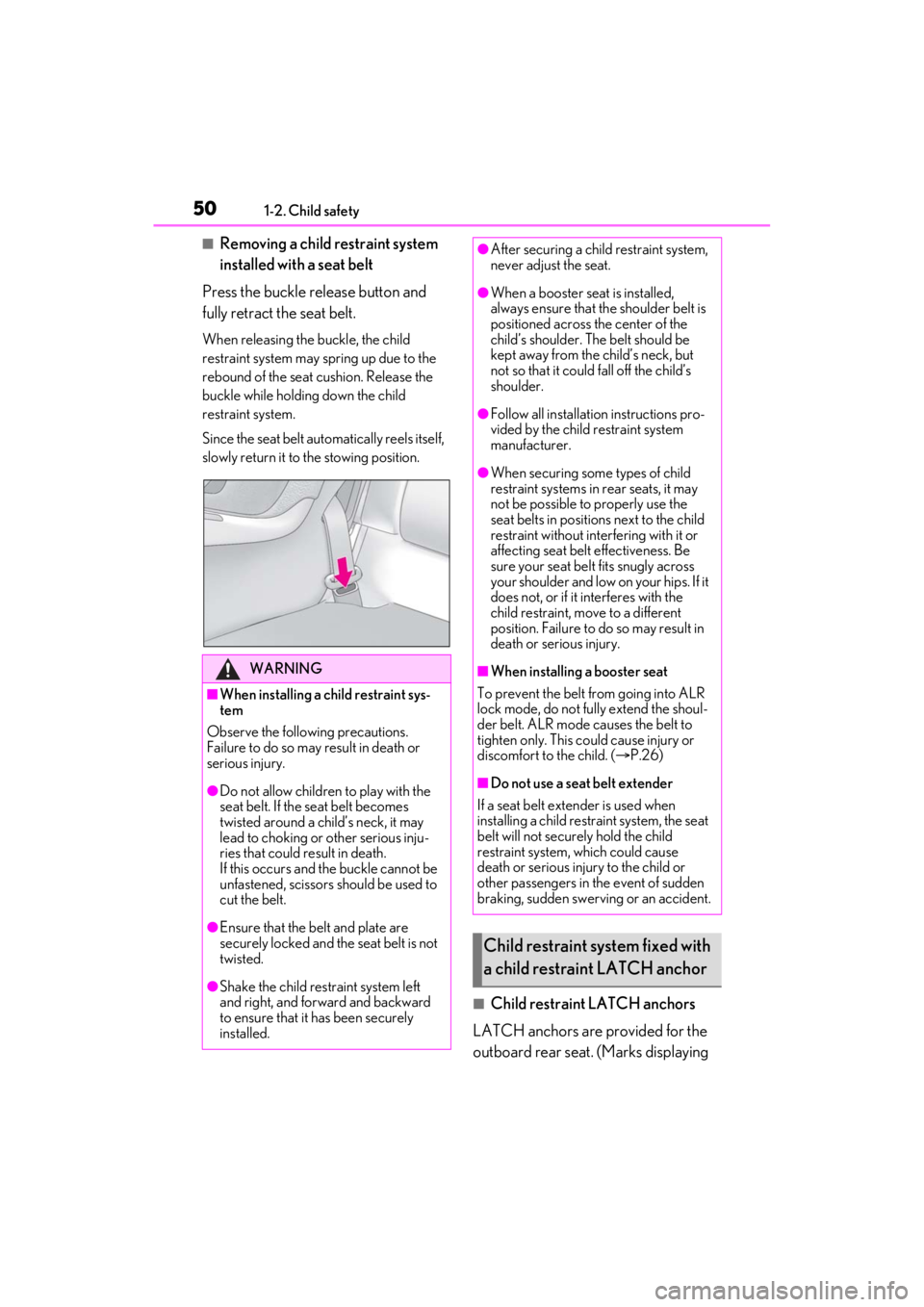
■Removing a child restraint system
installed with a seat belt
Press the buckle release button and
fully retract the seat belt.
When releasing the buckle, the child
restraint system may spring up due to the
rebound of the seat cushion. Release the
buckle while holding down the child
restraint system.
Since the seat belt automatically reels itself,
slowly return it to the stowing position.
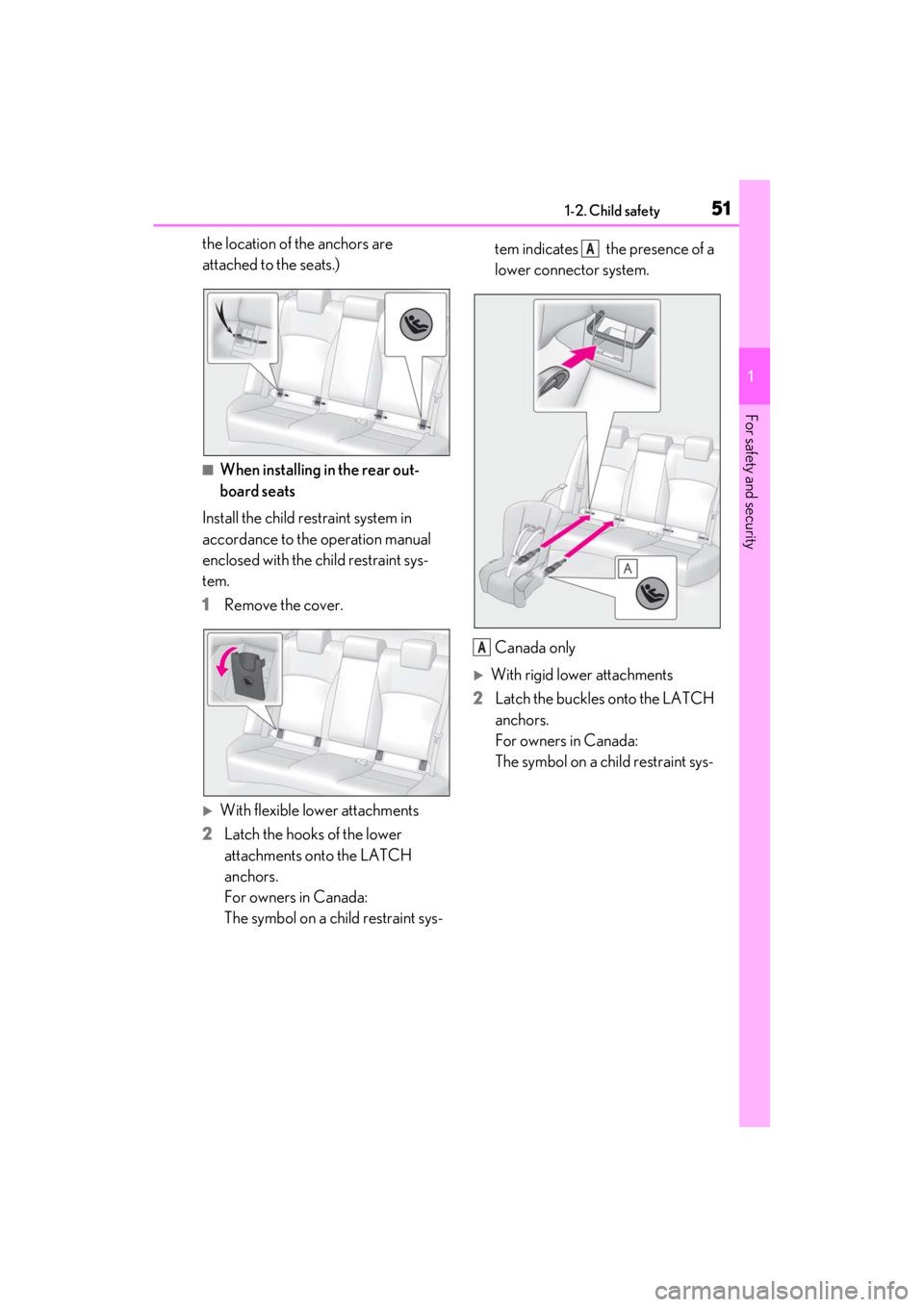
■Child restraint LATCH anchors
LATCH anchors are provided for the
outboard rear seat. (Marks displaying
WARNING
■When installing a child restraint sys-
tem
Observe the following precautions.
Failure to do so may result in death or
serious injury.
●Do not allow children to play with the
seat belt. If the seat belt becomes
twisted around a child’s neck, it may
lead to choking or other serious inju-
ries that could result in death.
If this occurs and the buckle cannot be
unfastened, scissors should be used to
cut the belt.
●Ensure that the belt and plate are
securely locked and the seat belt is not
twisted.
●Shake the child restraint system left
and right, and forward and backward
to ensure that it has been securely
installed.
●After securing a child restraint system,
never adjust the seat.
●When a booster seat is installed,
always ensure that th e shoulder belt is
positioned across the center of the
child’s shoulder. The belt should be
kept away from the child’s neck, but
not so that it could fall off the child’s
shoulder.
●Follow all installation instructions pro-
vided by the child restraint system
manufacturer.
●When securing some types of child
restraint systems in rear seats, it may
not be possible to properly use the
seat belts in position s next to the child
restraint without interfering with it or
affecting seat belt effectiveness. Be
sure your seat belt fits snugly across
your shoulder and low on your hips. If it
does not, or if it interferes with the
child restraint, move to a different
position. Failure to do so may result in
death or serious injury.
■When installing a booster seat
To prevent the belt from going into ALR
lock mode, do not fully extend the shoul-
der belt. ALR mode causes the belt to
tighten only. This could cause injury or
discomfort to the child. ( P.26)
■Do not use a seat belt extender
If a seat belt extender is used when
installing a child restra int system, the seat
belt will not securely hold the child
restraint system, which could cause
death or serious injury to the child or
other passengers in the event of sudden
braking, sudden swerving or an accident.
Child restraint system fixed with
a child restraint LATCH anchor
Page 51 of 464
511-2. Child safety
1
For safety and security
the location of the anchors are
attached to the seats.)
■When installing in the rear out-
board seats
Install the child restraint system in
accordance to the operation manual
enclosed with the child restraint sys-
tem.
1 Remove the cover.
With flexible lower attachments
2 Latch the hooks of the lower
attachments onto the LATCH
anchors.
For owners in Canada:
The symbol on a child restraint sys- tem indicates the presence of a
lower connector system.
Canada only
With rigid lower attachments
2 Latch the buckles onto the LATCH
anchors.
For owners in Canada:
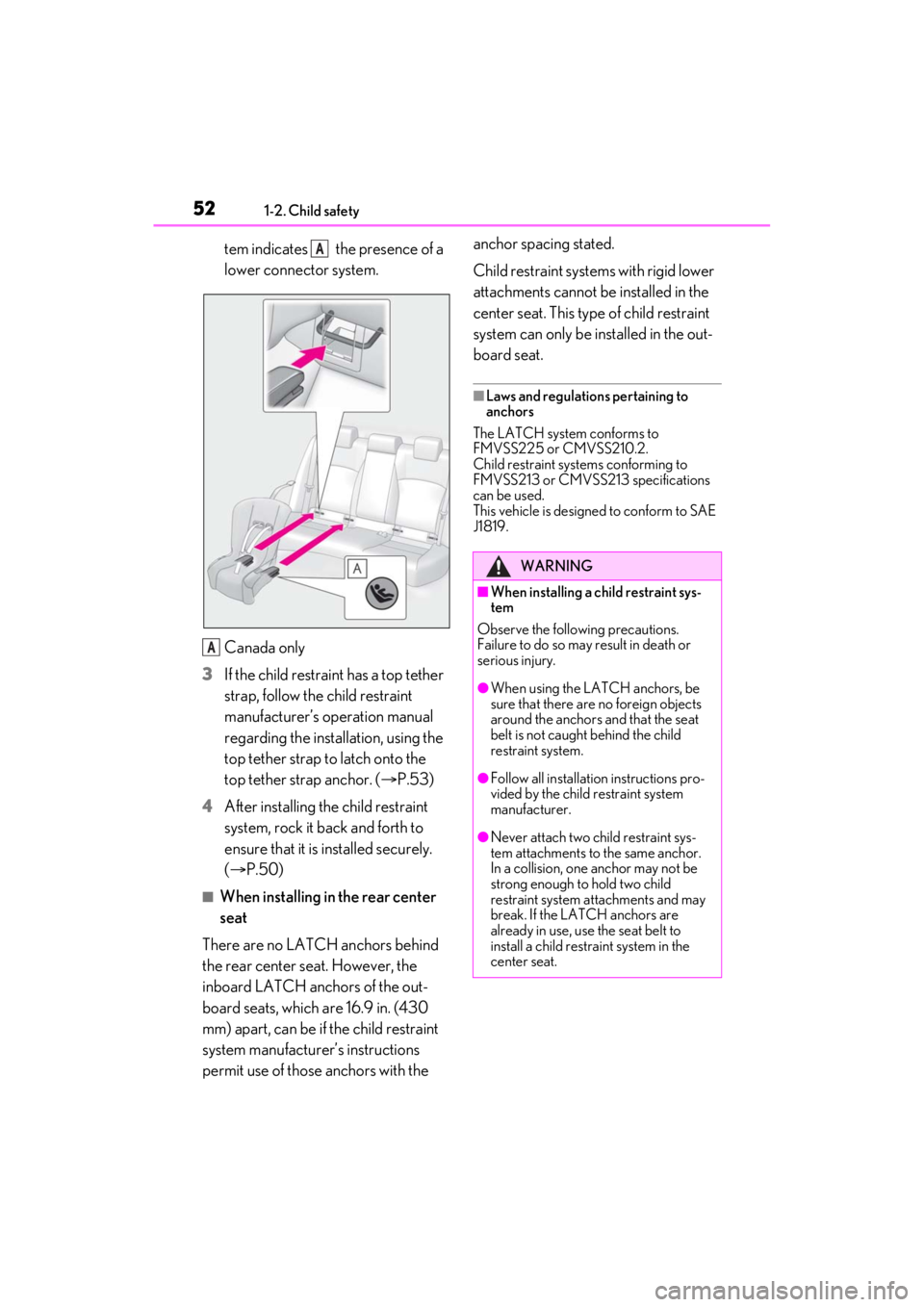
The symbol on a child restraint sys-
A
A
Page 52 of 464
521-2. Child safety
tem indicates the presence of a
lower connector system.
Canada only
3 If the child restraint has a top tether
strap, follow the child restraint
manufacturer’s operation manual
regarding the installation, using the
top tether strap to latch onto the
top tether strap anchor. ( P.53)
4 After installing the child restraint
system, rock it back and forth to
ensure that it is installed securely.
(P.50)
■When installing in the rear center
seat
There are no LATCH anchors behind
the rear center seat. However, the
inboard LATCH anchors of the out-
board seats, which are 16.9 in. (430
mm) apart, can be if the child restraint
system manufacturer ’s instructions
permit use of those anchors with the anchor spacing stated.
Child restraint systems with rigid lower
attachments cannot be installed in the
center seat. This type of child restraint
system can only be installed in the out-
board seat.
■Laws and regulations pertaining to
anchors
The LATCH system conforms to
FMVSS225 or CMVSS210.2.
Child restraint systems conforming to
FMVSS213 or CMVSS213 specifications
can be used.
This vehicle is designed to conform to SAE
J1819.
A
A
WARNING
■When installing a child restraint sys-
tem
Observe the following precautions.
Failure to do so may result in death or
serious injury.
●When using the LATCH anchors, be
sure that there are no foreign objects
around the anchors and that the seat
belt is not caught behind the child
restraint system.
●Follow all installation instructions pro-
vided by the child restraint system
manufacturer.
●Never attach two ch ild restraint sys-
tem attachments to the same anchor.
In a collision, one anchor may not be
strong enough to hold two child
restraint system at tachments and may
break. If the LATCH anchors are
already in use, use the seat belt to
install a child restraint system in the
center seat.
Page 53 of 464
531-2. Child safety
1
For safety and security
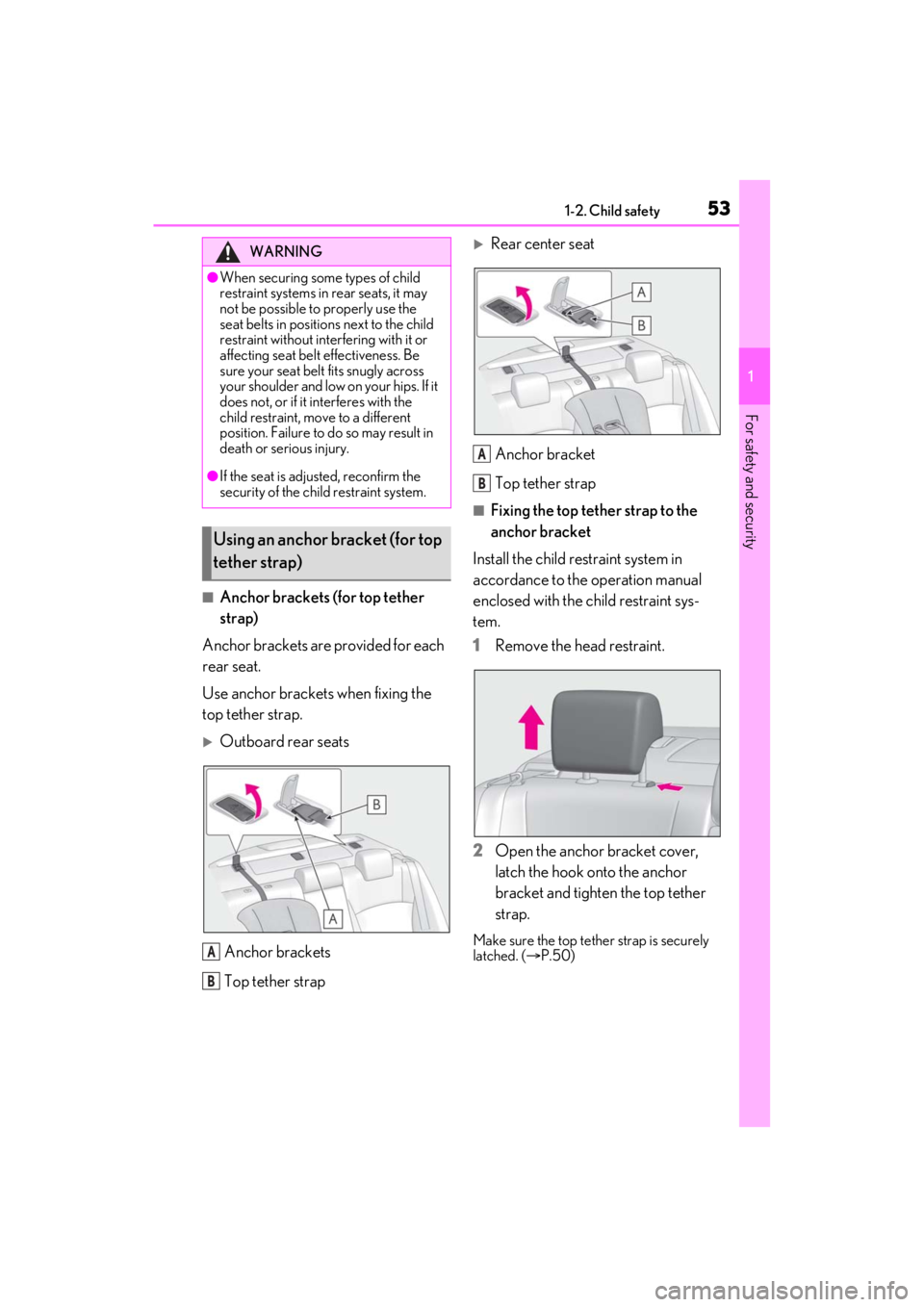
■Anchor brackets (for top tether
strap)
Anchor brackets are provided for each
rear seat.
Use anchor brackets when fixing the
top tether strap.
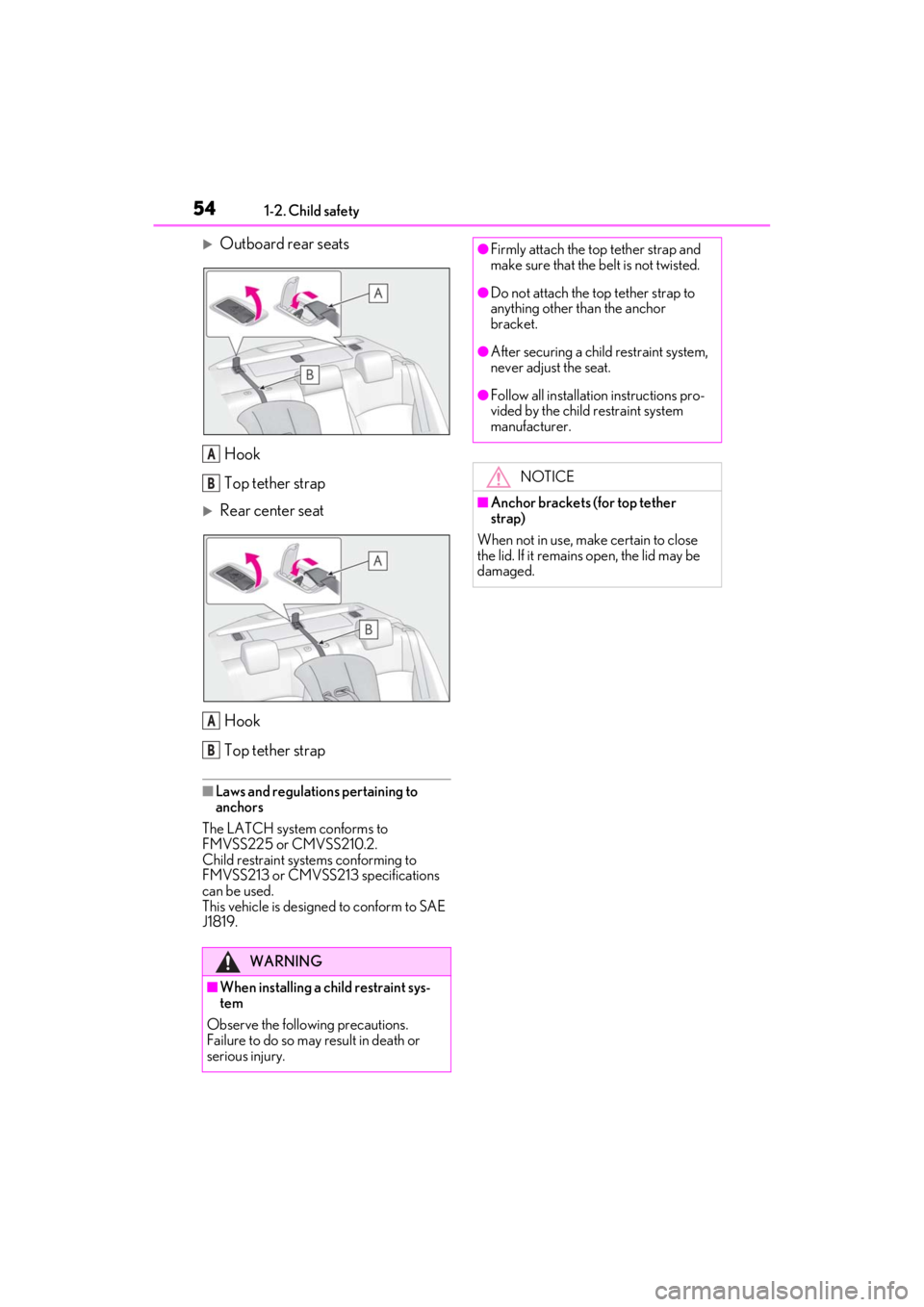
Outboard rear seats
Anchor brackets
Top tether strap
Rear center seatAnchor bracket
Top tether strap
■Fixing the top tether strap to the
anchor bracket
Install the child restraint system in
accordance to the operation manual
enclosed with the child restraint sys-
tem.
1 Remove the head restraint.
2 Open the anchor bracket cover,
latch the hook onto the anchor
bracket and tighten the top tether
strap.
Make sure the top tether strap is securely
latched. ( P.50)
WARNING
●When securing some types of child
restraint systems in rear seats, it may
not be possible to properly use the
seat belts in position s next to the child
restraint without inte rfering with it or
affecting seat belt effectiveness. Be
sure your seat belt fits snugly across
your shoulder and low on your hips. If it
does not, or if it interferes with the
child restraint, move to a different
position. Failure to do so may result in
death or serious injury.
●If the seat is adju sted, reconfirm the
security of the child restraint system.
Using an anchor bracket (for top
tether strap)
A
B
A
B
Page 54 of 464
541-2. Child safety
Outboard rear seatsHook
Top tether strap
Rear center seatHook
Top tether strap
■Laws and regulations pertaining to
anchors
The LATCH system conforms to
FMVSS225 or CMVSS210.2.
Child restraint systems conforming to
FMVSS213 or CMVSS213 specifications
can be used.
This vehicle is designed to conform to SAE
J1819.
WARNING
■When installing a child restraint sys-
tem
Observe the following precautions.
Failure to do so may result in death or
serious injury.
A
B
A
B
●Firmly attach the top tether strap and
make sure that the belt is not twisted.
●Do not attach the top tether strap to
anything other than the anchor
bracket.
●After securing a child restraint system,
never adjust the seat.
●Follow all installation instructions pro-
vided by the child restraint system
manufacturer.
NOTICE
■Anchor brackets (for top tether
strap)
When not in use, make certain to close
the lid. If it remains open, the lid may be
damaged.