door lock LEXUS ES350 2022 Owners Manual
[x] Cancel search | Manufacturer: LEXUS, Model Year: 2022, Model line: ES350, Model: LEXUS ES350 2022Pages: 468, PDF Size: 26.96 MB
Page 4 of 468
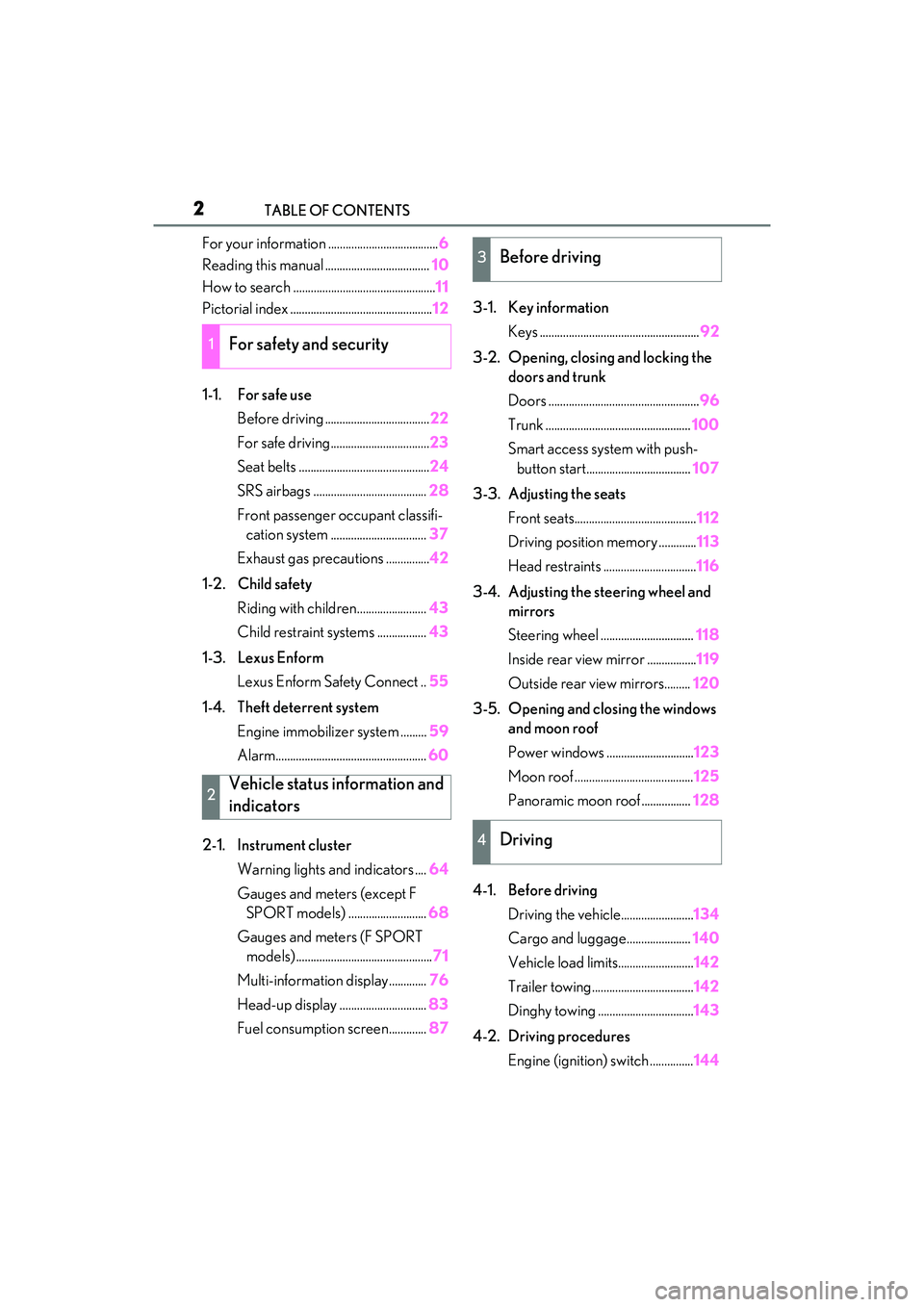
2TABLE OF CONTENTS
For your information ......................................6
Reading this manual .................................... 10
How to search ................................................. 11
Pictorial index ................................................. 12
1-1. For safe use Before driving .................................... 22
For safe driving.................................. 23
Seat belts ............................................. 24
SRS airbags ....................................... 28
Front passenger occupant classifi- cation system ................................. 37
Exhaust gas precautions ............... 42
1-2. Child safety Riding with children........................ 43
Child restraint systems ................. 43
1-3. Lexus Enform Lexus Enform Safety Connect .. 55
1-4. Theft deterrent system Engine immobilizer system ......... 59
Alarm.................................................... 60
2-1. Instrument cluster Warning lights and indicators .... 64
Gauges and meters (except F SPORT models) ........................... 68
Gauges and meters (F SPORT models)............................................... 71
Multi-information display ............. 76
Head-up display .............................. 83
Fuel consumption screen............. 873-1. Key information
Keys ....................................................... 92
3-2. Opening, closing and locking the doors and trunk
Doors .................................................... 96
Trunk .................................................. 100
Smart access system with push- button start.................................... 107
3-3. Adjusting the seats Front seats.......................................... 112
Driving position memory ............. 113
Head restraints ................................ 116
3-4. Adjusting the steering wheel and mirrors
Steering wheel ................................ 118
Inside rear view mirror ................. 119
Outside rear view mirrors......... 120
3-5. Opening and closing the windows and moon roof
Power windows .............................. 123
Moon roof ......................................... 125
Panoramic moon roof ................. 128
4-1. Before driving Driving the vehicle......................... 134
Cargo and luggage...................... 140
Vehicle load limits.......................... 142
Trailer towing................................... 142
Dinghy towing ................................. 143
4-2. Driving procedures Engine (ignition) switch ............... 144
1For safety and security
2Vehicle status information and
indicators
3Before driving
4Driving
Page 14 of 468

12Pictorial index
Pictorial index
■Exterior
Doors .......................................................................................................................... .. P.96
Locking/unlocking .............................................................................................................. P.96
Opening/closing the side windows ............................................................................P.123
Locking/unlocking by using the mechanical key ................................................ P.377
Warning buzzer ................................................................................................................. .. P.99
Trunk .......................................................................................................................... .P.100
Opening from inside the cabin .................................................................................... P.102
Opening from outside ..................................................................................................... P.103
Opening by using the mechanical key .................................................................... P.377
Warning buzzer ................................................................................................................. .. P.99
Outside rear view mirrors....................................................................................P.120
Adjusting the mirror angle ............................................................................................. P.120
Folding the mirrors .............................................................................................................. P.121
Driving position memory
*................................................................................................ P.113
Defogging the mirrors .................................................................................................... P.263
Windshield wipers .................................................................................................. P.164
A
B
C
D
Page 19 of 468
17Pictorial index
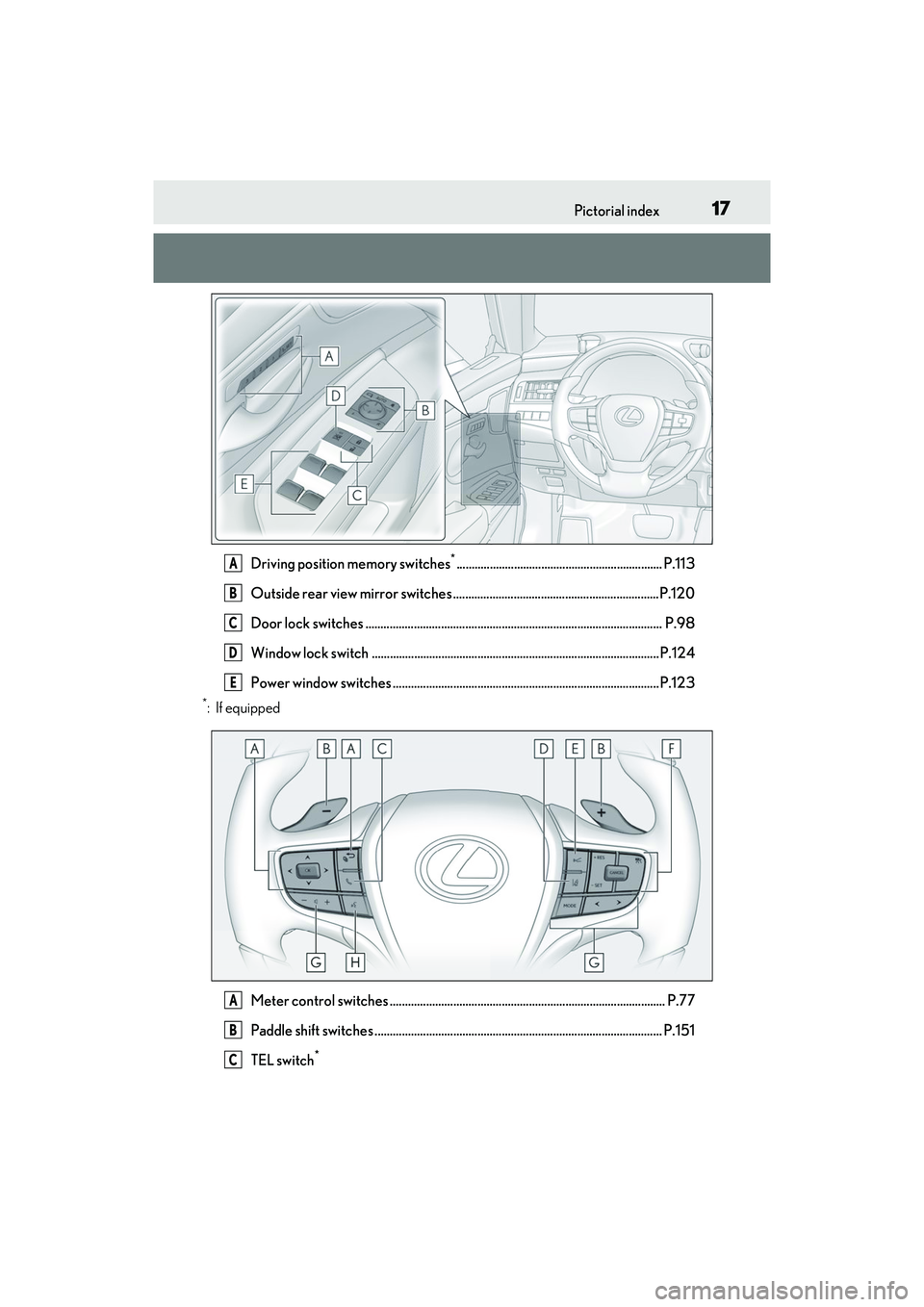
Driving position memory switches*.................................................................... P.113
Outside rear view mirror switches ....................................................................P.120
Door lock switches .................................................................................................. P.98
Window lock switch ............................................................................................... P.124
Power window switches ........................................................................................P.123
*: If equipped
Meter control switches ........................................................................................... P.77
Paddle shift switches ............................................................................................... P.151
TEL switch
*
A
B
C
D
E
A
B
C
Page 32 of 468
301-1. For safe use
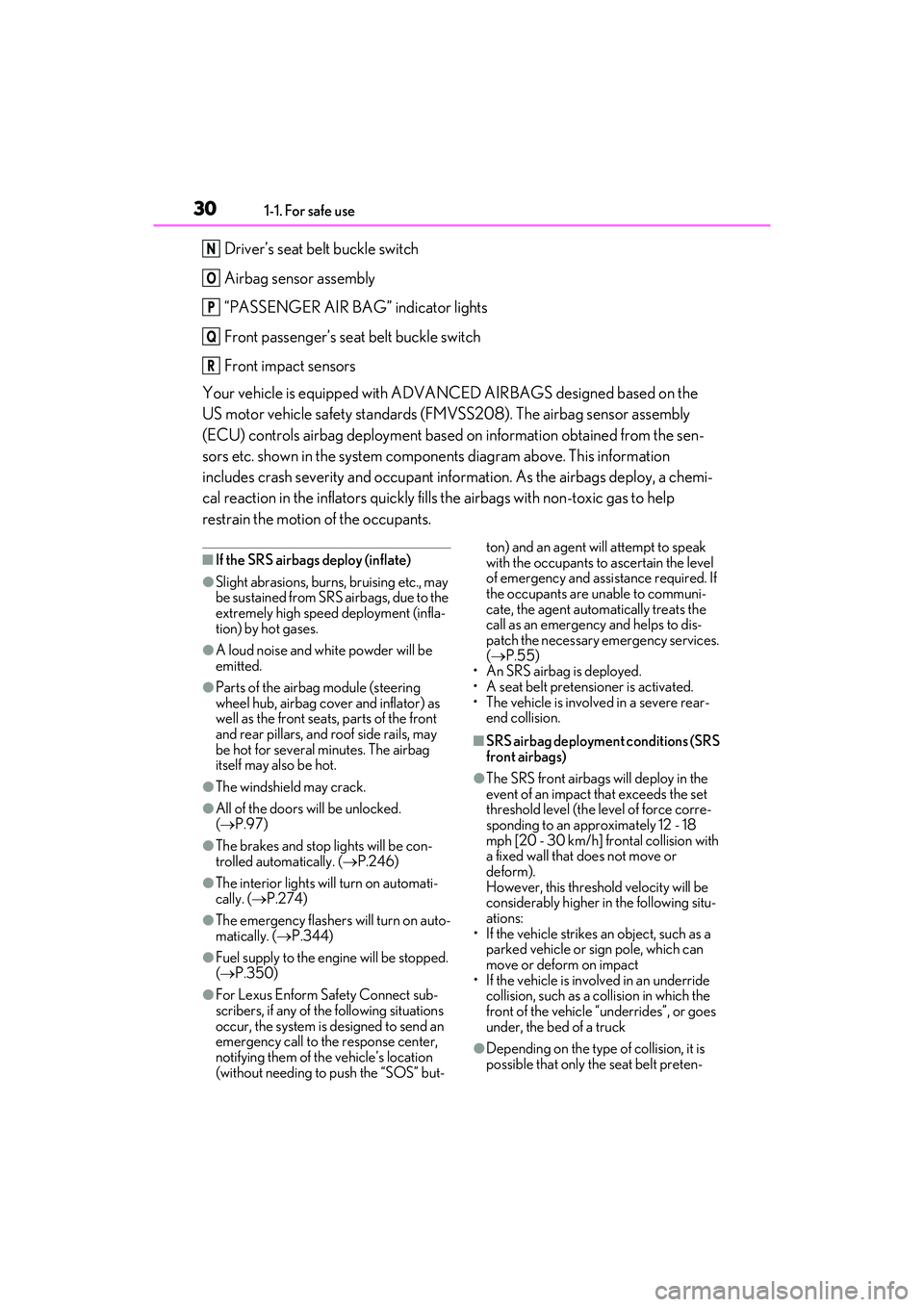
Driver’s seat belt buckle switch
Airbag sensor assembly
“PASSENGER AIR BAG” indicator lights
Front passenger’s seat belt buckle switch
Front impact sensors
Your vehicle is equipped with ADVANCED AIRBAGS designed based on the
US motor vehicle safety standards (FMVSS208). The airbag sensor assembly
(ECU) controls airbag deployment based on information obtained from the sen-
sors etc. shown in the system components diagram above. This information
includes crash severity and occupant information. As the airbags deploy, a chemi-
cal reaction in the inflators quickly fills the airbags with non-toxic gas to help
restrain the motion of the occupants.
■If the SRS airbags deploy (inflate)
●Slight abrasions, burns, bruising etc., may
be sustained from SRS airbags, due to the
extremely high speed deployment (infla-
tion) by hot gases.
●A loud noise and white powder will be
emitted.
●Parts of the airbag module (steering
wheel hub, airbag cover and inflator) as
well as the front seats, parts of the front
and rear pillars, and roof side rails, may
be hot for several minutes. The airbag
itself may also be hot.
●The windshield may crack.
●All of the doors will be unlocked.
( P.97)
●The brakes and stop lights will be con-
trolled automatically. ( P.246)
●The interior lights will turn on automati-
cally. ( P.274)
●The emergency flashers will turn on auto-
matically. ( P.344)
●Fuel supply to the engine will be stopped.
( P.350)
●For Lexus Enform Safety Connect sub-
scribers, if any of the following situations
occur, the system is designed to send an
emergency call to the response center,
notifying them of the vehicle’s location
(without needing to push the “SOS” but- ton) and an agent will attempt to speak
with the occupants to ascertain the level
of emergency and assistance required. If
the occupants are unable to communi-
cate, the agent automatically treats the
call as an emergency and helps to dis-
patch the necessary emergency services.
(
P.55)
•An SRS airbag is deployed.
• A seat belt pretensioner is activated.
• The vehicle is involved in a severe rear- end collision.
■SRS airbag deployment conditions (SRS
front airbags)
●The SRS front airbags will deploy in the
event of an impact that exceeds the set
threshold level (the level of force corre-
sponding to an approximately 12 - 18
mph [20 - 30 km/h] frontal collision with
a fixed wall that does not move or
deform).
However, this threshold velocity will be
considerably higher in the following situ-
ations:
• If the vehicle strikes an object, such as a parked vehicle or sign pole, which can
move or deform on impact
• If the vehicle is involved in an underride collision, such as a collision in which the
front of the vehicle “underrides”, or goes
under, the bed of a truck
●Depending on the type of collision, it is
possible that only the seat belt preten-
N
O
P
Q
R
Page 45 of 468

431-2. Child safety
1
For safety and security
1-2.Child safety
Points to remember: P.43
Child restraint system: P.44
When using a child restraint system:
P.45
Child restraint system installation
method
• Fixed with a seat belt: P.47
• Fixed with a child restraint LATCH anchor: P.50
• Using an anchor bracket (for top
tether strap): P.53
The laws of all 50 states of the U.S.A.
as well as Canada now require the use
of child restraint systems.
Prioritize and observe the warnings,
as well as the laws and regulations
Riding with children
Observe the following precautions
when children are in the vehicle.
Use a child restraint system appro-
priate for the child, until the child
becomes large eno ugh to properly
wear the vehicle’s seat belt.
It is recommended that children
sit in the rear seats to avoid acci-
dental contact with the shift lever,
wiper switch, etc.
Use the rear door child-protector
lock or the window lock switch to
avoid children opening the door
while driving or operating the
power window accidentally.
( P.99, 124)
Do not let small children operate
equipment which may catch or
pinch body parts, such as the
power window, hood, trunk, seats
etc.
WARNING
■When children are in the vehicle
Never leave children unattended in the
vehicle, and never allow children to have
or use the key.
Children may be able to start the vehicle
or shift the vehicle into neutral. There is
also a danger that children may injure
themselves by playing with the windows,
the moon roof (if equipped), panoramic
moon roof (if equipped), or other fea-
tures of the vehicle. In addition, heat
build-up or extremely cold tempera-
tures inside the vehicle can be fatal to
children.
Child restraint systems
Before installing a child restraint
system in the vehicle, there are pre-
cautions that need to be observed,
different types of child restraint sys-
tems, as well as installation meth-
ods, etc., written in this manual.
Use a child restraint system when
riding with a small child that cannot
properly use a seat belt. For the
child’s safety, install the child
restraint system to a rear seat. Be
sure to follow the installation method
that is in the operation manual
enclosed with the restraint system.
Table of contents
Points to remember
Page 62 of 468

601-4. Theft deterrent system
■Items to check before locking the
vehicle
To prevent unexpected triggering of
the alarm and vehicle theft, make sure
of the following:
Nobody is in the vehicle.
The windows and moon roof (if
equipped) or panoramic moon roof
(if equipped) are closed before the
alarm is set.
No valuables or other personal
items are left in the vehicle.
■Setting
Close the doors, trunk and hood, and
lock all the doors using the entry func-
tion or wireless remote control. The
system will be set automatically after
30 seconds.
Except for Canada, the alarm can also
be set using the mechanical key.
The indicator light changes from being on
to flashing when the system is set.
■Canceling or stopping
Do one of the following to deactivate
or stop the alarm:
Except for Canada: Unlock the
doors using the entry function, wire-
less remote control or mechanical
key.
For Canada: Unlock the doors using
the entry function or wireless
remote control.
Turn the engine switch to ACCES-
SORY or IGNITION ON mode, or
start the engine. (The alarm will be
deactivated or stopped after a few
seconds.)
■System maintenance
The vehicle has a maintenance-free type
alarm system.
Alarm
The alarm uses light and sound to
give an alert when an intrusion is
detected.
The alarm is triggered in the follow-
ing situations when the alarm is set:
A locked door is unlocked or
opened in any way other than
using the entry function, wireless
remote control or mechanical
key
*. (The doors will lock again
automatically.)
A locked trunk is unlocked or
opened in any way other than
using the entry function or wire-
less remote control.
The hood is opened.
*:Except for Canada
Setting/canceling/stopping the
alarm system
Page 63 of 468

611-4. Theft deterrent system
1
For safety and security
■Triggering of the alarm
The alarm may be triggered in the following
situations:
(Stopping the alarm deactivates the alarm
system.)
●For Canada: The doors are unlocked
using the mechanical key.
●The trunk is unlocked using the mechani-
cal key.
●A person inside the vehicle opens a door,
the trunk or hood, or unlocks the vehicle
using a door lock switch.
●The battery is recharged or replaced
when the vehicle is locked. ( P.381)
■Alarm-operated door lock
In the following cases, depending on the sit-
uation, the door may automatically lock to
prevent improper entry into the vehicle:
●When a person remaining in the vehicle
unlocks the door and the alarm is acti-
vated.
●While the alarm is activated, a person
remaining in the vehicle unlocks the door.
●When recharging or replacing the bat-
tery
NOTICE
■To ensure the system operates cor-
rectly
Do not modify or remove the system. If
modified or removed, the proper opera-
tion of the system cannot be guaranteed.
Page 93 of 468

91
3
3
Before driving
Before driving
3-1. Key informationKeys ................................................... 92
3-2. Opening, closing and locking the doors and trunk
Doors................................................. 96
Trunk................................................ 100
Smart access system with push- button start ................................. 107
3-3. Adjusting the seats
Front seats ...................................... 112
Driving position memory ......... 113
Head restraints............................. 116
3-4. Adjusting the steering wheel and mirrors
Steering wheel.............................. 118
Inside rear view mirror.............. 119
Outside rear view mirrors ...... 120
3-5. Opening and closing the win- dows and moon roof
Power windows........................... 123
Moon roof ..................................... 125
Panoramic moon roof .............. 128
Page 95 of 468

933-1. Key information
3
Before driving
power consumption of electronic keys
that are not used for long periods of time.
( P.109)
●As the electronic key always receives
radio waves, the battery will become
depleted even if the electronic key is not
used. The following symptoms indicate
that the electronic key battery may be
depleted. Replace the battery when nec-
essary. ( P.333)
• The smart access system with push-but-
ton start or the wireless remote control
does not operate.
• The detection area becomes smaller.
• The LED indicator on the key surface does not turn on.
You can replace the battery by yourself
( P.333). However, as there is a danger
that the electronic key may be damaged, it
is recommended that replacement be car-
ried out by your Lexus dealer.
●To avoid serious deterioration, do not
leave the electronic key within 3 ft. (1 m)
of the following electrical appliances that
produce a magnetic field:
•TVs
• Personal computers
• Cellular phones, cordless phones and battery chargers
• Recharging cellular phones or cordless phones
• Table lamps
• Induction cookers
■Replacing the battery
P.333
■Confirmation of the registered key
number
The number of keys already registered to
the vehicle can be confirmed. Ask your
Lexus dealer for details.
■If “A New Key has been Registered
Contact Your Dealer for Details” is
shown on the multi-information display
This message will be displayed each time
the driver’s door is opened when the doors
are unlocked from the outside for approxi-
mately 10 days after a new electronic key
has been registered.
If this message is displayed but you have not had a new electronic key registered, ask
your Lexus dealer to check if an unknown
electronic key (other than those in your
possession) has been registered.
NOTICE
■To prevent key damage
●Do not drop the keys, subject them to
strong shocks or bend them.
●Do not expose the keys to high tem-
peratures for long periods of time.
●Do not get the keys wet or wash them
in an ultrasonic washer etc.
●Do not attach metallic or magnetic
materials to the keys or place the keys
close to such materials.
●Do not disassemble the keys.
●Do not attach a sticker or anything else
to the surface of the electronic key.
●Do not place the keys near objects that
produce magnetic fields, such as TVs,
audio systems and induction cookers.
●Do not place the keys near medical
electrical equipment such as low-fre-
quency therapy equipment or micro-
wave therapy equipment, and do not
receive medical attention with the keys
on your person.
■Carrying the electronic key on your
person
Carry the electronic key 3.9 in. (10 cm)
or more away from electric appliances
that are turned on. Radio waves emitted
from electric appliances within 3.9 in. (10
cm) of the electronic key may interfere
with the key, causing the key to not func-
tion properly.
■In case of a smart access system with
push-button start malfunction or
other key-related problems
P.376
■When an electronic key is lost
P.375
Page 96 of 468

943-1. Key information
The electronic keys are equipped with
the following wireless remote control:Locks the doors (
P.96)
Unlocks the doors ( P.96)
Opens the windows and moon
roof
*1, 2 or panoramic moon roof*1,
2
( P.96)
Opens the trunk ( P.103)
Sounds the alarm ( P.94)
*1: If equipped
*2: This setting must be customized at your
Lexus dealer.
■Theft deterrent panic mode
When is pressed for longer than
about one second, an alarm will sound
intermittently and the vehicle lights will flash
to deter any person from trying to break
into or damage your vehicle.
To stop the alarm, press any button on the
electronic key.
To take out the mechanical key, push
NOTICE
■Handling the card key (if equipped)
●Do not apply excess force when
inserting the mechanical key into the
card key. Doing so may damage the
card key.
●If the battery or card key terminals get
wet, the battery may corrode and the
card key may stop working.
If the key is dropped into water, or if
drinking water, etc. is spilled on the
key, immediately remove the battery
cover and wipe the battery and termi-
nals. (To remove th e battery cover,
lightly grasp and pull it .) If the battery is
corroded, have your Lexus dealer
replace the battery.
●Do not crush the battery cover or use
a screwdriver to re move the battery
cover. Forcibly re moving the battery
cover may bend or damage the key.
●If the battery cover is frequently
removed, the battery cover may
become loose.
●When installing the battery, make sure
to check the direction of the battery.
Installing the battery in the wrong
direction may cause the battery to
deplete rapidly.
●The surface of the card key may be
damaged, or its coating may peel off in
the following situations:
• The card key is carried together with hard objects, such as coins and keys.
• The card key is scraped with a sharp object, such as the tip of a mechanical
pencil.
• The surface of the card key is wiped with thinner or benzene.
Wireless remote controlUsing the mechanical key
A
B
C
D
E