hood open LEXUS ES350 2022 Owners Manual
[x] Cancel search | Manufacturer: LEXUS, Model Year: 2022, Model line: ES350, Model: LEXUS ES350 2022Pages: 468, PDF Size: 26.96 MB
Page 6 of 468
4TABLE OF CONTENTS
6-3. Do-it-yourself maintenanceDo-it-yourself service precautions........................................................... 308
Hood................................................... 310
Positioning a floor jack ................ 310
Engine compartment................... 312
Tires ................................................... 320
Tire inflation pressure ................. 328
Wheels.............................................. 330
Air conditioning filter................... 331
Electronic key battery ................ 333
Checking and replacing fuses 335
Headlight aim................................. 337
Light bulbs ....................................... 338
7-1. Essential information Emergency flashers..................... 344
If your vehicle has to be stopped in an emergency ............................. 344
If the vehicle is submerged or water on the road is rising .................. 345
7-2. Steps to take in an emergency If your vehicle needs to be towed........................................................... 347
If you think something is wrong ........................................................... 349
Fuel pump shut off system ........ 350
If a warning light turns on or a warning buzzer sounds ........... 351
If a warning message is displayed ............................................................ 361
If you have a flat tire..................... 365
If the engine will not start .......... 374
If you lose your keys .................... 375If the fuel filler door cannot be
opened .......................................... 376
If the electronic key does not oper- ate properly ................................. 376
If the battery is discharged ....... 379
If your vehicle overheats ........... 382
If the vehicle becomes stuck ... 385
8-1. Specifications Maintenance data (fuel, oil level, etc.) ................................................. 388
Fuel information............................ 397
Tire information ............................ 399
8-2. Customization Customizable features .............. 408
8-3. Items to initialize Items to initialize ............................ 419
9-1. For owners Reporting safety defects for U.S. owners ............................................ 422
Reporting safety defects for Cana- dian owners .................................. 422
Seat belt instructions for Canadian owners (in French) ................... 423
SRS airbag instructions for Cana- dian owners (in French) .......... 424
Headlight aim instructions for Canadian owners (in French)
.......................................................... 430
7When trouble arises
8Vehicle specifications
9For owners
Page 15 of 468
13Pictorial index
Precautions against winter season ............................................................................ P.253
To prevent freezing (windshield wiper de-icer)
*................................................. P.267
Precautions against car wash
*.................................................................................... P.299
Fuel filler door .......................................................................................................... P.169
Refueling method .............................................................................................................. P .169
Fuel type/fuel tank capacity .........................................................................................P.390
Tires.......................................................................................................................... .P.320
Tire size/inflation pressure ...........................................................................................P.395
Winter tires/tire chain ..................................................................................................... P.2 51
Checking/rotation/tire pressure warning system..............................................P.320
Coping with flat tires........................................................................................................ P .365
Hood ........................................................................................................................... P.310
Opening ................................................................................................................................ P.310
Engine oil ..............................................................................................................................P.390
Coping with overheating............................................................................................... P.382
Warning messages ........................................................................................................... P.36 1
Headlights/side marker lights/cornering lights............................................P.158
Turn signal lights ......................................................................................................P.153
Parking lights/daytime running lights...............................................................P.158
Tail/stop lights ..........................................................................................................P.158
License plate lights .................................................................................................P.158
Back up lights
Shifting the shift lever to R ........... ................................................................................... P.15 0
*: If equipped
Light bulbs of the exterior lights for driving
(Replacing method: P.338, Watts: P.396)
E
F
G
H
I
J
K
L
Page 17 of 468
15Pictorial index
Parking brake switch ............................................................................................. P.154
Applying/releasing ........................................................................................................... P.154
Precautions against winter season ............................................................................ P.252
Warning buzzer/message ........................................................................P.155, 351, 362
Turn signal lever ......................................................................................................P.153
Headlight switch......................................................................................................P.158
Headlights/parking lights/tail lights/daytime running lights ........................... P.158
AHB (Automatic High Beam)........................................................................................ P.161
Windshield wiper and washer switch ................................................................ P.164
Usage.......................................................................................................................................P.164
Adding washer fluid .......................................................................................................... P. 319
Warning messages ................................................................................................ P.319, 362
Emergency flasher switch ...................................................................................P.344
Hood lock release lever........................................................................................P.310
Tilt and telescopic steering control switch
*1/tilt and telescopic steering lock
release lever
*1........................................................................................................... P.118
Adjustment ..................................................................................................................... ........P.118
Driving position memory
*1............................................................................................... P.113
Air conditioning system .......................................................................................P.262
Usage..................................................................................................................................... P.262
Rear window defogger................................................................................................... P.263
Audio system
*2
Trunk opener main switch .................................................................................... P.106
*1: If equipped
*2: Refer to “NAVIGATION AND MULTIMEDIA SYSTEM OWNER’S MANUAL”.
E
F
G
H
I
J
K
L
M
Page 45 of 468

431-2. Child safety
1
For safety and security
1-2.Child safety
Points to remember: P.43
Child restraint system: P.44
When using a child restraint system:
P.45
Child restraint system installation
method
• Fixed with a seat belt: P.47
• Fixed with a child restraint LATCH anchor: P.50
• Using an anchor bracket (for top
tether strap): P.53
The laws of all 50 states of the U.S.A.
as well as Canada now require the use
of child restraint systems.
Prioritize and observe the warnings,
as well as the laws and regulations
Riding with children
Observe the following precautions
when children are in the vehicle.
Use a child restraint system appro-
priate for the child, until the child
becomes large eno ugh to properly
wear the vehicle’s seat belt.
It is recommended that children
sit in the rear seats to avoid acci-
dental contact with the shift lever,
wiper switch, etc.
Use the rear door child-protector
lock or the window lock switch to
avoid children opening the door
while driving or operating the
power window accidentally.
( P.99, 124)
Do not let small children operate
equipment which may catch or
pinch body parts, such as the
power window, hood, trunk, seats
etc.
WARNING
■When children are in the vehicle
Never leave children unattended in the
vehicle, and never allow children to have
or use the key.
Children may be able to start the vehicle
or shift the vehicle into neutral. There is
also a danger that children may injure
themselves by playing with the windows,
the moon roof (if equipped), panoramic
moon roof (if equipped), or other fea-
tures of the vehicle. In addition, heat
build-up or extremely cold tempera-
tures inside the vehicle can be fatal to
children.
Child restraint systems
Before installing a child restraint
system in the vehicle, there are pre-
cautions that need to be observed,
different types of child restraint sys-
tems, as well as installation meth-
ods, etc., written in this manual.
Use a child restraint system when
riding with a small child that cannot
properly use a seat belt. For the
child’s safety, install the child
restraint system to a rear seat. Be
sure to follow the installation method
that is in the operation manual
enclosed with the restraint system.
Table of contents
Points to remember
Page 62 of 468

601-4. Theft deterrent system
■Items to check before locking the
vehicle
To prevent unexpected triggering of
the alarm and vehicle theft, make sure
of the following:
Nobody is in the vehicle.
The windows and moon roof (if
equipped) or panoramic moon roof
(if equipped) are closed before the
alarm is set.
No valuables or other personal
items are left in the vehicle.
■Setting
Close the doors, trunk and hood, and
lock all the doors using the entry func-
tion or wireless remote control. The
system will be set automatically after
30 seconds.
Except for Canada, the alarm can also
be set using the mechanical key.
The indicator light changes from being on
to flashing when the system is set.
■Canceling or stopping
Do one of the following to deactivate
or stop the alarm:
Except for Canada: Unlock the
doors using the entry function, wire-
less remote control or mechanical
key.
For Canada: Unlock the doors using
the entry function or wireless
remote control.
Turn the engine switch to ACCES-
SORY or IGNITION ON mode, or
start the engine. (The alarm will be
deactivated or stopped after a few
seconds.)
■System maintenance
The vehicle has a maintenance-free type
alarm system.
Alarm
The alarm uses light and sound to
give an alert when an intrusion is
detected.
The alarm is triggered in the follow-
ing situations when the alarm is set:
A locked door is unlocked or
opened in any way other than
using the entry function, wireless
remote control or mechanical
key
*. (The doors will lock again
automatically.)
A locked trunk is unlocked or
opened in any way other than
using the entry function or wire-
less remote control.
The hood is opened.
*:Except for Canada
Setting/canceling/stopping the
alarm system
Page 63 of 468

611-4. Theft deterrent system
1
For safety and security
■Triggering of the alarm
The alarm may be triggered in the following
situations:
(Stopping the alarm deactivates the alarm
system.)
●For Canada: The doors are unlocked
using the mechanical key.
●The trunk is unlocked using the mechani-
cal key.
●A person inside the vehicle opens a door,
the trunk or hood, or unlocks the vehicle
using a door lock switch.
●The battery is recharged or replaced
when the vehicle is locked. ( P.381)
■Alarm-operated door lock
In the following cases, depending on the sit-
uation, the door may automatically lock to
prevent improper entry into the vehicle:
●When a person remaining in the vehicle
unlocks the door and the alarm is acti-
vated.
●While the alarm is activated, a person
remaining in the vehicle unlocks the door.
●When recharging or replacing the bat-
tery
NOTICE
■To ensure the system operates cor-
rectly
Do not modify or remove the system. If
modified or removed, the proper opera-
tion of the system cannot be guaranteed.
Page 101 of 468

993-2. Opening, closing and locking the doors and trunk
3
Before driving
■Inside door handles (to unlock)
For the front doors
Pull the handle to unlock and open the
door.
When the door is unlo cked, the inside lock
button will pop up.
For the rear doors
Pull the handle to unlock the door. Pull
the handle a second time to open the
door.
When the door is unlo cked, the inside lock
button will pop up.
■Locking the front door s from the outside
without a key
1 Push down the inside lock button.
2 Close the door.
The door cannot be locked if the engine
switch is in ACCESSORY or IGNITION
ON mode, or the electronic key is left
inside the vehicle. However, the key may
not be detected correctly and the door may
be locked.
■Open door warning buzzer
If the vehicle speed reaches 3 mph (5
km/h), a buzzer sounds to indicate that the
door(s), the hood or the trunk is not fully
closed.
The open door(s), the hood or the trunk is
displayed on the multi-information display.
The door cannot be opened from inside the vehicle when the lock is set.
1
Unlock
2 Lock
These locks can be set to prevent chil-
dren from opening the rear doors.
Push down on each rear door switch to
lock both rear doors.
The following functions can be set or
canceled:
For instructions on customizing, refer to
P.408.
Rear door child-protector lock
Automatic door locking and
unlocking systems
FunctionOperation
Speed linked
door locking
function
All doors are automati-
cally locked when vehi-
cle speed is
approximately 12 mph
(20 km/h) or higher.
Shift position
linked door lock-
ing functionAll doors are automati-
cally locked when the
shift lever is shifted to a
position other than P.
Page 169 of 468
1674-3. Operating the lights and wipers
4
Driving
the front door is closed, wiper operation will
resume.
■To protect the windshield wipers
If movement of the windshield wipers is
largely restricted by a foreign object such
as snow, the operation of the windshield
wipers may be stopped automatically to
protect the windshield wipers. In this case,
turn the windshield wiper switch off and
remove the foreign object, and then use the
windshield wipers.
■When stopping the engine in an emer-
gency while driving
If the windshield wipers are operating when
the engine is stopped, the windshield wipers
will operate in high speed operation. After
the vehicle is stopped, operation will return
to normal when the engine switch is turned
to IGNITION ON mode, or operation will
stop when the driver’s door is opened.
When the windshield wipers are not
being used, they retract to below the
hood. To enable the windshield wipers
to be lifted when parking in cold condi-
tions or when replacing a windshield
wiper insert, change the rest position of
the windshield wipers to the service
position using the wiper lever.
■Raising the wipers to the service
position
Within approximately 45 seconds of
turning the engine switch off, move the
wiper lever to the (U.S.A.) or
(Canada) position and hold it for
approximately 2 seconds or more.
The wipers will move to the service posi-
tion.
WARNING
■Caution regarding the use of wind-
shield wipers in AUTO mode (vehi-
cles with rain-sensing windshield
wipers)
The windshield wipers may operate
unexpectedly if the sensor is touched or
the windshield is subject to vibration in
AUTO mode. Take care that your fin-
gers or anything else do not become
caught in the windshield wipers.
■Caution regarding the use of washer
fluid
When it is cold, do not use the washer
fluid until the windshield becomes warm.
The fluid may freeze on the windshield
and cause low visibility. This may lead to
an accident, resulting in death or serious
injury.
NOTICE
■When there is no washer fluid spray
from the nozzle
Damage to the washer fluid pump may
be caused if the lever is pulled toward
you and held continually.
■When a nozzle becomes blocked
In this case, contact your Lexus dealer.
Do not try to clear it with a pin or other
object. The nozzle will be damaged.
■To prevent battery discharge
Do not leave the wipers on longer than
necessary when the engine is off.
Changing the windshield wiper
rest position/Lifting the wind-
shield wipers
Page 176 of 468
1744-5. Using the driving support systems
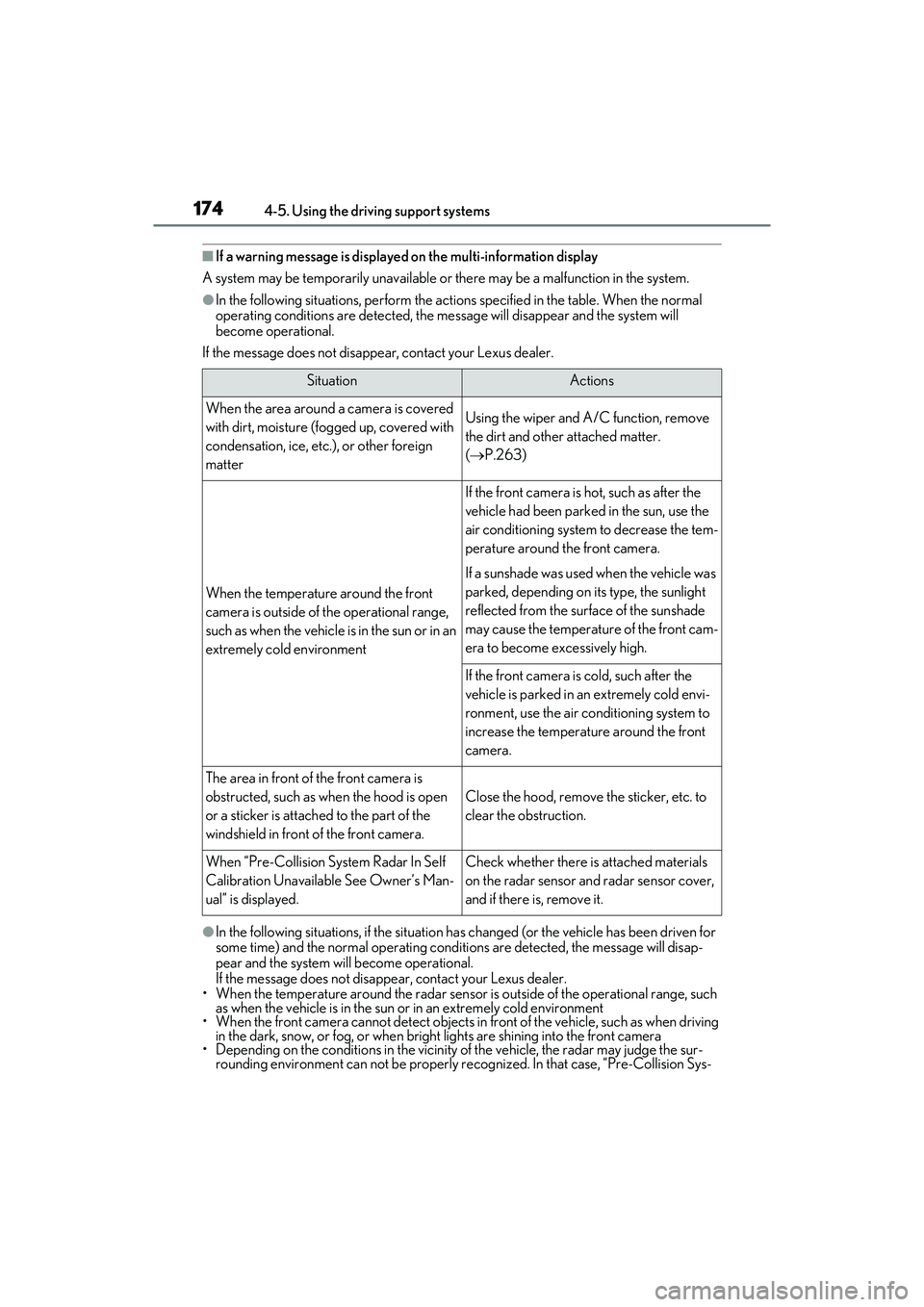
■If a warning message is displayed on the multi-information display
A system may be temporarily unavailable or there may be a malfunction in the system.
●In the following situations, perform the actions specified in the table. When the normal
operating conditions are detected, the message will disappear and the system will
become operational.
If the message does not disappear, contact your Lexus dealer.
●In the following situations, if the situation has changed (or the vehicle has been driven for
some time) and the normal operating conditions are detected, the message will disap-
pear and the system will become operational.
If the message does not disappear, contact your Lexus dealer.
• When the temperature around the radar sensor is outside of the operational range, such as when the vehicle is in the sun or in an extremely cold environment
• When the front camera cannot detect objects in front of the vehicle, such as when driving in the dark, snow, or fog, or when bright lights are shining into the front camera
• Depending on the conditions in the vicinity of the vehicle, the radar may judge the sur- rounding environment can not be properly re cognized. In that case, “Pre-Collision Sys-
SituationActions
When the area around a camera is covered
with dirt, moisture (fogged up, covered with
condensation, ice, etc.), or other foreign
matterUsing the wiper and A/C function, remove
the dirt and other attached matter.
( P.263)
When the temperature around the front
camera is outside of the operational range,
such as when the vehicle is in the sun or in an
extremely cold environment
If the front camera is hot, such as after the
vehicle had been parked in the sun, use the
air conditioning system to decrease the tem-
perature around the front camera.
If a sunshade was used when the vehicle was
parked, depending on its type, the sunlight
reflected from the surface of the sunshade
may cause the temperature of the front cam-
era to become excessively high.
If the front camera is cold, such after the
vehicle is parked in an extremely cold envi-
ronment, use the air conditioning system to
increase the temperature around the front
camera.
The area in front of the front camera is
obstructed, such as when the hood is open
or a sticker is attached to the part of the
windshield in front of the front camera.
Close the hood, remove the sticker, etc. to
clear the obstruction.
When “Pre-Collision System Radar In Self
Calibration Unavailable See Owner’s Man-
ual” is displayed.Check whether there is attached materials
on the radar sensor and radar sensor cover,
and if there is, remove it.
Page 312 of 468
3106-3. Do-it-yourself maintenance
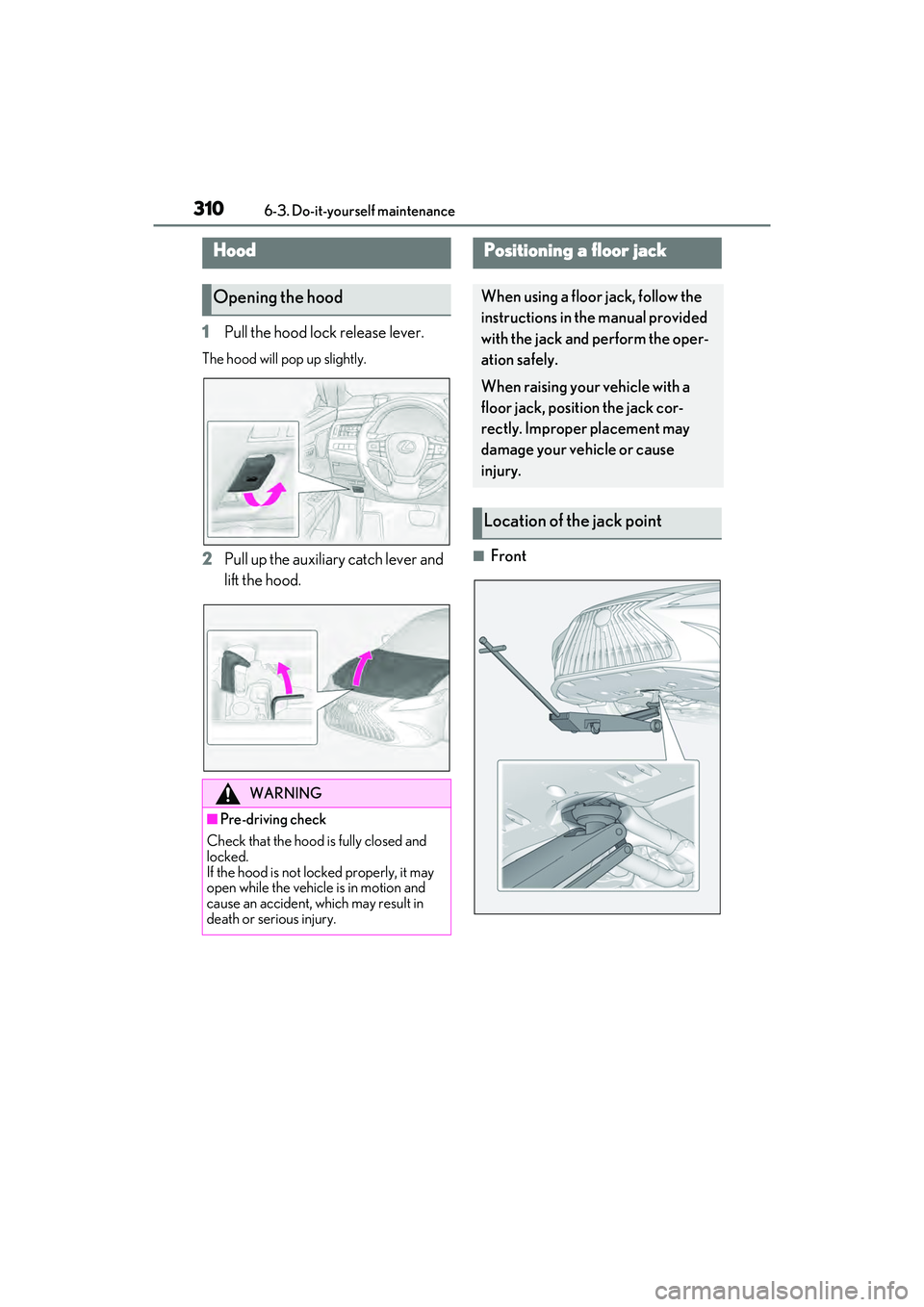
1Pull the hood lock release lever.
The hood will pop up slightly.
2Pull up the auxiliary catch lever and
lift the hood.■Front
Hood
Opening the hood
WARNING
■Pre-driving check
Check that the hood is fully closed and
locked.
If the hood is not locked properly, it may
open while the vehicle is in motion and
cause an accident, which may result in
death or serious injury.
Positioning a floor jack
When using a floor jack, follow the
instructions in the manual provided
with the jack and perform the oper-
ation safely.
When raising your vehicle with a
floor jack, position the jack cor-
rectly. Improper placement may
damage your vehicle or cause
injury.
Location of the jack point