stop LEXUS ES350 2022 Owners Manual
[x] Cancel search | Manufacturer: LEXUS, Model Year: 2022, Model line: ES350, Model: LEXUS ES350 2022Pages: 468, PDF Size: 26.96 MB
Page 6 of 468
4TABLE OF CONTENTS
6-3. Do-it-yourself maintenanceDo-it-yourself service precautions........................................................... 308
Hood................................................... 310
Positioning a floor jack ................ 310
Engine compartment................... 312
Tires ................................................... 320
Tire inflation pressure ................. 328
Wheels.............................................. 330
Air conditioning filter................... 331
Electronic key battery ................ 333
Checking and replacing fuses 335
Headlight aim................................. 337
Light bulbs ....................................... 338
7-1. Essential information Emergency flashers..................... 344
If your vehicle has to be stopped in an emergency ............................. 344
If the vehicle is submerged or water on the road is rising .................. 345
7-2. Steps to take in an emergency If your vehicle needs to be towed........................................................... 347
If you think something is wrong ........................................................... 349
Fuel pump shut off system ........ 350
If a warning light turns on or a warning buzzer sounds ........... 351
If a warning message is displayed ............................................................ 361
If you have a flat tire..................... 365
If the engine will not start .......... 374
If you lose your keys .................... 375If the fuel filler door cannot be
opened .......................................... 376
If the electronic key does not oper- ate properly ................................. 376
If the battery is discharged ....... 379
If your vehicle overheats ........... 382
If the vehicle becomes stuck ... 385
8-1. Specifications Maintenance data (fuel, oil level, etc.) ................................................. 388
Fuel information............................ 397
Tire information ............................ 399
8-2. Customization Customizable features .............. 408
8-3. Items to initialize Items to initialize ............................ 419
9-1. For owners Reporting safety defects for U.S. owners ............................................ 422
Reporting safety defects for Cana- dian owners .................................. 422
Seat belt instructions for Canadian owners (in French) ................... 423
SRS airbag instructions for Cana- dian owners (in French) .......... 424
Headlight aim instructions for Canadian owners (in French)
.......................................................... 430
7When trouble arises
8Vehicle specifications
9For owners
Page 15 of 468
13Pictorial index
Precautions against winter season ............................................................................ P.253
To prevent freezing (windshield wiper de-icer)
*................................................. P.267
Precautions against car wash
*.................................................................................... P.299
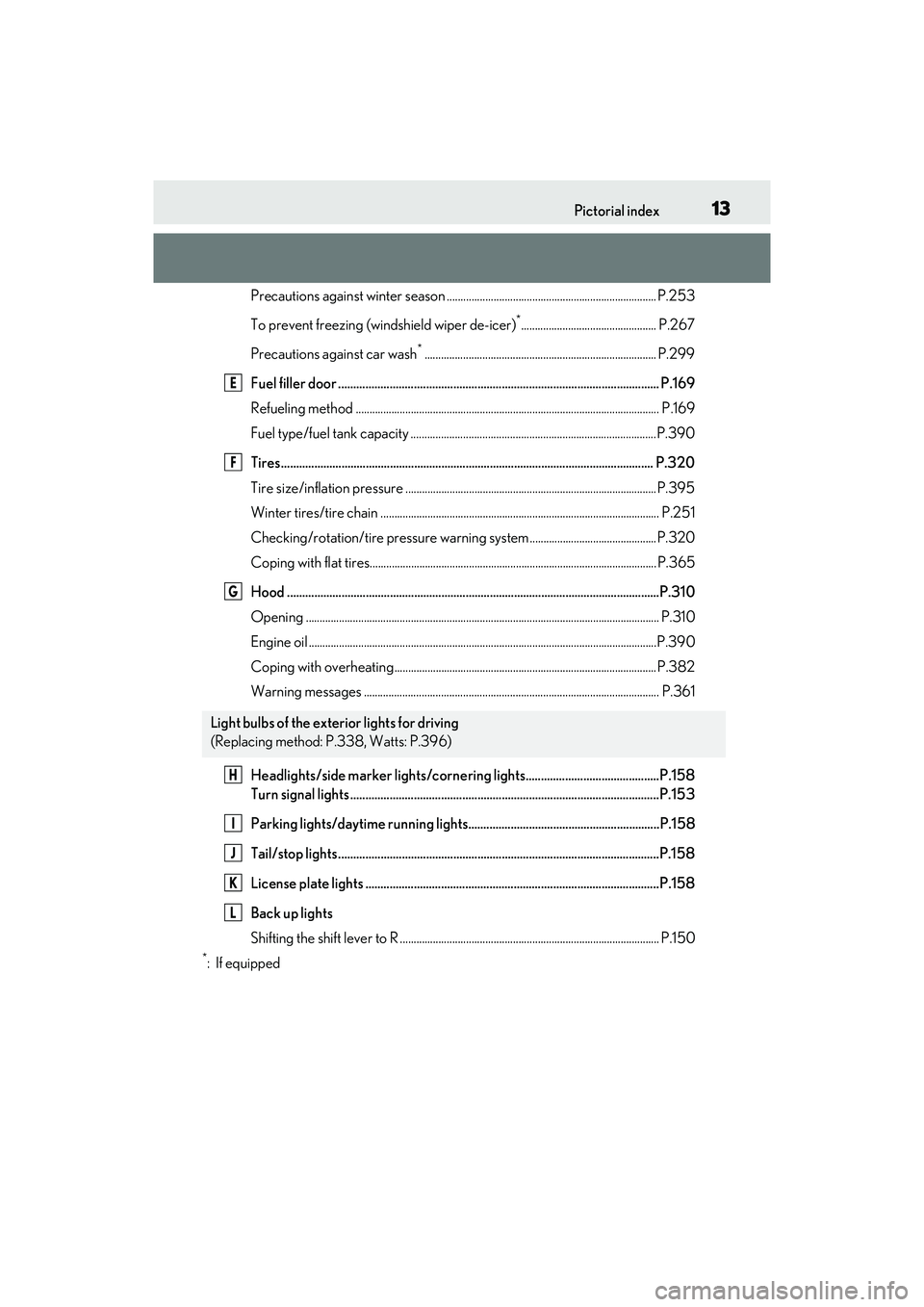
Fuel filler door .......................................................................................................... P.169
Refueling method .............................................................................................................. P .169
Fuel type/fuel tank capacity .........................................................................................P.390
Tires.......................................................................................................................... .P.320
Tire size/inflation pressure ...........................................................................................P.395
Winter tires/tire chain ..................................................................................................... P.2 51
Checking/rotation/tire pressure warning system..............................................P.320
Coping with flat tires........................................................................................................ P .365
Hood ........................................................................................................................... P.310
Opening ................................................................................................................................ P.310
Engine oil ..............................................................................................................................P.390
Coping with overheating............................................................................................... P.382
Warning messages ........................................................................................................... P.36 1
Headlights/side marker lights/cornering lights............................................P.158
Turn signal lights ......................................................................................................P.153
Parking lights/daytime running lights...............................................................P.158
Tail/stop lights ..........................................................................................................P.158
License plate lights .................................................................................................P.158
Back up lights
Shifting the shift lever to R ........... ................................................................................... P.15 0
*: If equipped
Light bulbs of the exterior lights for driving
(Replacing method: P.338, Watts: P.396)
E
F
G
H
I
J
K
L
Page 16 of 468
14Pictorial index
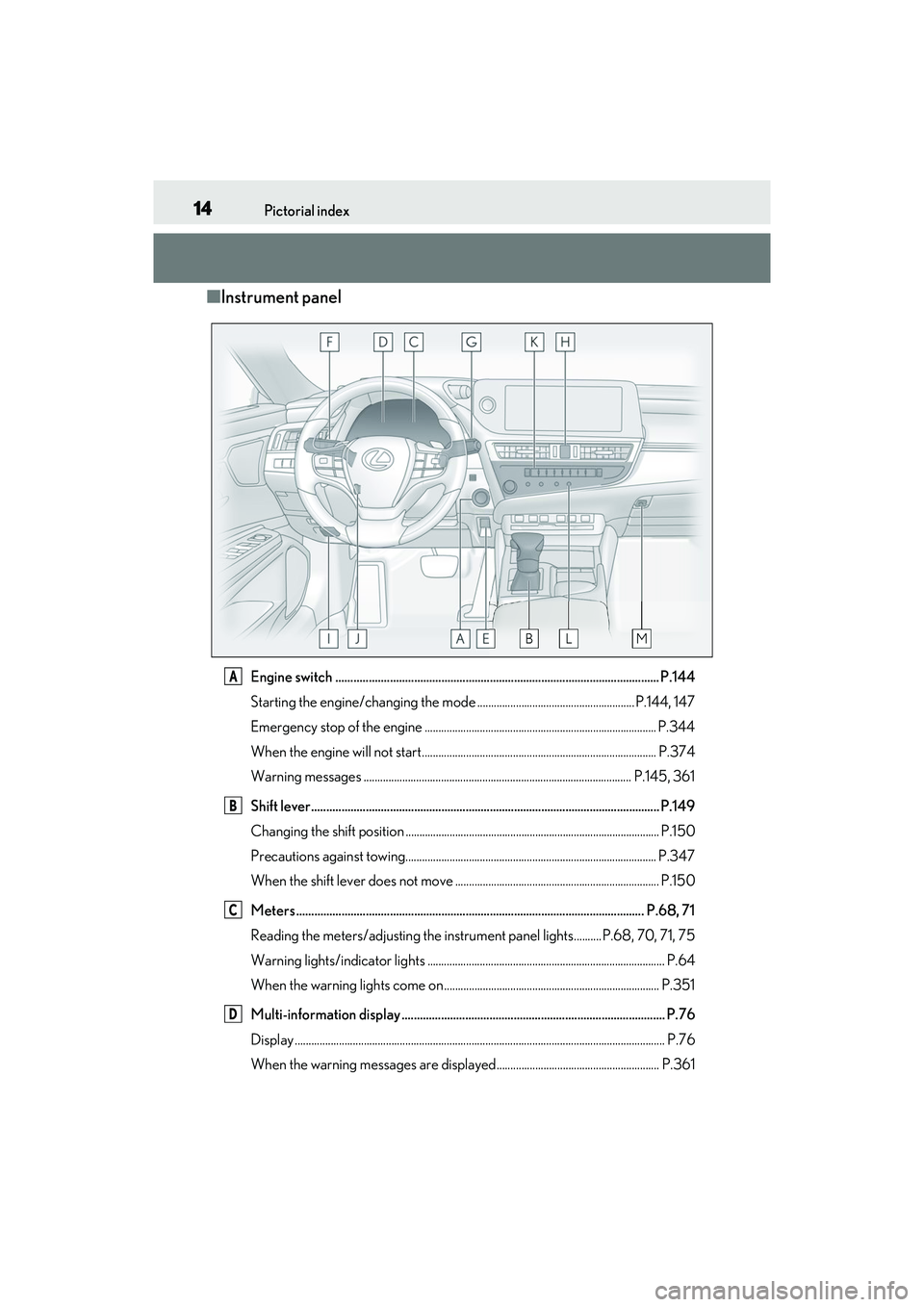
■Instrument panel
Engine switch ........................................................................................................... P.144
Starting the engine/changing the mode ......................................................... P.144, 147
Emergency stop of the engine .................................................................................... P.344
When the engine will not start..................................................................................... P.374
Warning messages ................................................................................................. P.145, 361
Shift lever................................................................................................................... P .149
Changing the shift position ............................................................................................ P.150
Precautions against towing........................................................................................... P.347
When the shift lever does not move .......................................................................... P.150
Meters ................................................................................................................... P.68, 71
Reading the meters/adjusting the instru ment panel lights..........P.68, 70, 71, 75
Warning lights/indicator lights ...................................................................................... P.64
When the warning lights come on.............................................................................. P.351
Multi-information display ....................................................................................... P.76
Display ........................................................................................................................ .............. P.76
When the warning messages are displayed........................................................... P.361A
B
C
D
Page 24 of 468

221-1. For safe use
1-1 . Fo r sa fe use
Use only floor mats designed specifi-
cally for vehicles of the same model
and model year as your vehicle. Fix
them securely in place onto the carpet.
1Insert the retaining hooks (clips)
into the floor mat eyelets.
2 Turn the upper knob of each retain-
ing hook (clip) to secure the floor
mats in place.
Always align the marks .
The shape of the retaining hooks (clips)
may differ from that shown in the illustra-
tion.
Before driving
Observe the following before start-
ing off in the vehicle to ensure
safety of driving.
Installing floor mats
A
WARNING
Observe the following precautions.
Failure to do so may cause the driver’s
floor mat to slip, possibly interfering with
the pedals while driving. An unexpect-
edly high speed may result or it may
become difficult to stop the vehicle. This
could lead to an accident, resulting in
death or serious injury.
■When installing the driver’s floor mat
●Do not use floor mats designed for
other models or different model year
vehicles, even if they are Lexus
Genuine floor mats.
●Only use floor mats designed for the
driver’s seat.
●Always install the floor mat securely
using the retaining hooks (clips) pro-
vided.
●Do not use two or more floor mats on
top of each other.
●Do not place the floor mat bottom-
side up or upside-down.
■Before driving
●Check that the floor mat is securely
fixed in the correct place with all the
provided retaining hooks (clips). Be
especially careful to perform this
check after cleaning the floor.
●With the engine stopped and the shift
lever in P, fully depress each pedal to
the floor to make sure it does not inter-
fere with the floor mat.
Page 25 of 468

231-1. For safe use
1
For safety and security
Adjust the angle of the seatback so
that you are sitting straight up and
so that you do not have to lean for-
ward to steer. (P.112)
Adjust the seat so that you can
depress the pedals fully and so that
your arms bend slightly at the
elbow when gripping the steering
wheel. ( P.112)
Lock the head restraint in place
with the center of the head restraint
closest to the top of your ears.
( P.116)
Wear the seat belt correctly.
( P.25) Make sure that all occupants are wear-
ing their seat belts before driving the
vehicle. (
P.25)
Use a child restraint system appropri-
ate for the child until the child becomes
large enough to properly wear the
vehicle’s seat belt. ( P.43)
Make sure that you can see backward
clearly by adjusting the inside and out-
side rear view mirrors properly.
( P.119, 120)
For safe driving
For safe driving, adjust the seat and
mirror to an appropriate position
before driving.
Correct driving posture
WARNING
Observe the following precautions.
Failure to do so may result in death or
serious injury.
A
B
C
D
●Do not adjust the position of the
driver’s seat while driving.
Doing so could cause the driver to lose
control of the vehicle.
●Do not place a cushion between the
driver or passenger and the seatback.
A cushion may prevent correct pos-
ture from being achieved, and reduce
the effectiveness of the seat belt and
head restraint.
●Do not place anything under the front
seats.
Objects placed under the front seats
may become jammed in the seat
tracks and stop the seat from locking
in place. This may lead to an accident
and the adjustment mechanism may
also be damaged.
●Always observe the legal speed limit
when driving on public roads.
●When driving over long distances,
take regular breaks before you start to
feel tired.
Also, if you feel tired or sleepy while
driving, do not force yourself to con-
tinue driving and take a break immedi-
ately.
Correct use of the seat belts
Adjusting the mirrors
Page 28 of 468
261-1. For safe use
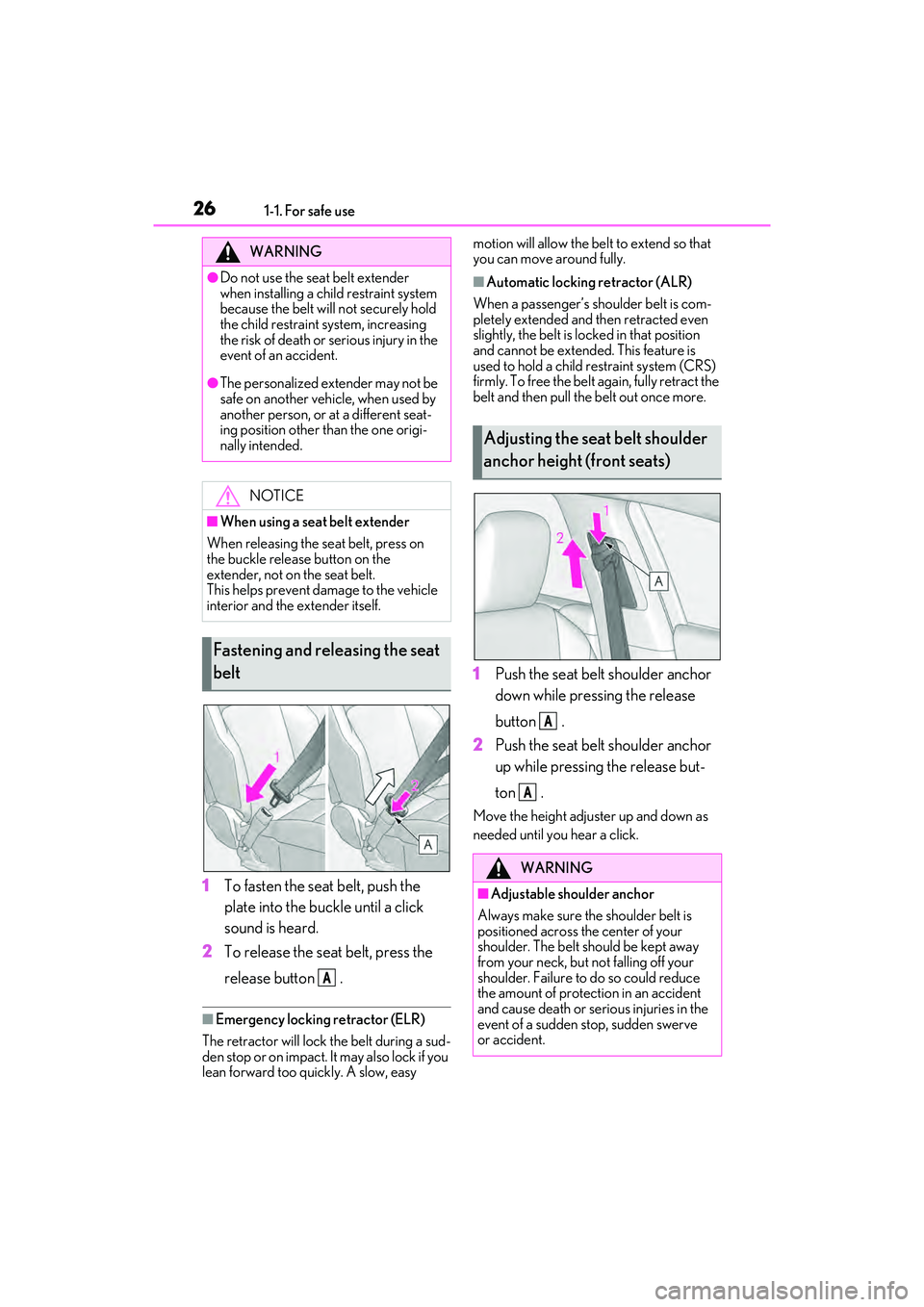
1To fasten the seat belt, push the
plate into the buckle until a click
sound is heard.
2 To release the seat belt, press the
release button .
■Emergency locking retractor (ELR)
The retractor will lock the belt during a sud-
den stop or on impact. It may also lock if you
lean forward too quickly. A slow, easy motion will allow the belt to extend so that
you can move around fully.
■Automatic locking retractor (ALR)
When a passenger’s shoulder belt is com-
pletely extended and then retracted even
slightly, the belt is locked in that position
and cannot be extended. This feature is
used to hold a child restraint system (CRS)
firmly. To free the belt again, fully retract the
belt and then pull the belt out once more.
1 Push the seat belt shoulder anchor
down while pressing the release
button .
2 Push the seat belt shoulder anchor
up while pressing the release but-
ton .
Move the height adjuster up and down as
needed until you hear a click.
WARNING
●Do not use the seat belt extender
when installing a child restraint system
because the belt will not securely hold
the child restraint system, increasing
the risk of death or serious injury in the
event of an accident.
●The personalized extender may not be
safe on another vehicle, when used by
another person, or at a different seat-
ing position other than the one origi-
nally intended.
NOTICE
■When using a seat belt extender
When releasing the se at belt, press on
the buckle release button on the
extender, not on the seat belt.
This helps prevent damage to the vehicle
interior and the extender itself.
Fastening and releasing the seat
belt
A
Adjusting the seat belt shoulder
anchor height (front seats)
WARNING
■Adjustable shoulder anchor
Always make sure the shoulder belt is
positioned across the center of your
shoulder. The belt should be kept away
from your neck, but not falling off your
shoulder. Failure to do so could reduce
the amount of protection in an accident
and cause death or serious injuries in the
event of a sudden stop, sudden swerve
or accident.
A
A
Page 32 of 468
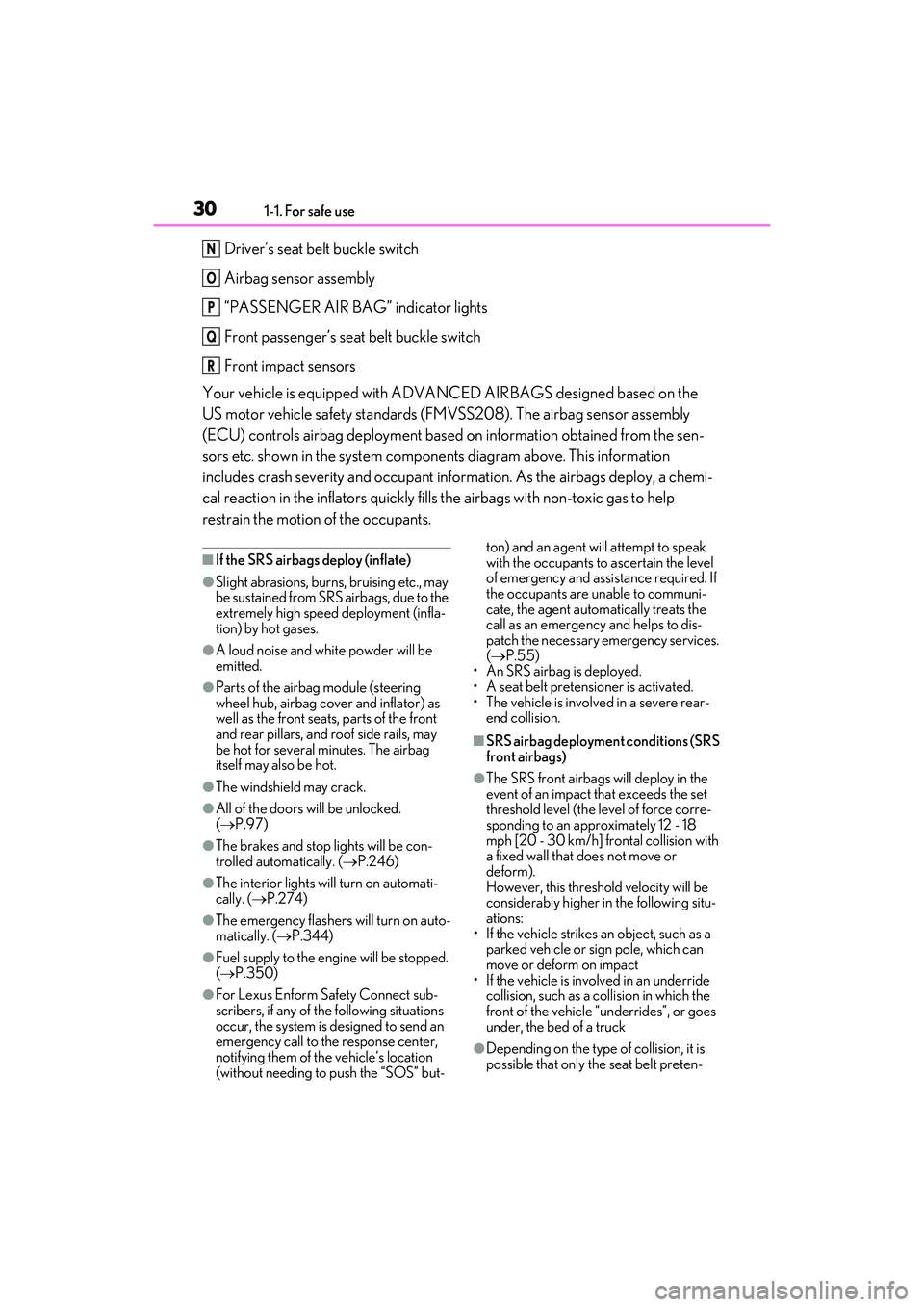
301-1. For safe use
Driver’s seat belt buckle switch
Airbag sensor assembly
“PASSENGER AIR BAG” indicator lights
Front passenger’s seat belt buckle switch
Front impact sensors
Your vehicle is equipped with ADVANCED AIRBAGS designed based on the
US motor vehicle safety standards (FMVSS208). The airbag sensor assembly
(ECU) controls airbag deployment based on information obtained from the sen-
sors etc. shown in the system components diagram above. This information
includes crash severity and occupant information. As the airbags deploy, a chemi-
cal reaction in the inflators quickly fills the airbags with non-toxic gas to help
restrain the motion of the occupants.
■If the SRS airbags deploy (inflate)
●Slight abrasions, burns, bruising etc., may
be sustained from SRS airbags, due to the
extremely high speed deployment (infla-
tion) by hot gases.
●A loud noise and white powder will be
emitted.
●Parts of the airbag module (steering
wheel hub, airbag cover and inflator) as
well as the front seats, parts of the front
and rear pillars, and roof side rails, may
be hot for several minutes. The airbag
itself may also be hot.
●The windshield may crack.
●All of the doors will be unlocked.
( P.97)
●The brakes and stop lights will be con-
trolled automatically. ( P.246)
●The interior lights will turn on automati-
cally. ( P.274)
●The emergency flashers will turn on auto-
matically. ( P.344)
●Fuel supply to the engine will be stopped.
( P.350)
●For Lexus Enform Safety Connect sub-
scribers, if any of the following situations
occur, the system is designed to send an
emergency call to the response center,
notifying them of the vehicle’s location
(without needing to push the “SOS” but- ton) and an agent will attempt to speak
with the occupants to ascertain the level
of emergency and assistance required. If
the occupants are unable to communi-
cate, the agent automatically treats the
call as an emergency and helps to dis-
patch the necessary emergency services.
(
P.55)
•An SRS airbag is deployed.
• A seat belt pretensioner is activated.
• The vehicle is involved in a severe rear- end collision.
■SRS airbag deployment conditions (SRS
front airbags)
●The SRS front airbags will deploy in the
event of an impact that exceeds the set
threshold level (the level of force corre-
sponding to an approximately 12 - 18
mph [20 - 30 km/h] frontal collision with
a fixed wall that does not move or
deform).
However, this threshold velocity will be
considerably higher in the following situ-
ations:
• If the vehicle strikes an object, such as a parked vehicle or sign pole, which can
move or deform on impact
• If the vehicle is involved in an underride collision, such as a collision in which the
front of the vehicle “underrides”, or goes
under, the bed of a truck
●Depending on the type of collision, it is
possible that only the seat belt preten-
N
O
P
Q
R
Page 44 of 468
421-1. For safe use
Exhaust gas precautions
Harmful substance to the human
body is included in exhaust gases if
inhaled.
WARNING
Exhaust gases include harmful carbon
monoxide (CO), which is colorless and
odorless. Observe the following precau-
tions.
Failure to do so may cause exhaust gases
enter the vehicle and may lead to an
accident caused by light-headedness, or
may lead to death or a serious health
hazard.
■Important points while driving
●Keep the trunk lid closed.
●If you smell exhaust gases in the vehi-
cle even when the trunk lid is closed,
open the windows and have the vehi-
cle inspected at your Lexus dealer as
soon as possible.
■When parking
●If the vehicle is in a poorly ventilated
area or a closed area, such as a
garage, stop the engine.
●Do not leave the vehicle with the
engine running for a long time.
If such a situation cannot be avoided,
park the vehicle in an open space and
ensure that exhaust fumes do not enter
the vehicle interior.
●Do not leave the engine running in an
area with snow build-up, or where it is
snowing. If snowbanks build up around
the vehicle while the engine is running,
exhaust gases may collect and enter
the vehicle.
■Exhaust pipe
The exhaust system needs to be checked
periodically. If there is a hole or crack
caused by corrosion, damage to a joint
or abnormal exhaust noise, be sure to
have the vehicle inspected and repaired
by your Lexus dealer.
Page 46 of 468

441-2. Child safety
for child restraint systems.
Use a child restraint system until the
child becomes large enough to
properly wear the vehicle’s seat
belt.
Choose a child restraint system that
suits your vehicle and is appropriate
to the age and size of the child.
■Types of child restraint system installation methods
Confirm with the operation manual enclosed with the child restraint system about
the installation of the child restraint system.
WARNING
■When a child is riding
Observe the following precautions.
Failure to do so may result in death or
serious injury.
●For effective protection in automobile
accidents and sudden stops, a child
must be properly restrained, using a
seat belt or child restraint system
which is correctly installed. For instal-
lation details, refer to the operation
manual enclosed with the child
restraint system. General installation
instruction is provided in this manual.
●Lexus strongly urges the use of a
proper child restraint system that con-
forms to the weight and size of the
child, installed on the rear seat.
According to accident statistics, the
child is safer when properly restrained
in the rear seat than in the front seat.
●Holding a child in your or someone
else’s arms is not a substitute for a child
restraint system. In an accident, the
child can be crushed against the wind-
shield or between the holder and the
interior of the vehicle.
■Handling the child restraint system
If the child restraint system is not prop-
erly fixed in place, the child or other pas-
sengers may be seriously injured or even
killed in the event of sudden braking,
sudden swerving, or an accident.
●If the vehicle were to receive a strong
impact from an accident, etc., it is pos-
sible that the child restraint system has
damage that is not readily visible. In
such cases, do not reuse the restraint
system.
●Make sure you have complied with all
installation instructions provided with
the child restraint system manufac-
turer and that the system is properly
secured.
●Keep the child restraint system prop-
erly secured on the seat even if it is not
in use. Do not store the child restraint
system unsecured in the passenger
compartment.
●If it is necessary to detach the child
restraint system, remove it from the
vehicle or store it securely in the trunk.
Child restraint system
Page 61 of 468

591-4. Theft deterrent system
1
For safety and security
1-4.Theft deterrent system
The indicator light flashes after the
engine switch has been turned off to
indicate that the system is operating.
The indicator light stops flashing after
the engine switch has been turned to
ACCESSORY or IGNITION ON
mode to indicate that the system has
been canceled.
■System maintenance
The vehicle has a maintenance-free type
engine immobilizer system.
■Conditions that may cause the system to
malfunction
●If the grip portion of the key is in contact with a metallic object
●If the key is in close proximity to or touch-
ing a key registered to the security sys-
tem (key with a built-in transponder chip)
of another vehicleEngine immobilizer system
The vehicle’s keys have built-in
transponder chips that prevent the
engine from starting if a key has not
been previously registered in the
vehicle’s on-board computer.
Never leave the keys inside the
vehicle when you leave the vehicle.
This system is designed to help pre-
vent vehicle theft but does not guar-
antee absolute security against all
vehicle thefts.
Operating the system
NOTICE
■To ensure the system operates cor-
rectly
Do not modify or remove the system. If
modified or removed, the proper opera-
tion of the system cannot be guaranteed.