warning light Lexus GS F 2018 s Manual PDF
[x] Cancel search | Manufacturer: LEXUS, Model Year: 2018, Model line: GS F, Model: Lexus GS F 2018Pages: 602, PDF Size: 13.37 MB
Page 442 of 602
4407-2. Steps to take in an emergency
GS350_300_GS F_OM_OM30G34U_(U)
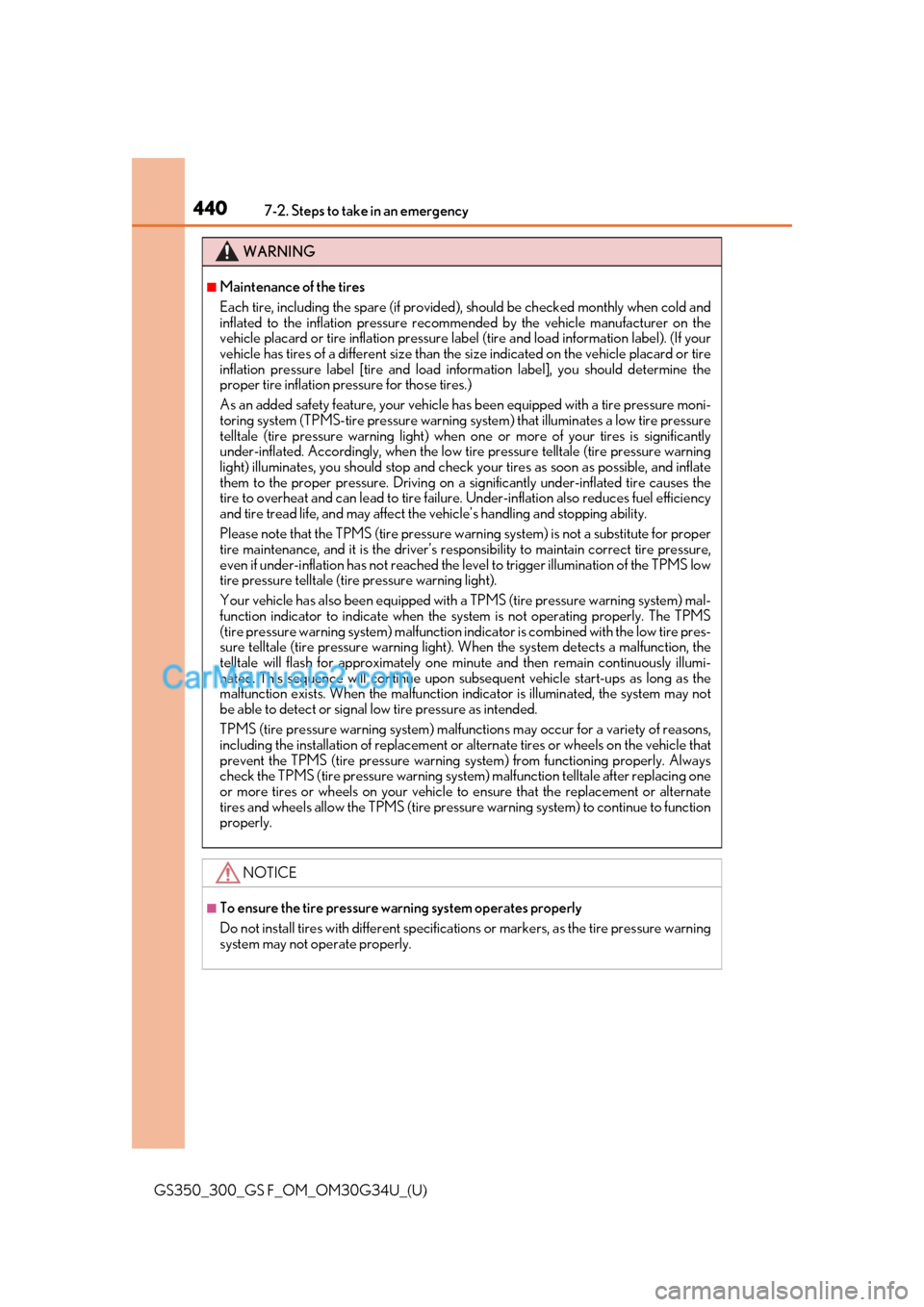
WARNING
■Maintenance of the tires
Each tire, including the spare (if provided), should be checked monthly when cold and
inflated to the inflation pressure recomm ended by the vehicle manufacturer on the
vehicle placard or tire inflation pressure label (tire and load information label). (If your
vehicle has tires of a different size than the size indicated on the vehicle placard or tire
inflation pressure label [tire and load in formation label], you should determine the
proper tire inflation pressure for those tires.)
As an added safety feature, your vehicle ha s been equipped with a tire pressure moni-
toring system (TPMS-tire pressure warning system) that illuminates a low tire pressure
telltale (tire pressure warning light) when on e or more of your tires is significantly
under-inflated. Accordingly, when the low ti re pressure telltale (tire pressure warning
light) illuminates, you should stop and check your tires as soon as possible, and inflate
them to the proper pressure. Driving on a si gnificantly under-inflated tire causes the
tire to overheat and can lead to tire failure . Under-inflation also reduces fuel efficiency
and tire tread life, and may affect the vehicle’s handling and stopping ability.
Please note that the TPMS (tire pressure wa rning system) is not a substitute for proper
tire maintenance, and it is th e driver’s responsibility to ma intain correct tire pressure,
even if under-inflation has not reached the le vel to trigger illumination of the TPMS low
tire pressure telltale (tir e pressure warning light).
Your vehicle has also been equipped with a TPMS (tire pressure warning system) mal-
function indicator to indicate when the system is not operating properly. The TPMS
(tire pressure warning system) malfunction indi cator is combined with the low tire pres-
sure telltale (tire pressure warning light). When the system detects a malfunction, the
telltale will flash for approximately one mi nute and then remain continuously illumi-
nated. This sequence will cont inue upon subsequent vehicle start-ups as long as the
malfunction exists. When the malfunction in dicator is illuminated, the system may not
be able to detect or signal low tire pressure as intended.
TPMS (tire pressure warning system) malfun ctions may occur for a variety of reasons,
including the installation of replacement or alternate tires or wheels on the vehicle that
prevent the TPMS (tire pressure warning system) from functioning properly. Always
check the TPMS (tire pressure warning system) malfunction telltale after replacing one
or more tires or wheels on your vehicle to ensure that the replacement or alternate
tires and wheels allow the TPMS (tire pressu re warning system) to continue to function
properly.
NOTICE
■To ensure the tire pressure warning system operates properly
Do not install tires with differ ent specifications or markers, as the tire pressure warning
system may not operate properly.
Page 443 of 602
441
GS350_300_GS F_OM_OM30G34U_(U)
7
When trouble arises
7-2. Steps to take in an emergency
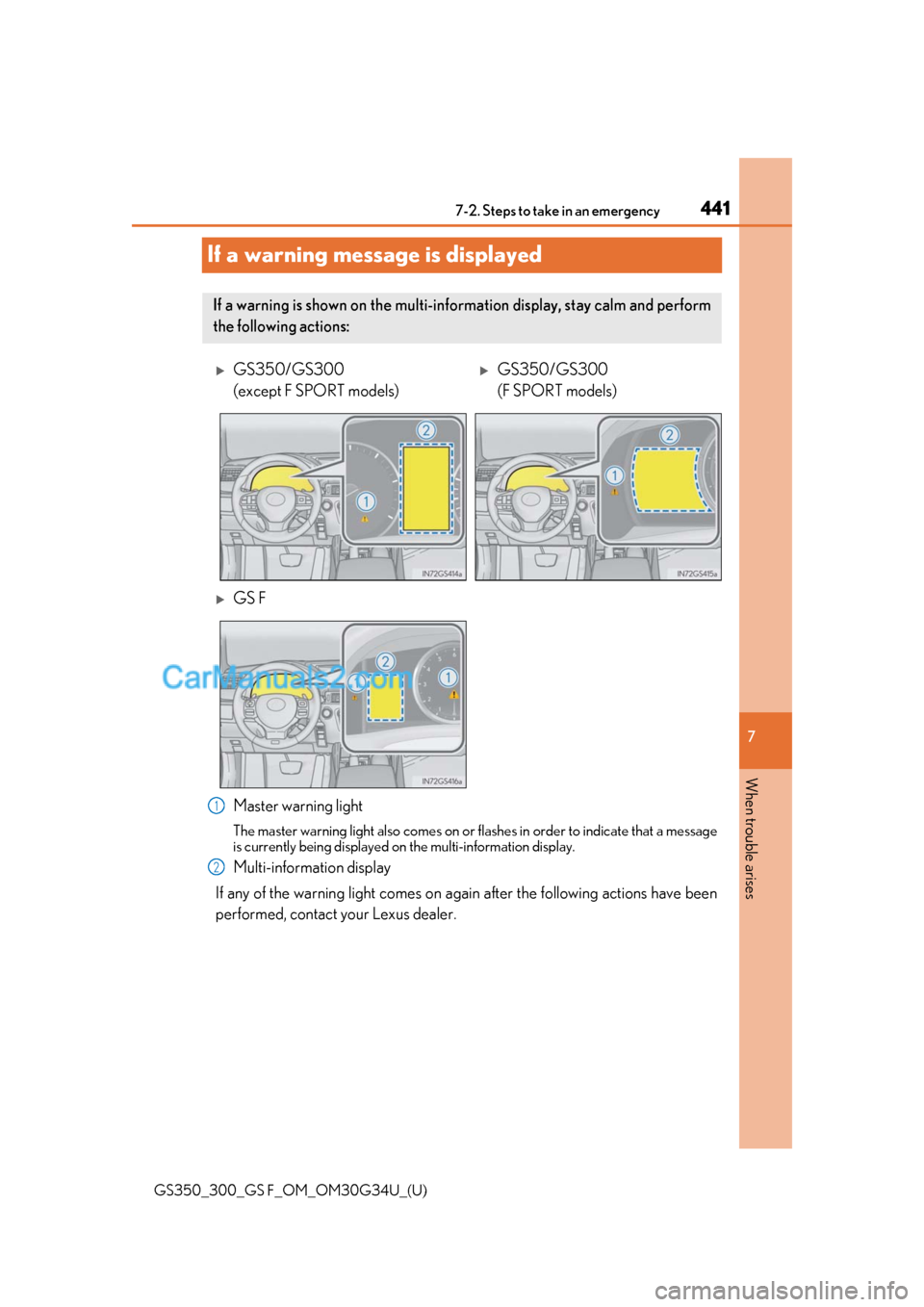
If a warning message is displayed
Master warning light
The master warning light also comes on or flashes in order to indicate that a message
is currently being displayed on the multi-information display.
Multi-information display
If any of the warning light comes on ag ain after the following actions have been
performed, contact your Lexus dealer.
If a warning is shown on the multi-info rmation display, stay calm and perform
the following actions:
GS350/GS300
(except F SPORT models)GS350/GS300
(F SPORT models)
GS F
1
2
Page 458 of 602
4567-2. Steps to take in an emergency
GS350_300_GS F_OM_OM30G34U_(U)
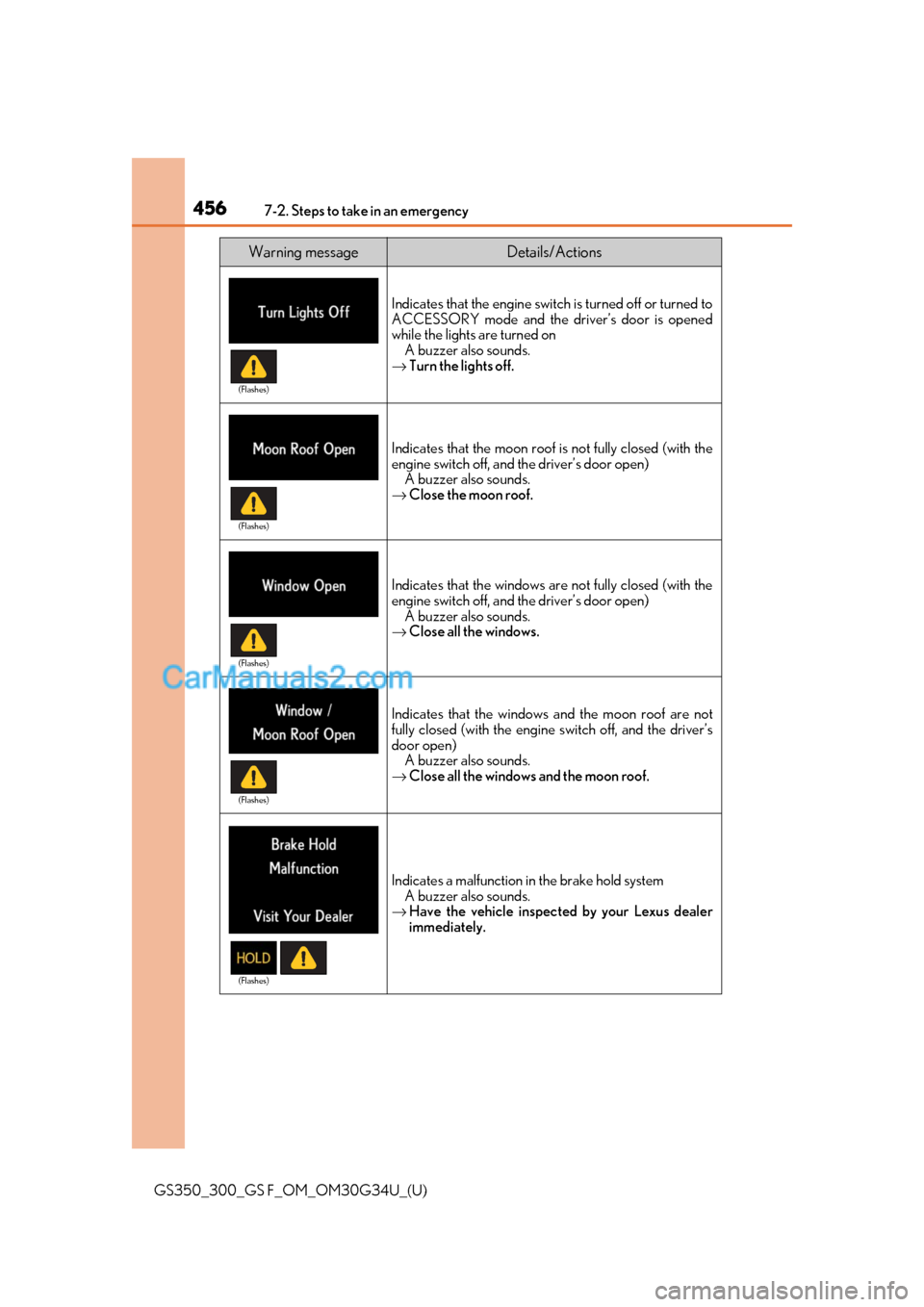
Indicates that the engine switch is turned off or turned to
ACCESSORY mode and the driver’s door is opened
while the lights are turned onA buzzer also sounds.
→ Turn the lights off.
Indicates that the moon roof is not fully closed (with the
engine switch off, and the driver’s door open)
A buzzer also sounds.
→ Close the moon roof.
Indicates that the windows are not fully closed (with the
engine switch off, and the driver’s door open)
A buzzer also sounds.
→ Close all the windows.
Indicates that the windows and the moon roof are not
fully closed (with the engine switch off, and the driver’s
door open)
A buzzer also sounds.
→ Close all the windows and the moon roof.
Indicates a malfunction in the brake hold system
A buzzer also sounds.
→ Have the vehicle inspecte d by your Lexus dealer
immediately.
Warning messageDetails/Actions
(Flashes)
(Flashes)
(Flashes)
(Flashes)
(Flashes)
Page 462 of 602
4607-2. Steps to take in an emergency
GS350_300_GS F_OM_OM30G34U_(U)
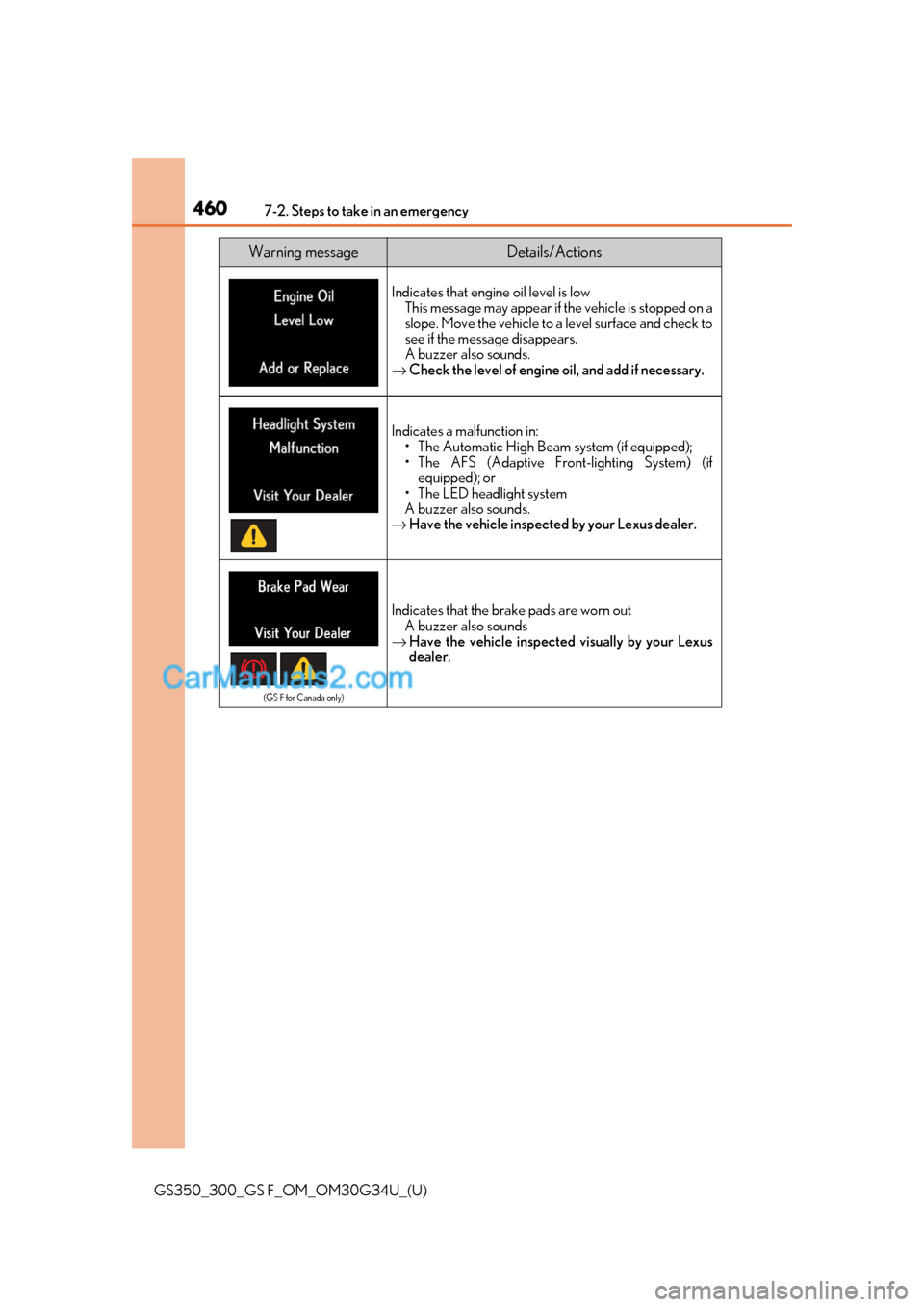
Indicates that engine oil level is low
This message may ap pear if the vehicle is stopped on a
slope. Move the vehicle to a level surface and check to
see if the message disappears.
A buzzer also sounds.
→ Check the level of engine oil, and add if necessary.
Indicates a malfunction in:
• The Automatic High Beam system (if equipped);
• The AFS (Adaptive Front-lighting System) (if
equipped); or
• The LED headlight system
A buzzer also sounds.
→ Have the vehicle inspected by your Lexus dealer.
(GS F for Canada only)
Indicates that the brake pads are worn out
A buzzer also sounds
→ Have the vehicle inspected visually by your Lexus
dealer.
Warning messageDetails/Actions
Page 466 of 602
4647-2. Steps to take in an emergency
GS350_300_GS F_OM_OM30G34U_(U)
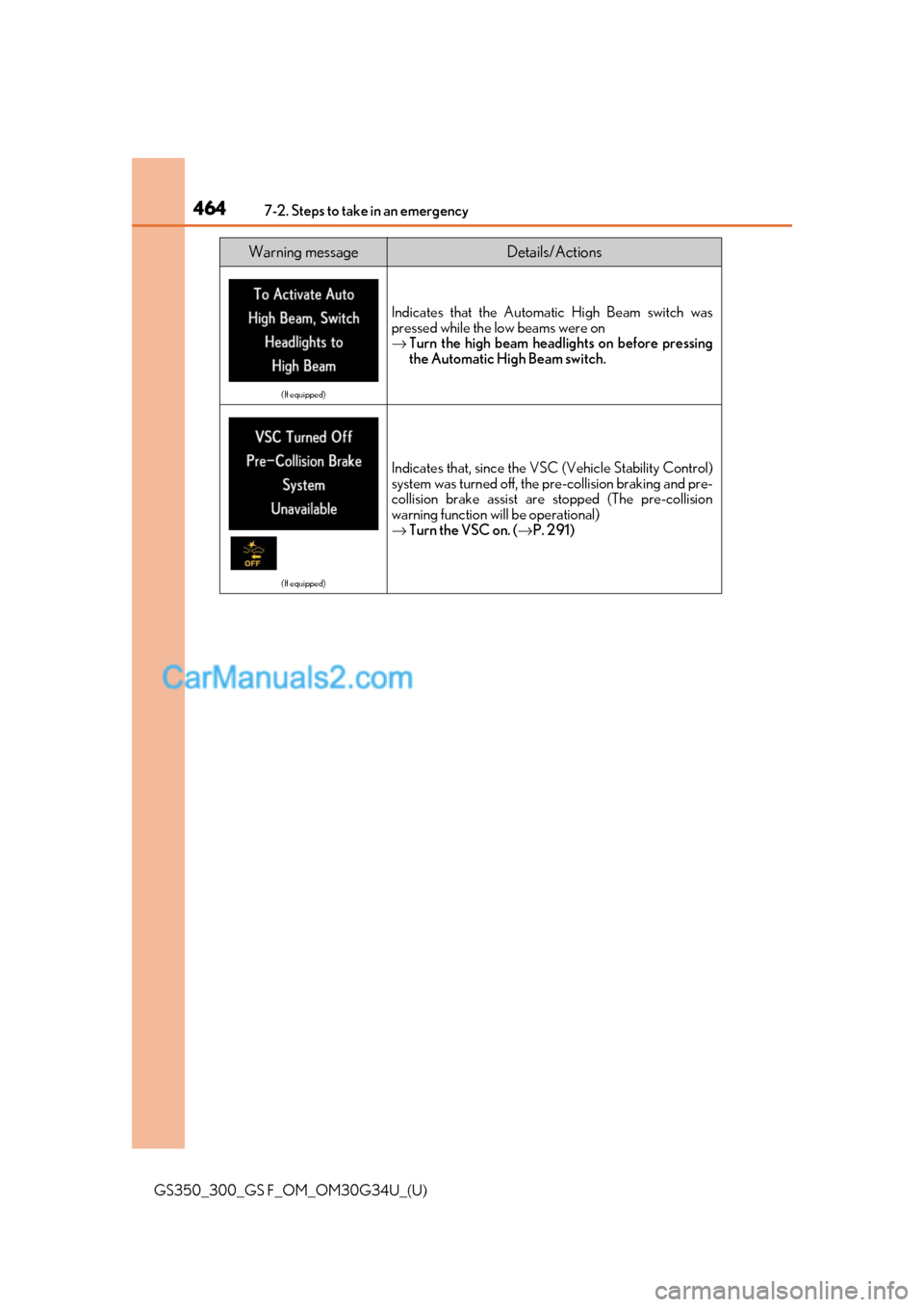
Warning messageDetails/Actions
(If equipped)
Indicates that the Automatic High Beam switch was
pressed while the low beams were on
→ Turn the high beam headlights on before pressing
the Automatic High Beam switch.
(If equipped)
Indicates that, since the VSC (Vehicle Stability Control)
system was turned off, the pre-collision braking and pre-
collision brake assist are stopped (The pre-collision
warning function will be operational)
→ Turn the VSC on. ( →P. 291)
Page 471 of 602
4697-2. Steps to take in an emergency
GS350_300_GS F_OM_OM30G34U_(U)
7
When trouble arises
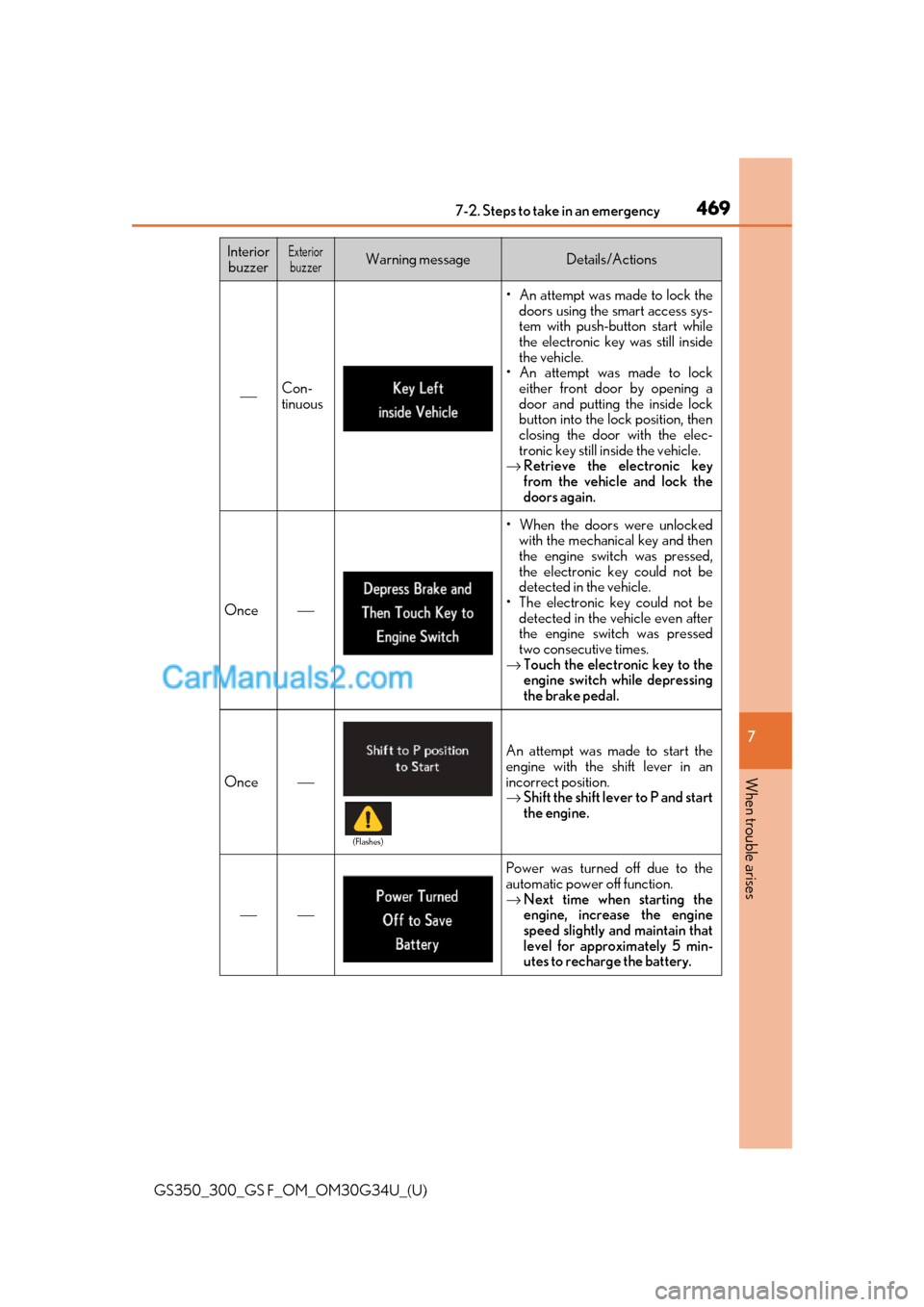
⎯Con-
tinuous
• An attempt was made to lock the doors using the sm art access sys-
tem with push-button start while
the electronic key was still inside
the vehicle.
• An attempt was made to lock either front door by opening a
door and putting the inside lock
button into the lock position, then
closing the door with the elec-
tronic key still inside the vehicle.
→ Retrieve the electronic key
from the vehicle and lock the
doors again.
Once⎯
• When the doors were unlocked
with the mechanical key and then
the engine swit ch was pressed,
the electronic key could not be
detected in the vehicle.
• The electronic key could not be
detected in the vehicle even after
the engine switch was pressed
two consecutive times.
→ Touch the electronic key to the
engine switch while depressing
the brake pedal.
Once⎯
An attempt was made to start the
engine with the shift lever in an
incorrect position.
→Shift the shift lever to P and start
the engine.
⎯⎯
Power was turned off due to the
automatic power off function.
→Next time when starting the
engine, increase the engine
speed slightly and maintain that
level for approximately 5 min-
utes to recharge the battery.
Interior
buzzerExteriorbuzzerWarning messageDetails/Actions
(Flashes)
Page 481 of 602
4797-2. Steps to take in an emergency
GS350_300_GS F_OM_OM30G34U_(U)
7
When trouble arises
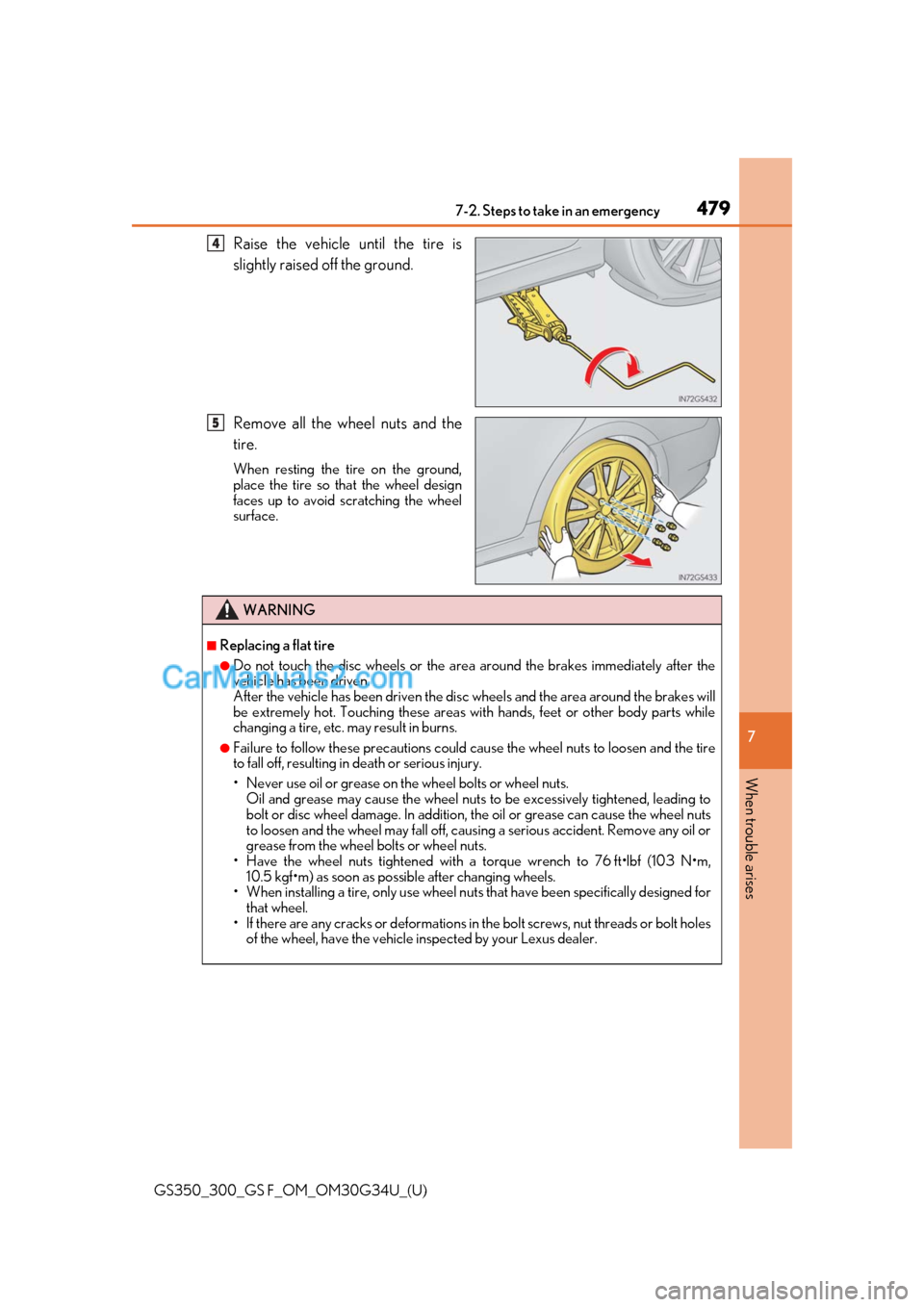
Raise the vehicle until the tire is
slightly raised off the ground.
Remove all the wheel nuts and the
tire.
When resting the tire on the ground,
place the tire so that the wheel design
faces up to avoid scratching the wheel
surface.
4
5
WARNING
■Replacing a flat tire
●Do not touch the disc wheels or the area around the brakes immediately after the
vehicle has been driven.
After the vehicle has been driven the disc wheels and the area around the brakes will
be extremely hot. Touching these areas with hands, feet or other body parts while
changing a tire, etc. may result in burns.
●Failure to follow these precautions could cau se the wheel nuts to loosen and the tire
to fall off, resulting in death or serious injury.
• Never use oil or grease on the wheel bolts or wheel nuts. Oil and grease may cause the wheel nuts to be excessively tightened, leading to
bolt or disc wheel damage. In addition, the oil or grease can cause the wheel nuts
to loosen and the wheel may fall off, causing a serious accident. Remove any oil or
grease from the wheel bolts or wheel nuts.
• Have the wheel nuts tightened with a torque wrench to 76 ft•lbf (103 N•m, 10.5 kgf•m) as soon as possible after changing wheels.
• When installing a tire, only use wheel nuts that have been specifically designed for
that wheel.
• If there are any cracks or deformations in the bolt screws, nut threads or bolt holes
of the wheel, have the vehicle inspected by your Lexus dealer.
Page 483 of 602
4817-2. Steps to take in an emergency
GS350_300_GS F_OM_OM30G34U_(U)
7
When trouble arises
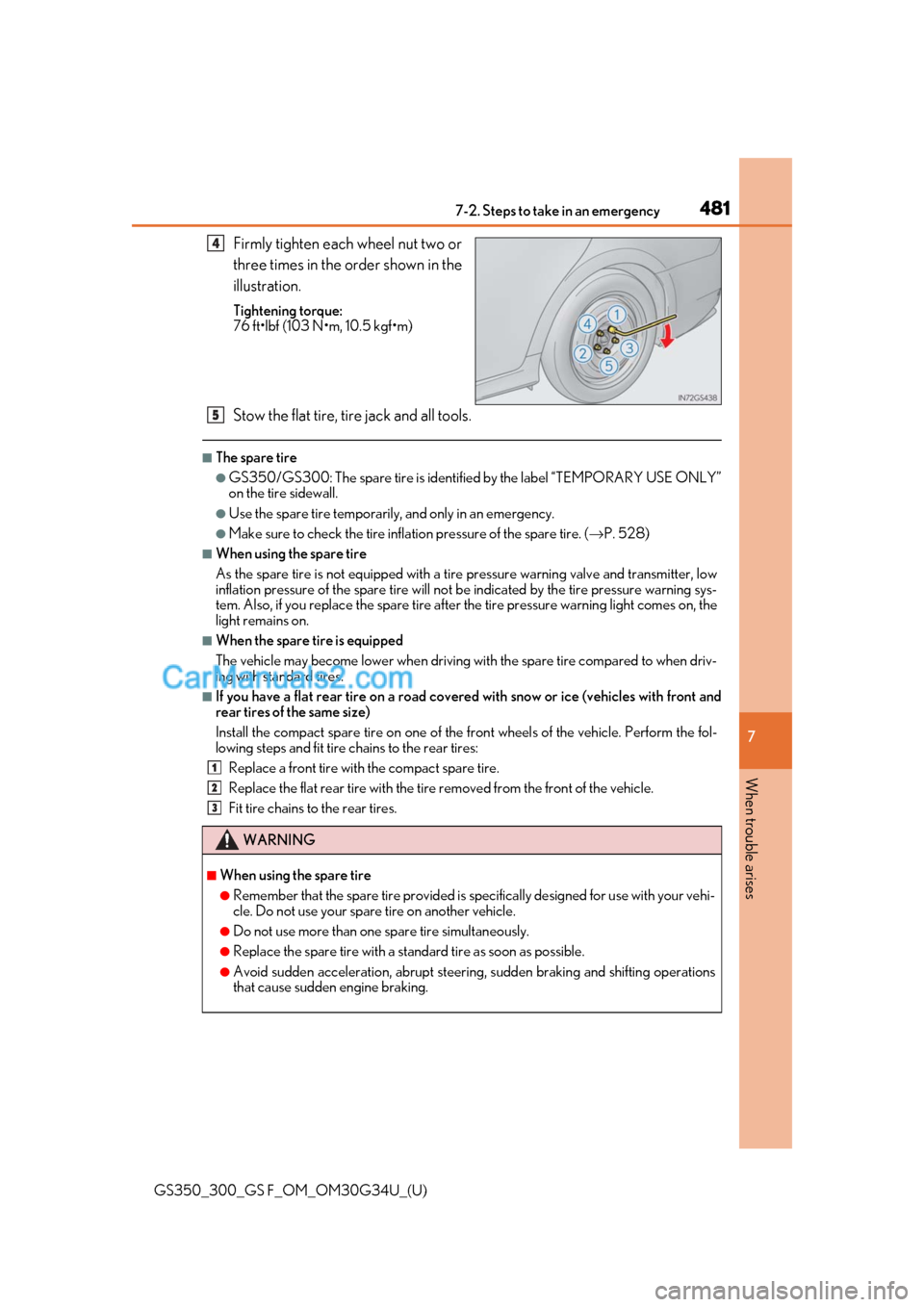
Firmly tighten each wheel nut two or
three times in the order shown in the
illustration.
Tightening torque:
76 ft•lbf (103 N•m, 10.5 kgf•m)
Stow the flat tire, tire jack and all tools.
■The spare tire
●GS350/GS300: The spare tire is identifi ed by the label “TEMPORARY USE ONLY”
on the tire sidewall.
●Use the spare tire temporarily , and only in an emergency.
●Make sure to check the tire inflat ion pressure of the spare tire. (→P. 528)
■When using the spare tire
As the spare tire is not equipped with a tire pressure warning valve and transmitter, low
inflation pressure of the spare tire will not be indicated by the tire pressure warning sys-
tem. Also, if you replace the spare tire after the tire pressure warning light comes on, the
light remains on.
■When the spare tire is equipped
The vehicle may become lower when driving with the spare tire compared to when driv-
ing with standard tires.
■If you have a flat rear tire on a road covered with snow or ice (vehicles with front and
rear tires of the same size)
Install the compact spare tire on one of the front wheels of the vehicle. Perform the fol-
lowing steps and fit tire chains to the rear tires:
Replace a front tire with the compact spare tire.
Replace the flat rear tire with the tire removed from the front of the vehicle.
Fit tire chains to the rear tires.
4
WARNING
■When using the spare tire
●Remember that the spare tire provided is specifically designed for use with your vehi-
cle. Do not use your spare tire on another vehicle.
●Do not use more than one spare tire simultaneously.
●Replace the spare tire with a stan dard tire as soon as possible.
●Avoid sudden acceleration, abrupt steering, sudden braking and shifting operations
that cause sudden engine braking.
5
1
2
3
Page 496 of 602
4947-2. Steps to take in an emergency
GS350_300_GS F_OM_OM30G34U_(U)
■Emergency tire puncture repair kit
●The sealant has a limited lifespan. The expiry date is shown on the bottle. The sealant
should be replaced before the expiry date. Contact your Lexus dealer for replacement.
●The sealant stored in the emergency tire puncture repair kit can be used only once to
temporarily repair a single tire. If the sealant has been used and need to be purchased,
contact your Lexus dealer.
●The sealant can be used when the outside temperature is from -40 °F (-40 °C) to
140 °F (60 °C).
●The repair kit is exclusively designed for size and type of tires originally installed on your
vehicle. Do not use it for tires that a differen t size than the original ones, or for any other
purposes.
●If the sealant gets on yo ur clothes, it may stain.
●If the sealant adheres to a wheel or the surface of the vehicle body, the stain may not be
removable if it is not cleaned at once. Immediately wipe away the sealant with a wet
cloth.
●During operation of the repair kit, a loud operation noise is produced. This does not
indicate a malfunction.
●Do not use the emergency tire puncture repair kit to check or to adjust the tire pres-
sure.
■If the tire is inflated to mo re than the recommended level
Disconnect the hose from the valve.
Disconnect the hose from the valve, remove the air releas e cap from the hose and then
reconnect the hose.
Turn the compressor switch on and wait for several seconds, and then turn it off. Check
that the air pressure indicator shows the recommended level. ( →P. 528)
If the air pressure is lower than the reco mmended level, turn the compressor switch on
again and repeat the inflation procedure un til the recommended pressure is reached.
■The valve of a tire that has been repaired
●After a tire is repaired with the emergency tire puncture repair kit, the valve should be
replaced.
●After a tire is repaired with the emergency tire puncture repair kit, even if the tire infla-
tion pressure is at the recommended level, the tire pressure warning light may come
on/flash.
■Note for checking the emergency tire puncture repair kit
Check the sealant expi ry date occasionally.
The expiry date is shown on the bottle.
Do not use sealant whose expiry date has al ready passed. Otherwise, repairs conducted
using the emergency tire puncture repa ir kit may not be performed properly.
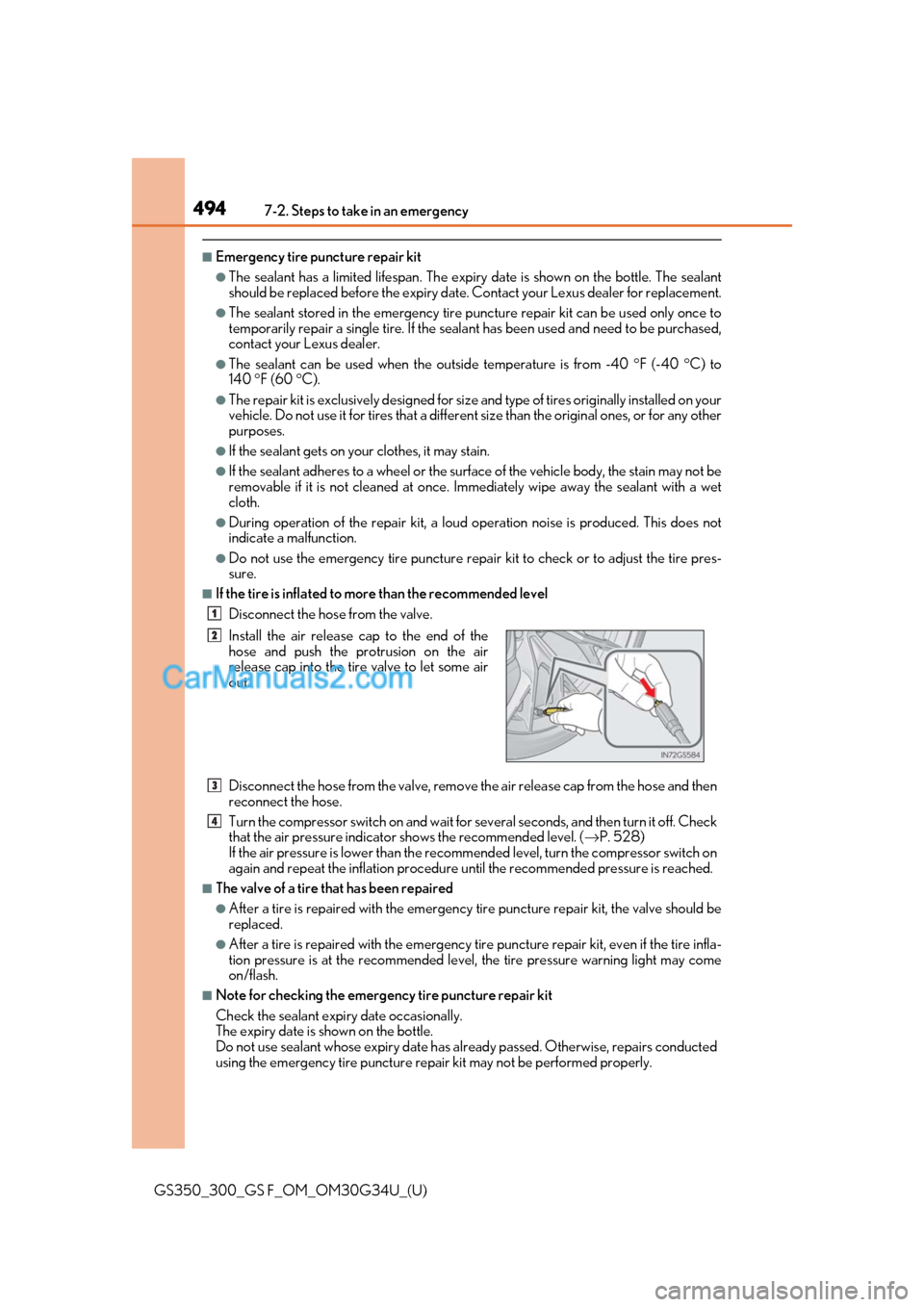
Install the air release cap to the end of the
hose and push the protrusion on the air
release cap into the tire valve to let some air
out.
1
2
3
4
Page 510 of 602
5087-2. Steps to take in an emergency
GS350_300_GS F_OM_OM30G34U_(U)
WARNING
■Avoiding battery fires or explosions
Observe the following precautions to prevent accidentally igniting the flammable gas
that may be emitted from the battery:
●Make sure each jumper cable is connected to the correct terminal and that it is not
unintentionally in contact with any other than the intended terminal.
●Do not allow the other end of the jumper cab le connected to the “+” terminal to come
into contact with any other parts or metal surfaces in the area, such as brackets or
unpainted metal.
●Do not allow the + and - clamps of the jump er cables to come into contact with each
other.
●Do not smoke, use matches, cigarette lighters or allow open flame near the battery.
■Battery precautions
The battery contains poisonous and corrosive acidic electrolyte, while related parts
contain lead and lead compounds. Observ e the following precautions when handling
the battery:
●When working with the battery, always wear safety glasses and take care not to allow
any battery fluids (acid) to come into cont act with skin, clothing or the vehicle body.
●Do not lean over the battery.
●In the event that battery fluid comes into contact with the skin or eyes, immediately
wash the affected area with water and seek medical attention.
Place a wet sponge or cloth over the affected area until medical attention can be
received.
●Always wash your hands afte r handling the battery support, terminals, and other bat-
tery-related parts.
●Do not allow childre n near the battery.
NOTICE
■When handling jumper cables
When connecting the jumper cables, ensure that they do not become entangled in the
cooling fans or engine drive belt.