ECU Lexus GS200t 2016 s User Guide
[x] Cancel search | Manufacturer: LEXUS, Model Year: 2016, Model line: GS200t, Model: Lexus GS200t 2016Pages: 668, PDF Size: 177.56 MB
Page 54 of 668
541-1. For safe use
GS350_200t_GS F_OM_OM30E87E_(EE)
WA R N I N G
■SRS airbag precautions
●The SRS front passenger airbag also deploys with considerable force, and can cause
death or serious injury especially if the front passenger is very close to the airbag. The
front passenger seat should be as far from the airbag as possible with the seatback
adjusted, so the front passenger sits upright.
●Improperly seated and/or restrained infants and children can be killed or seriously
injured by a deploying airbag. An infant or child who is too small to use a seat belt
should be properly secured using a child restraint system. Lexus strongly recom-
mends that all infants and children be placed in the rear seats of the vehicle and prop-
erly restrained. The rear seats are safer for infants and children than the front
passenger seat. ( →P. 6 4 )
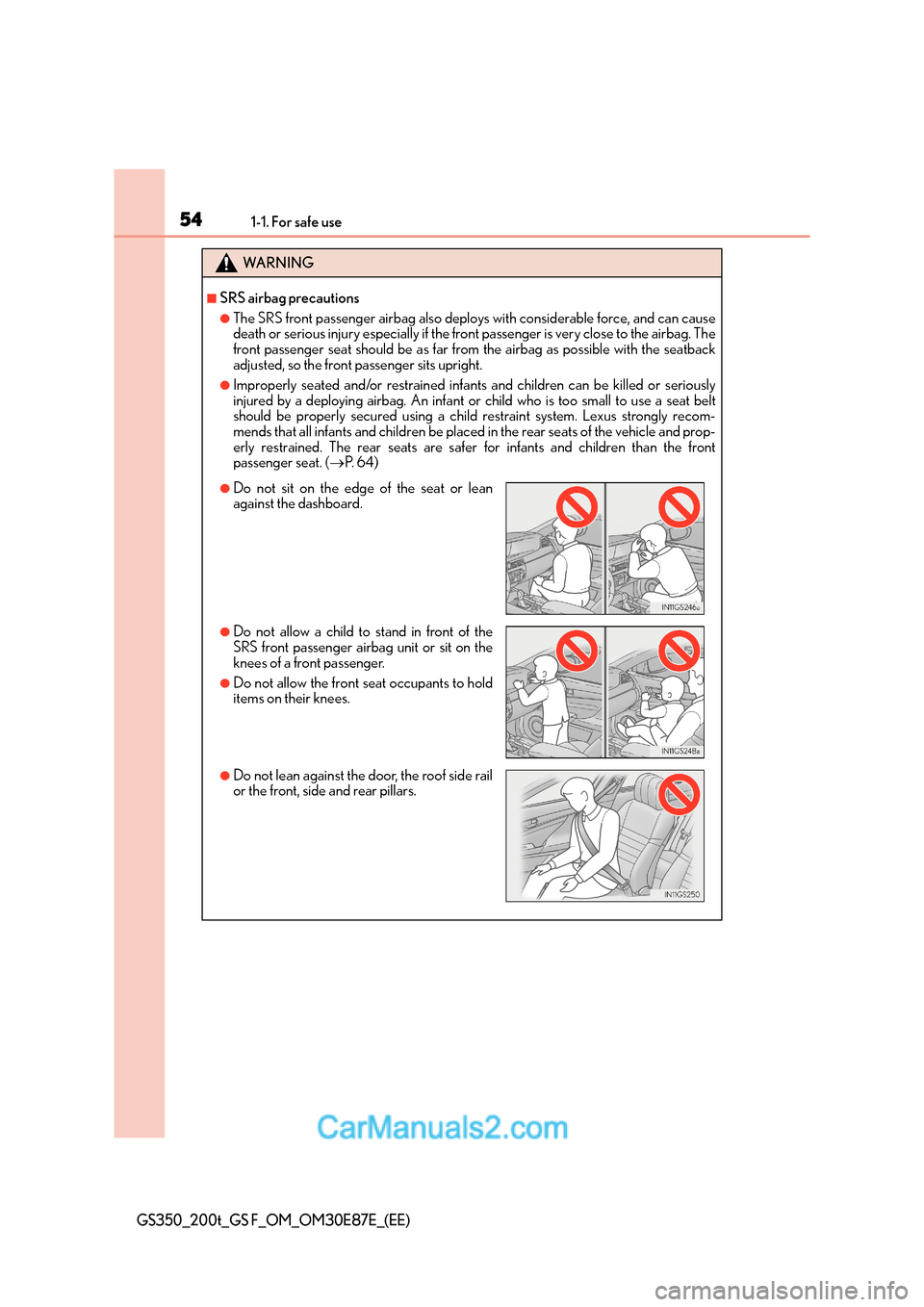
●Do not sit on the edge of the seat or lean
against the dashboard.
●Do not allow a child to stand in front of the
SRS front passenger airbag unit or sit on the
knees of a front passenger.
●Do not allow the front seat occupants to hold
items on their knees.
●Do not lean against the door, the roof side rail
or the front, side and rear pillars.
Page 55 of 668
551-1. For safe use
1
For safety and security
GS350_200t_GS F_OM_OM30E87E_(EE)
WA R N I N G
■SRS airbag precautions
●Do not hang coat hangers or other hard objects on the coat hooks. All of these items
could become projectiles and may cause death or serious injury, should the SRS cur-
tain shield airbags deploy.
●If a vinyl cover is put on the area where the SRS knee airbag will deploy, be sure to
remove it.
●Do not use seat accessories which cover the parts where the SRS side airbags inflate
as they may interfere with inflation of the airbags. Such accessories may prevent the
side airbags from activating correctly, disable the system or cause the side airbags to
inflate accidentally, resulting in death or serious injury.
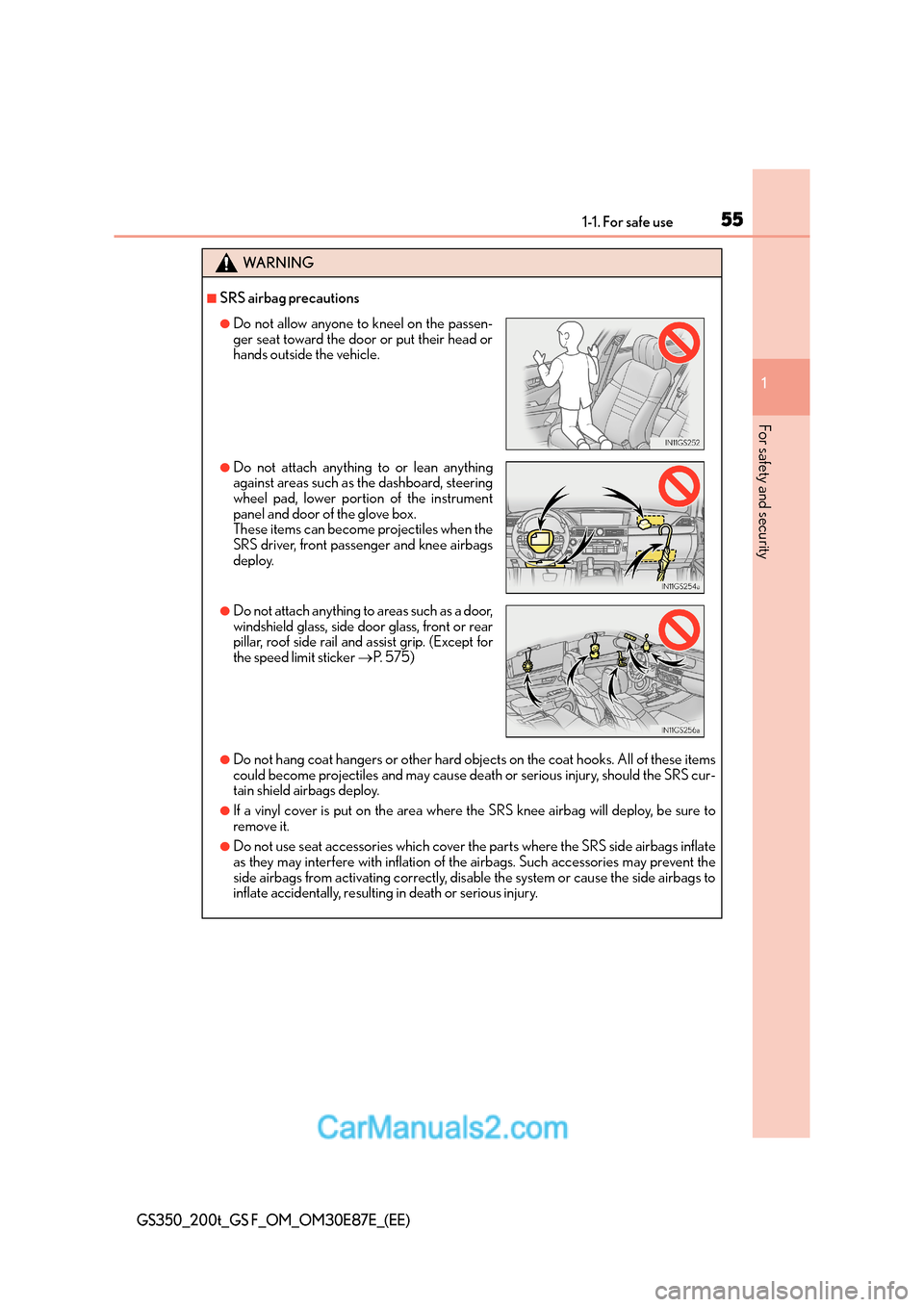
●Do not allow anyone to kneel on the passen-
ger seat toward the door or put their head or
hands outside the vehicle.
●Do not attach anything to or lean anything
against areas such as the dashboard, steering
wheel pad, lower portion of the instrument
panel and door of the glove box.
These items can become projectiles when the
SRS driver, front passenger and knee airbags
deploy.
●Do not attach anything to areas such as a door,
windshield glass, side door glass, front or rear
pillar, roof side rail and assist grip. (Except for
the speed limit sticker →P. 5 7 5 )
Page 57 of 668
571-1. For safe use
1
For safety and security
GS350_200t_GS F_OM_OM30E87E_(EE)
■If the SRS airbags deploy (inflate)
●Slight abrasions, burns, bruising etc., may be sustained from SRS airbags, due to the
extremely high speed deployment (inflation) by hot gases.
●A loud noise and white powder will be emitted.
●Parts of the airbag module (steering wheel hub, airbag cover and inflator) as well as the
seats, the glove box, parts of the front and rear pillars, and roof side rails may be hot for
several minutes. The airbag itself may also be hot.
●The windshield may crack.
■SRS airbag deployment conditions (SRS front airbags)
●The SRS front airbags will deploy in the event of an impact that exceeds the set thresh-
old level (the level of force corresponding to an approximately 20 - 30 km/h [12 - 18
mph] frontal collision with a fixed wall that does not move or deform).
However, this threshold velocity will be considerably higher in the following situations:
• If the vehicle strikes an object, such as a parked vehicle or sign pole, which can move or deform on impact
• If the vehicle is involved in an underride collision, such as a collision in which the
front of the vehicle “underrides”, or goes under, the bed of a truck
●Depending on the type of collision, it is possi ble that only the seat belt pretensioners will
activate.
■SRS airbag deployment conditions (SRS side and curtain shield airbags)
●The SRS side and curtain shield airbags w ill deploy in the event of an impact that
exceeds the set threshold level (the level of force corresponding to the impact force
produced by an approximately 1500 kg [ 3300 lb.] vehicle colliding with the vehicle
cabin from a direction perpendicular to the vehicle orientation at an approximate
speed of 20 - 30 km/h [12 - 18 mph]).
●The SRS side and curtain shield airbags may also deploy in the event of a severe frontal
collision.
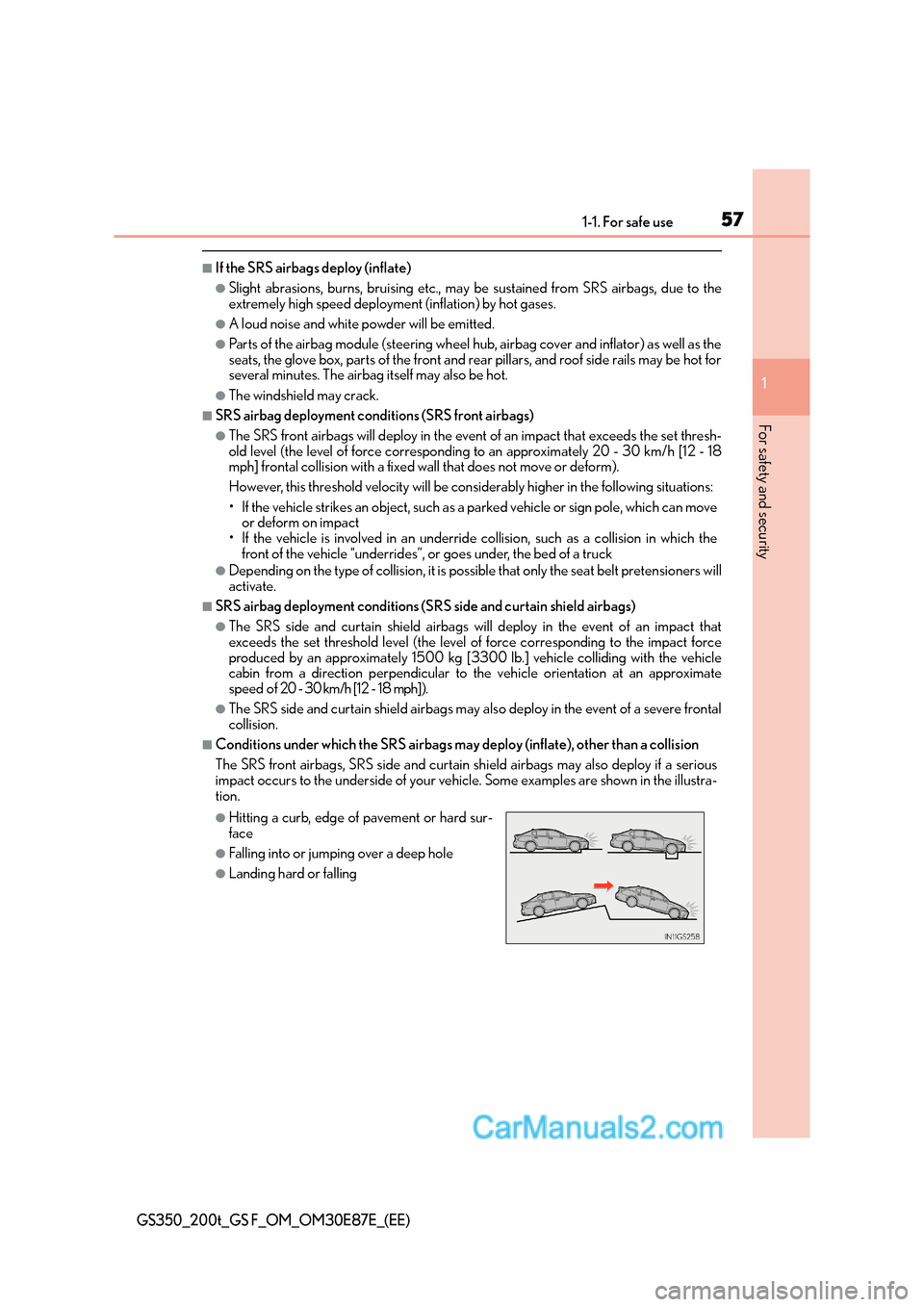
■Conditions under which the SRS airbags may deploy (inflate), other than a collision
The SRS front airbags, SRS side and curtain shield airbags may also deploy if a serious
impact occurs to the underside of your vehicle. Some examples are shown in the illustra-
tion.
●Hitting a curb, edge of pavement or hard sur-
face
●Falling into or jumping over a deep hole
●Landing hard or falling
Page 59 of 668
591-1. For safe use
1
For safety and security
GS350_200t_GS F_OM_OM30E87E_(EE)
■When to contact any authorized Lexus dealer or repairer, or another duly qualified and
equipped professional
In the following cases, the vehicle will require inspection and/or repair. Contact any
authorized Lexus dealer or repairer, or another duly qualified and equipped professional
as soon as possible.
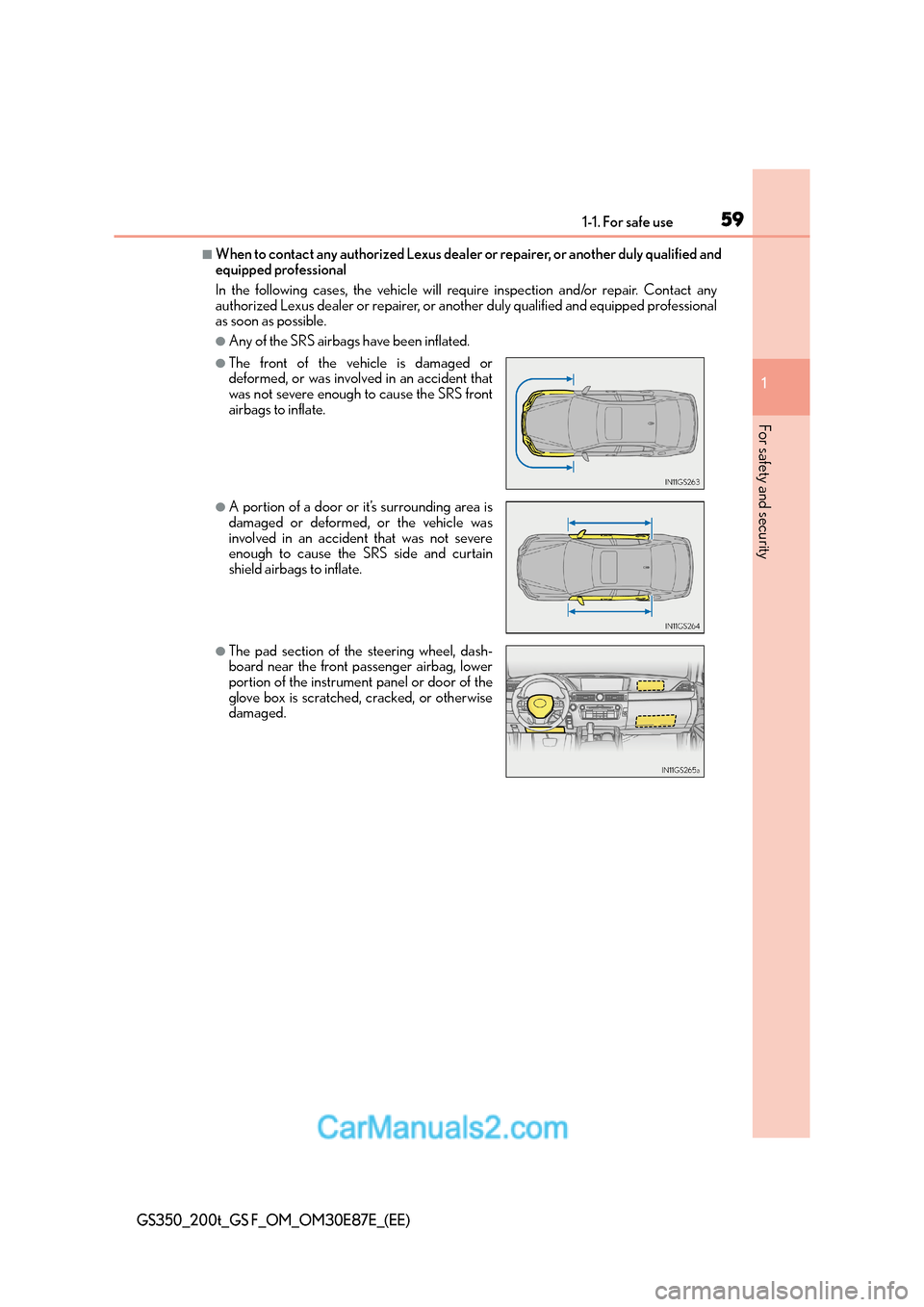
●Any of the SRS airbags have been inflated.
●The front of the vehicle is damaged or
deformed, or was involv ed in an accident that
was not severe enough to cause the SRS front
airbags to inflate.
●A portion of a door or it’s surrounding area is
damaged or deformed, or the vehicle was
involved in an accident that was not severe
enough to cause the SRS side and curtain
shield airbags to inflate.
●The pad section of the steering wheel, dash-
board near the front passenger airbag, lower
portion of the instrument panel or door of the
glove box is scratched, cracked, or otherwise
damaged.
Page 61 of 668
611-1. For safe use
1
GS350_200t_GS F_OM_OM30E87E_(EE)
For safety and security
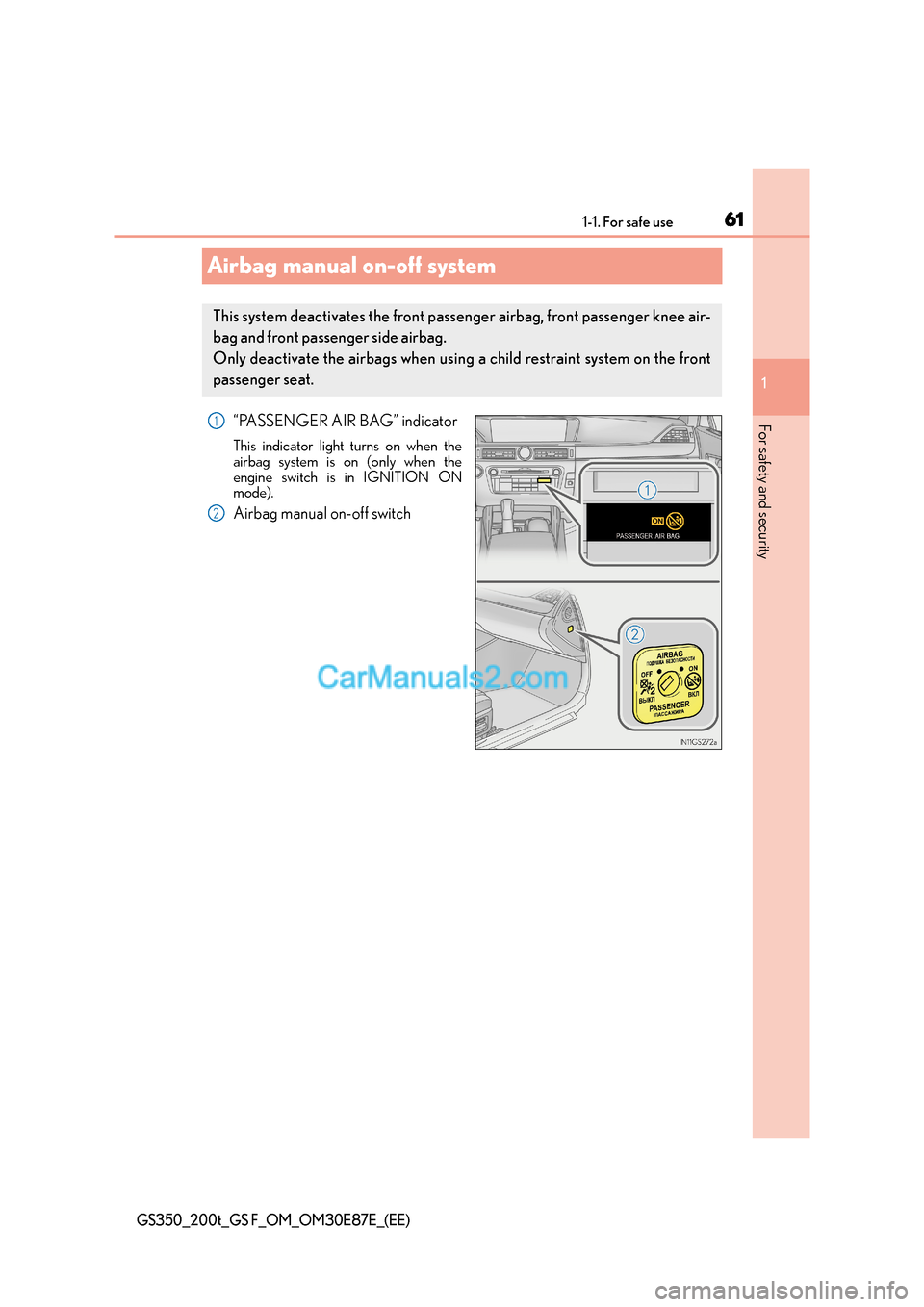
Airbag manual on-off system
“PASSENGER AIR BAG” indicator
This indicator light turns on when the
airbag system is on (only when the
engine switch is in IGNITION ON
mode).
Airbag manual on-off switch
This system deactivates the front passenger airbag, front passenger knee air-
bag and front passen ger side airbag.
Only deactivate the airbags when using a child restraint system on the front
passenger seat.
1
2
Page 63 of 668
631-1. For safe use
1
GS350_200t_GS F_OM_OM30E87E_(EE)
For safety and security
Safety information for children
●It is recommended that children sit in the rear seats to avoid accidental con-
tact with the shift lever, wiper switch etc.
●Use the rear door child-protector lock or the window lock switch to avoid
children opening the door while driving or operating the power window acci-
dentally. ( →P. 163, 213)
●Do not let small children operate equipment which may catch or pinch body
parts, such as the power window, hood, trunk, seats etc.
Observe the following precautions when children are in the vehicle.
Use a child restraint system appropriate for the child, until the child becomes
large enough to properly wear the vehicle’s seat belt.
WA R N I N G
Never leave children unattended in the vehicle, and never allow children to have or use
the key.
Children may be able to start the vehicle or sh ift the vehicle into neutral. There is also a
danger that children may injure themselves by playing with the windows, the moon roof
(if equipped) or other features of the vehicl e. In addition, heat build-up or extremely
cold temperatures inside the vehicle can be fatal to children.
Page 65 of 668
651-1. For safe use
1
For safety and security
GS350_200t_GS F_OM_OM30E87E_(EE)
Child restraint systems are classified into the following 5 groups according to the
regulation ECE No.44:
Group 0: Up to 10 kg (22 lb.) (0 - 9 months)
Group 0+: Up to 13 kg (28 lb.) (0 - 2 years)
Group I: 9 to 18 kg (20 to 39 lb.) (9 months - 4 years)
Group II: 15 to 25 kg (34 to 55 lb.) (4 years - 7 years)
Group III: 22 to 36 kg (49 to 79 lb.) (6 years - 12 years)
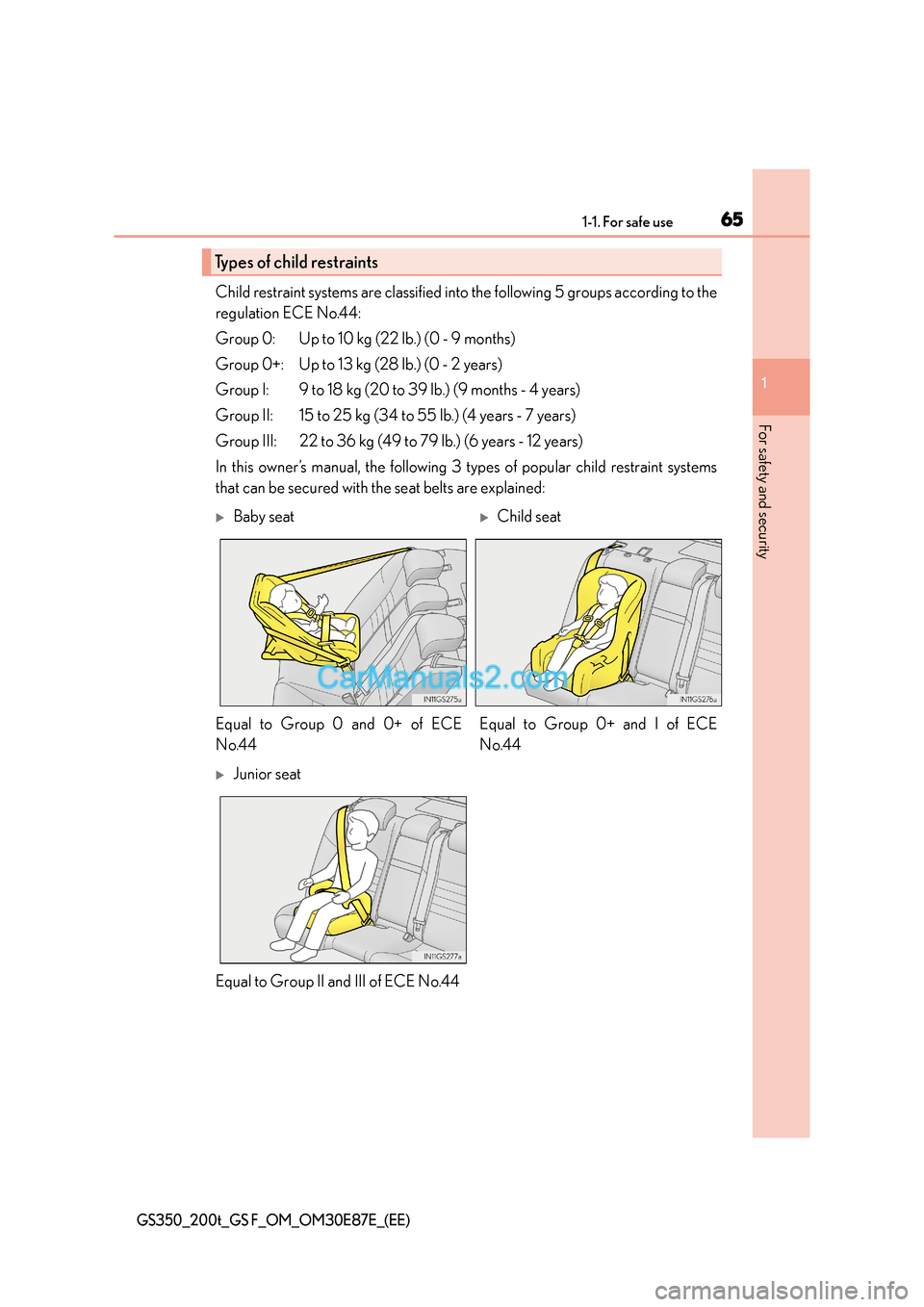
In this owner’s manual, the following 3 types of popular child restraint systems
that can be secured with the seat belts are explained:
Types of child restraints
XBaby seat XChild seat
Equal to Group 0 and 0+ of ECE
No.44 Equal to Group 0+ and I of ECE
No.44
XJunior seat
Equal to Group II and III of ECE No.44
Page 67 of 668
671-1. For safe use
1
For safety and security
GS350_200t_GS F_OM_OM30E87E_(EE)
*1: Adjust the front seatback to the most upright position. Move the front seat to the rear-most position.
If the head restraint interferes with your child restraint system, and the head restraint
can be removed, remove the head restraint.
If the passenger seat is equipped with a vertical height adjuster, it must be placed in
the upper most position.
Follow these procedures:
• For installing a baby seat with support base If the baby seat interferes with the seatback when latching the baby seat into the
support base, adjust the seatback rearward until there is no interference.
• For installing a forw ard-facing child seat
If there is gap between the child seat and the seatback, tilt the seatback rearward
until good contact is achieved.
If the seat belt shoulder anchor is ahead of the child seat belt guide, move the seat
cushion forward.
• For installing a junior seat
If the child in your child rest raint system is in a very upright position, adjust the seat-
back to the most comfortable position.
If the seat belt shoulder anchor is ahead of the child seat belt guide, move the seat
cushion forward.
*2: If the head restraint interferes with your child restraint system, and the head restraint
can be removed, remove the head restraint.
The child restraint systems mentioned in the table may not be available outside of
the EU area.
Other child restraint systems which are different from the systems mentioned in
the table can be used, but the suitability of the systems must be carefully checked
with the child restraint system manufacturer concerned and the seller of those
seats.
Page 69 of 668
691-1. For safe use
1
For safety and security
GS350_200t_GS F_OM_OM30E87E_(EE)
*1: Adjust the front seatback to the most upright position. Move the front seat to the rear-most position.
If the passenger seat is equipped with a vertical height adjuster, it must be placed in
the upper most position.
Follow these procedures:
• For installing a baby seat with support base If the baby seat interferes with the seatback when latching the baby seat into the
support base, adjust the seatback rearward until there is no interference.
• For installing a forwar d-facing child seat
If there is gap between the child seat and the seatback, tilt the seatback rearward
until good contact is achieved. If the seat belt shoulder anchor is ahead of the child
seat belt guide, move the seat cushion forward.
• For installing a junior seat If the child in your child rest raint system is in a very upright position, adjust the seat-
back to the most comfortable position.
If the seat belt shoulder anchor is ahead of the child seat belt guide, move the seat
cushion forward.
*2: If the head restraint interferes with your child restraint system, and the head restraint
can be removed, remove the head restraint.
The child restraint systems mentioned in the table may not be available outside of
the EU area.
Other child restraint systems which are different from the systems mentioned in
the table can be used, but the suitability of the systems must be carefully checked
with the child restraint system manufacturer concerned and the seller of those
seats.
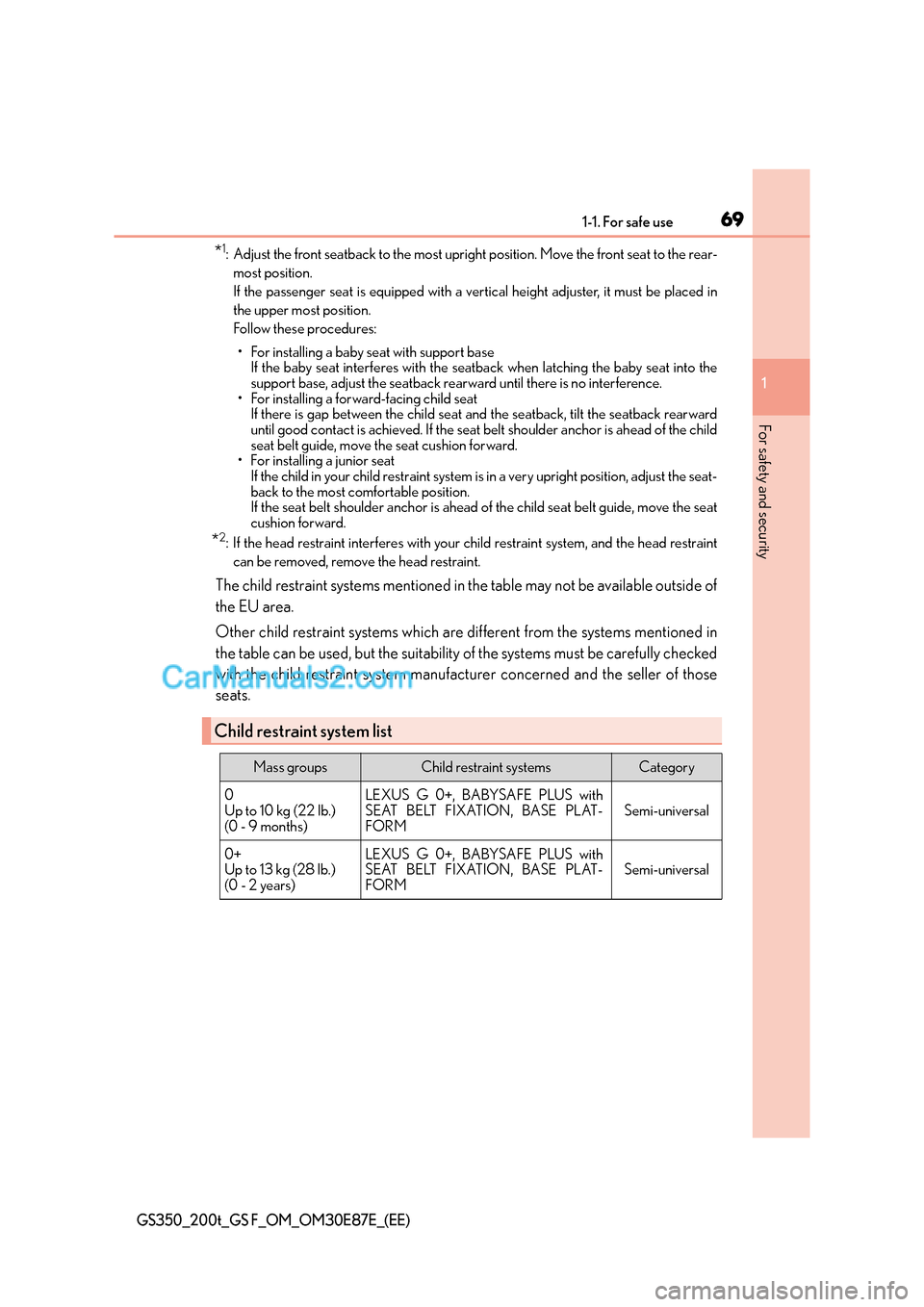
Child restraint system list
Mass groupsChild restraint systemsCategory
0
Up to 10 kg (22 lb.)
(0 - 9 months)LEXUS G 0+, BABYSAFE PLUS with
S E AT B E LT F I X AT I O N , B A S E P L AT -
FORMSemi-universal
0+
Up to 13 kg (28 lb.)
(0 - 2 years)LEXUS G 0+, BABYSAFE PLUS with
S E AT B E LT F I X AT I O N , B A S E P L AT -
FORMSemi-universal
Page 71 of 668
711-1. For safe use
1
For safety and security
GS350_200t_GS F_OM_OM30E87E_(EE)
Key of letters inserted in the above table:
IUF: Suitable for ISOFIX forward-facing child restraint systems of universal cat-egory approved for use in this mass group.
IL: Suitable for child restraint systems sh own in the ISOFIX child restraint sys-
tem list.
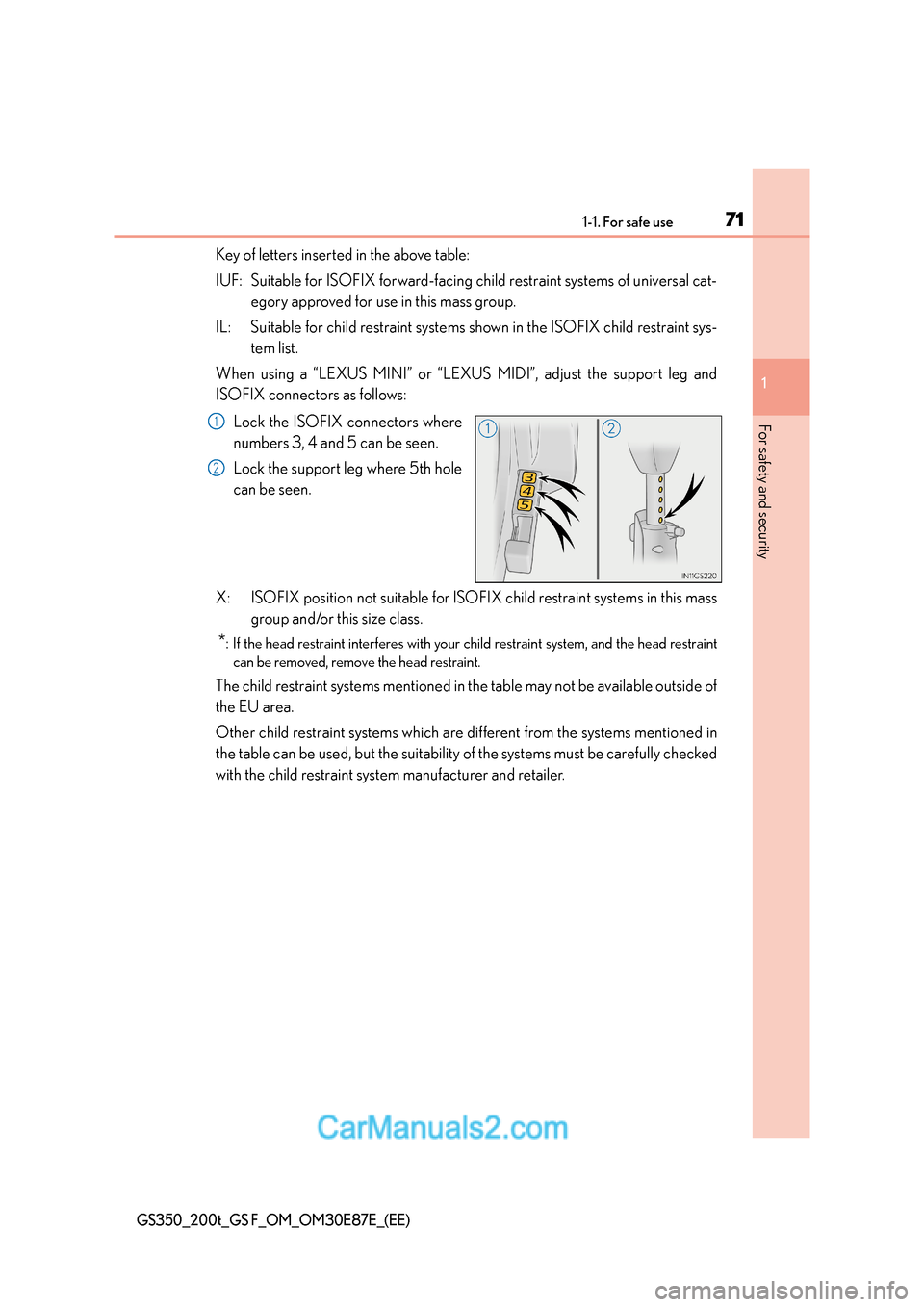
When using a “LEXUS MINI” or “LEXUS MIDI”, adjust the support leg and
ISOFIX connectors as follows:
Lock the ISOFIX connectors where
numbers 3, 4 and 5 can be seen.
Lock the support leg where 5th hole
can be seen.
X: ISOFIX position not suitable for ISOFIX child restraint systems in this mass group and/or this size class.
*: If the head restraint interferes with your child restraint system, and the head restraint
can be removed, remove the head restraint.
The child restraint systems mentioned in the table may not be available outside of
the EU area.
Other child restraint systems which are different from the systems mentioned in
the table can be used, but the suitability of the systems must be carefully checked
with the child restraint system manufacturer and retailer.
1
2