seat Lexus GS250 2012 User Guide
[x] Cancel search | Manufacturer: LEXUS, Model Year: 2012, Model line: GS250, Model: Lexus GS250 2012Pages: 914, PDF Size: 53.04 MB
Page 35 of 914
351-1. For safe use
1
For safety and security
GS350/250_EE (OM30C36E)
CAUTION
Observe the following precautions.
Failure to do so may cause the driver’s floor mat to slip, possibly interfering
with the pedals while driving. An unexpectedly high speed may result or it
may become difficult to stop the vehicle, leading to an accident, or leading to
death or a serious injury.
When installing the driver’s floor mat
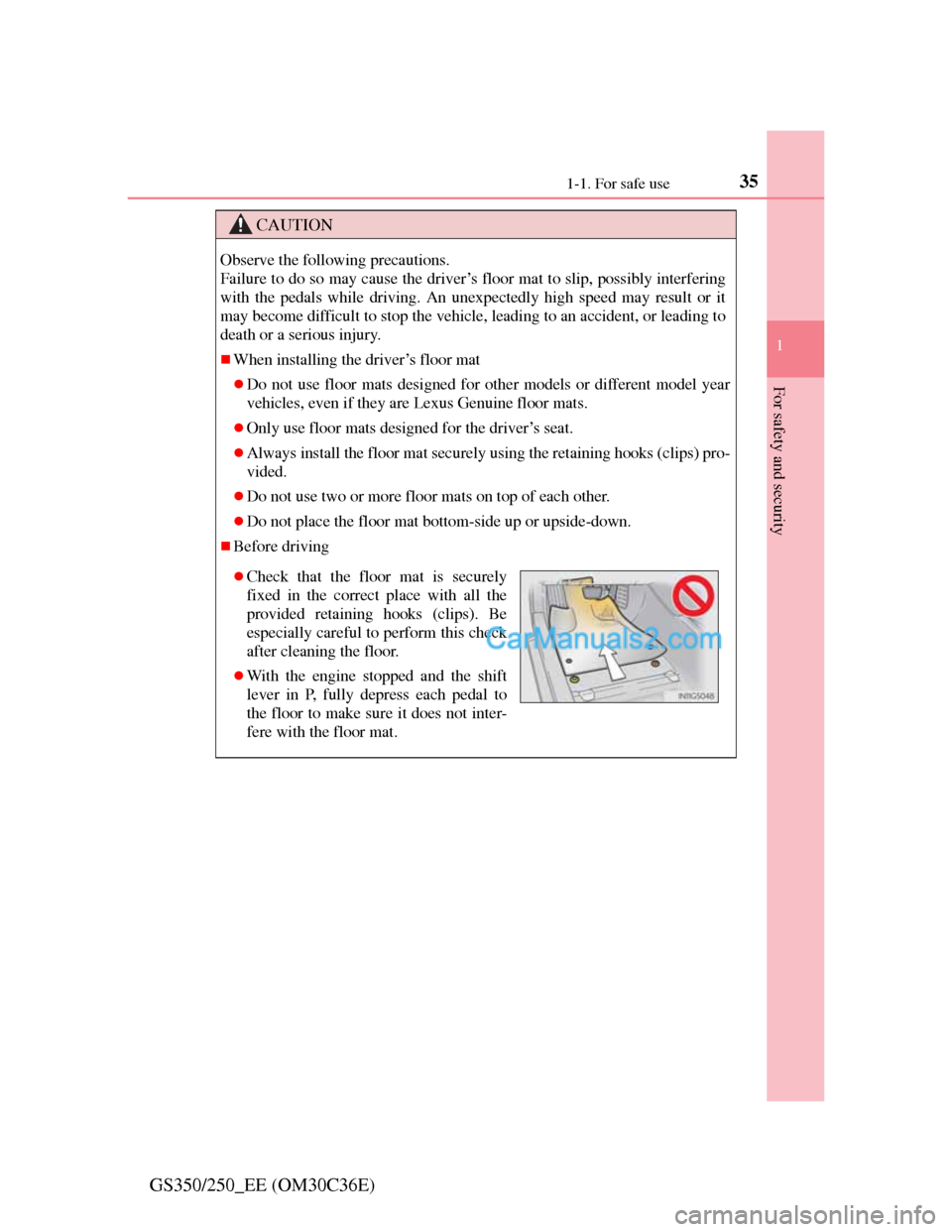
Do not use floor mats designed for other models or different model year
vehicles, even if they are Lexus Genuine floor mats.
Only use floor mats designed for the driver’s seat.
Always install the floor mat securely using the retaining hooks (clips) pro-
vided.
Do not use two or more floor mats on top of each other.
Do not place the floor mat bottom-side up or upside-down.
Before driving
Check that the floor mat is securely
fixed in the correct place with all the
provided retaining hooks (clips). Be
especially careful to perform this check
after cleaning the floor.
With the engine stopped and the shift
lever in P, fully depress each pedal to
the floor to make sure it does not inter-
fere with the floor mat.
Page 36 of 914
361-1. For safe use
GS350/250_EE (OM30C36E)
For safety drive
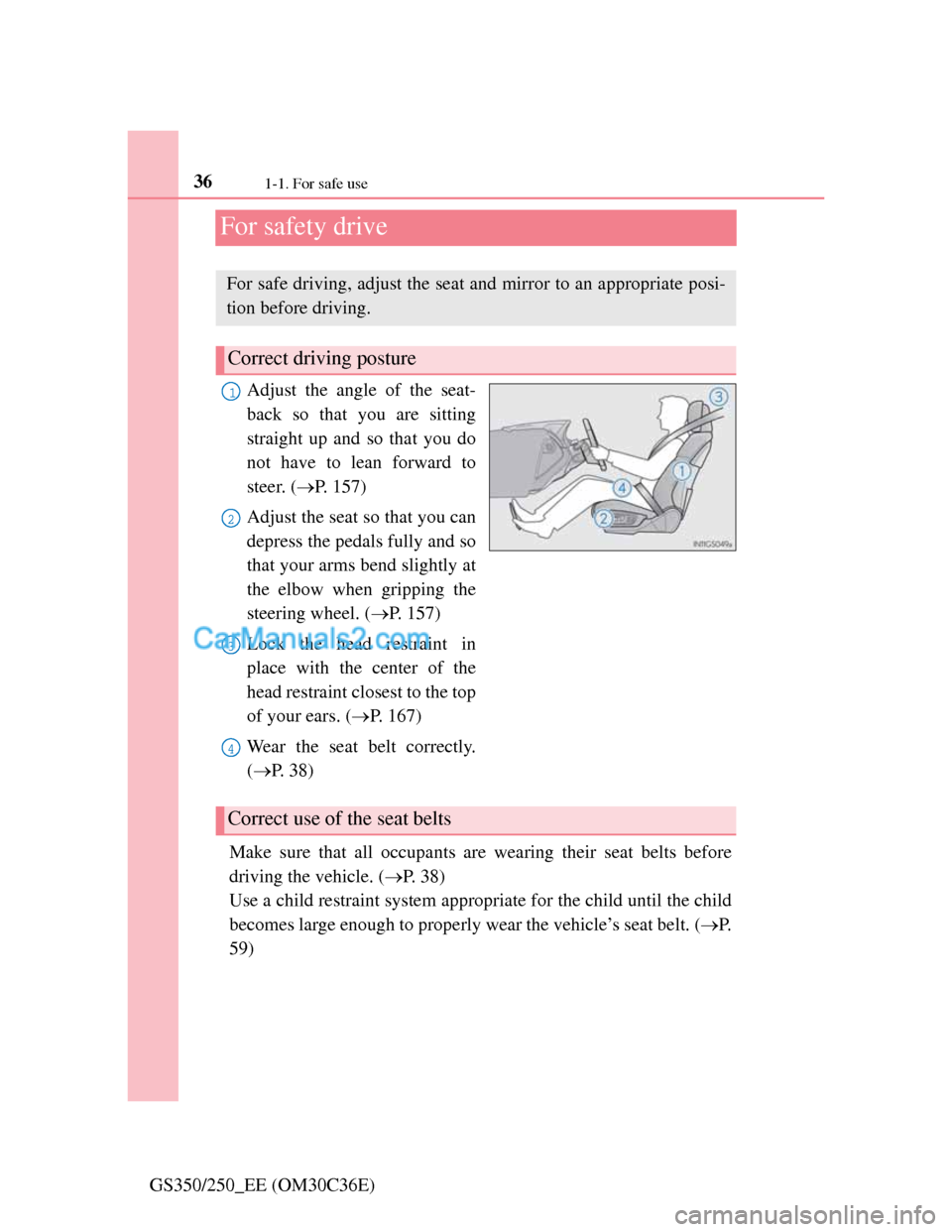
Adjust the angle of the seat-
back so that you are sitting
straight up and so that you do
not have to lean forward to
steer. (P. 157)
Adjust the seat so that you can
depress the pedals fully and so
that your arms bend slightly at
the elbow when gripping the
steering wheel. (P. 157)
Lock the head restraint in
place with the center of the
head restraint closest to the top
of your ears. (P. 167)
Wear the seat belt correctly.
(P. 38)
Make sure that all occupants are wearing their seat belts before
driving the vehicle. (P. 38)
Use a child restraint system appropriate for the child until the child
becomes large enough to properly wear the vehicle’s seat belt. (P.
59)
For safe driving, adjust the seat and mirror to an appropriate posi-
tion before driving.
Correct driving posture
1
2
3
4
Correct use of the seat belts
Page 37 of 914
371-1. For safe use
1
For safety and security
GS350/250_EE (OM30C36E)Make sure that you can see backward clearly by adjusting the
inside and outside rear view mirrors properly. (P. 171, 174)
Adjusting the mirrors
CAUTION
Observe the following precautions.
Failure to do so may result in death or serious injury.
Do not adjust the position of the driver’s seat while driving.
Doing so could cause the driver to lose control of the vehicle.
Do not place a cushion between the driver or passenger and the seatback.
A cushion may prevent correct posture from being achieved, and reduce
the effectiveness of the seat belt and head restraint.
Do not place anything under the front seats.
Objects placed under the front seats may become jammed in the seat
tracks and stop the seat from locking in place. This may lead to an acci-
dent and the adjustment mechanism may also be damaged.
When driving over long distances, take regular breaks before you start to
feel tired.
Also, if you feel tired or sleepy while driving, do not force yourself to
continue driving and take a break immediately.
Page 38 of 914
381-1. For safe use
GS350/250_EE (OM30C36E)
Seat belts
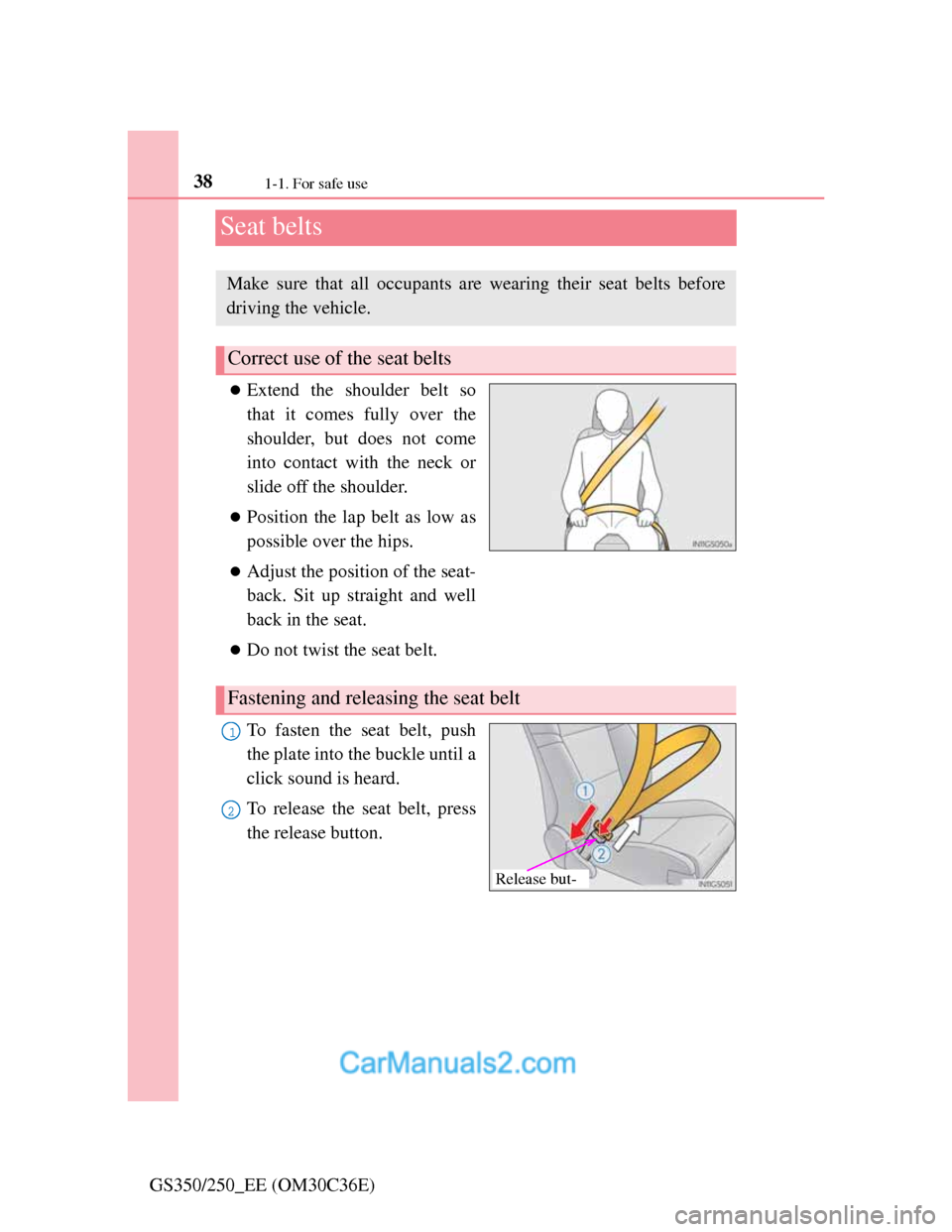
Extend the shoulder belt so
that it comes fully over the
shoulder, but does not come
into contact with the neck or
slide off the shoulder.
Position the lap belt as low as
possible over the hips.
Adjust the position of the seat-
back. Sit up straight and well
back in the seat.
Do not twist the seat belt.
To fasten the seat belt, push
the plate into the buckle until a
click sound is heard.
To release the seat belt, press
the release button.
Make sure that all occupants are wearing their seat belts before
driving the vehicle.
Correct use of the seat belts
Fastening and releasing the seat belt
Release but-
1
2
Page 39 of 914
391-1. For safe use
1
For safety and security
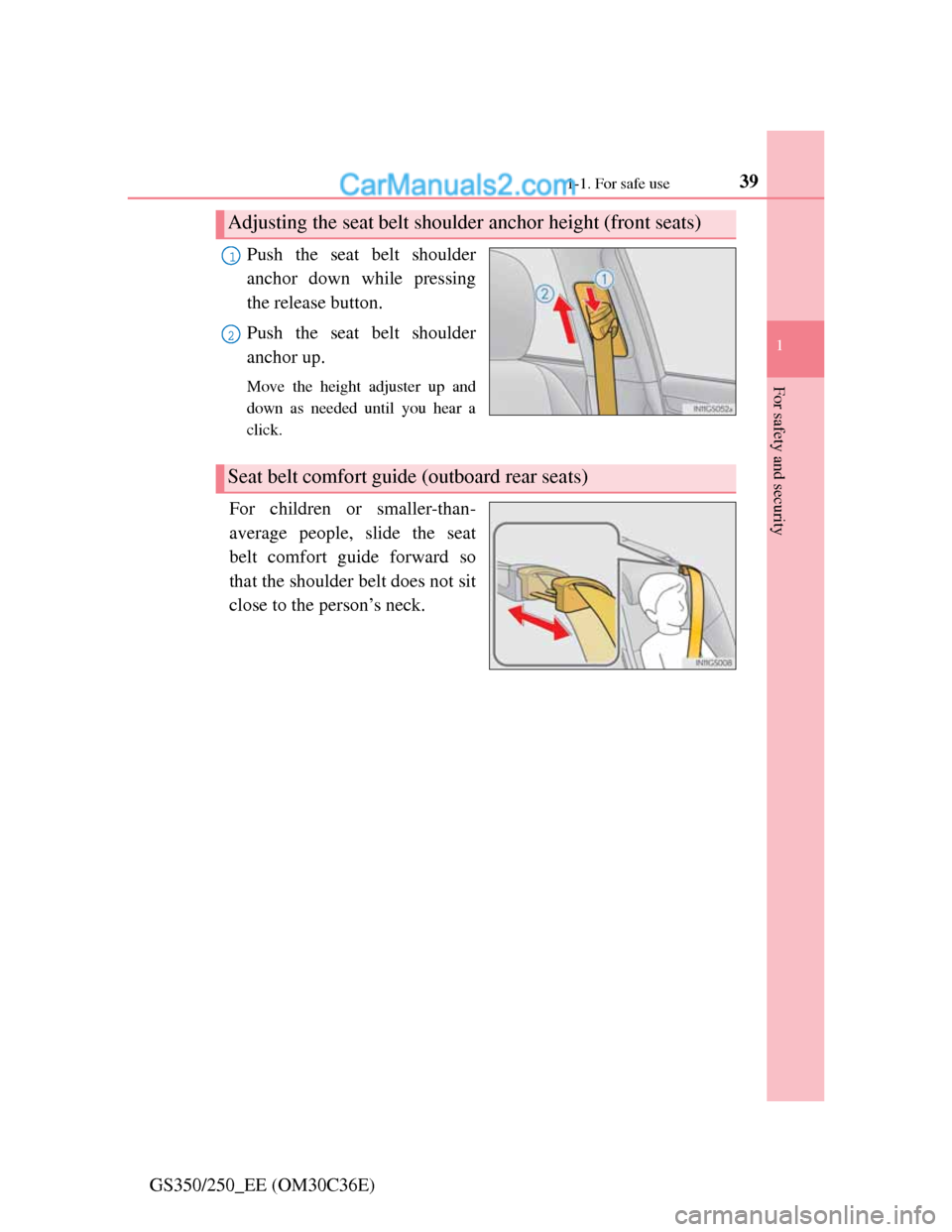
GS350/250_EE (OM30C36E)Push the seat belt shoulder
anchor down while pressing
the release button.
Push the seat belt shoulder
anchor up.
Move the height adjuster up and
down as needed until you hear a
click.
For children or smaller-than-
average people, slide the seat
belt comfort guide forward so
that the shoulder belt does not sit
close to the person’s neck.
Adjusting the seat belt shoulder anchor height (front seats)
1
2
Seat belt comfort guide (outboard rear seats)
Page 40 of 914

401-1. For safe use
GS350/250_EE (OM30C36E)The pretensioner helps the seat
belt to quickly restrain the occu-
pant by retracting the seat belt
when the vehicle is subjected to
certain types of severe frontal
collision.
The front seat pretensioners also
activate when the vehicle is sub-
jected to certain types of severe
side collision.
The pretensioner does not activate
in the event of a minor frontal
impact, a minor side impact, a rear
impact or a vehicle rollover.
If the pre-crash sensor detects that a collision is unavoidable, the
pre-crash safety system will retract the seat belt before the collision
occurs. (P. 341)
Seat belt pretensioners (front and outboard rear seats)
Pre-crash seat belts (front seats of vehicles with pre-crash
safety system)
Page 41 of 914
411-1. For safe use
1
For safety and security
GS350/250_EE (OM30C36E)
Emergency locking retractor (ELR)
The retractor will lock the belt during a sudden stop or on impact. It may also
lock if you lean forward too quickly. A slow, easy motion will allow the belt
to extend so that you can move around fully.
Child seat belt usage
The seat belts of your vehicle were principally designed for persons of adult
size.
Use a child restraint system appropriate for the child, until the child
becomes large enough to properly wear the vehicle’s seat belt. (P. 5 9 )
When the child becomes large enough to properly wear the vehicle’s seat
belt, follow the instructions regarding seat belt usage. (P. 3 8 )
Replacing the belt after the pretensioner has been activated
If the vehicle is involved in multiple collisions, the pretensioner will activate
for the first collision, but will not activate for the second or subsequent colli-
sions.
Seat belt regulations
If seat belt regulations exist in the country where you reside, please contact
any authorized Lexus dealer or repairer, or another duly qualified and
equipped professional for seat belt replacement or installation.
Page 42 of 914
421-1. For safe use
GS350/250_EE (OM30C36E)
CAUTION
Observe the following precautions to reduce the risk of injury in the event of
sudden braking, sudden swerving or an accident.
Failure to do so may cause death or serious injury.
Wearing a seat belt
Ensure that all passengers wear a seat belt.
Always wear a seat belt properly.
Each seat belt should be used by one person only. Do not use a seat belt
for more than one person at once, including children.
Lexus recommends that children be seated in the rear seat and always use
a seat belt and/or an appropriate child restraint system.
To achieve a proper seating position, do not recline the seat more than
necessary. The seat belt is most effective when the occupants are sitting up
straight and well back in the seats.
Do not wear the shoulder belt under your arm.
Always wear your seat belt low and snug across your hips.
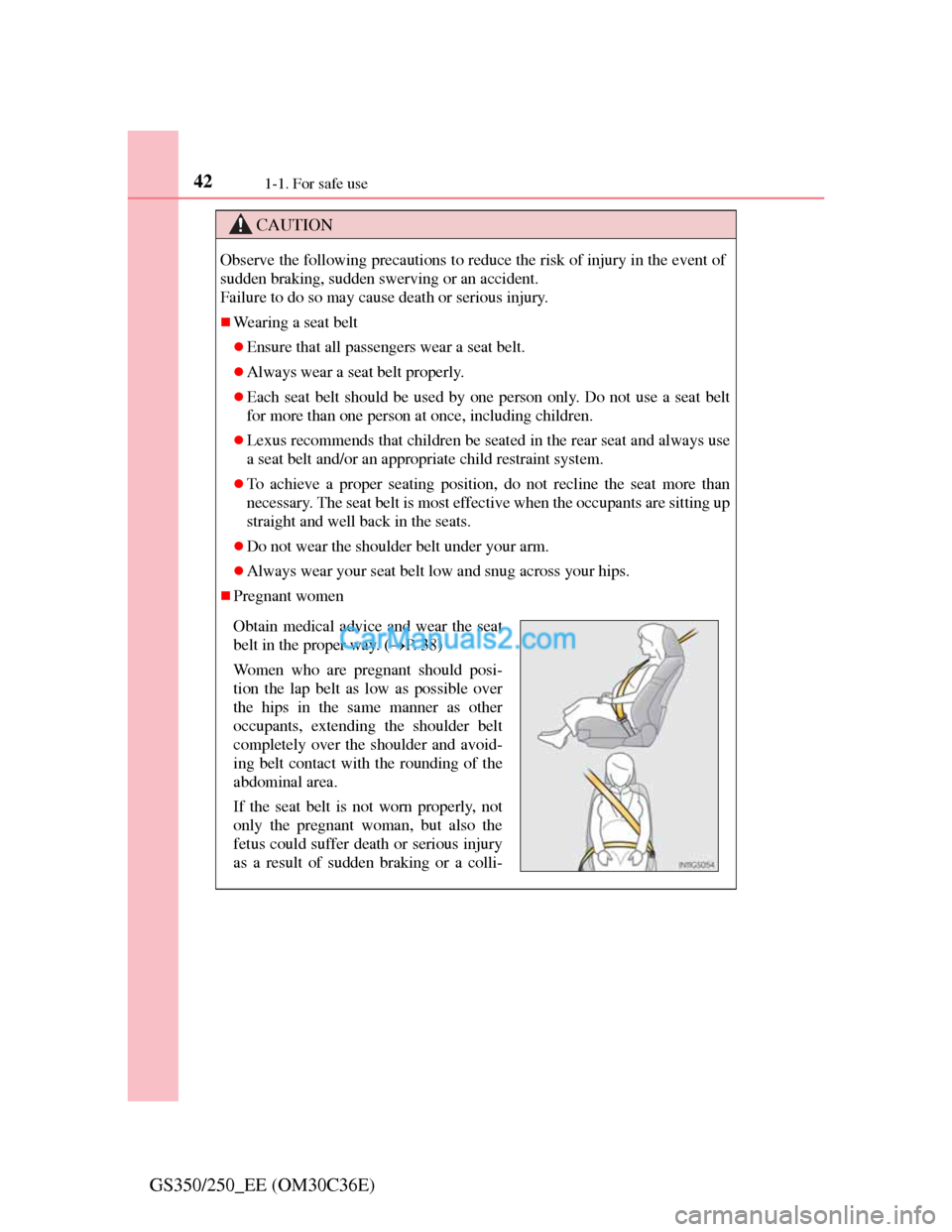
Pregnant women
Obtain medical advice and wear the seat
belt in the proper way. (P. 3 8 )
Women who are pregnant should posi-
tion the lap belt as low as possible over
the hips in the same manner as other
occupants, extending the shoulder belt
completely over the shoulder and avoid-
ing belt contact with the rounding of the
abdominal area.
If the seat belt is not worn properly, not
only the pregnant woman, but also the
fetus could suffer death or serious injury
as a result of sudden braking or a colli-
Page 43 of 914
431-1. For safe use
1
For safety and security
GS350/250_EE (OM30C36E)
CAUTION
People suffering illness
Obtain medical advice and wear the seat belt in the proper way. (P. 3 8 )
When children are in the vehicle
Do not allow children to play with the seat belt. If the seat belt becomes
twisted around a child’s neck, it may lead to choking or other serious inju-
ries that could result in death.
If this occurs and the buckle cannot be unfastened, scissors should be used
to cut the belt.
Seat belt pretensioners
If the pretensioner has activated, the SRS warning light will come on. In
that case, the seat belt cannot be used again and must be replaced at any
authorized Lexus dealer or repairer, or another duly qualified and equipped
professional.
Seat belt damage and wear
Do not damage the seat belts by allowing the belt, plate, or buckle to be
jammed in the door.
Inspect the seat belt system periodically. Check for cuts, fraying, and
loose parts. Do not use a damaged seat belt until it is replaced. Damaged
seat belts cannot protect an occupant from death or serious injury.
Ensure that the belt and plate are locked and the belt is not twisted.
If the seat belt does not function correctly, immediately contact any autho-
rized Lexus dealer or repairer, or another duly qualified and equipped pro-
fessional.
Replace the seat assembly, including the belts, if your vehicle has been
involved in a serious accident, even if there is no obvious damage.
Do not attempt to install, remove, modify, disassemble or dispose of the
seat belts. Have any necessary repairs carried out by any authorized Lexus
dealer or repairer, or another duly qualified and equipped professional.
Inappropriate handling may lead to incorrect operation.
Page 44 of 914
441-1. For safe use
GS350/250_EE (OM30C36E)
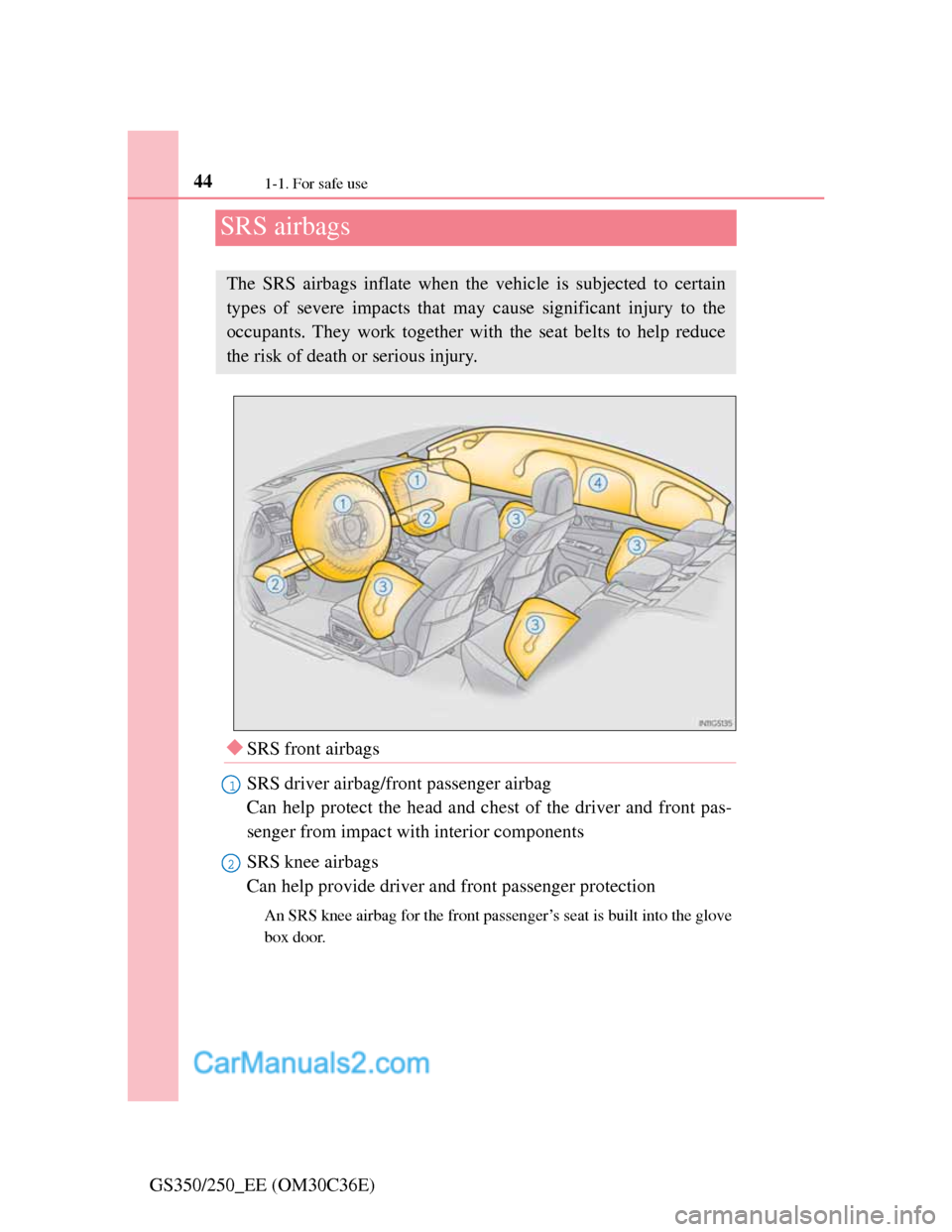
SRS airbags
SRS front airbags
SRS driver airbag/front passenger airbag
Can help protect the head and chest of the driver and front pas-
senger from impact with interior components
SRS knee airbags
Can help provide driver and front passenger protection
An SRS knee airbag for the front passenger’s seat is built into the glove
box door.
The SRS airbags inflate when the vehicle is subjected to certain
types of severe impacts that may cause significant injury to the
occupants. They work together with the seat belts to help reduce
the risk of death or serious injury.
1
2