brakes Lexus GS250 2014 User Guide
[x] Cancel search | Manufacturer: LEXUS, Model Year: 2014, Model line: GS250, Model: Lexus GS250 2014Pages: 688, PDF Size: 152.64 MB
Page 320 of 688
3204-5. Using the driving support systems
GS350_250_OM_OM30E16E_(EE)
Driving assist systems
◆ABS (Anti-lock Brake System)
Helps to prevent wheel lock when the brakes are applied suddenly, or if
the brakes are applied while driving on a slippery road surface
◆Brake assist
Generates an increased level of braking force after the brake pedal is
depressed when the system detects a panic stop situation
◆VSC (Vehicle Stability Control)
Helps the driver to control skidding when swerving suddenly or turning
on slippery road surfaces
◆VSC+ (Vehicle Stability Control+)
Provides cooperative control of the ABS, TRC, VSC and EPS.
Helps to maintain directional stability when swerving on slippery road
surfaces by controlling steering performance.
◆TRC (Traction Control)
Helps to maintain drive power and prevent the drive wheels from spin-
ning when starting the vehicle or accelerating on slippery roads
◆Hill-start assist control
→ P. 328
To help enhance driving safety and performance, the following systems
operate automatically in response to various driving situations. Be
aware, however, that these system s are supplementary and should not
be relied upon too heavily when operating the vehicle.
GS350_250_OM_OM30E16E_(EE).book Page 320 Tuesday, July 8, 201 4 7:11 PM
Page 321 of 688
3214-5. Using the driving support systems
4
Driving
GS350_250_OM_OM30E16E_(EE)
◆EPS (Electric Power Steering)
Employs an electric motor to reduce the amount of effort needed to
turn the steering wheel
◆AVS (Adaptive Variable Suspension system) (if equipped)
By independently controlling the damping force of the shock absorbers
for each of the 4 wheels according to the road and driving conditions,
this system helps riding comfort with superior steering stability, and
helps good vehicle posture
When SPORT S+ mode is selected by the driving mode select switch,
the damping force is suitable for sporty driving ( →P. 317)
◆VDIM (Vehicle Dynamics Integrated Management)
Provides integrated control of the ABS, brake assist, TRC, VSC, hill-
start assist control and EPS systems
Helps to maintain vehicle stability when swerving on slippery road sur-
faces by controlling the brakes, engine output, steering assist, and
steering ratio
◆PCS (Pre-Crash Safety system) (if equipped)
→ P. 3 3 0
◆Emergency brake signal
When the brakes are applied suddenly, the stop lights automatically
flash to alert the vehicle behind.
GS350_250_OM_OM30E16E_(EE).book Page 321 Tuesday, July 8, 201 4 7:11 PM
Page 328 of 688

3284-5. Using the driving support systems
GS350_250_OM_OM30E16E_(EE)
Hill-start assist control
To engage hill-start assist control,
further depress the brake pedal
when the vehicle is stopped com-
pletely.
A buzzer will sound once to indicate
the system is activated. The slip indica-
tor will also start flashing.
■Hill-start assist control operating conditions
●The system operates in the following situations:
• The shift lever is in a position other than P.
• The parking brake is not applied.
• The accelerator pedal is not depressed.
●Hill-start assist control cannot be operated while the slip indicator light is illumi-
nated.
■Hill-start assist control
●While hill-start assist control is operating, the brakes remain automatically applied
after the driver releases the brake pedal. The stop lights and the high mounted
stoplight turn on.
●Hill-start assist control operates for about 2 seconds after the brake pedal is
released.
●If the slip indicator does not flash and the buzzer does not sound when the brake
pedal is further depressed, slightly reduce the pressure on the brake pedal (do not
allow the vehicle to roll backward) and then firmly depress it again. If the system still
does not operate, check that the operating conditions explained above have been
met.
Assists with starting off and tempo rarily maintains braking power even
if the foot is removed from the brake pedal when starting off on an
incline or a slippery slope.
GS350_250_OM_OM30E16E_(EE).book Page 328 Tuesday, July 8, 201 4 7:11 PM
Page 330 of 688
3304-5. Using the driving support systems
GS350_250_OM_OM30E16E_(EE)
PCS (Pre-Crash Safety system)∗
◆Pre-crash seat belts (front seat only)
If the pre-crash sensor detects that a collision is unavoidable, the pre-
crash safety system will retract the seat belt before the collision occurs.
The same will happen if the driver makes an emergency braking or
loses control of the vehicle. (→P. 4 0 )
◆Pre-crash brake assist
When there is a high possibility of a frontal collision, the system applies
greater braking force in relation to how strongly the brake pedal is
depressed.
◆Pre-crash braking
When there is a high possibility of a frontal collision, the system warns
the driver using a warning light, warning display and buzzer. If the sys-
tem determines that a collision is unavoidable, the brakes are automati-
cally applied to reduce the collision speed.
∗
: If equipped
When the radar sensor detects possibility of a frontal collision, the pre-
crash safety system such as the brakes and seat belts are automatically
engaged to lessen impact as well as vehicle damage.
The pre-crash safety system can be turned on and off as necessary by
operating the switch. ( →P. 3 3 1 )
GS350_250_OM_OM30E16E_(EE).book Page 330 Tuesday, July 8, 201 4 7:11 PM
Page 334 of 688
3344-5. Using the driving support systems
GS350_250_OM_OM30E16E_(EE)
●Pre-crash alert braking:
• The system determines that the driver is not facing forward, or that the driver’seyes are closed.
• Vehicle speed is greater than about 40 km/h (25 mph).
• The speed at which your vehicle is approaching the vehicle running ahead of you is greater than about 40 km/h (25 mph).
• The steering is not being turned.
■Conditions that may trigger the system even if there is no danger of a collision
●When there is an object by the roadside at the entrance to a curve
●When passing an oncoming vehicle on a curve
●When driving over a narrow iron bridge
●When there is a metal object on the road surface
●When driving on an uneven road surface
●When passing an oncoming vehicle on a left-turn (left-hand drive vehicles) or right-
turn (right-hand drive vehicles)
●When your vehicle rapidly closes on the vehicle in front
●When a grade separation/interchange, sign, billboard, or other structure appears
to be directly in the vehicle’s line of travel
●When climbing a steep hill causes an overhead billboard or other metallic structure
to appear directly in the vehicle’s line of travel
When the system is activated in the situations described above, there is also a possi-
bility that the seat belts will retract quickly and the brakes will be applied with a force
greater than normal. When the seat belt is locked in the retracted position, stop the
vehicle in a safe place, release the seat belt and refasten it.
■Obstacles not detected
The sensor cannot detect plastic obstacles such as traffic cones. There may also be
occasions when the sensor cannot detect pedestrians, animals, bicycles, motorcy-
cles, trees, or snowdrifts.
GS350_250_OM_OM30E16E_(EE).book Page 334 Tuesday, July 8, 201 4 7:11 PM
Page 355 of 688

3554-6. Driving tips
4
Driving
GS350_250_OM_OM30E16E_(EE)
Perform the following according to the driving conditions:
●Do not try to forcibly open a window or move a wiper that is frozen.
Pour warm water over the frozen area to melt the ice. Wipe away the
water immediately to prevent it from freezing.
●To ensure proper operation of the climate control system fan, remove
any snow that has accumulated on the air inlet vents in front of the wind-
shield.
●Check for and remove any excess ice or snow that may have accumu-
lated on the exterior lights, vehicle’s roof, chassis, around the tires or on
the brakes.
●Remove any snow or mud from the bottom of your shoes before getting
in the vehicle.
Accelerate the vehicle slowly, keep a safe distance between you and the
vehicle ahead, and drive at a reduced speed suitable to road conditions.
Park the vehicle and move the shift lever to P without setting the parking
brake. The parking brake may freeze up, preventing it from being
released. If necessary, block the wheels to prevent inadvertent sliding or
creeping.
Before driving the vehicle
When driving the vehicle
When parking the vehicle
GS350_250_OM_OM30E16E_(EE).book Page 355 Tuesday, July 8, 201 4 7:11 PM
Page 535 of 688
535
7
7-1. Essential information
When trouble arises
GS350_250_OM_OM30E16E_(EE)
If your vehicle has to be stopped in an emergency
Steadily step on the brake pedal wi
th both feet and firmly depress it.
Do not pump the brake pedal repeatedly as this will increase the effort required to
slow the vehicle.
Shift the shift lever to N.
XIf the shift lever is shifted to N
After slowing down, stop the vehicle in a safe place by the road.
Stop the engine.
XIf the shift lever cannot be shifted to N
Keep depressing the brake pedal with both feet to reduce vehicle
speed as much as possible.
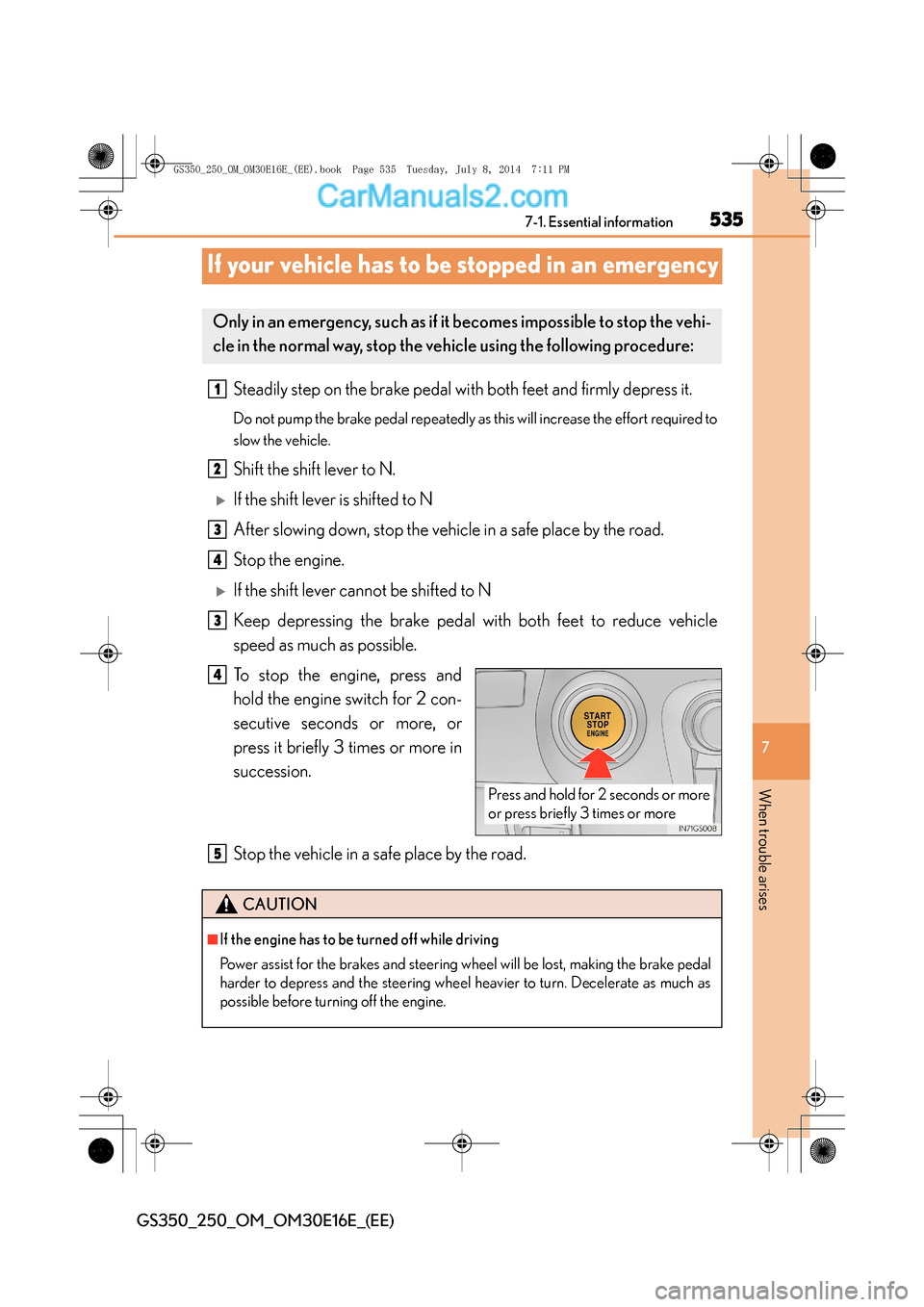
To stop the engine, press and
hold the engine switch for 2 con-
secutive seconds or more, or
press it briefly 3 times or more in
succession.
Stop the vehicle in a safe place by the road.
Only in an emergency, such as if it becomes impossible to stop the vehi-
cle in the normal way, stop the ve hicle using the following procedure:
1
2
3
4
3
Press and hold for 2 seconds or more
or press briefly 3 times or more
4
CAUTION
■If the engine has to be turned off while driving
Power assist for the brakes and steering wheel will be lost, making the brake pedal
harder to depress and the steering wheel heavier to turn. Decelerate as much as
possible before turning off the engine.
5
GS350_250_OM_OM30E16E_(EE).book Page 535 Tuesday, July 8, 201 4 7:11 PM
Page 538 of 688
5387-2. Steps to take in an emergency
GS350_250_OM_OM30E16E_(EE)
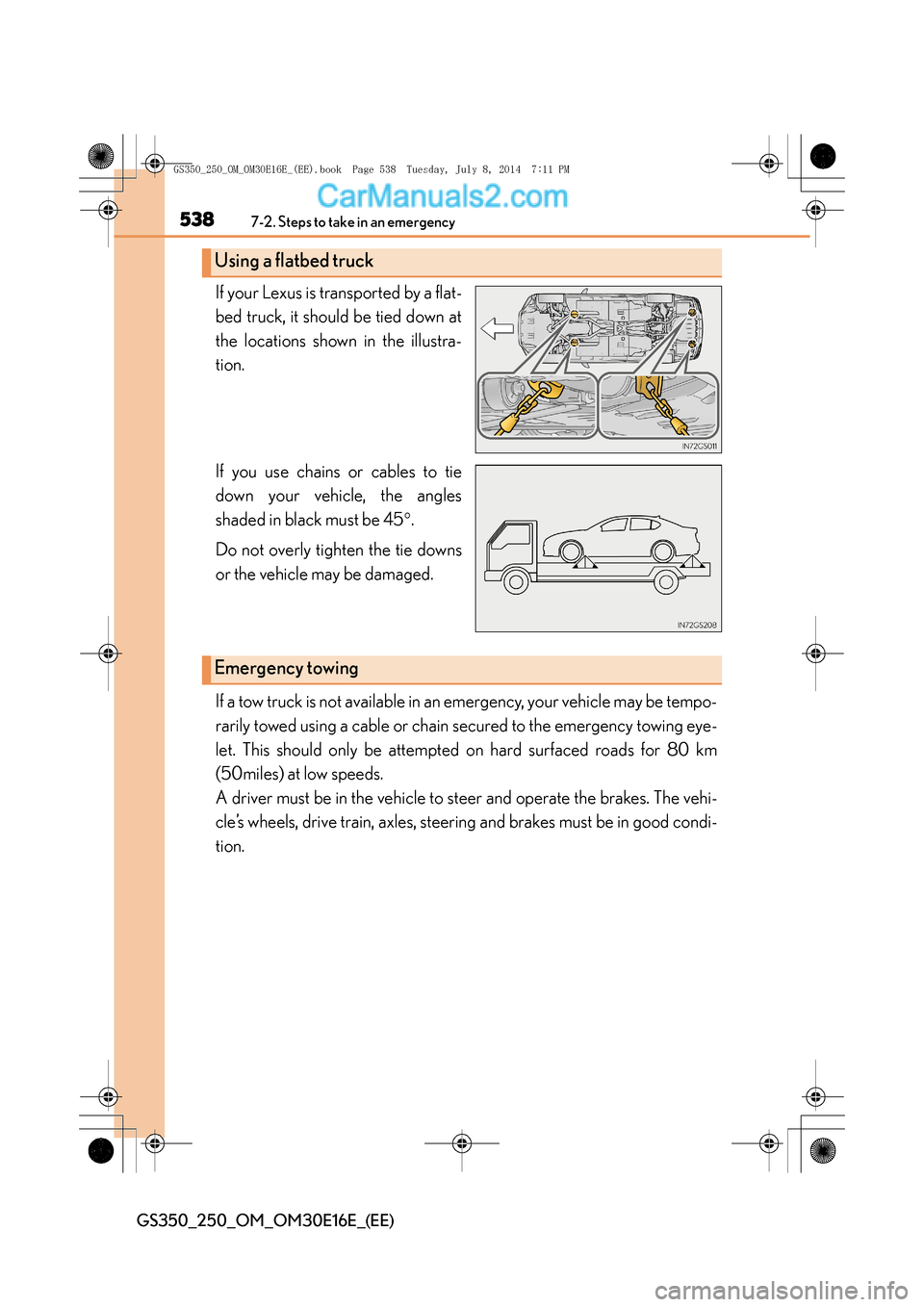
If your Lexus is transported by a flat-
bed truck, it should be tied down at
the locations shown in the illustra-
tion.
If you use chains or cables to tie
down your vehicle, the angles
shaded in black must be 45°.
Do not overly tighten the tie downs
or the vehicle may be damaged.
If a tow truck is not available in an emergency, your vehicle may be tempo-
rarily towed using a cable or chain secured to the emergency towing eye-
let. This should only be attempted on hard surfaced roads for 80 km
(50miles) at low speeds.
A driver must be in the vehicle to steer and operate the brakes. The vehi-
cle’s wheels, drive train, axles, steer ing and brakes must be in good condi-
tion.
Using a flatbed truck
Emergency towing
GS350_250_OM_OM30E16E_(EE).book Page 538 Tuesday, July 8, 201 4 7:11 PM
Page 540 of 688
5407-2. Steps to take in an emergency
GS350_250_OM_OM30E16E_(EE)
■While towing
If the engine is not running, the power assist for the brakes and steering will not func-
tion, making steering and braking more difficult.
■Wheel nut wrench
Wheel nut wrench is installed in trunk. (→P. 5 7 8 , 5 9 3 )
CAUTION
Observe the following precautions.
Failure to do so may result in death or serious injury.
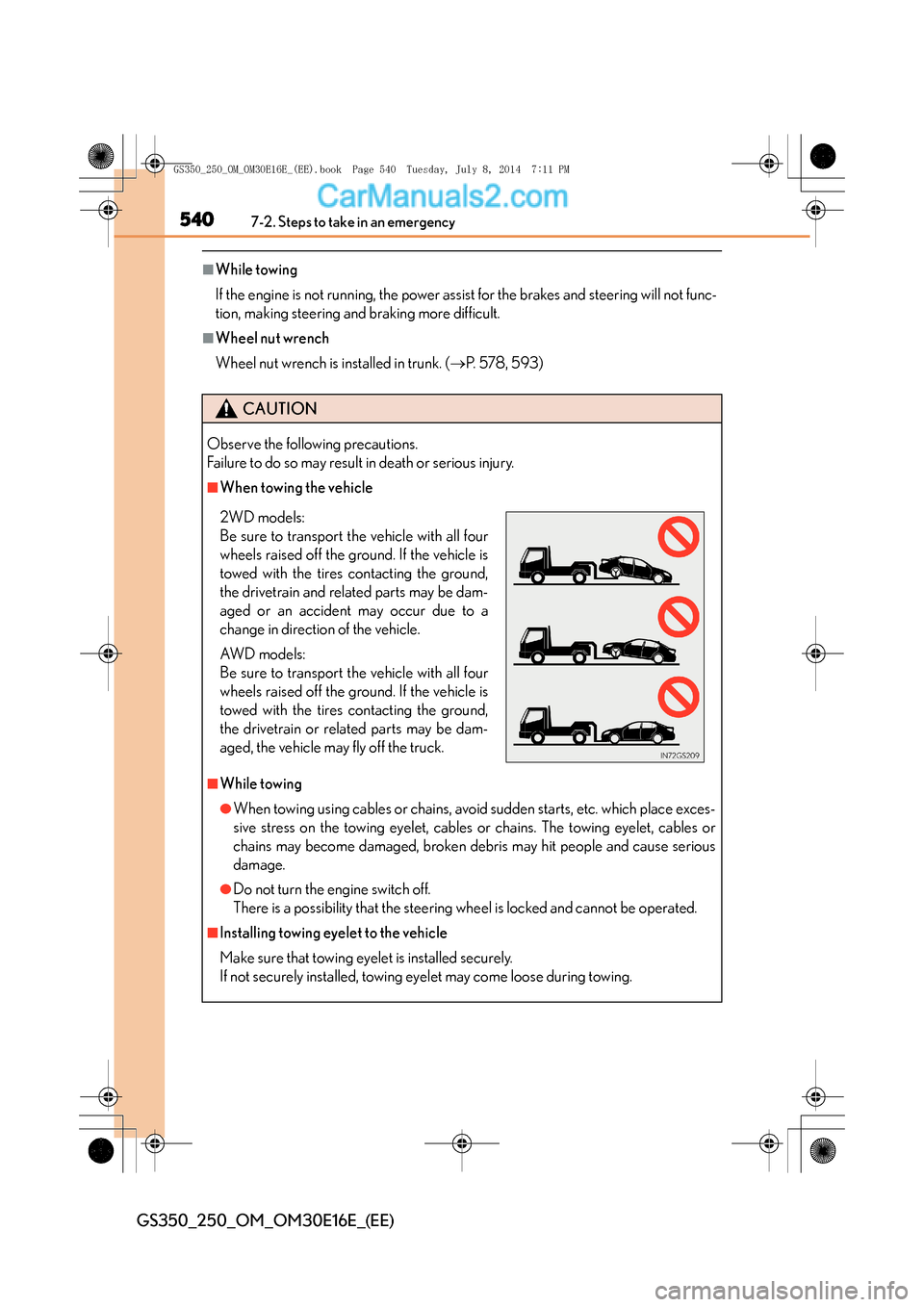
■When towing the vehicle
■While towing
●When towing using cables or chains, avoid sudden starts, etc. which place exces-
sive stress on the towing eyelet, cables or chains. The towing eyelet, cables or
chains may become damaged, broken debris may hit people and cause serious
damage.
●Do not turn the engine switch off.
There is a possibility that the steering wheel is locked and cannot be operated.
■Installing towing eyelet to the vehicle
Make sure that towing eyelet is installed securely.
If not securely installed, towing eyelet may come loose during towing.
2WD models:
Be sure to transport the vehicle with all four
wheels raised off the ground. If the vehicle is
towed with the tires contacting the ground,
the drivetrain and related parts may be dam-
aged or an accident may occur due to a
change in direction of the vehicle.
AW D m o d e l s :
Be sure to transport the vehicle with all four
wheels raised off the ground. If the vehicle is
towed with the tires contacting the ground,
the drivetrain or related parts may be dam-
aged, the vehicle may fly off the truck.
GS350_250_OM_OM30E16E_(EE).book Page 540 Tuesday, July 8, 201 4 7:11 PM
Page 551 of 688

5517-2. Steps to take in an emergency
7
When trouble arises
GS350_250_OM_OM30E16E_(EE)
CAUTION
■If both the ABS and the brake system warning lights remain on
Stop your vehicle in a safe place immediately and contact any authorized Lexus
dealer or repairer, or another duly qualified and equipped professional. The vehicle
will become extremely unstable during braking, and the ABS system may fail,
which could cause an accident resulting in death or serious injury.
■When the electric power steering system warning light comes on
The steering wheel may become extremely heavy.
If the steering wheel becomes heavier than usual when operating, hold firmly and
operate using more force than usual.
■If the tire pressure warning light comes on
Be sure to observe the following precautions. Failure to do so could cause a loss of
vehicle control and result in death or serious injury.
●Stop your vehicle in a safe place as soon as possible. Adjust the tire inflation pres-
sure immediately.
●If the tire pressure warning light comes on even after tire inflation pressure adjust-
ment, it is probable that you have a flat tire. Check the tires. If a tire is flat, change
it with the spare tire and have the flat tire repaired by the nearest any authorized
Lexus dealer or repairer, or another duly qualified and equipped professional.
●Avoid abrupt maneuvering and braking. If the vehicle tires deteriorate, you could
lose control of the steering wheel or the brakes.
■If a blowout or sudden air leakage should occur
The tire pressure warning system may not activate immediately.
NOTICE
■To ensure the tire pressure warning system operates properly
Do not install tires with different specifications or makers, as the tire pressure warn-
ing system may not operate properly.
GS350_250_OM_OM30E16E_(EE).book Page 551 Tuesday, July 8, 2014 7:11 PM