steering wheel Lexus GS250 2014 Owner's Guide
[x] Cancel search | Manufacturer: LEXUS, Model Year: 2014, Model line: GS250, Model: Lexus GS250 2014Pages: 688, PDF Size: 152.64 MB
Page 199 of 688
199
3
3-4. Adjusting the steering wheel and mirrors
Operation of each component
GS350_250_OM_OM30E16E_(EE)
Outside rear view mirrors
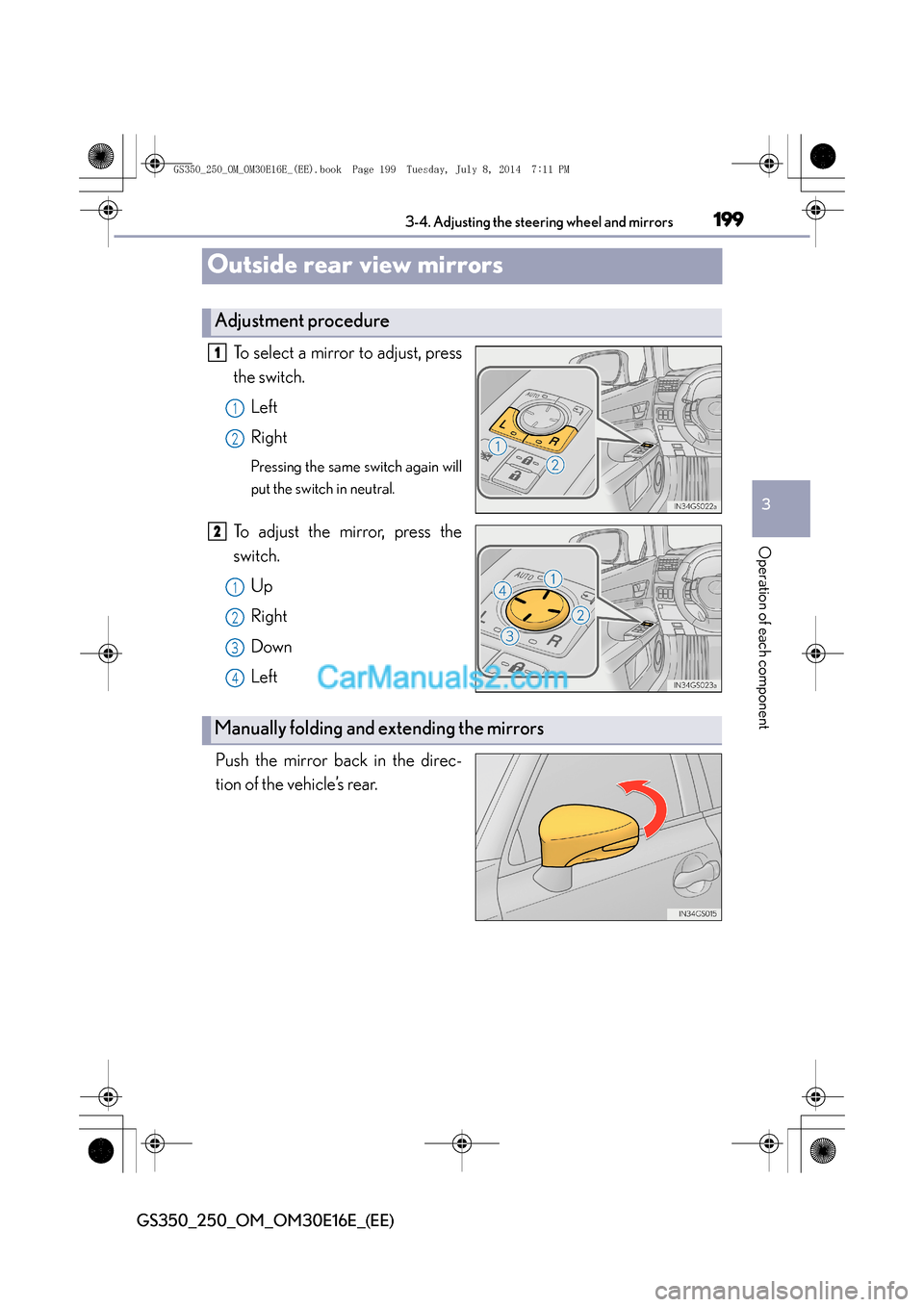
To select a mirror to adjust, press
the switch.
Left
Right
Pressing the same switch again will
put the switch in neutral.
To adjust the mirror, press the
switch.
Up
Right
Down
Left
Push the mirror back in the direc-
tion of the vehicle’s rear.
Adjustment procedure
1
1
2
2
1
2
3
4
Manually folding and extending the mirrors
GS350_250_OM_OM30E16E_(EE).book Page 199 Tuesday, July 8, 201 4 7:11 PM
Page 200 of 688
2003-4. Adjusting the steering wheel and mirrors
GS350_250_OM_OM30E16E_(EE)
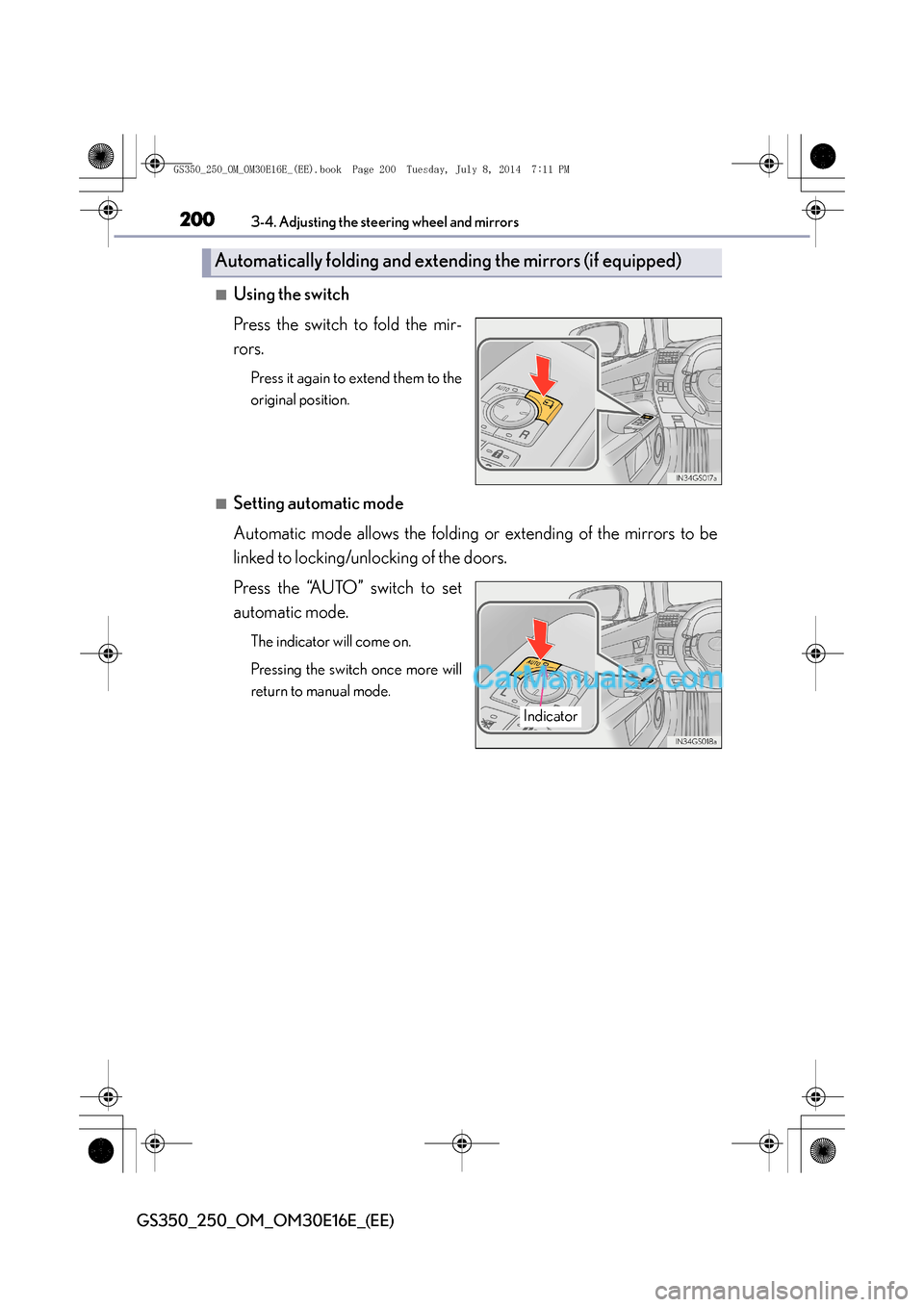
■Using the switch
Press the switch to fold the mir-
rors.
Press it again to extend them to the
original position.
■Setting automatic mode
Automatic mode allows the folding or extending of the mirrors to be
linked to locking/unlocking of the doors.
Press the “AUTO” switch to set
automatic mode.
The indicator will come on.
Pressing the switch once more will
return to manual mode.
Automatically folding and extending the mirrors (if equipped)
Indicator
GS350_250_OM_OM30E16E_(EE).book Page 200 Tuesday, July 8, 2014 7:11 PM
Page 201 of 688
2013-4. Adjusting the steering wheel and mirrors
3
Operation of each component
GS350_250_OM_OM30E16E_(EE)
When either “L” or “R” of the mirror select switch is selected, the outside
rear view mirrors will automatically angle downwards when the vehicle is
reversing in order to give a better view of the ground. To disable this func-
tion, select neither “L” nor “R”.
■Adjusting the mirror angle when the vehicle is reversing
With the shift lever in R, adjust the mirror angle at a desired position.
The adjusted angle will be memorized and the mirror will automatically
tilt to the memorized angle whenever the shift lever is shifted to R from
next time.
The memorized downward tilt position of the mirror is linked to the normal
position (angle adjusted with the shift lever in other than R). Therefore, if the
normal position is changed after adjustme nt, the tilt position will also change.
When the normal position is changed, readjust the angle in reversing.
Linked mirror function when reversing
GS350_250_OM_OM30E16E_(EE).book Page 201 Tuesday, July 8, 201 4 7:11 PM
Page 202 of 688
2023-4. Adjusting the steering wheel and mirrors
GS350_250_OM_OM30E16E_(EE)
■Mirror angle can be adjusted when
The engine switch is in ACCESSORY or IGNITION ON mode.
■Rain clearing mirrors (if equipped)
When water droplets collects on the mirror surface, for example when it rains, the
rain clearing (hydrophilic) effect of the mirrors causes the droplets to be spread out
into a film making the rear view clearer. In the following cases, the rain clearing effect
will be reduced temporarily, but will return after 1 or 2 days’ exposure to direct sun-
light.
●After wiping dirt off the mirrors
●When the mirrors fog up
●After waxing your vehicle in an automatic car wash
●After your vehicle has been parked for a long period in underground parking lots
etc. where there is no direct sunlight
■When the mirrors are fogged up
The outside rear view mirrors can be cleared using the mirror defoggers. Turn on the
rear window defogger to turn on the outside rear view mirror defoggers. (→P. 3 9 6 )
■Automatic adjustment of the mirror angle
A desired mirror face angle can be entered to memory and recalled automatically
by the driving position memory. ( →P. 1 8 6 )
■Auto anti-glare function (if equipped)
When the anti-glare inside rear view mirror is set to automatic mode, the outside
rear view mirrors will activate in conjunction with the anti-glare inside rear view mir-
ror to reduce reflected light. ( →P. 1 9 7 )
■Using automatic mode in cold weather
When automatic mode is used in cold weather, the door mirror could freeze up and
automatic stowing and return may not be possible. In this event, remove any ice and
snow from the door mirror, then either operate the mirror using manual mode or
move the mirror by hand.
GS350_250_OM_OM30E16E_(EE).book Page 202 Tuesday, July 8, 201 4 7:11 PM
Page 203 of 688
2033-4. Adjusting the steering wheel and mirrors
3
Operation of each component
GS350_250_OM_OM30E16E_(EE)
CAUTION
■Important points while driving
Observe the following precautions while driving.
Failure to do so may result in loss of control of the vehicle and cause an accident,
resulting in death or serious injury.
●Do not adjust the mirrors while driving.
●Do not drive with the mirrors folded.
●Both the driver and passenger side mirrors must be extended and properly
adjusted before driving.
■When a mirror is moving
To avoid personal injury and mirror malfunction, be careful not to get your hand
caught by the moving mirror.
■When the mirror defoggers are operating
Do not touch the rear view mirror surfaces, as they can become very hot and burn
you.
NOTICE
■If the mirrors become iced up (vehicles with rain-clearing mirrors)
In order to retain the rain-clearing properties of the mirror, do not attempt to
scrape the ice off. Instead, remove it by turning on the mirror defoggers or by
applying warm water.
GS350_250_OM_OM30E16E_(EE).book Page 203 Tuesday, July 8, 2014 7:11 PM
Page 218 of 688
2184-1. Before driving
GS350_250_OM_OM30E16E_(EE)
CAUTION
Observe the following precautions.
Failure to do so may result in death or serious injury.
■When driving the vehicle
●During normal driving, do not turn off the engine. Turning the engine off while
driving will not cause loss of steering or braking control, but the power assist to
these systems will be lost. This will make it more difficult to steer and brake, so you
should pull over and stop the vehicle as soon as it is safe to do so.
However, in the event of an emergency, such as if it becomes impossible to stop
the vehicle in the normal way: →P. 5 3 5
●Use engine braking (downshift) to maintain a safe speed when driving down a
steep hill.
Using the brakes continuously may cause the brakes to overheat and lose effec-
tiveness. ( →P. 2 4 4 )
●Do not adjust the positions of the steering wheel, the seat, or the inside or outside
rear view mirrors while driving.
Doing so may result in a loss of vehicle control.
●Always check that all passengers’ arms, heads or other parts of their body are not
outside the vehicle.
■When driving on slippery road surfaces
●Sudden braking, acceleration and steering may cause tire slippage and reduce
your ability to control the vehicle.
●Sudden acceleration, engine braking due to shifting, or changes in engine speed
could cause the vehicle to skid.
●After driving through a puddle, lightly depress the brake pedal to make sure that
the brakes are functioning properly. Wet brake pads may prevent the brakes from
functioning properly. If the brakes on only one side are wet and not functioning
properly, steering control may be affected.
GS350_250_OM_OM30E16E_(EE).book Page 218 Tuesday, July 8, 201 4 7:11 PM
Page 223 of 688
2234-1. Before driving
4
Driving
GS350_250_OM_OM30E16E_(EE)
NOTICE
■When driving the vehicle
●Do not depress the accelerator and brake pedals at the same time during driving,
as this may restrain driving torque.
●Do not use the accelerator pedal or depress the accelerator and brake pedals at
the same time to hold the vehicle on a hill.
■When parking the vehicle
Always shift the shift lever to P. Failure to do so may cause the vehicle to move or
the vehicle may accelerate suddenly if the accelerator pedal is accidentally
depressed.
■Avoiding damage to vehicle parts
●Do not turn the steering wheel fully in either direction and hold it there for an
extended period of time.
Doing so may damage the power steering motor.
●When driving over bumps in the road, drive as slowly as possible to avoid damag-
ing the wheels, underside of the vehicle, etc.
■If you get a flat tire while driving
A flat or damaged tire may cause the following situations. Hold the steering wheel
firmly and gradually depress the brake pedal to slow down the vehicle.
●It may be difficult to control your vehicle.
●The vehicle will make abnormal sounds or vibrations.
●The vehicle will lean abnormally.
Information on what to do in case of a flat tire ( →P. 577, 592)
GS350_250_OM_OM30E16E_(EE).book Page 223 Tuesday, July 8, 201 4 7:11 PM
Page 233 of 688
2334-1. Before driving
4
Driving
GS350_250_OM_OM30E16E_(EE)
Your vehicle will handle differently when towing a trailer. In order to avoid
accident, death or serious injury, keep the following in mind when towing:
■Checking connections between trailer and lights
Stop the vehicle and check the operation of the connection between
the trailer and lights after driving for a brief period as well as before
starting off.
■Practicing driving with a coupled trailer
●Get the feel for turning, stopping and reversing with the trailer cou-
pled by practicing in an area with no or light traffic.
●When reversing with a coupled trailer, hold the section of the steer-
ing wheel nearest to you and rotate clockwise to turn the trailer left
or counterclockwise to turn it right. Always rotate a little at a time to
prevent steering error. Have someone guide you when reversing to
lessen the risk of an accident.
NOTICE
■When the rear bumper strengthening material is aluminum
Ensure the steel bracket part does not come directly in contact with that area.
When steel and aluminum come into contact, there is a reaction similar to corro-
sion, which will weaken the section concerned and may result in damage. Apply a
rust inhibitor to parts that will come in contact when attaching a steel bracket.
Guidance
GS350_250_OM_OM30E16E_(EE).book Page 233 Tuesday, July 8, 201 4 7:11 PM
Page 234 of 688
2344-1. Before driving
GS350_250_OM_OM30E16E_(EE)
■Increasing vehicle-to-vehicle distance
At a speed of 10 km/h (6 mph), the distance to the vehicle running
ahead of you should be equivalent to or greater than the combined
length of your vehicle and trailer. Avoid sudden braking that may cause
skidding. Otherwise, the vehicle may spin out of control. This is espe-
cially true when driving on wet or slippery road surfaces.
■Sudden acceleration/steering input/cornering
Executing sharp turns when towing may result in the trailer colliding
with your vehicle. Decelerate well in advance when approaching turns
and take them slowly and carefully to avoid sudden braking.
■Important points regarding turning
The wheels of the trailer will travel closer to the inside of the curve than
the wheels of the vehicle. To make allowance for this, take the turns
wider than you would normally do.
■Important points regarding stability
Vehicle movement resulting from uneven road surfaces and strong
crosswinds will affect handling. The vehicle may also be rocked by pass-
ing buses or large trucks. Frequent ly check behind when moving along-
side such vehicles. As soon as such vehicle movement occurs,
immediately start to decelerate smoot hly by slowly applying the brakes.
Always steer the vehicle straight ahead while braking.
■Passing other vehicles
Consider the total combined length of your vehicle and trailer and
ensure that the vehicle-to-vehicle distance is sufficient before execut-
ing lane changes.
■Transmission information
To maintain engine braking efficiency, when using engine braking,
when driving on a long steep downgrade, do not use the transmission in
D. If in the M mode, the transmission shift range position must be in 4 or
lower. ( →P. 2 4 8 )
GS350_250_OM_OM30E16E_(EE).book Page 234 Tuesday, July 8, 201 4 7:11 PM
Page 240 of 688
2404-2. Driving procedures
GS350_250_OM_OM30E16E_(EE)
■Auto power off function
If the vehicle is left in ACCESSORY mode for more than 20 minutes or IGNITION
ON mode (the engine is not running) for more than an hour with the shift lever in P,
the engine switch will automatically turn off. However, this function cannot entirely
prevent battery discharge. Do not leave the vehicle with the engine switch in
ACCESSORY or IGNITION ON mode for long periods of time when the engine is
not running.
■Electronic key battery depletion
→P. 1 3 8
■Conditions affecting operation
→P. 1 3 4
■Notes for the push-start function
→P. 1 3 7
■If the engine does not start
●The engine immobilizer system may not have been deactivated. ( →P. 8 0 )
Contact any authorized Lexus dealer or repairer, or another duly qualified and
equipped professional.
●Check that the shift lever is securely set in P. The engine may not start if the shift
lever is displaced out of P. “Shift to P position to Start” will be displayed on the multi-
information display.
■Steering lock
After turning the engine switch off and opening and closing the doors, the steering
wheel will be locked due to the steering lock function. Operating the engine switch
again automatically cancels the steering lock.
GS350_250_OM_OM30E16E_(EE).book Page 240 Tuesday, July 8, 201 4 7:11 PM