ignition Lexus GS250 2014 Workshop Manual
[x] Cancel search | Manufacturer: LEXUS, Model Year: 2014, Model line: GS250, Model: Lexus GS250 2014Pages: 688, PDF Size: 152.64 MB
Page 469 of 688
469 6-3. Do-it-yourself maintenance
6
Maintenance and care
GS350_250_OM_OM30E16E_(EE)
◆Initializing the tire pressure warning system
■The tire pressure warning system must be initialized in the following
circumstances:
●When rotating the tires.
●When the tire inflation pressure is changed such as when changing
traveling speed.
When the tire pressure warning system is initialized, the current tire
inflation pressure is set as the benchmark pressure.
■How to initialize the tire pressure warning system Park the vehicle in a safe place and turn the engine switch off.
Initialization cannot be performed while the vehicle is moving.
Adjust the tire inflation pressure to the specified cold tire inflation
pressure level. ( →P. 645)
Make sure to adjust the tire pressure to the specified cold tire inflation pres-
sure level. The tire pressure warning system will operate based on this pressure
level.
Turn the engine switch to IGNITION ON mode.
1
2
3
GS350_250_OM_OM30E16E_(EE).book Page 469 Tuesday, July 8, 201 4 7:11 PM
Page 470 of 688
4706-3. Do-it-yourself maintenance
GS350_250_OM_OM30E16E_(EE)
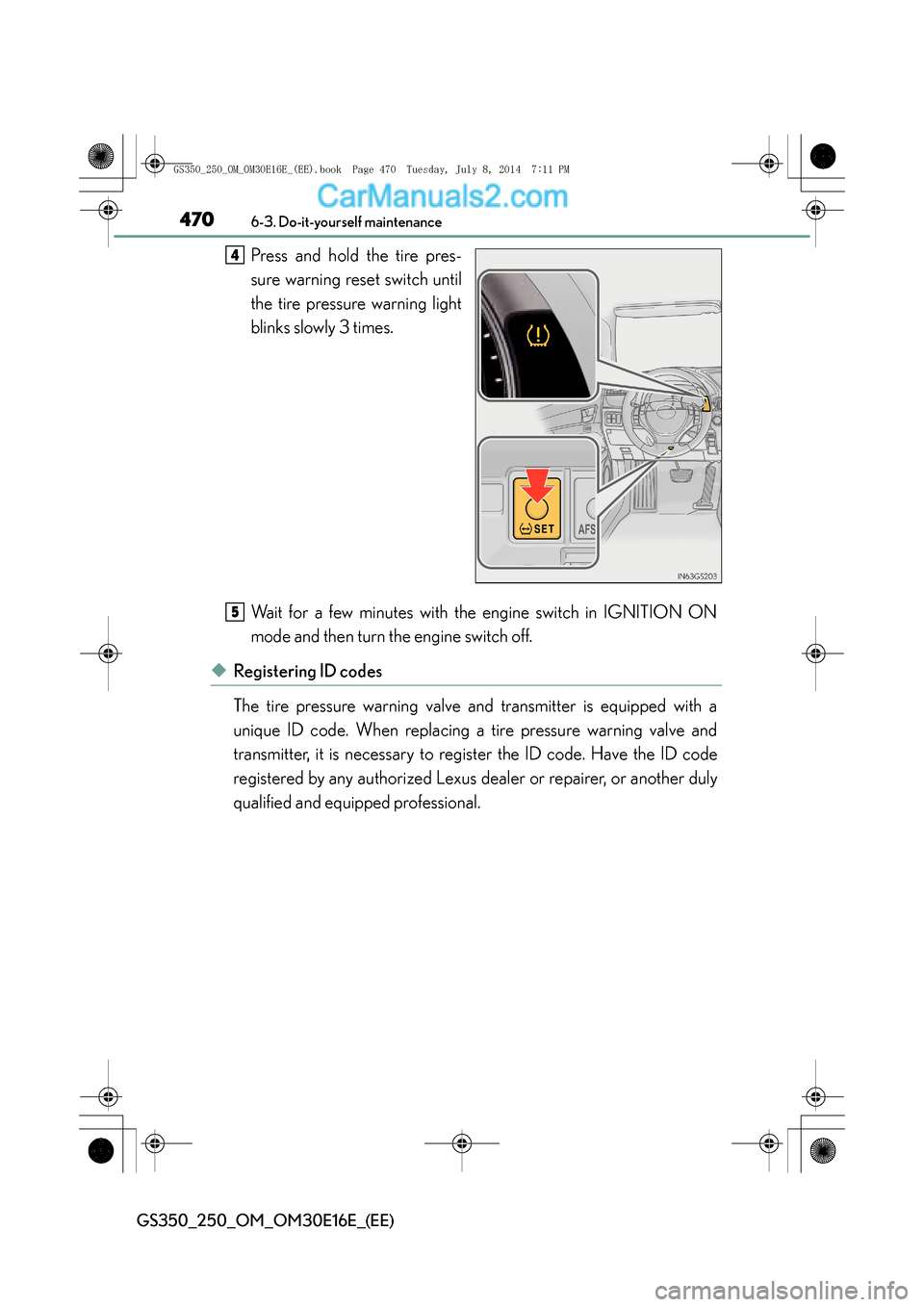
Press and hold the tire pres-
sure warning reset switch until
the tire pressure warning light
blinks slowly 3 times.
Wait for a few minutes with the engine switch in IGNITION ON
mode and then turn the engine switch off.
◆Registering ID codes
The tire pressure warning valve and transmitter is equipped with a
unique ID code. When replacing a tire pressure warning valve and
transmitter, it is necessary to register the ID code. Have the ID code
registered by any authorized Lexus dealer or repairer, or another duly
qualified and equipped professional.
4
5
GS350_250_OM_OM30E16E_(EE).book Page 470 Tuesday, July 8, 2014 7:11 PM
Page 471 of 688
471 6-3. Do-it-yourself maintenance
6
Maintenance and care
GS350_250_OM_OM30E16E_(EE)
■When to replace your vehicle’s tires
Tires should be replaced if:
●You have tire damage such as cuts, splits, cracks deep enough to expose the fabric,
and bulges indicating internal damage
●A tire goes flat repeatedly or cannot be properly repaired due to the size or loca-
tion of a cut or other damage
If you are not sure, consult with any authorized Lexus dealer or repairer, or another
duly qualified and equipped professional.
■Replacing tires and wheels (vehicles wi th the tire pressure warning system)
If the ID code of the tire pressure warning valve and transmitter is not registered, the
tire pressure warning system will not work properly. After driving for about 10 min-
utes, the tire pressure warning light blinks for 1 minute and stays on to indicate a sys-
tem malfunction.
■Tire life
Any tire over 6 years old must be checked by a qualified technician even if it has sel-
dom or never been used or damage is not obvious.
■Routine tire inflation pressure checks
The tire pressure warning system does not replace routine tire inflation pressure
checks. Make sure to check tire inflation pressure as part of your routine of daily
vehicle checks.
■When rotating the tires (vehicles with the tire pressure warning system featuring a
tire inflation pressure display function)
Make sure that the engine switch is off. If the tires are rotated while the engine switch
is in IGNITION ON mode, the tire position information will not be updated.
If this accidentally occurs, either turn the engine switch to off and then to IGNITION
ON mode, or initialize the system after checking that the tire pressure is properly
adjusted.
GS350_250_OM_OM30E16E_(EE).book Page 471 Tuesday, July 8, 201 4 7:11 PM
Page 473 of 688
473 6-3. Do-it-yourself maintenance
6
Maintenance and care
GS350_250_OM_OM30E16E_(EE)
■The initialization operation (vehicles with the tire pressure warning system)
●Make sure to carry out initialization after adjusting the tire inflation pressure.
Also, make sure the tires are cold before carrying out initialization or tire inflation
pressure adjustment.
●If you have accidentally turned the engine switch off during initialization, it is not
necessary to press the reset switch again as initialization will restart automatically
when the engine switch has been turned to IGNITION ON mode for the next time.
●If you accidentally press the reset switch when initialization is not necessary, adjust
the tire inflation pressure to the specifie d level when the tires are cold, and conduct
initialization again.
■Warning performance of the tire pressure warning system (if equipped)
The warning of the tire pressure warning system will change in accordance with the
conditions under which it was initialized. For this reason, the system may give a warn-
ing even if the tire pressure does not reach a low enough level, or if the pressure is
higher than the pressure that was adjusted to when the system was initialized.
■When initialization of the tire pressure warning system has failed (vehicles with the
tire pressure warning system)
Initialization can be completed in a few minutes. However, in the following cases, the
settings have not been recorded and the system will not operate properly. If
repeated attempts to record tire inflation pressure settings are unsuccessful, have
the vehicle inspected by any authorized Lexus dealer or repairer, or another duly
qualified and equipped professional.
●When operating the tire pressure warning reset switch, the tire pressure warning
light does not blink 3 times.
●After carrying out the initialization procedure, the tire pressure warning light blinks
for 1 minute then stays on after driving for 20 minutes.
■Registering ID codes (vehicles with the tire pressure warning system)
The ID codes of the tire pressure warning valve and transmitters for two sets of
wheels can be registered.
It is not necessary to register the ID codes when replacing normal tires with snow
tires, if the ID codes for the wheels of both normal tires and snow tires are registered
beforehand.
For information about changing ID codes, ask any authorized Lexus dealer or
repairer, or another duly qualified and equipped professional.
GS350_250_OM_OM30E16E_(EE).book Page 473 Tuesday, July 8, 201 4 7:11 PM
Page 539 of 688
5397-2. Steps to take in an emergency
7
When trouble arises
GS350_250_OM_OM30E16E_(EE)
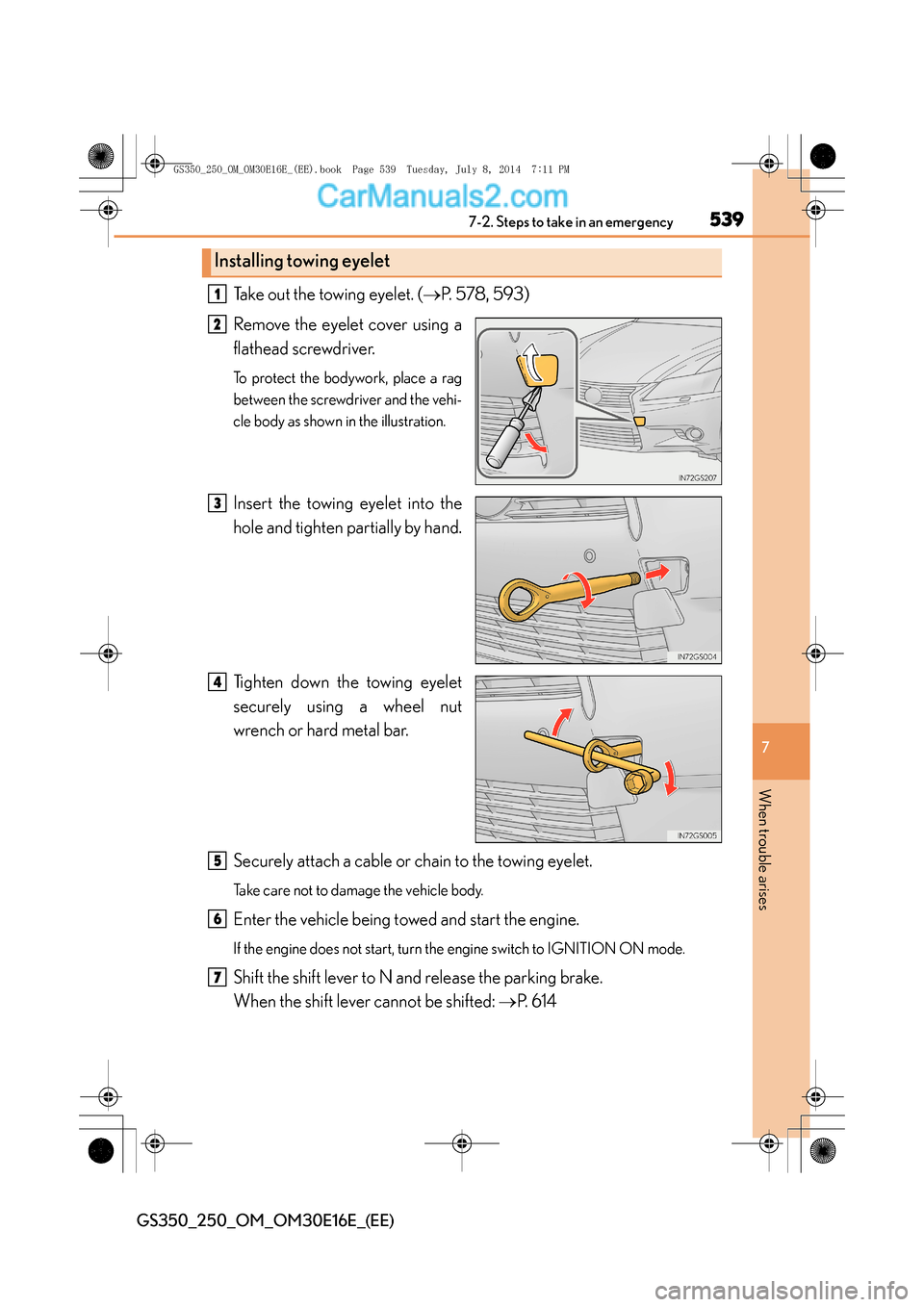
Take out the towing eyelet. (→P. 578, 593)
Remove the eyelet cover using a
flathead screwdriver.
To protect the bodywork, place a rag
between the screwdriver and the vehi-
cle body as shown in the illustration.
Insert the towing eyelet into the
hole and tighten partially by hand.
Tighten down the towing eyelet
securely using a wheel nut
wrench or hard metal bar.
Securely attach a cable or chain to the towing eyelet.
Take care not to damage the vehicle body.
Enter the vehicle being towed and start the engine.
If the engine does not start, turn the engine switch to IGNITION ON mode.
Shift the shift lever to N and release the parking brake.
When the shift lever cannot be shifted: →P. 6 1 4
Installing towing eyelet
1
2
3
4
5
6
7
GS350_250_OM_OM30E16E_(EE).book Page 539 Tuesday, July 8, 201 4 7:11 PM
Page 550 of 688
5507-2. Steps to take in an emergency
GS350_250_OM_OM30E16E_(EE)
■When a tire is replaced with a spare tire
Vehicles with a compact spare tire: The compact spare tire is not equipped with a tire
pressure warning valve and transmitter. If a tire goes flat, the tire pressure warning
light will not turn off even though the flat tire has been replaced with the spare tire.
Vehicles with a full-size spare tire: The spare tire is also equipped with a tire pressure
warning valve and transmitter. The tire pressure warning light will turn on if the tire
inflation pressure of the spare tire is low. If a tire goes flat, the tire pressure warning
light will not turn off even though the flat tire has been replaced with the spare tire.
■Conditions that the tire pressure warning system may not function properly
→P. 4 7 2
■If the tire pressure warning light freque ntly comes on after blinking for 1 minute
If the tire pressure warning light frequently comes on after blinking for 1 minute when
the engine switch is turned to IGNITION ON mode, have it checked by any autho-
rized Lexus dealer or repairer, or another duly qualified and equipped professional.
■Warning buzzer
In some cases, the buzzer may not be heard because of noisy place or an audio
sound.
GS350_250_OM_OM30E16E_(EE).book Page 550 Tuesday, July 8, 201 4 7:11 PM
Page 622 of 688
6227-2. Steps to take in an emergency
GS350_250_OM_OM30E16E_(EE)
Start the engine of the second vehicle. Increase the engine speed
slightly and maintain at that level for approximately 5 minutes to
recharge the battery of your vehicle.
Open and close any of the doors of your vehicle with the engine switch
off.
Maintain the engine speed of the second vehicle and start the engine of
your vehicle by turning the engine switch to IGNITION ON mode.
Once the vehicle’s engine has started, remove the jumper cables in the
exact reverse order from which they were connected.
Once the engine starts, have the vehicle inspected at any authorized
Lexus dealer or repairer, or another duly qualified and equipped profes-
sional as soon as possible.
■Starting the engine when the battery is discharged
The engine cannot be started by push-starting.
■To prevent battery discharge
●Turn off the headlights and the audio system while the engine is off.
●Turn off any unnecessary electrical components when the vehicle is running at a
low speed for an extended period, such as in heavy traffic.
■Charging the battery
The electricity stored in the battery will discharge gradually even when the vehicle is
not in use, due to natural discharge and the draining effects of certain electrical
appliances. If the vehicle is left for a long time, the battery may discharge, and the
engine may be unable to start. (The battery recharges automatically during driving.)
3
4
5
6
GS350_250_OM_OM30E16E_(EE).book Page 622 Tuesday, July 8, 201 4 7:11 PM
Page 642 of 688
6428-1. Specifications
GS350_250_OM_OM30E16E_(EE)
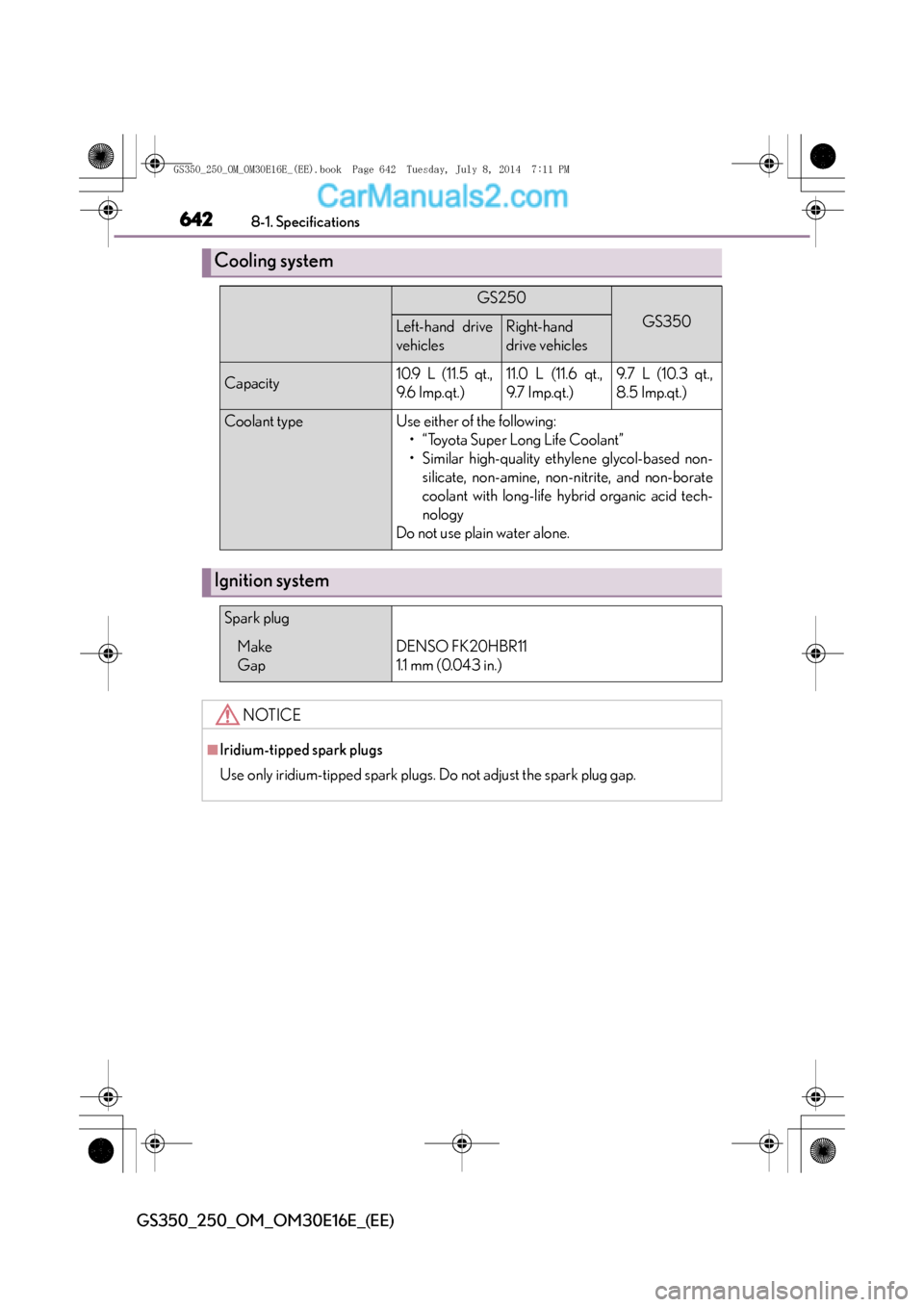
Cooling system
GS250
GS350Left-hand drive
vehiclesRight-hand
drive vehicles
Capacity10.9 L (11.5 qt.,
9.6 I m p . q t . )11.0 L (11.6 qt.,
9.7 I m p.q t.)9.7 L ( 1 0. 3 q t . ,
8.5 Imp.qt.)
Coolant typeUse either of the following:• “Toyota Super Long Life Coolant”
• Similar high-quality ethylene glycol-based non-silicate, non-amine, non-nitrite, and non-borate
coolant with long-life hybrid organic acid tech-
nology
Do not use plain water alone.
Ignition system
Spark plug
Make
GapDENSO FK20HBR11
1.1 mm (0.043 in.)
NOTICE
■Iridium-tipped spark plugs
Use only iridium-tipped spark plugs. Do not adjust the spark plug gap.
GS350_250_OM_OM30E16E_(EE).book Page 642 Tuesday, July 8, 201 4 7:11 PM
Page 665 of 688
665What to do if... (Troubleshooting)
GS350_250_OM_OM30E16E_(EE)
●Is the electronic key battery weak or depleted? (→P. 4 8 9 )
●Vehicles with an entry function
Is the engine switch in IGNITION ON mode?
When locking the doors, turn the engine switch off. ( →P. 2 3 8 )
●Vehicles with an entry function
Is the electronic key left inside the vehicle?
When locking the doors, make sure that you have the elec-
tronic key on your person.
●The function may not operate properly due to the condition of
the radio wave. ( →P. 1 3 4 )
●Is the child-protector lock set?
The rear door cannot be opened from inside the vehicle when
the lock is set. Open the rear door from outside and then
unlock the child-protector lock. ( →P. 1 7 2 )
●The function to prevent the electronic key from being left inside
the trunk will operate and you can open the trunk as usual. Take
the key out from the trunk. ( →P. 1 2 8 )
The doors cannot be locked or unlocked
The rear door cannot be opened
The trunk lid is closed with
the electronic key left inside
GS350_250_OM_OM30E16E_(EE).book Page 665 Tuesday, July 8, 201 4 7:11 PM
Page 666 of 688
666What to do if... (Troubleshooting)
GS350_250_OM_OM30E16E_(EE)
●Did you press the engine switch while firmly depressing the
brake pedal? (→P. 2 3 7 )
●Is the shift lever in P? ( →P. 2 4 0 )
●Is the electronic key anywhere detectable inside the vehicle?
(→ P. 1 3 0 )
●Is the steering wheel unlocked? ( →P. 2 4 1 )
●Is the electronic key battery weak or depleted?
In this case, the engine can be started in a temporary way.
(→ P. 6 1 9 )
●Is the battery discharged? ( →P. 6 2 1 )
●Is the engine switch in IGNITION ON mode?
If you cannot release the shift lever by depressing the brake
pedal with the engine switch in IGNITION ON mode
(→ P. 6 1 4 )
If you think something is wrong
The engine does not start
The shift lever cannot be shifted from P even if you depress the
brake pedal
GS350_250_OM_OM30E16E_(EE).book Page 666 Tuesday, July 8, 201 4 7:11 PM