instrument panel Lexus GS300h 2013 User Guide
[x] Cancel search | Manufacturer: LEXUS, Model Year: 2013, Model line: GS300h, Model: Lexus GS300h 2013Pages: 1014
Page 152 of 1014
1513-2. Opening, closing and locking the doors and trunk
3
Operation of each component
GS450h_300h_OM_OM30D53E_(EE)
Note for the entry function (if equipped)
Even when the electronic key is within the effective range (detection areas),
the system may not operate properly in the following cases:
• The electronic key is too close to the window or outside door handle,
near the ground, or in a high place when the doors are locked or
unlocked.
• The electronic key is near the ground or in a high place, or too close to
the rear bumper center when the trunk is opened.
Do not leave the electronic key on top of the instrument panel or near the
door pockets when exiting the vehicle. Depending on the radio wave recep-
tion conditions, it may be detected by the antenna outside the cabin and the
door will become lockable from the outside, possibly trapping the elec-
tronic key inside the vehicle.
As long as the electronic key is within the effective range, the doors may be
locked or unlocked by anyone. However, only the doors detecting the elec-
tronic key can be used to unlock the vehicle.
The doors may unlock or lock if a large amount of water splashes on the
door handle, such as in the rain or in a car wash when the electronic key is
within the effective range. (The doors will automatically be locked after
approximately 30 seconds if the doors are not opened and closed.)
If the wireless remote control is used to lock the doors when the electronic
key is near the vehicle, there is a possibility that the door may not be
unlocked by the entry function. (Use the wireless remote control to unlock
the doors.)
Page 154 of 1014
1533-2. Opening, closing and locking the doors and trunk
3
Operation of each component
GS450h_300h_OM_OM30D53E_(EE)
Note for the push-start function
Even when the electronic key is within the effective range (detection areas),
the system may not operate properly when the electronic key is on the
instrument panel, rear package tray or floor, or in the door pockets or glove
box when the hybrid system is started or power switch modes are changed.
Even if the electronic key is not inside the vehicle, it may be possible to
start the hybrid system if the electronic key is near the window.
When the vehicle is not driven for extended periods
Vehicles with entry function: To prevent theft of the vehicle, do not leave
the electronic key within 2 m (6 ft.) of the vehicle.
The smart entry & start system can be deactivated in advance. (P. 942)
Alarm (if equipped)
Using the smart entry & start system to lock the doors will set the alarm sys-
tem.
(P. 97)
To operate the system properly
Make sure to carry the electronic key when operating the system. Do not get
the electronic key too close to the vehicle when operating the system from
the outside of the vehicle.
Depending on the position and holding condition of the electronic key, the
key may not be detected correctly and the system may not operate properly.
(The alarm may go off accidentally, or the door lock prevention function
may not operate.)
Do not leave the electronic key inside the luggage compartment.
The key confinement prevention function may not operate, depending on
the location of the key (close to a spare tire [if equipped], the inside edge of
the luggage compartment), conditions (inside a metal bag, close to metallic
objects) and the radio waves in the surrounding area. (P. 189)
If the smart entry & start system does not operate properly
Locking and unlocking the doors and opening the trunk: Use the mechani-
cal key.
(P. 908)
Starting the hybrid system: P. 9 0 9
Page 198 of 1014
1973-3. Adjusting the seats
3
Operation of each component
GS450h_300h_OM_OM30D53E_(EE)
CAUTION
Operating the front passenger’s seat from the driver’s seat (if equipped)
Do not operate the front passenger’s seat when a passenger is seated in it. In
addition, do not let anyone sit down in the front passenger’s seat while the
seat is being operated. The front passenger may catch their legs between the
instrument panel and seat, resulting in injury.
When adjusting the seat positions or the ottoman (if equipped)
Make sure to leave enough space around the feet so they do not get stuck.
When using the ottoman (if equipped)
Do not operate the ottoman when the vehicle is moving.
Failure to do so may cause death or serious injury in the event of sudden
braking or a collision.
Do not sit on the ottoman of the passenger seat.
Doing so may cause seat belts to be worn improperly, which may lead to
serious injury or death in the event of sudden braking or a collision.
Do not step on the ottoman.
Doing so could damage the ottoman, or could cause you to seriously
injure yourself by falling over.
Stow the ottoman when you get in or out of the vehicle or when the otto-
man is not in use to avoid stumbling over it.
Do not allow anyone to put their hands or feet under the passenger seat
when stowing the ottoman.
Page 203 of 1014
2023-3. Adjusting the seats
GS450h_300h_OM_OM30D53E_(EE)
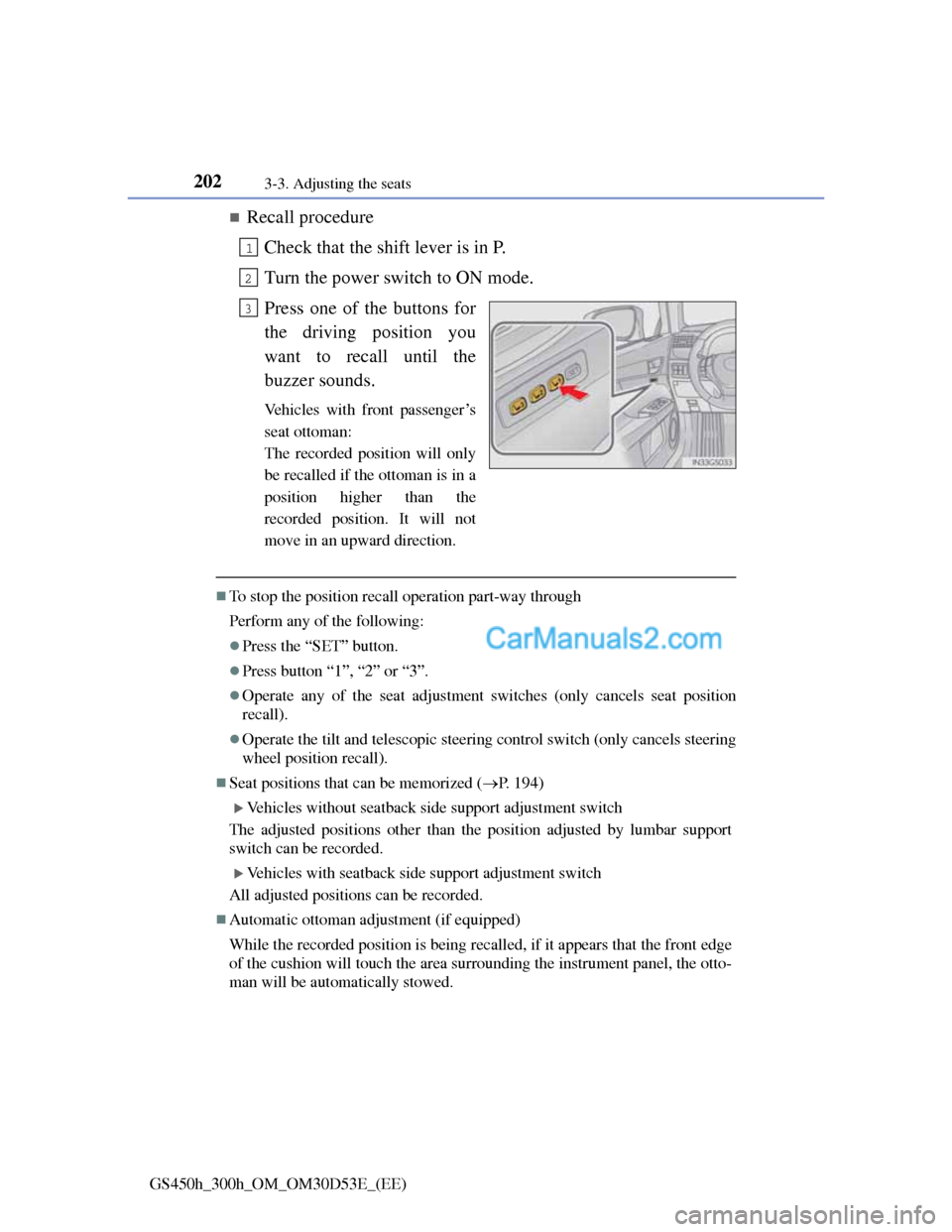
Recall procedure
Check that the shift lever is in P.
Turn the power switch to ON mode.
Press one of the buttons for
the driving position you
want to recall until the
buzzer sounds.
Vehicles with front passenger’s
seat ottoman:
The recorded position will only
be recalled if the ottoman is in a
position higher than the
recorded position. It will not
move in an upward direction.
To stop the position recall operation part-way through
Perform any of the following:
Press the “SET” button.
Press button “1”, “2” or “3”.
Operate any of the seat adjustment switches (only cancels seat position
recall).
Operate the tilt and telescopic steering control switch (only cancels steering
wheel position recall).
Seat positions that can be memorized (P. 194)
Vehicles without seatback side support adjustment switch
The adjusted positions other than the position adjusted by lumbar support
switch can be recorded.
Vehicles with seatback side support adjustment switch
All adjusted positions can be recorded.
Automatic ottoman adjustment (if equipped)
While the recorded position is being recalled, if it appears that the front edge
of the cushion will touch the area surrounding the instrument panel, the otto-
man will be automatically stowed.
1
2
3
Page 235 of 1014
2324-1. Before driving
GS450h_300h_OM_OM30D53E_(EE)
CAUTION
When the vehicle is parked
Do not leave glasses, cigarette lighters, spray cans, or soft drink cans in
the vehicle when it is in the sun.
Doing so may result in the following:
• Gas may leak from a cigarette lighter or spray can, and may lead to a
fire.
• The temperature inside the vehicle may cause the plastic lenses and
plastic material of glasses to deform or crack.
• Soft drink cans may fracture, causing the contents to spray over the
interior of the vehicle, and may also cause a short circuit in the vehi-
cle’s electrical components.
Do not leave cigarette lighters in the vehicle. If a cigarette lighter is in a
place such as the glove box or on the floor, it may be lit accidentally when
luggage is loaded or the seat is adjusted, causing a fire.
Do not attach adhesive discs to the windshield or windows. Do not place
containers such as air fresheners on the instrument panel or dashboard.
Adhesive discs or containers may act as lenses, causing a fire in the vehi-
cle.
Do not leave a door or window open if the curved glass is coated with a
metallized film such as a silver-colored one. Reflected sunlight may cause
the glass to act as a lens, causing a fire.
Always apply the parking brake, shift the shift lever to P, stop the hybrid
system and lock the vehicle.
Do not leave the vehicle unattended while the hybrid system is operating.
Do not touch the exhaust pipes while the hybrid system is operating or
immediately after turning the hybrid system off.
Doing so may cause burns.
Page 239 of 1014
2364-1. Before driving
GS450h_300h_OM_OM30D53E_(EE)
Cargo and luggage
Take notice of the following information about storage precau-
tions, cargo capacity and load:
CAUTION
Things that must not be carried in the trunk
The following things may cause a fire if loaded in the trunk:
Receptacles containing gasoline
Aerosol cans
Storage precautions
Observe the following precautions.
Failure to do so may prevent the pedals from being depressed properly, may
block the driver’s vision, or may result in items hitting the driver or passen-
gers, possibly causing an accident.
Stow cargo and luggage in the trunk whenever possible.
Do not place cargo or luggage in or on the following locations.
• At the feet of the driver
• On the front passenger or rear seats (when stacking items)
• On the package tray
• On the instrument panel
• On the dashboard
• In front of the Remote Touch screen
Secure all items in the occupant compartment.
Load and distribution
Do not overload your vehicle.
Do not apply loads unevenly.
Improper loading may cause deterioration of steering or braking control
which may cause death or serious injury.
Page 521 of 1014
501
5 5-3. Using the audio system
Interior features
GS450h_300h_OM_OM30D53E_(EE)
Audio system type
CD and DVD player with AM/FM radio
Vehicles with a 12.3-inch display: The audio functions can be dis-
played and operated on the “Side Display”. For details, refer to the
“Navigation System Owner’s Manual”.
The illustration below is for left-hand drive vehicles with a 8-inch
display.
The button positions and shapes will differ for right-hand drive
vehicles.
Also, the display and button positions will differ depending on the
type of the system.
Using the instrument panel
Press the “RADIO” or “MEDIA” button to display the audio
control screen.
Using the Remote Touch
Press the “MENU” button on the Remote Touch, select
“Audio” and select each tab to display the audio control screen.
Page 596 of 1014
5765-3. Using the audio system
GS450h_300h_OM_OM30D53E_(EE)
If you select
The display returns to the previous screen.
Connecting Bluetooth® audio player
Selecting “Connect portable player” on the “Bluetooth*” screen also con-
nects a Bluetooth® audio player. (P. 679)
When none of the selectable portable players have been registered, a screen
confirming registration is displayed. The registration method is the same as
phone registration. (P. 672)
When the currently connected portable player is selected, a screen confirm-
ing the selected player’s disconnection is displayed. (P. 672)
If connection fails once, a changing connection method confirmation screen
is displayed. If connection fails 2 or more times, a message will be dis-
played. When this message is displayed, try again.
*: Bluetooth is a registered trademark of Bluetooth SIG, Inc.
When using the Bluetooth® audio system
In the following conditions, the system may not function.
• The portable player is turned off
• The portable player is not connected
• The portable player battery is low
There may be a delay if phone connection is carried out during Bluetooth®
audio play.
Depending on the type of portable player that is connected to the system,
operation may differ slightly and certain functions may not be available.
Bluetooth® antenna
The antenna is built into the instrument panel. If the portable player is behind
the seat or in the glove box or console box, or is touching or covered by
metal objects, connection status may deteriorate.
Battery charge/signal status
This display may not correspond exactly with the portable player, and this
system does not have a charging function.
Page 607 of 1014
5875-3. Using the audio system
5
Interior features
GS450h_300h_OM_OM30D53E_(EE)
If you select
The display returns to the previous screen.
USB memory functions
When the USB memory is connected and the audio source is changed to
USB memory mode, the USB memory will start playing the first file in the
first folder. If the same device is removed and reinserted (and the contents
have not been changed), the USB memory will resume playing from the
same point it was last used.
Depending on the USB memory that is connected to the system, certain
functions may not be available. Disconnecting the device and reconnecting
it once again may resolve some malfunctions.
When using a USB memory
You may be unable to use the instrument panel power outlet if the USB mem-
ory is connected to the USB port at the same time.
Error messages for USB memory
“USB Error”: This indicates a problem in the USB memory or its connection.
“No music files found.”:This indicates that no MP3/WMA files are included
in the USB memory.
USB memory
Compatible devices
USB memory that can be used for MP3 and WMA playback.
Compatible device formats
The following device formats can be used:
• USB communication formats: USB2.0 HS (480 Mbps) and FS (12
Mbps)
• File formats: FAT16/32 (Windows)
• Correspondence class: Mass storage class
MP3 and WMA files written in any format other than those listed above
may not play correctly, and their file names and folder names may not be
displayed correctly.
Items related to standards and limitations are as follows:
• Maximum directory hierarchy: 8 levels
• Maximum number of folders in a device: 3000 (including the root)
• Maximum number of files in a device: 9999
• Maximum number of files per folder: 255
Page 619 of 1014
599
5 5-3. Using the audio system
Interior features
GS450h_300h_OM_OM30D53E_(EE)
iPod cover art
Depending on the iPod and the songs in the iPod, iPod cover art may be dis-
played. This function can be changed to “On” or “Off”. (P. 593)
It may take time to display iPod cover art, and the iPod may not be operated
while the cover art display is in process.
Only iPod cover art that is saved in JPEG format can be displayed.
iPod functions
When the iPod connected to the system includes iPod video, the system can
only output the sound by selecting “Video” on the “iPod” screen.
Depending on the iPod, the video sound may not be able to be heard.
When an iPod is connected and the audio source is changed to iPod mode,
the iPod will resume play from the same point in which it was last used.
Depending on the iPod that is connected to the system, certain functions
may not be available. If a function is unavailable due to a malfunction (as
opposed to a system specification), disconnecting the device and reconnect-
ing it once again may resolve the problem.
When using an iPod
You maybe unable to use the instrument panel power outlet if the iPod is con-
nected to the USB port at the same time.
Battery charge
When an iPod is connected using a genuine iPod cable, the iPod starts
charging its battery.
Error messages for iPod
“iPod error”:
This indicates a problem in the iPod or its connection.
“No music files found.”:
This indicates that there is no music data in the iPod.
“Please check the iPod firmware version.”:
This indicates that the software version is not compatible. Perform the iPod
firmware updates and try again.
“iPod authorization failed.”:
This indicates that it failed to authorize the iPod. Please check your iPod.