tires Lexus GS300h 2013 User Guide
[x] Cancel search | Manufacturer: LEXUS, Model Year: 2013, Model line: GS300h, Model: Lexus GS300h 2013Pages: 1014
Page 399 of 1014
3884-5. Using the driving support system
GS450h_300h_OM_OM30D53E_(EE)
CAUTION
When using the Lexus parking assist monitor system
The Lexus parking assist monitor is a supplemental device intended to
assist the driver when backing up. When backing up, be sure to check visu-
ally behind and all around the vehicle before proceeding.
Observe the following precautions to avoid an accident that could result in
death or serious injuries.
Never depend on the Lexus parking assist monitor entirely when backing
up. The image and the position of the guide lines displayed on the screen
may differ from the actual state.
Use caution, just as you would when backing up any vehicle.
Be sure to back up slowly, depressing the brake pedal to control vehicle
speed.
If you seem likely to hit nearby vehicles, obstacles, people or mount the
shoulder, depress the brake pedal to stop the vehicle, then disable the
assist system by select on the screen to cancel the system.
The instructions given are only guidelines.
When and how much to turn the steering wheel will vary according to
traffic conditions, road surface conditions, vehicle condition, etc. when
parking. It is necessary to be fully aware of this before using the parking
assist system.
When parking, be sure to check that the parking space will accommodate
your vehicle before maneuvering into it.
Do not use the Lexus parking assist monitor in the following cases:
• On icy or slick road surfaces, or in snow
• When using tire chains or emergency tires
• When the trunk lid is not closed completely
• On roads that are not flat or straight, such as curves or slopes.
Page 415 of 1014
4044-5. Using the driving support system
GS450h_300h_OM_OM30D53E_(EE)
CAUTION
The ABS does not operate effectively when
The limits of tire gripping performance have been exceeded (such as
excessively worn tires on a snow covered road).
The vehicle hydroplanes while driving at high speed on wet or slick roads.
Stopping distance when the ABS is operating may exceed that of normal
conditions
The ABS is not designed to shorten the vehicle’s stopping distance. Always
maintain a safe distance from the vehicle in front of you, especially in the
following situations:
When driving on dirt, gravel or snow-covered roads
When driving with tire chains
When driving over bumps in the road
When driving over roads with potholes or uneven surfaces
TRC may not operate effectively when
Directional control and power may not be achievable while driving on slip-
pery road surfaces, even if the TRC system is operating.
Drive the vehicle carefully in conditions where stability and power may be
lost.
When the VSC is activated
The slip indicator light flashes. Always drive carefully. Reckless driving
may cause an accident. Exercise particular care when the indicator light
flashes.
When the TRC/VSC systems are turned off
Be especially careful and drive at a speed appropriate to the road condi-
tions. As these are the systems to help vehicle stability and driving force,
do not turn the TRC/VSC systems off unless necessary.
Page 416 of 1014
4054-5. Using the driving support system
4
Driving
GS450h_300h_OM_OM30D53E_(EE)
CAUTION
Replacing tires
Make sure that all tires are of the specified size, brand, tread pattern and
total load capacity. In addition, make sure that the tires are inflated to the
recommended tire inflation pressure level.
The ABS, TRC and VSC systems will not function correctly if different
tires are installed on the vehicle.
Contact any authorized Lexus dealer or repairer, or another duly qualified
and equipped professional for further information when replacing tires or
wheels.
Handling of tires and the suspension
Using tires with any kind of problem or modifying the suspension will
affect the driving assist systems, and may cause a system to malfunction.
Page 450 of 1014
4334-6. Driving tips
4
Driving
GS450h_300h_OM_OM30D53E_(EE)
the accelerator and gently apply the brakes. A greater amount of
electrical energy can be retained when slowing down.
Air conditioning
Use the air conditioning only when necessary. Doing so can help
control excessive gasoline consumption.
In summer: In high temperatures, use the recirculated air mode.
Doing so will help to reduce the burden on the air conditioner
and reduce fuel consumption as well.
In winter: Because the gasoline engine will not automatically cut
out until the gasoline engine and the interior of the vehicle are
warm, it will consume fuel. Also, fuel consumption can be
improved by avoiding overuse of the heater.
Checking tire inflation pressure
Make sure to check the tire inflation pressure frequently.
Improper tire inflation pressure can cause poor fuel consumption.
Also, as snow tires can cause large amounts of friction, their use
on dry roads can lead to poor fuel consumption. Use a tire that is
appropriate for the season.
Luggage
Carrying heavy luggage can lead to poor fuel consumption.
Avoid carrying unnecessary luggage. Installing a large roof rack
can also cause poor fuel consumption.
Warming up before driving
Since the gasoline engine starts up and cuts out automatically
when cold, warming up the engine is unnecessary. Moreover, fre-
quently driving short distances will cause the engine to repeat-
edly warm up, which can lead to poor fuel consumption.
Page 451 of 1014
4344-6. Driving tips
GS450h_300h_OM_OM30D53E_(EE)
Winter driving tips
Use fluids that are appropriate to the prevailing outside tempera-
tures.
• Engine oil
• Engine/power control unit coolant
• Washer fluid
Have a service technician inspect the condition of the 12-volt
battery.
Have the vehicle fitted with four snow tires or purchase a set of
tire chains for the rear tires.
*
Ensure that all tires are the specified size and brand, and that chains
match the size of the tires.
*: Tire chains cannot be mounted on vehicles with front and rear tires of
differing sizes and vehicles with LDH and 19 inch tires
Carry out the necessary preparations and inspections before driv-
ing the vehicle in winter. Always drive the vehicle in a manner
appropriate to the prevailing weather conditions.
Preparation for winter
Page 452 of 1014
4354-6. Driving tips
4
Driving
GS450h_300h_OM_OM30D53E_(EE)
Perform the following according to the driving conditions:
Do not try to forcibly open a window or move a wiper that is fro-
zen. Pour warm water over the frozen area to melt the ice. Wipe
away the water immediately to prevent it from freezing.
To ensure proper operation of the climate control system fan,
remove any snow that has accumulated on the air inlet vents in
front of the windshield.
Check for and remove any excess ice or snow that may have
accumulated on the exterior lights, vehicle’s roof, chassis, around
the tires or on the brakes.
Remove any snow or mud from the bottom of your shoes before
getting in the vehicle.
Accelerate the vehicle slowly, keep a safe distance between you
and the vehicle ahead, and drive at a reduced speed suitable to road
conditions.
Park the vehicle and move the shift lever to P without setting the
parking brake. The parking brake may freeze up, preventing it from
being released. If necessary, block the wheels to prevent inadver-
tent sliding or creeping.
Before driving the vehicle
When driving the vehicle
When parking the vehicle
Page 453 of 1014
4364-6. Driving tips
GS450h_300h_OM_OM30D53E_(EE)
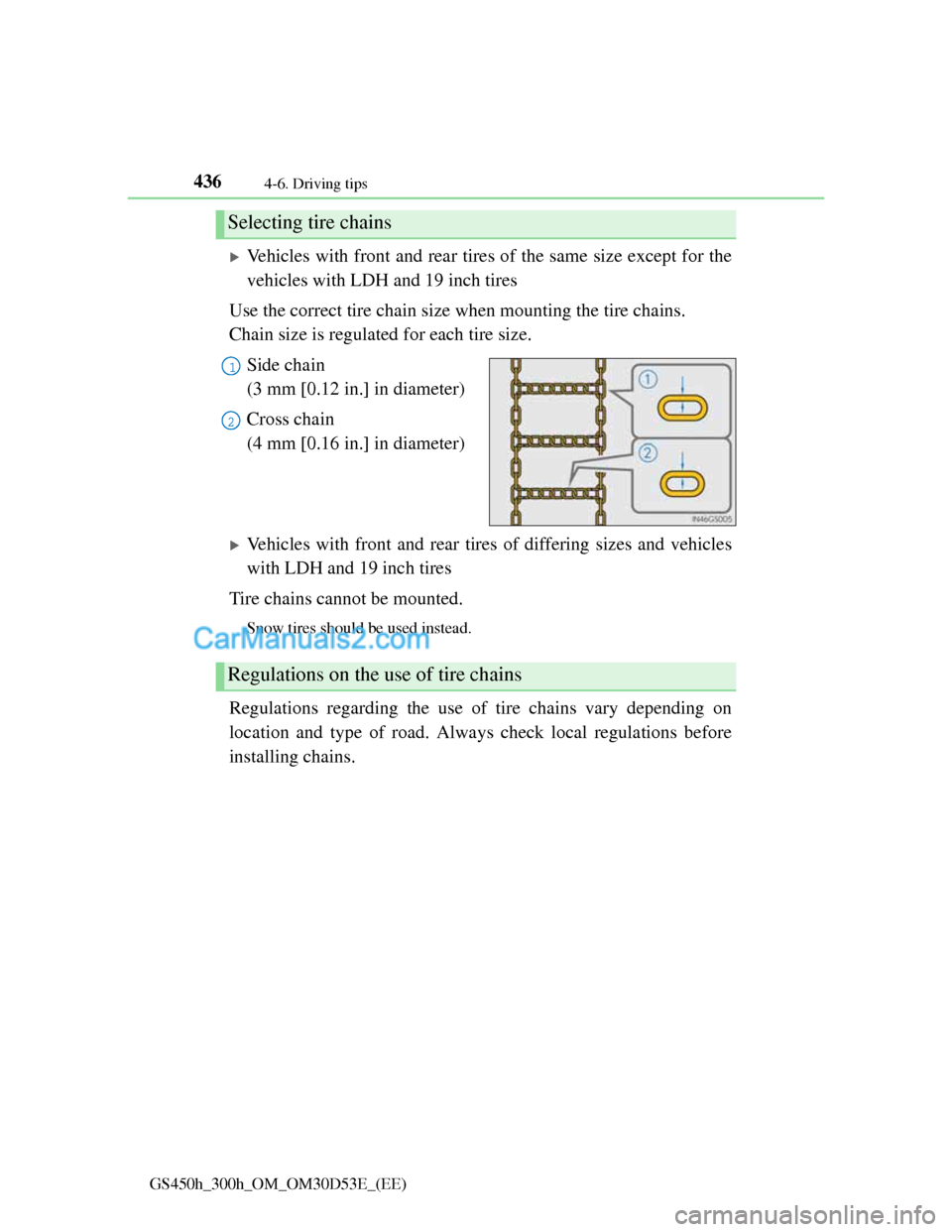
Vehicles with front and rear tires of the same size except for the
vehicles with LDH and 19 inch tires
Use the correct tire chain size when mounting the tire chains.
Chain size is regulated for each tire size.
Side chain
(3 mm [0.12 in.] in diameter)
Cross chain
(4 mm [0.16 in.] in diameter)
Vehicles with front and rear tires of differing sizes and vehicles
with LDH and 19 inch tires
Tire chains cannot be mounted.
Snow tires should be used instead.
Regulations regarding the use of tire chains vary depending on
location and type of road. Always check local regulations before
installing chains.
Selecting tire chains
1
2
Regulations on the use of tire chains
Page 454 of 1014
4374-6. Driving tips
4
Driving
GS450h_300h_OM_OM30D53E_(EE)
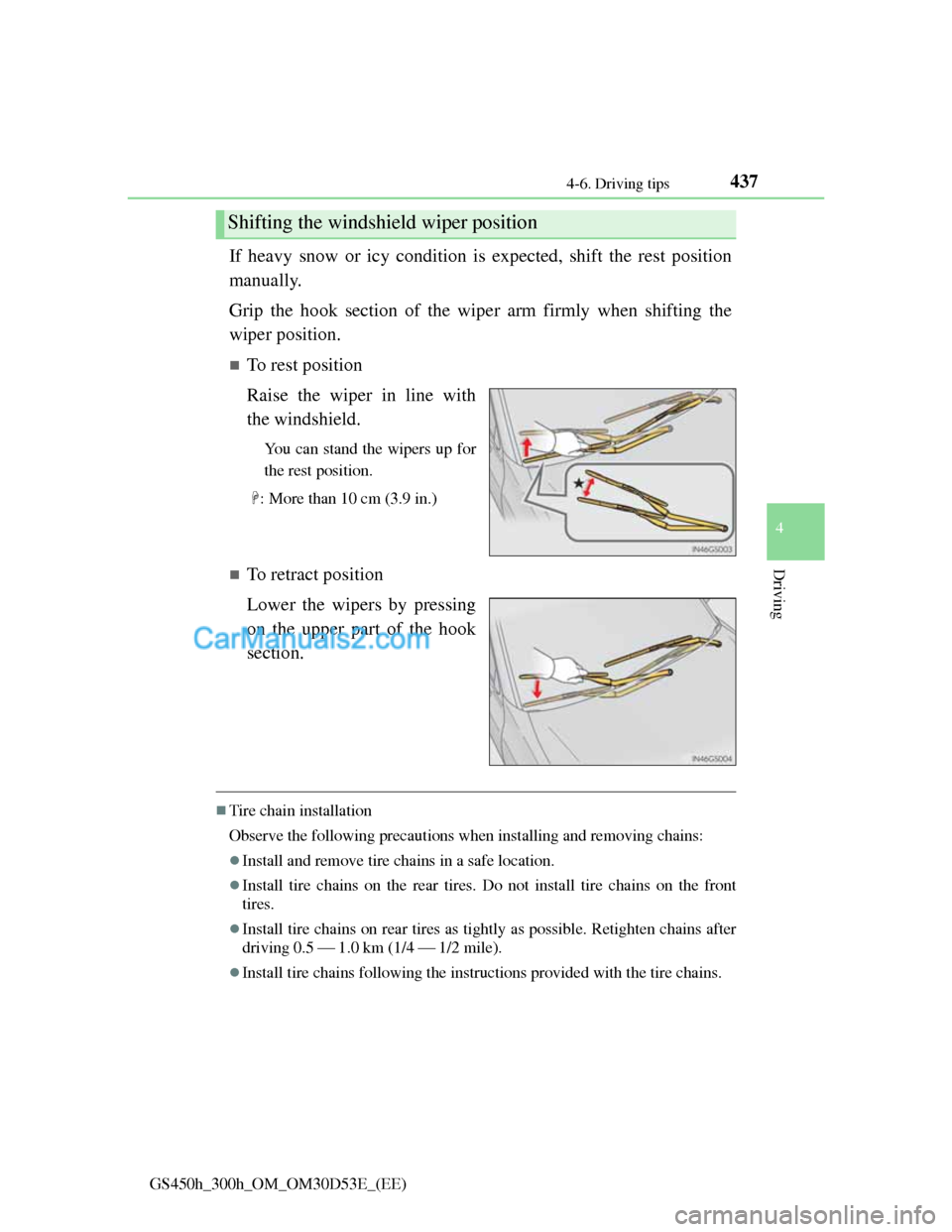
If heavy snow or icy condition is expected, shift the rest position
manually.
Grip the hook section of the wiper arm firmly when shifting the
wiper position.
To rest position
Raise the wiper in line with
the windshield.
You can stand the wipers up for
the rest position.
: More than 10 cm (3.9 in.)
To retract position
Lower the wipers by pressing
on the upper part of the hook
section.
Tire chain installation
Observe the following precautions when installing and removing chains:
Install and remove tire chains in a safe location.
Install tire chains on the rear tires. Do not install tire chains on the front
tires.
Install tire chains on rear tires as tightly as possible. Retighten chains after
driving 0.5 1.0 km (1/4 1/2 mile).
Install tire chains following the instructions provided with the tire chains.
Shifting the windshield wiper position
Page 455 of 1014
4384-6. Driving tips
GS450h_300h_OM_OM30D53E_(EE)
CAUTION
Driving with snow tires
Observe the following precautions to reduce the risk of accidents.
Failure to do so may result in a loss of vehicle control and cause death or
serious injury.
Use tires of the specified size.
Maintain the recommended level of air pressure.
Do not drive at speeds in excess of the speed limit or the speed limit spec-
ified for the snow tires being used.
Use snow tires on all, not just some wheels.
Do not use LKA (Lane-Keeping Assist) system.
Driving with tire chains (vehicles with front and rear tires of the same size
except for the vehicles with LDH and 19 inch tires)
Observe the following precautions to reduce the risk of accidents.
Failure to do so may result in the vehicle being unable to be driven safely,
and may cause death or serious injury.
Do not drive in excess of the speed limit specified for the tire chains being
used, or 50 km/h (30 mph), whichever is lower.
Avoid driving on bumpy road surfaces or over potholes.
Avoid sudden acceleration, abrupt steering, sudden braking and shifting
operations that cause sudden engine braking.
Slow down sufficiently before entering a curve to ensure that vehicle con-
trol is maintained.
Do not use LKA (Lane-Keeping Assist) system.
Page 456 of 1014
4394-6. Driving tips
4
Driving
GS450h_300h_OM_OM30D53E_(EE)
NOTICE
Repairing or replacing snow tires
Request repairs or replacement of snow tires from Lexus dealers or legiti-
mate tire retailers.
This is because the removal and attachment of snow tires affects the opera-
tion of the tire pressure warning valves and transmitters.
Fitting tire chains (vehicles with front and rear tires of the same size except
for the vehicles with LDH and 19 inch tires)
The tire pressure warning valves and transmitters may not function cor-
rectly when tire chains are fitted.
When standing the windshield wipers up
Raise the wipers in line with the windshield. (P. 437)
Failure to do so may result in damage to the wipers and/or the hood.