brake Lexus GS300h 2013 Owner's Guide
[x] Cancel search | Manufacturer: LEXUS, Model Year: 2013, Model line: GS300h, Model: Lexus GS300h 2013Pages: 1014
Page 235 of 1014
2324-1. Before driving
GS450h_300h_OM_OM30D53E_(EE)
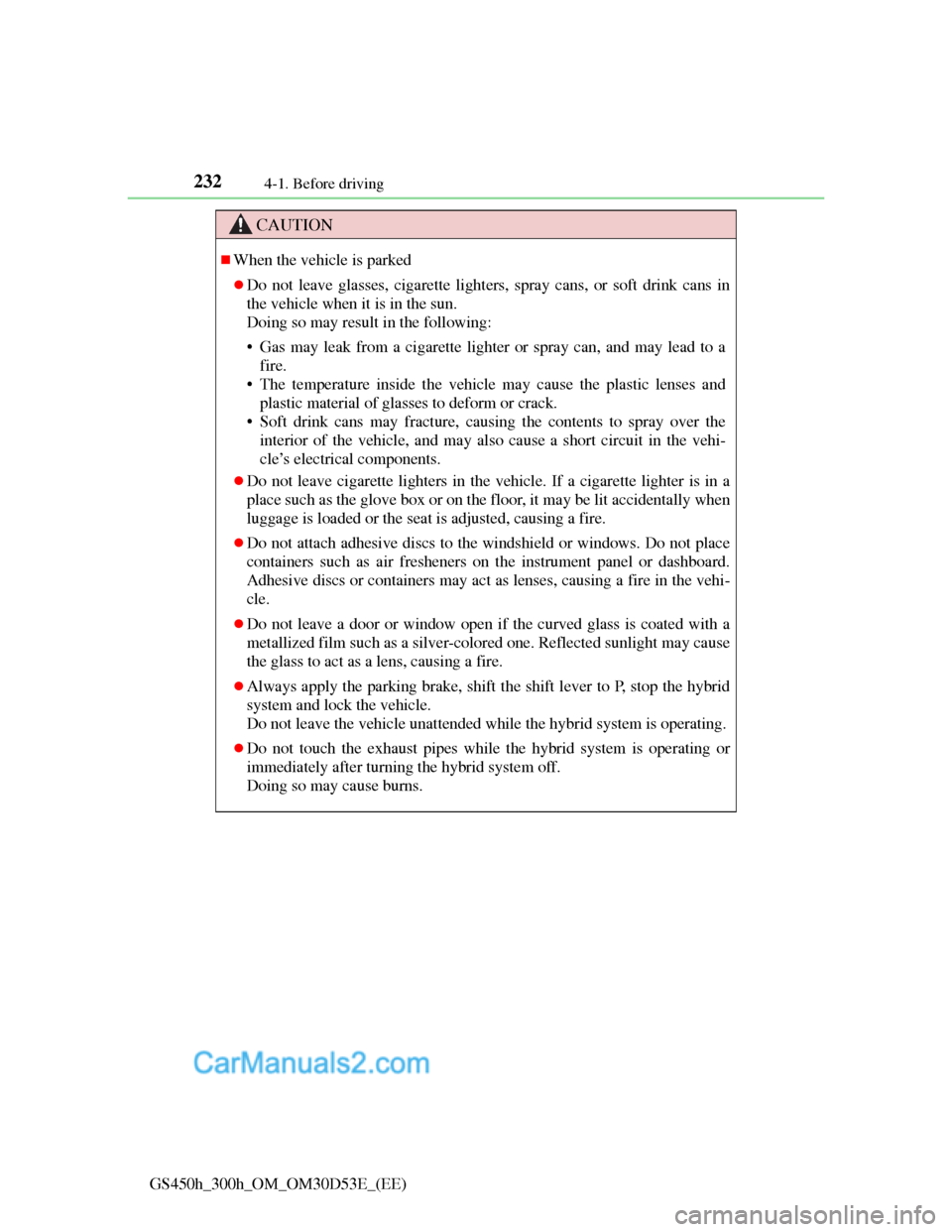
CAUTION
When the vehicle is parked
Do not leave glasses, cigarette lighters, spray cans, or soft drink cans in
the vehicle when it is in the sun.
Doing so may result in the following:
• Gas may leak from a cigarette lighter or spray can, and may lead to a
fire.
• The temperature inside the vehicle may cause the plastic lenses and
plastic material of glasses to deform or crack.
• Soft drink cans may fracture, causing the contents to spray over the
interior of the vehicle, and may also cause a short circuit in the vehi-
cle’s electrical components.
Do not leave cigarette lighters in the vehicle. If a cigarette lighter is in a
place such as the glove box or on the floor, it may be lit accidentally when
luggage is loaded or the seat is adjusted, causing a fire.
Do not attach adhesive discs to the windshield or windows. Do not place
containers such as air fresheners on the instrument panel or dashboard.
Adhesive discs or containers may act as lenses, causing a fire in the vehi-
cle.
Do not leave a door or window open if the curved glass is coated with a
metallized film such as a silver-colored one. Reflected sunlight may cause
the glass to act as a lens, causing a fire.
Always apply the parking brake, shift the shift lever to P, stop the hybrid
system and lock the vehicle.
Do not leave the vehicle unattended while the hybrid system is operating.
Do not touch the exhaust pipes while the hybrid system is operating or
immediately after turning the hybrid system off.
Doing so may cause burns.
Page 236 of 1014
2334-1. Before driving
4
Driving
GS450h_300h_OM_OM30D53E_(EE)
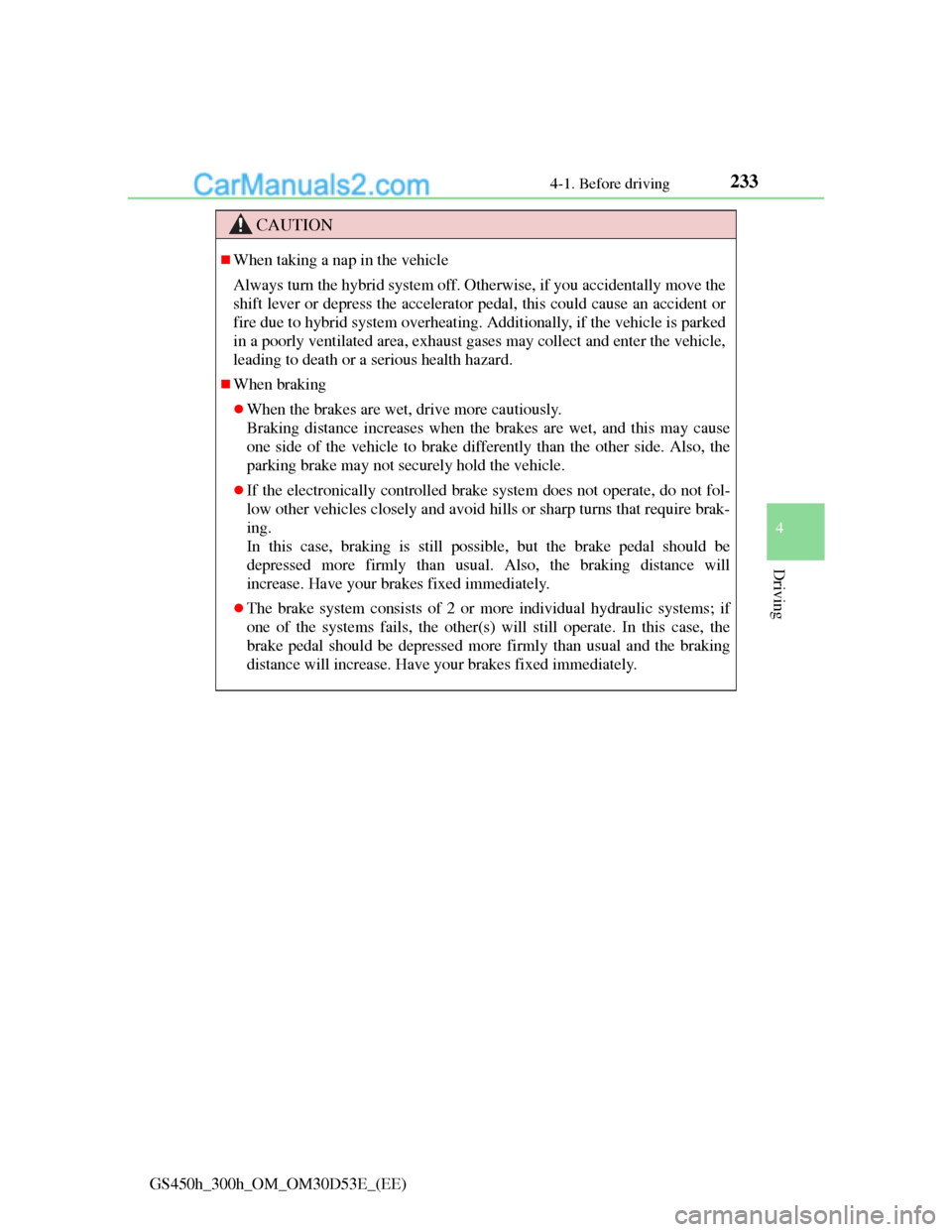
CAUTION
When taking a nap in the vehicle
Always turn the hybrid system off. Otherwise, if you accidentally move the
shift lever or depress the accelerator pedal, this could cause an accident or
fire due to hybrid system overheating. Additionally, if the vehicle is parked
in a poorly ventilated area, exhaust gases may collect and enter the vehicle,
leading to death or a serious health hazard.
When braking
When the brakes are wet, drive more cautiously.
Braking distance increases when the brakes are wet, and this may cause
one side of the vehicle to brake differently than the other side. Also, the
parking brake may not securely hold the vehicle.
If the electronically controlled brake system does not operate, do not fol-
low other vehicles closely and avoid hills or sharp turns that require brak-
ing.
In this case, braking is still possible, but the brake pedal should be
depressed more firmly than usual. Also, the braking distance will
increase. Have your brakes fixed immediately.
The brake system consists of 2 or more individual hydraulic systems; if
one of the systems fails, the other(s) will still operate. In this case, the
brake pedal should be depressed more firmly than usual and the braking
distance will increase. Have your brakes fixed immediately.
Page 237 of 1014
2344-1. Before driving
GS450h_300h_OM_OM30D53E_(EE)
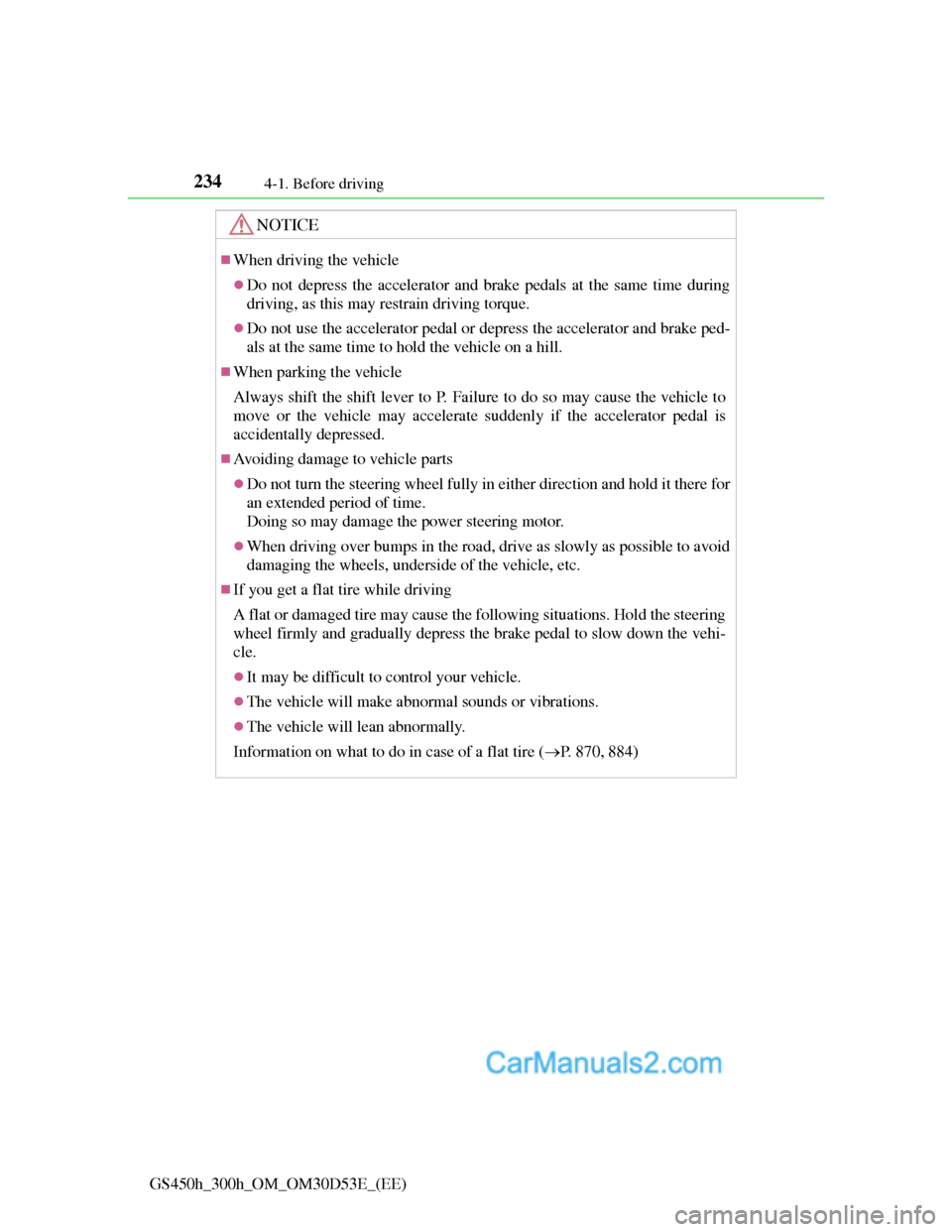
NOTICE
When driving the vehicle
Do not depress the accelerator and brake pedals at the same time during
driving, as this may restrain driving torque.
Do not use the accelerator pedal or depress the accelerator and brake ped-
als at the same time to hold the vehicle on a hill.
When parking the vehicle
Always shift the shift lever to P. Failure to do so may cause the vehicle to
move or the vehicle may accelerate suddenly if the accelerator pedal is
accidentally depressed.
Avoiding damage to vehicle parts
Do not turn the steering wheel fully in either direction and hold it there for
an extended period of time.
Doing so may damage the power steering motor.
When driving over bumps in the road, drive as slowly as possible to avoid
damaging the wheels, underside of the vehicle, etc.
If you get a flat tire while driving
A flat or damaged tire may cause the following situations. Hold the steering
wheel firmly and gradually depress the brake pedal to slow down the vehi-
cle.
It may be difficult to control your vehicle.
The vehicle will make abnormal sounds or vibrations.
The vehicle will lean abnormally.
Information on what to do in case of a flat tire (P. 870, 884)
Page 238 of 1014
235
4 4-1. Before driving
Driving
GS450h_300h_OM_OM30D53E_(EE)
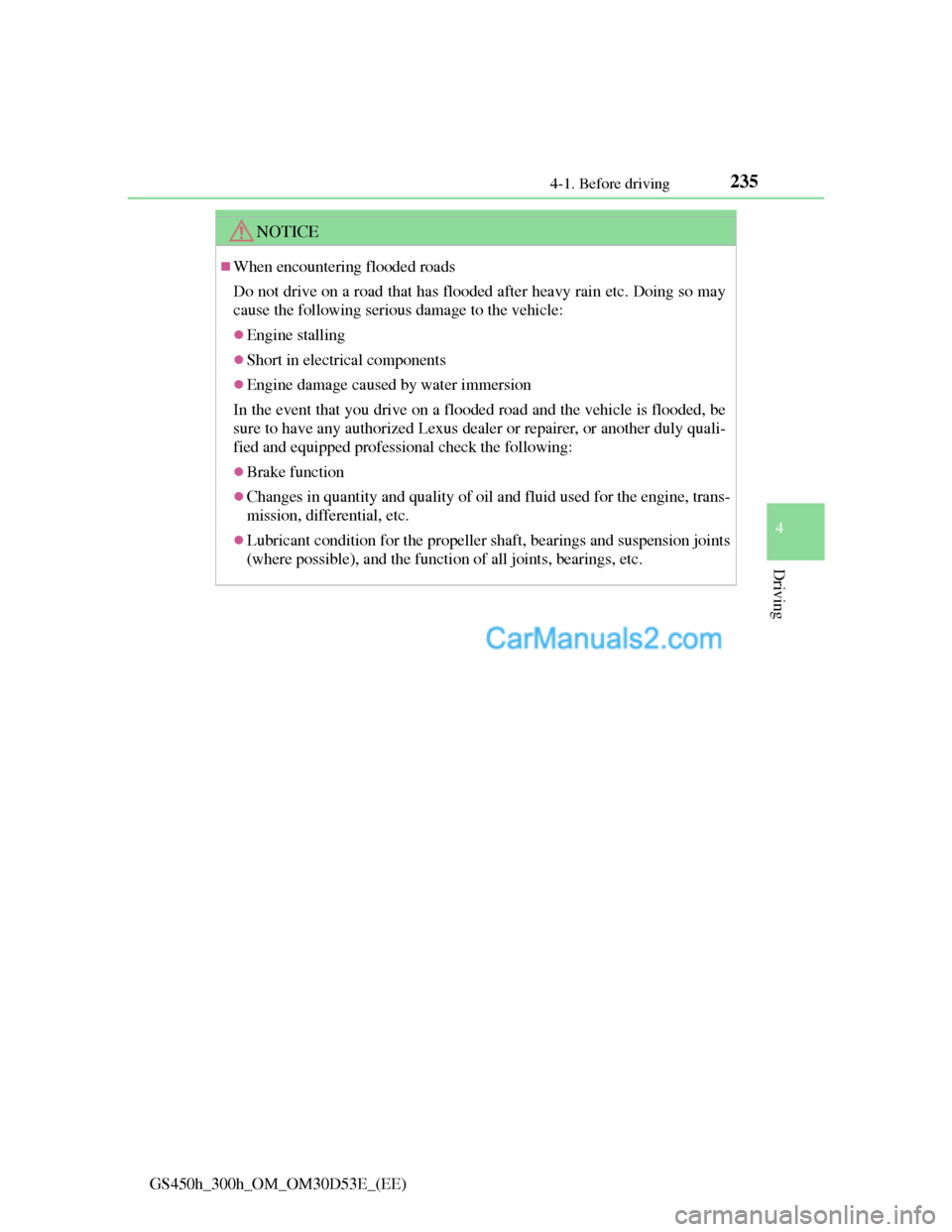
NOTICE
When encountering flooded roads
Do not drive on a road that has flooded after heavy rain etc. Doing so may
cause the following serious damage to the vehicle:
Engine stalling
Short in electrical components
Engine damage caused by water immersion
In the event that you drive on a flooded road and the vehicle is flooded, be
sure to have any authorized Lexus dealer or repairer, or another duly quali-
fied and equipped professional check the following:
Brake function
Changes in quantity and quality of oil and fluid used for the engine, trans-
mission, differential, etc.
Lubricant condition for the propeller shaft, bearings and suspension joints
(where possible), and the function of all joints, bearings, etc.
Page 248 of 1014
2454-1. Before driving
4
Driving
GS450h_300h_OM_OM30D53E_(EE)
Increasing vehicle-to-vehicle distance
At a speed of 10 km/h (6 mph), the distance to the vehicle run-
ning ahead of you should be equivalent to or greater than the
combined length of your vehicle and trailer. Avoid sudden brak-
ing that may cause skidding. Otherwise, the vehicle may spin out
of control. This is especially true when driving on wet or slippery
road surfaces.
Sudden acceleration/steering input/cornering
Executing sharp turns when towing may result in the trailer col-
liding with your vehicle. Decelerate well in advance when
approaching turns and take them slowly and carefully to avoid
sudden braking.
Important points regarding turning
The wheels of the trailer will travel closer to the inside of the
curve than the wheels of the vehicle. To make allowance for this,
take the turns wider than you would normally do.
Important points regarding stability
Vehicle movement resulting from uneven road surfaces and
strong crosswinds will affect handling. The vehicle may also be
rocked by passing buses or large trucks. Frequently check behind
when moving alongside such vehicles. As soon as such vehicle
movement occurs, immediately start to decelerate smoothly by
slowly applying the brakes. Always steer the vehicle straight
ahead while braking.
Passing other vehicles
Consider the total combined length of your vehicle and trailer
and ensure that the vehicle-to-vehicle distance is sufficient
before executing lane changes.
Transmission information
Page 250 of 1014
2474-1. Before driving
4
Driving
GS450h_300h_OM_OM30D53E_(EE)
If the engine overheats
Towing a loaded trailer up a long, steep incline in temperatures
exceeding 30C (85F) may result in the engine overheating. If
the engine coolant temperature gauge indicates that the engine is
overheating, turn the air conditioning off immediately, leave the
road and stop the vehicle in a safe place. (P. 915)
When parking the vehicle
Always place wheel chocks under the wheels of both the vehicle
and trailer. Firmly set the parking brake and shift the shift lever
to P.
CAUTION
To avoid accident or injury
Do not tow a trailer when the compact spare tire is installed on your vehi-
cle.
Do not tow a trailer when the tire installed is repaired with the emergency
tire puncture repair kit.
Do not use cruise control (if equipped) or dynamic radar cruise control (if
equipped) when trailer towing.
Vehicle speed in towing
Observe the legal maximum speeds for trailer towing.
Before descending hills or long declines
Reduce speed and downshift. However, never downshift suddenly while
descending steep or long downhill grades.
Operation of the brake pedal
Do not hold the brake pedal depressed often or for long periods of time.
Doing so may result in the brake overheating or reduce braking effects.
Page 252 of 1014
2464-2. Driving procedures
GS450h_300h_OM_OM30D53E_(EE)
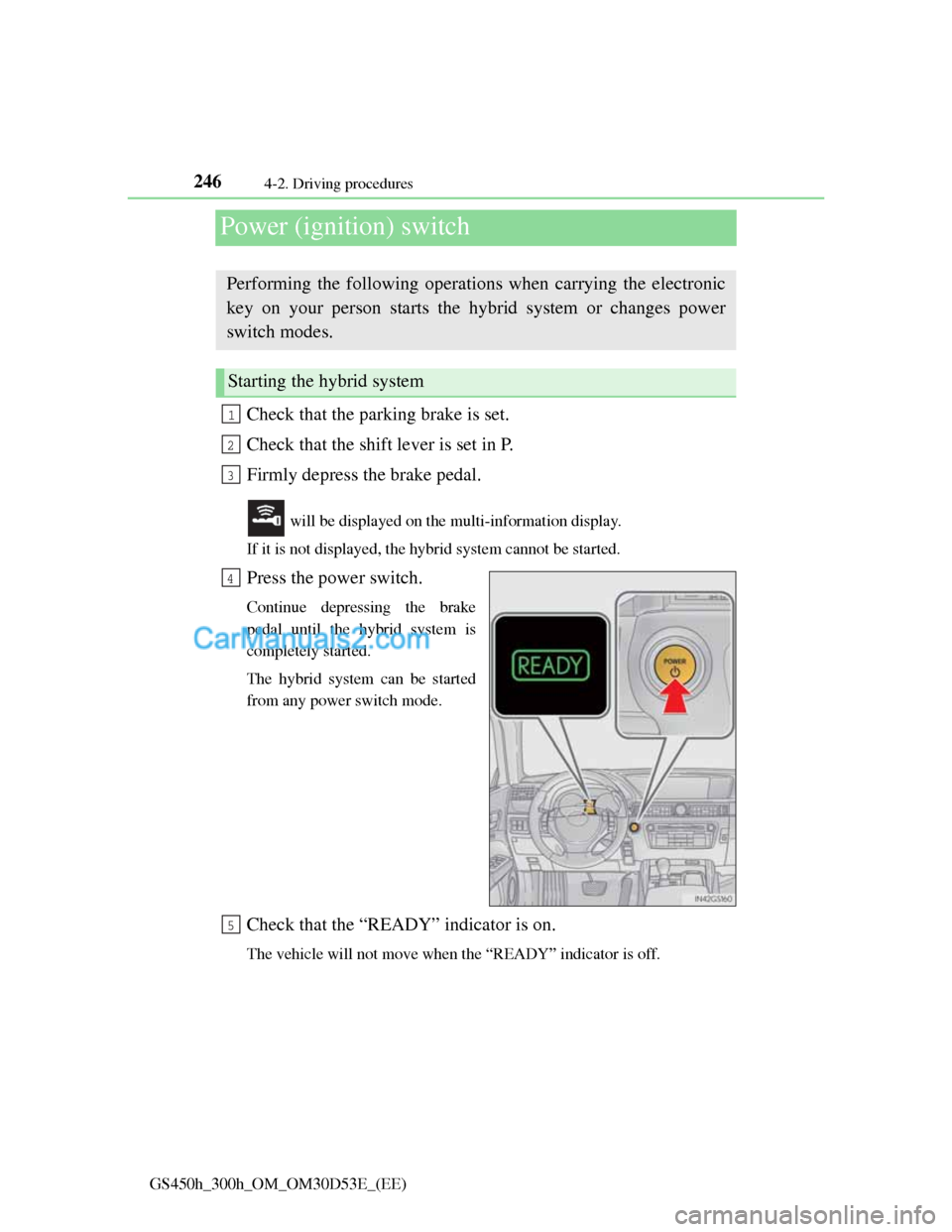
Power (ignition) switch
Check that the parking brake is set.
Check that the shift lever is set in P.
Firmly depress the brake pedal.
will be displayed on the multi-information display.
If it is not displayed, the hybrid system cannot be started.
Press the power switch.
Continue depressing the brake
pedal until the hybrid system is
completely started.
The hybrid system can be started
from any power switch mode.
Check that the “READY” indicator is on.
The vehicle will not move when the “READY” indicator is off.
Performing the following operations when carrying the electronic
key on your person starts the hybrid system or changes power
switch modes.
Starting the hybrid system
1
2
3
4
5
Page 253 of 1014
2474-2. Driving procedures
4
Driving
GS450h_300h_OM_OM30D53E_(EE)
Stop the vehicle.
Shift the shift lever to P.
Set the parking brake. (P. 269)
Press the power switch.
Release the brake pedal and check that “POWER ON” on the
multi-information display is off.
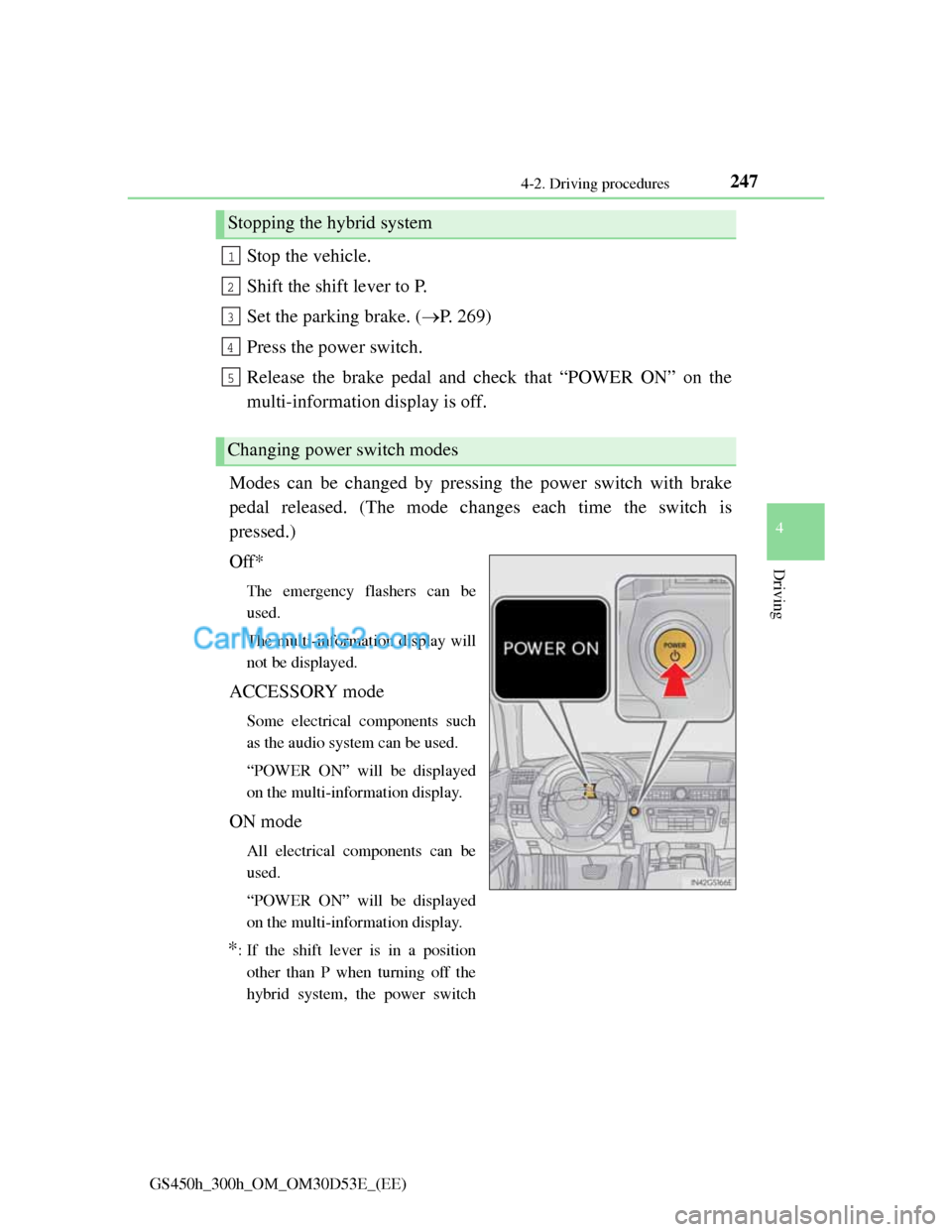
Modes can be changed by pressing the power switch with brake
pedal released. (The mode changes each time the switch is
pressed.)
Off*
The emergency flashers can be
used.
The multi-information display will
not be displayed.
ACCESSORY mode
Some electrical components such
as the audio system can be used.
“POWER ON” will be displayed
on the multi-information display.
ON mode
All electrical components can be
used.
“POWER ON” will be displayed
on the multi-information display.
*: If the shift lever is in a position
other than P when turning off the
hybrid system, the power switch
Stopping the hybrid system
Changing power switch modes
1
2
3
4
5
Page 255 of 1014
2494-2. Driving procedures
4
Driving
GS450h_300h_OM_OM30D53E_(EE)
If the hybrid system is stopped with the shift lever in a position
other than P, the power switch will not be turned off but instead be
turned to ACCESSORY mode. Perform the following procedure to
turn the switch off:
Check that the parking brake is set.
Shift the shift lever to P.
Check that “POWER ON” and “Turn Power OFF” are displayed
alternately on the multi-information display and then press the
power switch once.
Check that “POWER ON” and “Turn Power OFF” on the multi-
information display are off.
When stopping the hybrid system with the shift lever in a
position other than P
1
2
3
4
Page 257 of 1014
2514-2. Driving procedures
4
Driving
GS450h_300h_OM_OM30D53E_(EE)
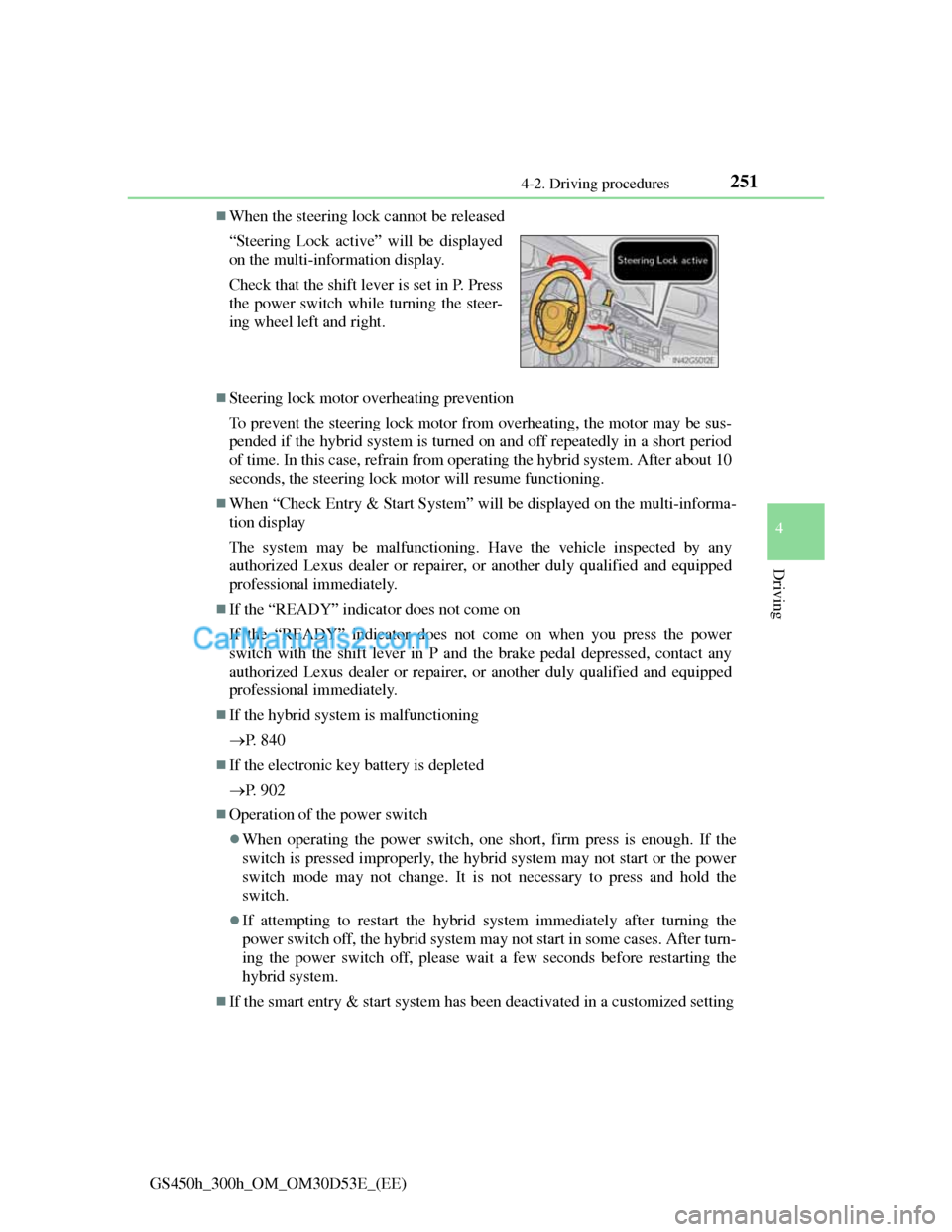
When the steering lock cannot be released
Steering lock motor overheating prevention
To prevent the steering lock motor from overheating, the motor may be sus-
pended if the hybrid system is turned on and off repeatedly in a short period
of time. In this case, refrain from operating the hybrid system. After about 10
seconds, the steering lock motor will resume functioning.
When “Check Entry & Start System” will be displayed on the multi-informa-
tion display
The system may be malfunctioning. Have the vehicle inspected by any
authorized Lexus dealer or repairer, or another duly qualified and equipped
professional immediately.
If the “READY” indicator does not come on
If the “READY” indicator does not come on when you press the power
switch with the shift lever in P and the brake pedal depressed, contact any
authorized Lexus dealer or repairer, or another duly qualified and equipped
professional immediately.
If the hybrid system is malfunctioning
P. 8 4 0
If the electronic key battery is depleted
P. 9 0 2
Operation of the power switch
When operating the power switch, one short, firm press is enough. If the
switch is pressed improperly, the hybrid system may not start or the power
switch mode may not change. It is not necessary to press and hold the
switch.
If attempting to restart the hybrid system immediately after turning the
power switch off, the hybrid system may not start in some cases. After turn-
ing the power switch off, please wait a few seconds before restarting the
hybrid system.
If the smart entry & start system has been deactivated in a customized setting “Steering Lock active” will be displayed
on the multi-information display.
Check that the shift lever is set in P. Press
the power switch while turning the steer-
ing wheel left and right.