headlights Lexus GS300h 2015 Owner's Guide
[x] Cancel search | Manufacturer: LEXUS, Model Year: 2015, Model line: GS300h, Model: Lexus GS300h 2015Pages: 620
Page 288 of 620
2884-5. Using the driving support systems
GS450h_300h_OM_OM30F00E_(EE)
■Hands off steering wheel alert
When the system determines that the driver has removed their hands from the steering
wheel while the lane departure control function or lane centering function is operating, a
warning message is displayed on the multi-information display.
If the driver continues to keep their hands off of the steering wheel, the buzzer sounds, a
warning message is displayed and the function is temporarily canceled. This alert also
operates in the same way when the vehicle is driven with the steering wheel lightly
gripped. However, depending on the road conditions, etc., the function may not cancel.
■White (yellow) lines are only on one side of road
The LKA system will not operate for the side on which white (yellow) lines could not be
recognized.
■Conditions in which functi ons may not operate properly
In the following situations, the camera sensor may not detect white (yellow) lines and var-
ious functions may not operate normally.
●There are shadows on the road that run parallel with, or cover, the white (yellow) lines.
●The vehicle is driven in an area without white (yellow) lines, such as in front of a tollgate
or checkpoint, or at an intersection, etc.
●The white (yellow) lines are cracked, “Raised pavement marker” or stones are present.
●The white (yellow) lines cannot be seen or are difficult to see due to sand, etc.
●The vehicle is driven on a road surface that is wet due to rain, puddles, etc.
●The traffic lines are yellow (which may be more difficult to recognize than lines that are
white).
●The white (yellow) lines cross over a curb, etc.
●The vehicle is driven on a bright surface, such as concrete.
●The vehicle is driven on a surface that is bright due to reflected light, etc.
●The vehicle is driven in an area where the brightness changes suddenly, such as at the
entrances and exits of tunnels, etc.
●Light from the headlights of an oncoming vehicle, the sun, etc., enters the camera.
●The vehicle is driven where the road diverges, merges, etc.
●The vehicle is driven on a slope.
●The vehicle is driven on a road which t ilts left or right, or a winding road.
●The vehicle is driven on an unpaved or rough road.
●The vehicle is driven around a sharp curve.
●The traffic lane is excessively narrow or wide.
●The vehicle is extremely tilted due to carrying heavy luggage or having improper tire
pressure.
●The distance to the preceding vehicle is extremely short.
●The vehicle is moving up and down a large am ount due to road conditions during driv-
ing (poor roads or road seams).
●The headlight lenses are dirty and emit a faint amount of light at night, or the beam axis
has deviated.
●The vehicle is struck by a crosswind.
●The vehicle has just changed lanes or crossed an intersection.
●Snow tires, etc., are equipped.
Page 292 of 620

2924-5. Using the driving support systems
GS450h_300h_OM_OM30F00E_(EE)
WA R N I N G
■Before using LDA system
Do not rely solely upon the LDA system. LDA is not a system which automatically
drives the vehicle or reduces the amount of attention that must be paid to the area in
front of the vehicle. The driver must always assume full responsibility for driving safely
by always paying careful attention to the surrounding conditions and operate the steer-
ing wheel to correct the path of the vehicle. Also, make sure to take adequate breaks
when fatigued, such as from driving for a long period of time.
Failure to perform appropriate driving operations and pay careful attention may lead to
an accident, resulting in death or serious injury.
■To avoid operating LDA by mistake
When not using the LDA system, use the LDA switch to turn the system off.
■Situations unsuitable for LDA
Do not use the LDA system in the following situations.
The system may not operate properly and lead to an accident, resulting in death or
serious injury.
●A spare tire, tire chains, etc., are equipped.
●When the tires have been excessively worn, or when the tire inflation pressure is low.
●Tires which differ by structure, manufacturer, brand or tread pattern are used.
●Objects or patterns that could be mistaken for white (yellow) lines are present on the
side of the road (guardrails, curbs, reflective poles, etc.).
●Vehicle is driven on a snow-covered road.
●White (yellow) lines are difficult to see due to rain, snow, fog, dust, etc.
●Asphalt repair marks, white (yellow) line ma rks, etc., are present due to road repair.
●Vehicle is driven in a temporary lane or restricted lane due to construction work.
●Vehicle is driven on a road surface which is slippery due to rainy weather, fallen snow,
freezing, etc.
●Vehicle is driven in traffic lanes other than on highways and freeways.
●Vehicle is driven in a construction zone.
●Vehicle is towing a trailer or another vehicle.
■Preventing LDA system malfunctions and operations performed by mistake
●Do not modify the headlights or place stickers, etc., on the surface of the lights.
●Do not modify the suspension etc. If the suspension etc. needs to be replaced, con-
tact any authorized Lexus dealer or repair er, or another duly qualified and equipped
professional.
●Do not install or place anything on the hood or grille. Also, do not install a grille guard
(bull bars, kangaroo bar, etc.).
●If your windshield needs repairs, contact any authorized Lexus dealer or repairer, or
another duly qualified and equipped professional.
Page 296 of 620
2964-5. Using the driving support systems
GS450h_300h_OM_OM30F00E_(EE)
■Conditions in which functions may not operate properly
In the following situations, the camera sensor may not detect white (yellow) lines and var-
ious functions may not operate normally.
●There are shadows on the road that run parallel with, or cover, the white (yellow) lines.
●The vehicle is driven in an area without white (yellow) lines, such as in front of a tollgate
or checkpoint, or at an intersection, etc.
●The white (yellow) lines are cracked, “Raised pavement marker” or stones are present.
●The white (yellow) lines cannot be seen or are difficult to see due to sand, etc.
●The vehicle is driven on a road surface that is wet due to rain, puddles, etc.
●The traffic lines are yellow (which may be more difficult to recognize than lines that are
white).
●The white (yellow) lines cross over a curb, etc.
●The vehicle is driven on a bright surface, such as concrete.
●The vehicle is driven on a surface that is bright due to reflected light, etc.
●The vehicle is driven in an area where the brightness changes suddenly, such as at the
entrances and exits of tunnels, etc.
●Light from the headlights of an oncoming vehicle, the sun, etc., enters the camera.
●The vehicle is driven where the road diverges, merges, etc.
●The vehicle is driven on a slope.
●The vehicle is driven on a road which t ilts left or right, or a winding road.
●The vehicle is driven on an unpaved or rough road.
●The vehicle is driven around a sharp curve.
●The traffic lane is excessively narrow or wide.
●The vehicle is extremely tilted due to carrying heavy luggage or having improper tire
pressure.
●The distance to the preceding vehicle is extremely short.
●The vehicle is moving up and down a large am ount due to road conditions during driv-
ing (poor roads or road seams).
●The headlight lenses are dirty and emit a faint amount of light at night, or the beam axis
has deviated.
●The vehicle is struck by a crosswind.
●The vehicle has just changed lanes or crossed an intersection.
●Snow tires, etc., are equipped.
Page 458 of 620
4586-3. Do-it-yourself maintenance
GS450h_300h_OM_OM30F00E_(EE)
Light bulbs
Check the wattage of the light bulb to be replaced. ( →P. 5 7 8 )
→ P. 4 2 1
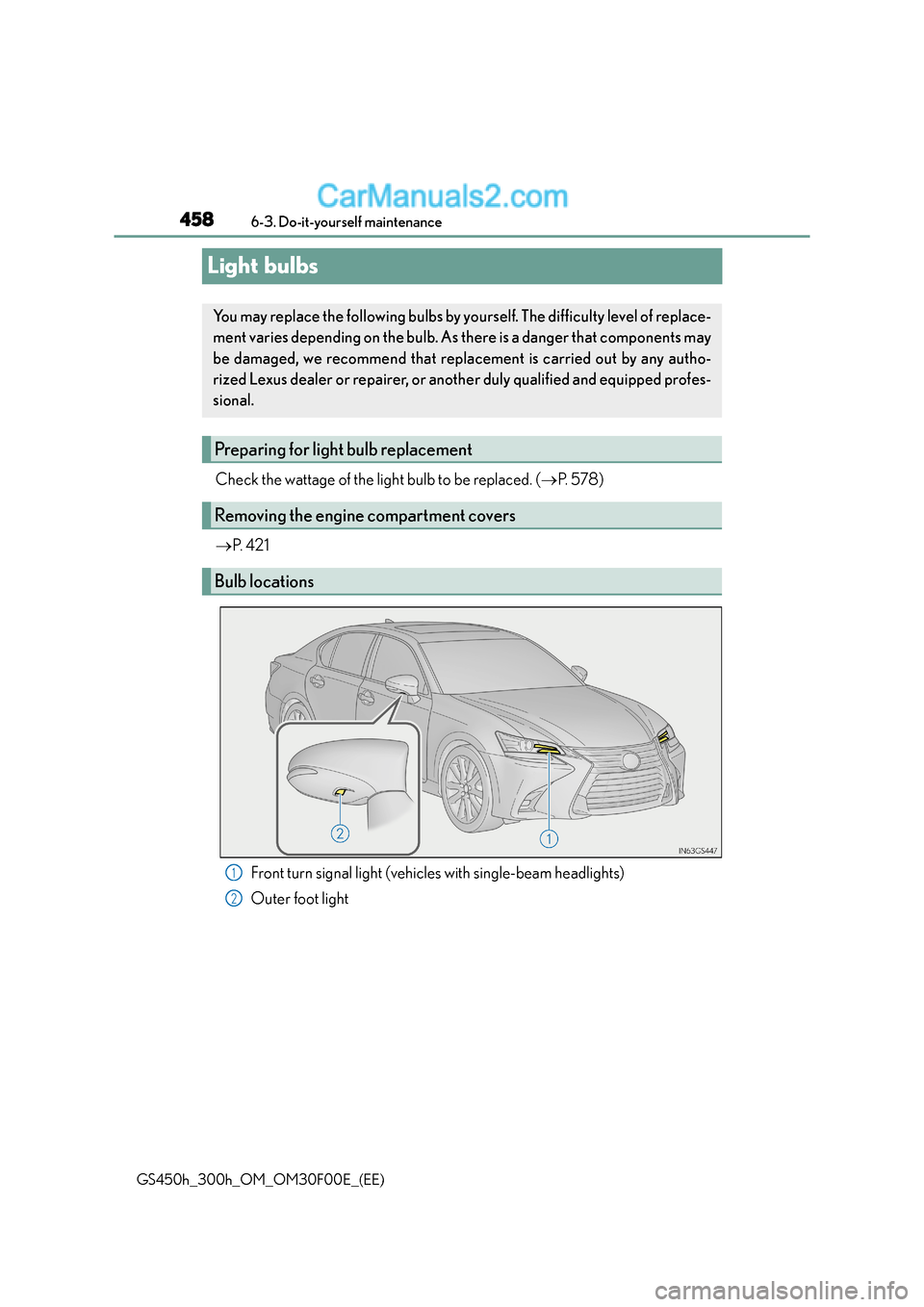
Front turn signal light (vehicles with single-beam headlights)
Outer foot light
You may replace the following bulbs by yourself. The difficulty level of replace-
ment varies depending on the bulb. As there is a danger that components may
be damaged, we recommend that replacement is carried out by any autho-
rized Lexus dealer or repairer, or an other duly qualified and equipped profes-
sional.
Preparing for light bulb replacement
Removing the engine compartment covers
Bulb locations
1
2
Page 459 of 620
459 6-3. Do-it-yourself maintenance
6
Maintenance and care
GS450h_300h_OM_OM30F00E_(EE)
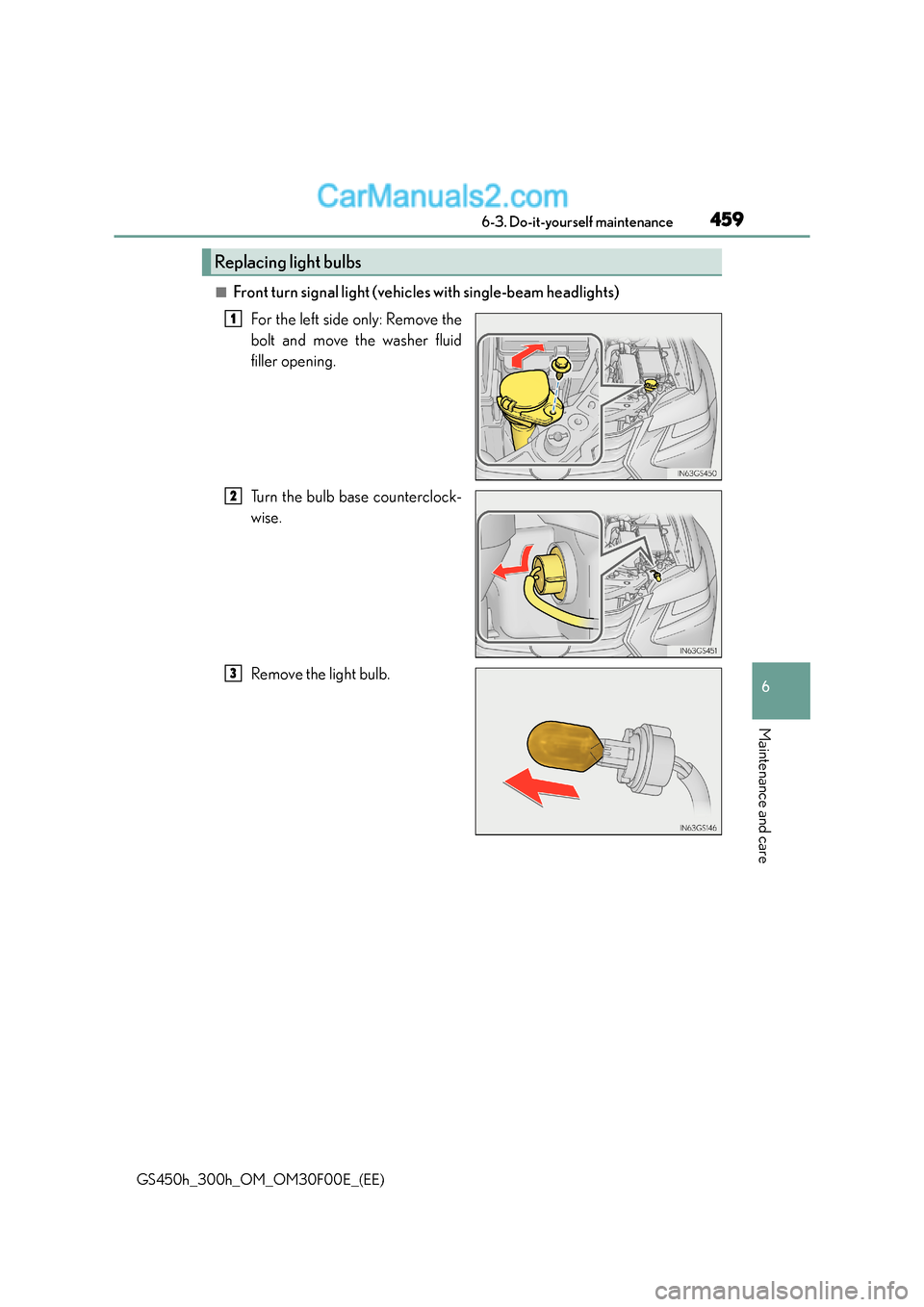
■Front turn signal light (vehicles with single-beam headlights)For the lef t side only: Remove the
bolt and move the washer fluid
filler opening.
Turn the bulb base counterclock-
wise.
Remove the light bulb.
Replacing light bulbs
1
2
3
Page 465 of 620
465 6-3. Do-it-yourself maintenance
6
Maintenance and care
GS450h_300h_OM_OM30F00E_(EE)
■Replacing the following bulbs
If any of the lights listed below has burnt out, have it replaced by any autho-
rized Lexus dealer or repairer, or another duly qualified and equipped profes-
sional.
●Headlights
●Front position lights/daytime running lights
●Front fog lights
●Front turn signal lights (vehicles with triple-beam headlights)
●Side turn signal lights
●Stop/tail lights
●Stop lights
●Rear fog light
●Rear turn signal lights
●Back-up lights
●High mounted stoplight
●License plate lights
■LED Lights
The lights other than the front turn signal light (vehicles with single-beam headlights) and
outer foot lights each consist of a number of LEDs. If any of the LEDs burn out, take your
vehicle to any authorized Lexus dealer or repairer, or another duly qualified and
equipped professional to have the light replaced.
■Condensation build-up on the inside of the lens
Temporary condensation build-up on the inside of the headlight lens does not indicate a
malfunction. Contact any authorized Lexus dealer or repairer, or another duly qualified
and equipped professional for more information in the following situations:
●Large drops of water have built up on the inside of the lens.
●Water has built up inside the headlight.
■When replacing light bulbs
→ P. 4 5 7
Page 506 of 620
5067-2. Steps to take in an emergency
GS450h_300h_OM_OM30F00E_(EE)
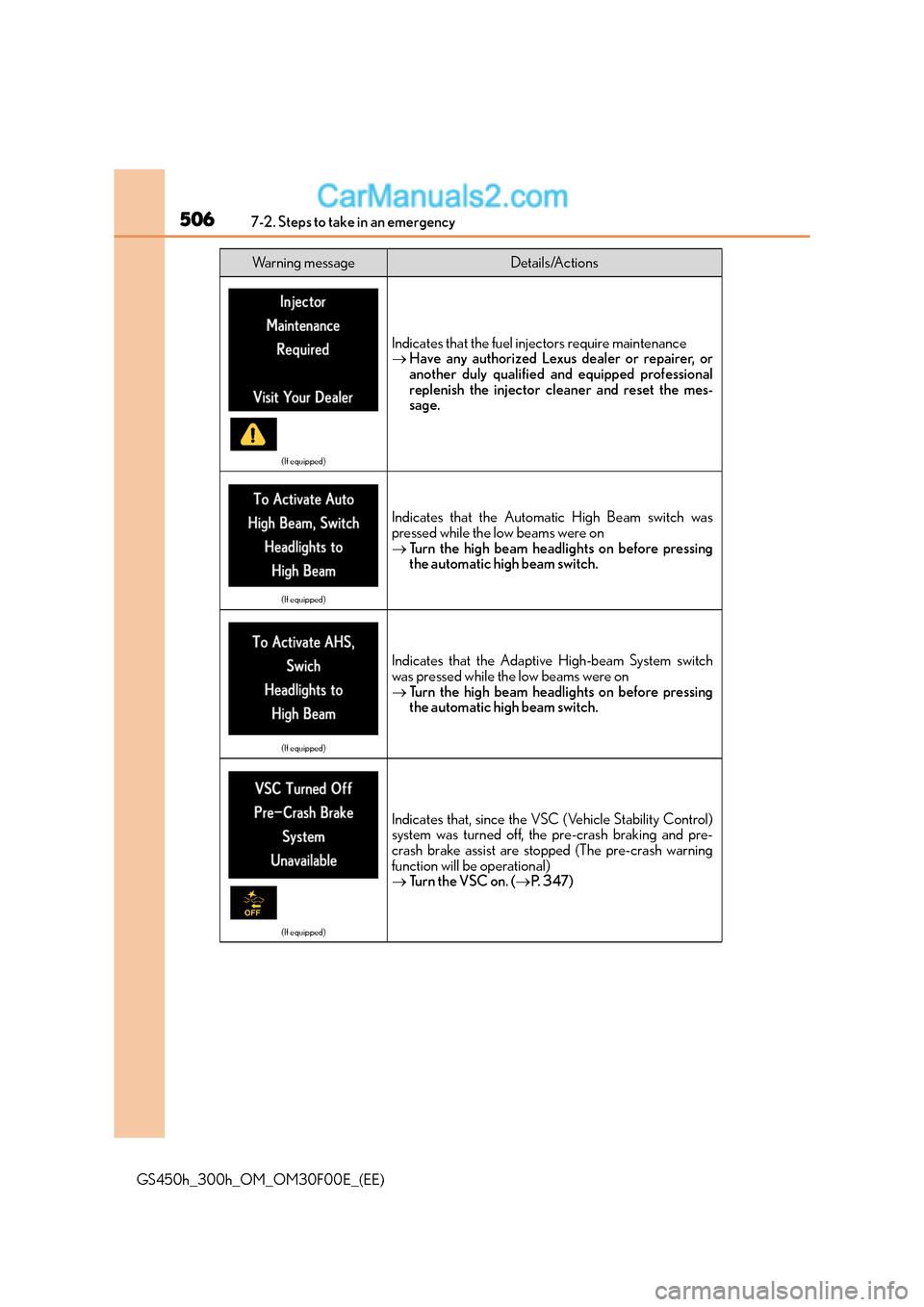
(If equipped)
Indicates that the fuel injectors require maintenance
→Have any authorized Lexus dealer or repairer, or
another duly qualified and equipped professional
replenish the injector cl eaner and reset the mes-
sage.
(If equipped)
Indicates that the Automatic High Beam switch was
pressed while the low beams were on
→ Turn the high beam headlights on before pressing
the automatic high beam switch.
(If equipped)
Indicates that the Adaptive High-beam System switch
was pressed while the low beams were on
→Turn the high beam headlights on before pressing
the automatic high beam switch.
(If equipped)
Indicates that, since the VSC (Vehicle Stability Control)
system was turned off, the pre-crash braking and pre-
crash brake assist are stopped (The pre-crash warning
function will be operational)
→Tu r n t h e V S C o n . ( →P. 3 4 7 )
Wa r n i n g m e s s a g eDetails/Actions
Page 543 of 620
543
7
7-2. Steps to take in an emergency
When trouble arises
GS450h_300h_OM_OM30F00E_(EE)
If the hybrid system will not start
One of the following may be the cause of the problem:
●The electronic key may not be functioning properly. (
→P. 549)
●There may not be sufficient fuel in the vehicle’s tank.
Refuel the vehicle.
●There may be a malfunction in the immobilizer system. ( →P. 8 4 )
●There may be a malfunction in the steering lock system.
●The hybrid system may be malfunctioning due to an electrical problem such
as electronic key battery depletion or a blown fuse. However, depending on
the type of malfunction, an interim measure is available to start the hybrid sys-
tem. ( →P. 544)
One of the following may be the cause of the problem:
●The 12-volt battery may be discharged. ( →P. 5 5 1 )
●The 12-volt battery terminal connections may be loose or corroded.
(→ P. 4 2 8 )
One of the following may be the cause of the problem:
●The 12-volt battery may be discharged. ( →P. 5 5 1 )
●One or both of the 12-volt battery terminals may be disconnected. ( →P. 4 2 8 )
Contact any authorized Lexus dealer or repairer, or another duly qualified and
equipped professional if the problem cannot be repaired, or if repair procedures are
unknown.
Reasons for the hybrid system not starting vary depending on the situation.
Check the following and perform the appropriate procedure:
The hybrid system will not start even though the correct starting proce-
dure is being followed. ( →P. 217)
The interior lights and headlights are dim, or the horn does not sound or
sounds at a low volume.
The interior lights and he adlights do not turn on, or the horn does not
sound.
Page 554 of 620
5547-2. Steps to take in an emergency
GS450h_300h_OM_OM30F00E_(EE)
■Starting the hybrid system when the 12-volt battery is discharged
The hybrid system cannot be started by push-starting.
■To prevent 12-volt battery discharge
●Turn off the headlights and the audio system while the hybrid system is off.
●Turn off any unnecessary electrical components when the vehicle is running at a low
speed for an extended period, such as in heavy traffic.
■Charging the 12-volt battery
The electricity stored in the 12-volt battery will discharge gradually even when the vehicle
is not in use, due to natural discharge and the draining effects of certain electrical appli-
ances. If the vehicle is left for a long time, the 12-volt battery may discharge, and the
hybrid system may be unable to start. (The 12-volt battery recharges automatically while
the hybrid system is operating.)
■When recharging or replacing the 12-volt battery
●In some cases, it may not be possible to un lock the doors using the smart entry & start
system when the 12-volt battery is discharged. Use the wireless remote control or the
mechanical key to lock or unlock the doors.
●The hybrid system may not start on the first attempt after the 12-volt battery has
recharged but will start normally after the second attempt. This is not a malfunction.
●The power switch mode is memorized by the vehicle. When the 12-volt battery is
reconnected, the system will return to the mo de it was in before the 12-volt battery was
discharged. Before disconnecting the 12-volt battery, turn the power switch off.
If you are unsure what mode the power switch was in before the 12-volt battery dis-
charged, be especially careful when reconnecting the 12-volt battery.
WA R N I N G
■Avoiding 12-volt battery fires or explosions
Observe the following precautions to prevent accidentally igniting the flammable gas
that may be emitted from the 12-volt battery:
●Make sure each jumper cable is connected to the correct terminal and that it is not
unintentionally in contact with any other than the intended terminal.
●Do not allow the other end of the jumper cable connected to the “+” terminal to come
into contact with any other parts or metal surfaces in the area, such as brackets or
unpainted metal.
●Do not allow the + and - clamps of the jumper cables to come into contact with each
other.
●Do not smoke, use matches, cigarette lighters or allow open flame near the 12-volt
battery.
Page 578 of 620
5788-1. Specifications
GS450h_300h_OM_OM30F00E_(EE)
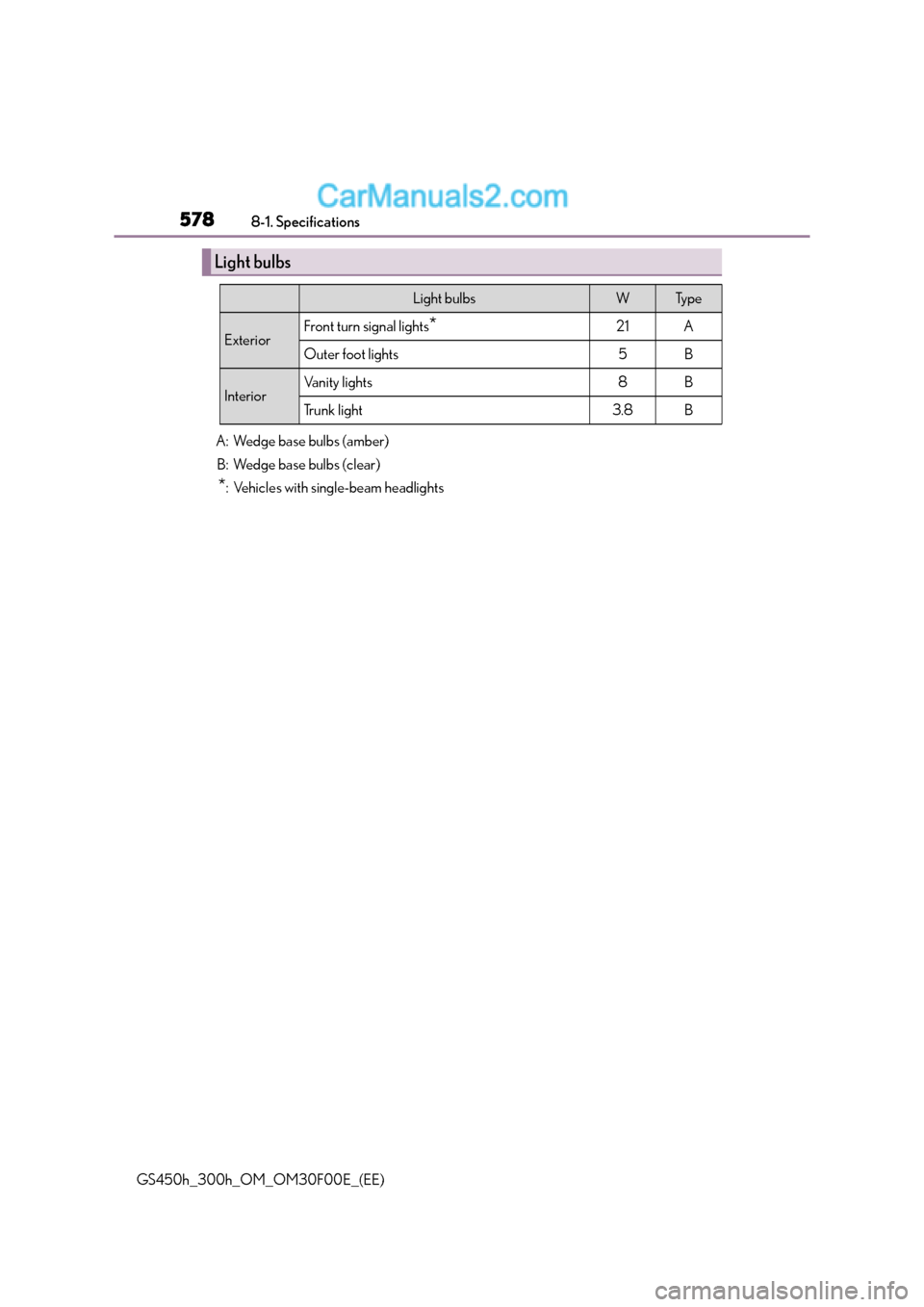
Light bulbs
Light bulbsWTy p e
ExteriorFront turn signal lights*21A
Outer foot lights5B
InteriorVanity lights8B
Trunk light3.8B
A: Wedge base bulbs (amber) B: Wedge base bulbs (clear)
*: Vehicles with single-beam headlights