light Lexus GS300h 2016 Owner's Manual
[x] Cancel search | Manufacturer: LEXUS, Model Year: 2016, Model line: GS300h, Model: Lexus GS300h 2016Pages: 620
Page 415 of 620
415
6
6-3. Do-it-yourself maintenance
Maintenance and care
GS450h_300h_OM_OM30F00E_(EE)
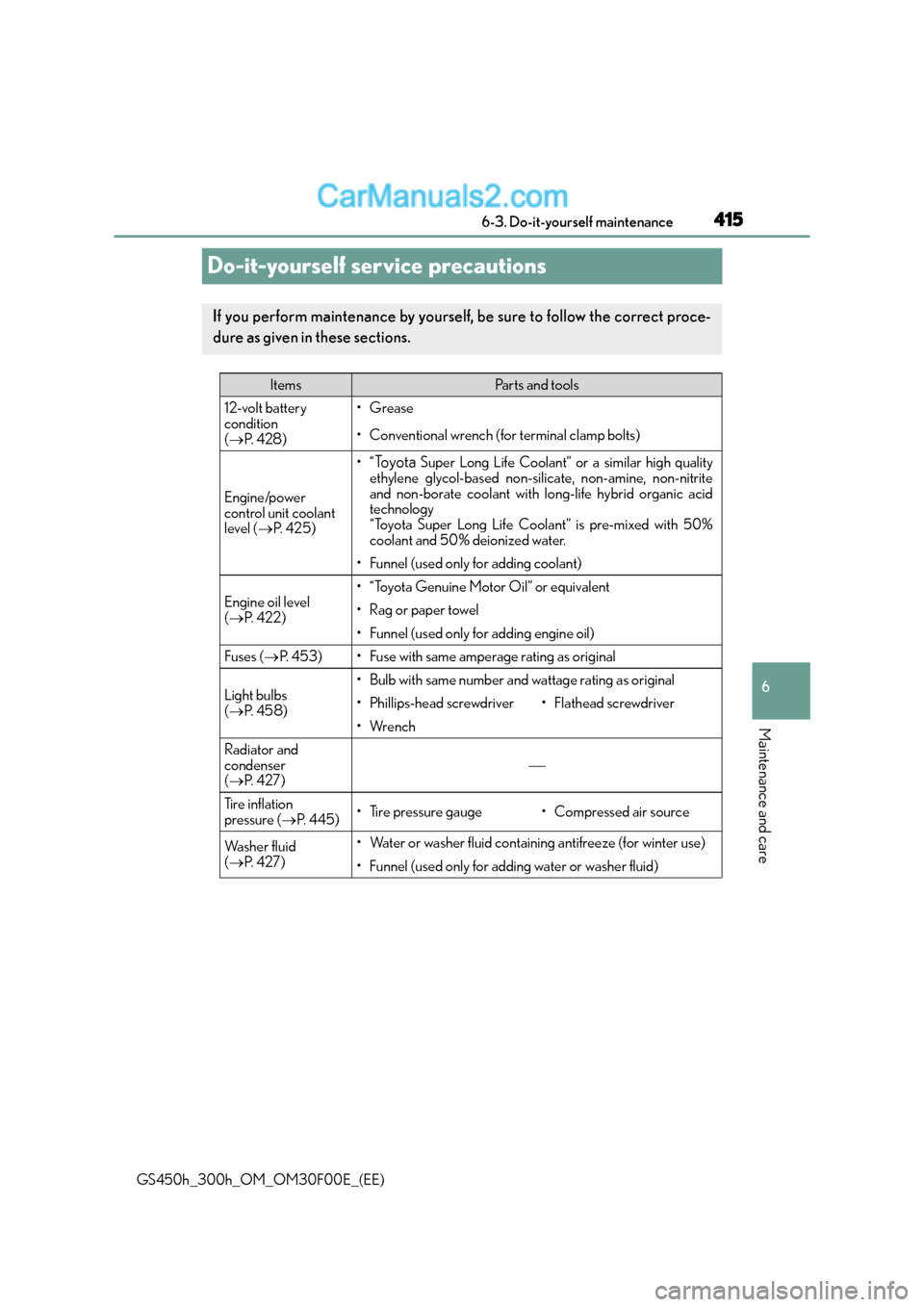
Do-it-yourself service precautions
If you perform maintenance by yourself, be sure to follow the correct proce-
dure as given in these sections.
ItemsParts and tools
12-volt battery
condition
(
→ P. 4 2 8 ) •Grease
• Conventional wrench (for terminal clamp bolts)
Engine/power
control unit coolant
level (
→P. 4 2 5 ) •“
To y o t a Super Long Life Coolant” or a similar high quality
ethylene glycol-based non-silicate, non-amine, non-nitrite
and non-borate coolant with long-life hybrid organic acid
technology
“Toyota Super Long Life Coolant” is pre-mixed with 50%
coolant and 50% deionized water.
• Funnel (used only for adding coolant)
Engine oil level
( → P. 4 2 2 )• “Toyota Genuine Motor Oil” or equivalent
• Rag or paper towel
• Funnel (used only for adding engine oil)
Fuses ( →P. 4 5 3 )• Fuse with same amperage rating as original
Light bulbs
(→ P. 4 5 8 )• Bulb with same number and wattage rating as original
• Phillips-head screwdriver•Flathead screwdriver
•Wrench
Radiator and
condenser
(→ P. 4 2 7 )
Tire inflation
pressure ( →P. 4 4 5 )• Tire pressure gauge• Compressed air source
Wa s h e r f l u i d
(→ P. 4 2 7 )• Water or washer fluid containing antifreeze (for winter use)
• Funnel (used only for adding water or washer fluid)
Page 416 of 620
4166-3. Do-it-yourself maintenance
GS450h_300h_OM_OM30F00E_(EE)
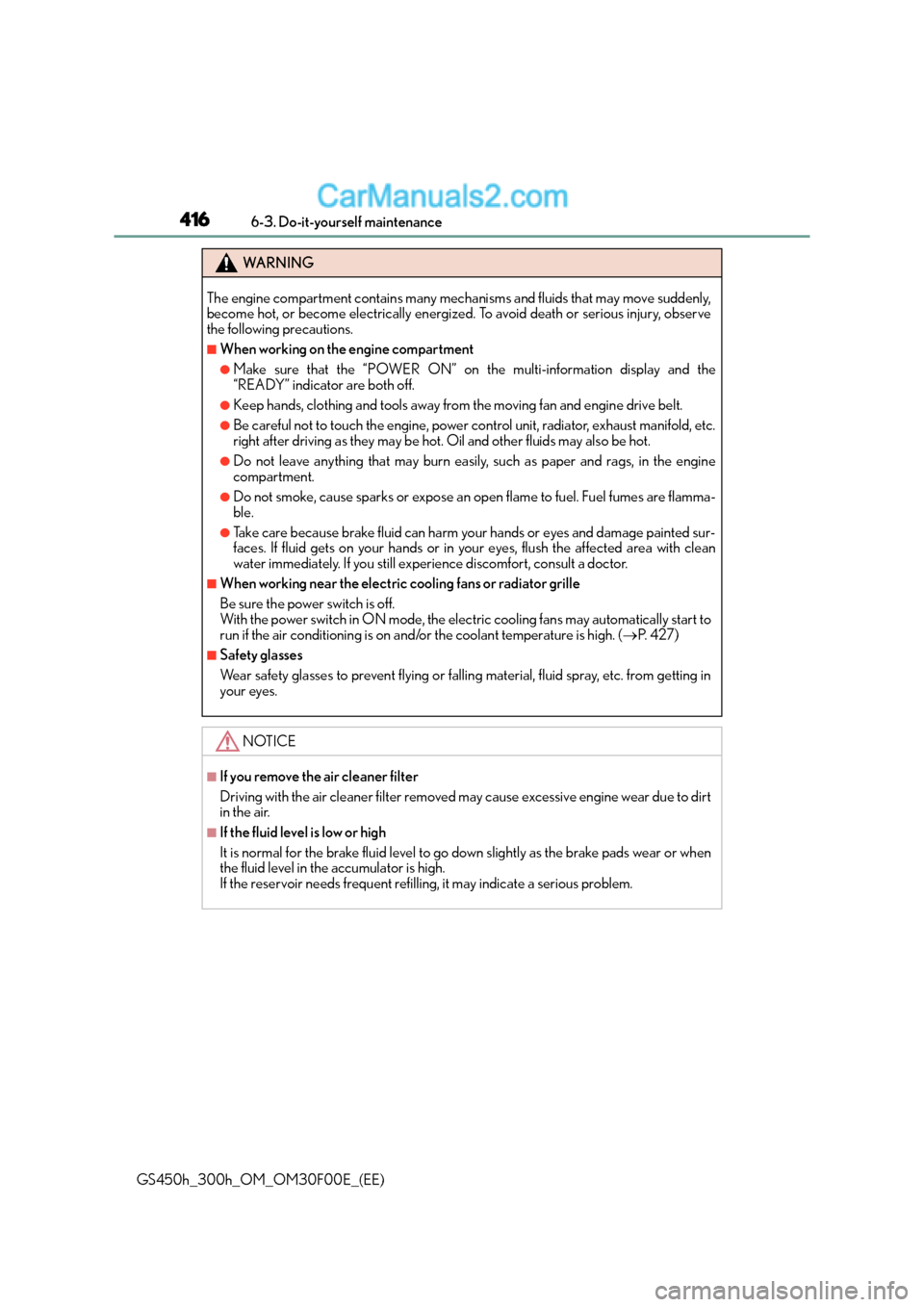
WA R N I N G
The engine compartment contains many mechanisms and fluids that may move suddenly,
become hot, or become electrically energized. To avoid death or serious injury, observe
the following precautions.
■When working on the engine compartment
●Make sure that the “POWER ON” on the multi-information display and the
“READY” indicator are both off.
●Keep hands, clothing and tools away from the moving fan and engine drive belt.
●Be careful not to touch the engine, power control unit, radiator, exhaust manifold, etc.
right after driving as they may be hot. Oil and other fluids may also be hot.
●Do not leave anything that may burn easily, such as paper and rags, in the engine
compartment.
●Do not smoke, cause sparks or expose an open flame to fuel. Fuel fumes are flamma-
ble.
●Take care because brake fluid can harm your hands or eyes and damage painted sur-
faces. If fluid gets on your hands or in your eyes, flush the affected area with clean
water immediately. If you still experience discomfort, consult a doctor.
■When working near the electric cooling fans or radiator grille
Be sure the power switch is off.
With the power switch in ON mode, the elec tric cooling fans may automatically start to
run if the air conditioning is on and/or the coolant temperature is high. ( →P. 4 2 7 )
■Safety glasses
Wear safety glasses to prevent flying or fallin g material, fluid spray, etc. from getting in
your eyes.
NOTICE
■If you remove the air cleaner filter
Driving with the air cleaner filter removed may cause excessive engine wear due to dirt
in the air.
■If the fluid level is low or high
It is normal for the brake fluid level to go down slightly as the brake pads wear or when
the fluid level in the accumulator is high.
If the reservoir needs frequent refilling, it may indicate a serious problem.
Page 417 of 620
417
6
6-3. Do-it-yourself maintenance
Maintenance and care
GS450h_300h_OM_OM30F00E_(EE)
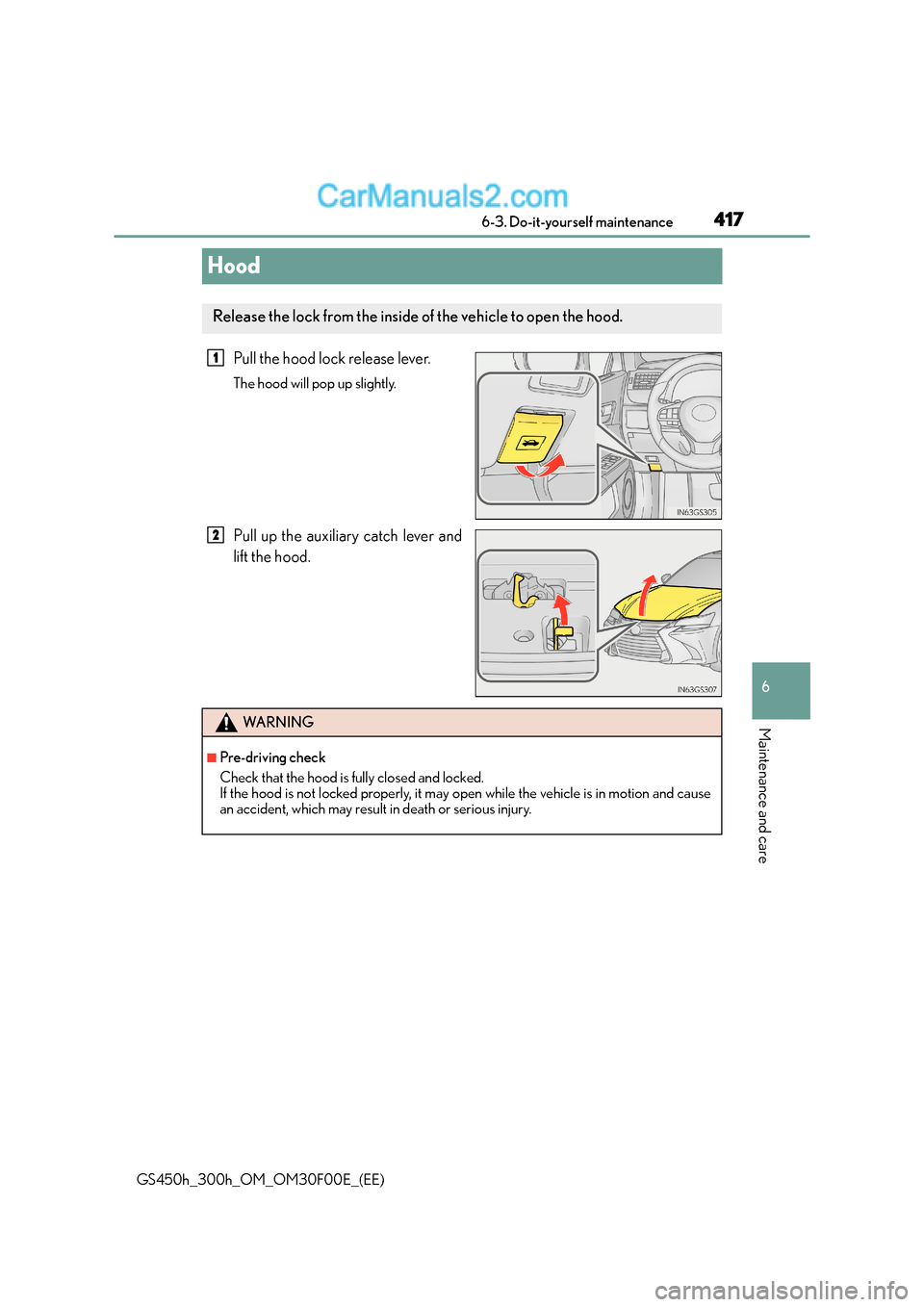
Hood
Pull the hood lock release lever.
The hood will pop up slightly.
Pull up the auxiliary catch lever and
lift the hood.
Release the lock from the inside of the vehicle to open the hood.
1
2
WA R N I N G
■Pre-driving check
Check that the hood is fully closed and locked.
If the hood is not locked properly, it may op
en while the vehicle is in motion and cause
an accident, which may result in death or serious injury.
Page 430 of 620
4306-3. Do-it-yourself maintenance
GS450h_300h_OM_OM30F00E_(EE)
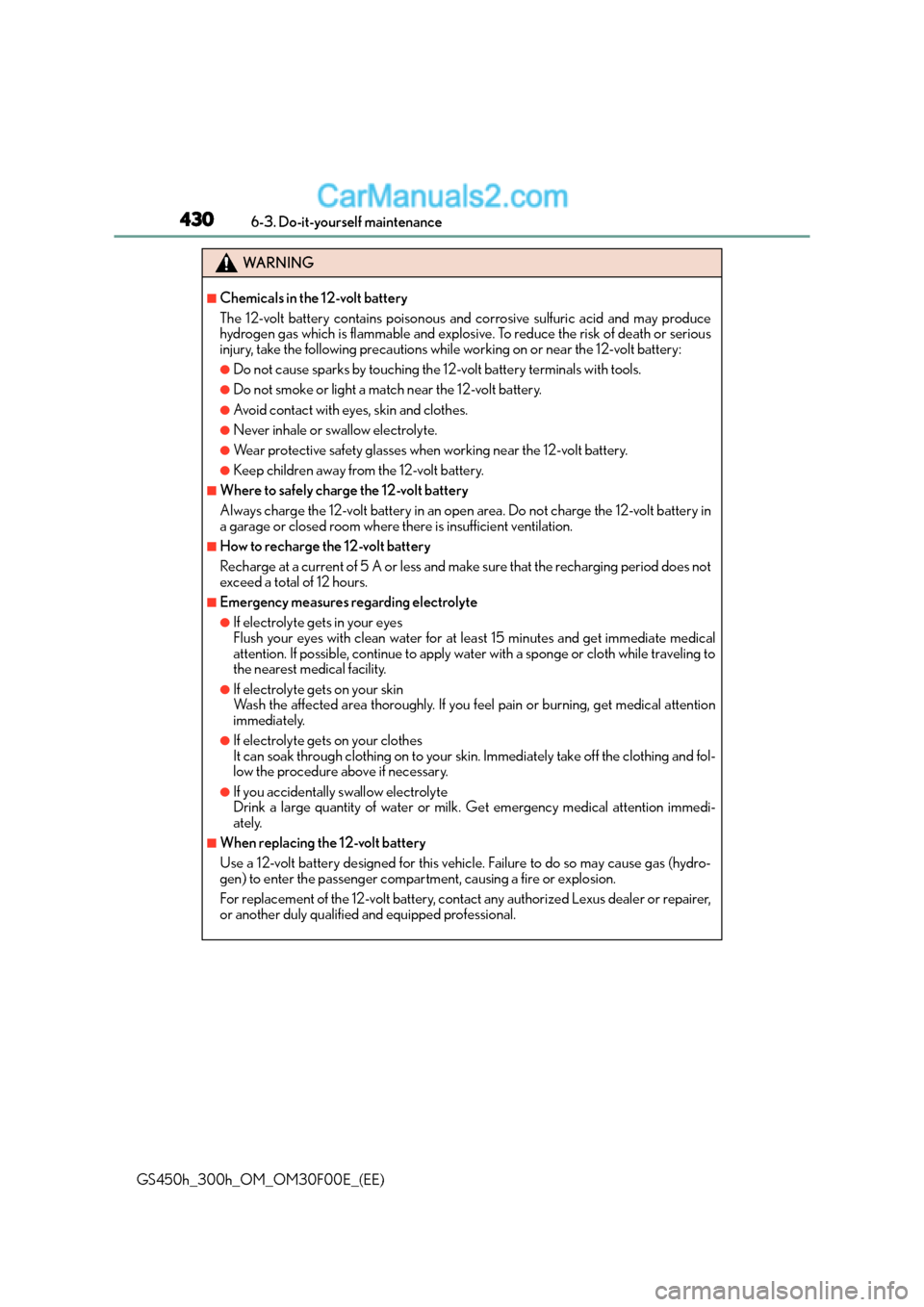
WA R N I N G
■Chemicals in the 12-volt battery
The 12-volt battery contains poisonous and corrosive sulfuric acid and may produce
hydrogen gas which is flammable and explosive. To reduce the risk of death or serious
injury, take the following precautions while working on or near the 12-volt battery:
●Do not cause sparks by touching the 12-volt battery terminals with tools.
●Do not smoke or light a match near the 12-volt battery.
●Avoid contact with eyes, skin and clothes.
●Never inhale or swallow electrolyte.
●Wear protective safety glasses when working near the 12-volt battery.
●Keep children away from the 12-volt battery.
■Where to safely charge the 12-volt battery
Always charge the 12-volt battery in an open area. Do not charge the 12-volt battery in
a garage or closed room where there is insufficient ventilation.
■How to recharge the 12-volt battery
Recharge at a current of 5 A or less and make sure that the recharging period does not
exceed a total of 12 hours.
■Emergency measures regarding electrolyte
●If electrolyte gets in your eyes
Flush your eyes with clean water for at least 15 minutes and get immediate medical
attention. If possible, continue to apply water with a sponge or cloth while traveling to
the nearest medical facility.
●If electrolyte gets on your skin
Wash the affected area thoroughly. If you feel pain or burning, get medical attention
immediately.
●If electrolyte gets on your clothes
It can soak through clothing on to your skin. Immediately take off the clothing and fol-
low the procedure above if necessary.
●If you accidentally swallow electrolyte
Drink a large quantity of water or milk . Get emergency medical attention immedi-
ately.
■When replacing the 12-volt battery
Use a 12-volt battery designed for this vehicle. Failure to do so may cause gas (hydro-
gen) to enter the passenger compartment, causing a fire or explosion.
For replacement of the 12-volt battery, contact any authorized Lexus dealer or repairer,
or another duly qualified and equipped professional.
Page 433 of 620
433 6-3. Do-it-yourself maintenance
6
Maintenance and care
GS450h_300h_OM_OM30F00E_(EE)
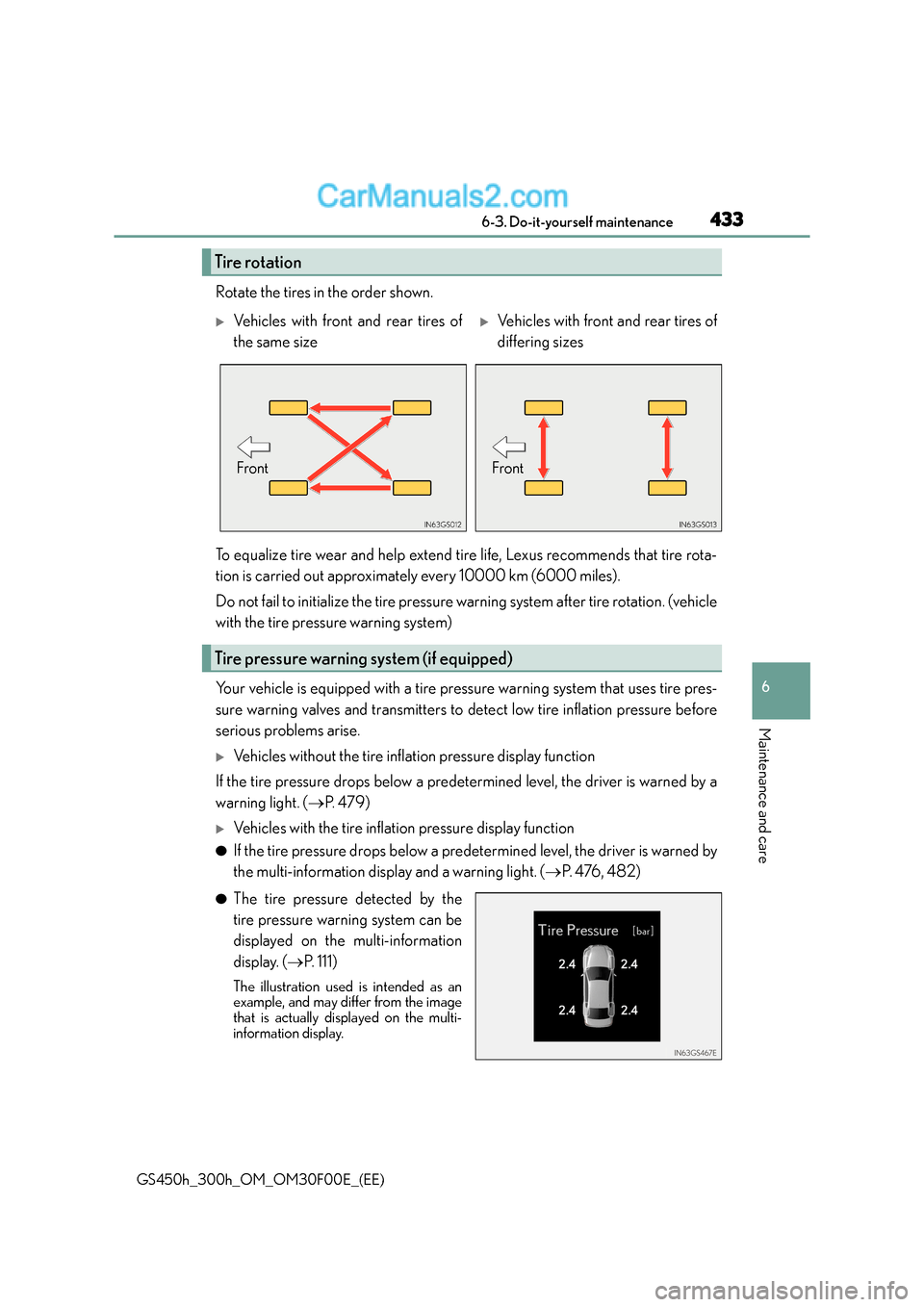
Rotate the tires in the order shown.
To equalize tire wear and help extend tire life, Lexus recommends that tire rota-
tion is carried out approximately every 10000 km (6000 miles).
Do not fail to initialize the tire pressure warning system after tire rotation. (vehicle
with the tire pressure warning system)
Your vehicle is equipped with a tire pressure warning system that uses tire pres-
sure warning valves and transmitters to detect low tire inflation pressure before
serious problems arise.
XVehicles without the tire inflation pressure display function
If the tire pressure drops below a predetermined level, the driver is warned by a
warning light. ( →P. 4 7 9 )
XVehicles with the tire inflation pressure display function
●If the tire pressure drops below a predetermined level, the driver is warned by
the multi-information display and a warning light. ( →P. 4 76 , 4 8 2 )
●The tire pressure detected by the
tire pressure warning system can be
displayed on the multi-information
display. ( →P. 111)
The illustration used is intended as an
example, and may differ from the image
that is actually displayed on the multi-
information display.
Tire rotation
XVehicles with front and rear tires of
the same sizeXVehicles with front and rear tires of
differing sizes
FrontFront
Tire pressure warning system (if equipped)
Page 435 of 620
435 6-3. Do-it-yourself maintenance
6
Maintenance and care
GS450h_300h_OM_OM30F00E_(EE)
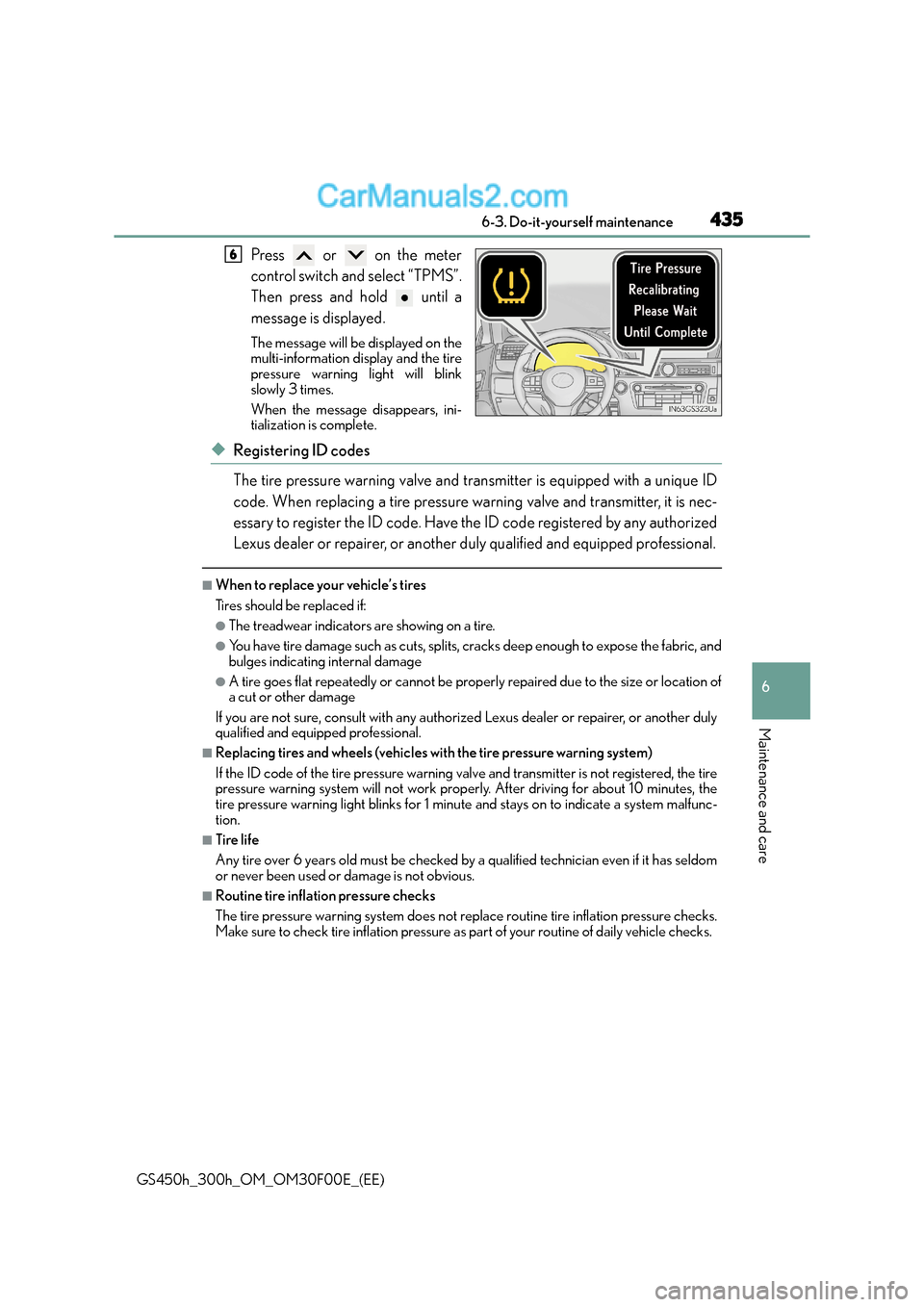
Press or on the meter
control switch and select “TPMS”.
Then press and hold until a
message is displayed.
The message will be displayed on the
multi-information display and the tire
pressure warning light will blink
slowly 3 times.
When the message disappears, ini-
tialization is complete.
◆Registering ID codes
The tire pressure warning valve and transmitter is equipped with a unique ID
code. When replacing a tire pressure warning valve and transmitter, it is nec-
essary to register the ID code. Have the ID code registered by any authorized
Lexus dealer or repairer, or another duly qualified and equipped professional.
■When to replace your vehicle’s tires
Tires should be replaced if:
●The treadwear indicators are showing on a tire.
●You have tire damage such as cuts, splits, cracks deep enough to expose the fabric, and
bulges indicating internal damage
●A tire goes flat repeatedly or cannot be properly repaired due to the size or location of
a cut or other damage
If you are not sure, consult with any authorized Lexus dealer or repairer, or another duly
qualified and equipped professional.
■Replacing tires and wheels (vehicles with the tire pressure warning system)
If the ID code of the tire pressure warning valve and transmitter is not registered, the tire
pressure warning system will not work properly. After driving for about 10 minutes, the
tire pressure warning light blinks for 1 minute and stays on to indicate a system malfunc-
tion.
■Tire life
Any tire over 6 years old must be checked by a qualified technician even if it has seldom
or never been used or damage is not obvious.
■Routine tire inflation pressure checks
The tire pressure warning system does not replace routine tire inflation pressure checks.
Make sure to check tire inflation pressure as part of your routine of daily vehicle checks.
6
Page 437 of 620
437 6-3. Do-it-yourself maintenance
6
Maintenance and care
GS450h_300h_OM_OM30F00E_(EE)
■The initialization operation (vehicles with the tire pressure warning system)
●Make sure to carry out initialization after adjusting the tire inflation pressure.
Also, make sure the tires are cold before carry ing out initialization or tire inflation pres-
sure adjustment.
●If you have accidentally turned the power switch off during initialization, it is not neces-
sary to manually restart the initialization ag ain, as initialization will restart automatically
the next time the power switch is turned to ON mode.
●If you accidentally perform initialization when initialization is not necessary, adjust the
tire inflation pressure to the specified leve l when the tires are cold, and conduct initial-
ization again.
■Warning performance of the tire pressure warning system (if equipped)
The warning of the tire pressu re warning system will change in accordance with the con-
ditions under which it was initialized. For this reason, the system may give a warning even
if the tire pressure does not reach a low enough level, or if the pressure is higher than the
pressure that was adjusted to when the system was initialized.
■When initialization of the tire pressure warn ing system has failed (vehicles with the tire
pressure warning system)
Initialization can be co mpleted in a few minutes. However, in the following cases, the set-
tings have not been recorded and the syst em will not operate properly. If repeated
attempts to record tire inflation pressure settings are unsuccessful, have the vehicle
inspected by any authorized Lexus dealer or repairer, or another duly qualified and
equipped professional.
●The initialization message is not displayed on the multi-information display when per-
forming initialization.
●After carrying out the initializat ion procedure, the tire pressure warning light blinks for 1
minute then stays on after driving for 20 minutes.
■Registering ID codes (vehicles with the tire pressure warning system)
The ID codes of the tire pressure warning valve and transmitters for two sets of wheels
can be registered.
It is not necessary to register the ID codes when replacing normal tires with snow tires, if
the ID codes for the wheels of both normal tires and snow tires are registered before-
hand.
For information about changing ID codes, ask any authorized Lexus dealer or repairer,
or another duly qualified and equipped professional.
■Certification for tire pressure warning system (vehicles with the tire pressure warning
system)
Page 443 of 620
443 6-3. Do-it-yourself maintenance
6
Maintenance and care
GS450h_300h_OM_OM30F00E_(EE)
WA R N I N G
■When inspecting or replacing tires
Observe the following precautions to prevent accidents.
Failure to do so may cause damage to parts of the drive train as well as dangerous han-
dling characteristics, which may lead to an accident resulting in death or serious injury.
●Do not mix tires of different makes, models or tread patterns.
Also, do not mix tires of remarkably different treadwear.
●Do not use tire sizes other than those recommended by Lexus.
●Do not mix differently constructed tires (radial, bias-belted or bias-ply tires).
●Do not mix summer, all season and snow tires.
●Do not use tires that have been used on another vehicle.
Do not use tires if you do not know how they were used previously.
●Vehicles with compact spare tire: Do not tow if your vehicle has a compact spare tire
installed.
●Vehicles with emergency tire puncture repair kit: Do not tow anything if a tire that has
been repaired using the emergency tire punc ture repair kit is installed. The load on
the tire may cause unexpected damage to the tire.
■When initializing the tire pressure warning system (vehicles with the tire pressure
warning system)
Do not initialize tire inflation pressure withou t first adjusting the tire inflation pressure to
the specified level. Otherwise, the tire pre ssure warning light may not come on even if
the tire inflation pressure is low, or it ma y come on when the tire inflation pressure is
actually normal.
■Caution regarding interference with electron ic devices (vehicles with the tire pres-
sure warning system featuring a tire inflation pressure display function)
●Users of any electrical medical device other than implantable cardiac pacemakers,
cardiac resynchronization therapy-pacemakers or implantable cardioverter defibril-
lators should consult the manufacturer of the device for information about its opera-
tion under the influence of radio waves.
Radio waves could have unexpected effects on the operation of such medical
devices.
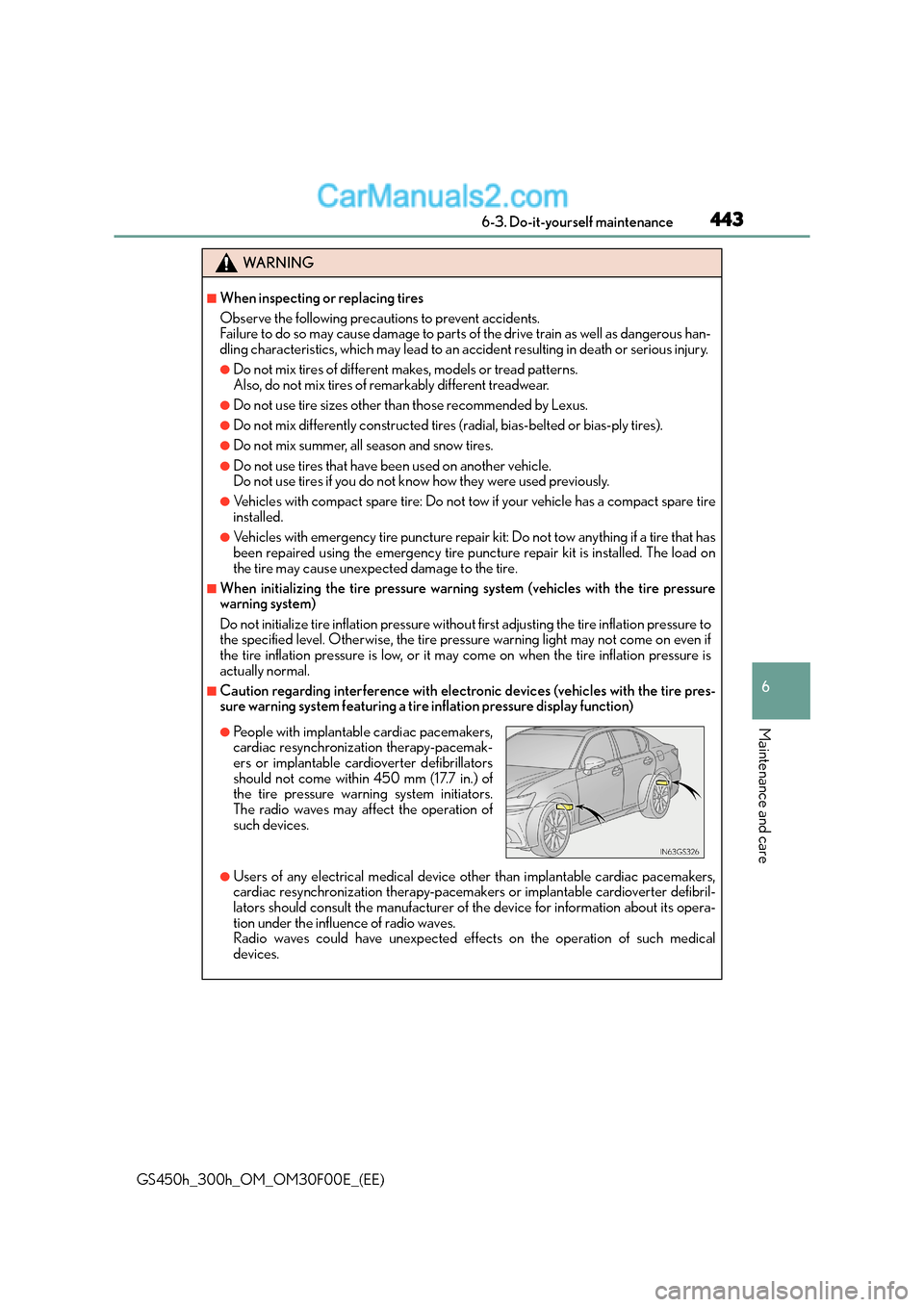
●People with implantable cardiac pacemakers,
cardiac resynchronization therapy-pacemak-
ers or implantable cardioverter defibrillators
should not come within 450 mm (17.7 in.) of
the tire pressure warning system initiators.
The radio waves may affect the operation of
such devices.
Page 457 of 620
457 6-3. Do-it-yourself maintenance
6
Maintenance and care
GS450h_300h_OM_OM30F00E_(EE)
■After a fuse is replaced
●If the lights do not turn on even after the fuse has been replaced, a bulb may need
replacement. (→P. 4 5 8 )
●If the replaced fuse blows again, have the vehicle inspected by any authorized Lexus
dealer or repairer, or another duly qualified and equipped professional.
■If there is an overload in a circuit
The fuses are designed to blow, protecting the wiring harness from damage.
■When replacing light bulbs
Lexus recommends that you use genuine Lexus products designed for this vehicle.
Because certain bulbs are connected to circuits designed to prevent overload, non-gen-
uine parts or parts not designed for this vehicle may be unusable.
WA R N I N G
■To prevent system breakdowns and vehicle fire
Observe the following precautions.
Failure to do so may cause damage to the vehicle, and possibly a fire or injury.
●Never use a fuse of a higher amperage rating than that indicated, or use any other
object in place of a fuse.
●Always use a genuine Lexus fuse or equivalent.
Never replace a fuse with a wire, even as a temporary fix.
●Do not modify the fuses or fuse boxes.
NOTICE
■Before replacing fuses
Have the cause of electrical overload determined and repaired by any authorized
Lexus dealer or repairer, or another duly qualified and equipped professional as soon
as possible.
Page 458 of 620
4586-3. Do-it-yourself maintenance
GS450h_300h_OM_OM30F00E_(EE)
Light bulbs
Check the wattage of the light bulb to be replaced. ( →P. 5 7 8 )
→ P. 4 2 1
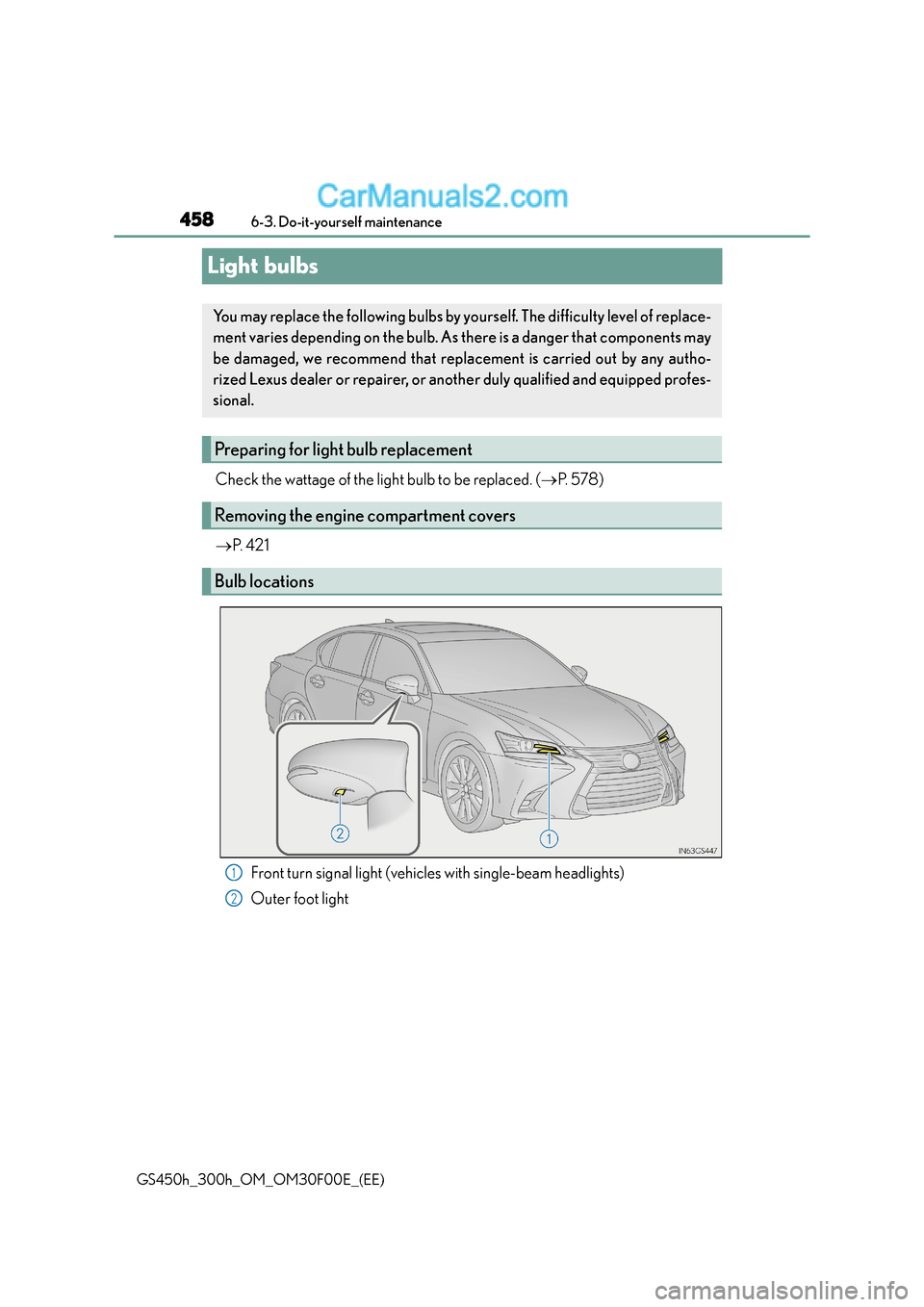
Front turn signal light (vehicles with single-beam headlights)
Outer foot light
You may replace the following bulbs by yourself. The difficulty level of replace-
ment varies depending on the bulb. As there is a danger that components may
be damaged, we recommend that replacement is carried out by any autho-
rized Lexus dealer or repairer, or an other duly qualified and equipped profes-
sional.
Preparing for light bulb replacement
Removing the engine compartment covers
Bulb locations
1
2