engine Lexus GS300h 2017 Owner's Guide
[x] Cancel search | Manufacturer: LEXUS, Model Year: 2017, Model line: GS300h, Model: Lexus GS300h 2017Pages: 600, PDF Size: 58.17 MB
Page 224 of 600
2244-2. Driving procedures
GS450h_300h_OM_OM30F92E_(EE)
Hybrid transmission
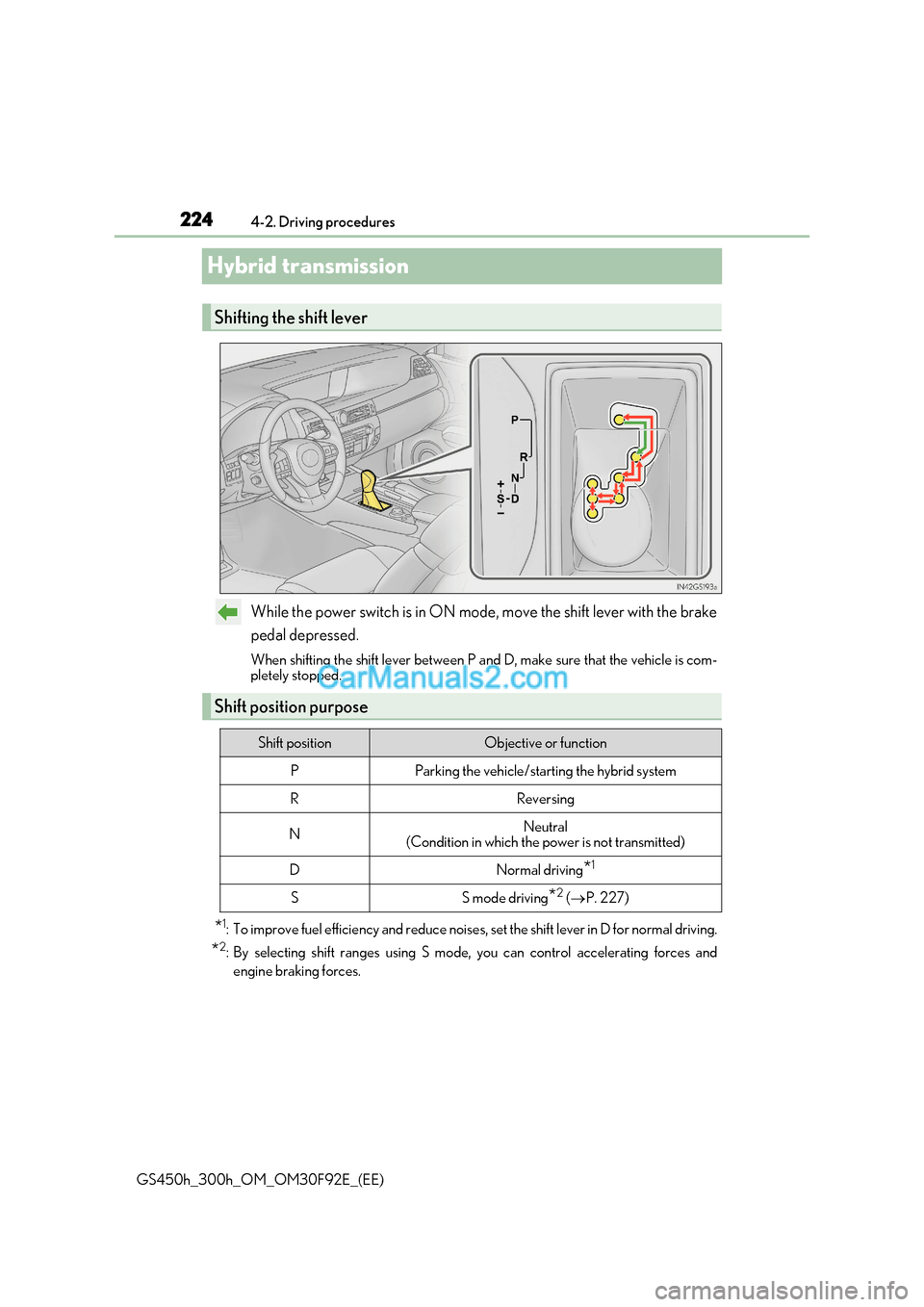
While the power switch is in ON mode, move the shift lever with the brake
pedal depressed.
When shifting the shift lever between P and D, make sure that the vehicle is com-
pletely stopped.
* 1
: To improve fuel efficiency and reduce noises , set the shift lever in D for normal driving.
* 2
: By selecting shift ranges using S mode, you can control accelerating forces and
engine braking forces.
Shifting the shift lever
Shift position purpose
Shift positionObjective or function
PParking the vehicle/starting the hybrid system
RReversing
NNeutral
(Condition in which the power is not transmitted)
DNormal driving *1
SS mode driving
*2
( P. 227)
Page 226 of 600
2264-2. Driving procedures
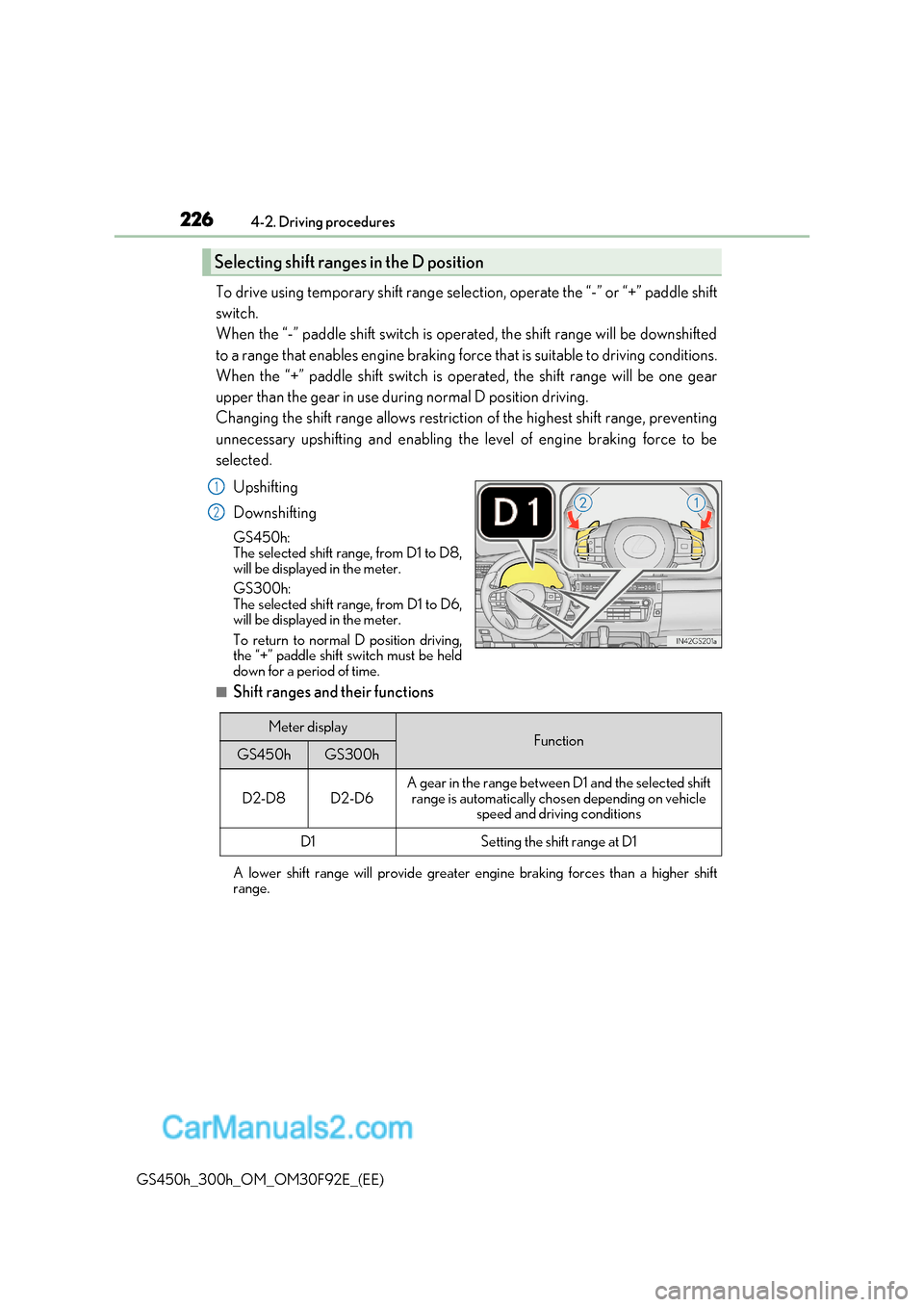
GS450h_300h_OM_OM30F92E_(EE) To drive using temporary shift range selection, operate the “-” or “+” paddle shift
switch.
When the “-” paddle shift switch is operated, the shift range will be downshifted
to a range that enables engine braking force that is suitable to driving conditio
ns.
When the “+” paddle shift switch is operated, the shift range will be one gear
upper than the gear in use during normal D position driving.
Changing the shift range allows restriction of the highest shift range, preventing
unnecessary upshifting and enabling th e level of engine braking force to be
selected.
Upshifting
Downshifting
GS450h:
The selected shift range, from D1 to D8,
will be displayed in the meter.
GS300h:
The selected shift range, from D1 to D6,
will be displayed in the meter.
To return to normal D position driving,
the “+” paddle shift switch must be held
down for a period of time.
■Shift ranges and their functions
A lower shift range will provide greater engi ne braking forces than a higher shift
range.
Selecting shift ranges in the D position
1
2
Meter displayFunctionGS450hGS300h
D2-D8D2-D6
A gear in the range between D1 and the selected shift
range is automatically chosen depending on vehicle speed and driving conditions
D1Setting the shift range at D1
Page 227 of 600
227
4-2. Driving procedures
4
Driving
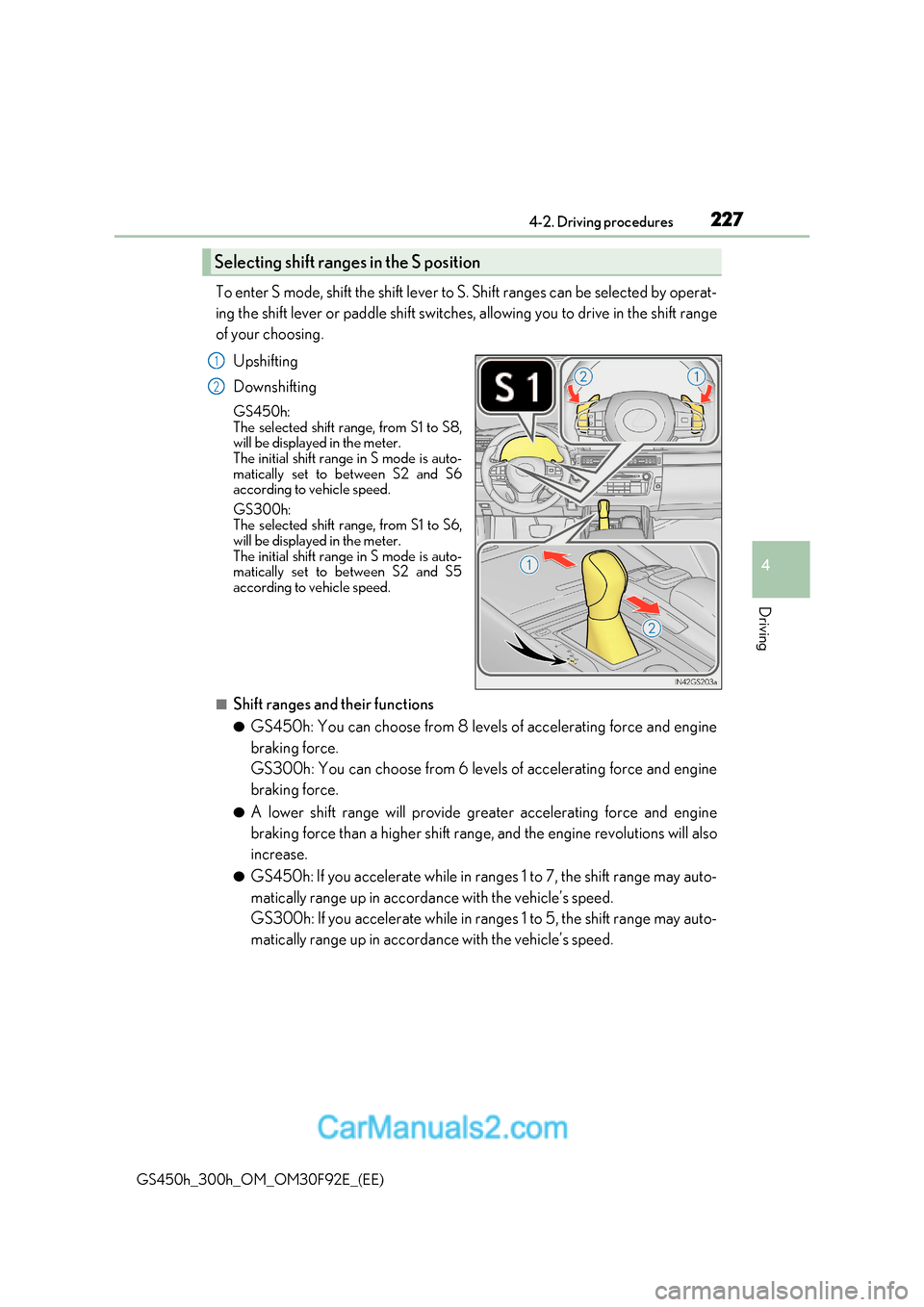
GS450h_300h_OM_OM30F92E_(EE) To enter S mode, shift the shift lever to S. Shift ranges can be selected by operat-
ing the shift lever or paddle shift switches, allowing you to drive in the shift rang
e
of your choosing.
Upshifting
Downshifting
GS450h:
The selected shift range, from S1 to S8,
will be displayed in the meter.
The initial shift range in S mode is auto-
matically set to between S2 and S6
according to vehicle speed.
GS300h:
The selected shift range, from S1 to S6,
will be displayed in the meter.
The initial shift range in S mode is auto-
matically set to between S2 and S5
according to vehicle speed.
■Shift ranges and their functions ● GS450h: You can choose from 8 levels of accelerating force and engine
braking force.
GS300h: You can choose from 6 levels of accelerating force and engine
braking force.
● A lower shift range will provide greater accelerating force and engine
braking force than a higher shift range, and the engine revolutions will also
increase.
● GS450h: If you accelerate while in ranges 1 to 7, the shift range may auto-
matically range up in accordance with the vehicle’s speed.
GS300h: If you accelerate while in ranges 1 to 5, the shift range may auto-
matically range up in accordance with the vehicle’s speed.
Selecting shift ranges in the S position
1
2
Page 228 of 600
2284-2. Driving procedures
GS450h_300h_OM_OM30F92E_(EE)
■Automatic deactivation of shift range selection in the D position
Shift range selection in the D position will be deactivated in the following situations:
●When the vehicle comes to a stop
●If the accelerator pedal is depressed for more than a certain period of time
●When the shift lever is shifted to other than D
■Downshifting restrictions warning buzzer
To help ensure safety and driving performance, downshifting operation may sometimes
be restricted. In some circumstances, downsh ifting may not be possible even when the
shift lever or paddle shift switch is operated. (A buzzer will sound twice.)
■Snow mode automatic deactivation
Snow mode is automatically deactivated if the power switch is turned off after driving in
snow mode.
■When driving with cruise control or dynamic radar cruise control with full-speed range
activated
Even when performing the following actions with the intent of enabling engine braking,
engine braking will not activate because crui se control or dynamic radar cruise control
with full-speed range will not be canceled.
●GS450h: While driving in the D position or S mode, downshifting to 7, 6, 5 or 4. ( P. 296, 308)
●GS300h: While driving in the D position, downshifting to 5 or 4. ( P. 296, 308)
●When switching the driving mode to sport mode while driving in D position. ( P. 311)
■Restraining sudden start (Drive-Start Control)
●When the following unusual operation is performed, the engine output may be
restrained.
Page 230 of 600
2304-2. Driving procedures
GS450h_300h_OM_OM30F92E_(EE)
NOTICE
■Hybrid battery (traction battery) charge
If the shift lever is in N, the hybrid battery (traction battery) will not be charged even
when the engine is running. Therefore, if the vehicle is left with the shift lever in N for a
long period of time, the hybrid battery (traction battery) will discharge, and this may
result in the vehicle not being able to start.
Page 328 of 600
3284-5. Using the driving support systems
GS450h_300h_OM_OM30F92E_(EE)
■Sounds and vibrations caused by the ABS, brake assist, VSC, Hill-start assist control,
TRC and VGRS systems
Any of the following conditions may occur when the above systems are operating. None
of these indicates that a malfunction has occurred.
●Vibrations may be felt through the vehicle body and steering.
●A motor sound may be heard after the vehicle comes to a stop.
■ECB operation sound
ECB operating sound may be heard in the follow ing cases, but it does not indicate that a
malfunction has occurred.
●Operating sound heard from the engine compartment when the brake pedal is oper-
ated.
●Motor sounds of the brake system heard from the front part of the vehicle when the
driver’s door is opened.
●Operating sound heard from the engine compartment when one or two minutes
passed after the stop of the hybrid system.
■EPS, VGRS and DRS operation sound
When the steering wheel is operated, a motor sound (whirring sound) may be heard.
This does not indicate a malfunction.
■Automatic reactivation of TRC and VSC systems
After turning the TRC and VSC systems off, the systems will be automatically re-enabled
in the following situations:
●When the power switch is turned off
●If only the TRC system is turned off, the TR C will turn on when vehicle speed increases
If both TRC and VSC systems are turned off, automatic re-enabling will not occur when
vehicle speed increases.
■Reduced effectiveness of the EPS system
The effectiveness of the EPS system is reduced to prevent the system from overheating
when there is frequent steering input over an extended period of time. The steering
wheel may feel heavy as a result. Should this occur, refrain from excessive steering input
or stop the vehicle and turn the hybrid system off. The EPS system should return to nor-
mal within 10 minutes.
■Operating conditions of hill-start assist control
When the following four conditions are met, the hill-start assist control will operate;
●The shift lever is in a position other than N or P (when starting off forward/backward on
an upward incline).
●The vehicle is stopped.
●The accelerator pedal is not depressed.
●The parking brake is not engaged.
Page 331 of 600
331
4
4-6. Driving tips
Driving
GS450h_300h_OM_OM30F92E_(EE)
Hybrid vehicle driving tips
◆Using Eco drive mode
When using Eco drive mode, the torque corresponding to the accelerator
pedal depression amount can be generated more smoothly than it is in normal
conditions. In addition, the operation of the air conditioning system (heating/
cooling) will be minimized, improving the fuel economy. ( P. 311)
◆Use of Hybrid System Indicator
The Eco-friendly driving is possible by keeping the indicate of Hybrid System
Indicator within Eco area. ( P. 108, 123)
◆Shift lever operation
Shift the shift lever to D when stopped at a traffic light, or driving in heavy traf-
fic etc. Shift the shift lever to P when parking. When using the N, there is no
positive effect on fuel consumption. In the N, the gasoline engine operates but
electricity cannot be generated. Also, when using the air conditioning system,
etc., the hybrid battery (traction battery) power is consumed.
◆Accelerator pedal/brake pedal operation ● Drive your vehicle smoothly. Avoid abrupt acceleration and deceleration.
Gradual acceleration and deceleration will make more effective use of the
electric motor (traction motor) without having to use gasoline engine
power.
● Avoid repeated acceleration. Repeated acceleration consumes hybrid bat-
tery (traction battery) power, resulting in poor fuel consumption. Battery
power can be restored by driving with the accelerator pedal slightly
released.
◆When braking
Make sure to operate the brakes gently and in a timely manner. A greater
amount of electrical energy can be regenerated when slowing down.
For economical and ecological driving, pay attention to the following points:
Page 332 of 600
3324-6. Driving tips
GS450h_300h_OM_OM30F92E_(EE)
◆Delays
Repeated acceleration and deceleration, as well as long waits at traffic lights,
will lead to bad fuel economy. Check traffic reports before leaving and avoid
delays as much as possible. When driving in a traffic jam, gently release the
brake pedal to allow the vehicle to move forward slightly while avoiding over-
use of the accelerator pedal. Doing so can help control excessive gasoline
consumption.
◆Highway driving
Control and maintain the vehicle at a constant speed. Before stopping at a toll
booth or similar, allow plenty of time to release the accelerator and gently
apply the brakes. A greater amount of electrical energy can be regenerated
when slowing down.
◆Air conditioning
Use the air conditioning only when necessary. Doing so can help reduce
excessive gasoline consumption.
In summer: When the ambient temperature is high, use the recirculated air
mode. Doing so will help to reduce the burden on the air conditioning system
and reduce fuel consumption as well.
In winter: Because the gasoline engine will not automatically cut out until it
and the interior of the vehicle are warm, it will consume fuel. Also, fuel con-
sumption can be improved by avoiding overuse of the heater.
◆Checking tire inflation pressure
Make sure to check the tire inflation pressure frequently. Improper tire infla-
tion pressure can cause poor fuel economy.
Also, as snow tires can cause large amounts of friction, their use on dry roads
can lead to poor fuel economy. Use ti res that are appropriate for the season.
Page 333 of 600
333
4-6. Driving tips
4
Driving
GS450h_300h_OM_OM30F92E_(EE)
◆Luggage
Carrying heavy luggage will lead to poor fuel economy. Avoid carrying
unnecessary luggage. Installing a large roof rack will also cause poor fuel
economy.
◆Warming up before driving
Since the gasoline engine starts up and cuts out automatically when cold,
warming up the engine is unnecessary. Moreover, frequently driving short dis-
tances will cause the engine to repeatedly warm up, which can lead to excess
fuel consumption.
Page 338 of 600
3384-6. Driving tips
GS450h_300h_OM_OM30F92E_(EE)
WARNING
■Driving with snow tires
Observe the following precautions to reduce the risk of accidents.
Failure to do so may result in a loss of vehicle control and cause death or serious injury.
●Use tires of the specified size.
●Maintain the recommended level of air pressure.
●Do not drive at speeds in excess of the speed limit or the speed limit specified for the
snow tires being used.
●Use snow tires on all, not just some wheels.
■Driving with tire chains (vehicles with front and rear tires of the same size except for
the vehicles with LDH and 19 inch tires)
Observe the following precautions to reduce the risk of accidents.
Failure to do so may result in the vehicle being unable to be driven safely, and may
cause death or serious injury.
●Do not drive in excess of the speed limit sp ecified for the tire chains being used, or
50 km/h (30 mph), whichever is lower.
●Avoid driving on bumpy road surfaces or over potholes.
●Avoid sudden acceleration, abrupt steerin g, sudden braking and shifting operations
that cause sudden engine braking.
●Slow down sufficiently before entering a curve to ensure that vehicle control is main-
tained.
●Do not use LKA (Lane-Keeping Assist) system. (if equipped)
NOTICE
■Repairing or replacing snow tires
Request repairs or replacement of snow ti res from Lexus dealers or legitimate tire
retailers.
This is because the removal and attachment of snow tires affects the operation of the
tire pressure warning va lves and transmitters.
■Fitting tire chains (vehicles with front and rear tires of the same size except for the
vehicles with LDH and 19 inch tires)
The tire pressure warning valves and transmitters may not function correctly when tire
chains are fitted.
■When standing the windshield wipers up
Raise the wipers in line with the windshield. ( P. 337)
Failure to do so may result in damage to the wipers and/or the hood.