air condition Lexus GS350 2008 Opening, closing and locking the doors and trunk / LEXUS 2008 GS460/350 (OM30A87U) Owner's Guide
[x] Cancel search | Manufacturer: LEXUS, Model Year: 2008, Model line: GS350, Model: Lexus GS350 2008Pages: 596, PDF Size: 9.29 MB
Page 222 of 596
222
3-2. Using the air conditioning system and defogger
GS_G_U
May 13, 2008 5:14 pm
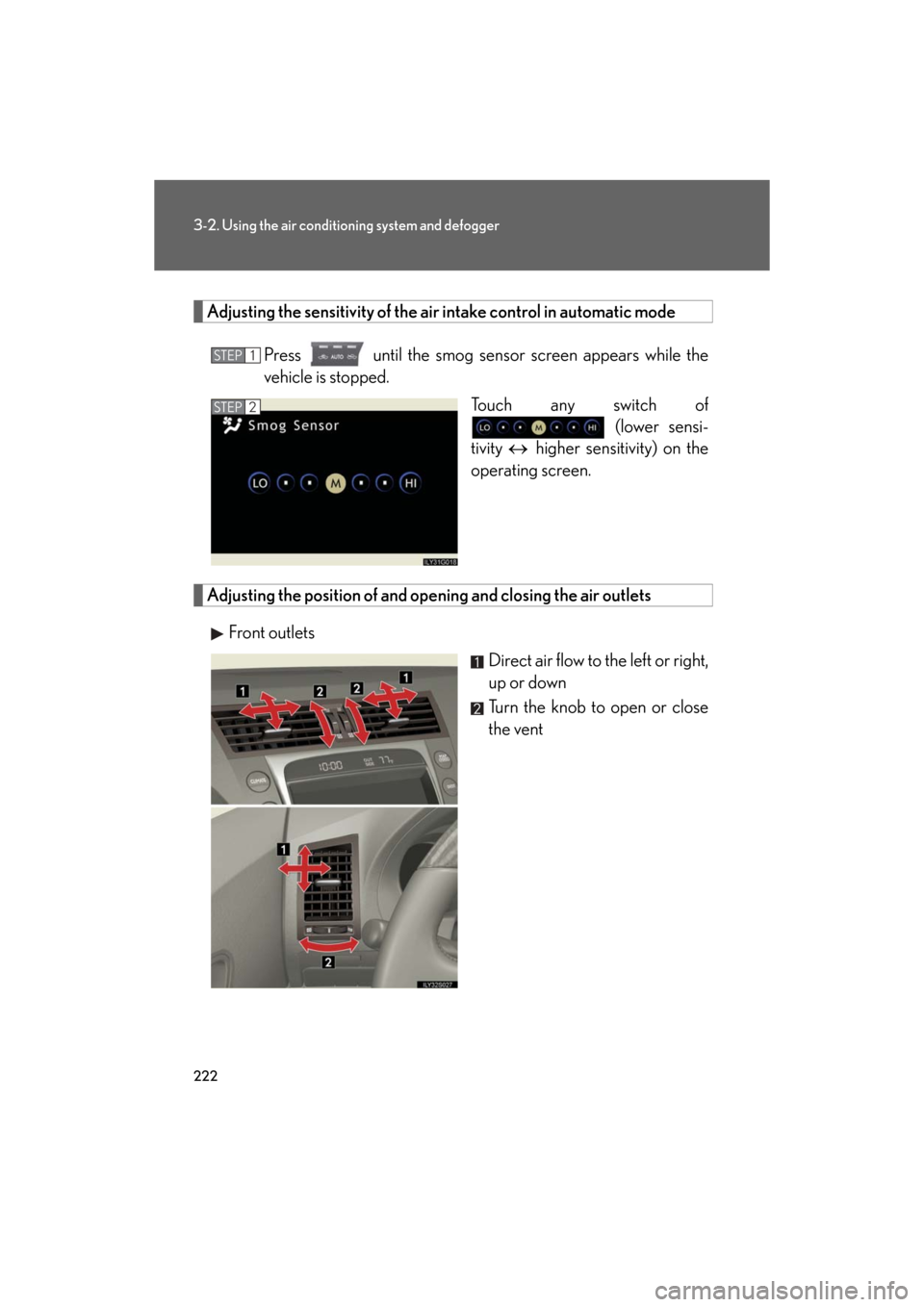
Adjusting the sensitivity of the air intake control in automatic mode
Press until the smog senso r screen appears while the
vehicle is stopped.
Touch any switch of (lower sensi-
tivity higher sensitivity) on the
operating screen.
Adjusting the position of and opening and closing the air outlets
Front outlets Direct air flow to the left or right,
up or down
Turn the knob to open or close
the vent
STEP1
STEP2
Page 223 of 596
223
3-2. Using the air conditioning system and defogger
3
Interior features
GS_G_U
May 13, 2008 5:14 pm
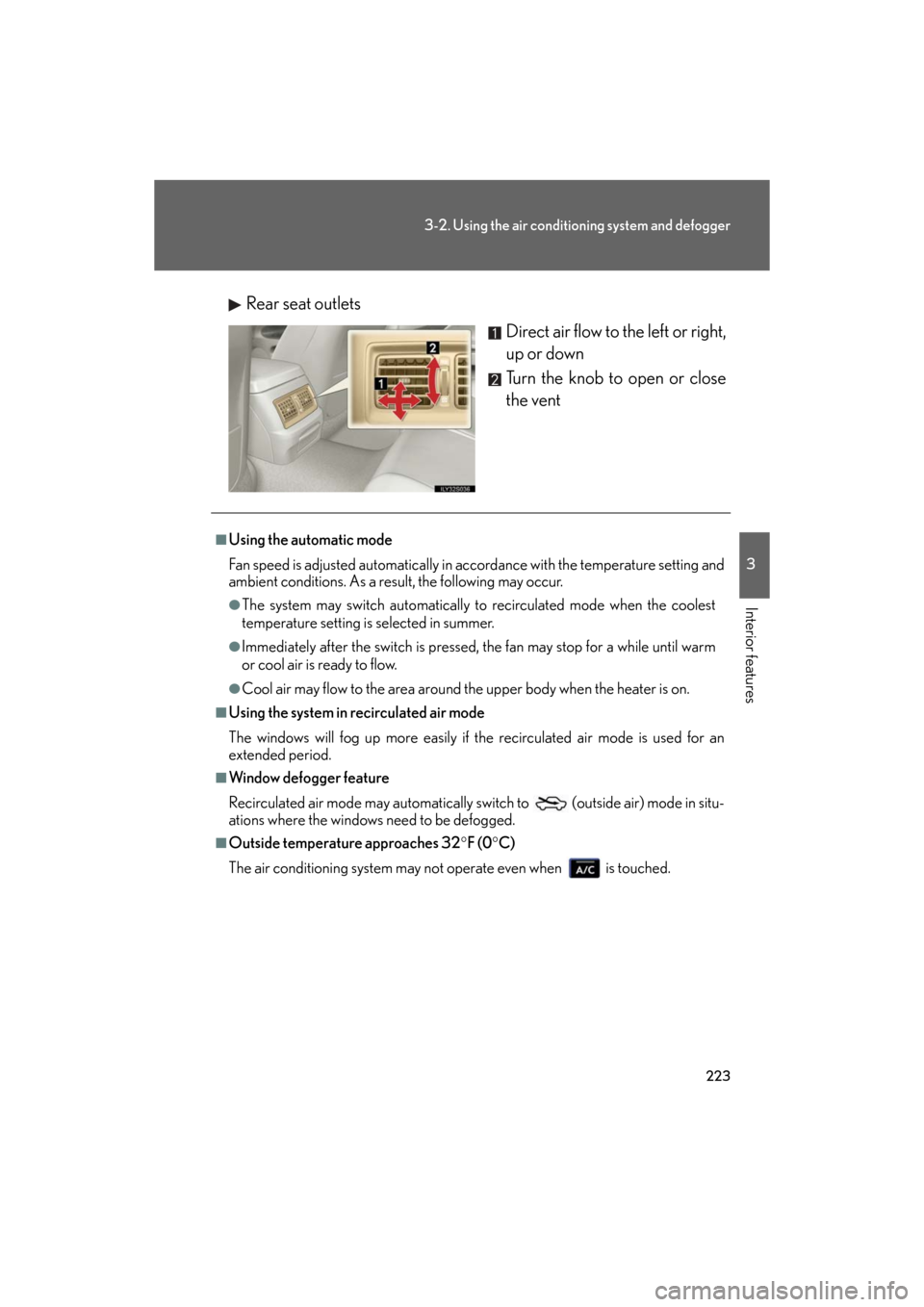
Rear seat outlets
Direct air flow to the left or right,
up or down
Turn the knob to open or close
the vent
■Using the automatic mode
Fan speed is adjusted automatically in acc ordance with the temperature setting and
ambient conditions. As a result, the following may occur.
●The system may switch automatically to recirculated mode when the coolest
temperature setting is selected in summer.
●Immediately after the switch is pressed, the fan may stop for a while until warm
or cool air is ready to flow.
●Cool air may flow to the area around the upper body when the heater is on.
■Using the system in recirculated air mode
The windows will fog up more easily if the recirculated air mode is used for an
extended period.
■Window defogger feature
Recirculated air mode may automatically switch to
(outside air) mode in situ-
ations where the windows need to be defogged.
■Outside temperature approaches 32 F (0C)
The air conditioning system may no t operate even when is touched.
Page 224 of 596
224
3-2. Using the air conditioning system and defogger
GS_G_U
May 13, 2008 5:14 pm
■Automatic mode for air intake control
In automatic mode, the system detects exhaust gas and other pollutants and auto-
matically switches between outside air and recirculated air modes.
When the air conditioning is off, and the fa n is operating, turning the auto mode ON
will activate the air conditioning system.
■Micro dust and pollen filter
●In order to prevent the windows from fogging up when the outside air is cold,
the following may occur.
• Outside air mode does not switch to .
• The air conditioning syst em operates automatically.
• The operation cancels after 1 minute.
●In rainy weather, the windows may fog up. Press .
■When the indicator light on flashes
Touch and turn off the air conditioning system before turning it on once
more. There may be a problem in the air conditioning system if the indicator light
continues to flash. Turn the air conditioning system off and have it inspected by your
Lexus dealer.
CAUTION
■To prevent the windshield from fogging up
Do not use during cool air operation in extremely humid weather. The differ-
ence between the temperature of the outside air and that of the windshield can
cause the outer surface of the windshield to fog up, blocking your vision.
NOTICE
■To prevent 12 volt battery discharge
Do not leave the automatic air conditioning system on longer than necessary when
the engine is off.
Page 225 of 596
225
3-2. Using the air conditioning system and defogger
3
Interior features
GS_G_U
May 13, 2008 5:14 pm
Rear window and outside re ar view mirror defoggers
■Operating conditions
The “ENGINE START STOP” switch must be in the IGNITION ON mode.
CAUTION
■When the outside rear view mirror defoggers are on
Do not touch the rear view mirror surfaces, as they can become very hot and burn
you.
NOTICE
■To prevent 12 volt battery discharge
Turn the defoggers off when the engine is off.
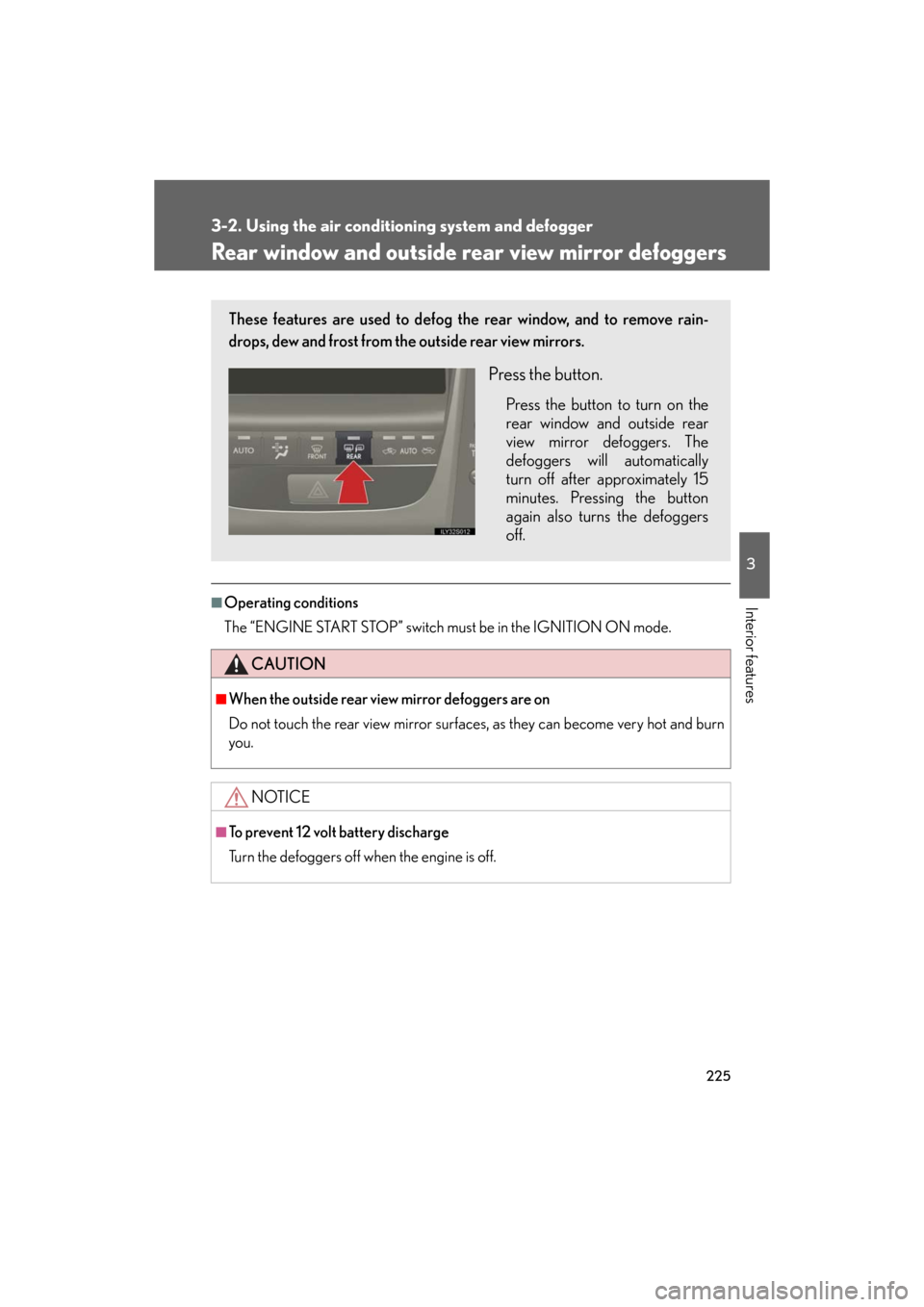
These features are used to defog the rear window, and to remove rain-
drops, dew and frost from the outside rear view mirrors.
Press the button.
Press the button to turn on the
rear window and outside rear
view mirror defoggers. The
defoggers will automatically
turn off after approximately 15
minutes. Pressing the button
again also turns the defoggers
off.
Page 293 of 596

293
3-4. Using the hands-free system (for cellular phone)
3
Interior features
GS_G_U
May 13, 2008 5:14 pm
■When using the hands-free system
●The audio system and voice guidance are muted when making a call.
●If both parties speak at the same time, it may be difficult to hear.
●If the received call volume is overly loud, an echo may be heard.
●Try to face toward the microphone as much as possible when speaking.
●In the following circumstances it may be difficult to hear the other party.
• When driving on unsealed roads
• When driving at high speeds
• If a window is open
• If the air conditioning is blowing directly on the microphone
• If the air conditioning is set to high
■Conditions under which the system will not operate
●If using a mobile phone that does not support Bluetooth®.
●If the mobile phone is switched off.
●If you are outside service range.
●If the mobile phon e is not connected.
●If the mobile phone’s battery is low.
■Bluetooth® antenna
The antenna is built into the display. If the mobile phone is behind the seat or in the
console box, or touching or covered by metal objects, connection status may dete-
riorate.
Page 383 of 596

383
3-7. Other interior features
3
Interior features
GS_G_U
May 13, 2008 5:14 pm
■Speech recognition information
The Lexus Link speech recognition systems use speech technology that is designed
to understand a wide range of speakers of American English. However, the technol-
ogy may not work as well if a regional or ethnic accent is encountered. If the speech
recognition system does not work properly, refer to the following.
●The system does not recognize your command properly if noise is present. Per-
form the following to improve voice command recognition.
• Turn down or off the air conditioning system.
• Slow down to reduce wind noise.
• Close the windows and the moon roof to block outside noise.
• Have all occupants be quiet so that the system does not recognize their con- versation as a command.
●When to speak
Say a command within 5 seconds after the system prompts you to speak.
●How to speak
• Speak forcefully and clearly.
• Speak calmly and naturally.
• The driver should speak while facing forward, and the passenger should
speak facing the inside rear view mirror.
• Avoid speaking with a rising intonati on. Use a flat or falling intonation.
●Tips for one-word commands
• The system recognizes only one word at a time for personal calling. (There
are some exceptions, such as “Advanced services” and “My number”.)
• When inputting the security codes or voice-activated keypad number, you
must say them one digit at a time. When inputting a phone number, the
speech recognition system can recognize 7, 10, and 11-digit numbers as well
as the number 911.
Page 387 of 596
Maintenance and care4
387
GS_G_U
May 13, 2008 5:14 pm
4-1. Maintenance and
care .............................. 388
Cleaning and protecting
the vehicle exterior............ 388
Cleaning and protecting
the vehicle interior ............... 391 4-2. Maintenance .................. 394
Maintenance
requirements........................ 394
General maintenance .......... 396
Emission inspection and
maintenance (I/M)
programs ............................... 399
4-3. Do-it-yourself
maintenance ................ 400
Do-it-yourself service
precautions ........................... 400
Hood .......................................... 403
Positioning a floor jack ......... 404
Engine compartment ........... 406
Tires............................................. 421
Tire inflation pressure............ 431
Wheels ...................................... 435
Air conditioning filter ........... 437
Electronic key battery.......... 440
Checking and replacing
fuses ........................................ 442
Headlight aim .......................... 467
Light bulbs ................................ 470
Page 402 of 596
402
4-3. Do-it-yourself maintenance
GS_G_U
May 13, 2008 5:14 pm
CAUTION
The engine compartment contains many mechanisms and fluids that may move sud-
denly, become hot, or become electrically energized. To avoid death or serious injury,
observe the following precautions.
■When working on the engine compartment
●Keep hands, clothing, and tools away from the moving fan and engine drive belt.
●Be careful not to touch the engine, radiator , exhaust manifold, etc. right after driv-
ing as they may be hot. Oil and other fluids may also be hot.
●Do not leave anything that may burn easily , such as paper or rags, in the engine
compartment.
●Do not smoke, cause sparks or expose an open flame to fuel or the 12 volt battery.
Fuel and 12 volt battery fumes are flammable.
●Be extremely cautious when working on the 12 volt battery. It contains poisonous
and corrosive sulfuric acid.
■When working near the electric cooling fan or radiator grille
Be sure the “ENGINE START STOP” switch is OFF.
With the “ENGINE START STOP” switch in IGNITION ON mode, the electric
cooling fan may automatically start to run if the air conditioning is on and/or the
coolant temperature is high. ( P. 4 1 5 )
■Safety glasses
Wear safety glasses to prevent flying or fall ing material, fluid spray, etc. from getting
in the eyes.
NOTICE
■If you remove the air cleaner filter
Driving with the air cleaner filter removed may cause excessive engine wear due to
dirt in the air. Also a backfire could cause a fire in the engine compartment.
Page 425 of 596

425
4-3. Do-it-yourself maintenance
4
Maintenance and care
GS_G_U
May 13, 2008 5:14 pm
■When to replace your vehicle’s tires
Tires should be replaced if:
●You have tire damage such as cuts, splits, cracks deep enough to expose the
fabric or bulges indicating internal damage
●A tire goes flat repeatedly or cannot be properly repaired due to the size or
location of a cut or other damage
If you are not sure, consult with your Lexus dealer.
■Replacing tires and wheels
If the ID code of the tire pressure warn ing valve and transmitter is not registered,
the tire pressure warning system will not work properly. After driving for about 20
minutes, the tire pressure warning light comes on after blinking for 1 minute to indi-
cate a system malfunction.
■Tire life
Any tire over 6 years old must be checked by a qualified technician even if they
have seldom or never been used or damage is not obvious.
■If the tread wears down below 0.16 in. (4 mm) on snow tires
The effectiveness of snow tires is lost.
■Low profile tires (245/40R18, P245/40R18 and 245/40ZR18 tires)
Generally, low profile tires will wear more rapidly and tire grip performance will be
reduced on snowy and/or icy roads when co mpared to standard tires. Be sure to
use snow tires or snow chains on snowy and/or icy roads and drive carefully at a
speed appropriate for road and weather conditions.
■Initializing the tire pressure warning system
Initialize the tires with the tire inflatio n pressure adjusted to the specified level.
Page 430 of 596

430
4-3. Do-it-yourself maintenance
GS_G_U
May 13, 2008 5:14 pm
NOTICE
■Repairing or replacing tires, wheels and tire pressure warning valves and trans-
mitters
When removing or fitting the wheels, tire s or the tire pressure warning valve and
transmitter, contact your Lexus dealer as the tire pressure warning valve and trans-
mitter may be damaged if not handled correctly.
■To avoid damaging the tire pressu re warning valves and transmitters
Do not use liquid sealants on flat tires.
■Driving on rough roads
Take particular care when driving on roads with loose surfaces or potholes.
These conditions may cause losses in tire inflation pressure, reducing the cushion-
ing ability of the tires. In addition driving on rough roads may cause damage to the
tires themselves, as well as the vehicle’s wheels and body.
■Low profile tires (245/40R18, P245/40R18 and 245/40ZR18 tires)
Low profile tires may cause greater damage than usual to the tire wheel when
receiving impact from the road surface. Therefore pay attention to the following:
●Be sure to use proper tire inflation pressure. If tires are under-inflated, they may
be damaged more severely.
●Avoid hot holes, uneven pavement, curbs and other road hazards. Failure to do so
can lead to severe tire and wheel damage.
■If tire inflation pressures become low while driving
Do not continue driving, or your tires and/or wheels may be ruined.