brake Lexus GS350 2009 Owner's Manual
[x] Cancel search | Manufacturer: LEXUS, Model Year: 2009, Model line: GS350, Model: Lexus GS350 2009Pages: 622, PDF Size: 17.98 MB
Page 4 of 622
1
2
3
4
5
6
7
3
GS_G_U (OM30B43U)
April 27, 2009 10:35 am
2-1. Driving proceduresDriving the vehicle ........................ 124
Engine (ignition) switch .............. 133
Automatic transmission.............. 137
Turn signal lever ............................ 142
Parking brake ................................. 143
Horn.................................................... 144
2-2. Instrument cluster Gauges and meters ..................... 145
Indicators and warning lights ............................... 149
Multi-information display........... 152
2-3. Operating the lights and windshield wipers
Headlight switch ............................ 155
Fog light switch .............................. 158
Windshield wipers and washer............................................. 159
Headlight cleaner switch ........... 164 2-4. Using other driving systems
Cruise control ................................ 165
Dynamic radar cruise control............................................. 169
Intuitive parking assist .................. 181
Rear view monitor system ......... 196
AVS (Adaptive Variable Suspension System) .................. 199
Driving assist systems................ 200
PCS (Pre-Collision System) ........... 207
2-5. Driving information Cargo and luggage ...................... 212
Vehicle load limits......................... 216
Winter driving tips ......................... 217
Trailer towing ................................. 222
Dinghy towing ............................... 223
2When driving
GS_U_G.book Page 3 Monday, April 27, 2009 10:50 AM
Page 15 of 622
14
GS_G_U (OM30B43U)
April 27, 2009 10:48 am
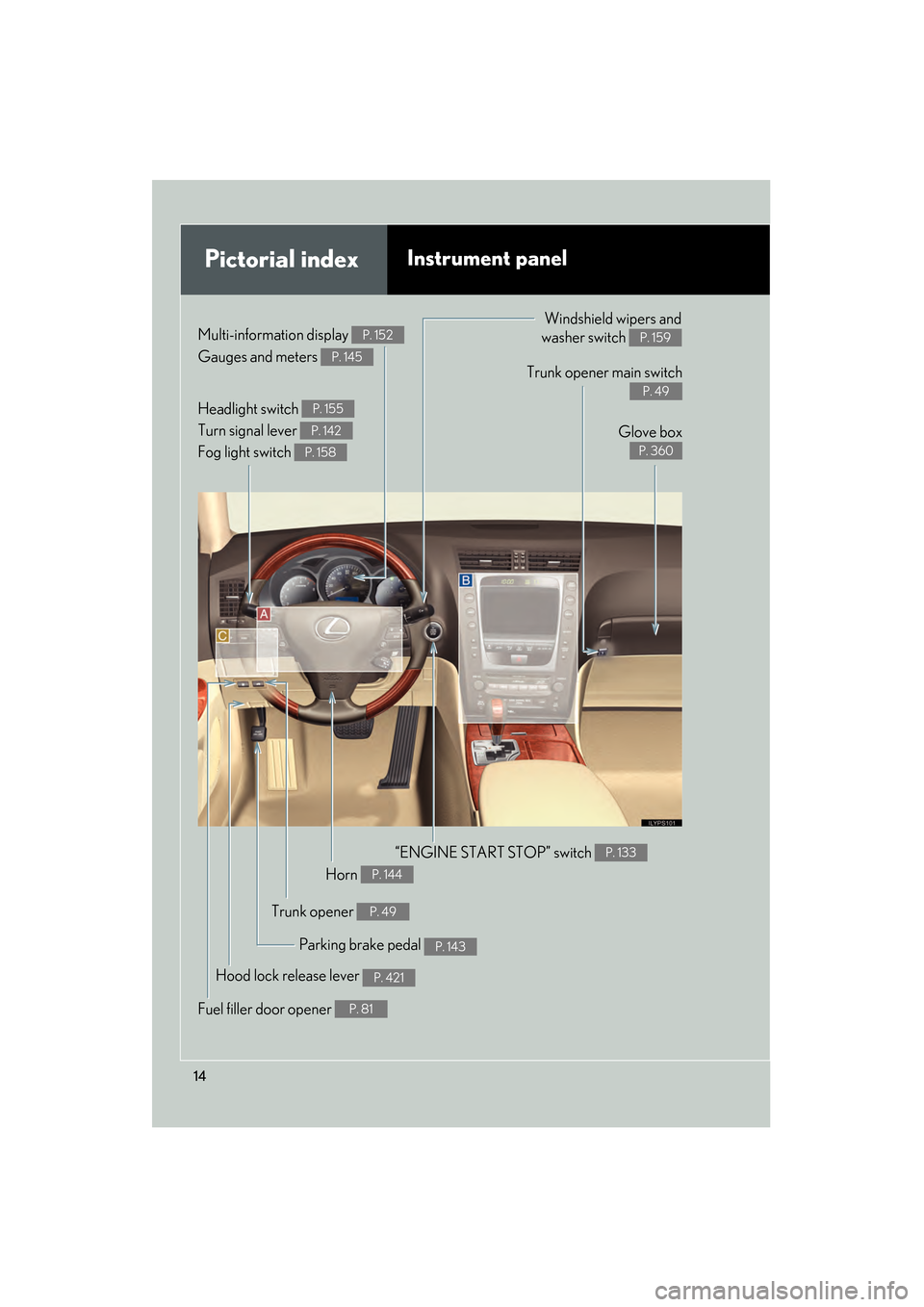
Pictorial indexInstrument panel
Headlight switch
Turn signal lever
Fog light switch P. 155
P. 142
P. 158
Gauges and meters P. 145
Multi-information display P. 152Windshield wipers and
washer switch
P. 159
Parking brake pedal P. 143
Trunk opener main switch
P. 49
Glove box
P. 360
Hood lock release lever P. 421
“ENGINE START STOP” switch P. 133
Trunk opener P. 49
Fuel filler door opener P. 81
Horn P. 144
GS_U_G.book Page 14 Monday, April 27, 2009 10:50 AM
Page 20 of 622
19
GS_G_U (OM30B43U)
April 20, 2009 4:34 pm
Installation of a mobile two-way radio system
As the installation of a mobile two-way radio system in your vehicle could affect
electronic systems such as the multiport fuel injection system/sequential multiport
fuel injection system, dynamic radar cruise control system, cruise control system,
anti-lock brake system, vehicle dynamics integrated management, SRS airbag sys-
tem and seat belt pretensioner system, be sure to check with your Lexus dealer for
precautionary measures or special instructions regarding installation.
Scrapping of your Lexus
The SRS airbag and seat belt pretensioner devices in your Lexus contain explosive
chemicals. If the vehicle is scrapped with the airbags and seat belt pretensioners left
as they are, this may cause an accident such as fire. Be sure to have the systems of
the SRS airbag and seat belt pretensioner removed and disposed of by a qualified
service shop or by your Lexus deal er before you scrap your vehicle.
Perchlorate Material
Special handling may apply, See www.d tsc.ca.gov/hazardouswaste/perchlorate.
Your vehicle has components that may contain perchlorate. These components may
include airbag, seat belt pretensioners, and wireless remote control batteries.
GS_U_G.book Page 19 Monday, April 27, 2009 10:50 AM
Page 124 of 622
When driving2
123
GS_G_U (OM30B43U)
April 27, 2009 10:37 am
2-1. Driving proceduresDriving the vehicle.................. 124
Engine (ignition) switch ......... 133
Automatic transmission ........ 137
Turn signal lever ....................... 142
Parking brake ........................... 143
Horn ............................................ 144
2-2. Instrument cluster Gauges and meters ................ 145
Indicators and warning lights ........................ 149
Multi-information display ...................................... 152
2-3. Operating the lights and windshield wipers
Headlight switch...................... 155
Fog light switch ........................ 158
Windshield wipers and washer ..................................... 159
Headlight cleaner switch...... 164 2-4. Using other driving
systems
Cruise control.......................... 165
Dynamic radar cruise control ...................................... 169
Intuitive parking assist ............ 181
Rear view monitor system .... 196
AVS (Adaptive Variable Suspension System) ............ 199
Driving assist systems ........... 200
PCS (Pre-Collision System) ...... 207
2-5. Driving information Cargo and luggage ................ 212
Vehicle load limits ................... 216
Winter driving tips .................. 217
Trailer towing .......................... 222
Dinghy towing......................... 223
GS_U_G.book Page 123 Monday, April 27, 2009 10:50 AM
Page 125 of 622
124
GS_G_U (OM30B43U)
April 27, 2009 10:48 am
2-1. Driving procedures
Driving the vehicle
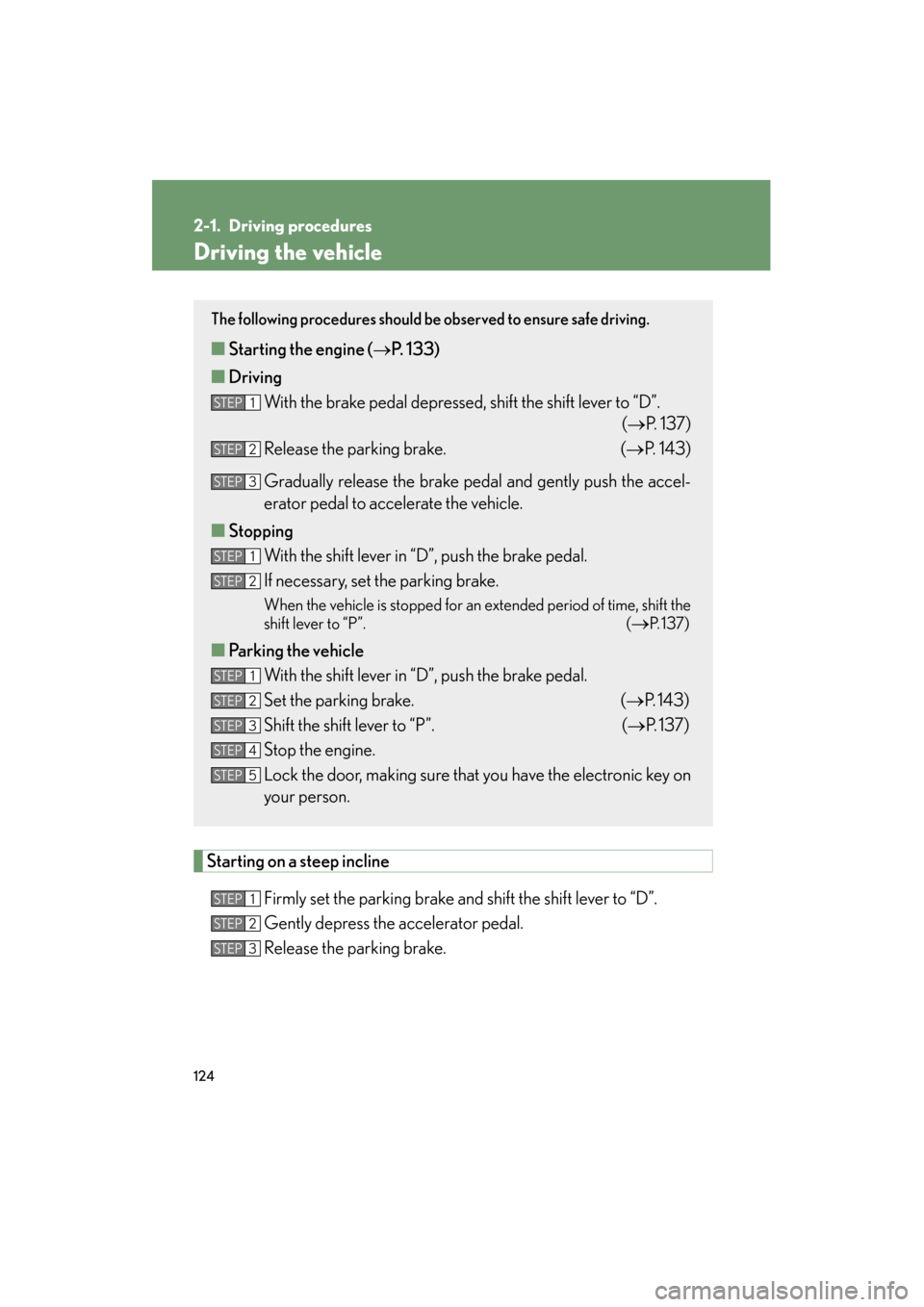
Starting on a steep inclineFirmly set the parking brake and shift the shift lever to “D”.
Gently depress the accelerator pedal.
Release the parking brake.
The following procedures should be observed to ensure safe driving.
■ Starting the engine ( →P. 1 3 3 )
■ Driving
With the brake pedal depressed, shift the shift lever to “D”. (→P. 1 3 7 )
Release the parking brake. (→P. 143)
Gradually release the brake peda l and gently push the accel-
erator pedal to accelerate the vehicle.
■ Stopping
With the shift lever in “D”, push the brake pedal.
If necessary, set the parking brake.
When the vehicle is stopped for an extended period of time, shift the
shift lever to “P”. (
→P. 1 3 7 )
■Parking the vehicle
With the shift lever in “D”, push the brake pedal.
Set the parking brake. (→ P. 143)
Shift the shift lever to “P”. (→P. 1 3 7 )
Stop the engine.
Lock the door, making sure that you have the electronic key on
your person.
STEP1
STEP2
STEP3
STEP1
STEP2
STEP1
STEP2
STEP3
STEP4
STEP5
STEP1
STEP2
STEP3
GS_U_G.book Page 124 Monday, April 27, 2009 10:50 AM
Page 126 of 622
125
2-1. Driving procedures
2
When driving
GS_G_U (OM30B43U)
April 27, 2009 10:48 am
■Driving in the rain
●Drive carefully when it is raining, because visibility will be reduced, the windows
may become fogged-up, and the road will be slippery.
●Drive carefully when it starts to rain, be cause the road surface will be especially
slippery.
●Refrain from high speeds when driving on an expressway in the rain, because
there may be a layer of water between th e tires and the road surface, preventing
the steering and brakes from operating properly.
■Breaking in your new Lexus
To extend the life of the vehicle, the following precautions are recommended to
observe:
●For the first 186 miles (300 km):
Avoid sudden stops.
●For the first 621 miles (1000 km):
• Do not drive at extremely high speeds.
• Avoid sudden acceleration.
• Do not drive continuously in the low range in the “S” position.
• Do not drive at a constant speed for extended periods.
■Operating your vehicle in a foreign country
Comply with the relevant vehicle registration laws and confirm the availability of the
correct fuel. ( →P. 5 6 1 )
■When starting on an incline
The hill-start assist control may operate. ( →P. 200)
GS_U_G.book Page 125 Monday, April 27, 2009 10:50 AM
Page 127 of 622
126
2-1. Driving procedures
GS_G_U (OM30B43U)
April 27, 2009 10:48 am
CAUTION
■When starting the vehicle
Always keep your foot on the brake pedal while stopped with the engine running.
This prevents the vehicle from creeping.
■When driving the vehicle
●Do not drive if you are unfamiliar with the location of the brake and accelerator
pedals to avoid depressing the wrong pedal.
• Accidentally depressing the accelerator pedal instead of the brake pedal will
result in sudden acceleration that may le ad to an accident that could result in
death or serious injury.
• When backing up, you may twist your body around, leading to a difficulty in operating the pedals. Make sure to operate the pedals properly.
• Make sure to keep a correct driving posture even when moving the vehicle only slightly, allowing you to depress the brake and accelerator pedals prop-
erly.
• Depress the brake pedal using your right foot. Depressing the brake pedal using your left foot may delay response in an emergency, resulting in an acci-
dent.
●Do not drive the vehicle over or stop the vehicle near flammable materials.
The exhaust system and exhaust gases ca n be extremely hot. This may cause a
fire if there is any flammable material nearby.
●Do not let the vehicle roll backwards while the shift lever is in a driving position, or
roll forward while the shift lever is in “R”.
Doing so may cause the engine not to oper ate or lead to poor brake and steering
performance, resulting in an accident or damage to the vehicle.
●If the smell of exhaust is noticed inside the vehicle, open the windows and check
that the trunk is closed.
Large amounts of exhaust in the vehicle can cause driver drowsiness and an acci-
dent, resulting in death or a serious health hazard. Have the vehicle inspected by
your Lexus deal er immediately.
●Do not under any circumstances shift the shift lever to “P”, “R” or “N” while the
vehicle is moving.
Doing so can cause significant damage to the automatic transmission and may
result in a loss of vehicle control.
GS_U_G.book Page 126 Monday, April 27, 2009 10:50 AM
Page 128 of 622
127
2-1. Driving procedures
2
When driving
GS_G_U (OM30B43U)
April 27, 2009 10:48 am
CAUTION
■When driving the vehicle
●Do not shift the shift lever to “N” while the vehicle is moving.
Doing so may cause the engine brake not to operate properly and lead to an
accident.
●Do not turn the engine off while driving.
The power steering and brake actuator (GS460) or brake booster (GS350) will
not operate properly if the engine is off.
●Use engine braking (downshift) to maintain a safe speed when driving down a
steep hill.
Using the brakes continuously may cause the brakes to overheat and lose effec-
tiveness. (→P. 1 3 9 )
●When stopped on an inclined surface, use the brake pedal and parking brake to
prevent the vehicle from rolling backwa rd or forward and causing an accident.
●Be careful when driving on slippery surfaces, as the vehicle may spin or skid when
downshifting, rapidly accelerating, braking or turning.
●Do not adjust the position of the steering wheel, the seat, or the inside or outside
rear view mirrors while driving.
Doing so may result in a loss of vehicle control that can cause accidents that may
result in death or serious injury.
●Always check that all passengers’ arms, heads or other parts of their bodies are
not outside the vehicle, as this may result in death or serious injury.
●Do not drive in excess of the speed limit. Even if the legal speed limit permits it, do
not drive over 85 mph (140 km/h) unless your vehicle has high-speed capability
tires. Driving over 85 mph (140 km/h) may result in tire failure, loss of control and
possible injury. Be sure to consult a tire dealer to determine whether the tires on
your vehicle are high-speed capability tires or not before driving at such speeds.
GS_U_G.book Page 127 Monday, April 27, 2009 10:50 AM
Page 129 of 622
128
2-1. Driving procedures
GS_G_U (OM30B43U)
April 27, 2009 10:48 am
CAUTION
■When driving on slippery road surfaces
●Sudden braking, acceleration and steering may cause tire slippage and reduce
your ability to control the vehi cle, resulting in an accident.
●Sudden changes in engine speed, such as engine braking caused by up-shifting
or down-shifting, may cause the vehicl e to skid, resulting in an accident.
●After driving through a puddle, lightly depress the brake pedal to make sure that
the brakes are functioning properly. Wet brake pads may prevent the brakes from
functioning properly. If the brakes on on ly one side are wet and not functioning
properly, steering control may be af fected, resulting in an accident.
■When shifting the shift lever
Be careful not to shift the shift lever with the accelerator pedal depressed.
This may lead to unexpected rapid acceleration of the vehicle that may cause an
accident and result in death or serious injury.
■When the vehicle is stopped
●Do not race the engine.
If the vehicle is in any positions other than “P” or “N” the vehicle may accelerate
suddenly and unexpectedly, and may cause an accident.
●Do not leave the vehicle with the engine on for a long time.
If such a situation cannot be avoided, park the vehicle in an open space and
check that exhaust fumes do no t enter the vehicle interior.
●Always keep a foot on the brake pedal while the engine is running to prevent an
accident caused by the vehicle moving.
GS_U_G.book Page 128 Monday, April 27, 2009 10:50 AM
Page 130 of 622
129
2-1. Driving procedures
2
When driving
GS_G_U (OM30B43U)
April 27, 2009 10:48 am
CAUTION
■When the vehicle is parked
●Do not leave glasses, cigarette lighters, spray cans, or soft drink cans in the vehi-
cle when it is in the sun.
Failure to do so may result in the following:
• Gas may leak from a cigarette lighter or spray can, and may lead to a fire.
• The temperature inside the vehicle may cause the plastic lenses and plastic material of eye glasses to deform or crack.
• Soft drink cans may fracture, causing the contents to spray over the interior of
the vehicle, and may also cause a short circuit in the vehicle’s electrical com-
ponents.
●Always apply the parking brake, shift the shift lever to “P”, stop the engine and
lock the vehicle.
Do not leave the vehicle unattend ed while the engine is running.
●Do not touch the exhaust pipe while the engine is running or immediately after
turning the engine off.
Doing so may cause burns.
●Do not leave the engine running in an area with snow build-up, or where it is
snowing. If snowbanks build up around the vehicle while the engine is running,
exhaust gases may collect and enter the vehi cle. This may lead to death or a seri-
ous health hazard.
■Exhaust gases
Exhaust gases include harmful carbon mono xide (CO) that is colorless and odor-
less. Inhaling exhaust gases may lead to death or a serious health hazard.
●If the vehicle is in a poorly ventilated ar ea, stop the engine. In a closed area, such
as a garage, exhaust gases may collect and enter the vehicle. This may lead to
death or a serious health hazard.
●The exhaust should be checked occasionally. If there is a hole or crack caused by
corrosion, damage to a joint or abnormal exhaust noise, be sure to have the vehi-
cle inspected and repaired by your Lexus dealer. Failure to do so may allow
exhaust gases to enter the vehicle, result ing in death or a serious health hazard.
GS_U_G.book Page 129 Monday, April 27, 2009 10:50 AM