engine overheat Lexus GS350 2009 Owner's Manual
[x] Cancel search | Manufacturer: LEXUS, Model Year: 2009, Model line: GS350, Model: Lexus GS350 2009Pages: 622, PDF Size: 17.98 MB
Page 128 of 622
127
2-1. Driving procedures
2
When driving
GS_G_U (OM30B43U)
April 27, 2009 10:48 am
CAUTION
■When driving the vehicle
●Do not shift the shift lever to “N” while the vehicle is moving.
Doing so may cause the engine brake not to operate properly and lead to an
accident.
●Do not turn the engine off while driving.
The power steering and brake actuator (GS460) or brake booster (GS350) will
not operate properly if the engine is off.
●Use engine braking (downshift) to maintain a safe speed when driving down a
steep hill.
Using the brakes continuously may cause the brakes to overheat and lose effec-
tiveness. (→P. 1 3 9 )
●When stopped on an inclined surface, use the brake pedal and parking brake to
prevent the vehicle from rolling backwa rd or forward and causing an accident.
●Be careful when driving on slippery surfaces, as the vehicle may spin or skid when
downshifting, rapidly accelerating, braking or turning.
●Do not adjust the position of the steering wheel, the seat, or the inside or outside
rear view mirrors while driving.
Doing so may result in a loss of vehicle control that can cause accidents that may
result in death or serious injury.
●Always check that all passengers’ arms, heads or other parts of their bodies are
not outside the vehicle, as this may result in death or serious injury.
●Do not drive in excess of the speed limit. Even if the legal speed limit permits it, do
not drive over 85 mph (140 km/h) unless your vehicle has high-speed capability
tires. Driving over 85 mph (140 km/h) may result in tire failure, loss of control and
possible injury. Be sure to consult a tire dealer to determine whether the tires on
your vehicle are high-speed capability tires or not before driving at such speeds.
GS_U_G.book Page 127 Monday, April 27, 2009 10:50 AM
Page 131 of 622
130
2-1. Driving procedures
GS_G_U (OM30B43U)
April 27, 2009 10:48 am
CAUTION
■When taking a nap in the vehicle
Always turn the engine off. Otherwise, you may accidentally move the shift lever or
depress the accelerator pedal, which could cause an accident or fire due to engine
overheating. Additionally, if the vehicle is parked in a poorly ventilated area, exhaust
gases may collect and enter th e vehicle, leading to death or a serious health hazard.
■When braking the vehicle
●When the brakes are wet, drive more cautiously.
Braking distance increases when the brakes are wet, and may cause one side of
the vehicle to brake differently than the other side. Also the parking brake may
not securely hold the vehicle.
●If the brake actuator (GS460) or brake booster (GS350) does not operate, do
not follow other vehicles closely and avoi d downhill or sharp turns that require
making.
In this case, braking is still possible, but it will require more force on the pedal than
usual. Braking distance may also increase.
●Do not pump the brake pedal if turning the engine off.
Each push on the brake pedal uses up the reserve for the power-assisted brakes.
●The brake system consists of 3 (GS460) or 2 (GS350) individual hydraulic sys-
tems: If one of the systems fails, the other will still operate. In this case, the brake
pedal should be depressed more firmly th an usual and braking distance becomes
longer.
Do not drive your vehicle with only a single brake system. Have your brakes fixed
immediately.
■If the vehicle becomes stuck or bogged (4WD models)
Do not spin the wheels recklessly when any of the tires is up in the air, or stuck in
sand or mud, etc. This may damage the drive system components or propel the
vehicle forward (or in another direction) and cause an accident.
GS_U_G.book Page 130 Monday, April 27, 2009 10:50 AM
Page 149 of 622
148
2-2. Instrument cluster
GS_G_U (OM30B43U)
April 27, 2009 10:48 am
NOTICE
■To prevent damage to the engine and its components
●The engine may be overheating if the engine coolant temperature gauge is in the
red zone (“H”). In this case, immediately stop the vehicle in a safe place. Check
the engine after it has cooled completely. (→P. 5 5 2 )
●Do not let the indicator needle of the tachometer enter the red zone, which indi-
cates the maximum engine speed.
■To activate the light sensitivity function properly
Do not affix a sticker or window tint to the rear window glass, or put an object
behind the rear seat.
GS_U_G.book Page 148 Monday, April 27, 2009 10:50 AM
Page 165 of 622
164
2-3. Operating the lights and windshield wipers
GS_G_U (OM30B43U)
April 27, 2009 10:40 am
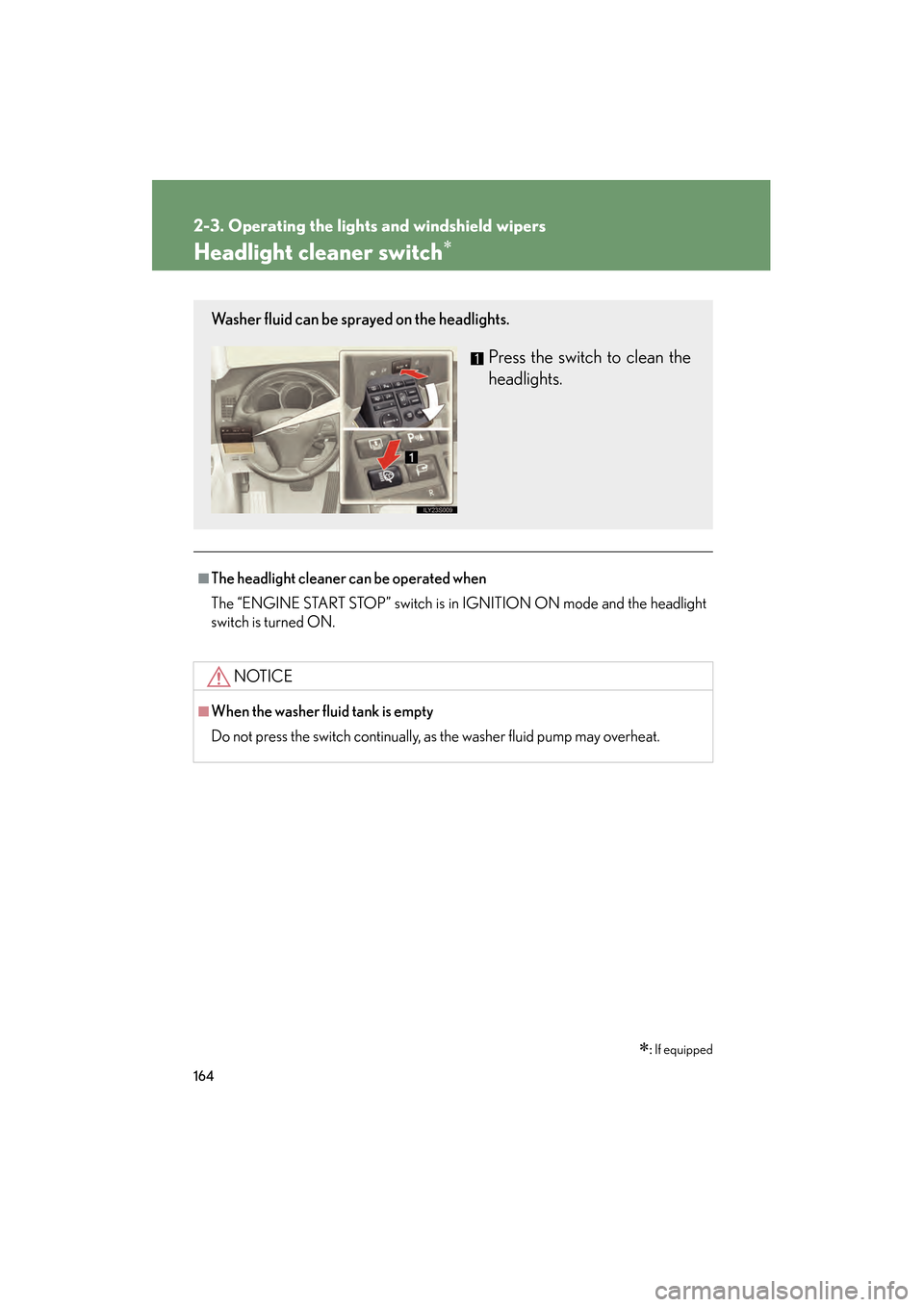
Headlight cleaner switch∗
■The headlight cleaner can be operated when
The “ENGINE START STOP” switch is in IGNITION ON mode and the headlight
switch is turned ON.
NOTICE
■When the washer fluid tank is empty
Do not press the switch continually, as the washer fluid pump may overheat.
∗: If equipped
Washer fluid can be sprayed on the headlights.
Press the switch to clean the
headlights.
GS_U_G.book Page 164 Monday, April 27, 2009 10:50 AM
Page 206 of 622
205
2-4. Using other driving systems
2
When driving
GS_G_U (OM30B43U)
April 27, 2009 10:48 am
■Reduced effectiveness of EPS
The effectiveness of EPS is reduced to prevent the system from overheating when
there is frequent steering input over an extended period of time. The steering wheel
may feel heavy as a result. Should this occur, refrain from excessive steering input or
stop the vehicle and turn the engine off. The system should return to normal about
10 minutes.
■GS460: VGRS is disabled in the following situations
●During stopping or the st eering wheel has been moved for a long time while
driving at lower speeds.
●After the engine is restarted at less than -22°F (-30°C).
CAUTION
Any of the following conditions may result in an accident which could cause death or
serious injury:
■The ABS does not operate effectively when
●The limits of tire gripping performance have been exceeded.
●The vehicle hydroplanes while driving at high speed on a wet or slick road.
■Stopping distance when the ABS is operating will exceed that of normal condi-
tions
The ABS is not designed to shorten the vehicle’s stopping dist ance. Always main-
tain a safe distance from the vehicle in front of you in the following situations.
●When driving on dirt, gravel or snow-covered roads
●When driving with tire chains
●When driving over bumps in the road
●When driving over roads with potholes or roads with uneven roads
■TRAC may not operate effectively when
Directional control and power may not be ac hievable while driving on slippery road
surfaces, even if the TRAC is operating.
Do not drive the vehicle in conditions where stability and power may be lost.
GS_U_G.book Page 205 Monday, April 27, 2009 10:50 AM
Page 372 of 622
371
3-7. Other interior features
3
Interior features
GS_G_U (OM30B43U)
April 27, 2009 10:48 am
Cigarette lighter
■The cigarette lighter can be used when
The “ENGINE START STOP” switch is in ACCESSORY or IGNITION ON mode.
CAUTION
■To avoid burns or fires
●Do not touch the metal parts of the cigarette lighter.
●Do not hold the cigarette lighter down. It could overheat and cause a fire.
●Do not insert anything other than the cigarette lighter into the outlet.
■When not in use
Keep the ashtray lid closed.
Injuries may result in the event of sudden braking, sudden swerving or an accident.
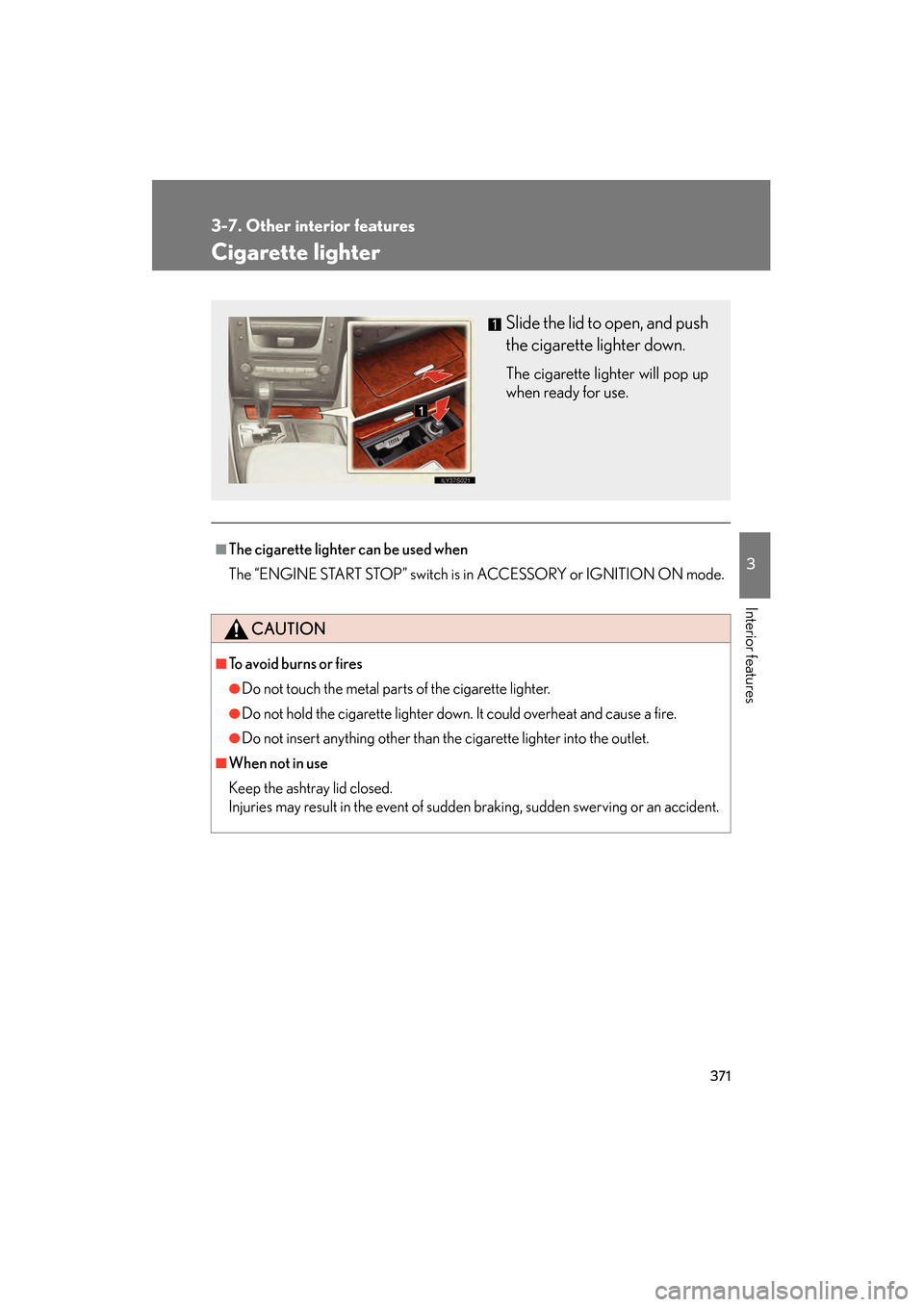
Slide the lid to open, and push
the cigarette lighter down.
The cigarette lighter will pop up
when ready for use.
GS_U_G.book Page 371 Monday, April 27, 2009 10:50 AM
Page 375 of 622
374
3-7. Other interior features
GS_G_U (OM30B43U)
April 27, 2009 10:48 am
CAUTION
■Burns
●Use caution when seating the following persons in a seat with the seat heater on
to avoid the possibility of burns:
• Babies, small children, the elderly, the sick and the disabled
• Persons with sensitive skin
• Persons who are fatigued
• Persons who have taken alcohol or dr ugs that induce sleep (sleeping drugs,
cold remedies, etc.)
●Do not cover the seat with anything when using the seat heater.
Using the seat heater with a blanket or cushion increases the temperature of the
seat and may lead to overheating.
●Do not use seat heater more than necessary.
Doing so may cause minor burns or overheating.
NOTICE
■To prevent damage to the seat heaters/ventilators
Do not put heavy objects on the seat and do not stick sharp objects (needles, nails,
etc.) into the seat.
■To prevent 12 volt battery discharge
Turn the switches off when the engine is off.
GS_U_G.book Page 374 Monday, April 27, 2009 10:50 AM
Page 496 of 622
When trouble arises5
495
GS_G_U (OM30B43U)
May 1, 2009 1:17 pm
5-1. Essential informationEmergency flashers............... 496
If your vehicle needs to be towed ............................ 497
If you think something is wrong ..................................... 503
Fuel pump shut off system .................................... 504
Event data recorder ............. 505 5-2. Steps to take
in an emergency
If a warning light turns on or a warning buzzer
sounds... ................................. 507
If a warning message is displayed................................. 516
If you have a flat tire (Vehicles with standard tires) ............. 531
If you have a flat tire (Vehicles with run-flat tires)................. 541
If the engine will not start .... 542
If the shift lever cannot be shifted from “P”.................... 543
If you lose your keys .............. 544
If the electronic key does not operate properly ................. 545
If the 12 volt battery is discharged ............................ 548
If your vehicle overheats ..... 552
If the vehicle becomes stuck........................................ 555
Sec_05TOC.fm Page 495 Friday, May 1, 2009 1:17 PM
Page 553 of 622
552
5-2. Steps to take in an emergency
GS_G_U (OM30B43U)
April 27, 2009 10:48 am
If your vehicle overheats
If your engine overheats:
Stop the vehicle in a safe place and turn off the air conditioning
system.
Check to see if steam is coming out from under the hood.
If you see steam: Stop the engine. Carefully lift the hood after the steam sub-
sides and then restart the engine.
If you do not see steam: Leave the engine running and carefully lift the hood.
Remove the engine compartment cover. ( →P. 4 2 6 )
Check to see if the cooling fan is operating.
If the fan is operating: Wait until the engine coolant temperature gauge begins to
fall and then stop the engine.
If the fan is not operating: Stop the engine immediately and call your Lexus dealer.
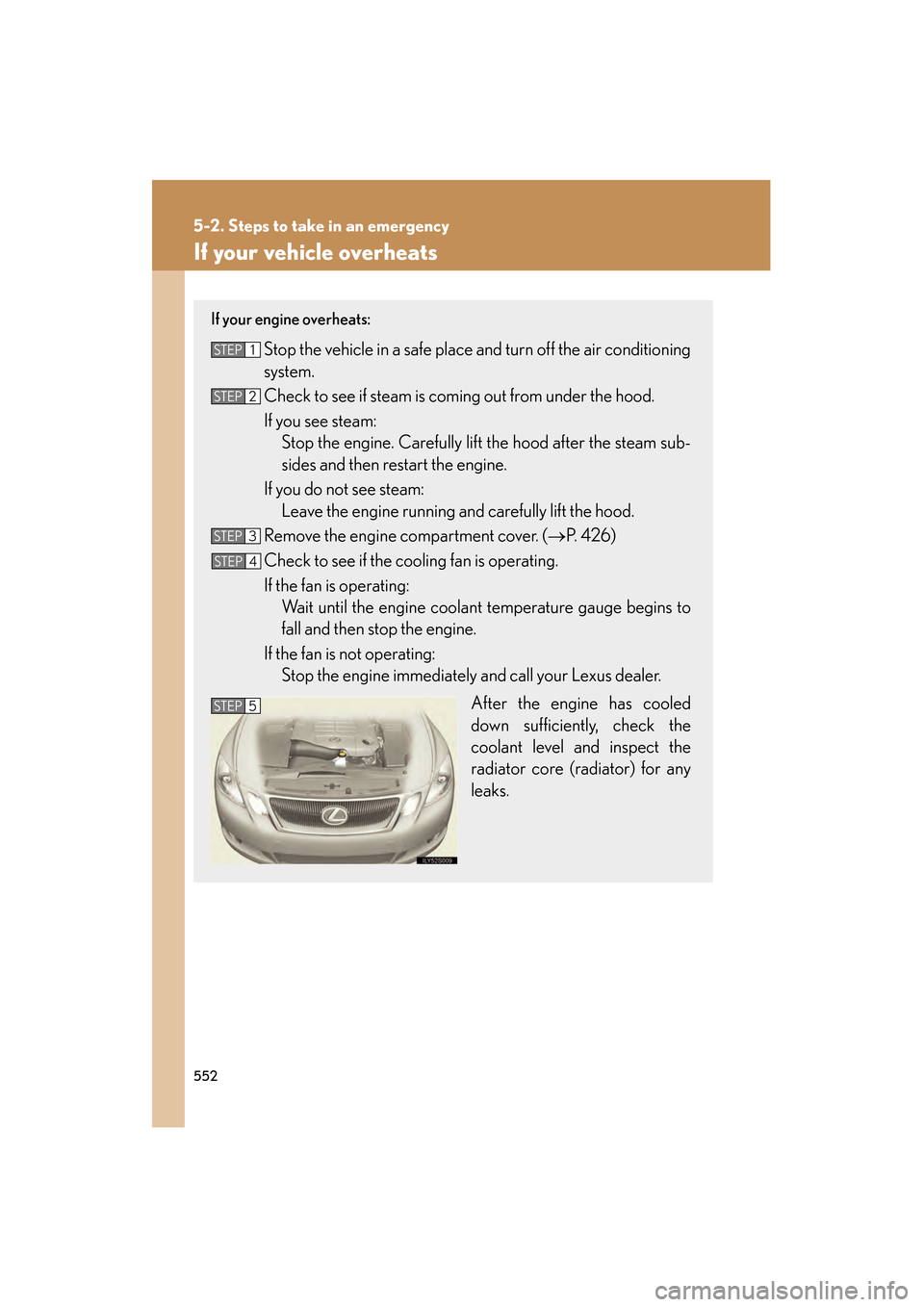
After the engine has cooled
down sufficiently, check the
coolant level and inspect the
radiator core (radiator) for any
leaks.STEP1
STEP2
STEP3
STEP4
STEP5
GS_U_G.book Page 552 Monday, April 27, 2009 10:50 AM
Page 554 of 622
5
When trouble arises
553
5-2. Steps to take in an emergency
GS_G_U (OM30B43U)
April 27, 2009 10:48 am
■Overheating
In the following situations, your vehicle may be overheating.
●The engine coolant temperature gauge enters the red zone or a loss of power is
experienced.
●Steam is coming from under the hood.
CAUTION
■To prevent an accident or injury when in specting under the hood of your vehicle
●If steam is seen coming from under the food, do not open the food until the steam
has subsided. The engine compartment may be very hot, causing serious injury
such as burns.
●Keep hands and clothing away from the fan and engine drive belt while the
engine is running.
●Do not loosen the radiator cap while the engine and radiator are hot.
Serious injury, such as burns, may result from hot coolant and steam released
under pressure.
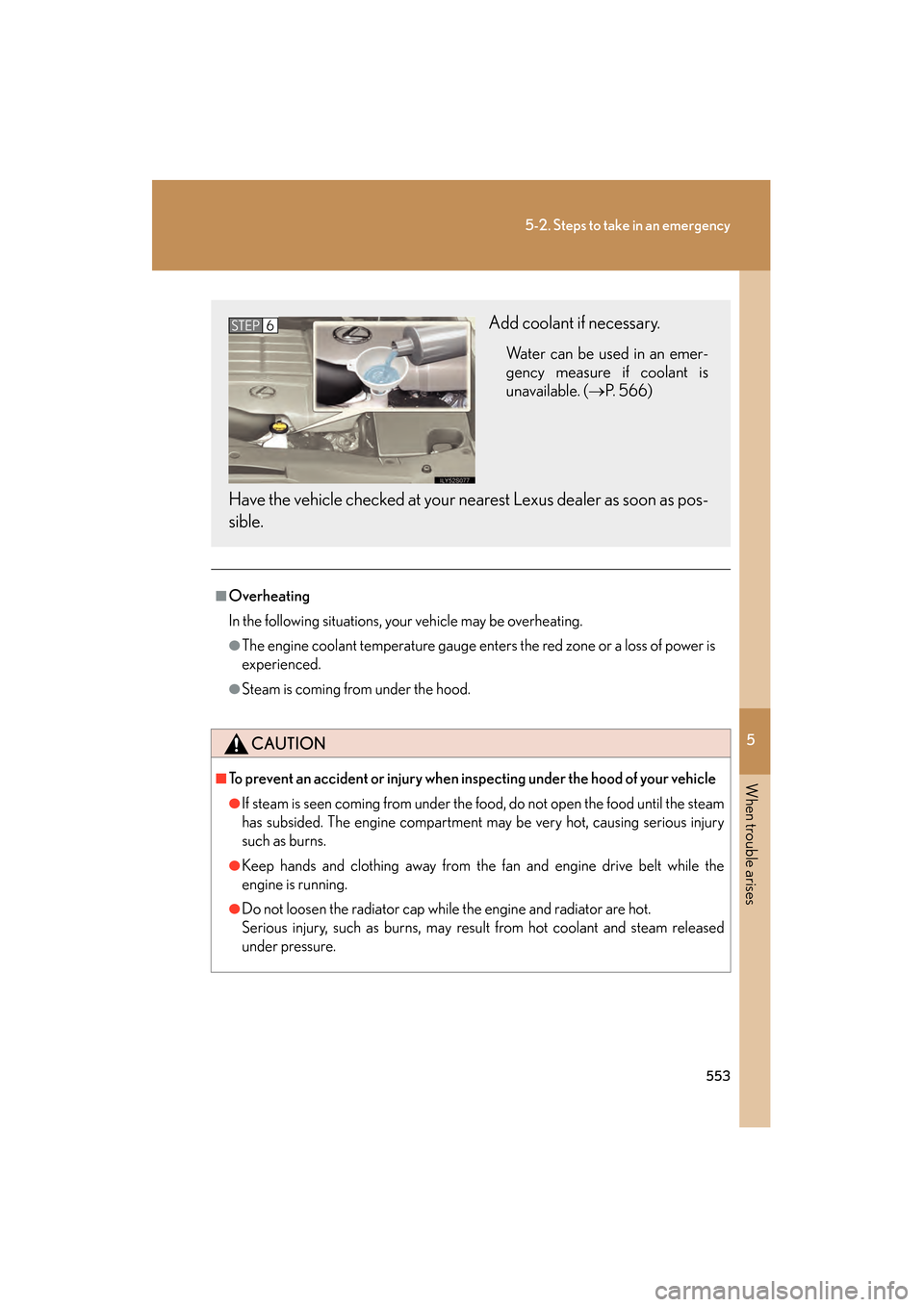
Add coolant if necessary.
Water can be used in an emer-
gency measure if coolant is
unavailable. ( →P. 5 6 6 )
Have the vehicle checked at your nearest Lexus dealer as soon as pos-
sible.
STEP6
GS_U_G.book Page 553 Monday, April 27, 2009 10:50 AM