inflation pressure Lexus GS350 2009 Owner's Manual
[x] Cancel search | Manufacturer: LEXUS, Model Year: 2009, Model line: GS350, Model: Lexus GS350 2009Pages: 622, PDF Size: 17.98 MB
Page 6 of 622
1
2
3
4
5
6
7
5
GS_G_U (OM30B43U)
April 27, 2009 10:35 am
4-1. Maintenance and careCleaning and protecting the vehicle exterior................... 406
Cleaning and protecting the vehicle interior ................... 409
4-2. Maintenance Maintenance requirements ...... 412
General maintenance ................. 414
Emission inspection and maintenance (I/M)
programs ....................................... 417
4-3. Do-it-yourself maintenance Do-it-yourself service precautions ................... 418
Hood................................................... 421
Positioning a floor jack............... 422
Engine compartment.................. 424
Tires .................................................. 438
Tire inflation pressure................. 448
Wheels.............................................. 453
Air conditioning filter.................. 455
Electronic key battery ............... 458
Checking and replacing fuses ........................... 460
Headlight aim ............................... 485
Light bulbs ...................................... 488 5-1. Essential information
Emergency flashers .................... 496
If your vehicle needs to be towed .................................. 497
If you think something is wrong ............................................ 503
Fuel pump shut off system ....... 504
Event data recorder................... 505
5-2. Steps to take in an emergency If a warning light turns on or a warning buzzer
sounds... ......................................... 507
If a warning message is displayed........................................ 516
If you have a flat tire (Vehicles with standard tires) .................... 531
If you have a flat tire (Vehicles with run-flat tires) ....................... 541
If the engine will not start .......... 542
If the shift lever cannot be shifted from “P” .......................... 543
If you lose your keys .................... 544
If the electronic key does not operate properly ....................... 545
If the 12 volt battery is discharged .................................. 548
If your vehicle ov erheats ........... 552
If the vehicle becomes stuck............................................... 555
4Maintenance and care5When trouble arises
GS_U_G.book Page 5 Monday, April 27, 2009 10:50 AM
Page 10 of 622
9
GS_G_U (OM30B43U)
April 27, 2009 10:48 am
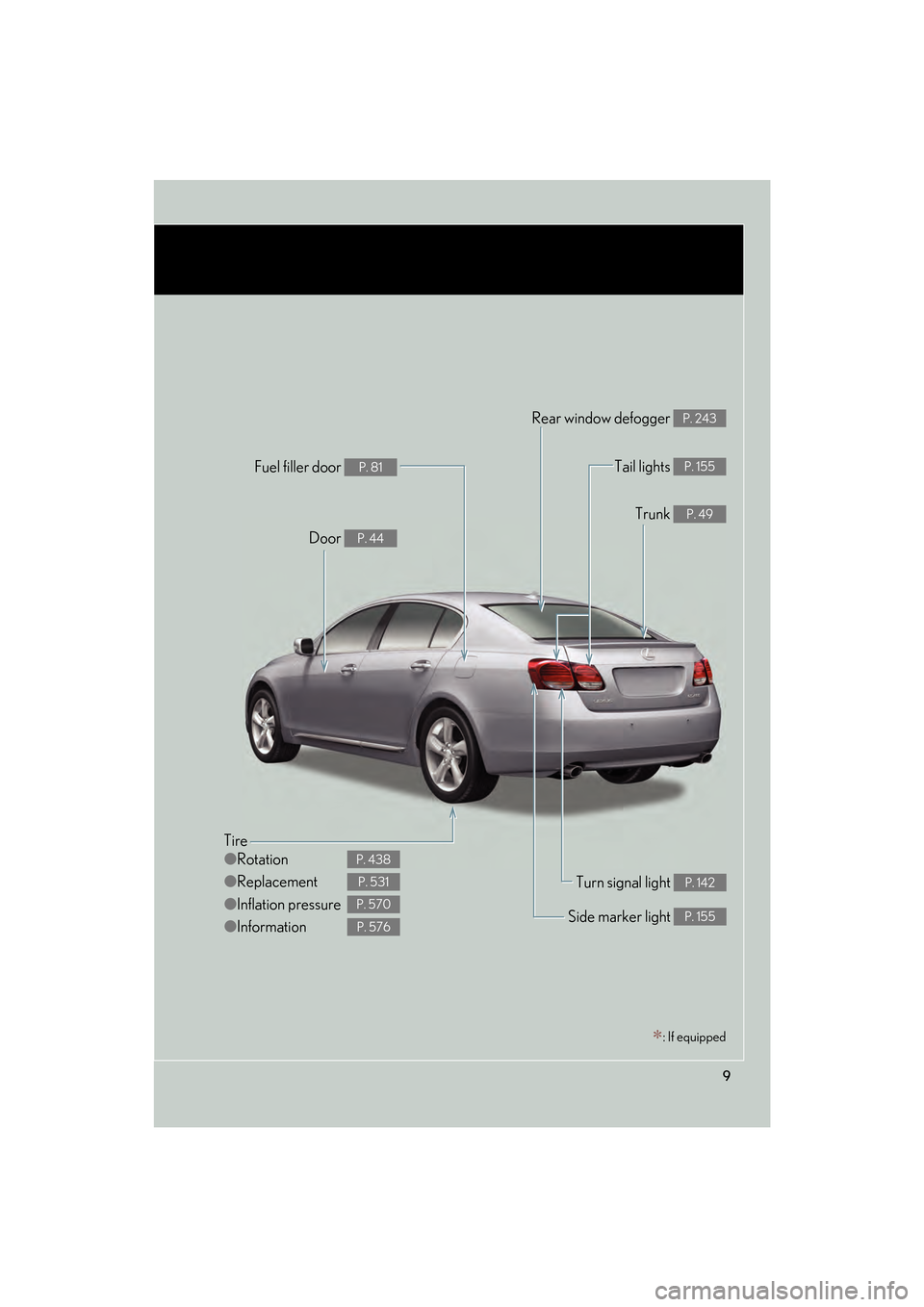
Tire
●Rotation
● Replacement
● Inflation pressure
● Information
P. 438
P. 531
P. 570
P. 576
Tail lights P. 155
Side marker light P. 155
Trunk P. 49
Rear window defogger P. 243
Door P. 44
Fuel filler door P. 81
Turn signal light P. 142
∗: If equipped
GS_U_G.book Page 9 Monday, April 27, 2009 10:50 AM
Page 221 of 622
220
2-5. Driving information
GS_G_U (OM30B43U)
April 27, 2009 10:48 am
CAUTION
■Driving with snow tires
Observe the following precautions to reduce the risk of accidents.
Failing to do so may result in a loss of vehicle control and cause death or serious
injury.
●Use tires of the size specified for your vehicle.
●Maintain the specified level of tire inflation pressure.
●Do not drive in excess of 75 mph (120 km/h), regardless of the type of snow tires
being used.
●Use snow tires on all, not just some wheels.
■Driving with snow chains
Observe the following precautions to reduce the risk of accidents.
Failing to do so may result in the vehicle being unable to be driven safely, and may
cause death or serious injury.
●Do not drive in excess of the speed limit specified for the tire chains being used,
or 30 mph (50 km/h), whichever is lower.
●Avoid driving on bumpy road surfaces or over potholes.
●Avoid sudden turns and braking, as use of chains may adversely affect vehicle
handling.
●Slow down sufficiently before entering a curve to ensure that vehicle control is
maintained.
GS_U_G.book Page 220 Monday, April 27, 2009 10:50 AM
Page 406 of 622
Maintenance and care4
405
GS_G_U (OM30B43U)
April 20, 2009 4:34 pm
4-1. Maintenance and careCleaning and protecting the vehicle exterior............. 406
Cleaning and protecting the vehicle interior .............. 409 4-2. Maintenance
Maintenance requirements......................... 412
General maintenance ........... 414
Emission inspection and maintenance (I/M)
programs ................................. 417
4-3. Do-it-yourself maintenance Do-it-yourself service precautions ............................ 418
Hood ........................................... 421
Positioning a floor jack ......... 422
Engine compartment ........... 424
Tires............................................ 438
Tire inflation pressure........... 448
Wheels ...................................... 453
Air conditioning filter ........... 455
Electronic key battery.......... 458
Checking and replacing fuses ..................... 460
Headlight aim ......................... 485
Light bulbs ................................ 488
GS_U_G.book Page 405 Monday, April 27, 2009 10:50 AM
Page 417 of 622
416
4-2. Maintenance
GS_G_U (OM30B43U)
April 27, 2009 10:48 am
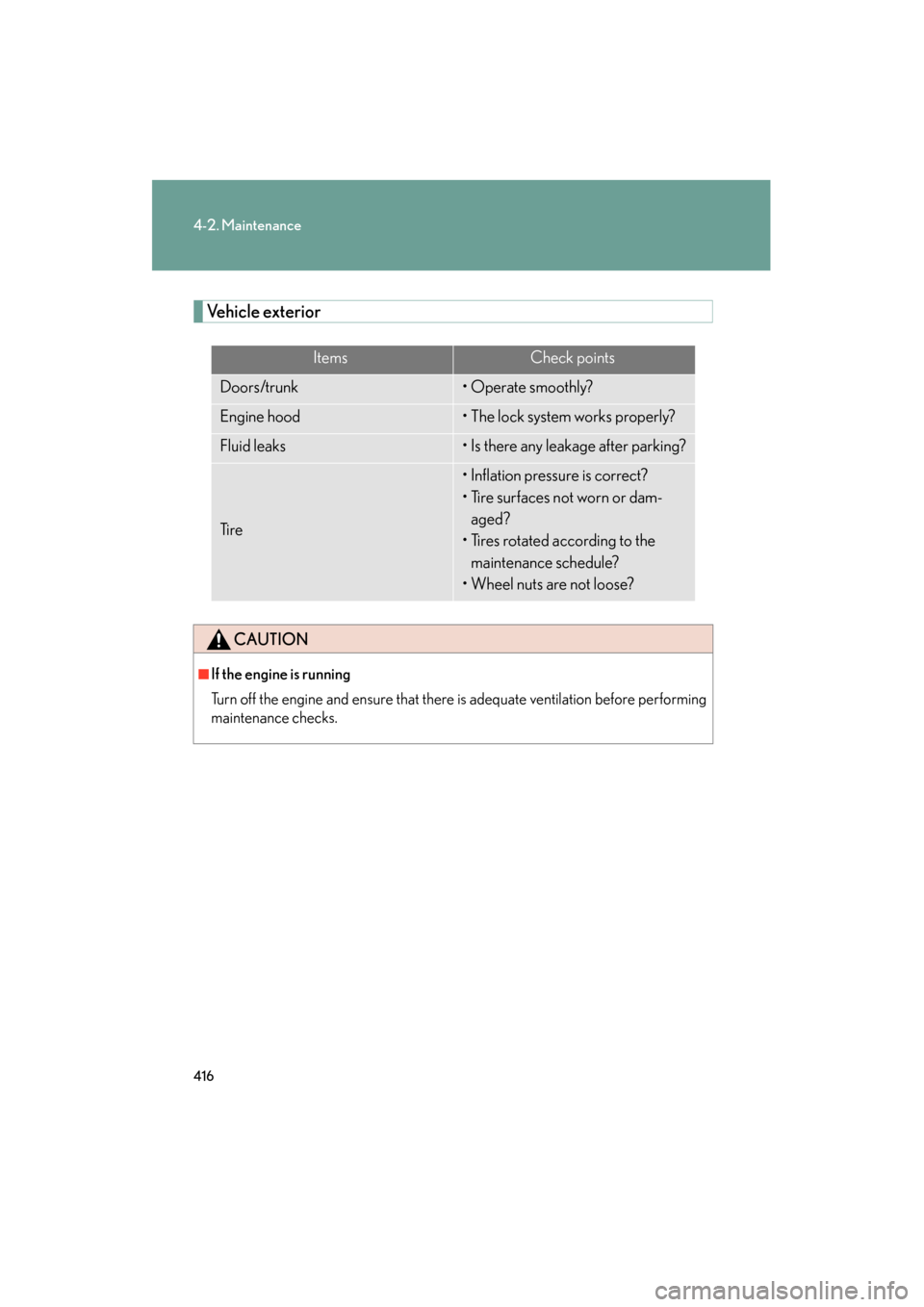
Vehicle exterior
ItemsCheck points
Doors/trunk• Operate smoothly?
Engine hood• The lock system works properly?
Fluid leaks• Is there any leakage after parking?
Ti r e
• Inflation pressure is correct?
• Tire surfaces not worn or dam-aged?
• Tires rotated according to the
maintenance schedule?
• Wheel nuts are not loose?
CAUTION
■If the engine is running
Turn off the engine and ensure that there is adequate ventilation before performing
maintenance checks.
GS_U_G.book Page 416 Monday, April 27, 2009 10:50 AM
Page 420 of 622
419
4-3. Do-it-yourself maintenance
4
Maintenance and care
GS_G_U (OM30B43U)
April 27, 2009 10:48 am
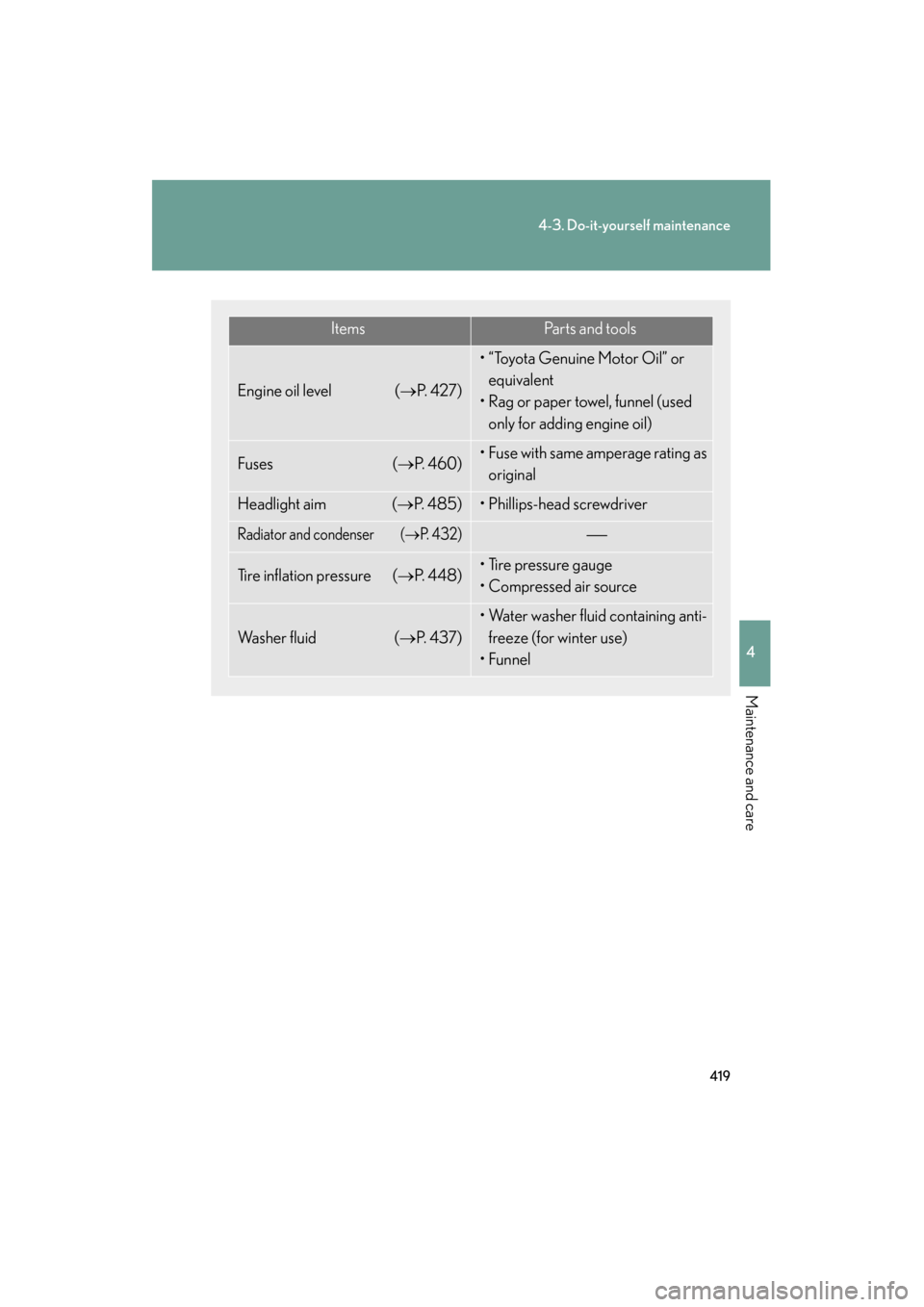
ItemsPa r t s a n d t o o l s
Engine oil level (→P. 4 2 7 )
• “Toyota Genuine Motor Oil” or
equivalent
• Rag or paper towel, funnel (used
only for adding engine oil)
Fuses (→ P. 4 6 0 )• Fuse with same amperage rating as
original
Headlight aim ( →P. 4 8 5 )• Phillips-head screwdriver
Radiator and condenser (→P. 4 3 2 )
Tire inflation pressure ( →P. 4 4 8 )• Tire pressure gauge
• Compressed air source
Wa s h e r f l u i d ( →P. 4 3 7 )
• Water washer fluid containing anti-
freeze (for winter use)
•Funnel
GS_U_G.book Page 419 Monday, April 27, 2009 10:50 AM
Page 439 of 622
438
4-3. Do-it-yourself maintenance
GS_G_U (OM30B43U)
April 27, 2009 10:48 am
Tires
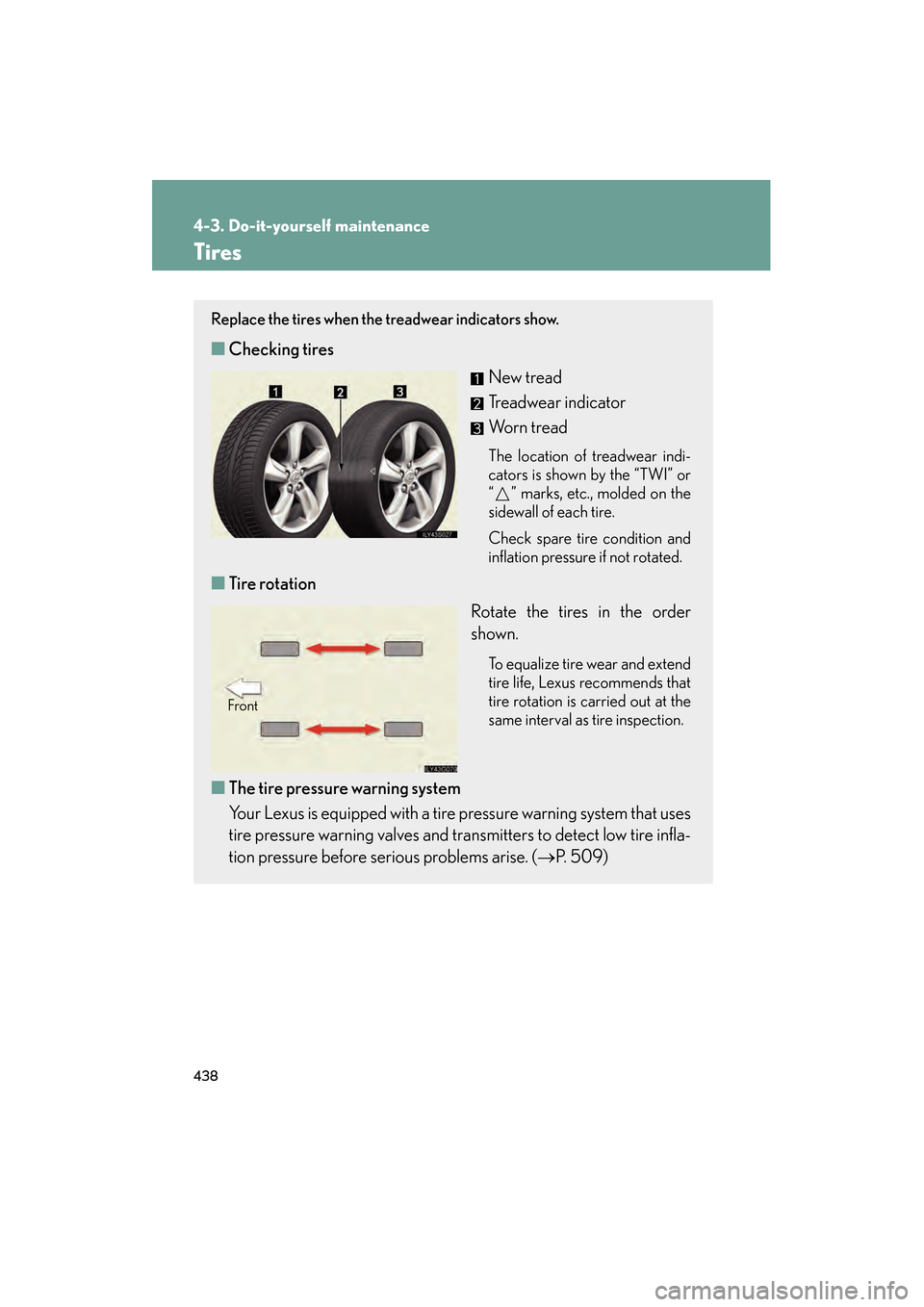
Replace the tires when the treadwear indicators show.
■Checking tires
New tread
Treadwear indicator
Worn tread
The location of treadwear indi-
cators is shown by the “TWI” or
“ ” marks, etc., molded on the
sidewall of each tire.
Check spare tire condition and
inflation pressure if not rotated.
■Tire rotation
Rotate the tires in the order
shown.
To equalize tire wear and extend
tire life, Lexus recommends that
tire rotation is carried out at the
same interval as tire inspection.
■The tire pressure warning system
Your Lexus is equipped with a tire pressure warning system that uses
tire pressure warning valves and tr ansmitters to detect low tire infla-
tion pressure before serious problems arise. ( →P. 509)
Front
GS_U_G.book Page 438 Monday, April 27, 2009 10:50 AM
Page 440 of 622
439
4-3. Do-it-yourself maintenance
4
Maintenance and care
GS_G_U (OM30B43U)
April 27, 2009 10:48 am
Installing tire pressure warning valves and transmittersWhen replacing tires or wheels, tire pressure warning valves and trans-
mitters must also be installed.
When new tire pressure warning va lves and transmitters are installed,
new tire pressure warning valve and transmitter ID codes must be regis-
tered in the tire pressure warning computer and tire pressure warning
system must be initialized. Have tire pressure warning valve and transmit-
ter ID codes registered by your Lexus dealer. ( →P. 4 4 1 )
Initializing the tire pressure warning system
■ The tire pressure warning system must be initialized in the following
circumstances:
●When changing the ti re inflation pressure by changing traveling
speed or load weight, etc.
● When changing the tire size.
When the tire pressure warning sy stem is initialized, the current tire
inflation pressure is set as the pressure benchmark.
GS_U_G.book Page 439 Monday, April 27, 2009 10:50 AM
Page 441 of 622
440
4-3. Do-it-yourself maintenance
GS_G_U (OM30B43U)
April 27, 2009 10:48 am
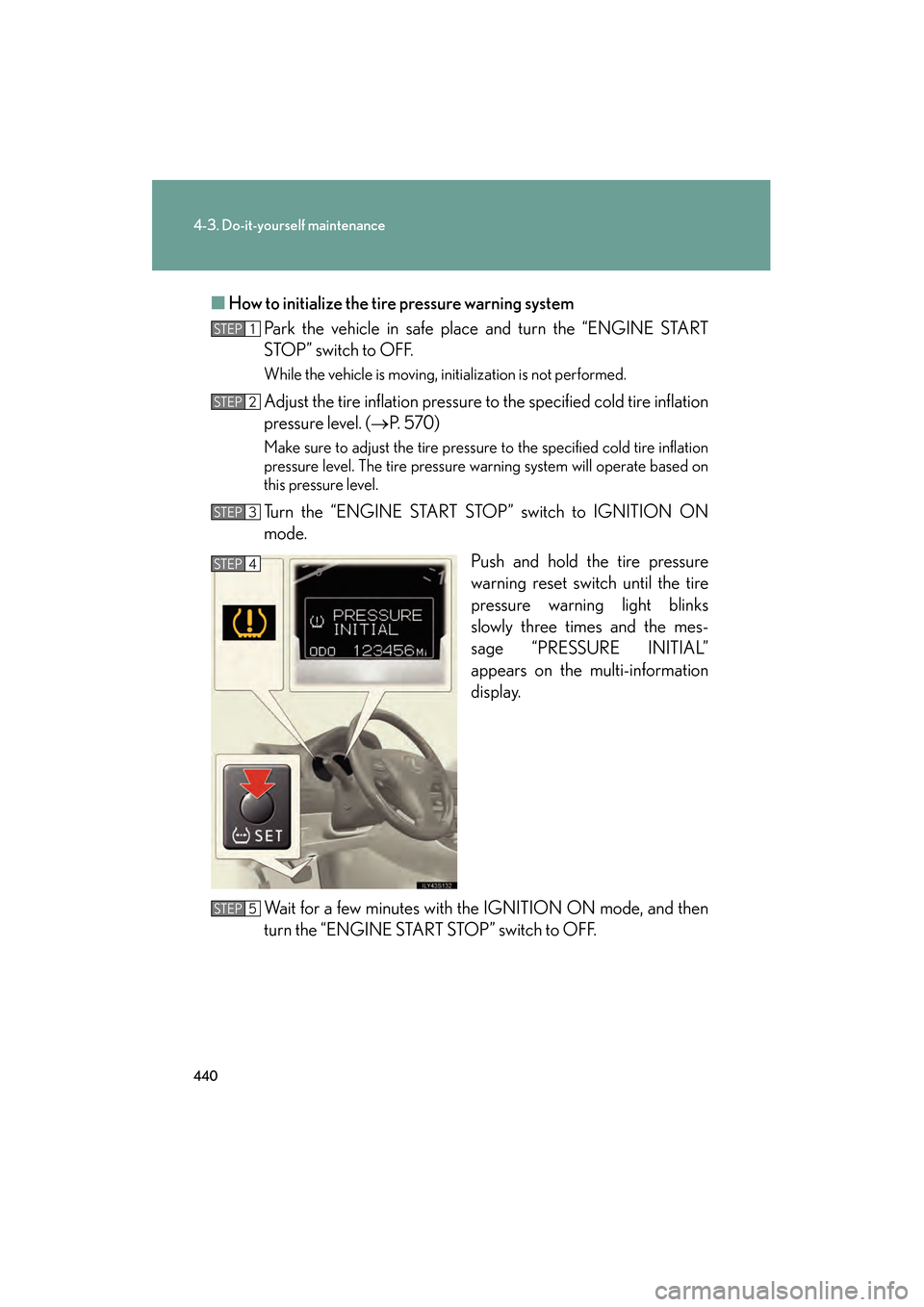
■How to initialize the tire pressure warning system
Park the vehicle in safe plac e and turn the “ENGINE START
STOP” switch to OFF.
While the vehicle is moving, initialization is not performed.
Adjust the tire inflation pressure to the specified cold tire inflation
pressure level. ( →P. 570)
Make sure to adjust the tire pressure to the specified cold tire inflation
pressure level. The tire pressure warning system will operate based on
this pressure level.
Turn the “ENGINE START STOP” switch to IGNITION ON
mode.
Push and hold the tire pressure
warning reset switch until the tire
pressure warning light blinks
slowly three times and the mes-
sage “PRESSURE INITIAL”
appears on the multi-information
display.
Wait for a few minutes with the IGNITION ON mode, and then
turn the “ENGINE START STOP” switch to OFF.
STEP1
STEP2
STEP3
STEP4
STEP5
GS_U_G.book Page 440 Monday, April 27, 2009 10:50 AM
Page 444 of 622
443
4-3. Do-it-yourself maintenance
4
Maintenance and care
GS_G_U (OM30B43U)
April 27, 2009 10:48 am
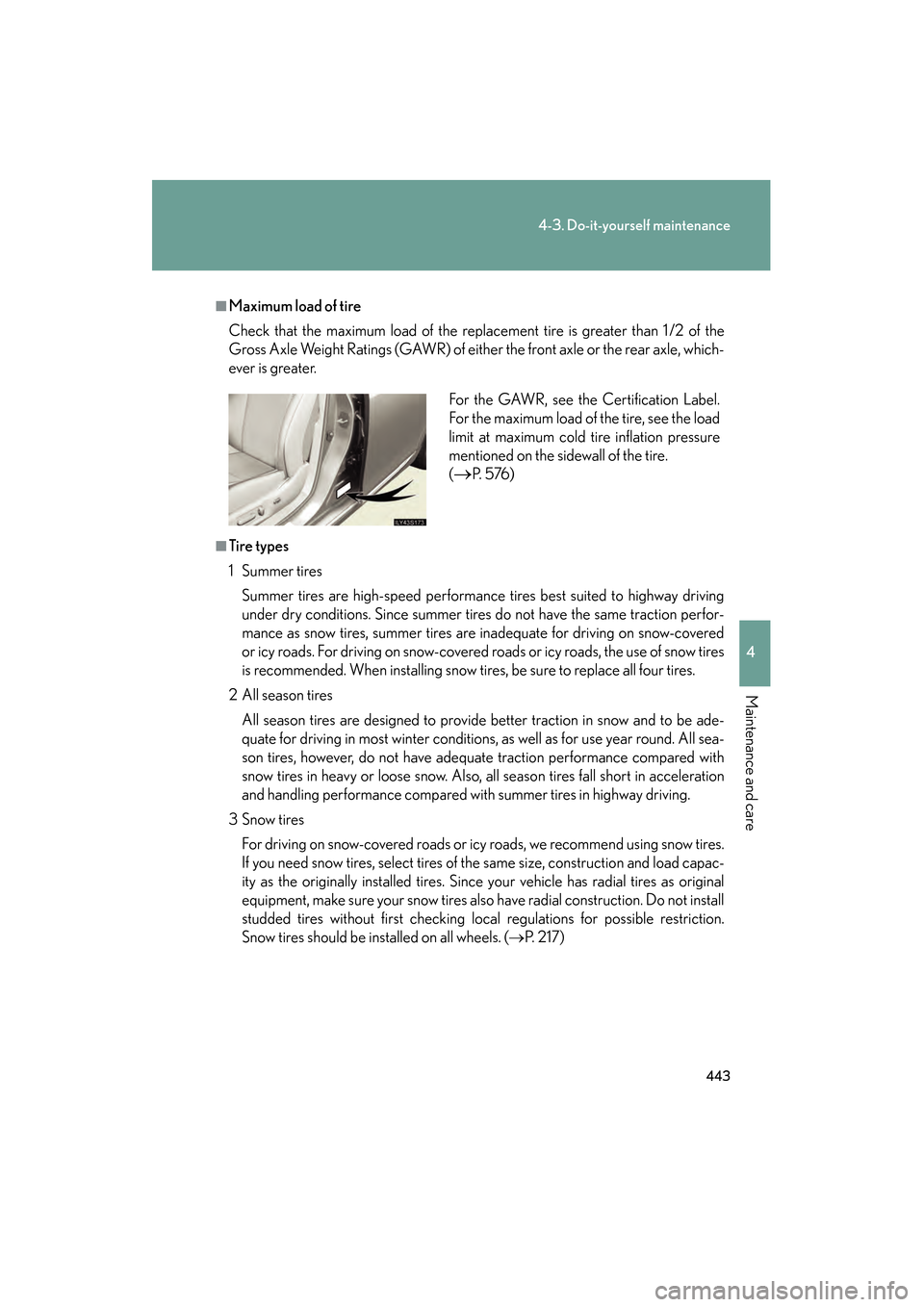
■Maximum load of tire
Check that the maximum load of the replacement tire is greater than 1 /2 of the
Gross Axle Weight Ratings (GAWR) of either the front axle or the rear axle, which-
ever is greater.
■Tire types
1 Summer tires
Summer tires are high-speed performance tires best suited to highway driving
under dry conditions. Since summer tires do not have the same traction perfor-
mance as snow tires, summer tires are inadequate for driving on snow-covered
or icy roads. For driving on snow-covered roads or icy roads, the use of snow tires
is recommended. When installing snow tires, be sure to replace all four tires.
2 All season tires
All season tires are designed to provide better traction in snow and to be ade-
quate for driving in most winter conditions , as well as for use year round. All sea-
son tires, however, do not have adequate traction performance compared with
snow tires in heavy or loose snow. Also, al l season tires fall short in acceleration
and handling performance compared with summer tires in highway driving.
3Snow tires For driving on snow-covered roads or ic y roads, we recommend using snow tires.
If you need snow tires, select tires of the same size, construction and load capac-
ity as the originally installed tires. Since your vehicle has radial tires as original
equipment, make sure your snow tires also have radial construction. Do not install
studded tires without first checking loca l regulations for possible restriction.
Snow tires should be installed on all wheels. ( →P. 2 1 7 )
For the GAWR, see the Certification Label.
For the maximum load of the tire, see the load
limit at maximum cold tire inflation pressure
mentioned on the sidewall of the tire.
(
→P. 5 76 )
GS_U_G.book Page 443 Monday, April 27, 2009 10:50 AM