gas Lexus GS350 2010 Specifications / LEXUS 2010 GS460 GS350 OWNERS MANUAL (OM30C80U)
[x] Cancel search | Manufacturer: LEXUS, Model Year: 2010, Model line: GS350, Model: Lexus GS350 2010Pages: 648, PDF Size: 15.57 MB
Page 33 of 648

33
1-2. Opening, closing and locking the doors and trunk
1
Before driving
GS_G_U (OM30C80U)
June 29, 2011 10:30 am
■Operation signals
A buzzer sounds and the emergency flashers flash to indicate that the doors have
been locked/unlocked. (Locked: Once; Unlocked: Twice)
■Conditions affecting operation
The smart access system with push-button start uses weak radio waves. In the fol-
lowing situations, the communication between the electronic key and the vehicle
may be affected, preventing the smart access system with push-button start, wire-
less remote control and immobilizer system from operating properly:
(Way of coping: P. 5 7 1 )
●When the electronic key battery is depleted
●Near a TV tower, electric power plant, gas station, radio station, large display,
airport or other facility that generates strong radio waves or electrical noise
●When carrying a portable radio, cellular phone, cordless phone or other wire-
less communication devices
●When the electronic key is in contact with, or is covered by the following metal-
lic objects
• Cards to which aluminum foil is attached
• Cigarette boxes that have aluminum foil inside
• Metallic wallets or bags
•Coins
• Hand warmers made of metal
• Media such as CDs and DVDs
●When multiple electronic keys are in the vicinity
●When other wireless keys (that emit radio waves) are being used nearby
●When carrying or using the electronic key together with the following devices
that emit radio waves
• Another vehicle’s electronic key or a wireless key that emits radio waves
• Personal computers or personal digital assistants (PDAs)
• Digital audio players
• Portable game systems
●If window tint with a metallic content or metallic objects are attached to the rear
window
Page 50 of 648

50
1-2. Opening, closing and locking the doors and trunk
GS_G_U (OM30C80U)
June 29, 2011 10:30 am
CAUTION
■Caution while driving
●Keep the trunk lid closed while driving.
If the trunk lid is left open, it may hit near-by objects while driving or luggage in
the trunk may be unexpectedly thrown out, causing an accident.
In addition, exhaust gases may enter the vehicle, causing death or a serious
health hazard. Make sure to close the trunk lid before driving.
●Before driving the vehicle, make sure that the trunk lid is fully closed. If the trunk
lid is not fully closed, it may open unexpectedly while driving, causing an accident.
●Never let anyone sit in the trunk. In the event of sudden braking or a collision, they
are susceptible to death or serious injury.
■When children are in the vehicle
Observe the following precautions.
Failure to do so may result in death or serious injury.
●Do not allow children to enter the trunk.
If a child is accidentally locked in the trunk, they could overheat or suffocate.
●Do not allow a child to open or close the trunk lid.
Doing so may cause the trunk lid operate unexpectedly, or cause the child’s
hands, head, or neck to be caught by the closing trunk lid.
Page 83 of 648
83
1-5. Refueling
1
Before driving
GS_G_U (OM30C80U)
June 29, 2011 10:30 am
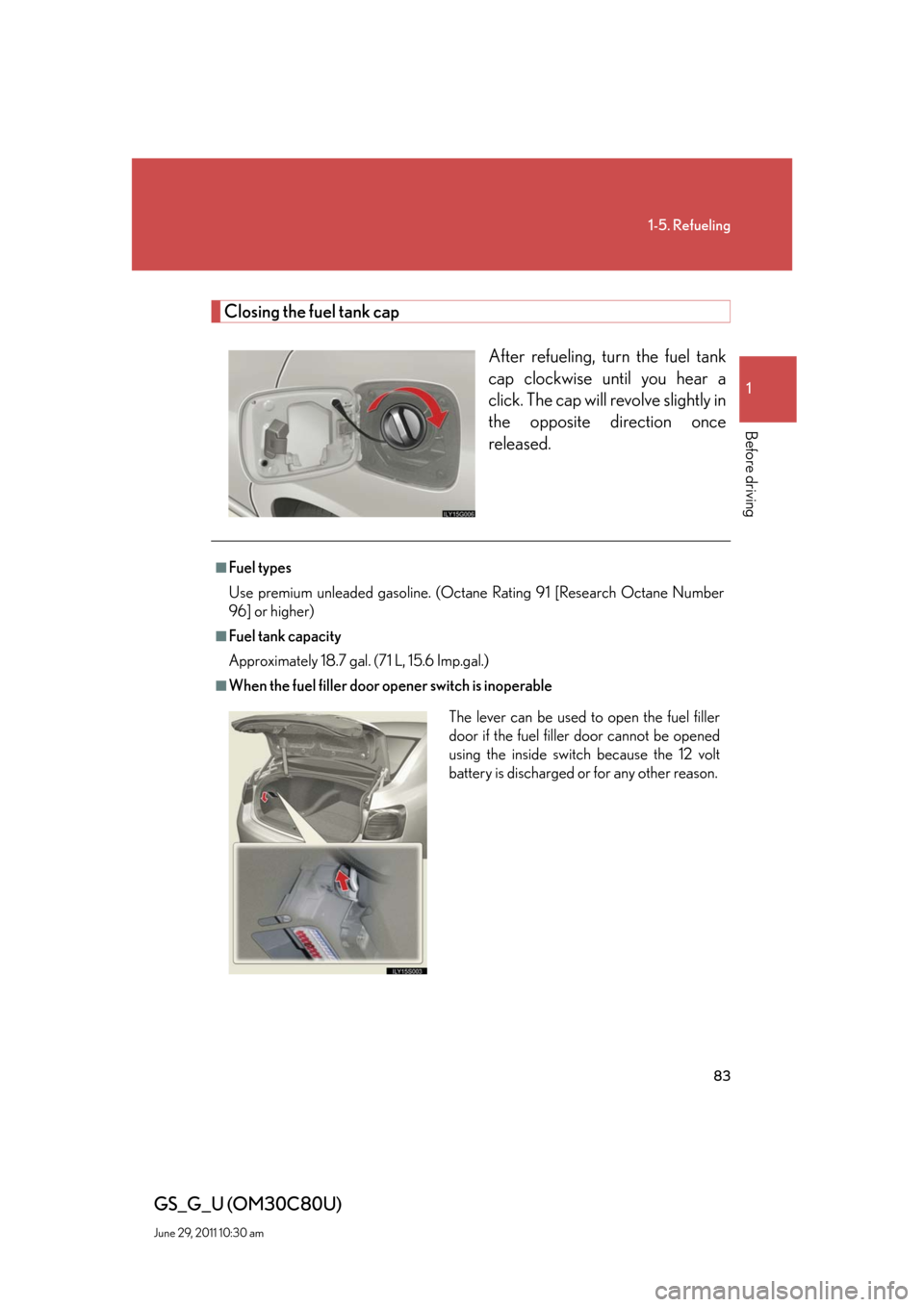
Closing the fuel tank cap
After refueling, turn the fuel tank
cap clockwise until you hear a
click. The cap will revolve slightly in
the opposite direction once
released.
■Fuel types
Use premium unleaded gasoline. (Octane Rating 91 [Research Octane Number
96] or higher)
■Fuel tank capacity
Approximately 18.7 gal. (71 L, 15.6 Imp.gal.)
■When the fuel filler door opener switch is inoperable
The lever can be used to open the fuel filler
door if the fuel filler door cannot be opened
using the inside switch because the 12 volt
battery is discharged or for any other reason.
Page 95 of 648

95
1-7. Safety information
1
Before driving
GS_G_U (OM30C80U)
June 29, 2011 10:30 am
Your vehicle is equipped with “ADVANCED AIRBAGS” designed based
on US motor vehicle safety standards (FMVSS208). The airbag system
controls airbag deployment power for the driver and front passenger. The
driver airbag system consists of the driver’s seat position sensor etc. The
front passenger’s airbag system consists of the front passenger occupant
classification sensor etc.
The main SRS airbag system components are shown above. The SRS air-
bag system is controlled by the airbag sensor assembly. The airbag sen-
sor assembly consists of a safing sensor and an airbag sensor.
In certain types of severe frontal or side impacts, the SRS airbag system
triggers the airbag inflators. A chemical reaction in the inflators quickly
fills the airbags with non-toxic gas to help restrain the motion of the occu-
pants.
■If the SRS airbags deploy (inflate)
●Bruising and slight abrasions may result from contact with a deploying (inflating)
SRS airbag.
●A loud noise and white powder will be emitted.
●Parts of the airbag module (steering wheel hub, airbag cover and inflator) as
well as the seats, and parts of the front pillar and roof side rail, may be hot for
several minutes. The airbag itself may also be hot.
●The windshield may crack.
●For vehicles with Safety Connect: For Safety Connect subscribers, if the SRS
airbags deploy or in the event of a severe collision, the system is designed to
send an emergency call to the response center, notifying them of the vehicle’s
location (without needing to push the “SOS” button) and an agent will attempt
to speak with the occupants to ascertain the level of emergency and assistance
required. If the occupants are unable to communicate, the agent automatically
treats the call as an emergency and helps to dispatch the necessary emergency
services. (P. 4 2 1 )
Page 128 of 648

128
2-1. Driving procedures
GS_G_U (OM30C80U)
June 29, 2011 10:30 am
CAUTION
■When starting the vehicle
Always keep your foot on the brake pedal while stopped with the engine running.
This prevents the vehicle from creeping.
■When driving the vehicle
●Do not drive if you are unfamiliar with the location of the brake and accelerator
pedals to avoid depressing the wrong pedal.
• Accidentally depressing the accelerator pedal instead of the brake pedal will
result in sudden acceleration that may lead to an accident that could result in
death or serious injury.
• When backing up, you may twist your body around, leading to a difficulty in
operating the pedals. Make sure to operate the pedals properly.
• Make sure to keep a correct driving posture even when moving the vehicle
only slightly, allowing you to depress the brake and accelerator pedals prop-
erly.
• Depress the brake pedal using your right foot. Depressing the brake pedal
using your left foot may delay response in an emergency, resulting in an acci-
dent.
●Do not drive the vehicle over or stop the vehicle near flammable materials.
The exhaust system and exhaust gases can be extremely hot. This may cause a
fire if there is any flammable material nearby.
●Do not let the vehicle roll backwards while the shift lever is in a driving position, or
roll forward while the shift lever is in “R”.
Doing so may cause the engine not to operate or lead to poor brake and steering
performance, resulting in an accident or damage to the vehicle.
●If the smell of exhaust is noticed inside the vehicle, open the windows and check
that the trunk is closed.
Large amounts of exhaust in the vehicle can cause driver drowsiness and an acci-
dent, resulting in death or a serious health hazard. Have the vehicle inspected by
your Lexus dealer immediately.
●Do not shift the shift lever to "P" while the vehicle is moving.
Doing so can damage the transmission and may result in a loss of vehicle control.
●Do not shift the shift lever to "R" while the vehicle is moving forward.
Doing so can damage the transmission and may result in a loss of vehicle control.
Page 131 of 648
131
2-1. Driving procedures
2
When driving
GS_G_U (OM30C80U)
June 29, 2011 10:30 am
CAUTION
■When the vehicle is parked
●Do not leave glasses, cigarette lighters, spray cans, or soft drink cans in the vehi-
cle when it is in the sun.
Failure to do so may result in the following:
• Gas may leak from a cigarette lighter or spray can, and may lead to a fire.
• The temperature inside the vehicle may cause the plastic lenses and plastic
material of eye glasses to deform or crack.
• Soft drink cans may fracture, causing the contents to spray over the interior of
the vehicle, and may also cause a short circuit in the vehicle’s electrical com-
ponents.
●Always apply the parking brake, shift the shift lever to “P”, stop the engine and
lock the vehicle.
Do not leave the vehicle unattended while the engine is running.
●Do not touch the exhaust pipe while the engine is running or immediately after
turning the engine off.
Doing so may cause burns.
●Do not leave the engine running in an area with snow build-up, or where it is
snowing. If snowbanks build up around the vehicle while the engine is running,
exhaust gases may collect and enter the vehicle. This may lead to death or a seri-
ous health hazard.
■Exhaust gases
Exhaust gases include harmful carbon monoxide (CO) that is colorless and odor-
less. Inhaling exhaust gases may lead to death or a serious health hazard.
●If the vehicle is in a poorly ventilated area, stop the engine. In a closed area, such
as a garage, exhaust gases may collect and enter the vehicle. This may lead to
death or a serious health hazard.
●The exhaust should be checked occasionally. If there is a hole or crack caused by
corrosion, damage to a joint or abnormal exhaust noise, be sure to have the vehi-
cle inspected and repaired by your Lexus dealer. Failure to do so may allow
exhaust gases to enter the vehicle, resulting in death or a serious health hazard.
Page 132 of 648

132
2-1. Driving procedures
GS_G_U (OM30C80U)
June 29, 2011 10:30 am
CAUTION
■When taking a nap in the vehicle
Always turn the engine off. Otherwise, you may accidentally move the shift lever or
depress the accelerator pedal, which could cause an accident or fire due to engine
overheating. Additionally, if the vehicle is parked in a poorly ventilated area, exhaust
gases may collect and enter the vehicle, leading to death or a serious health hazard.
■When braking the vehicle
●When the brakes are wet, drive more cautiously.
Braking distance increases when the brakes are wet, and may cause one side of
the vehicle to brake differently than the other side. Also the parking brake may
not securely hold the vehicle.
●If the brake actuator (GS460) or brake booster (GS350) does not operate, do
not follow other vehicles closely and avoid downhill or sharp turns that require
making.
In this case, braking is still possible, but it will require more force on the pedal than
usual. Braking distance may also increase.
●Do not pump the brake pedal if turning the engine off.
Each push on the brake pedal uses up the reserve for the power-assisted brakes.
●The brake system consists of 3 (GS460) or 2 (GS350) individual hydraulic sys-
tems: If one of the systems fails, the other will still operate. In this case, the brake
pedal should be depressed more firmly than usual and braking distance becomes
longer.
Do not drive your vehicle with only a single brake system. Have your brakes fixed
immediately.
■If the vehicle becomes stuck or bogged (4WD models)
Do not spin the wheels recklessly when any of the tires is up in the air, or stuck in
sand or mud, etc. This may damage the drive system components or propel the
vehicle forward (or in another direction) and cause an accident.
Page 217 of 648
217
2-5. Driving information
2
When driving
GS_G_U (OM30C80U)
June 29, 2011 10:30 am
CAUTION
■Things that must not be carried in the trunk
The following things may cause a fire if loaded in the trunk.
●Receptacles containing gasoline
●Aerosol cans
■Storage precautions
Observe the following precautions.
Failing to do so may result in death or serious injury.
●Do not place cargo or luggage in or on the following locations as the item may
get under the brake or accelerator pedal and prevent the pedals from being
depressed properly, block the driver’s vision, or hit the driver or passengers,
causing an accident.
•Driver’s feet
• Front passenger or rear seats (when stacking items)
• Package tray
•Instrument panel
•Dashboard
●Secure all items in the occupant compartment, as they may shift and injure some-
one during sudden braking, sudden swerving or an accident.
■Weight of the load
●Improper loading may cause deterioration of steering or braking control result-
ing in an accident which may cause death or serious injury.
●Do not exceed the maximum axle weight rating or the total vehicle weight rating.
●Even if the total load of occupant’s weight and the cargo load is less than the total
load capacity, do not apply the load unevenly. Improper loading may cause dete-
rioration of steering or braking control which may cause death or serious injury.
Page 253 of 648

253
3-2. Using the air conditioning system and defogger
3
Interior features
GS_G_U (OM30C80U)
June 29, 2011 10:30 am
■Using the automatic mode
Fan speed is adjusted automatically in accordance with the temperature setting and
ambient conditions. As a result, the following may occur.
●Immediately after the switch is pressed, the fan may stop for a while until warm
or cool air is ready to flow.
●Cool air may flow to the area around the upper body when the heater is on.
■Using the system in recirculated air mode
The windows will fog up more easily if the recirculated air mode is used for an
extended period.
■Switching between outside air and recirculated air modes
Recirculated air mode or outside air mode may be automatically switched to in
accordance with the temperature setting and the inside temperature.
■Window defogger feature
Recirculated air mode may automatically switch to
(outside air) mode in situ-
ations where the windows need to be defogged.
■Outside temperature approaches 32F (0C)
The air conditioning system may not operate even when
“A / C ” is touched.
■Automatic mode for air intake control
In automatic mode, the system detects exhaust gas and other pollutants and auto-
matically switches between outside air and recirculated air modes.
When the air conditioning is off, and the fan is operating, turning the auto mode on
will activate the air conditioning system.
Page 292 of 648
292
3-3. Using the audio system
GS_G_U (OM30C80U)
June 29, 2011 10:30 am
CodeLanguageCodeLanguageCodeLanguage
1119Kashmiri1415Norwegian1914Shona
1121Kurdish1503Occitan1915Somali
1125Kirghiz1513(Afan)
Oromo1917Albanian
1201Latin1518Oriya1918Serbian
1214Lingala1601Pa n j a b i1919Siswati
1215Laothian1612Polish1920Sesotho
1220Lithuanian1619Pa s h t o,
Pushto1921Sundanese
1222Latvian1721Quechua1923Swahili
1307Malagasy1813Rhaeto-
Romance2001Ta m i l
1309Maori1814Kirundi2005Te l u g u
1311Macedonian1815Romanian2007Tajik
1312Malayalam1823Kinyarwanda2008Thai
1314Mongolian1901Sanskrit2009Ti g r i n y a
1315Moldavian1904Sindhi2011Tu r k m e n
1318Marathi1907Sangho2012Ta g a l o g
1319Malay1908Serbo-
Croatian2014Setswana
1320Maltese1909Sinhalese2015To n g a
1325Burmese1911Slovak2018Tu r k i s h
1401Nauru1912Slovenian2019Ts o n g a
1405Nepali1913Samoan2020Ta t a r