tire size Lexus GS350 2011 User Guide
[x] Cancel search | Manufacturer: LEXUS, Model Year: 2011, Model line: GS350, Model: Lexus GS350 2011Pages: 654, PDF Size: 11.03 MB
Page 479 of 654
478
4-3. Do-it-yourself maintenance
GS_G_U (OM30C11U)
October 28, 2011 5:15 pm
CAUTION
■When replacing wheels
●Do not use wheels that are a different size from those recommended in the
Owner’s Manual, as this may result in loss of handling control.
●Never use an inner tube in a leaking wheel which is designed for a tubeless tire.
Doing so may result in an accident, causing death or serious injury.
■When installing the wheel nuts
●Never use oil or grease on the wheel bolts or wheel nuts.
Oil and grease may cause the wheel nuts to be excessively tightened, leading to
bolt or disc wheel damage. In addition, the oil or grease can cause the wheel nuts
to loosen and the wheel may fall off, causing an accident and resulting in death or
serious injury. Remove any oil or grease from the wheel bolts or wheel nuts.
NOTICE
■Replacing tire pressure warning valves and transmitters
●Because tire repair or replacement may affect the tire pressure warning valves
and transmitters, make sure to have tires serviced by your Lexus dealer or other
qualified service shop. In addition, make sure to purchase your tire pressure
warning valves and transmitters at your Lexus dealer.
●Ensure that only genuine Lexus wheels are used on your vehicle.
Tire pressure warning valves and transmitters may not work properly with non-
genuine wheels.
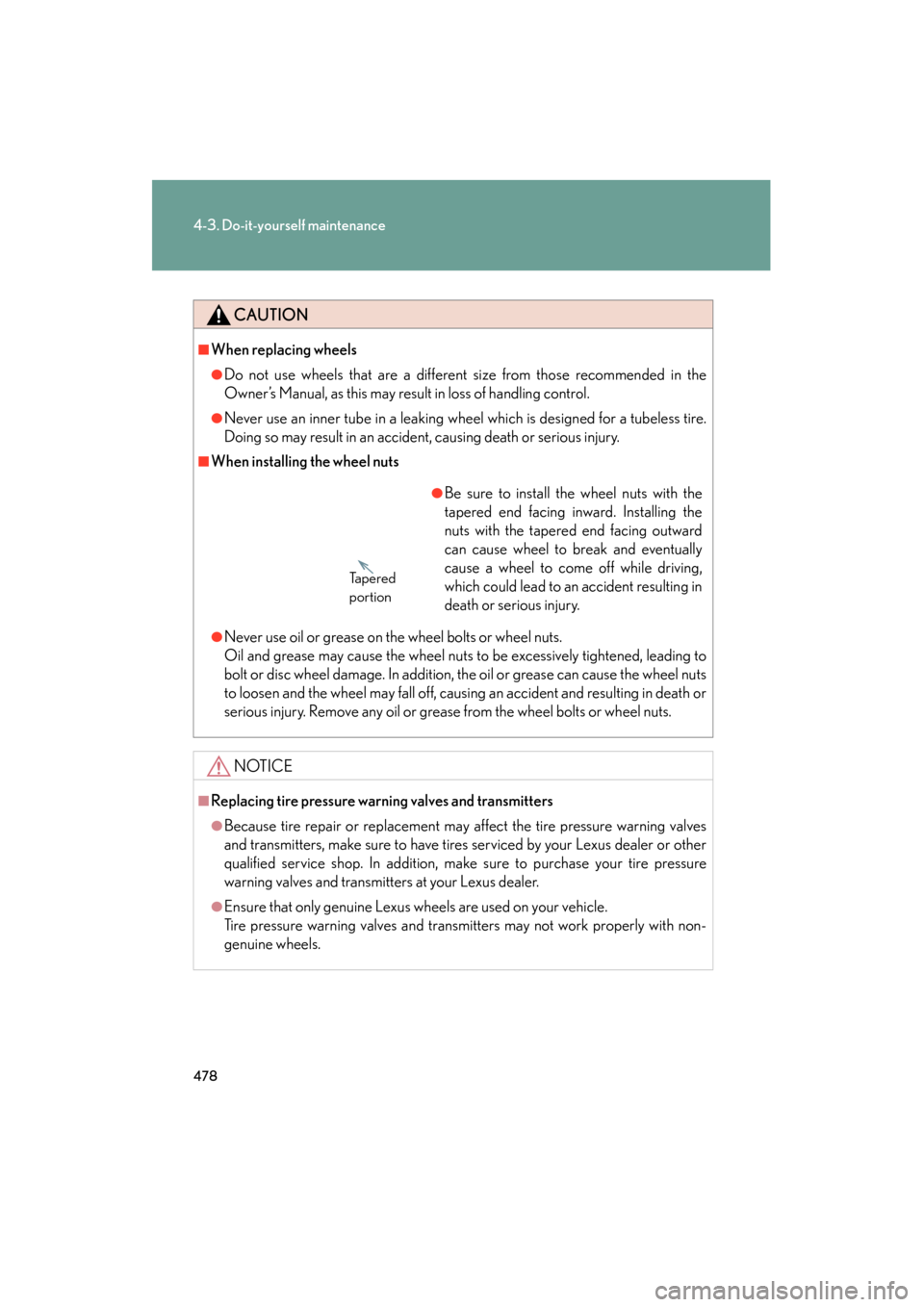
●Be sure to install the wheel nuts with the
tapered end facing inward. Installing the
nuts with the tapered end facing outward
can cause wheel to break and eventually
cause a wheel to come off while driving,
which could lead to an accident resulting in
death or serious injury.
Ta p e r e d
portion
Page 543 of 654
542
5-2. Steps to take in an emergency
GS_G_U (OM30C11U)
October 28, 2011 5:15 pm
CAUTION
■Maintenance of the tires
Each tire, including the spare (if provided), should be checked monthly when cold
and inflated to the inflation pressure recommended by the vehicle manufacturer on
the vehicle placard or tire inflation pressure label (tire and load information label).
(If your vehicle has tires of a different size than the size indicated on the vehicle
placard or tire inflation pressure label [tire and load information label], you should
determine the proper tire inflation pressure for those tires.)
As an added safety feature, your vehicle has been equipped with a tire pressure
monitoring system (TPMS-tire pressure warning system) that illuminates a low tire
pressure telltale (tire pressure warning light) when one or more of your tires is sig-
nificantly under-inflated. Accordingly, when the low tire pressure telltale (tire pres-
sure warning light) illuminates, you should stop and check your tires as soon as
possible, and inflate them to the proper pressure. Driving on a significantly under-
inflated tire causes the tire to overheat and can lead to tire failure. Under-inflation
also reduces fuel efficiency and tire tread life, and may affect the vehicle’s handling
and stopping ability.
Please note that the TPMS (tire pressure warning system) is not a substitute for
proper tire maintenance, and it is the driver’s responsibility to maintain correct tire
pressure, even if under-inflation has not reached the level to trigger illumination of
the TPMS low tire pressure telltale (tire pressure warning light).
Your vehicle has also been equipped with a TPMS (tire pressure warning system)
malfunction indicator to indicate when the system is not operating properly. The
TPMS (tire pressure warning system) malfunction indicator is combined with the
low tire pressure telltale (tire pressure warning light). When the system detects a
malfunction, the telltale will flash for approximately one minute and then remain
continuously illuminated. This sequence will continue upon subsequent vehicle
start-ups as long as the malfunction exists. When the malfunction indicator is illumi-
nated, the system may not be able to detect or signal low tire pressure as intended.
TPMS (tire pressure warning system) malfunctions may occur for a variety of rea-
sons, including the installation of replacement or alternate tires or wheels on the
vehicle that prevent the TPMS (tire pressure warning system) from functioning
properly. Always check the TPMS (tire pressure warning system) malfunction tell-
tale after replacing one or more tires or wheels on your vehicle to ensure that the
replacement or alternate tires and wheels allow the TPMS (tire pressure warning
system) to continue to function properly.
Page 597 of 654
596
6-1. Specifications
GS_G_U (OM30C11U)
October 28, 2011 5:15 pm
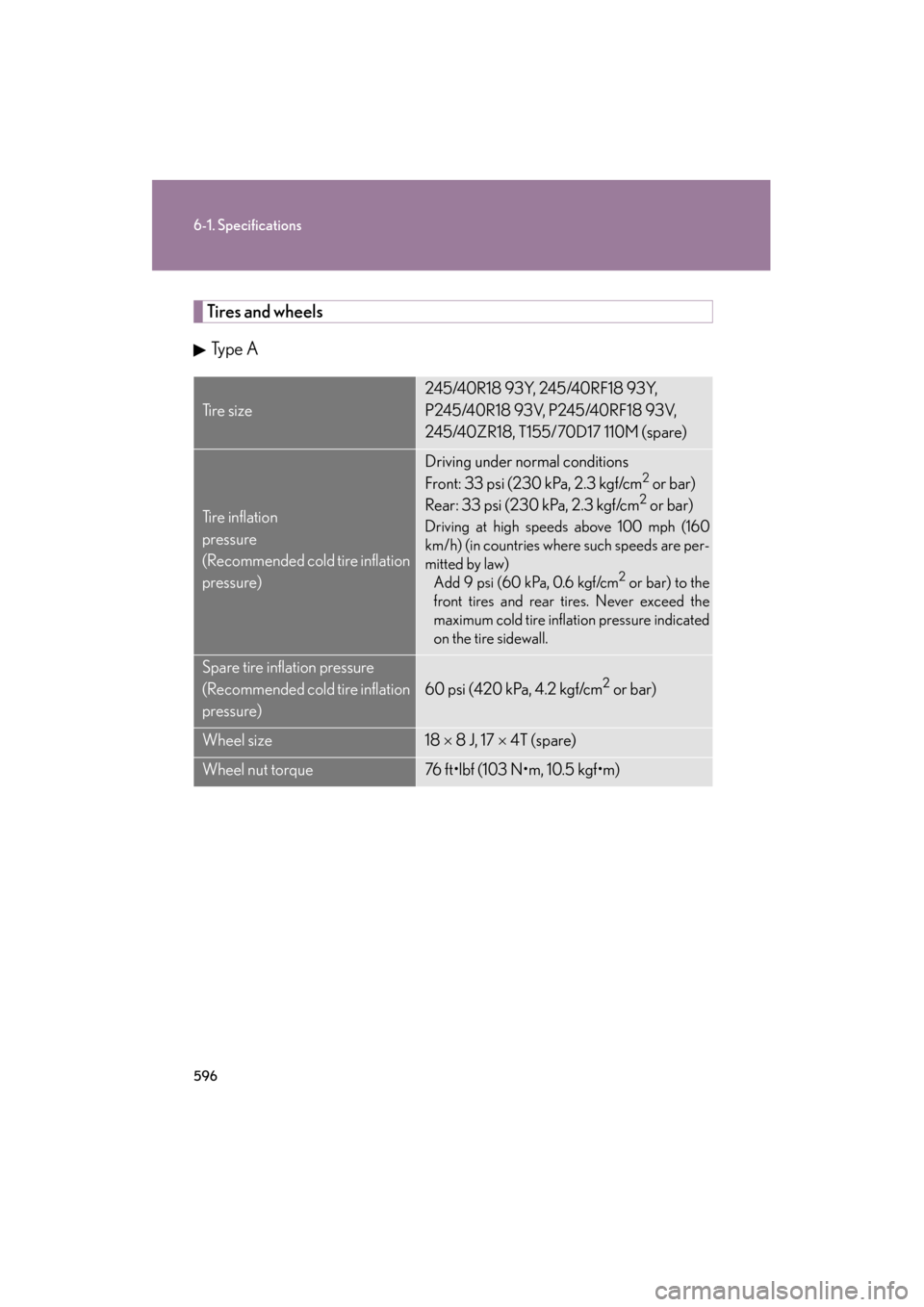
Tires and wheels
Ty p e A
Ti r e s i z e
245/40R18 93Y, 245/40RF18 93Y,
P245/40R18 93V, P245/40RF18 93V,
245/40ZR18, T155/70D17 110M (spare)
Tire inflation
pressure
(Recommended cold tire inflation
pressure)
Driving under normal conditions
Front: 33 psi (230 kPa, 2.3 kgf/cm2 or bar)
Rear: 33 psi (230 kPa, 2.3 kgf/cm2 or bar)
Driving at high speeds above 100 mph (160
km/h) (in countries where such speeds are per-
mitted by law) Add 9 psi (60 kPa, 0.6 kgf/cm
2 or bar) to the
front tires and rear tires. Never exceed the
maximum cold tire inflation pressure indicated
on the tire sidewall.
Spare tire inflation pressure
(Recommended cold tire inflation
pressure)
60 psi (420 kPa, 4.2 kgf/cm2 or bar)
Wheel size18 × 8 J, 17 × 4T (spare)
Wheel nut torque76 ft•lbf (103 N•m, 10.5 kgf•m)
Page 598 of 654

597
6-1. Specifications
6
Vehicle specifications
GS_G_U (OM30C11U)
October 28, 2011 5:15 pm
Type B
Ti r e s i z e
225/50R17 94W, P225/50R17 93V,
P225/50RF17 93V,
T155/70D17 110M (spare)
Tire inflation
pressure
(Recommended cold tire inflation
pressure)
Driving under normal conditions
Front: 33 psi (230 kPa, 2.3 kgf/cm2 or bar)
Rear: 33 psi (230 kPa, 2.3 kgf/cm2 or bar)
Driving at high speeds above 100 mph (160
km/h) (in countries where such speeds are
permitted by law) Add 7 psi (50 kPa, 0.5 kgf/cm
2 or bar) to the
front tires and rear tires. Never exceed the
maximum cold tire inflation pressure indi-
cated on the tire sidewall.
Spare tire inflation pressure
(Recommended cold tire inflation
pressure)
60 psi (420 kPa, 4.2 kgf/cm2 or bar)
Wheel size17 × 7 1 /2 J, 17 × 4T (spare)
Wheel nut torque76 ft•lbf (103 N•m, 10.5 kgf•m)
Page 604 of 654
603
6-1. Specifications
6
Vehicle specifications
GS_G_U (OM30C11U)
October 28, 2011 5:15 pm
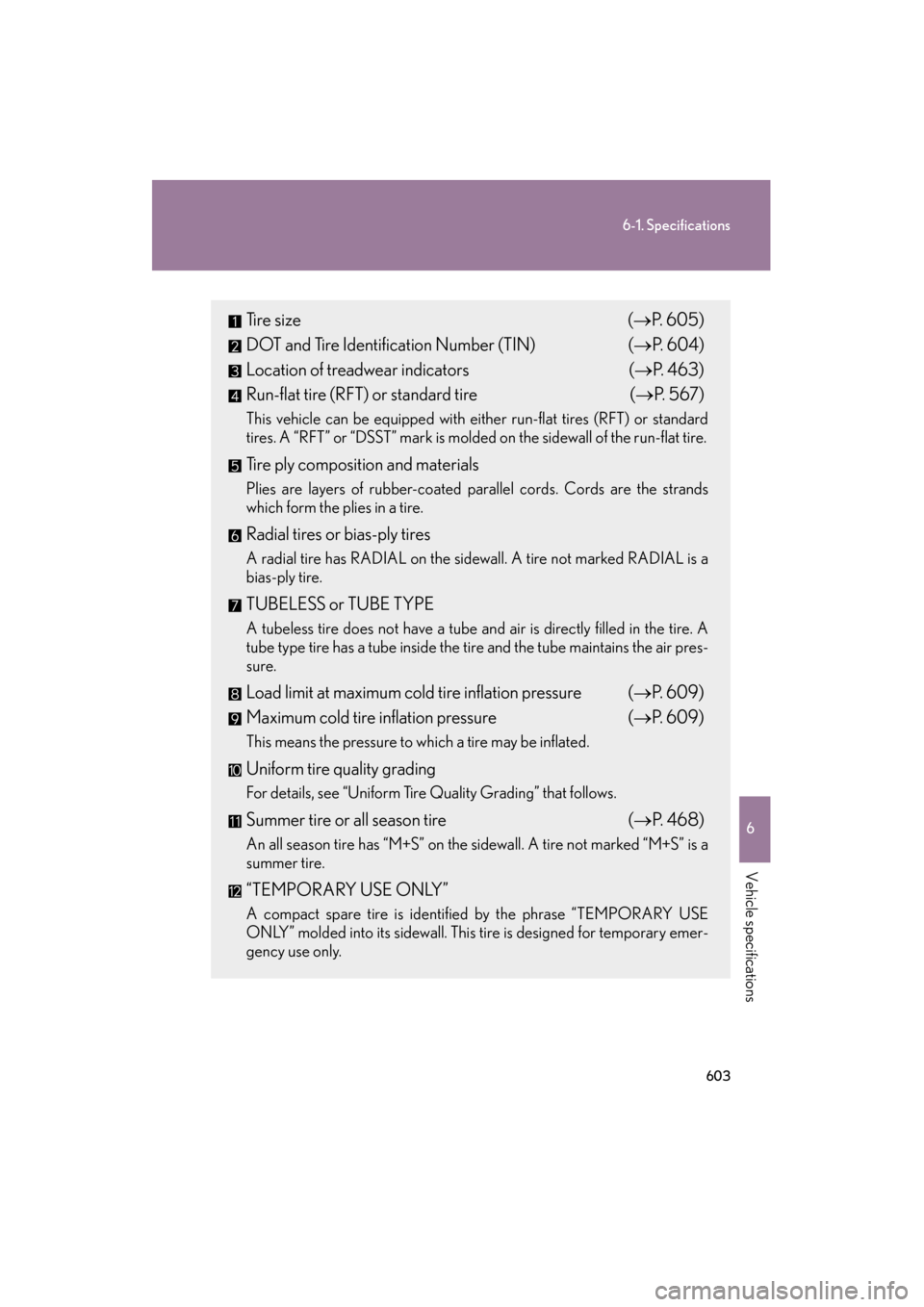
Tire size(→ P. 605)
DOT and Tire Identification Number (TIN) (→ P. 6 0 4 )
Location of treadwear indicators (→ P. 463)
Run-flat tire (RFT) or standard tire (→ P. 567)
This vehicle can be equipped with either run-flat tires (RFT) or standard
tires. A “RFT” or “DSST” mark is molded on the sidewall of the run-flat tire.
Tire ply composition and materials
Plies are layers of rubber-coated parallel cords. Cords are the strands
which form the plies in a tire.
Radial tires or bias-ply tires
A radial tire has RADIAL on the sidewall. A tire not marked RADIAL is a
bias-ply tire.
TUBELESS or TUBE TYPE
A tubeless tire does not have a tube and air is directly filled in the tire. A
tube type tire has a tube inside the ti re and the tube maintains the air pres-
sure.
Load limit at maximum cold tire inflation pressure ( →P. 609)
Maximum cold tire inflation pressure ( →P. 609)
This means the pressure to which a tire may be inflated.
Uniform tire quality grading
For details, see “Uniform Tire Quality Grading” that follows.
Summer tire or all season tire (→ P. 4 6 8 )
An all season tire has “M+S” on the sidewall. A tire not marked “M+S” is a
summer tire.
“TEMPORARY USE ONLY”
A compact spare tire is identified by the phrase “TEMPORARY USE
ONLY” molded into its sidewall. This tire is designed for temporary emer-
gency use only.
Page 605 of 654
604
6-1. Specifications
GS_G_U (OM30C11U)
October 28, 2011 5:15 pm
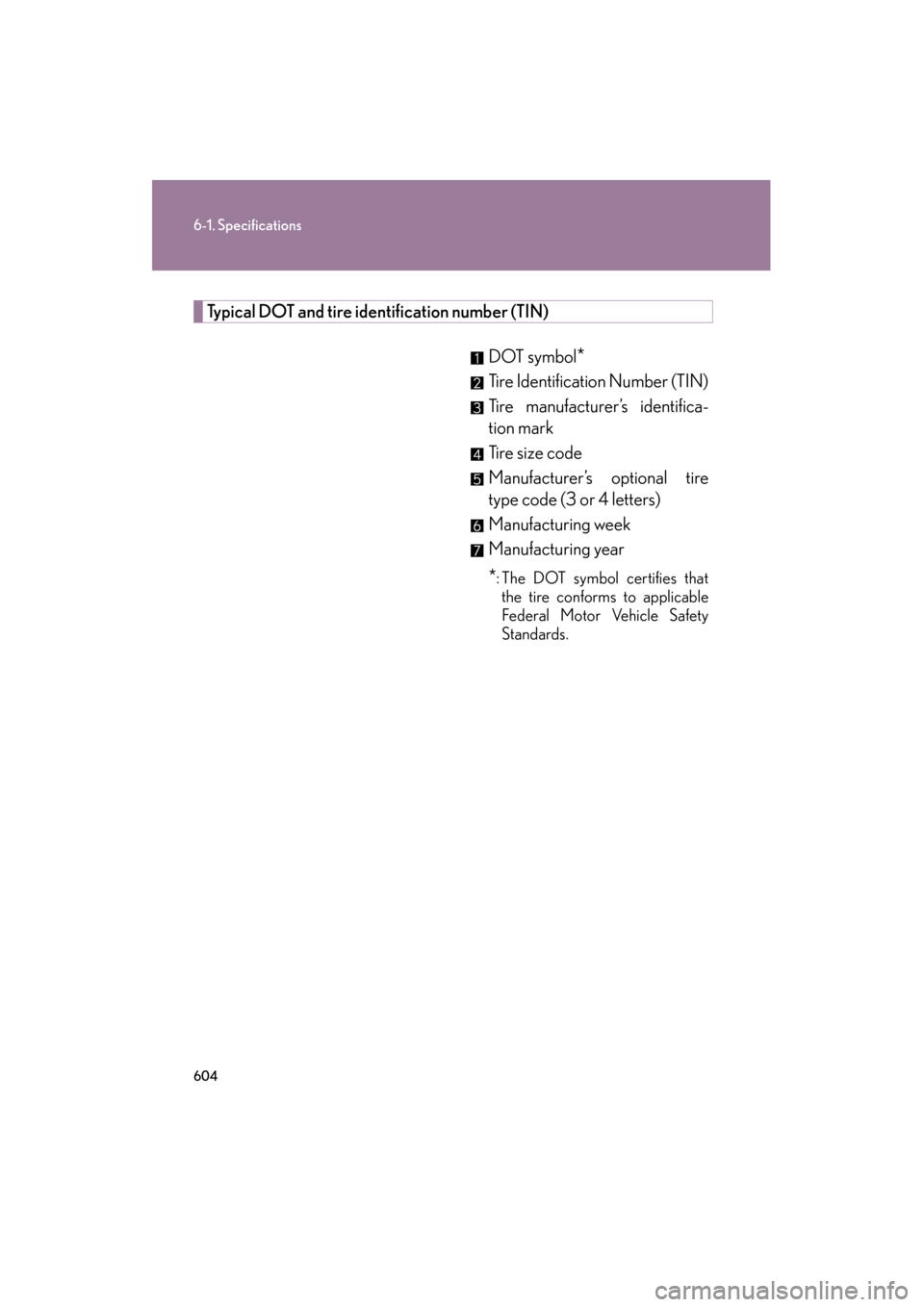
Typical DOT and tire iden tification number (TIN)
DOT symbol
*
Tire Identification Number (TIN)
Tire manufacturer’s identifica-
tion mark
Tire size code
Manufacturer’s optional tire
type code (3 or 4 letters)
Manufacturing week
Manufacturing year
*: The DOT symbol certifies thatthe tire conforms to applicable
Federal Motor Vehicle Safety
Standards.
Page 606 of 654
605
6-1. Specifications
6
Vehicle specifications
GS_G_U (OM30C11U)
October 28, 2011 5:15 pm
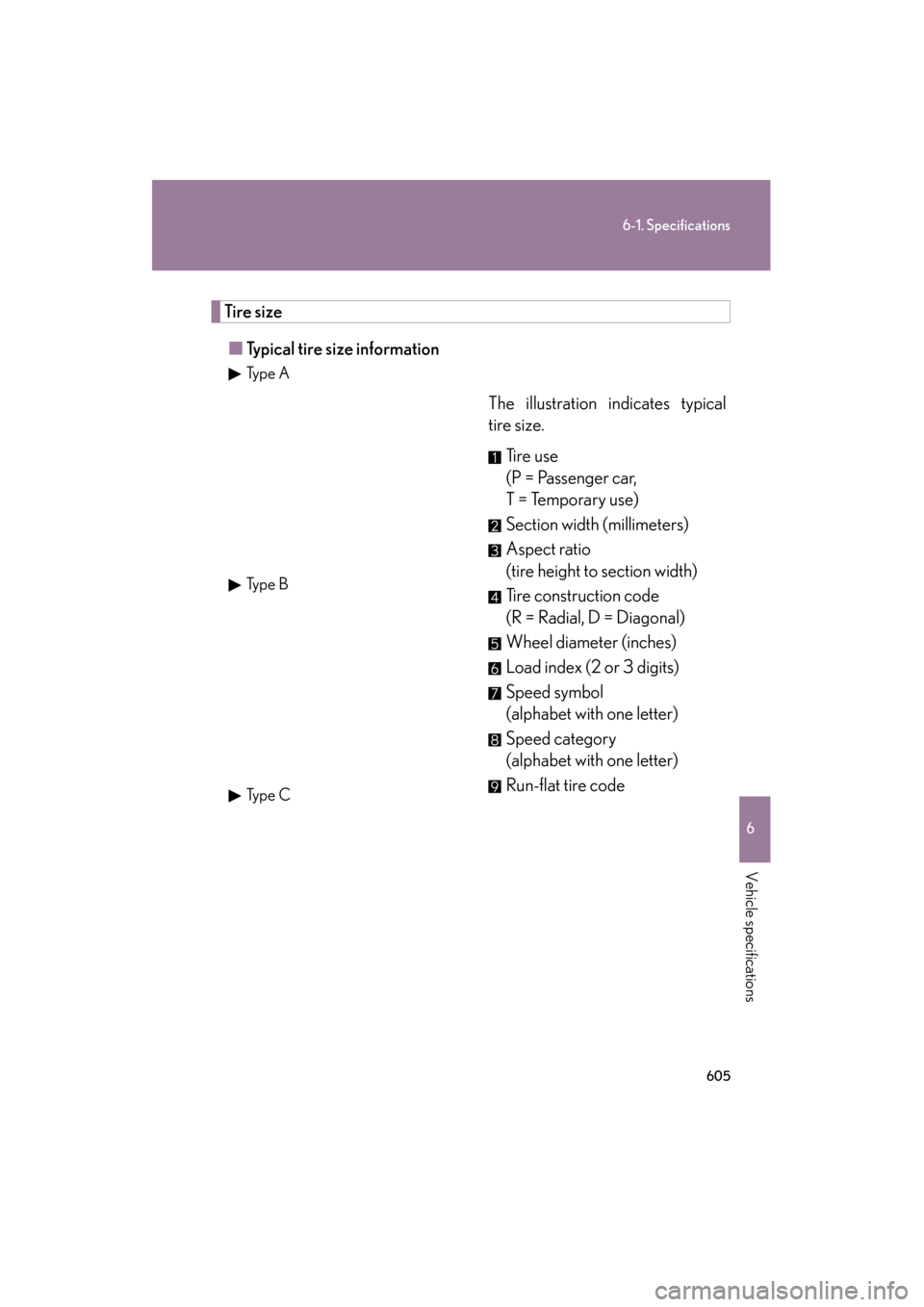
Tire size■ Typical tire si ze information
Ty p e A
The illustration indicates typical
tire size.
Ti r e u s e
(P = Passenger car,
T = Temporary use)
Section width (millimeters)
Aspect ratio
(tire height to section width)
Tire construction code
(R = Radial, D = Diagonal)
Wheel diameter (inches)
Load index (2 or 3 digits)
Speed symbol
(alphabet with one letter)
Speed category
(alphabet with one letter)
Run-flat tire code
Ty p e B
Ty p e C
Page 611 of 654
610
6-1. Specifications
GS_G_U (OM30C11U)
October 28, 2011 5:15 pm
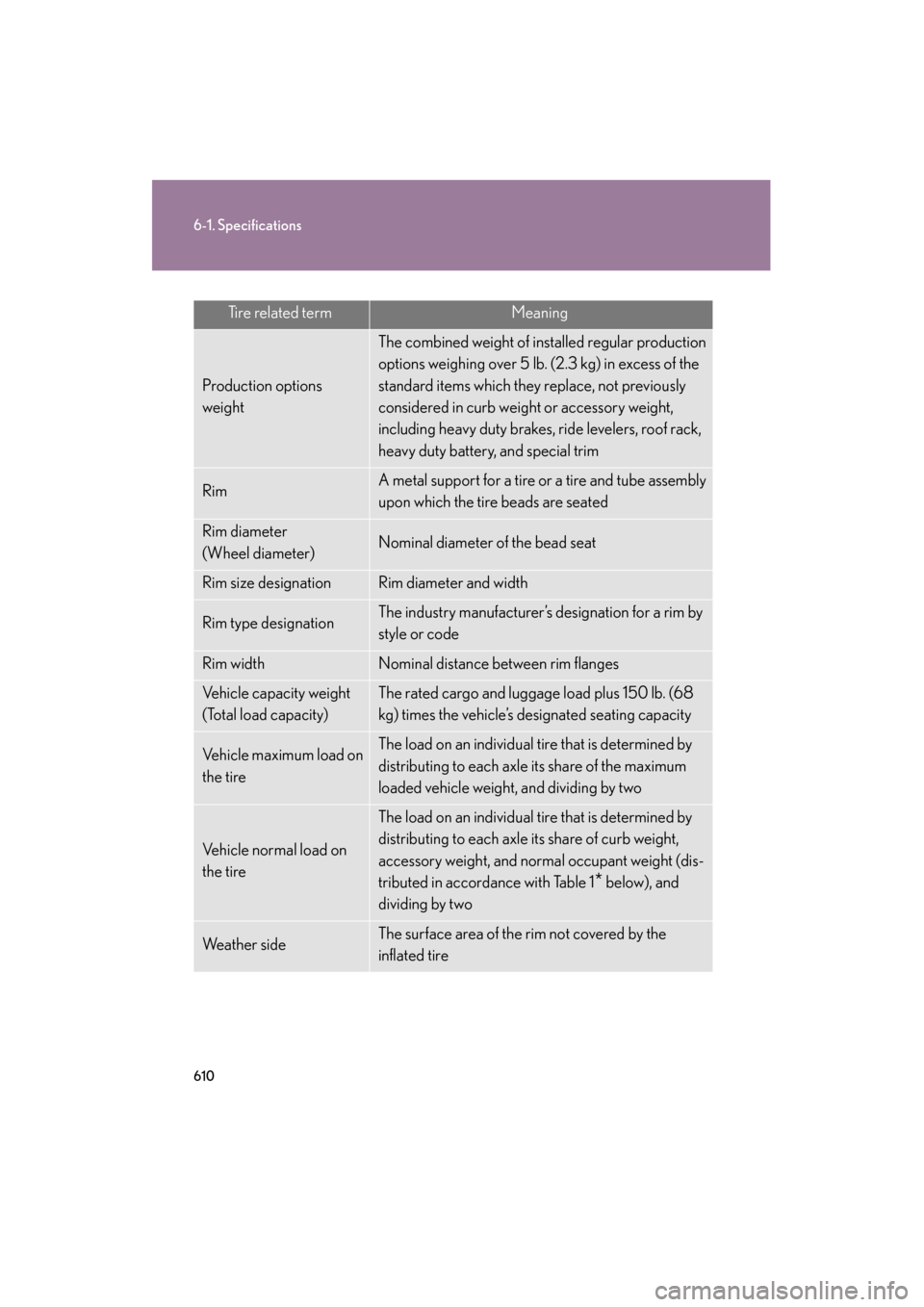
Tire related termMeaning
Production options
weight
The combined weight of installed regular production
options weighing over 5 lb. (2.3 kg) in excess of the
standard items which they replace, not previously
considered in curb weight or accessory weight,
including heavy duty brakes, ride levelers, roof rack,
heavy duty battery, and special trim
RimA metal support for a tire or a tire and tube assembly
upon which the tire beads are seated
Rim diameter
(Wheel diameter)Nominal diameter of the bead seat
Rim size designationRim diameter and width
Rim type designationThe industry manufacturer’s designation for a rim by
style or code
Rim widthNominal distance between rim flanges
Vehicle capacity weight
(Total load capacity)The rated cargo and luggage load plus 150 lb. (68
kg) times the vehicle’s designated seating capacity
Vehicle maximum load on
the tireThe load on an individual tire that is determined by
distributing to each axle its share of the maximum
loaded vehicle weight, and dividing by two
Vehicle normal load on
the tire
The load on an individual tire that is determined by
distributing to each axle its share of curb weight,
accessory weight, and normal occupant weight (dis-
tributed in accordance with Table 1
* below), and
dividing by two
We a t h e r s i d eThe surface area of the rim not covered by the
inflated tire
Page 623 of 654
622
GS_G_U (OM30C11U)
October 28, 2011 5:15 pm
6-3. Initialization
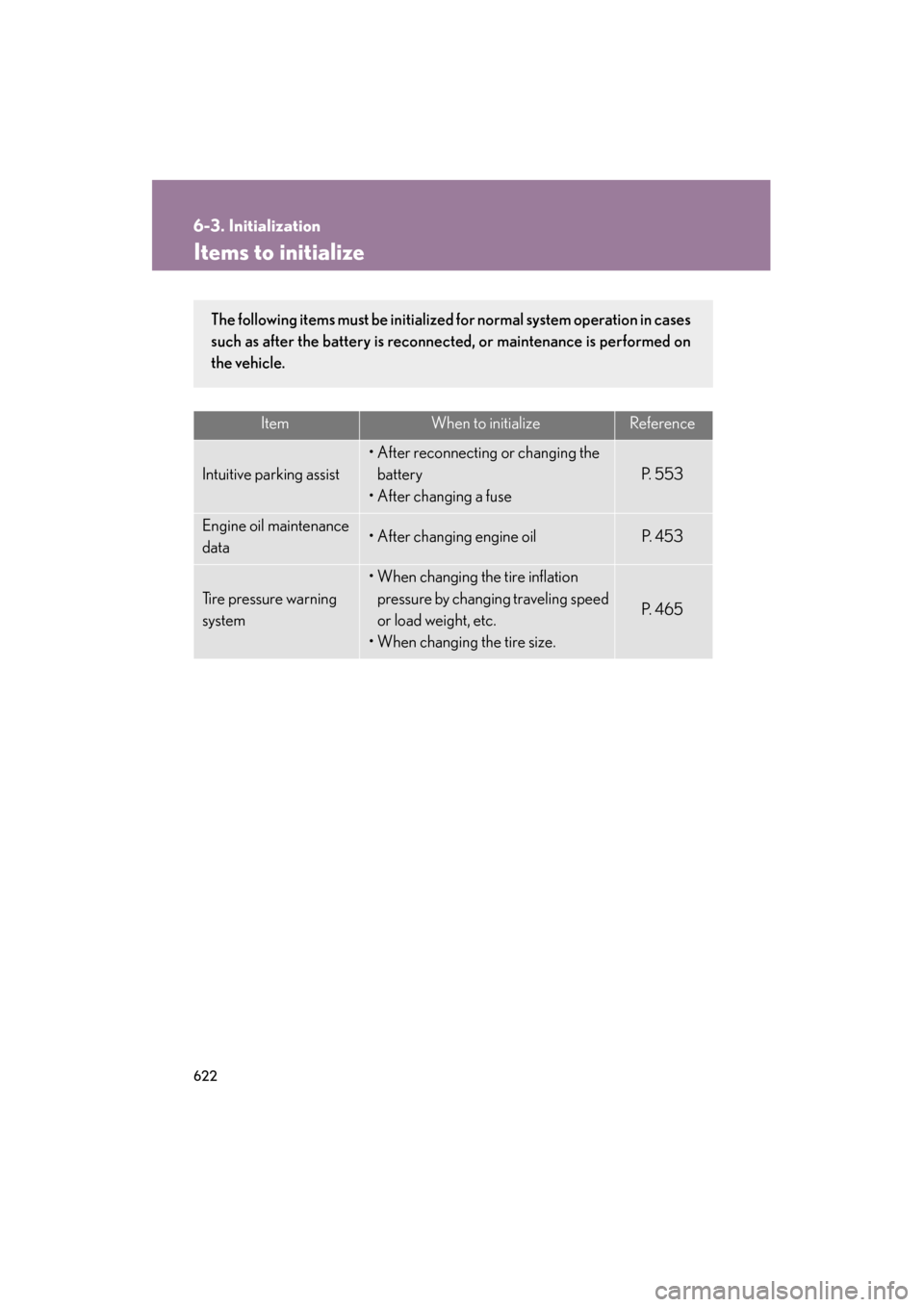
Items to initialize
ItemWhen to initializeReference
Intuitive parking assist
• After reconnecting or changing the battery
• After changing a fuse
P. 5 5 3
Engine oil maintenance
data•After changing engine oilP. 4 5 3
Ti r e p r e s s u r e w a r n i n g
system
• When changing the tire inflation pressure by changing traveling speed
or load weight, etc.
•When changing the tire size.
P. 4 6 5
The following items must be initialized for normal system operation in cases
such as after the battery is reconnected, or maintenance is performed on
the vehicle.
Page 646 of 654
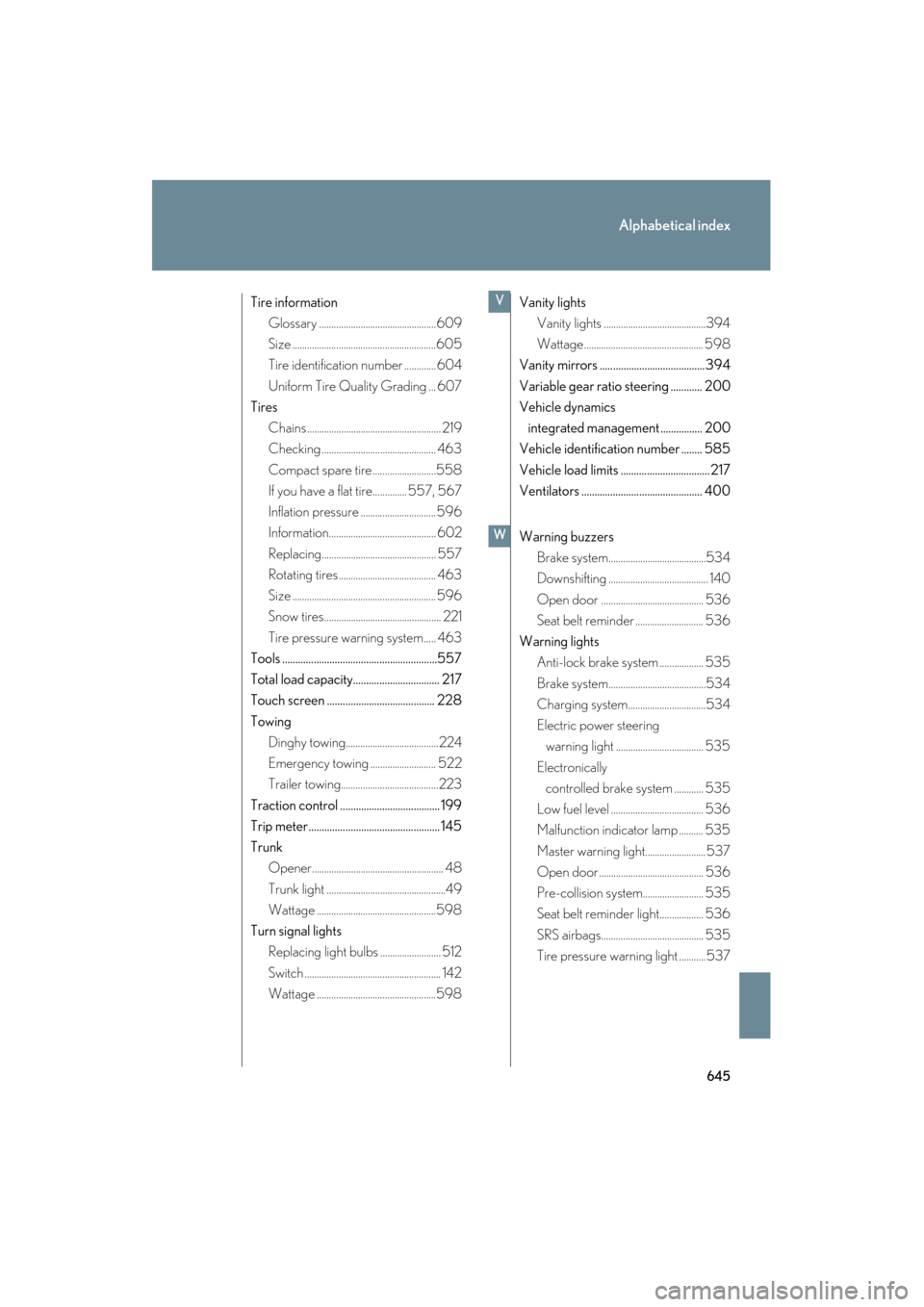
645
Alphabetical index
GS_G_U (OM30C11U)
October 28, 2011 5:15 pm
Tire informationGlossary ................................................609
Size ...........................................................605
Tire identification number .............604
Uniform Tire Quality Grading ... 607
Tires
Chains ....................................................... 219
Checking ............................................... 463
Compact spare tire ..........................558
If you have a flat tire.............. 557, 567
Inflation pressure ............................... 596
Information............................................ 602
Replacing............................................... 557
Rotating tires........................................ 463
Size ........................................................... 596
Snow tires................................................ 221
Tire pressure warning system..... 463
Tools ...........................................................557
Total load capacity................................. 217
Touch screen ......................................... 228
Towing Dinghy towing......................................224
Emergency towing ........................... 522
Trailer towing........................................223
Traction control ...................................... 199
Trip meter.................................................. 145
Trunk Opener...................................................... 48
Trunk light .................................................49
Wattage .................................................598
Turn signal lights Replacing light bulbs ......................... 512
Switch ........................................................ 142
Wattage .................................................598 Vanity lights
Vanity lights ..........................................394
Wattage................................................. 598
Vanity mirrors ........................................394
Variable gear ratio steering ............ 200
Vehicle dynamics
integrated management ................ 200
Vehicle identification number ........ 585
Vehicle load limits ..................................217
Ventilators .............................................. 400
Warning buzzers
Brake system........................................534
Downshifting ......................................... 140
Open door .......................................... 536
Seat belt reminder ............................ 536
Warning lights Anti-lock brake system .................. 535
Brake system........................................534
Charging system................................534
Electric power steering warning light .................................... 535
Electronically controlled brake system ............ 535
Low fuel level ...................................... 536
Malfunction indicator lamp .......... 535
Master warning light.........................537
Open door ........................................... 536
Pre-collision system......................... 535
Seat belt reminder light.................. 536
SRS airbags.......................................... 535
Tire pressure warning light ........... 537V
W