brakes Lexus GS350 2011 Owner's Guide
[x] Cancel search | Manufacturer: LEXUS, Model Year: 2011, Model line: GS350, Model: Lexus GS350 2011Pages: 654, PDF Size: 11.03 MB
Page 583 of 654
582
5-2. Steps to take in an emergency
GS_G_U (OM30C11U)
October 28, 2011 5:15 pm
If your vehicle has to be stopped in an emergency
CAUTION
■If the engine has to be turned off while driving
Power assist for the brakes and steering wheel will be lost, making the brake pedal
harder to depress and the steering wheel heavier to turn. Decelerate as much as
possible before turning off the engine.
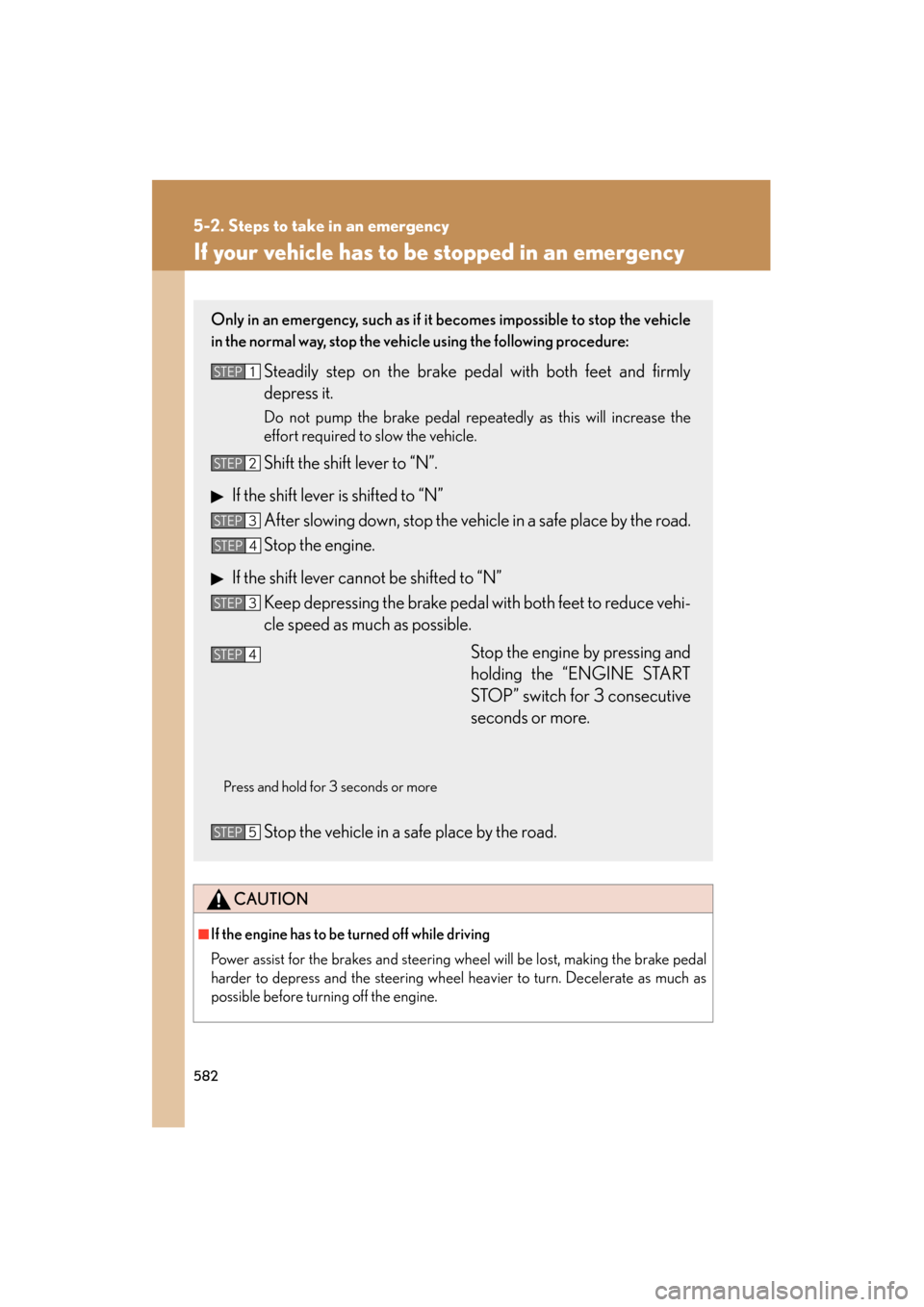
Only in an emergency, such as if it becomes impossible to stop the vehicle
in the normal way, stop the vehicle using the following procedure:
Steadily step on the brake pedal with both feet and firmly
depress it.
Do not pump the brake pedal repeatedly as this will increase the
effort required to slow the vehicle.
Shift the shift lever to “N”.
If the shift lever is shifted to “N” After slowing down, stop the vehicle in a safe place by the road.
Stop the engine.
If the shift lever cannot be shifted to “N” Keep depressing the brake pedal with both feet to reduce vehi-
cle speed as much as possible.
Stop the engine by pressing and
holding the “ENGINE START
STOP” switch for 3 consecutive
seconds or more.
Stop the vehicle in a safe place by the road.
STEP1
STEP2
STEP3
STEP4
STEP3
Press and hold for 3 seconds or more
STEP4
STEP5
Page 596 of 654
595
6-1. Specifications
6
Vehicle specifications
GS_G_U (OM30C11U)
October 28, 2011 5:15 pm
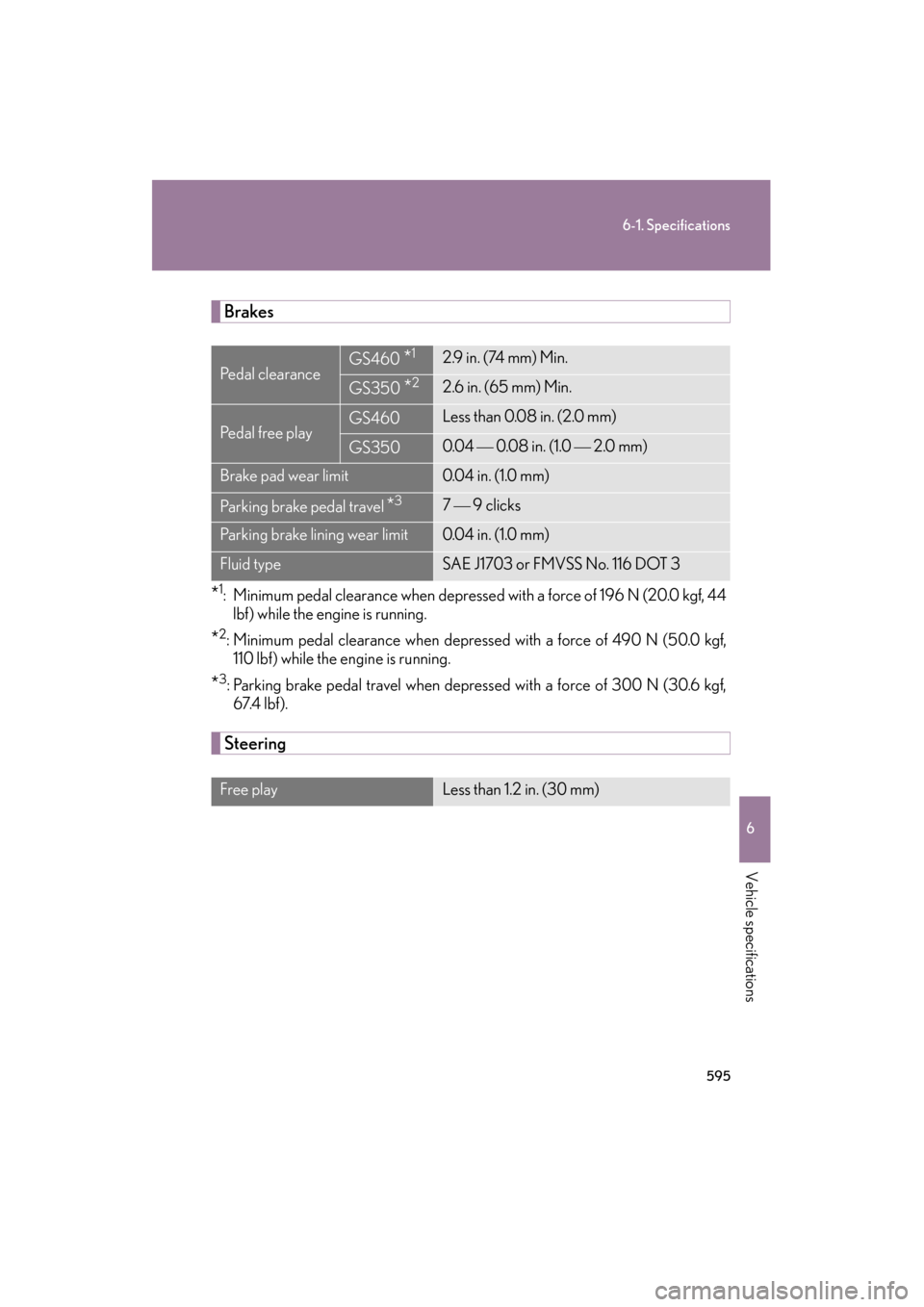
Brakes
*1: Minimum pedal clearance when depressed with a force of 196 N (20.0 kgf, 44lbf) while the engine is running.
*2: Minimum pedal clearance when depressed with a force of 490 N (50.0 kgf,110 lbf) while the engine is running.
*3: Parking brake pedal travel when depressed with a force of 300 N (30.6 kgf,67.4 l bf ).
Steering
Pe d a l c l e a r a n c e GS460 *12.9 in. (74 mm) Min.
GS350 *22.6 in. (65 mm) Min.
Pedal free play GS460Less than 0.08 in. (2.0 mm)
GS3500.04 0.08 in. (1.0 2.0 mm)
Brake pad wear limit0.04 in. (1.0 mm)
Parking brake pedal travel *37 9 clicks
Parking brake lining wear limit0.04 in. (1.0 mm)
Fluid typeSAE J1703 or FMVSS No. 116 DOT 3
Free playLess than 1.2 in. (30 mm)
Page 610 of 654
609
6-1. Specifications
6
Vehicle specifications
GS_G_U (OM30C11U)
October 28, 2011 5:15 pm
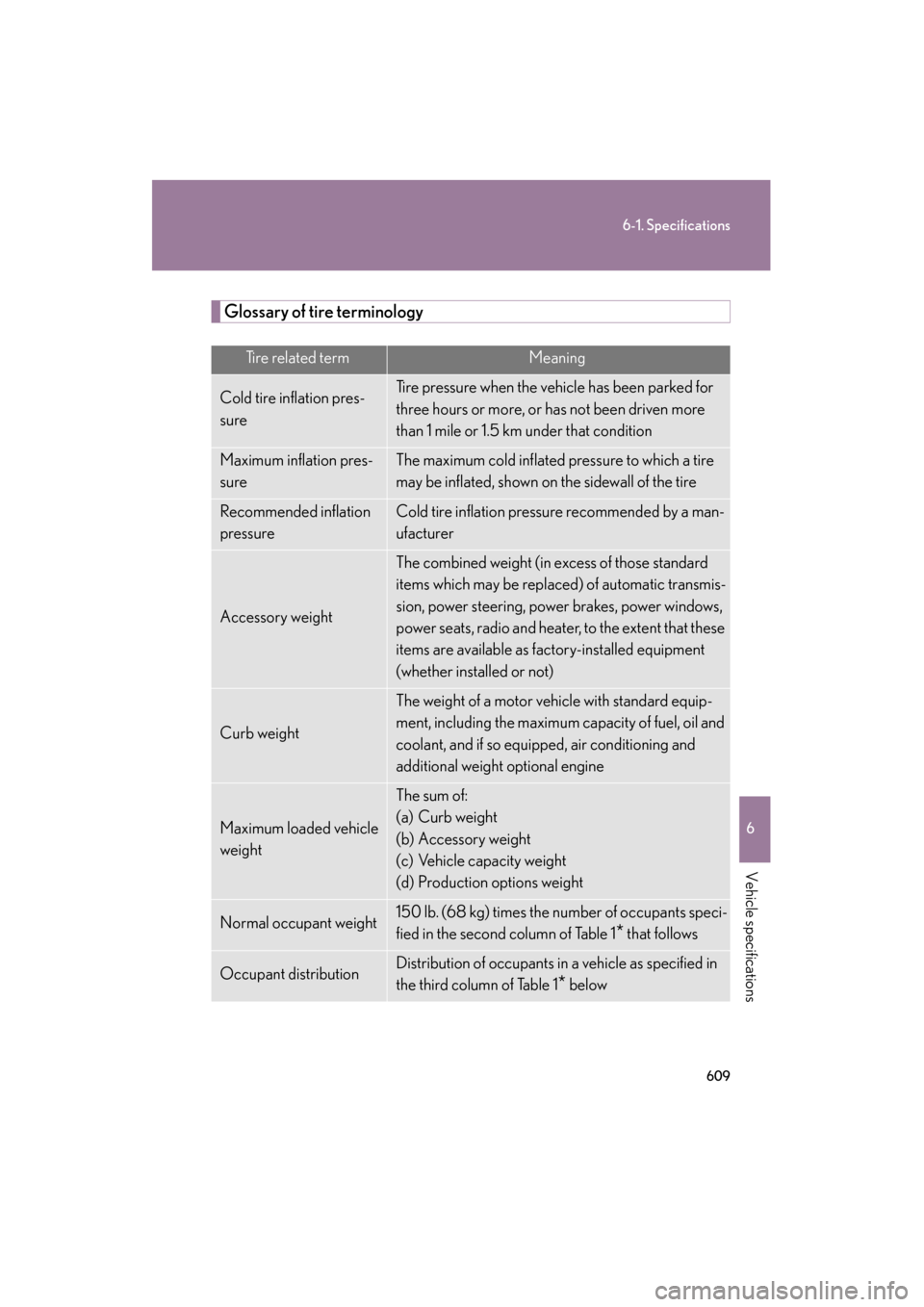
Glossary of tire terminology
Tire related termMeaning
Cold tire inflation pres-
sureTire pressure when the vehicle has been parked for
three hours or more, or has not been driven more
than 1 mile or 1.5 km under that condition
Maximum inflation pres-
sureThe maximum cold inflated pressure to which a tire
may be inflated, shown on the sidewall of the tire
Recommended inflation
pressureCold tire inflation pressure recommended by a man-
ufacturer
Accessory weight
The combined weight (in excess of those standard
items which may be replaced) of automatic transmis-
sion, power steering, power brakes, power windows,
power seats, radio and heater, to the extent that these
items are available as factory-installed equipment
(whether installed or not)
Curb weight
The weight of a motor vehicle with standard equip-
ment, including the maximum capacity of fuel, oil and
coolant, and if so equipped, air conditioning and
additional weight optional engine
Maximum loaded vehicle
weight
The sum of:
(a) Curb weight
(b) Accessory weight
(c) Vehicle capacity weight
(d) Production options weight
Normal occupant weight150 lb. (68 kg) times the number of occupants speci-
fied in the second column of Table 1
* that follows
Occupant distributionDistribution of occupants in a vehicle as specified in
the third column of Table 1
* below
Page 611 of 654
610
6-1. Specifications
GS_G_U (OM30C11U)
October 28, 2011 5:15 pm
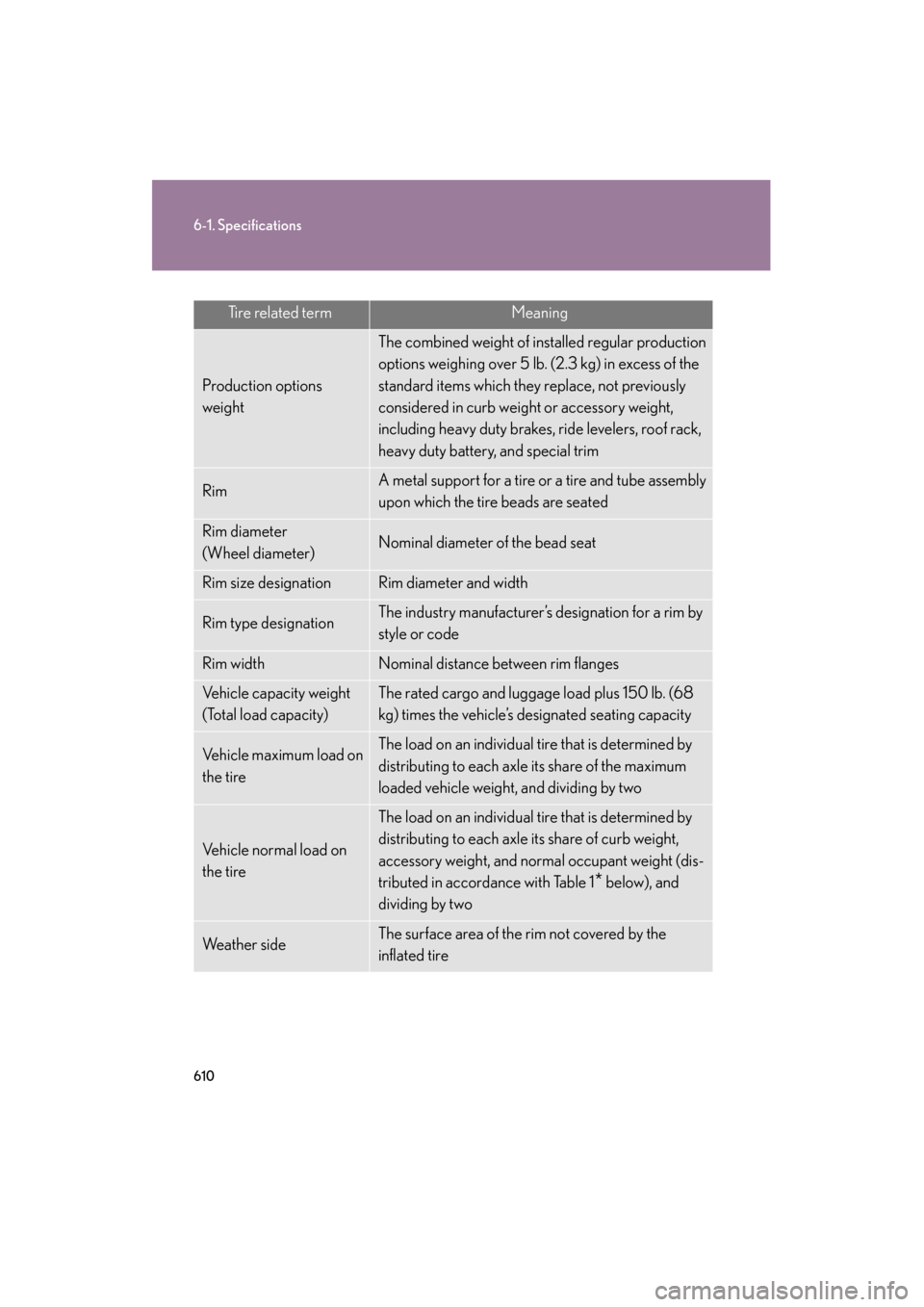
Tire related termMeaning
Production options
weight
The combined weight of installed regular production
options weighing over 5 lb. (2.3 kg) in excess of the
standard items which they replace, not previously
considered in curb weight or accessory weight,
including heavy duty brakes, ride levelers, roof rack,
heavy duty battery, and special trim
RimA metal support for a tire or a tire and tube assembly
upon which the tire beads are seated
Rim diameter
(Wheel diameter)Nominal diameter of the bead seat
Rim size designationRim diameter and width
Rim type designationThe industry manufacturer’s designation for a rim by
style or code
Rim widthNominal distance between rim flanges
Vehicle capacity weight
(Total load capacity)The rated cargo and luggage load plus 150 lb. (68
kg) times the vehicle’s designated seating capacity
Vehicle maximum load on
the tireThe load on an individual tire that is determined by
distributing to each axle its share of the maximum
loaded vehicle weight, and dividing by two
Vehicle normal load on
the tire
The load on an individual tire that is determined by
distributing to each axle its share of curb weight,
accessory weight, and normal occupant weight (dis-
tributed in accordance with Table 1
* below), and
dividing by two
We a t h e r s i d eThe surface area of the rim not covered by the
inflated tire