flat tire Lexus GS350 2011 Owner's Guide
[x] Cancel search | Manufacturer: LEXUS, Model Year: 2011, Model line: GS350, Model: Lexus GS350 2011Pages: 654, PDF Size: 11.03 MB
Page 543 of 654
542
5-2. Steps to take in an emergency
GS_G_U (OM30C11U)
October 28, 2011 5:15 pm
CAUTION
■Maintenance of the tires
Each tire, including the spare (if provided), should be checked monthly when cold
and inflated to the inflation pressure recommended by the vehicle manufacturer on
the vehicle placard or tire inflation pressure label (tire and load information label).
(If your vehicle has tires of a different size than the size indicated on the vehicle
placard or tire inflation pressure label [tire and load information label], you should
determine the proper tire inflation pressure for those tires.)
As an added safety feature, your vehicle has been equipped with a tire pressure
monitoring system (TPMS-tire pressure warning system) that illuminates a low tire
pressure telltale (tire pressure warning light) when one or more of your tires is sig-
nificantly under-inflated. Accordingly, when the low tire pressure telltale (tire pres-
sure warning light) illuminates, you should stop and check your tires as soon as
possible, and inflate them to the proper pressure. Driving on a significantly under-
inflated tire causes the tire to overheat and can lead to tire failure. Under-inflation
also reduces fuel efficiency and tire tread life, and may affect the vehicle’s handling
and stopping ability.
Please note that the TPMS (tire pressure warning system) is not a substitute for
proper tire maintenance, and it is the driver’s responsibility to maintain correct tire
pressure, even if under-inflation has not reached the level to trigger illumination of
the TPMS low tire pressure telltale (tire pressure warning light).
Your vehicle has also been equipped with a TPMS (tire pressure warning system)
malfunction indicator to indicate when the system is not operating properly. The
TPMS (tire pressure warning system) malfunction indicator is combined with the
low tire pressure telltale (tire pressure warning light). When the system detects a
malfunction, the telltale will flash for approximately one minute and then remain
continuously illuminated. This sequence will continue upon subsequent vehicle
start-ups as long as the malfunction exists. When the malfunction indicator is illumi-
nated, the system may not be able to detect or signal low tire pressure as intended.
TPMS (tire pressure warning system) malfunctions may occur for a variety of rea-
sons, including the installation of replacement or alternate tires or wheels on the
vehicle that prevent the TPMS (tire pressure warning system) from functioning
properly. Always check the TPMS (tire pressure warning system) malfunction tell-
tale after replacing one or more tires or wheels on your vehicle to ensure that the
replacement or alternate tires and wheels allow the TPMS (tire pressure warning
system) to continue to function properly.
Page 558 of 654
5
When trouble arises
557
5-2. Steps to take in an emergency
GS_G_U (OM30C11U)
October 28, 2011 5:15 pm
If you have a flat tire (Vehicles with standard tires)
Remove the flat tire and replace it with the spare provided.
■Before jacking up the vehicle
● Stop the vehicle on a hard, flat surface.
● Set the parking brake.
● Shift the shift lever to “P”.
● Stop the engine.
● Turn on the emergency flashers.
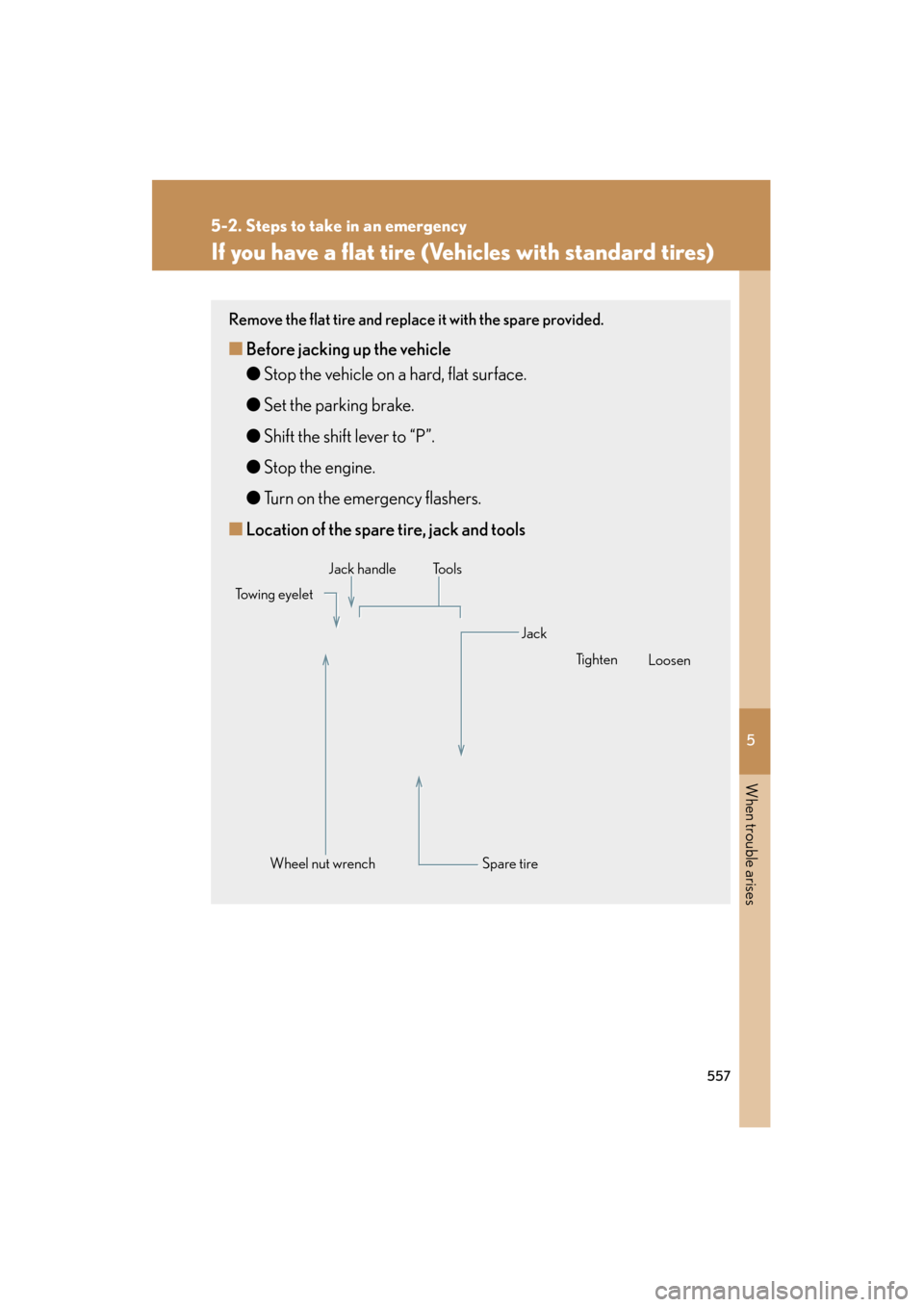
■ Location of the spare tire, jack and tools
Wheel nut wrench Jack
Jack handle
Spare tireTi g h t e n
Loosen
Tools
Towing eyelet
Page 559 of 654
558
5-2. Steps to take in an emergency
GS_G_U (OM30C11U)
October 28, 2011 5:15 pm
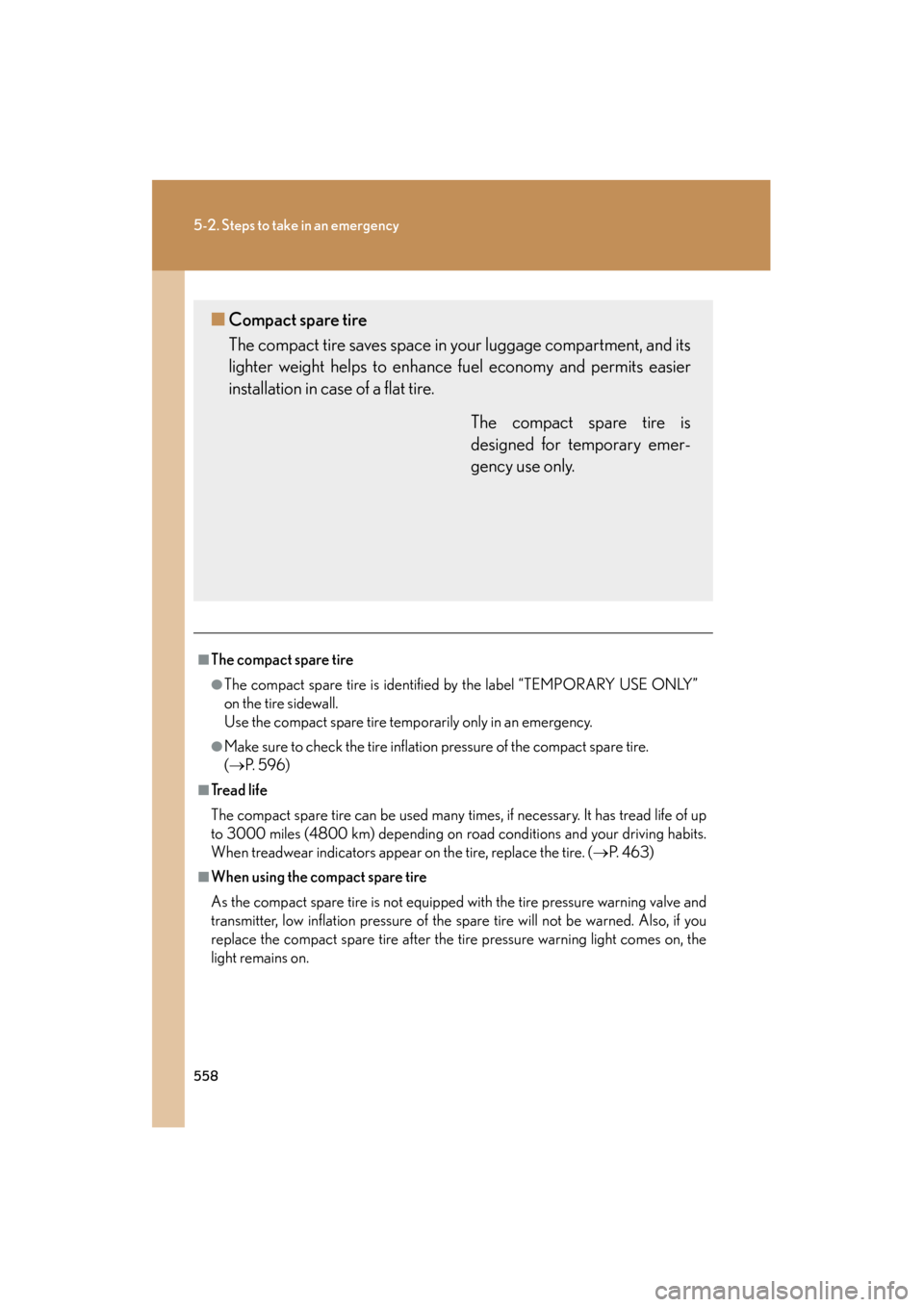
■The compact spare tire
●The compact spare tire is identified by the label “TEMPORARY USE ONLY”
on the tire sidewall.
Use the compact spare tire temporarily only in an emergency.
●Make sure to check the tire inflation pressure of the compact spare tire.
(→ P. 5 9 6 )
■Tread life
The compact spare tire can be used many times, if necessary. It has tread life of up
to 3000 miles (4800 km) depending on road conditions and your driving habits.
When treadwear indicators appear on the tire, replace the tire. ( →P. 4 6 3 )
■When using the compact spare tire
As the compact spare tire is not equipped with the tire pressure warning valve and
transmitter, low inflation pressure of the spare tire will not be warned. Also, if you
replace the compact spare tire after the tire pressure warning light comes on, the
light remains on.
■Compact spare tire
The compact tire saves space in your luggage compartment, and its
lighter weight helps to enhance fuel economy and permits easier
installation in case of a flat tire.
The compact spare tire is
designed for temporary emer-
gency use only.
Page 561 of 654
560
5-2. Steps to take in an emergency
GS_G_U (OM30C11U)
October 28, 2011 5:15 pm
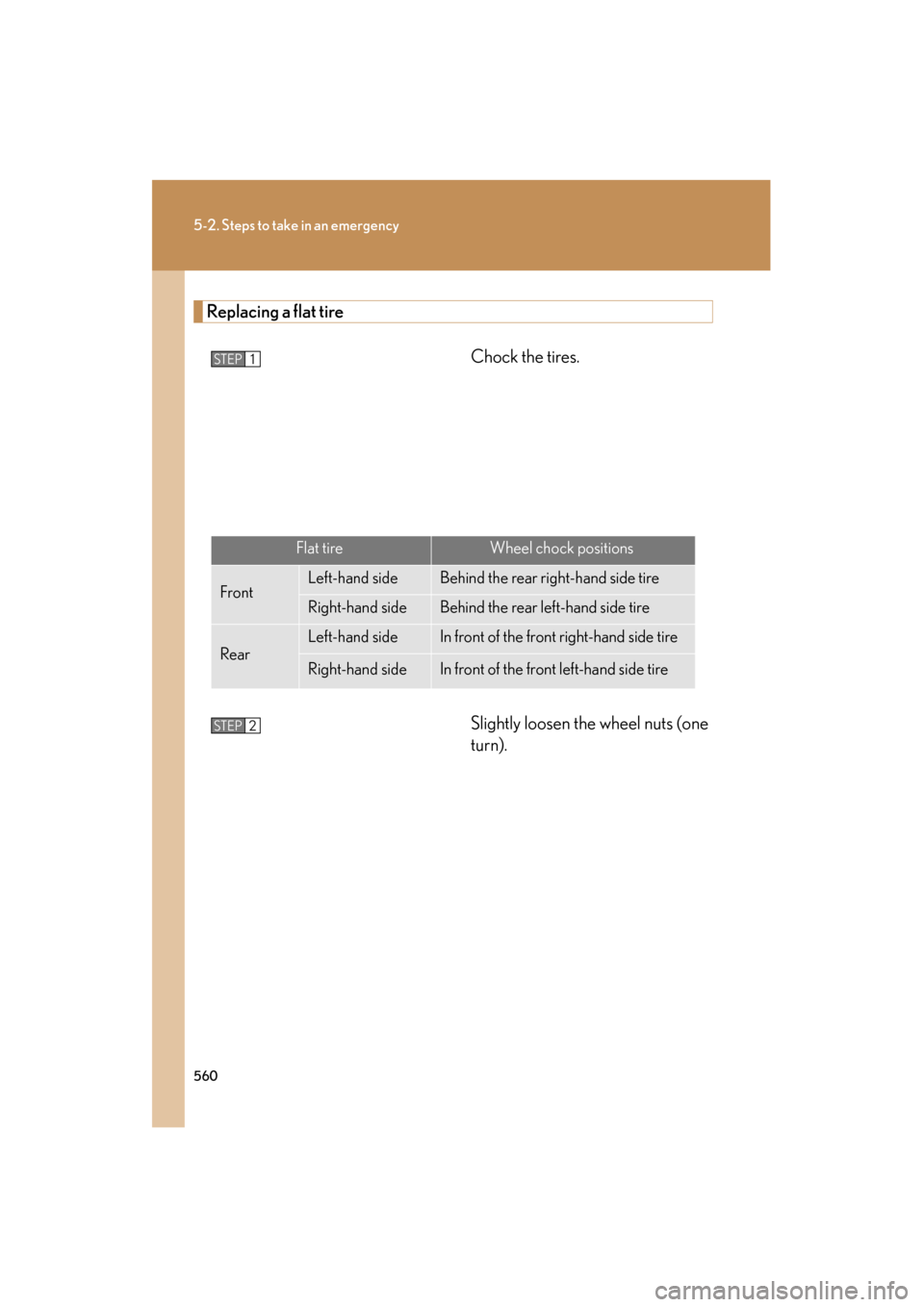
Replacing a flat tireChock the tires.
Slightly loosen the wheel nuts (one
turn).
STEP1
Flat tireWheel chock positions
FrontLeft-hand sideBehind the rear right-hand side tire
Right-hand sideBehind the rear left-hand side tire
Rear
Left-hand sideIn front of the front right-hand side tire
Right-hand sideIn front of the front left-hand side tire
STEP2
Page 564 of 654

5
When trouble arises
563
5-2. Steps to take in an emergency
GS_G_U (OM30C11U)
October 28, 2011 5:15 pm
Firmly tighten each nut two or
three times in the order shown in
the illustration.
Tightening torque:
76 ft•lbf (103 N•m, 10.5 kgf•m)
Stow the flat tire, tire jack and all tools.
STEP4
■If you have a flat rear tire on a road covered with snow or ice
Install the compact spare tire on the front of the vehicle. Perform the following steps
and fit tire chains to the rear tires.Replace a front tire with the compact spare tire.
Replace the flat rear tire with the tire removed from the front of the vehi-
cle.
Fit tire chains to the rear tires.
■After completing the tire change
The tire pressure warning system must be reset. ( →P. 4 6 4 )
STEP5
STEP1
STEP2
STEP3
Page 565 of 654

564
5-2. Steps to take in an emergency
GS_G_U (OM30C11U)
October 28, 2011 5:15 pm
CAUTION
■Using the tire jack
Improper use of the tire jack may lead to death or serious injuries due to the vehicle
suddenly falling off the jack.
●Do not use the tire jack for any purpose other than replacing tires or installing and
removing tire chains.
●Only use the tire jack that comes with this vehicle for replacing a flat tire.
Do not use it on other vehicles, and do not use other tire jacks for replacing tires
on this vehicle.
●Always check that the tire jack is securely set to the jack point.
●Do not raise the vehicle while someone is in it.
●When raising the vehicle, do not put an object on or under the jack.
●Do not raise the vehicle to a height greater than that required to replace the tire.
●Use a jack stand if it is necessary to get under the vehicle.
●Do not put any part of your body under the vehicle supported by a jack.
●Do not start or run the engine while your vehicle is supported by the jack.
Take particular care when lowering the vehicle to ensure that no one working on or
near the vehicle may be injured.
■Replacing a flat tire
Have the wheel nuts tightened with a torque wrench to 76 ft•lbf (103 N•m, 10.5
kgf•m) as soon as possible after changing wheels.
Failure to follow these precautions could cause the nuts to loosen and the wheels
may fall off, which could lead to an accident causing death or serious injury.
■When installing the wheel nuts
Be sure to install the wheel nuts with the tapered end facing inward.( →P. 4 7 8 )
Page 567 of 654
566
5-2. Steps to take in an emergency
GS_G_U (OM30C11U)
October 28, 2011 5:15 pm
NOTICE
■Do not drive the vehicle with a flat tire
Do not continue driving with a flat tire.
Driving even a short distance with a flat tire can damage the tire and the wheel
beyond repair.
■Be careful when driving over bumps with the compact spare tire installed on the
vehicle
The vehicle becomes lower when driving with the compact spare tire compared to
when driving with standard tires. Be careful when driving over uneven road sur-
faces.
■Driving with tire chains and the compact spare tire
Do not fit tire chains to the compact spare tire.
Tire chains may damage the vehicle body and adversely affect driving performance.
■When replacing the tires
When removing or fitting the wheels, tires or the tire pressure warning valve and
transmitter, contact your Lexus dealer as the tire pressure warning valve and trans-
mitter may be damaged if not handled correctly.
■To avoid damage to the tire pressure warning valves and transmitters
When a tire is repaired with liquid sealants, the tire pressure warning valve and
transmitter may not operate properly. If a liquid sealant is used, contact your Lexus
dealer or other qualified service shop as soon as possible. Make sure to replace the
tire pressure warning valve and transmitter when replacing the tire. ( →P. 4 6 4 )
Page 568 of 654
5
When trouble arises
567
5-2. Steps to take in an emergency
GS_G_U (OM30C11U)
October 28, 2011 5:15 pm
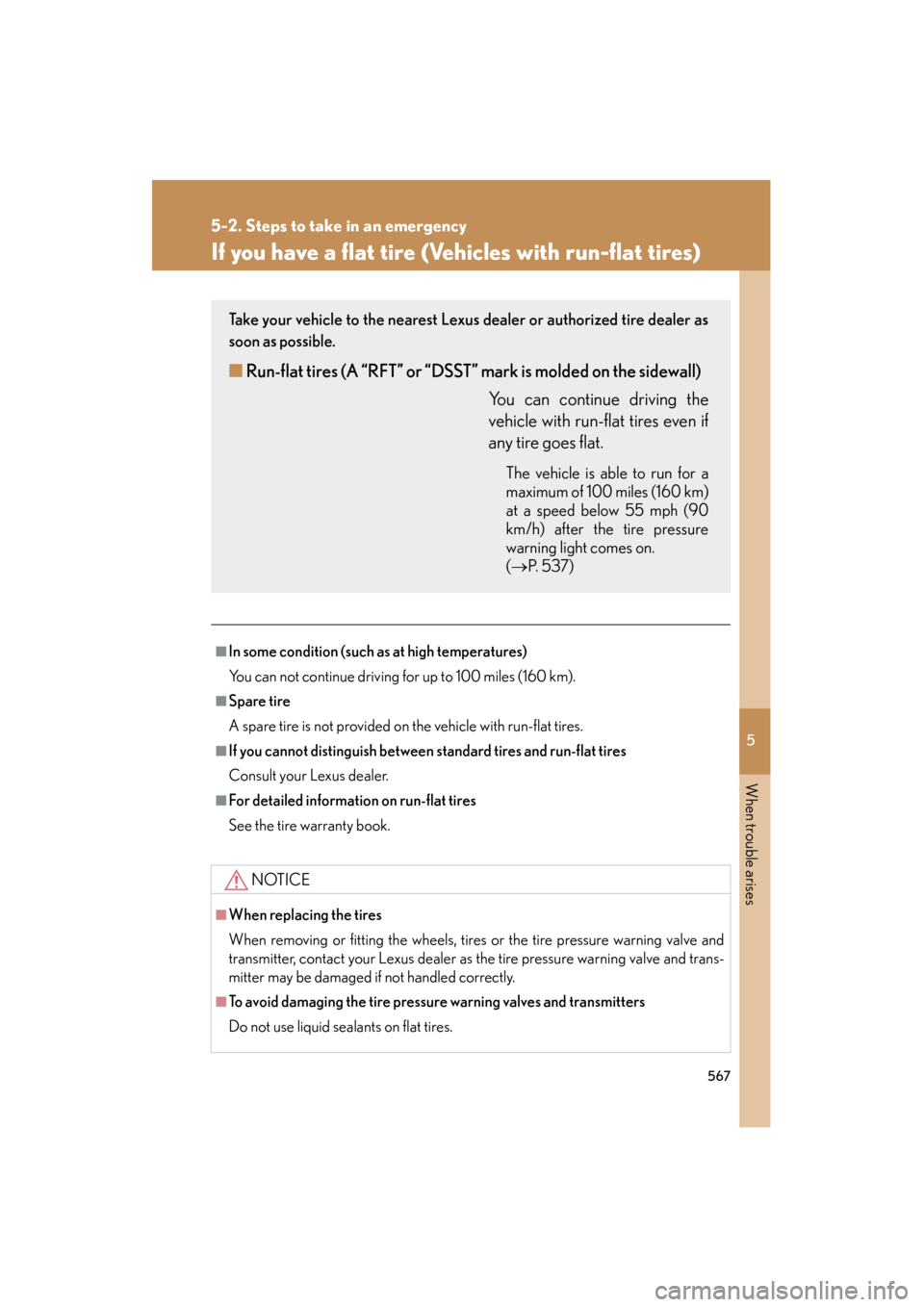
If you have a flat tire (Vehicles with run-flat tires)
■In some condition (such as at high temperatures)
You can not continue driving for up to 100 miles (160 km).
■Spare tire
A spare tire is not provided on the vehicle with run-flat tires.
■If you cannot distinguish between standard tires and run-flat tires
Consult your Lexus dealer.
■For detailed informatio n on run-flat tires
See the tire warranty book.
NOTICE
■When replacing the tires
When removing or fitting the wheels, tires or the tire pressure warning valve and
transmitter, contact your Lexus dealer as the tire pressure warning valve and trans-
mitter may be damaged if not handled correctly.
■To avoid damaging the tire pressu re warning valves and transmitters
Do not use liquid sealants on flat tires.
Take your vehicle to the nearest Lexus dealer or authorized tire dealer as
soon as possible.
■ Run-flat tires (A “RFT” or “DSST” mark is molded on the sidewall)
You can continue driving the
vehicle with run-flat tires even if
any tire goes flat.
The vehicle is able to run for a
maximum of 100 miles (160 km)
at a speed below 55 mph (90
km/h) after the tire pressure
warning light comes on.
(→ P. 5 3 7 )
Page 597 of 654
596
6-1. Specifications
GS_G_U (OM30C11U)
October 28, 2011 5:15 pm
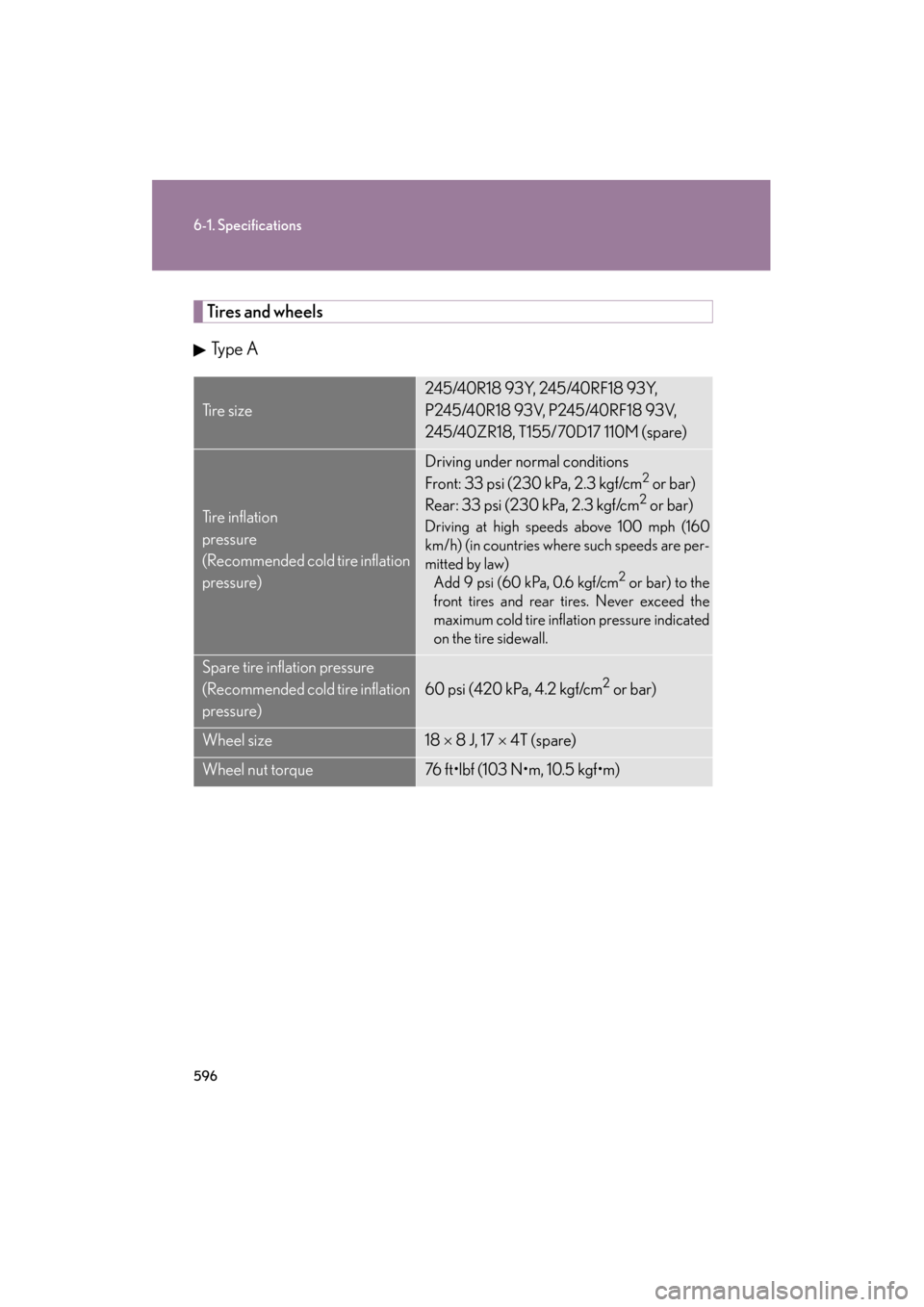
Tires and wheels
Ty p e A
Ti r e s i z e
245/40R18 93Y, 245/40RF18 93Y,
P245/40R18 93V, P245/40RF18 93V,
245/40ZR18, T155/70D17 110M (spare)
Tire inflation
pressure
(Recommended cold tire inflation
pressure)
Driving under normal conditions
Front: 33 psi (230 kPa, 2.3 kgf/cm2 or bar)
Rear: 33 psi (230 kPa, 2.3 kgf/cm2 or bar)
Driving at high speeds above 100 mph (160
km/h) (in countries where such speeds are per-
mitted by law) Add 9 psi (60 kPa, 0.6 kgf/cm
2 or bar) to the
front tires and rear tires. Never exceed the
maximum cold tire inflation pressure indicated
on the tire sidewall.
Spare tire inflation pressure
(Recommended cold tire inflation
pressure)
60 psi (420 kPa, 4.2 kgf/cm2 or bar)
Wheel size18 × 8 J, 17 × 4T (spare)
Wheel nut torque76 ft•lbf (103 N•m, 10.5 kgf•m)
Page 598 of 654

597
6-1. Specifications
6
Vehicle specifications
GS_G_U (OM30C11U)
October 28, 2011 5:15 pm
Type B
Ti r e s i z e
225/50R17 94W, P225/50R17 93V,
P225/50RF17 93V,
T155/70D17 110M (spare)
Tire inflation
pressure
(Recommended cold tire inflation
pressure)
Driving under normal conditions
Front: 33 psi (230 kPa, 2.3 kgf/cm2 or bar)
Rear: 33 psi (230 kPa, 2.3 kgf/cm2 or bar)
Driving at high speeds above 100 mph (160
km/h) (in countries where such speeds are
permitted by law) Add 7 psi (50 kPa, 0.5 kgf/cm
2 or bar) to the
front tires and rear tires. Never exceed the
maximum cold tire inflation pressure indi-
cated on the tire sidewall.
Spare tire inflation pressure
(Recommended cold tire inflation
pressure)
60 psi (420 kPa, 4.2 kgf/cm2 or bar)
Wheel size17 × 7 1 /2 J, 17 × 4T (spare)
Wheel nut torque76 ft•lbf (103 N•m, 10.5 kgf•m)