light Lexus GS350 2013 Owner's Manual
[x] Cancel search | Manufacturer: LEXUS, Model Year: 2013, Model line: GS350, Model: Lexus GS350 2013Pages: 830, PDF Size: 9.71 MB
Page 729 of 830
7287-2. Steps to take in an emergency
GS350_U (OM30C34U)Raise the vehicle until the tire is
slightly raised off the ground.
Remove all the wheel nuts and
the tire.
When resting the tire on the ground,
place the tire so that the wheel design
faces up to avoid scratching the wheel
surface.
4
5
Page 733 of 830
7327-2. Steps to take in an emergency
GS350_U (OM30C34U)
■The compact spare tire
●The compact spare tire is identified by the label “TEMPORARY USE ONLY” on
the tire sidewall.
Use the compact spare tire temporarily, and only in an emergency.
●Make sure to check the tire inflation pressure of the compact spare tire.
(→ P. 7 5 9 )
■When using the compact spare tire
As the compact spare tire is not equipped with a tire pressure warning valve and
transmitter, low inflation pressure of the spare tire will not be indicated by the tire
pressure warning system. Also, if you replace the compact spare tire after the tire
pressure warning light comes on, the light remains on.
■When the compact spare tire is equipped
The vehicle becomes lower when driving with the compact spare tire compared to
when driving with standard tires.
■If you have a flat rear tire on a road covered with snow or ice (vehicles with front
and rear tires of the same size)
Install the compact spare tire on one of the front wheels of the vehicle. Perform the
following steps and fit tire chains to the rear tires:
Replace a front tire with the compact spare tire.
Replace the flat rear tire with the tire removed from the front of the vehicle.
Fit tire chains to the rear tires.
1
2
3
Page 736 of 830
735
GS350_U (OM30C34U)
7
When trouble arises
7-2. Steps to take in an emergency
If the engine will not start
One of the following may be the cause of the problem:
●There may not be sufficient fuel in the vehicle’s tank.
Refuel the vehicle.
●The engine may be flooded.
Try to restart the engine again following correct starting procedures.
(→ P. 1 5 4 )
●There may be a malfunction in the engine immobilizer system.
(→P. 6 8 )
One of the following may be the cause of the problem:
●The battery may be discharged. ( →P. 743)
●The battery terminal connections may be loose or corroded.
The engine starting system may be malfunctioning due to an electrical
problem such as electronic key battery depletion or a blown fuse. How-
ever, an interim measure is available to start the engine. ( →P. 7 3 6 )
If the engine will not start even though correct starting procedures are
being followed ( →P. 154), consider each of the following points:
The engine will not start even though the starter motor operates
normally.
The starter motor turns over slowly, the interior lights and head-
lights are dim, or the horn does not sound or sounds at a low vol-
ume.
The starter motor does not turn over
Page 737 of 830
7367-2. Steps to take in an emergency
GS350_U (OM30C34U)One of the following may be the cause of the problem:
●One or both of the battery terminals may be disconnected.
●The battery may be discharged. (
→P. 743)
●There may be a malfunction in the steering lock system.
Contact your Lexus dealer if the problem cannot be repaired, or if repair proce-
dures are unknown.
When the engine does not start, the following steps can be used as an
interim measure to start the engine if the engine switch is functioning nor-
mally:
Set the parking brake.
Shift the shift lever to P.
Turn the engine switch to ACCESSORY mode.
Press and hold the engine switch for about 15 seconds while depress-
ing the brake pedal firmly.
Even if the engine can be started using the above steps, the system may be
malfunctioning. Have the vehicle inspected by your Lexus dealer.
The starter motor does not turn over, the interior lights and head-
lights do not turn on, or the horn does not sound.
Emergency start function
1
2
3
4
Page 745 of 830
7447-2. Steps to take in an emergency
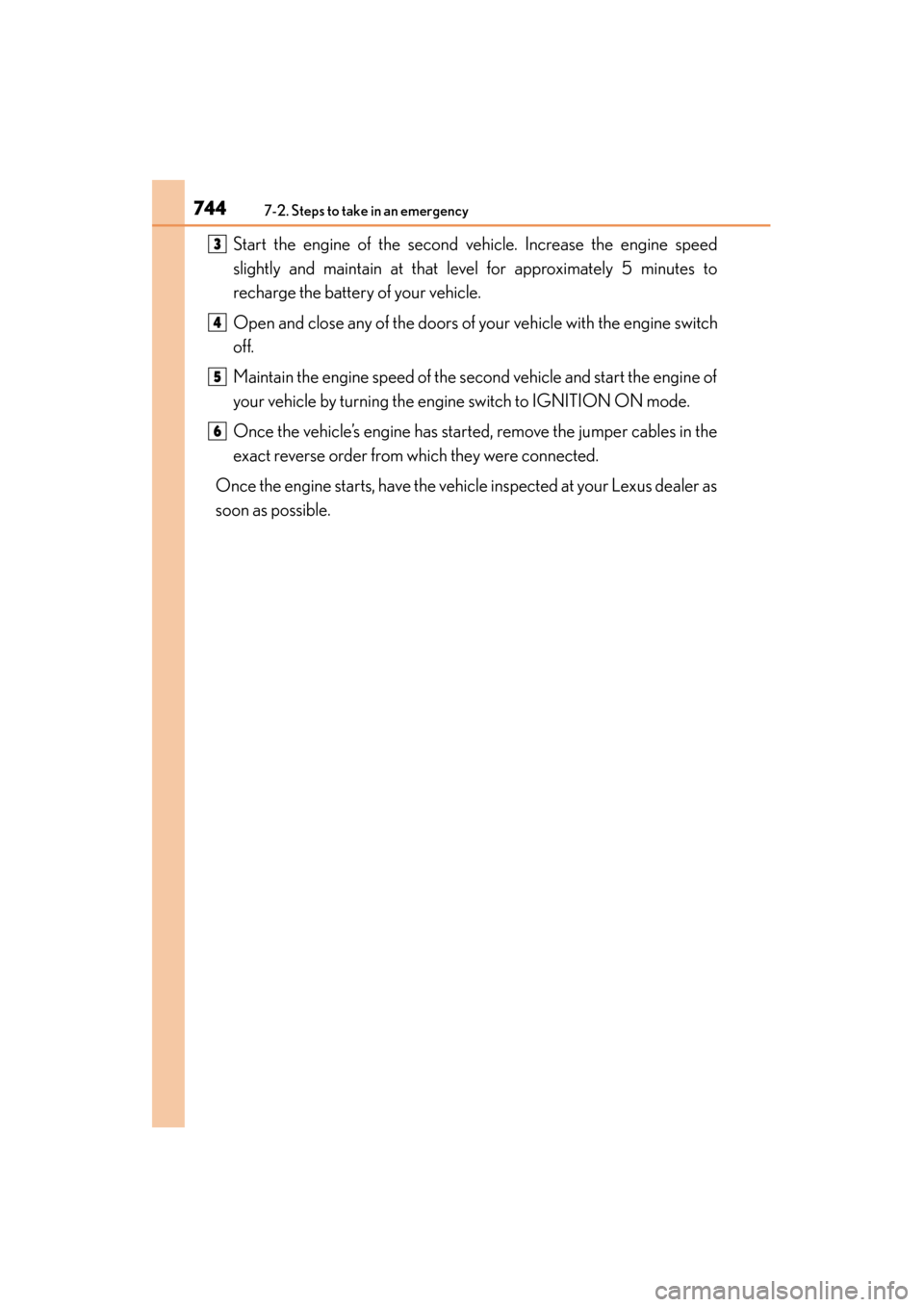
GS350_U (OM30C34U)Start the engine of the second ve
hicle. Increase the engine speed
slightly and maintain at that level for approximately 5 minutes to
recharge the battery of your vehicle.
Open and close any of the doors of your vehicle with the engine switch
off.
Maintain the engine speed of the second vehicle and start the engine of
your vehicle by turning the engine switch to IGNITION ON mode.
Once the vehicle’s engine has started, remove the jumper cables in the
exact reverse order from which they were connected.
Once the engine starts, have the vehicle inspected at your Lexus dealer as
soon as possible.
3
4
5
6
Page 746 of 830
7457-2. Steps to take in an emergency
GS350_U (OM30C34U)
7
When trouble arises
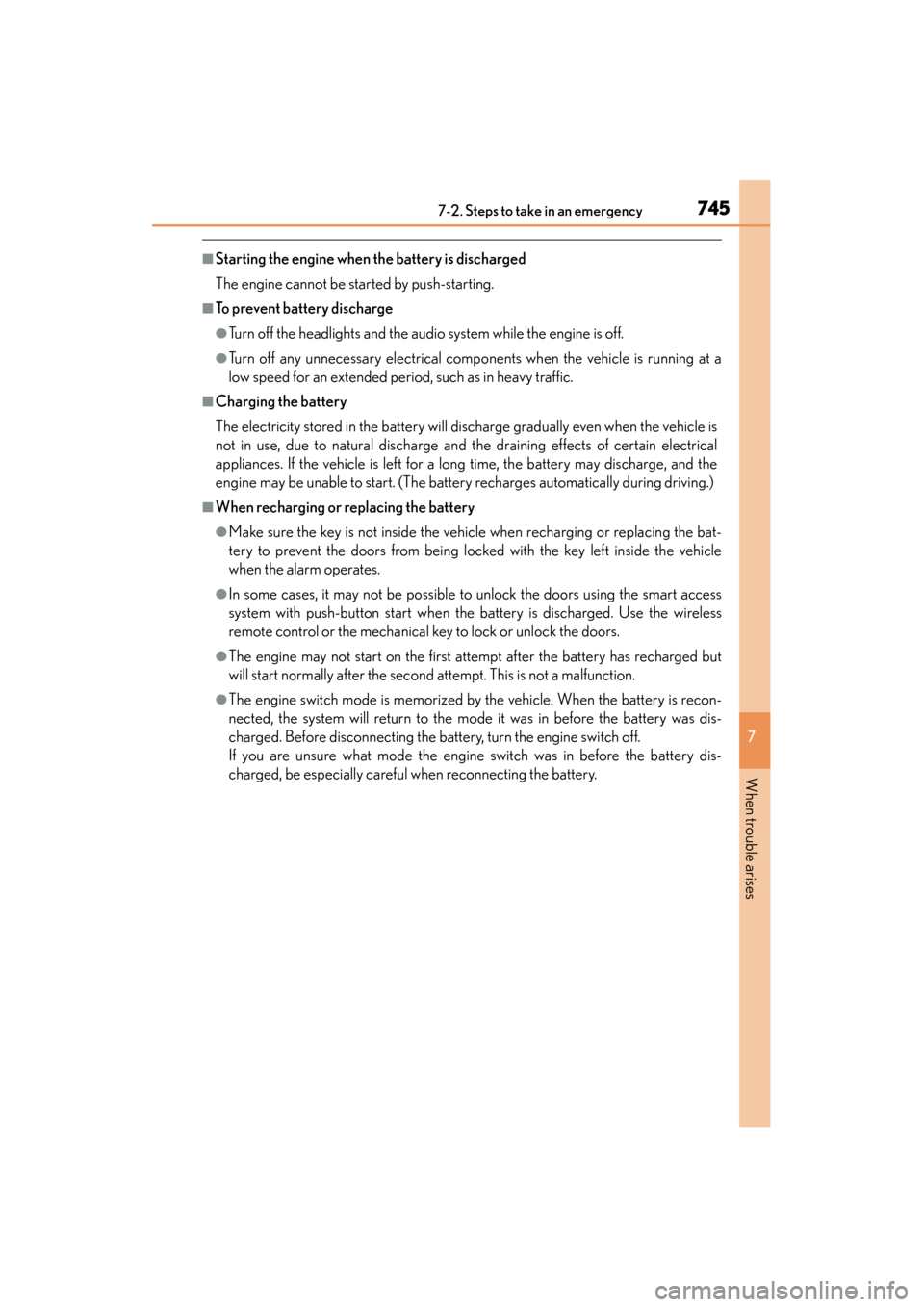
■Starting the engine when the battery is discharged
The engine cannot be started by push-starting.
■To prevent battery discharge
●Turn off the headlights and the audio system while the engine is off.
●Turn off any unnecessary electrical components when the vehicle is running at a
low speed for an extended period, such as in heavy traffic.
■Charging the battery
The electricity stored in the battery will discharge gradually even when the vehicle is
not in use, due to natural discharge and the draining effects of certain electrical
appliances. If the vehicle is left for a long time, the battery may discharge, and the
engine may be unable to start. (The battery recharges automatically during driving.)
■When recharging or replacing the battery
●Make sure the key is not inside the vehicle when recharging or replacing the bat-
tery to prevent the doors from being locked with the key left inside the vehicle
when the alarm operates.
●In some cases, it may not be possible to unlock the doors using the smart access
system with push-button start when the battery is discharged. Use the wireless
remote control or the mechanical key to lock or unlock the doors.
●The engine may not start on the first attempt after the battery has recharged but
will start normally after the second attempt. This is not a malfunction.
●The engine switch mode is memorized by the vehicle. When the battery is recon-
nected, the system will return to the mode it was in before the battery was dis-
charged. Before disconnecting the battery, turn the engine switch off.
If you are unsure what mode the engine switch was in before the battery dis-
charged, be especially careful when reconnecting the battery.
Page 747 of 830
7467-2. Steps to take in an emergency
GS350_U (OM30C34U)
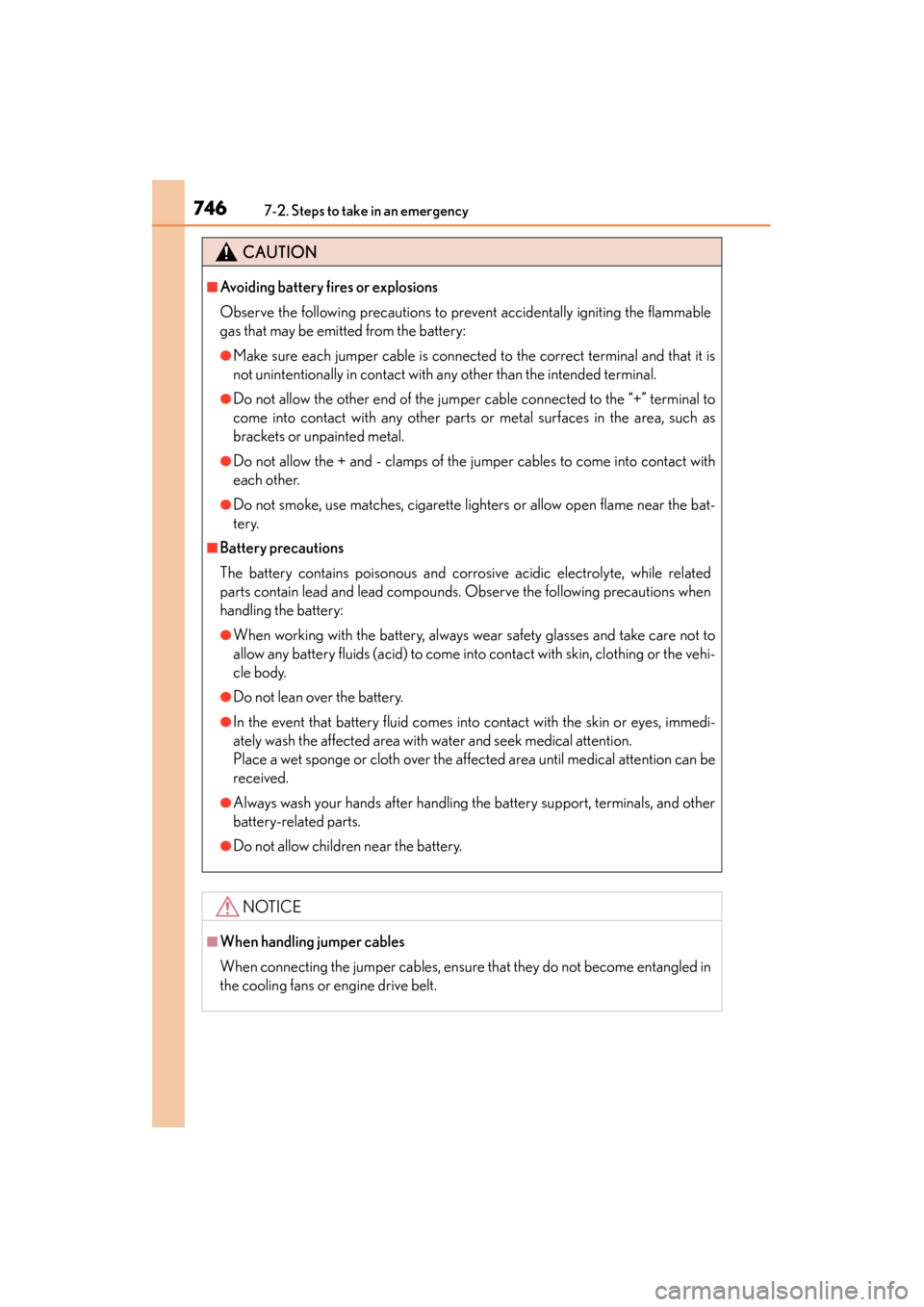
CAUTION
■Avoiding battery fires or explosions
Observe the following precautions to prevent accidentally igniting the flammable
gas that may be emitted from the battery:
●Make sure each jumper cable is connected to the correct terminal and that it is
not unintentionally in contact with any other than the intended terminal.
●Do not allow the other end of the jumper cable connected to the “+” terminal to
come into contact with any other parts or metal surfaces in the area, such as
brackets or unpainted metal.
●Do not allow the + and - clamps of the jumper cables to come into contact with
each other.
●Do not smoke, use matches, cigarette lighters or allow open flame near the bat-
tery.
■Battery precautions
The battery contains poisonous and corrosive acidic electrolyte, while related
parts contain lead and lead compounds. Observe the following precautions when
handling the battery:
●When working with the battery, always wear safety glasses and take care not to
allow any battery fluids (acid) to come into contact with skin, clothing or the vehi-
cle body.
●Do not lean over the battery.
●In the event that battery fluid comes into contact with the skin or eyes, immedi-
ately wash the affected area with water and seek medical attention.
Place a wet sponge or cloth over the affected area until medical attention can be
received.
●Always wash your hands after handling the battery support, terminals, and other
battery-related parts.
●Do not allow children near the battery.
NOTICE
■When handling jumper cables
When connecting the jumper cables, ensure that they do not become entangled in
the cooling fans or engine drive belt.
Page 758 of 830
GS350_U (OM30C34U)
7578-1. Specifications
8
Vehicle specifications
*: The fluid capacity is the quantity of reference.If replacement is necessary, contact your Lexus dealer.
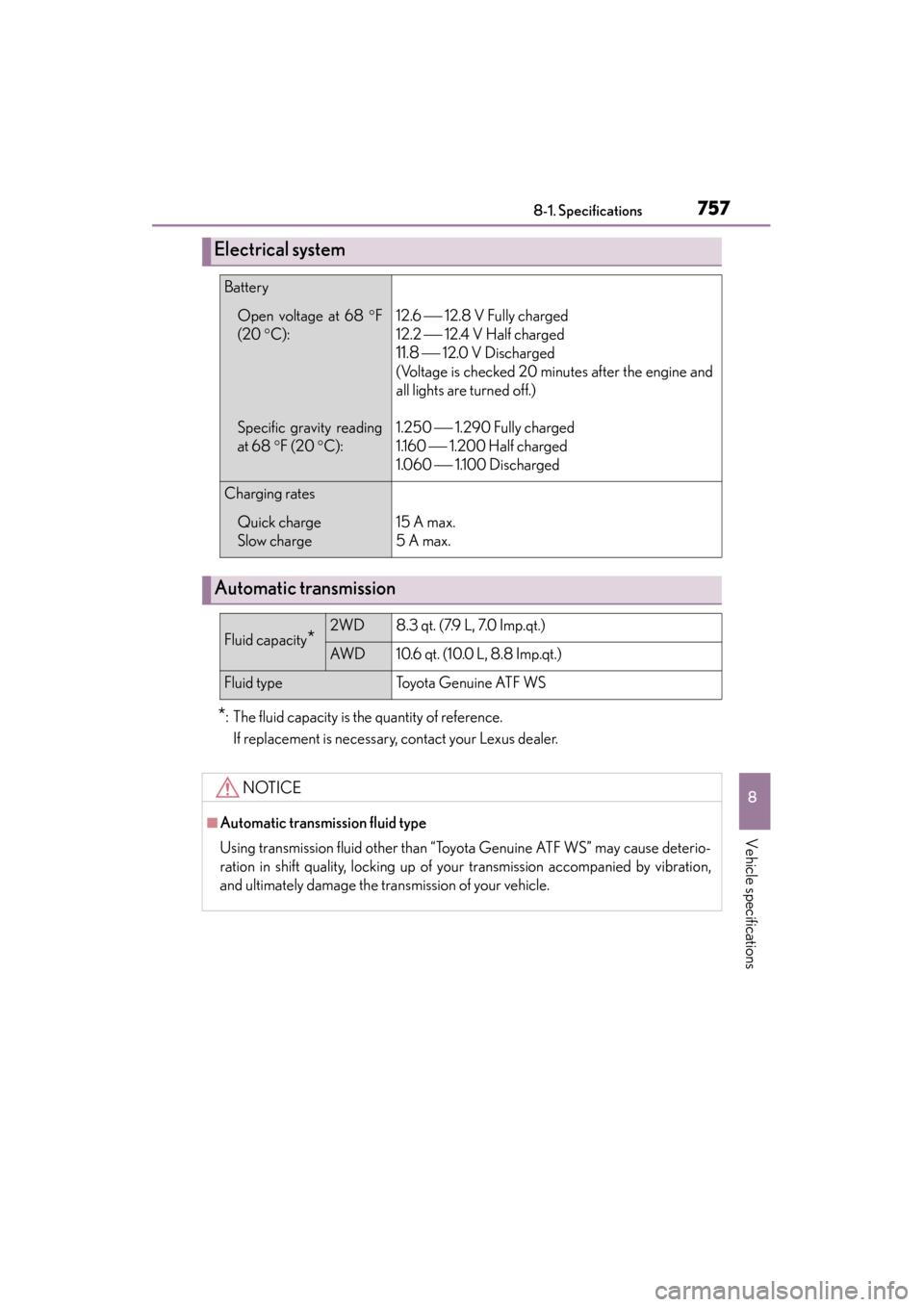
Electrical system
Battery
Open voltage at 68 ° F
(20 °C):
Specific gravity reading
at 68 °F (20 °C):12.6 12.8 V Fully charged
12.2
12.4 V Half charged
11.8 12.0 V Discharged
(Voltage is checked 20 minutes after the engine and
all lights are turned off.)
1.250
1.290 Fully charged
1.160
1.200 Half charged
1.060
1.100 Discharged
Charging rates
Quick charge
Slow charge15 A max.
5 A max.
Automatic transmission
Fluid capacity*2WD8.3 qt. (7.9 L, 7.0 Imp.qt.)
AW D10.6 qt. (10.0 L, 8.8 Imp.qt.)
Fluid typeTo y o t a G e n u i n e AT F W S
NOTICE
■Automatic transmission fluid type
Using transmission fluid other than “Toyota Genuine ATF WS” may cause deterio-
ration in shift quality, locking up of your transmission accompanied by vibration,
and ultimately damage the transmission of your vehicle.
Page 762 of 830
GS350_U (OM30C34U)
7618-1. Specifications
8
Vehicle specifications
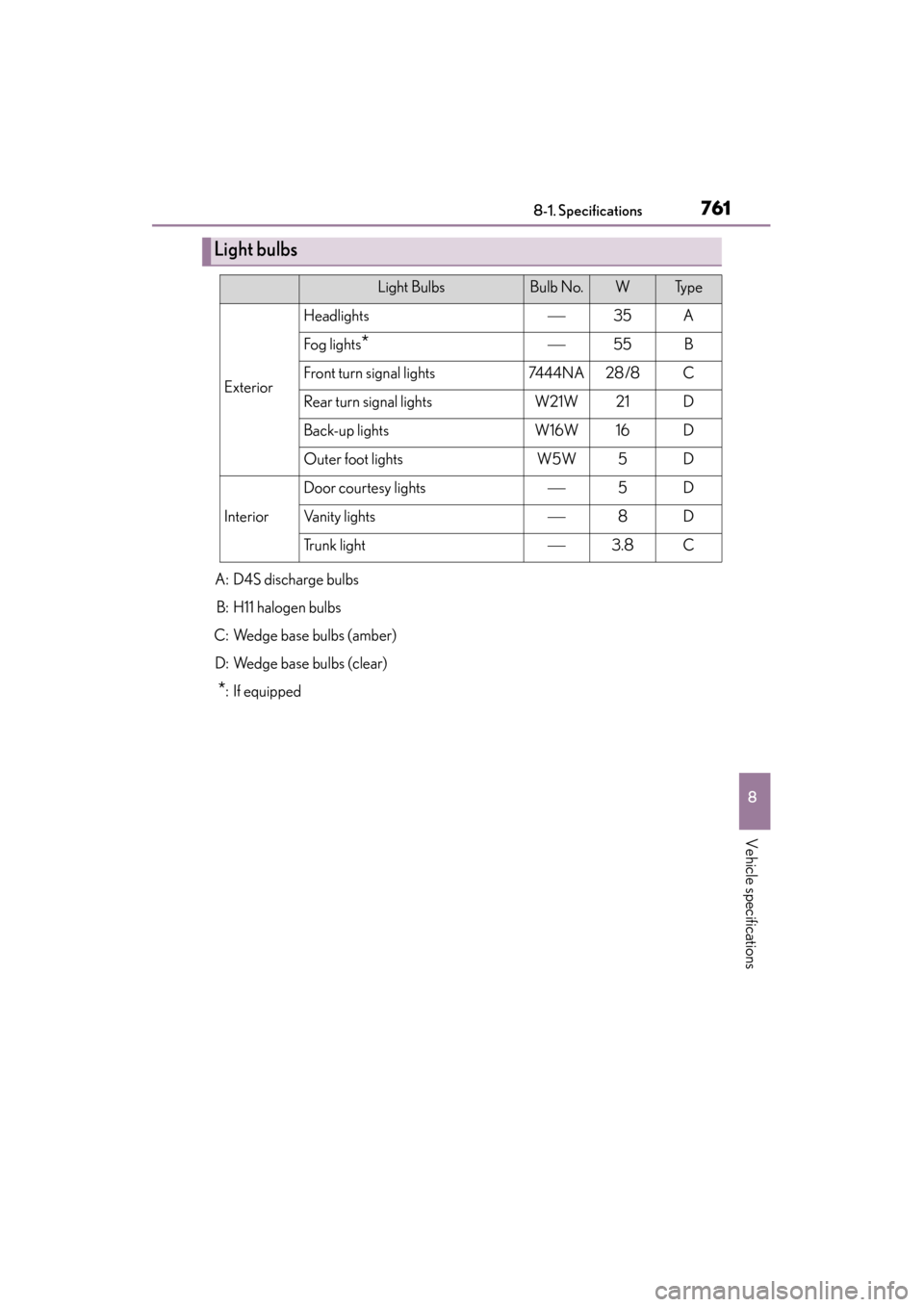
Light bulbs
Light BulbsBulb No.WTy p e
Exterior
Headlights35A
Fog lights*55B
Front turn signal lights7444NA28 /8C
Rear turn signal lightsW21W21D
Back-up lightsW16W16D
Outer foot lightsW5W5D
Interior
Door courtesy lights5D
Vanity lights8D
Tr u n k l i g h t3.8C
A: D4S discharge bulbsB: H11 halogen bulbs
C: Wedge base bulbs (amber) D: Wedge base bulbs (clear)
*: If equipped
Page 764 of 830
GS350_U (OM30C34U)
7638-1. Specifications
8
Vehicle specifications
■Recommendation of the use of gasoline containing detergent additives
●Lexus recommends the use of gasoline that contains detergent additives to avoid
the build-up of engine deposits.
●All gasoline sold in the U.S.A. contains detergent additives to clean and/or keep
clean intake systems.
■Recommendation of the use of cleaner burning gasoline
Cleaner burning gasoline, including reformulated gasoline that contains oxygenates
such as ethanol or MTBE (Methyl Tertiary Butyl Ether) is available in many areas.
Lexus recommends the use of cleaner burning gasoline and appropriately blended
reformulated gasoline. These types of gasoline provide excellent vehicle perfor-
mance, reduce vehicle emissions and improve air quality.
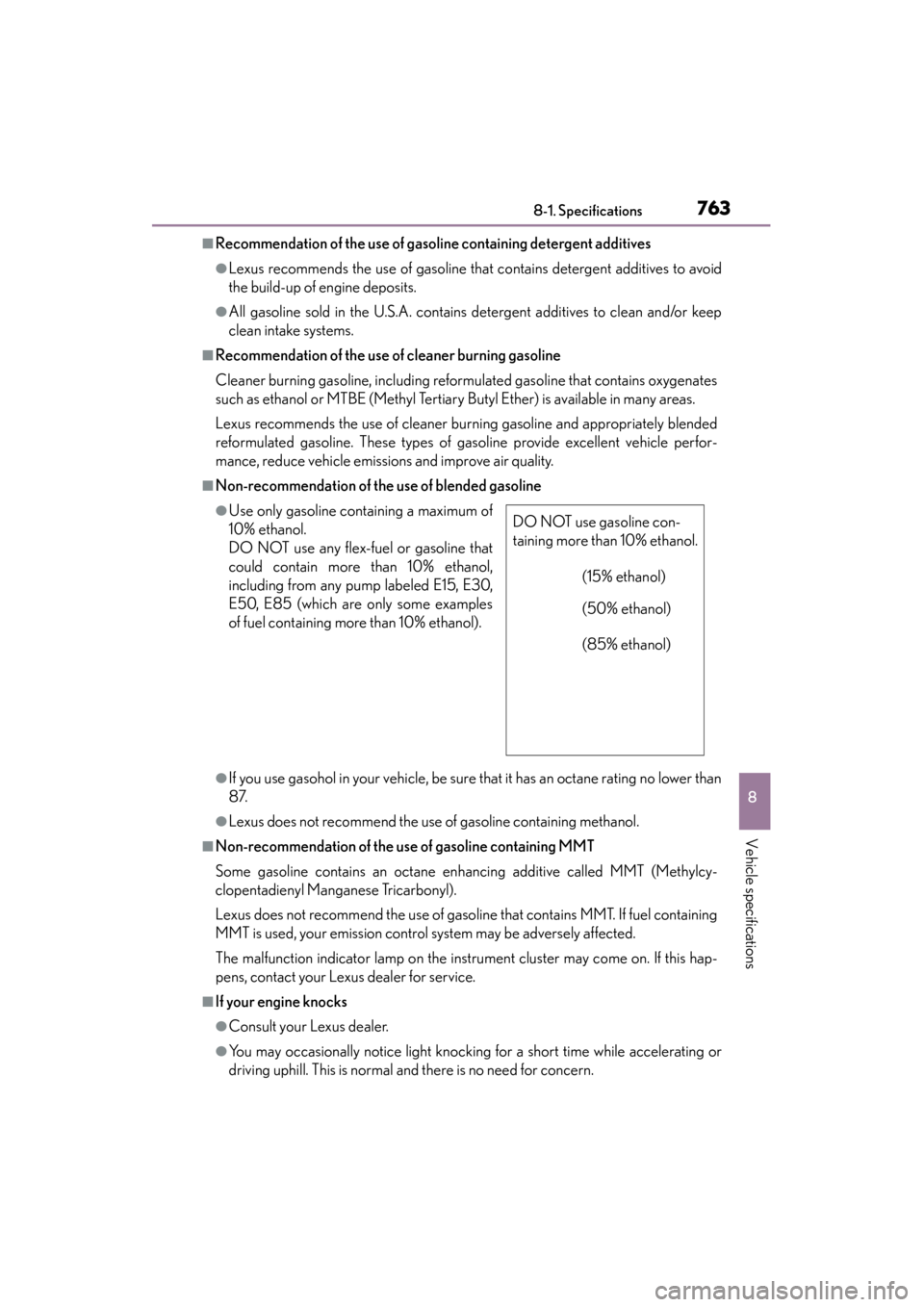
■Non-recommendation of the use of blended gasoline
●If you use gasohol in your vehicle, be sure that it has an octane rating no lower than
87.
●Lexus does not recommend the use of gasoline containing methanol.
■Non-recommendation of the use of gasoline containing MMT
Some gasoline contains an octane enhancing additive called MMT (Methylcy-
clopentadienyl Manganese Tricarbonyl).
Lexus does not recommend the use of gasoline that contains MMT. If fuel containing
MMT is used, your emission control system may be adversely affected.
The malfunction indicator lamp on the instrument cluster may come on. If this hap-
pens, contact your Lexus dealer for service.
■If your engine knocks
●Consult your Lexus dealer.
●You may occasionally notice light knocking for a short time while accelerating or
driving uphill. This is normal and there is no need for concern.
●Use only gasoline containing a maximum of
10% ethanol.
DO NOT use any flex-fuel or gasoline that
could contain more than 10% ethanol,
including from any pump labeled E15, E30,
E50, E85 (which are only some examples
of fuel containing more than 10% ethanol).DO NOT use gasoline con-
taining more than 10% ethanol.
(15% ethanol)
(50% ethanol)
(85% ethanol)