key battery Lexus GS350 2013 User Guide
[x] Cancel search | Manufacturer: LEXUS, Model Year: 2013, Model line: GS350, Model: Lexus GS350 2013Pages: 830, PDF Size: 9.71 MB
Page 176 of 830
GS350_U (OM30C34U)
1754-2. Driving procedures
4
Driving
■When the steering lock cannot be released
■Steering lock motor overheating prevention
To prevent the steering lock motor from overheating, the motor may be suspended if
the engine is turned on and off repeatedly in a short period of time. In this case,
refrain from operating the engine. After about 10 seconds, the steering lock motor
will resume functioning.
■When “Check Access System with Elec. Key” will be displayed on the multi-infor-
mation display
The system may be malfunctioning. Have the vehicle inspected by your Lexus dealer
immediately.
■If the electronic key battery is depleted
→P. 6 4 6
■Operation of the engine switch
●When operating the engine switch, one short, firm press is enough. If the switch is
pressed improperly, the engine may not start or the engine switch mode may not
change. It is not necessary to press and hold the switch.
●If attempting to restart the engine immediately after turning the engine switch off,
the engine may not start in some cases. After turning the engine switch off, please
wait a few seconds before restarting the engine.
■If the smart access system with push-button start has been deactivated in a cus-
tomized setting
→P. 74 0
“Steering Lock active” will be displayed on
the multi-information display.
Check that the shift lever is set in P. Press the
engine switch while turning the steering
wheel left and right.
Page 551 of 830
550
GS350_U (OM30C34U)
5-5. Using the interior lights
■Illuminated entry system
The lights automatically turn on/off according to engine switch mode, the presence
of the electronic key, whether the doors are locked/unlocked, and whether the doors
are opened/closed.
■To prevent battery discharge
If the interior lights remain on when the engine switch is turned off, the lights will go
off automatically after 20 minutes.
■Customization
Setting (e.g. the time elapsed before lights turn off) can be changed.
(Customizable features: →P. 777)
NOTICE
■To prevent battery discharge
Do not leave the lights on longer than necessary when the engine is not running.
Page 594 of 830
593
GS350_U (OM30C34U)
Maintenance and care6
6-1. Maintenance and care Cleaning and protecting the vehicle exterior................. 594
Cleaning and protecting the vehicle interior ..................598
6-2. Maintenance Maintenance requirements .... 601
General maintenance ..............604
Emission inspection and maintenance (I/M)
programs ................................... 608
6-3. Do-it-yourself maintenance Do-it-yourself service precautions................................609
Hood .................................................612
Positioning a floor jack ...............613
Engine compartment .................615
Tires.................................................. 629
Tire inflation pressure ............... 639
Wheels ........................................... 642
Air conditioning filter ............... 644
Electronic key battery .............. 646
Checking and replacing fuses..............................................648
Headlight aim ................................661
Light bulbs..................................... 663
Page 595 of 830
594
GS350_U (OM30C34U)
6-1. Maintenance and care
Cleaning and protecting the vehicle exterior
●Working from top to bottom, liberally apply water to the vehicle body,
wheel wells and underside of the vehicle to remove any dirt and dust.
●Wash the vehicle body using a sponge or soft cloth, such as a chamois.
●For hard-to-remove marks, use car wash soap and rinse thoroughly
with water.
●Wipe away any water.
●Wax the vehicle when the waterproof coating deteriorates.
If water does not bead on a clean surface, apply wax when the vehicle body is
cool.
■Automatic car washes
●Fold the mirrors before washing the vehicle. Start washing from the front of the
vehicle. Make sure to extend the mirrors before driving.
●Brushes used in automatic car washes may scratch the vehicle surface and harm
your vehicle’s paint.
●Rear spoiler (if equipped) may not be washable in some automatic car washes.
There may also be an increased risk of damage to vehicle.
■High pressure car washes
●Do not allow the nozzles of the car wash to come within close proximity of the win-
dows.
●Before using the car wash, check that the fuel filler door on your vehicle is closed
properly.
■When using a car wash
If the door handle becomes wet while the electronic key is within the effective range,
the door may lock and unlock repeatedly. In that case, follow the following correc-
tion procedures to wash the vehicle:
●Place the key in a position 6 ft. (2 m) or more separate from the vehicle while the
vehicle is being washed. (Take care to ensure that the key is not stolen.)
●Set the electronic key to battery-saving mode to disable the smart access system
with push-button start. (→P. 1 0 7 )
Perform the following to protect the vehicle and mainta in it in prime
condition:
Page 627 of 830
626
GS350_U (OM30C34U)
6-3. Do-it-yourself maintenance
■After recharging/reconnecting the battery
The engine may not start. Follow the procedure below to initialize the system.Shift the shift lever to P.
Open and close any of the doors.
Restart the engine.
●Unlocking the doors using the smart access system with push-button start may not
be possible immediately after reconnecting the battery. If this happens, use the
wireless remote control or the mechanical key to lock/unlock the doors.
●Start the engine with the engine switch in ACCESSORY mode. The engine may
not start with the engine switch turned off. However, the engine will operate nor-
mally from the second attempt.
●The engine switch mode is recorded by the vehicle. If the battery is reconnected,
the vehicle will return the engine switch mode to the status it was in before the bat-
tery was disconnected. Make sure to turn off the engine before disconnect the bat-
tery. Take extra care when connecting the battery if the engine switch mode prior
to discharge is unknown.
If the system will not start even after multiple attempts, contact your Lexus dealer.
CAUTION
■Chemicals in the battery
Batteries contain poisonous and corrosive sulfuric acid and may produce hydro-
gen gas which is flammable and explosive. To reduce the risk of death or serious
injury, take the following precautions while working on or near the battery:
●Do not cause sparks by touching the battery terminals with tools.
●Do not smoke or light a match near the battery.
●Avoid contact with eyes, skin and clothes.
●Never inhale or swallow electrolyte.
●Wear protective safety glasses when working near the battery.
●Keep children away from the battery.
1
2
3
Page 647 of 830
646
GS350_U (OM30C34U)
6-3. Do-it-yourself maintenance
Electronic key battery
●Flathead screwdriver
●Small flathead screwdriver
●Lithium battery CR2032
Take out the mechanical key.
Remove the cover.
To prevent damage to the key, cover
the tip of the screwdriver with a rag.
Remove the depleted battery.
Insert a new battery with the “+” termi-
nal facing up.
Replace the battery with a new one if it is depleted.
You will need the following items:
Replacing the battery
1
2
3
Page 648 of 830
GS350_U (OM30C34U)
6476-3. Do-it-yourself maintenance
6
Maintenance and care
■Use a CR2032 lithium battery
●Batteries can be purchased at your Lexus dealer, local electrical appliance shops
or camera stores.
●Replace only with the same or equivalent type recommended by the manufacturer.
●Dispose of used batteries according to local laws.
■If the electronic key battery is depleted
The following symptoms may occur:
●The smart access system with push-button start and wireless remote control will
not function properly.
●The operational range will be reduced.
CAUTION
■Removed battery and other parts
Keep away from children. These parts are small and if swallowed by a child, they
can cause choking. Failure to do so could result in death or serious injury.
NOTICE
■For normal operation after replacing the battery
Observe the following precautions to prevent accidents:
●Always work with dry hands.
Moisture may cause the battery to rust.
●Do not touch or move any other component inside the remote control.
●Do not bend either of the battery terminals.
Page 676 of 830
675
GS350_U (OM30C34U)
When trouble arises7
7-1. Essential information Emergency flashers....................676
If your vehicle has to be stopped in an emergency .... 677 7-2. Steps to take in an emergency
If your vehicle needs to be towed ................................ 678
If you think something is wrong ................684
Fuel pump shut off system ......685
If a warning light turns on or a warning buzzer sounds .....686
If a warning message is displayed .................................697
If you have a flat tire................... 722
If the engine will not start ........ 735
If the shift lever cannot be shifted from P ......................737
If the parking brake cannot be released ................................ 738
If the electronic key does not operate properly ......................740
If the vehicle battery is discharged ..............................743
If your vehicle overheats .......... 747
If the vehicle becomes stuck .............................................. 749
Page 720 of 830
7197-2. Steps to take in an emergency
GS350_U (OM30C34U)
7
When trouble arises
InteriorbuzzerExterior
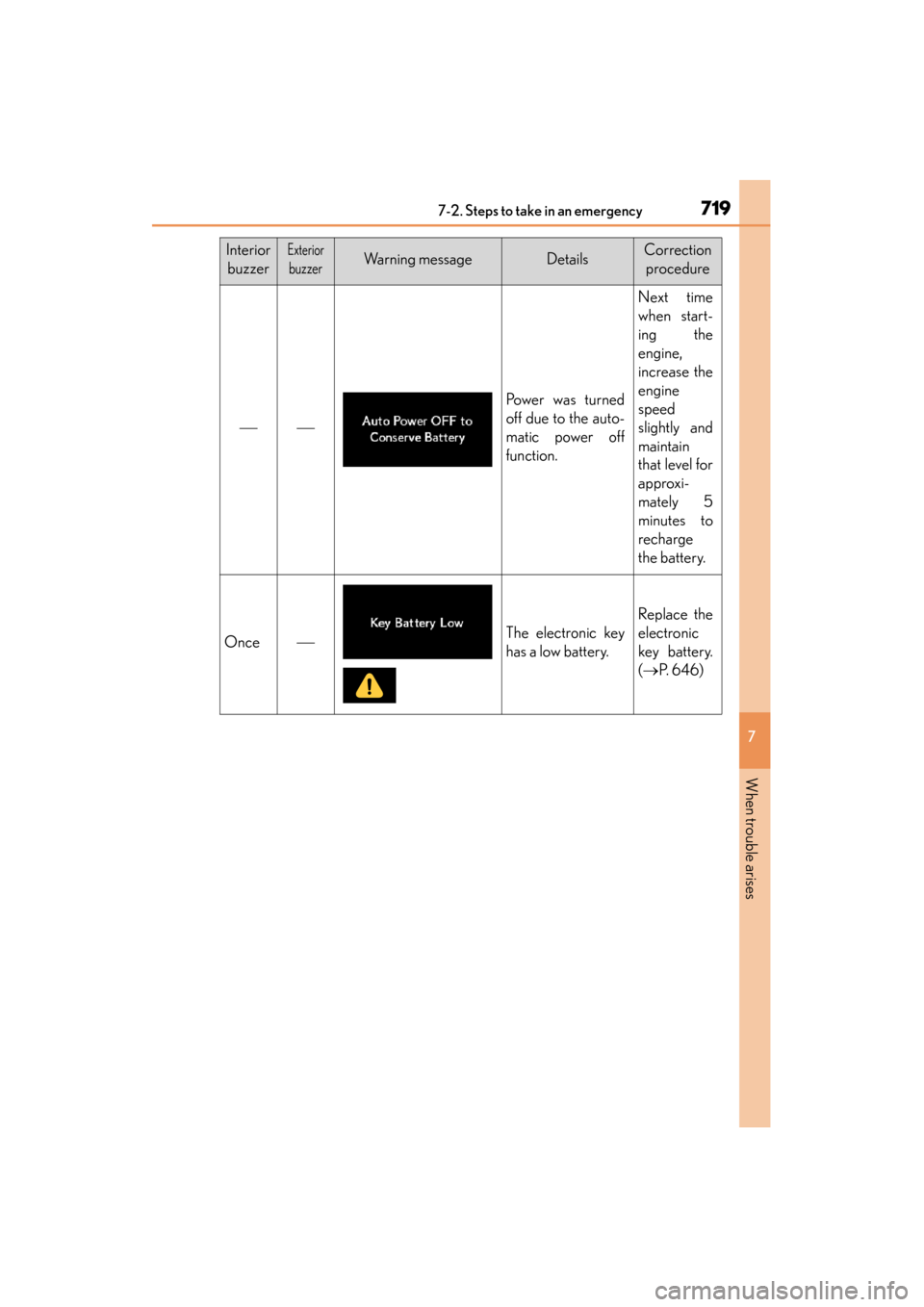
buzzerWarning messageDetailsCorrection procedure
Po we r w a s t u r n e d
off due to the auto-
matic power off
function.
Next time
when start-
ing the
engine,
increase the
engine
speed
slightly and
maintain
that level for
approxi-
mately 5
minutes to
recharge
the battery.
OnceThe electronic key
has a low battery.
Replace the
electronic
key battery.
( → P. 646)
Page 736 of 830
735
GS350_U (OM30C34U)
7
When trouble arises
7-2. Steps to take in an emergency
If the engine will not start
One of the following may be the cause of the problem:
●There may not be sufficient fuel in the vehicle’s tank.
Refuel the vehicle.
●The engine may be flooded.
Try to restart the engine again following correct starting procedures.
(→ P. 1 5 4 )
●There may be a malfunction in the engine immobilizer system.
(→P. 6 8 )
One of the following may be the cause of the problem:
●The battery may be discharged. ( →P. 743)
●The battery terminal connections may be loose or corroded.
The engine starting system may be malfunctioning due to an electrical
problem such as electronic key battery depletion or a blown fuse. How-
ever, an interim measure is available to start the engine. ( →P. 7 3 6 )
If the engine will not start even though correct starting procedures are
being followed ( →P. 154), consider each of the following points:
The engine will not start even though the starter motor operates
normally.
The starter motor turns over slowly, the interior lights and head-
lights are dim, or the horn does not sound or sounds at a low vol-
ume.
The starter motor does not turn over