steering Lexus GS350 2016 Owners Manual
[x] Cancel search | Manufacturer: LEXUS, Model Year: 2016, Model line: GS350, Model: Lexus GS350 2016Pages: 624, PDF Size: 15.29 MB
Page 472 of 624
4727-2. Steps to take in an emergency
GS350_200t_GS F_OM_OM30E86U_(U)
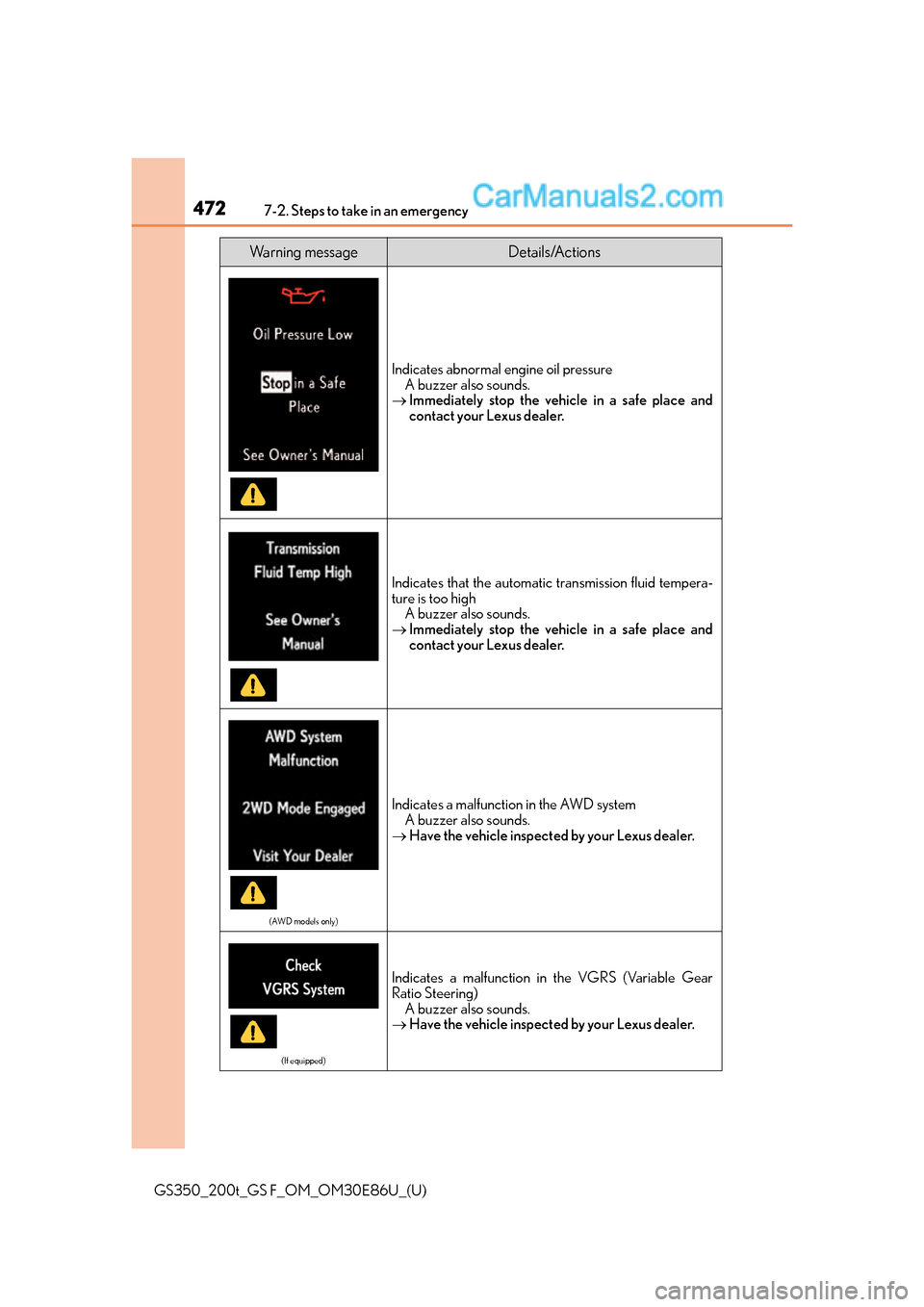
Indicates abnormal engine oil pressureA buzzer also sounds.
Immediately stop the vehicle in a safe place and
contact your Lexus dealer.
Indicates that the automatic transmission fluid tempera-
ture is too high
A buzzer also sounds.
Immediately stop the vehicle in a safe place and
contact your Lexus dealer.
(AWD models only)
Indicates a malfunctio n in the AWD system
A buzzer also sounds.
Have the vehicle inspected by your Lexus dealer.
(If equipped)
Indicates a malfunction in the VGRS (Variable Gear
Ratio Steering)
A buzzer also sounds.
Have the vehicle inspected by your Lexus dealer.
Wa r n i n g m e s s a g eDetails/Actions
Page 473 of 624
4737-2. Steps to take in an emergency
GS350_200t_GS F_OM_OM30E86U_(U)
7
When trouble arises
(If equipped)
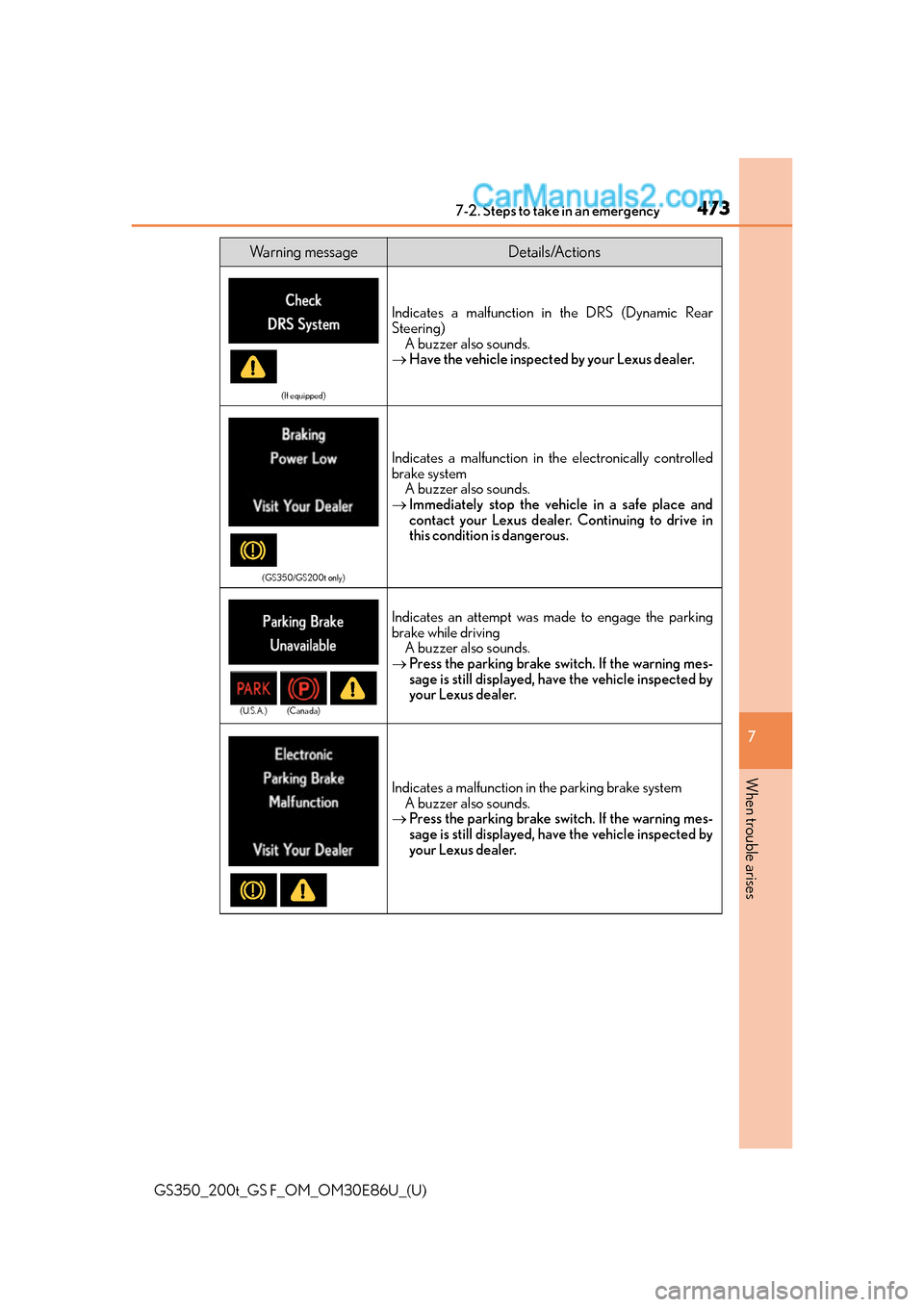
Indicates a malfunction in the DRS (Dynamic Rear
Steering) A buzzer also sounds.
Have the vehicle inspected by your Lexus dealer.
(GS350/GS200t only)
Indicates a malfunction in th e electronically controlled
brake system A buzzer also sounds.
Immediately stop the vehicle in a safe place and
contact your Lexus dealer. Continuing to drive in
this condition is dangerous.
Indicates an attempt was made to engage the parking
brake while driving
A buzzer also sounds.
Press the parking brake switch. If the warning mes-
sage is still displayed, have the vehicle inspected by
your Lexus dealer.
Indicates a malfunction in the parking brake system
A buzzer also sounds.
Press the parking brake switch. If the warning mes-
sage is still displayed, have the vehicle inspected by
your Lexus dealer.
Wa r n i n g m e s s a g eDetails/Actions
(U.S.A.) (Canada)
Page 474 of 624
4747-2. Steps to take in an emergency
GS350_200t_GS F_OM_OM30E86U_(U)
(If equipped)
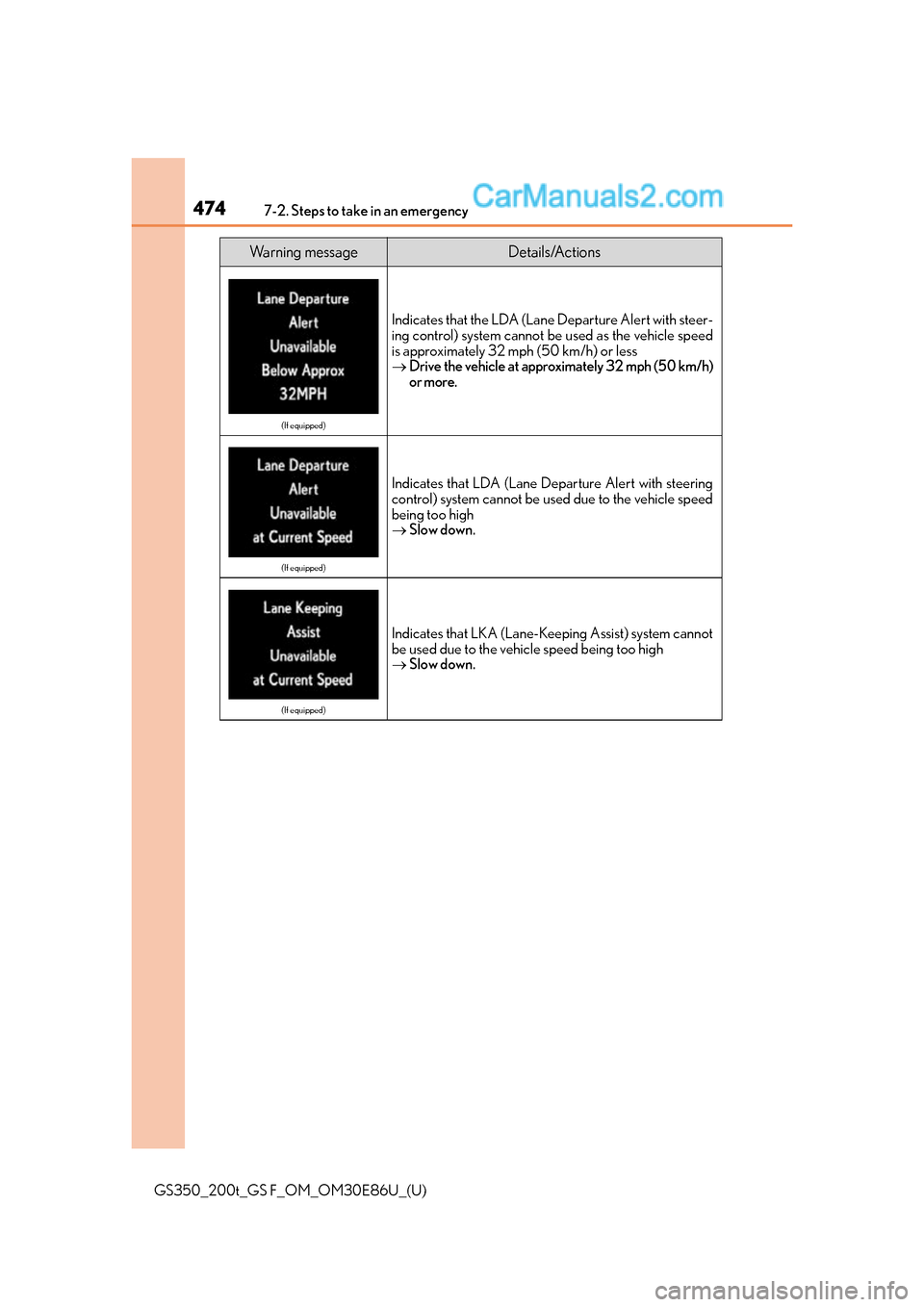
Indicates that the LDA (Lane Departure Alert with steer-
ing control) system cannot be used as the vehicle speed
is approximately 32 mph (50 km/h) or less
Drive the vehicle at approximately 32 mph (50 km/h)
or more.
(If equipped)
Indicates that LDA (Lane Departure Alert with steering
control) system cannot be used due to the vehicle speed
being too high
Slow down.
(If equipped)
Indicates that LKA (Lane-Ke eping Assist) system cannot
be used due to the vehicle speed being too high
Slow down.
Wa r n i n g m e s s a g eDetails/Actions
Page 489 of 624
4897-2. Steps to take in an emergency
GS350_200t_GS F_OM_OM30E86U_(U)
7
When trouble arises
Once
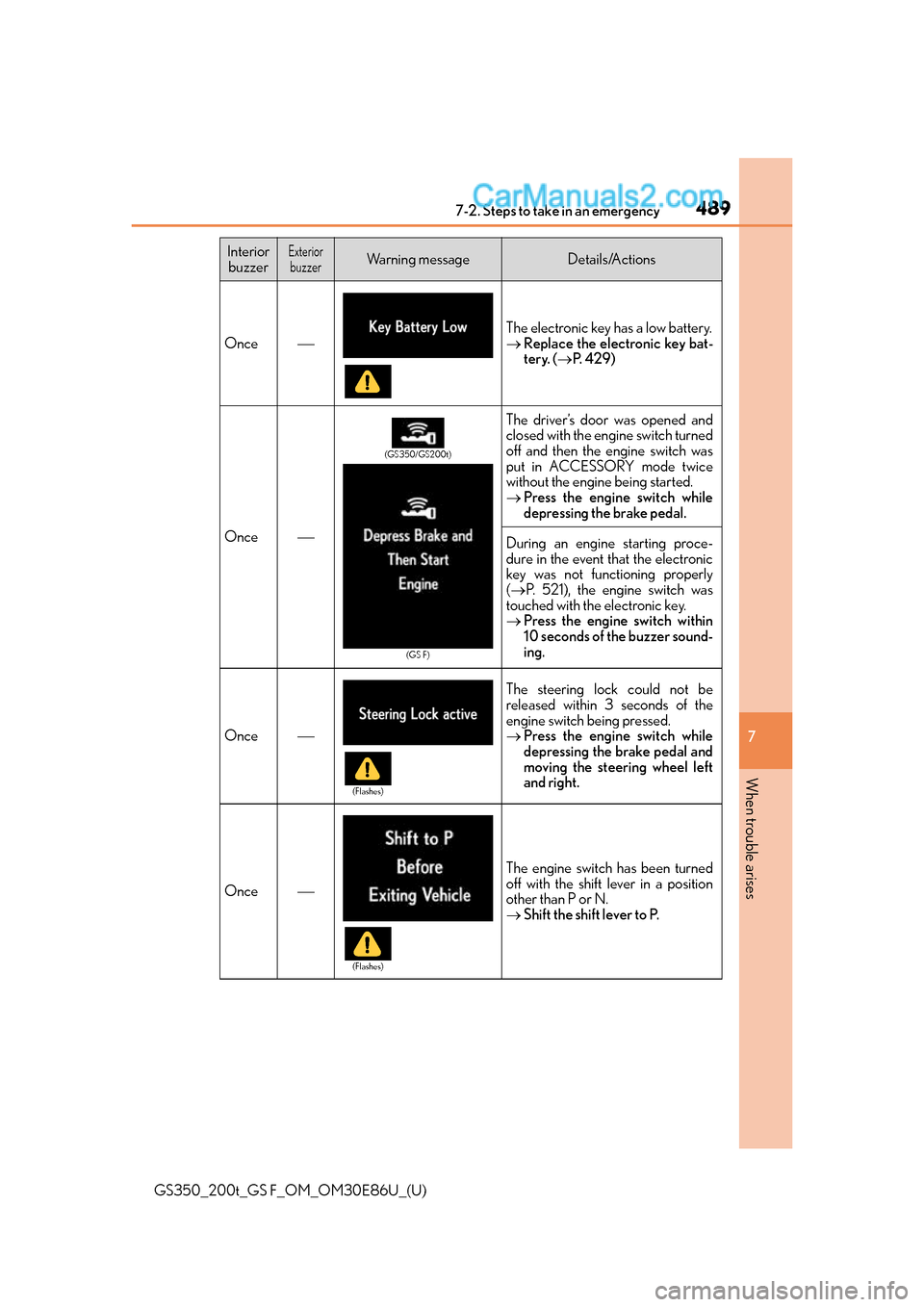
The electronic key has a low battery.
Replace the electronic key bat-
tery. ( P. 4 2 9 )
Once
The driver’s door was opened and
closed with the engine switch turned
off and then the engine switch was
put in ACCESSORY mode twice
without the engine being started.
Press the engine switch while
depressing the brake pedal.
During an engine starting proce-
dure in the event that the electronic
key was not functioning properly
( P. 521), the engine switch was
touched with the electronic key.
Press the engine switch within
10 seconds of the buzzer sound-
ing.
Once
The steering lock could not be
released within 3 seconds of the
engine switch being pressed.
Press the engine switch while
depressing the brake pedal and
moving the steering wheel left
and right.
Once
The engine switch has been turned
off with the shift lever in a position
other than P or N.
Shift the shift lever to P.
Interior
buzzerExteriorbuzzerWa r n i n g m e s s a g eDetails/Actions
(GS350/GS200t)
(GS F)
(Flashes)
(Flashes)
Page 500 of 624
5007-2. Steps to take in an emergency
GS350_200t_GS F_OM_OM30E86U_(U)
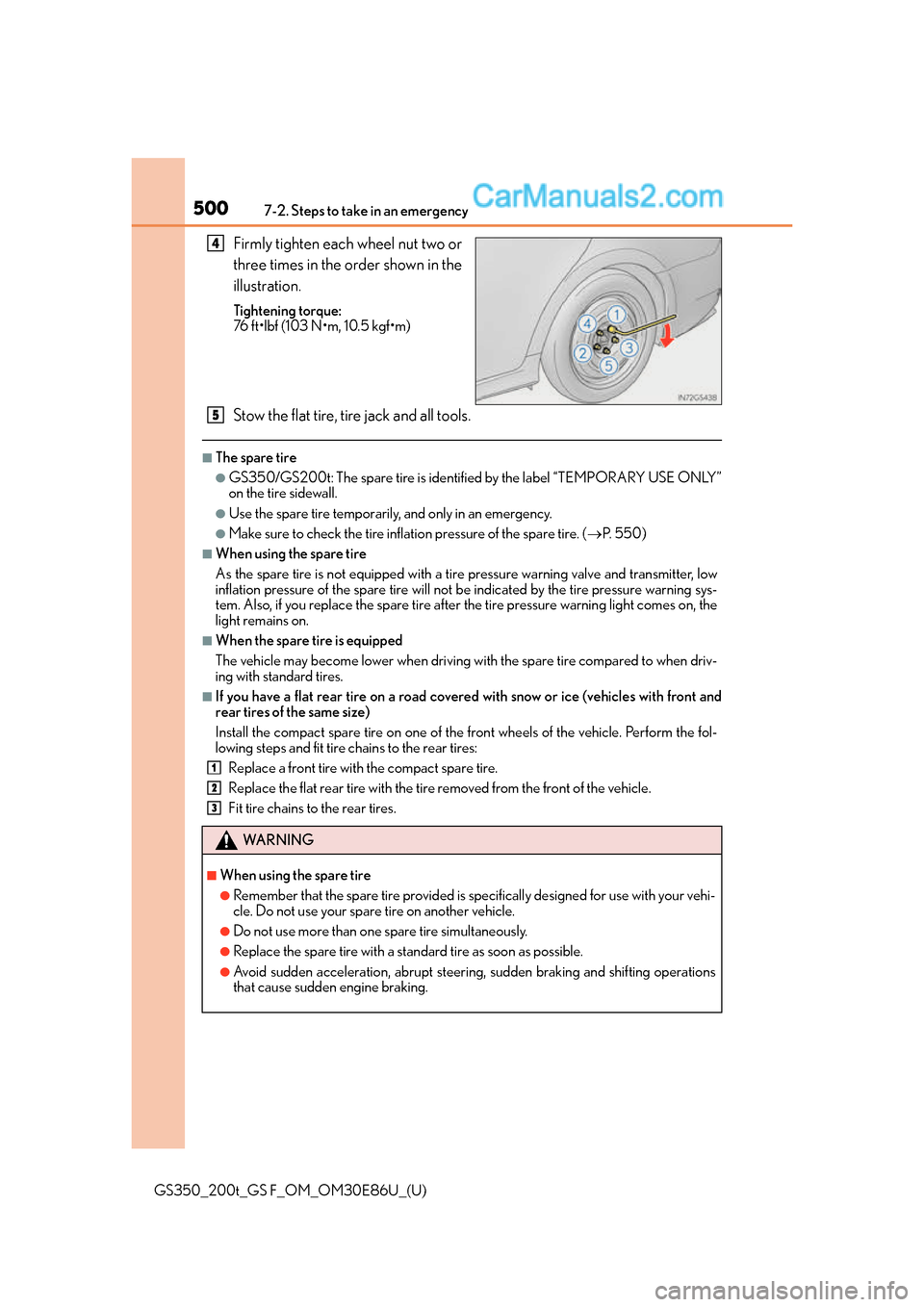
Firmly tighten each wheel nut two or
three times in the order shown in the
illustration.
Tightening torque:
76 ft•lbf (103 N•m, 10.5 kgf•m)
Stow the flat tire, tire jack and all tools.
■The spare tire
●GS350/GS200t: The spare tire is identified by the label “TEMPORARY USE ONLY”
on the tire sidewall.
●Use the spare tire temporarily, and only in an emergency.
●Make sure to check the tire inflation pressure of the spare tire. (P. 5 5 0 )
■When using the spare tire
As the spare tire is not equipped with a tire pressure warning valve and transmitter, low
inflation pressure of the spare tire will not be indicated by the tire pressure warning sys-
tem. Also, if you replace the spare tire after the tire pressure warning light comes on, the
light remains on.
■When the spare tire is equipped
The vehicle may become lower when driving with the spare tire compared to when driv-
ing with standard tires.
■If you have a flat rear tire on a road covered with snow or ice (vehicles with front and
rear tires of the same size)
Install the compact spare tire on one of the front wheels of the vehicle. Perform the fol-
lowing steps and fit tire chains to the rear tires:
Replace a front tire with the compact spare tire.
Replace the flat rear tire with the tire removed from the front of the vehicle.
Fit tire chains to the rear tires.
4
WA R N I N G
■When using the spare tire
●Remember that the spare tire provided is specifically designed for use with your vehi-
cle. Do not use your spare tire on another vehicle.
●Do not use more than one spare tire simultaneously.
●Replace the spare tire with a stan dard tire as soon as possible.
●Avoid sudden acceleration, abrupt steering, sudden braking and shifting operations
that cause sudden engine braking.
5
1
2
3
Page 501 of 624
5017-2. Steps to take in an emergency
GS350_200t_GS F_OM_OM30E86U_(U)
7
When trouble arises
WA R N I N G
■When the spare tire is attached
The vehicle speed may not be correctly detected, and the following systems may not
operate correctly:
Also, not only can the following system not be utilized fully, but it may even negatively
affect the drive-train components:
•AWD system
■Speed limit when using the spare tire
Do not drive at speeds in excess of 50 mp h (80 km/h) when a spare tire is installed on
the vehicle.
The spare tire is not designed for driving at high speeds. Failure to observe this precau-
tion may lead to an accident causing death or serious injury.
■After using the tools and jack
Before driving, make sure all the tools and jack are securely in place in their storage
location to reduce the possibility of personal injury during a collision or sudden brak-
ing.
NOTICE
■Be careful when driving over bumps with the spare tire installed on the vehicle.
The vehicle may become lower when driving with the spare tire compared to when
driving with standard tires. Be careful when driving over uneven road surfaces.
■Driving with tire chains and the spare tire
Do not fit tire chains to the spare tire.
Tire chains may damage the vehicle body and adversely affect driving performance.
■When replacing the tires
When removing or fitting the wheels, tires or the tire pressure warning valve and trans-
mitter, contact your Lexus dealer as the tire pressure warning valve and transmitter
may be damaged if not handled correctly.
• ABS & Brake assist
•VSC
•TRAC
•Cruise control
• Dynamic radar cruise control with
full-speed range (if equipped)
• Dynamic radar cruise control
(if equipped)
• PCS (Pre-Collision System) (if equipped)
•EPS
•AFS (if equipped)
• Adaptive Variable Suspension system (if equipped) • LDA (Lane Departure Alert with
steering control) (if equipped)
• LKA (Lane-Keeping Assist) (if equipped)
• Tire pressure warning system
•VDIM
• Lexus parking assist monitor
• Intuitive parking assist (if equipped)
• Navigation system (if equipped)
• DRS (if equipped)
• VGRS (if equipped)
• LDH (if equipped)
Page 513 of 624
5137-2. Steps to take in an emergency
GS350_200t_GS F_OM_OM30E86U_(U)
7
When trouble arises
WA R N I N G
■Caution while driving
Observe the following precautions.
Failure to do so may cause an accident.
●The emergency tire puncture repair kit is made exclusively for your vehicle. Do not
use it on other vehicles.
●Do not use the emergency tire puncture repair kit for tires that are a different size
than the specified ones or fo r any other purpose. Doing so may cause the tires to not
be repaired properly.
■Precautions for use of the sealant
●Ingesting the sealant is hazardous to your health. If you ingest sealant, consume as
much water as possible, and then immediately consult a doctor.
●If sealant gets in eyes or adheres to skin, immediately wash it off with water. If discom-
fort persists, consult a doctor.
■When fixing the flat tire
●Stop your vehicle in a safe and flat area.
●Do not touch the wheels or the area around the brakes immediately after the vehicle
has been driven.
After the vehicle has been driven, the wheels and the area around the brakes may be
extremely hot. Touching these areas with hands, feet or other body parts may result in
burns.
●Connect the valve and hose securely wi th the tire installed on the vehicle.
●If the hose is not properly connected to the valve, air leakage may occur or sealant
may be sprayed out.
●If the hose comes off the valve while inflating the tire, there is a risk that the hose will
move abruptly due to air pressure.
●After inflation of the tire has completed, the sealant may splatter when the hose is dis-
connected or some air is let out of the tire.
●Follow the operation procedure to repair the tire. If the procedures not followed, the
sealant may spray out.
●Keep back from the tire while it is being re paired, as there is a chance of it bursting
while the repair operation is being perfor med. If you notice any cracks or deforma-
tion of the tire, turn off the compressor sw itch and stop the repair operation immedi-
ately.
●The repair kit may overheat if operated for a long period of time. Do not operate the
repair kit continuously for more than 35 minutes.
●Parts of the repair kit become hot during op eration. Be careful handling the repair kit
during and after operation. Do not touch the metal part connecting the bottle and the
compressor. It will be extremely hot.
●Do not attach the vehicle speed warning sticker to an area other than the one indi-
cated. If the sticker is attached to an area where an SRS airbag is located, such as the
pad of the steering wheel, it may preven t the SRS air bag from operating properly.
Page 514 of 624
5147-2. Steps to take in an emergency
GS350_200t_GS F_OM_OM30E86U_(U)
WA R N I N G
■Driving to spread the liquid sealant evenly
●Drive the vehicle carefully at a low speed. Be especially careful when turning and cor-
nering.
●If the vehicle does not drive straight or you feel a pull through the steering wheel, stop
the vehicle and check the following:
• Tire condition. The tire may have separated from the wheel.
• Tire inflation pressure. If tire inflation pressure is 19 psi (130 kPa, 1.3 kgf/cm
2 or
bar) or less, the tire may be severely damaged.
NOTICE
■When performing an emergency repair
●Perform the emergency repair without removi ng the nail or screw that has punctured
the tread of the tire. If the object that has punctured the tire is removed, repair by the
emergency tire puncture repair kit may not be possible.
●The repair kit is not waterproof. Make sure that the repair kit is not exposed to water,
such as when it is being used in the rain.
●Do not put the repair kit directly onto dusty ground such as sand at the side of the
road. If the repair kit vacuums up dust etc., a malfunction may occur.
■Handling the emergency tire puncture repair kit
●The repair kit power source should be 12 V DC suitable for vehicle use. Do not con-
nect the repair kit to any other source.
●If gasoline splatters on the repair kit, the repair kit may deteriorate. Take care not to
allow gasoline to contact it.
●Store the emergency tire puncture repair kit in the trunk.
The kit may be thrown around during sudden braking and so forth, damaging the kit.
●Store the repair kit in the tr unk out of reach of children.
●Do not disassemble or modify the repair kit. Do not subject parts such as the air pres-
sure indicator to impacts. This may cause a malfunction.
■To avoid damage to the tire pressu re warning valves and transmitters
When a tire is repaired with liquid sealants, the tire pressure warning valve and trans-
mitter may not operate properly. If a liquid se alant is used, contact your Lexus dealer or
other qualified service shop as soon as possible. Make sure to replace the tire pressure
warning valve and transmitter when replacing the tire. ( P. 4 1 4 )
Page 515 of 624
515
GS350_200t_GS F_OM_OM30E86U_(U)
7
When trouble arises
7-2. Steps to take in an emergency
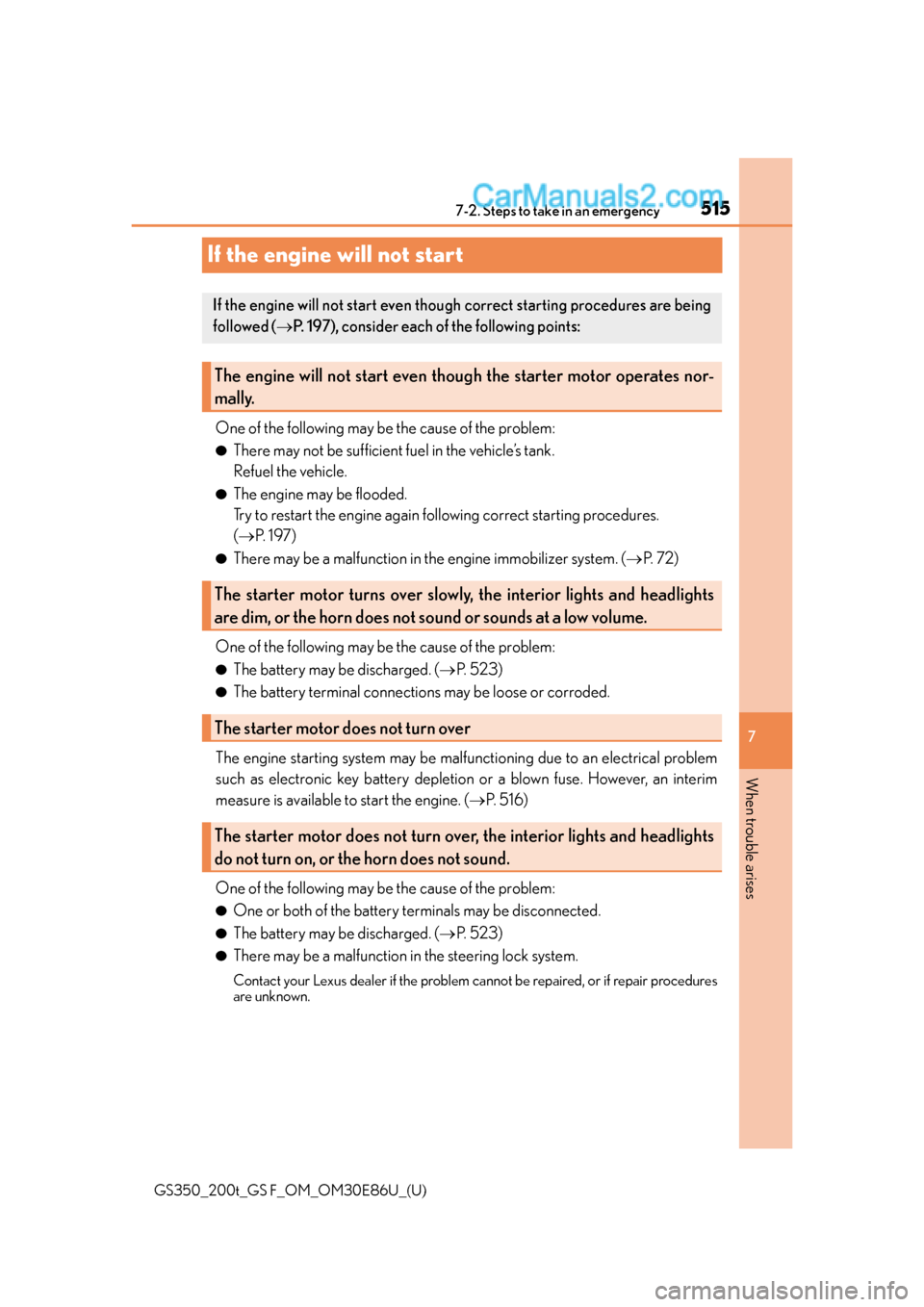
If the engine will not start
One of the following may be the cause of the problem:
●There may not be sufficient fuel in the vehicle’s tank.
Refuel the vehicle.
●The engine may be flooded.
Try to restart the engine again following correct starting procedures.
(P. 1 9 7 )
●There may be a malfunction in the engine immobilizer system. ( P. 7 2 )
One of the following may be the cause of the problem:
●The battery may be discharged. ( P. 5 2 3 )
●The battery terminal connections may be loose or corroded.
The engine starting system may be malfun ctioning due to an electrical problem
such as electronic key battery depletion or a blown fuse. However, an interim
measure is available to start the engine. ( P. 5 1 6 )
One of the following may be the cause of the problem:
●One or both of the battery terminals may be disconnected.
●The battery may be discharged. ( P. 5 2 3 )
●There may be a malfunction in the steering lock system.
Contact your Lexus dealer if the problem cannot be repaired, or if repair procedures
are unknown.
If the engine will not start even though correct starting procedures are being
followed ( P. 197), consider each of the following points:
The engine will not start even thoug h the starter motor operates nor-
mally.
The starter motor turns over slowly , the interior lights and headlights
are dim, or the horn does not sound or sounds at a low volume.
The starter motor does not turn over
The starter motor does not turn over, the interior lights and headlights
do not turn on, or the horn does not sound.
Page 550 of 624
550
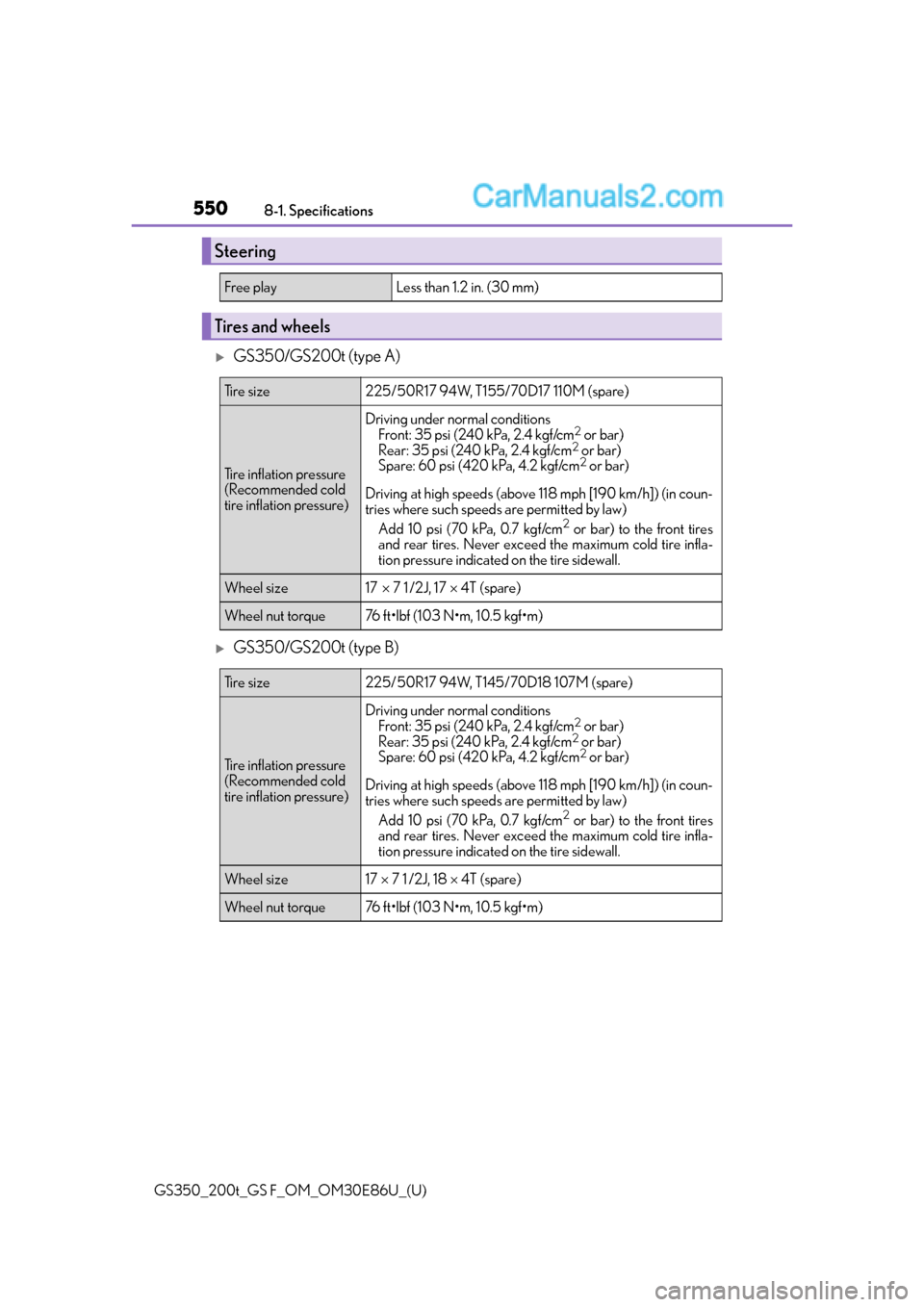
GS350_200t_GS F_OM_OM30E86U_(U)8-1. Specifications
GS350/GS200t (type A)
GS350/GS200t (type B)
Steering
Free playLess than 1.2 in. (30 mm)
Tires and wheels
Ti r e s i z e225/50R17 94W, T155/70D17 110M (spare)
Tire inflation pressure
(Recommended cold
tire inflation pressure)
Driving under normal conditions
Front: 35 psi (240 kPa, 2.4 kgf/cm2 or bar)
Rear: 35 psi (240 kPa, 2.4 kgf/cm2 or bar)
Spare: 60 psi (420 kPa, 4.2 kgf/cm2 or bar)
Driving at high speeds (above 118 mph [190 km/h]) (in coun-
tries where such speeds are permitted by law)
Add 10 psi (70 kPa, 0.7 kgf/cm
2 or bar) to the front tires
and rear tires. Never exceed the maximum cold tire infla-
tion pressure indicated on the tire sidewall.
Wheel size17 7 1 /2J, 17 4T (spare)
Wheel nut torque76 ft•lbf (103 N•m, 10.5 kgf•m)
Ti r e s i z e225/50R17 94W, T145/70D18 107M (spare)
Tire inflation pressure
(Recommended cold
tire inflation pressure)
Driving under normal conditions
Front: 35 psi (240 kPa, 2.4 kgf/cm2 or bar)
Rear: 35 psi (240 kPa, 2.4 kgf/cm2 or bar)
Spare: 60 psi (420 kPa, 4.2 kgf/cm2 or bar)
Driving at high speeds (above 118 mph [190 km/h]) (in coun-
tries where such speeds are permitted by law)
Add 10 psi (70 kPa, 0.7 kgf/cm
2 or bar) to the front tires
and rear tires. Never exceed the maximum cold tire infla-
tion pressure indicated on the tire sidewall.
Wheel size17 7 1 /2J, 18 4T (spare)
Wheel nut torque76 ft•lbf (103 N•m, 10.5 kgf•m)