light Lexus GS350 2016 Owner's Manual
[x] Cancel search | Manufacturer: LEXUS, Model Year: 2016, Model line: GS350, Model: Lexus GS350 2016Pages: 624, PDF Size: 15.29 MB
Page 498 of 624
4987-2. Steps to take in an emergency
GS350_200t_GS F_OM_OM30E86U_(U)
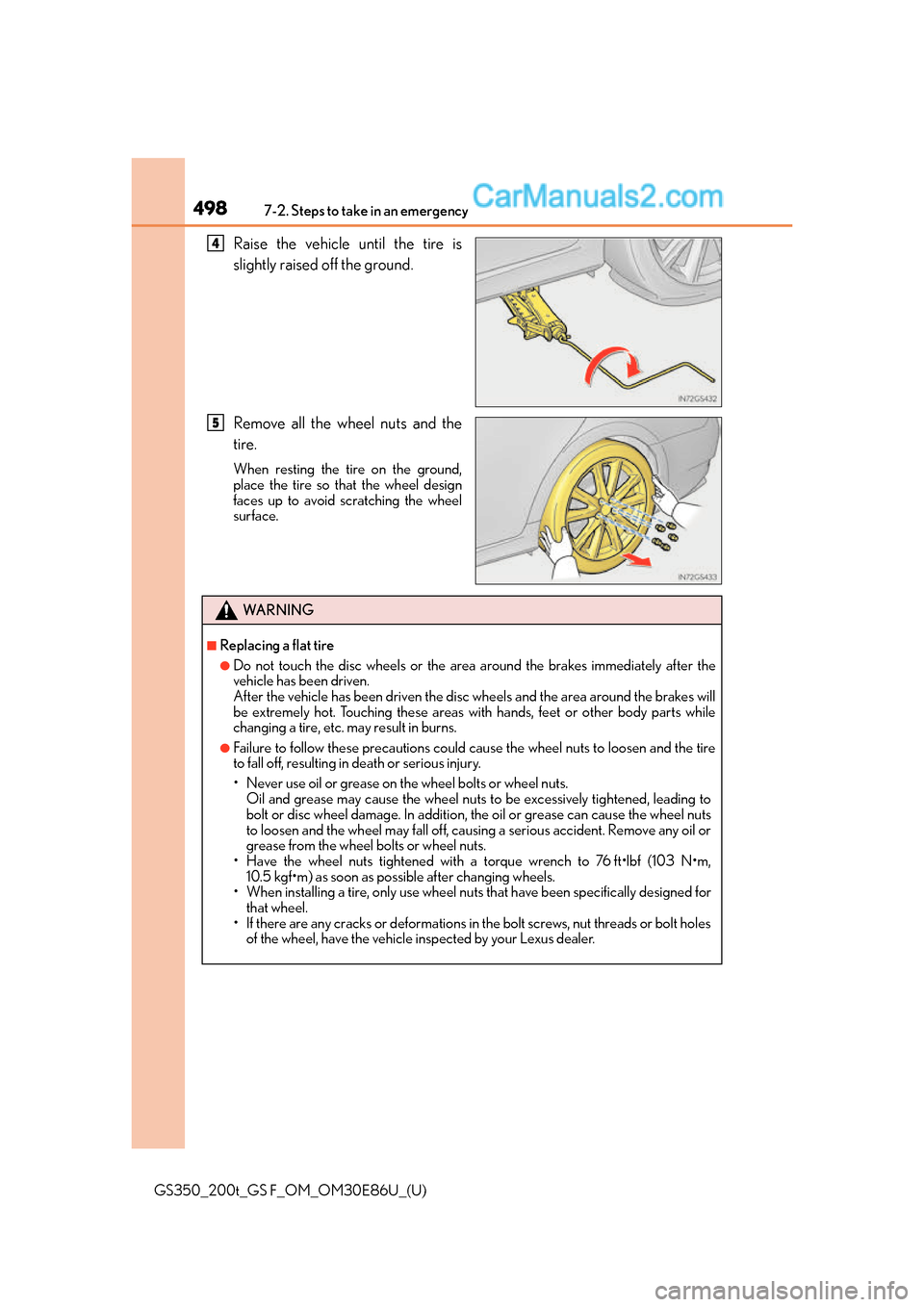
Raise the vehicle until the tire is
slightly raised off the ground.
Remove all the wheel nuts and the
tire.
When resting the tire on the ground,
place the tire so that the wheel design
faces up to avoid scratching the wheel
surface.
4
5
WA R N I N G
■Replacing a flat tire
●Do not touch the disc wheels or the area around the brakes immediately after the
vehicle has been driven.
After the vehicle has been driven the disc wheels and the area around the brakes will
be extremely hot. Touching these areas with hands, feet or other body parts while
changing a tire, etc. may result in burns.
●Failure to follow these precautions could cause the wheel nuts to loosen and the tire
to fall off, resulting in death or serious injury.
• Never use oil or grease on the wheel bolts or wheel nuts.
Oil and grease may cause the wheel nuts to be excessively tightened, leading to
bolt or disc wheel damage. In addition, the oil or grease can cause the wheel nuts
to loosen and the wheel may fall off, caus ing a serious accident. Remove any oil or
grease from the wheel bolts or wheel nuts.
• Have the wheel nuts tightened with a torque wrench to 76 ft•lbf (103 N•m, 10.5 kgf•m) as soon as possible after changing wheels.
• When installing a tire, only use wheel nuts that have been specifically designed for
that wheel.
• If there are any cracks or deformations in the bolt screws, nut threads or bolt holes of the wheel, have the vehicle inspected by your Lexus dealer.
Page 500 of 624
5007-2. Steps to take in an emergency
GS350_200t_GS F_OM_OM30E86U_(U)
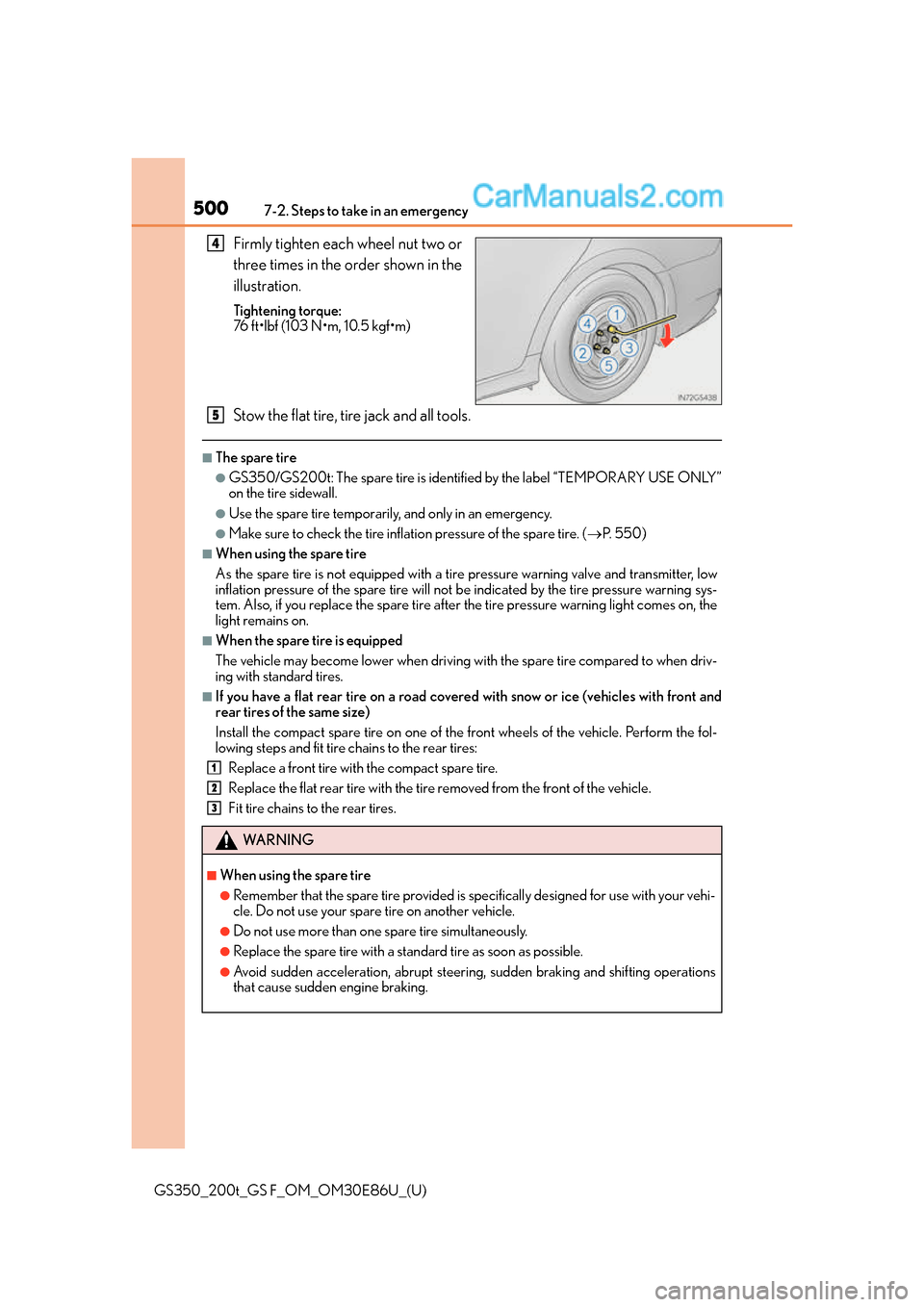
Firmly tighten each wheel nut two or
three times in the order shown in the
illustration.
Tightening torque:
76 ft•lbf (103 N•m, 10.5 kgf•m)
Stow the flat tire, tire jack and all tools.
■The spare tire
●GS350/GS200t: The spare tire is identified by the label “TEMPORARY USE ONLY”
on the tire sidewall.
●Use the spare tire temporarily, and only in an emergency.
●Make sure to check the tire inflation pressure of the spare tire. (P. 5 5 0 )
■When using the spare tire
As the spare tire is not equipped with a tire pressure warning valve and transmitter, low
inflation pressure of the spare tire will not be indicated by the tire pressure warning sys-
tem. Also, if you replace the spare tire after the tire pressure warning light comes on, the
light remains on.
■When the spare tire is equipped
The vehicle may become lower when driving with the spare tire compared to when driv-
ing with standard tires.
■If you have a flat rear tire on a road covered with snow or ice (vehicles with front and
rear tires of the same size)
Install the compact spare tire on one of the front wheels of the vehicle. Perform the fol-
lowing steps and fit tire chains to the rear tires:
Replace a front tire with the compact spare tire.
Replace the flat rear tire with the tire removed from the front of the vehicle.
Fit tire chains to the rear tires.
4
WA R N I N G
■When using the spare tire
●Remember that the spare tire provided is specifically designed for use with your vehi-
cle. Do not use your spare tire on another vehicle.
●Do not use more than one spare tire simultaneously.
●Replace the spare tire with a stan dard tire as soon as possible.
●Avoid sudden acceleration, abrupt steering, sudden braking and shifting operations
that cause sudden engine braking.
5
1
2
3
Page 512 of 624
5127-2. Steps to take in an emergency
GS350_200t_GS F_OM_OM30E86U_(U)
■Emergency tire puncture repair kit
●The sealant has a limited lifespan. The expiry date is shown on the bottle. The sealant
should be replaced before the expiry date. Contact your Lexus dealer for replacement.
●The sealant stored in the emergency tire puncture repair kit can be used only once to
temporarily repair a single tire. If the sealant has been used and need to be purchased,
contact your Lexus dealer.
●The sealant can be used when the outside temperature is from -40 F (-40 C) to
140 F (60 C).
●The repair kit is exclusively designed for size and type of tires originally installed on your
vehicle. Do not use it for tires that a different size than the original ones, or for any other
purposes.
●If the sealant gets on your clothes, it may stain.
●If the sealant adheres to a wheel or the surface of the vehicle body, the stain may not be
removable if it is not cleaned at once. Immediately wipe away the sealant with a wet
cloth.
●During operation of the repair kit, a loud operation noise is produced. This does not
indicate a malfunction.
●Do not use the emergency tire puncture repair kit to check or to adjust the tire pres-
sure.
■If the tire is inflated to more than the recommended level
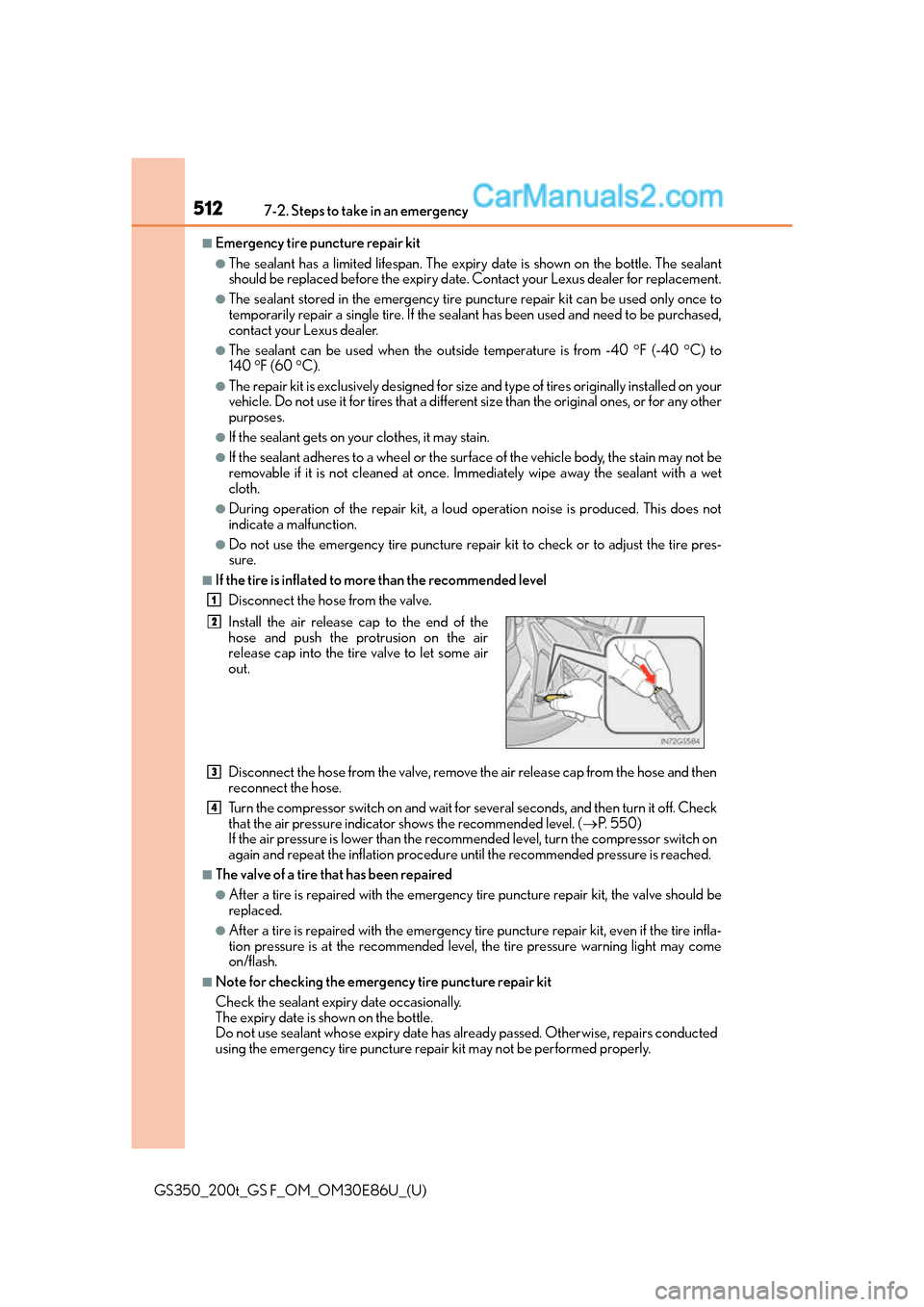
Disconnect the hose from the valve.
Disconnect the hose from the valve, remove the air release cap from the hose and then
reconnect the hose.
Turn the compressor switch on and wait for several seconds, and then turn it off. Check
that the air pressure indicator shows the recommended level. ( P. 5 5 0 )
If the air pressure is lower than the recommended level, turn the compressor switch on
again and repeat the inflation procedure until the recommended pressure is reached.
■The valve of a tire that has been repaired
●After a tire is repaired with the emergency tire puncture repair kit, the valve should be
replaced.
●After a tire is repaired with the emergency tire puncture repair kit, even if the tire infla-
tion pressure is at the recommended level, the tire pressure warning light may come
on/flash.
■Note for checking the emergency tire puncture repair kit
Check the sealant expiry date occasionally.
The expiry date is shown on the bottle.
Do not use sealant whose expiry date has al ready passed. Otherwise, repairs conducted
using the emergency tire puncture repair kit may not be performed properly. Install the air release cap to the end of the
hose and push the protrusion on the air
release cap into the tire valve to let some air
out.
1
2
3
4
Page 515 of 624
515
GS350_200t_GS F_OM_OM30E86U_(U)
7
When trouble arises
7-2. Steps to take in an emergency
If the engine will not start
One of the following may be the cause of the problem:
●There may not be sufficient fuel in the vehicle’s tank.
Refuel the vehicle.
●The engine may be flooded.
Try to restart the engine again following correct starting procedures.
(P. 1 9 7 )
●There may be a malfunction in the engine immobilizer system. ( P. 7 2 )
One of the following may be the cause of the problem:
●The battery may be discharged. ( P. 5 2 3 )
●The battery terminal connections may be loose or corroded.
The engine starting system may be malfun ctioning due to an electrical problem
such as electronic key battery depletion or a blown fuse. However, an interim
measure is available to start the engine. ( P. 5 1 6 )
One of the following may be the cause of the problem:
●One or both of the battery terminals may be disconnected.
●The battery may be discharged. ( P. 5 2 3 )
●There may be a malfunction in the steering lock system.
Contact your Lexus dealer if the problem cannot be repaired, or if repair procedures
are unknown.
If the engine will not start even though correct starting procedures are being
followed ( P. 197), consider each of the following points:
The engine will not start even thoug h the starter motor operates nor-
mally.
The starter motor turns over slowly , the interior lights and headlights
are dim, or the horn does not sound or sounds at a low volume.
The starter motor does not turn over
The starter motor does not turn over, the interior lights and headlights
do not turn on, or the horn does not sound.
Page 525 of 624
5257-2. Steps to take in an emergency
GS350_200t_GS F_OM_OM30E86U_(U)
7
When trouble arises
GS F
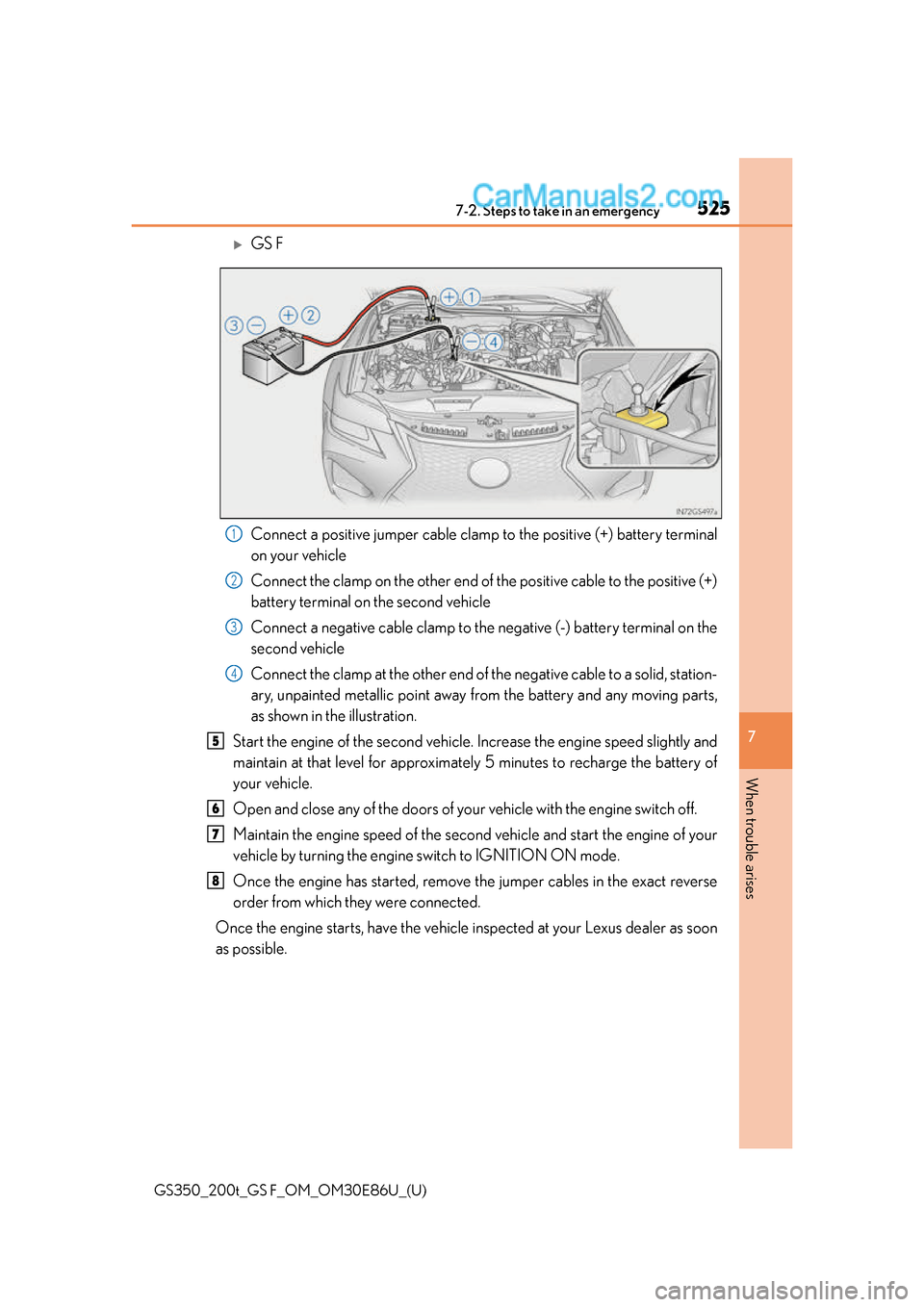
Connect a positive jumper cable clamp to the positive (+) battery terminal
on your vehicle
Connect the clamp on the other end of the positive cable to the positive (+)
battery terminal on the second vehicle
Connect a negative cable clamp to the negative (-) battery terminal on the
second vehicle
Connect the clamp at the other end of the negative cable to a solid, station-
ary, unpainted metallic point away from the battery and any moving parts,
as shown in the illustration.
Start the engine of the second vehicle. Increase the engine speed slightly and
maintain at that level for approximately 5 minutes to recharge the battery of
your vehicle.
Open and close any of the doors of your vehicle with the engine switch off.
Maintain the engine speed of the second vehicle and start the engine of your
vehicle by turning the engine switch to IGNITION ON mode.
Once the engine has started, remove the jumper cables in the exact reverse
order from which they were connected.
Once the engine starts, have the vehicle inspected at your Lexus dealer as soon
as possible.
1
2
3
4
5
6
7
8
Page 526 of 624
5267-2. Steps to take in an emergency
GS350_200t_GS F_OM_OM30E86U_(U)
■Starting the engine when the battery is discharged
The engine cannot be started by push-starting.
■To prevent battery discharge
●Turn off the headlights and the audio system while the engine is off.
●Turn off any unnecessary electrical components when the vehicle is running at a low
speed for an extended period, such as in heavy traffic.
■Charging the battery
The electricity stored in the battery will discharge gradually even when the vehicle is not
in use, due to natural discharge and the draining effects of certain electrical appliances. If
the vehicle is left for a long time, the battery may discharge, and the engine may be
unable to start. (The battery recharges automatically during driving.)
■When recharging or replacing the battery
●In some cases, it may not be possible to unlock the doors using the smart access system
with push-button start when the battery is discharged. Use the wireless remote control
or the mechanical key to lock or unlock the doors.
●The engine may not start on the first attempt after the battery has recharged but will
start normally after the second attempt. This is not a malfunction.
●The engine switch mode is memorized by the vehicle. When the battery is recon-
nected, the system will return to the mode it was in before the battery was discharged.
Before disconnecting the battery, turn the engine switch off.
If you are unsure what mode the engine switch was in before the battery discharged, be
especially careful when reconnecting the battery.
Page 527 of 624
5277-2. Steps to take in an emergency
GS350_200t_GS F_OM_OM30E86U_(U)
7
When trouble arises
WA R N I N G
■Avoiding battery fires or explosions
Observe the following precautions to preven t accidentally igniting the flammable gas
that may be emitted from the battery:
●Make sure each jumper cable is connected to the correct terminal and that it is not
unintentionally in contact with any other than the intended terminal.
●Do not allow the other end of the jumper cable connected to the “+” terminal to come
into contact with any other parts or metal surfaces in the area, such as brackets or
unpainted metal.
●Do not allow the + and - clamps of the jump er cables to come into contact with each
other.
●Do not smoke, use matches, cigarette lighters or allow open flame near the battery.
■Battery precautions
The battery contains poisonous and corrosive acidic electrolyte, while related parts
contain lead and lead comp ounds. Observe the following precautions when handling
the battery:
●When working with the battery, always wear safety glasses and take care not to allow
any battery fluids (acid) to come into contact with skin, clothing or the vehicle body.
●Do not lean over the battery.
●In the event that battery fluid comes into contact with the skin or eyes, immediately
wash the affected area with water and seek medical attention.
Place a wet sponge or cloth over the affected area until medical attention can be
received.
●Always wash your hands after handling the battery support, terminals, and other bat-
tery-related parts.
●Do not allow children near the battery.
NOTICE
■When handling jumper cables
When connecting the jumper cables, ensure th at they do not become entangled in the
cooling fans or engine drive belt.
Page 548 of 624
548
GS350_200t_GS F_OM_OM30E86U_(U)8-1. Specifications
*: The fluid capacity is the quantity of reference.
If replacement is necessary, contact your Lexus dealer.
Electrical system
Battery
Open voltage at 68 F (20 C):12.3 V or higher
(Voltage is checked 20 minutes after the engine
and all lights are turned off.)
Charging rates5 A
Automatic transmission
Fluid capacity*
GS350 (2WD)10.0 qt. (9.5 L, 8.4 Imp.qt.)
GS350 (AWD)10.6 qt. (10.0 L, 8.8 Imp.qt.)
GS200t9. 2 q t . ( 8 .7 L , 7.7 I m p.q t . )
GS F11.8 qt. (11.2 L, 9.9 Imp.qt.)
Fluid typeTo y o t a G e n u i n e AT F W S
NOTICE
■Automatic transmission fluid type
Using transmission fluid other than “Toyota Genuine ATF WS” may cause deterioration
in shift quality, locking up of your transm ission accompanied by vibration, and ulti-
mately damage the transmission of your vehicle.
Front differential (AWD models)
Oil capacity0.74 qt. (0.70 L, 0.62 Imp.qt.)
Oil type and viscosityToyota Genuine Differential gear oil GL-5 or equivalent
Above 0 F (-18 C): SAE90
Below 0 F (-18 C): SAE80W or SAE80W-90
Page 554 of 624
554
GS350_200t_GS F_OM_OM30E86U_(U)8-1. Specifications
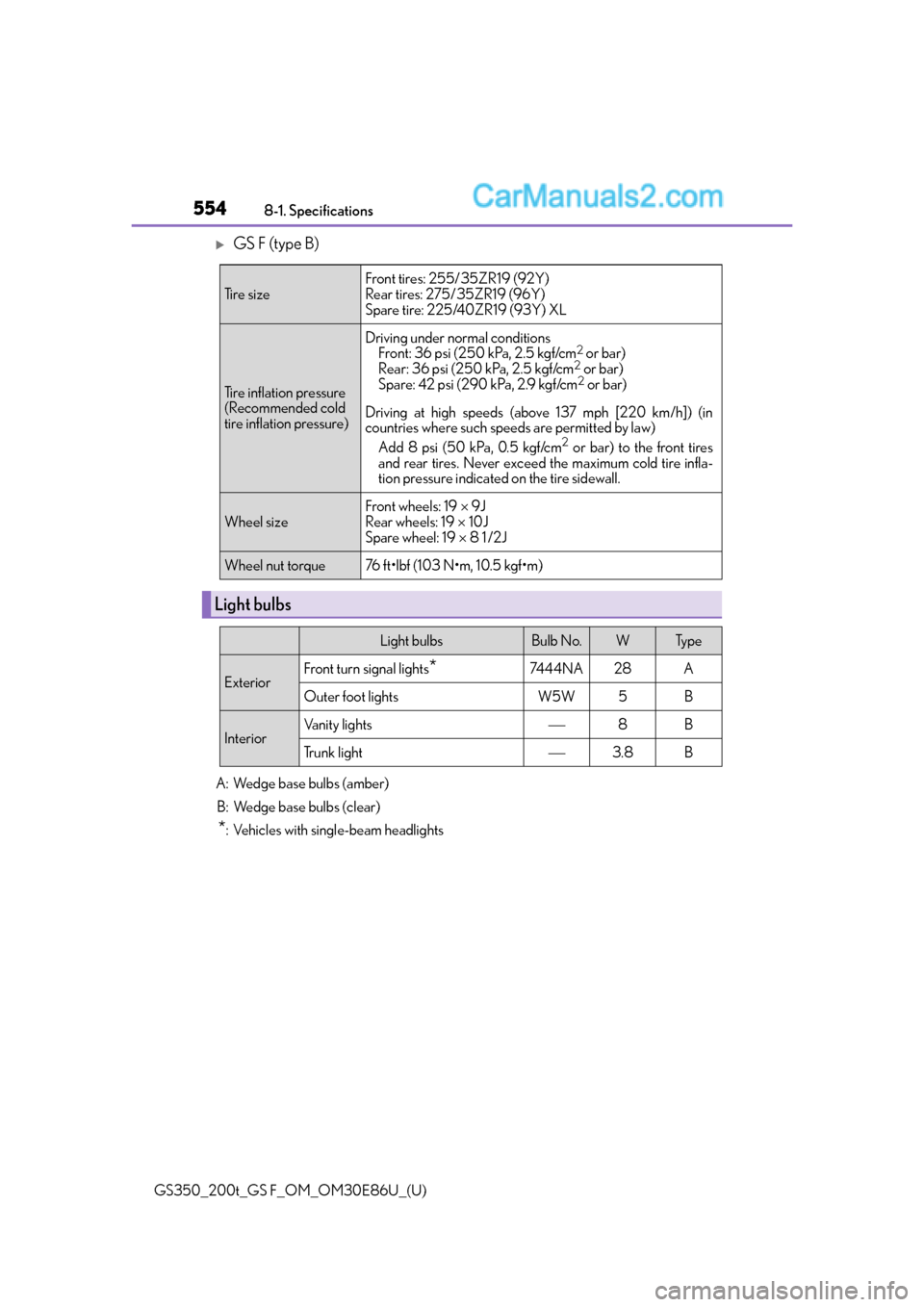
GS F (type B)
Ti r e s i z e
Front tires: 255/ 35ZR19 (92Y)
Rear tires: 275/35ZR19 (96Y)
Spare tire: 225/40ZR19 (93Y) XL
Tire inflation pressure
(Recommended cold
tire inflation pressure)
Driving under normal conditions
Front: 36 psi (250 kPa, 2.5 kgf/cm2 or bar)
Rear: 36 psi (250 kPa, 2.5 kgf/cm2 or bar)
Spare: 42 psi (290 kPa, 2.9 kgf/cm2 or bar)
Driving at high speeds (above 137 mph [220 km/h]) (in
countries where such speeds are permitted by law)
Add 8 psi (50 kPa, 0.5 kgf/cm
2 or bar) to the front tires
and rear tires. Never exceed the maximum cold tire infla-
tion pressure indicated on the tire sidewall.
Wheel sizeFront wheels: 19 9J
Rear wheels: 19 10J
Spare wheel: 19 8 1 /2J
Wheel nut torque76 ft•lbf (103 N•m, 10.5 kgf•m)
Light bulbs
Light bulbsBulb No.WTy p e
ExteriorFront turn signal lights*7444NA28A
Outer foot lightsW5W5B
InteriorVanity lights8B
Trunk light3.8B
A: Wedge base bulbs (amber)
B: Wedge base bulbs (clear)
*: Vehicles with single-beam headlights
Page 556 of 624
556
GS350_200t_GS F_OM_OM30E86U_(U)8-1. Specifications
■Recommendation of the use of gasoli
ne containing detergent additives
●Lexus recommends the use of gasoline that contains detergent additives to avoid the
build-up of engine deposits.
●All gasoline sold in the U.S.A. contains minimum detergent additives to clean and/or
keep clean intake systems, per EPA’s lowest additives concentration program.
●Lexus strongly recommends the use of Top Ti er Detergent Gasoline. For more informa-
tion on Top Tier Detergent Gasoline and a list of marketers, please go to the official
website www.toptiergas.com.
■Recommendation of the use of low emissions gasoline
Gasolines containing oxygenates such as et hers and ethanol, as well as reformulated
gasolines, are available in some cities. These fuels are typically acceptable for use, pro-
viding they meet other fuel requirements.
Lexus recommends these fuels, since the fo rmulations allow for reduced vehicle emis-
sions.
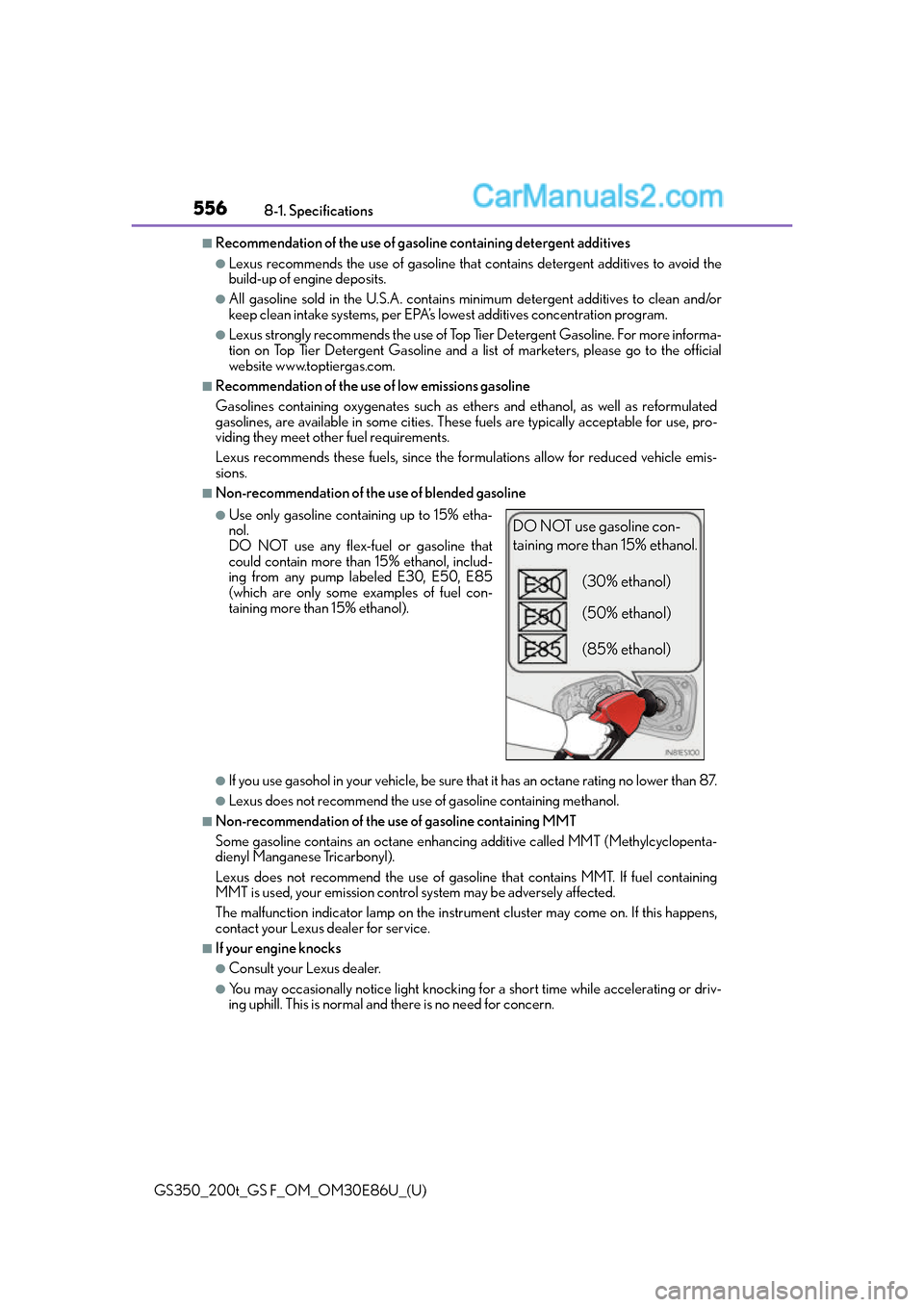
■Non-recommendation of the use of blended gasoline
●If you use gasohol in your vehicle, be sure th at it has an octane rating no lower than 87.
●Lexus does not recommend the use of gasoline containing methanol.
■Non-recommendation of the use of gasoline containing MMT
Some gasoline contains an octane enhancin g additive called MMT (Methylcyclopenta-
dienyl Manganese Tricarbonyl).
Lexus does not recommend the use of gasolin e that contains MMT. If fuel containing
MMT is used, your emission control system may be adversely affected.
The malfunction indicator lamp on the instru ment cluster may come on. If this happens,
contact your Lexus dealer for service.
■If your engine knocks
●Consult your Lexus dealer.
●You may occasionally notice light knocking fo r a short time while accelerating or driv-
ing uphill. This is normal and there is no need for concern.
●Use only gasoline containing up to 15% etha-
nol.
DO NOT use any flex-fuel or gasoline that
could contain more than 15% ethanol, includ-
ing from any pump labeled E30, E50, E85
(which are only some examples of fuel con-
taining more than 15% ethanol).DO NOT use gasoline con-
taining more than 15% ethanol.
(30% ethanol)
(50% ethanol)
(85% ethanol)