seats Lexus GS350 2016 User Guide
[x] Cancel search | Manufacturer: LEXUS, Model Year: 2016, Model line: GS350, Model: Lexus GS350 2016Pages: 624, PDF Size: 15.29 MB
Page 51 of 624
511-1. For safe use
GS350_200t_GS F_OM_OM30E86U_(U)
1
For safety and security
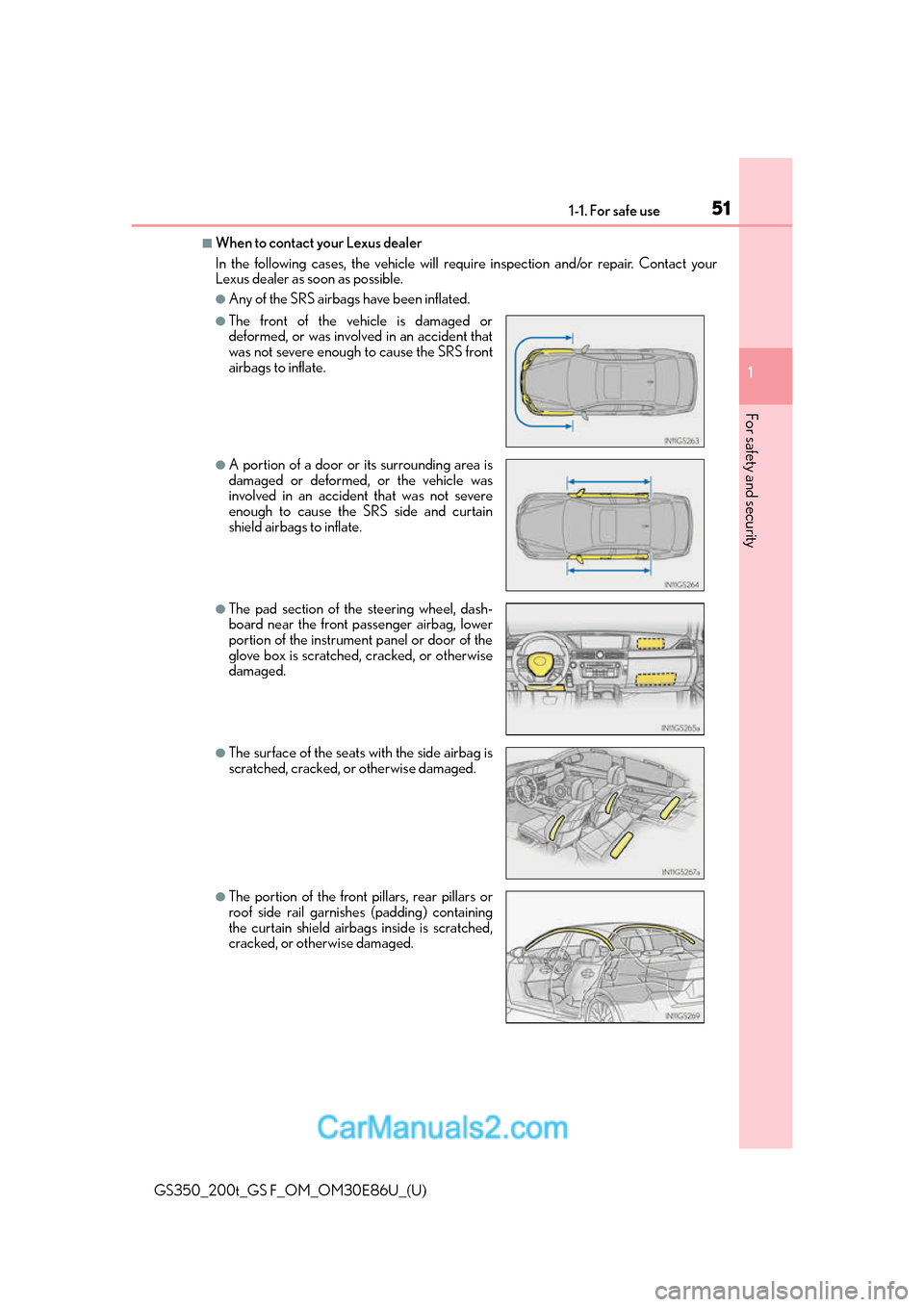
■When to contact your Lexus dealer
In the following cases, the vehicle will re quire inspection and/or repair. Contact your
Lexus dealer as soon as possible.
●Any of the SRS airbags have been inflated.
●The front of the vehicle is damaged or
deformed, or was involv ed in an accident that
was not severe enough to cause the SRS front
airbags to inflate.
●A portion of a door or its surrounding area is
damaged or deformed, or the vehicle was
involved in an accident that was not severe
enough to cause the SRS side and curtain
shield airbags to inflate.
●The pad section of the steering wheel, dash-
board near the front passenger airbag, lower
portion of the instrument panel or door of the
glove box is scratched, cracked, or otherwise
damaged.
●The surface of the seats with the side airbag is
scratched, cracked, or otherwise damaged.
●The portion of the front pillars, rear pillars or
roof side rail garnishes (padding) containing
the curtain shield airbag s inside is scratched,
cracked, or otherwise damaged.
Page 56 of 624
561-1. For safe use
GS350_200t_GS F_OM_OM30E86U_(U)
WA R N I N G
■Front passenger occupant classification system precautions
Observe the following precautions regarding the front passenger occupant classifica-
tion system.
Failure to do so may cause death or serious injury.
●Wear the seat belt properly.
●Make sure the front passenger’s seat belt plate has not been left inserted into the
buckle before someone sits in the front passenger seat.
●Make sure the “AIR BAG OFF” indicator li ght is not illuminated when using the seat
belt extender for the front passenger seat. If the “AIR BAG OFF” indicator light is illu-
minated, disconnect the extender tongue from the seat belt buckle, and reconnect
the seat belt. Reconnect the seat belt extender after making sure the “AIR BAG ON”
indicator light is illuminated. If you use th e seat belt extender while the “AIR BAG
OFF” indicator light is illumi nated, the SRS airbags for the front passenger will not
activate, which could cause death or serious injury in the event of a collision.
●Do not apply a heavy load to the front pa ssenger seat or equipment (e.g. seatback
pockets).
●Do not put weight on the front passenger se at by putting your hands or feet on the
front passenger seat seatback from the rear passenger seat.
●Do not let a rear passenger lift the front passenger seat with their feet or press on the
seatback with their legs.
●Do not put objects under the front passenger seat.
●Do not recline the front passenger seatback so far that it touches a rear seat. This may
cause the “AIR BAG OFF” indicator light to be illuminated, which indicates that the
SRS airbags for the front passenger will not activate in the event of a severe accident.
If the seatback touches the rear seat, return the seatback to a position where it does
not touch the rear seat. Keep the front pa ssenger seatback as upright as possible
when the vehicle is moving. Reclining the seatback excessively may lessen the effec-
tiveness of the seat belt system.
●If an adult sits in the front passenger seat , the “AIR BAG ON” indicator light is illumi-
nated. If the “AIR BAG OFF” indicator is illuminated, ask the passenger to sit up
straight, well back in the seat, feet on the floor, and with the seat belt worn correctly. If
the “AIR BAG OFF” indicator still remains illuminated, either ask the passenger to
move to the rear seat, or if that is not possible, move the front passenger seat fully
rearward.
●When it is unavoidable to install a forward- facing child restraint system on the front
passenger seat, install the child restraint sy stem on the front passenger seat in the
proper order. ( P. 6 3 )
●Do not modify or remove the front seats.
●Do not kick the front passenger seat or subj ect it to severe impact. Otherwise, the
SRS warning light may come on to indicat e a malfunction of the front passenger
occupant classification system. In this ca se, contact your Lexus dealer immediately.
Page 58 of 624
581-1. For safe use
GS350_200t_GS F_OM_OM30E86U_(U)
Safety information for children
●It is recommended that children sit in the rear seats to avoid accidental con-
tact with the shift lever, wiper switch etc.
●Use the rear door child-protector lock or the window lock switch to avoid
children opening the door while driving or operating the power window acci-
dentally. ( P. 140, 175)
●Do not let small children operate equi pment which may catch or pinch body
parts, such as the power window, hood, trunk, seats etc.
Observe the following precautions when children are in the vehicle.
Use a child restraint system appropriate for the child, until the child becomes
large enough to properly wear the vehicle’s seat belt.
WA R N I N G
Never leave children unattended in the vehicle, and never allow children to have or use
the key.
Children may be able to start the vehicle or sh ift the vehicle into neutral. There is also a
danger that children may injure themselves by playing with the windows, the moon roof
or other features of the vehicle. In additi on, heat build-up or extremely cold tempera-
tures inside the vehicle can be fatal to children.
Page 63 of 624
631-1. For safe use
GS350_200t_GS F_OM_OM30E86U_(U)
1
For safety and security
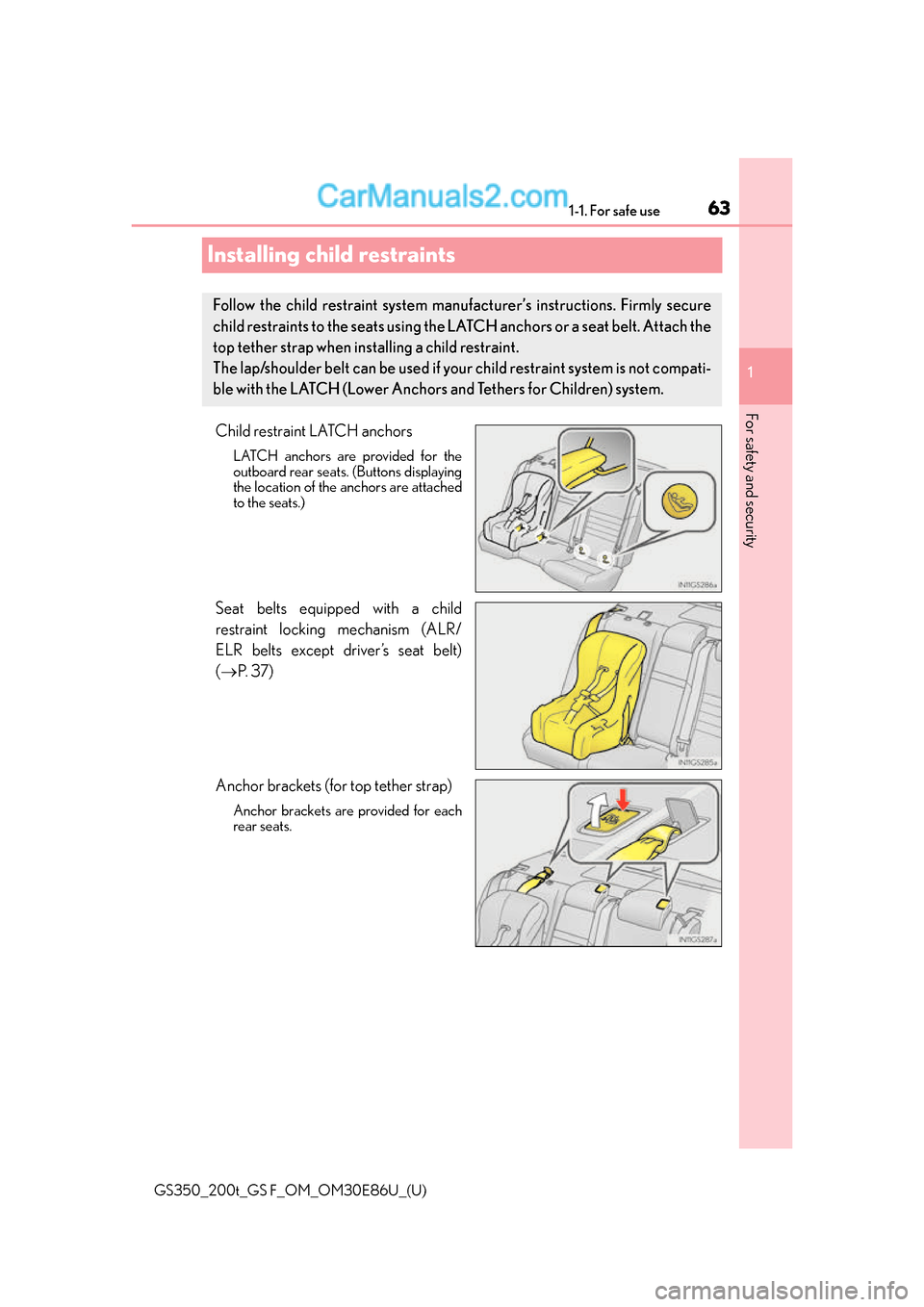
Installing child restraints
Child restraint LATCH anchors
LATCH anchors are provided for the
outboard rear seats. (Buttons displaying
the location of the anchors are attached
to the seats.)
Seat belts equipped with a child
restraint locking mechanism (ALR/
ELR belts except driver’s seat belt)
( P. 3 7 )
Anchor brackets (for top tether strap)
Anchor brackets are provided for each
rear seats.
Follow the child restraint system manu facturer’s instructions. Firmly secure
child restraints to the seat s using the LATCH anchors or a seat belt. Attach the
top tether strap when installing a child restraint.
The lap/shoulder belt can be used if yo ur child restraint system is not compati-
ble with the LATCH (Lower Anchor s and Tethers for Children) system.
Page 66 of 624
661-1. For safe use
GS350_200t_GS F_OM_OM30E86U_(U)
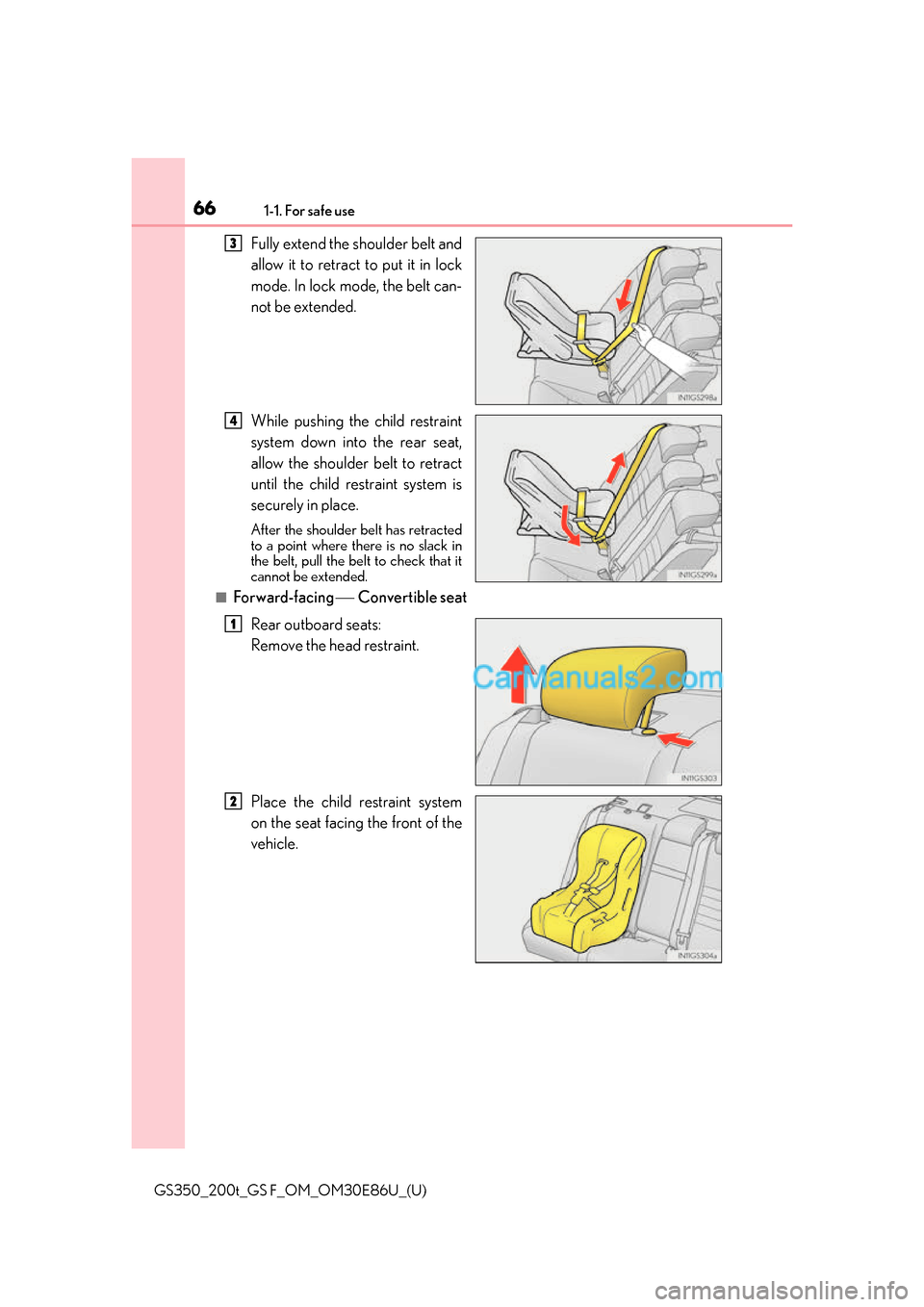
Fully extend the shoulder belt and
allow it to retract to put it in lock
mode. In lock mode, the belt can-
not be extended.
While pushing the child restraint
system down into the rear seat,
allow the shoulder belt to retract
until the child restraint system is
securely in place.
After the shoulder belt has retracted
to a point where there is no slack in
the belt, pull the belt to check that it
cannot be extended.
■For ward-facing Convertible seat
Rear outboard seats:
Remove the head restraint.
Place the child restraint system
on the seat facing the front of the
vehicle.
3
4
1
2
Page 68 of 624
681-1. For safe use
GS350_200t_GS F_OM_OM30E86U_(U)
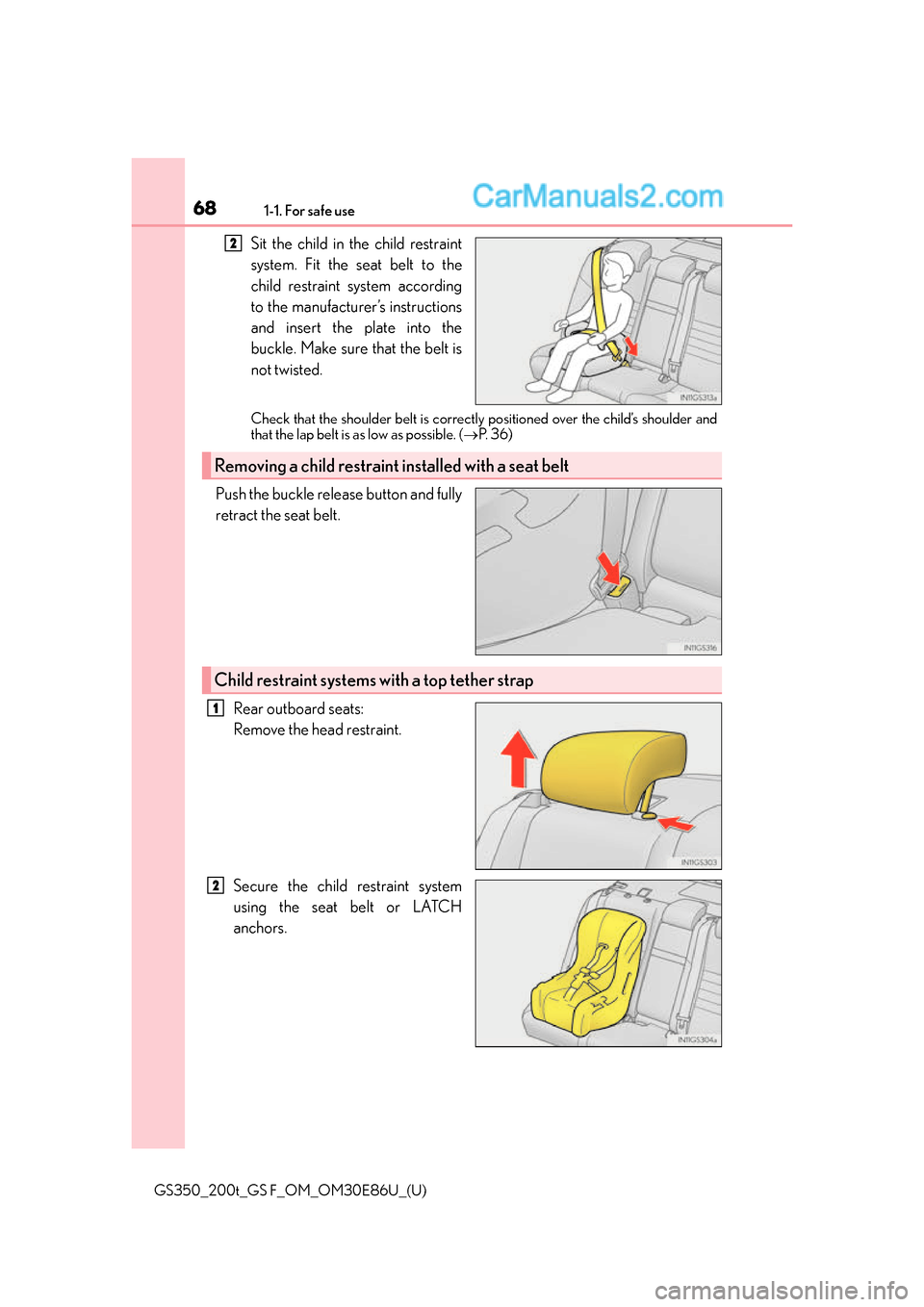
Sit the child in the child restraint
system. Fit the seat belt to the
child restraint system according
to the manufacturer’s instructions
and insert the plate into the
buckle. Make sure that the belt is
not twisted.
Check that the shoulder belt is correctly positioned over the child’s shoulder and
that the lap belt is as low as possible. ( P. 3 6 )
Push the buckle release button and fully
retract the seat belt.
Rear outboard seats:
Remove the head restraint.
Secure the child restraint system
using the seat belt or LATCH
anchors.
2
Removing a child restraint installed with a seat belt
Child restraint systems with a top tether strap
1
2
Page 131 of 624
131
GS350_200t_GS F_OM_OM30E86U_(U)
3
Operation of
each component
3-1. Key information
Keys .................................................. 132
3-2. Opening, closing and locking the doors and trunk
Doors ................................................ 137
Trunk ................................................. 143
Smart access system with push-button start ............ 150
3-3. Adjusting the seats Front seats ...................................... 158
Driving position memory ......... 160
Head restraints ............................ 165
3-4. Adjusting the steering wheel and mirrors
Steering wheel ............................. 168
Inside rear view mirror...............169
Outside rear view mirrors ......... 171
3-5. Opening, closing the windows and moon roof
Power windows .............................175
Moon roof .......................................178
Page 142 of 624
142
GS350_200t_GS F_OM_OM30E86U_(U)3-2. Opening, closing and
locking the doors and trunk
WA R N I N G
■To prevent an accident
Observe the following precautions while driving the vehicle.
Failure to do so may result in a door openin g and an occupant throwing out of the vehi-
cle, resulting in death or serious injury.
●Ensure that all doors are properly closed and locked.
●Do not pull the inside handle of the doors while driving.
Be especially careful for the front doors, as the doors may be opened even if the
inside lock buttons ar e in locked position.
●Set the rear door child-protector locks when children are seated in the rear seats.
Page 158 of 624
158
GS350_200t_GS F_OM_OM30E86U_(U)3-3. Adjusting the seats
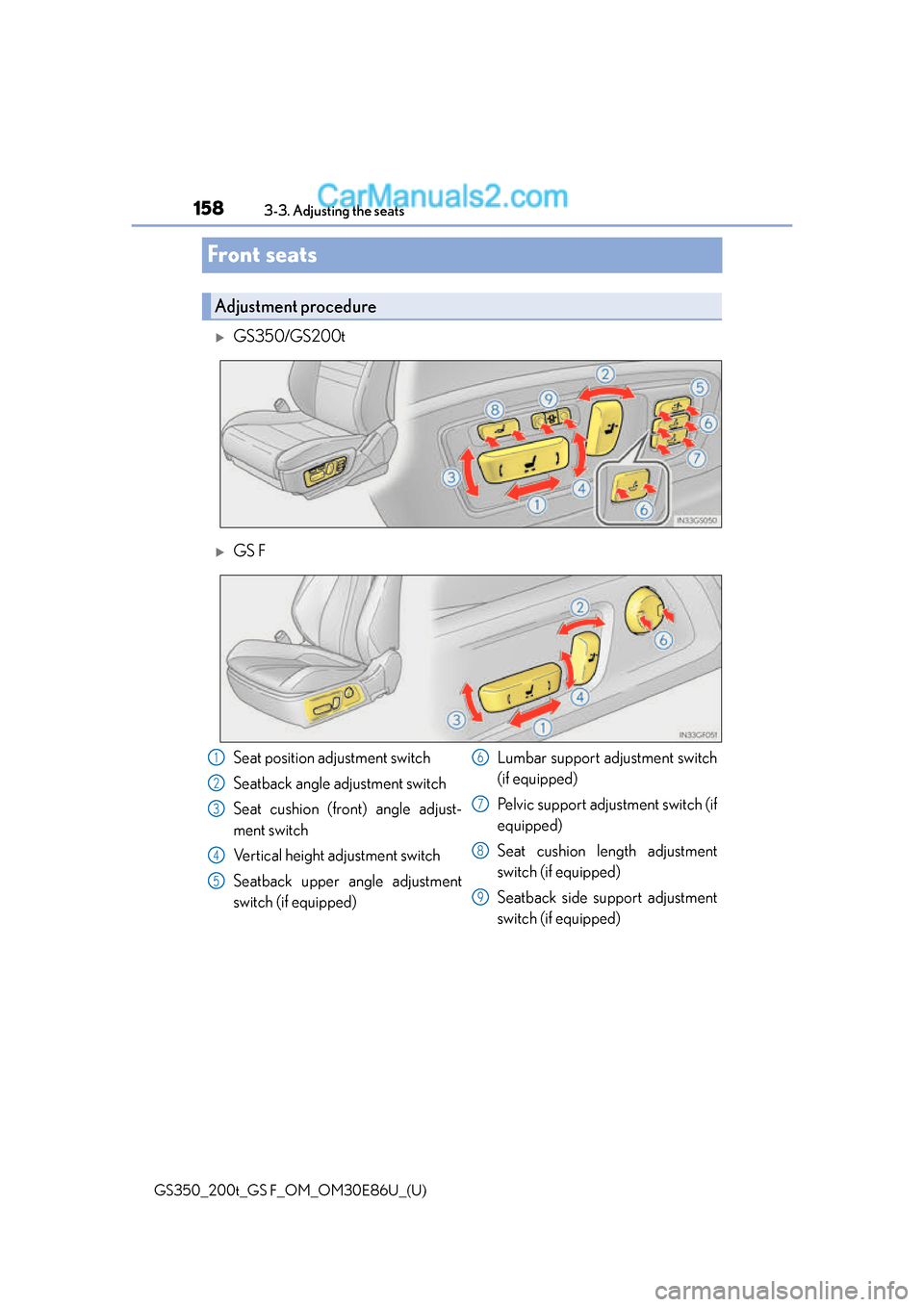
Front seats
GS350/GS200t
GS F
Adjustment procedure
Seat position adjustment switch
Seatback angle adjustment switch
Seat cushion (front) angle adjust-
ment switch
Vertical height adjustment switch
Seatback upper angle adjustment
switch (if equipped)
Lumbar support adjustment switch
(if equipped)
Pelvic support adjustment switch (if
equipped)
Seat cushion length adjustment
switch (if equipped)
Seatback side support adjustment
switch (if equipped)1
2
3
4
5
6
7
8
9
Page 159 of 624
GS350_200t_GS F_OM_OM30E86U_(U)
1593-3. Adjusting the seats
3
Operation of each component
■When adjusting the seat
Take care when adjusting the seat so that the head restraint does not touch the ceiling.
■Power easy access system
The driver’s seat and steering wheel move in accordance with engine switch mode and
the driver’s seat belt condition. The passenger’s seat moves when the passenger’s door is
opened. ( P. 1 6 0 )
WA R N I N G
■When adjusting the seat position
●Take care when adjusting the seat position to ensure that other passengers are not
injured by the moving seat.
●Do not put your hands under the seat or near the moving parts to avoid injury.
Fingers or hands may become jammed in the se at mechanism.
●Make sure to leave enough space around the feet so they do not get stuck.
■Seat adjustment
To reduce the risk of sliding under the lap belt during a collision, do not recline the seat
more than necessary.
If the seat is too rec lined, the lap belt may slide past the hips and apply restraint forces
directly to the abdomen, or your neck may contact the shoulder belt, increasing the risk
of death or serious injury in the event of an accident.
Adjustments should not be ma de while driving as the seat may unexpectedly move and
cause the driver to lose control of the vehicle.