weight Lexus GS350 2016 User Guide
[x] Cancel search | Manufacturer: LEXUS, Model Year: 2016, Model line: GS350, Model: Lexus GS350 2016Pages: 624, PDF Size: 15.29 MB
Page 424 of 624
424
GS350_200t_GS F_OM_OM30E86U_(U)6-3. Do-it-yourself maintenance
■Instructions for checking tire inflation pressure
When checking tire inflation pressure, observe the following:
●Check only when the tires are cold.
If your vehicle has been parked for at least 3 hours or has not been driven for more than
1 mile or 1.5 km, you will get an accurate cold tire inflation pressure reading.
●Always use a tire pressure gauge.
It is difficult to judge if a tire is prop
erly inflated based only on its appearance.
●It is normal for the tire inflation pressure to be higher after driving as heat is generated
in the tire. Do not reduce tire inflation pressure after driving.
●Never exceed the vehicle capacity weight.
Passengers and luggage weight should be placed so that the vehicle is balanced.
WA R N I N G
■Proper inflation is critical to save tire performance
Keep your tires properly inflated.
If the tires are not properly inflated, the following conditions may occur which could
lead to an accident resulting in death or serious injury:
●Excessive wear
●Uneven wear
●Poor handling
●Possibility of blowouts result ing from overheated tires
●Air leaking from between tire and wheel
●Wheel deformation and/or tire damage
●Greater possibility of tire damage while driving (due to road hazards, expansion
joints, sharp edges in the road, etc.)
NOTICE
■When inspecting and adjust ing tire inflation pressure
Be sure to put the tire valve caps back on.
If a valve cap is not installed, dirt or moisture may get into the valve and cause an air
leak, resulting in decreased tire inflation pressure.
Page 425 of 624
425
GS350_200t_GS F_OM_OM30E86U_(U)6-3. Do-it-yourself maintenance
6
Maintenance and care
Wheels
When replacing wheels, care should be taken to ensure that they are equivalent
to those removed in load capacity
, diameter, rim width and inset
*.
Replacement wheels are available at your Lexus dealer.
*: Conventionally referred to as “offset”.
Lexus does not recommend using the following:
●Wheels of different sizes or types
●Used wheels
●Bent wheels that have been straightened
●Steel wheels (2WD F SPORT models only)
●Use only Lexus wheel nuts and wrenches designed for use with your alumi-
num wheels.
●When rotating, repairing or changing your tires, check that the wheel nuts are
still tight after driving 1000 miles (1600 km).
●Be careful not to damage the aluminum wheels when using tire chains.
●Use only Lexus genuine balance weights or equivalent and a plastic or rubber
hammer when balancing your wheels.
■When replacing wheels
The wheels of your vehicle are equipped with tire pressure warning valves and transmit-
ters that allow the tire pressure warning system to provide advance warning in the event
of a loss in tire inflation pressure. Whenever wheels are replaced, tire pressure warning
valves and transmitters must be installed. ( P. 4 1 4 )
If a wheel is bent, cracked or heavily corroded, it should be replaced. Other-
wise, the tire may separate from the wheel or cause a loss of handling control.
Wheel selection
Aluminum wheel precautions
Page 538 of 624
538
GS350_200t_GS F_OM_OM30E86U_(U)8-1. Specifications
Maintenance data (fuel, oil level, etc.)
GS350/GS200t
*1: Unladen vehicle
*2: Vehicles with 265/35R19 tires
GS F
*: Unladen vehicle
Dimensions and weight
Overall length190.9 in. (4850 mm)
Overall width72.4 in. (1840 mm)
Overall height*12WD57.3 in. (1455 mm)
AW D57.9 in. (1470 mm)
Wheelbase112.2 in. (2850 mm)
Tr e a d*1
Front62.0 in. (1575 mm)
Rear62.6 in. (1590 mm)
61.4 in. (1560 mm)
*2
Vehicle capacity weight
(Occupants + luggage)825 lb. (370 kg)
Overall length193.5 in. (4915 mm)
Overall width72.6 in. (1845 mm)
Overall height*56.7 in. (1440 mm)
Wheelbase112.2 in. (2850 mm)
Tr e a d*Front61.2 in. (1555 mm)
Rear61.4 in. (1560 mm)
Vehicle capacity weight
(Occupants + luggage)865 lb. (390 kg)
Page 563 of 624
GS350_200t_GS F_OM_OM30E86U_(U)
5638-1. Specifications
8
Vehicle specifications
■Temperature A, B, C
The temperature grades are A (the highest), B, and C, representing the tire’s
resistance to the generation of heat and its ability to dissipate heat when
tested under controlled conditions on a specified indoor laboratory test
wheel.
Sustained high temperature can cause the material of the tire to degenerate and
reduce tire life, and excessive temperature can lead to sudden tire failure.
Grade C corresponds to a level of perfor mance which all passenger car tires must
meet under the Federal Motor Vehicle Safety Standard No. 109.
Grades B and A represent higher levels of performance on the laboratory test
wheel than the minimum required by law.
Warning: The temperature grades of a tire assume that it is properly inflated and
not overloaded.
Excessive speed, underinflation, or excessiv e loading, either separately or in com-
bination, can cause heat buildup and possible tire failure.
Glossary of tire terminology
Tire related termMeaning
Cold tire inflation pressure
Tire pressure when the vehicle has been parked for
three hours or more, or has not been driven more than 1
mile or 1.5 km un der that condition
Maximum inflation pres-
sureThe maximum cold inflated pressure to which a tire may
be inflated, shown on the sidewall of the tire
Recommended inflation
pressureCold tire inflation pressure recommended by a manu-
facturer
Accessory weight
The combined weight (in excess of those standard items
which may be replaced) of automatic transmission,
power steering, power brakes, power windows, power
seats, radio and heater, to the extent that these items are
available as factory-installed equipment (whether
installed or not)
Curb weight
The weight of a motor vehicle with standard equipment,
including the maximum capacity of fuel, oil and coolant,
and if so equipped, air co nditioning and additional
weight optional engine
Maximum loaded vehicle
weight
The sum of:
(a) Curb weight
(b) Accessory weight
(c) Vehicle capacity weight
(d) Production options weight
Normal occupant weight150 lb. (68 kg) times the numb er of occupants specified
in the second column of Table 1
* that follows
Page 564 of 624
564
GS350_200t_GS F_OM_OM30E86U_(U)8-1. Specifications
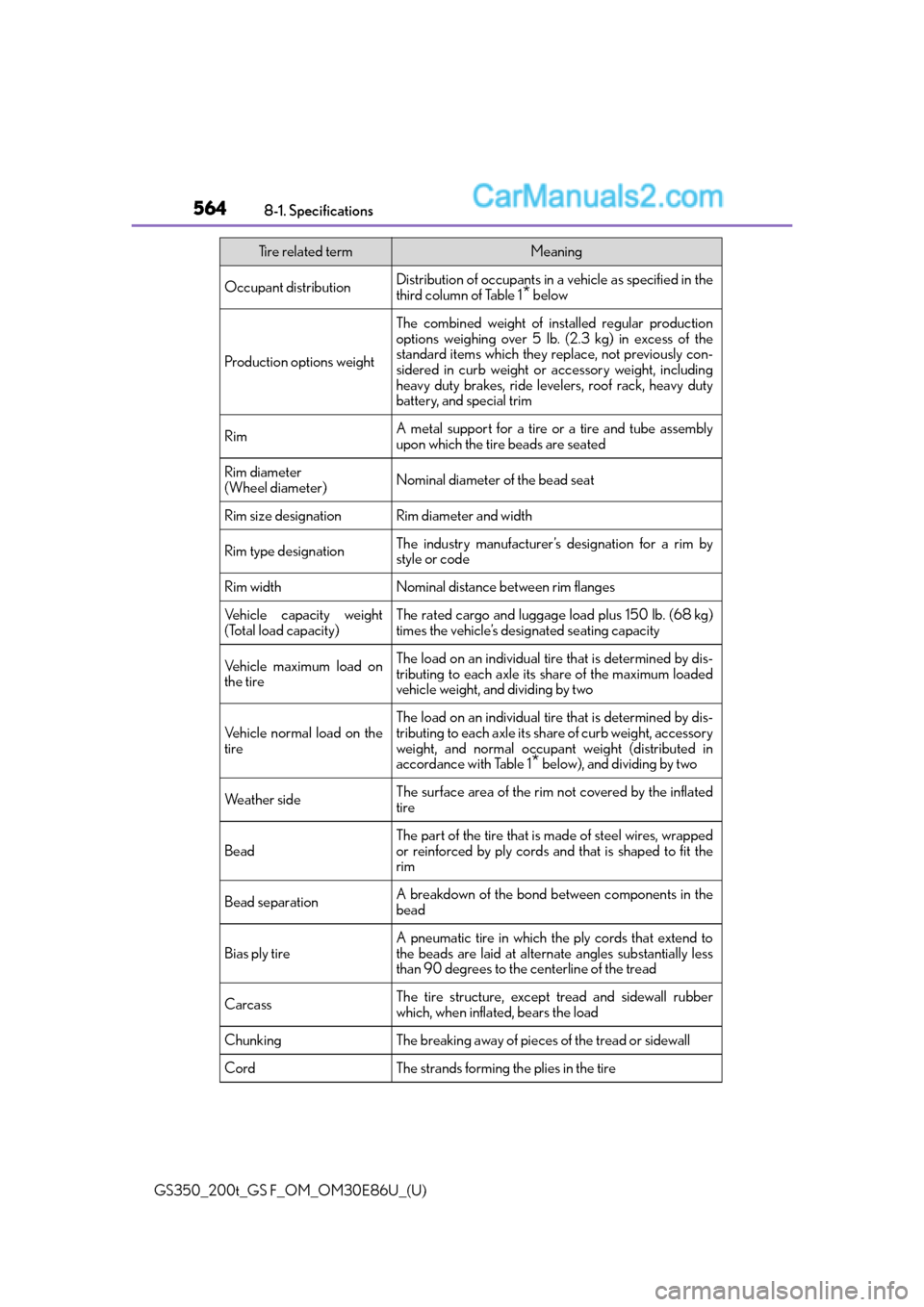
Occupant distributionDistribution of occupants in
a vehicle as specified in the
third column of Table 1* below
Production options weight
The combined weight of installed regular production
options weighing over 5 lb. (2.3 kg) in excess of the
standard items which they replace, not previously con-
sidered in curb weight or accessory weight, including
heavy duty brakes, ride levelers, roof rack, heavy duty
battery, and special trim
RimA metal support for a tire or a tire and tube assembly
upon which the tire beads are seated
Rim diameter
(Wheel diameter)Nominal diameter of the bead seat
Rim size designationRim diameter and width
Rim type designationThe industry manufacturer’s designation for a rim by
style or code
Rim widthNominal distance between rim flanges
Vehicle capacity weight
(Total load capacity)The rated cargo and luggage load plus 150 lb. (68 kg)
times the vehicle’s designated seating capacity
Vehicle maximum load on
the tireThe load on an individual tire that is determined by dis-
tributing to each axle its share of the maximum loaded
vehicle weight, and dividing by two
Vehicle normal load on the
tireThe load on an individual tire that is determined by dis-
tributing to each axle its sh are of curb weight, accessory
weight, and normal occupant weight (distributed in
accordance with Table 1
* below), and dividing by two
We a t h e r s i d eThe surface area of the rim not covered by the inflated
tire
Bead
The part of the tire that is made of steel wires, wrapped
or reinforced by ply cords and that is shaped to fit the
rim
Bead separationA breakdown of the bond be tween components in the
bead
Bias ply tireA pneumatic tire in which the ply cords that extend to
the beads are laid at altern ate angles substantially less
than 90 degrees to the centerline of the tread
CarcassThe tire structure, except tread and sidewall rubber
which, when inflated, bears the load
ChunkingThe breaking away of pieces of the tread or sidewall
CordThe strands forming th e plies in the tire
Tire related termMeaning
Page 565 of 624
GS350_200t_GS F_OM_OM30E86U_(U)
5658-1. Specifications
8
Vehicle specifications
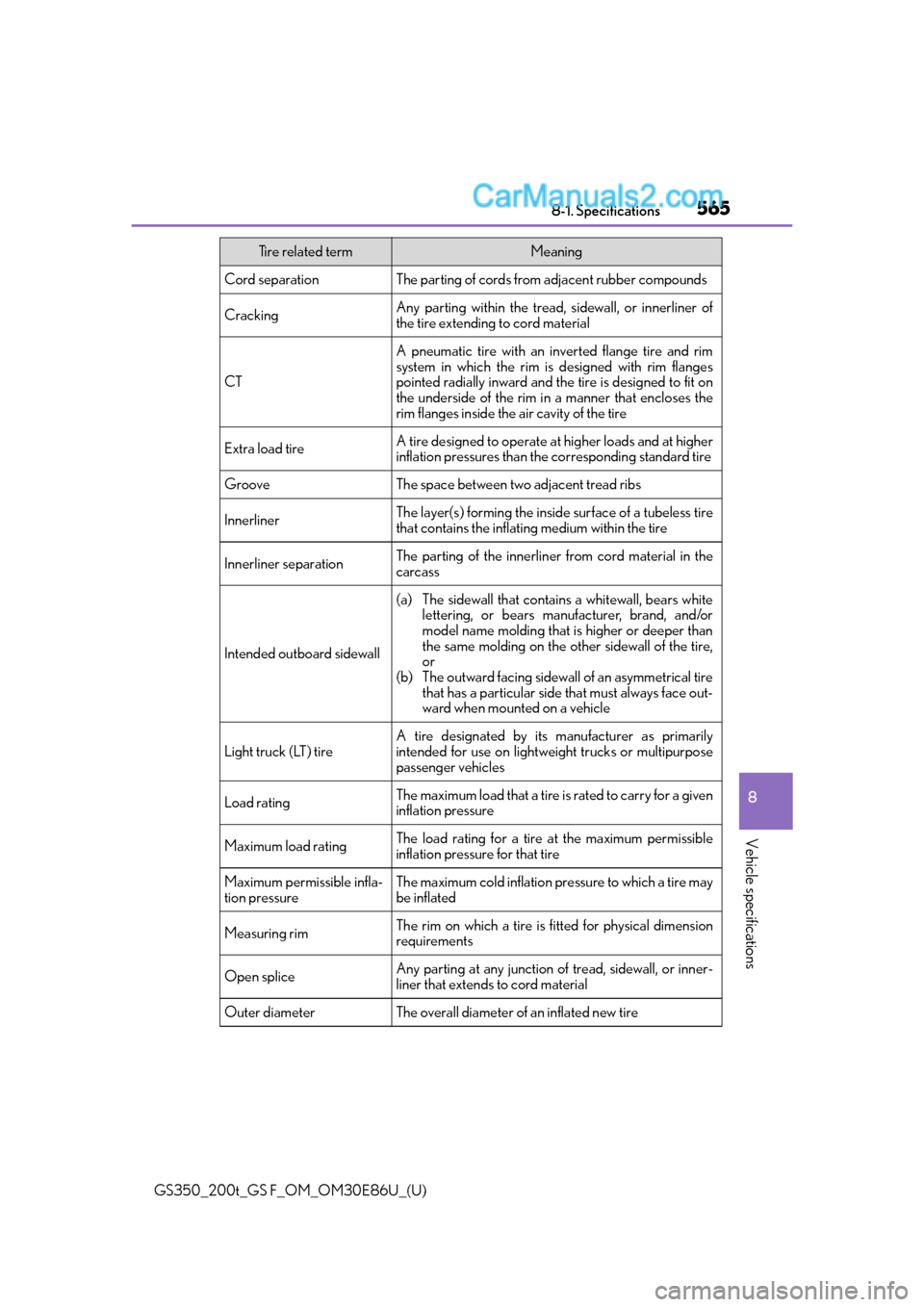
Cord separationThe parting of cords from adjacent rubber compounds
CrackingAny parting within the tread, sidewall, or innerliner of
the tire extending to cord material
CT
A pneumatic tire with an inverted flange tire and rim
system in which the rim is designed with rim flanges
pointed radially inward and the tire is designed to fit on
the underside of the rim in a manner that encloses the
rim flanges inside the air cavity of the tire
Extra load tireA tire designed to operate at higher loads and at higher
inflation pressures than the corresponding standard tire
GrooveThe space between two adjacent tread ribs
InnerlinerThe layer(s) forming the inside surface of a tubeless tire
that contains the inflating medium within the tire
Innerliner separationThe parting of the i nnerliner from cord material in the
carcass
Intended outboard sidewall
(a) The sidewall that contains a whitewall, bears white lettering, or bears manufacturer, brand, and/or
model name molding that is higher or deeper than
the same molding on the ot her sidewall of the tire,
or
(b) The outward facing sidewall of an asymmetrical tire
that has a particular side that must always face out-
ward when mounted on a vehicle
Light truck (LT) tireA tire designated by its manufacturer as primarily
intended for use on lightweight trucks or multipurpose
passenger vehicles
Load ratingThe maximum load that a tire is rated to carry for a given
inflation pressure
Maximum load ratingThe load rating for a tire at the maximum permissible
inflation pressure for that tire
Maximum permissible infla-
tion pressureThe maximum cold inflation pressure to which a tire may
be inflated
Measuring rimThe rim on which a tire is fitted for physical dimension
requirements
Open spliceAny parting at any junction of tread, sidewall, or inner-
liner that extends to cord material
Outer diameterThe overall diameter of an inflated new tire
Tire related termMeaning
Page 566 of 624
566
GS350_200t_GS F_OM_OM30E86U_(U)8-1. Specifications
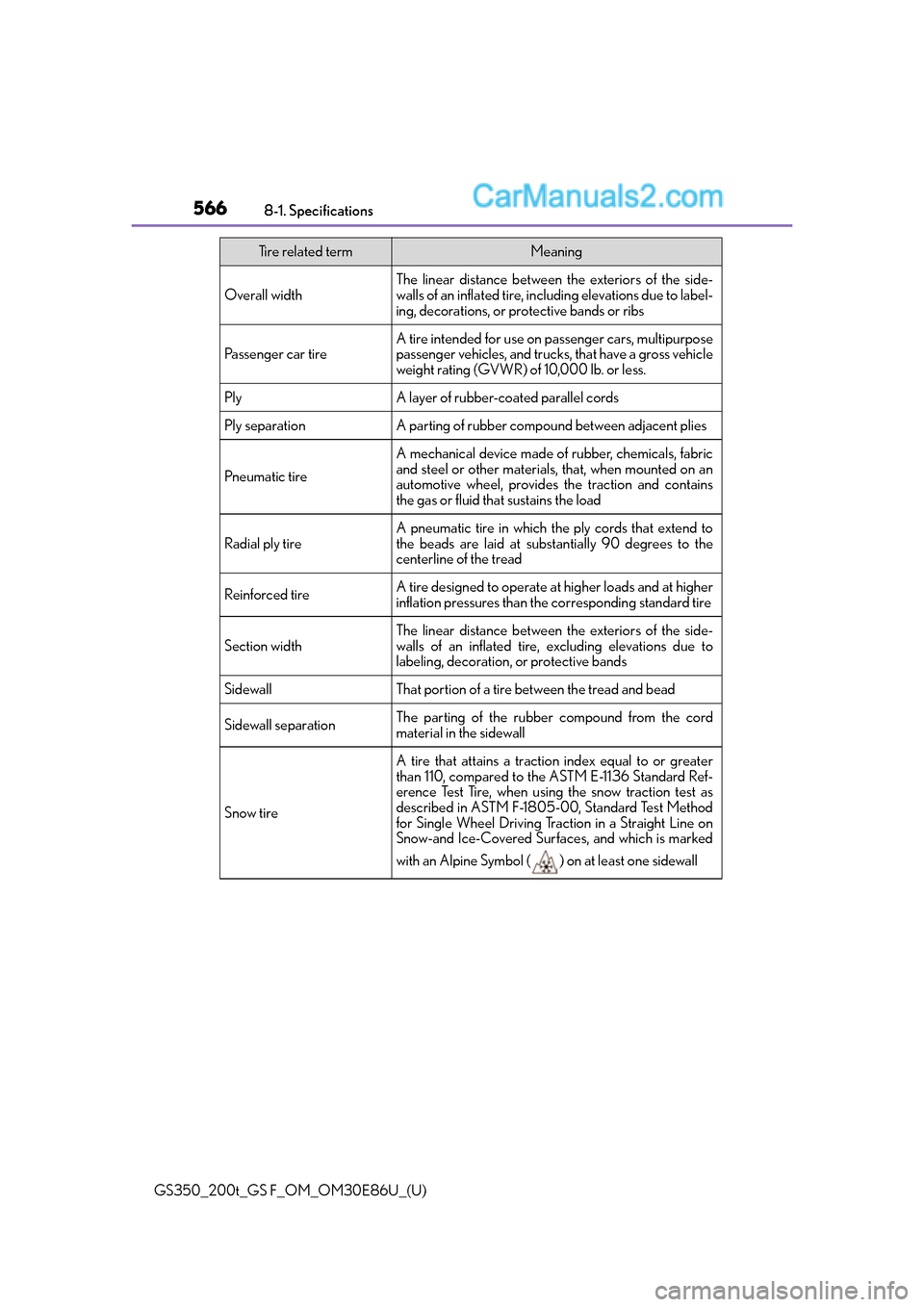
Overall widthThe linear distance between the exteriors of the side-
walls of an inflated tire, incl
uding elevations due to label-
ing, decorations, or pr otective bands or ribs
Passenger car tire
A tire intended for use on passenger cars, multipurpose
passenger vehicles, and trucks, that have a gross vehicle
weight rating (GVWR) of 10,000 lb. or less.
PlyA layer of rubber-coated parallel cords
Ply separationA parting of rubber compound between adjacent plies
Pneumatic tire
A mechanical device made of rubber, chemicals, fabric
and steel or other materials, that, when mounted on an
automotive wheel, provides the traction and contains
the gas or fluid that sustains the load
Radial ply tire
A pneumatic tire in which the ply cords that extend to
the beads are laid at substantially 90 degrees to the
centerline of the tread
Reinforced tire A tire designed to operate at higher loads and at higher
inflation pressures than the corresponding standard tire
Section width
The linear distance between the exteriors of the side-
walls of an inflated tire, excluding elevations due to
labeling, decoration, or protective bands
SidewallThat portion of a tire between the tread and bead
Sidewall separationThe parting of the rubber compound from the cord
material in the sidewall
Snow tire
A tire that attains a traction index equal to or greater
than 110, compared to the ASTM E-1136 Standard Ref-
erence Test Tire, when using the snow traction test as
described in ASTM F-1805-00, Standard Test Method
for Single Wheel Driving Tract ion in a Straight Line on
Snow-and Ice-Covered Surfaces, and which is marked
with an Alpine Symbol ( ) on at least one sidewall
Tire related termMeaning
Page 583 of 624
583
GS350_200t_GS F_OM_OM30E86U_(U)8-3. Initialization
8
Vehicle specifications
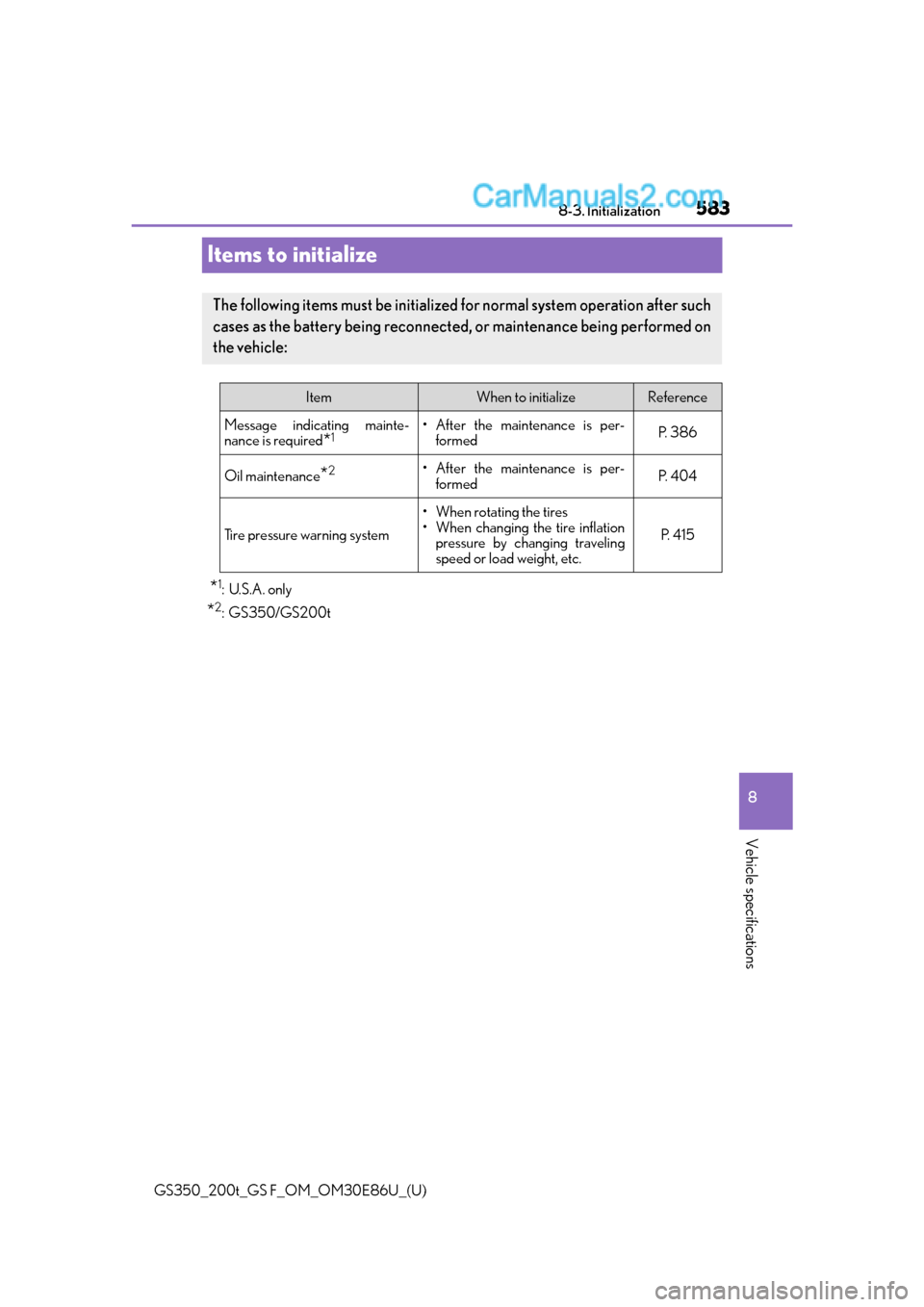
Items to initialize
*1: U.S.A. only
*2: GS350/GS200t
The following items must be initialized for normal system operation after such
cases as the battery being reconnecte
d, or maintenance being performed on
the vehicle:
ItemWhen to initializeReference
Message indicating mainte-
nance is required
*1• After the maintenance is per- formedP. 3 8 6
Oil maintenance*2• After the maintenance is per-
formedP. 4 0 4
Tire pressure warning system
• When rotating the tires
• When changing the tire inflationpressure by changing traveling
speed or load weight, etc.
P. 4 1 5
Page 621 of 624
621Alphabetical index
GS350_200t_GS F_OM_OM30E86U_(U)
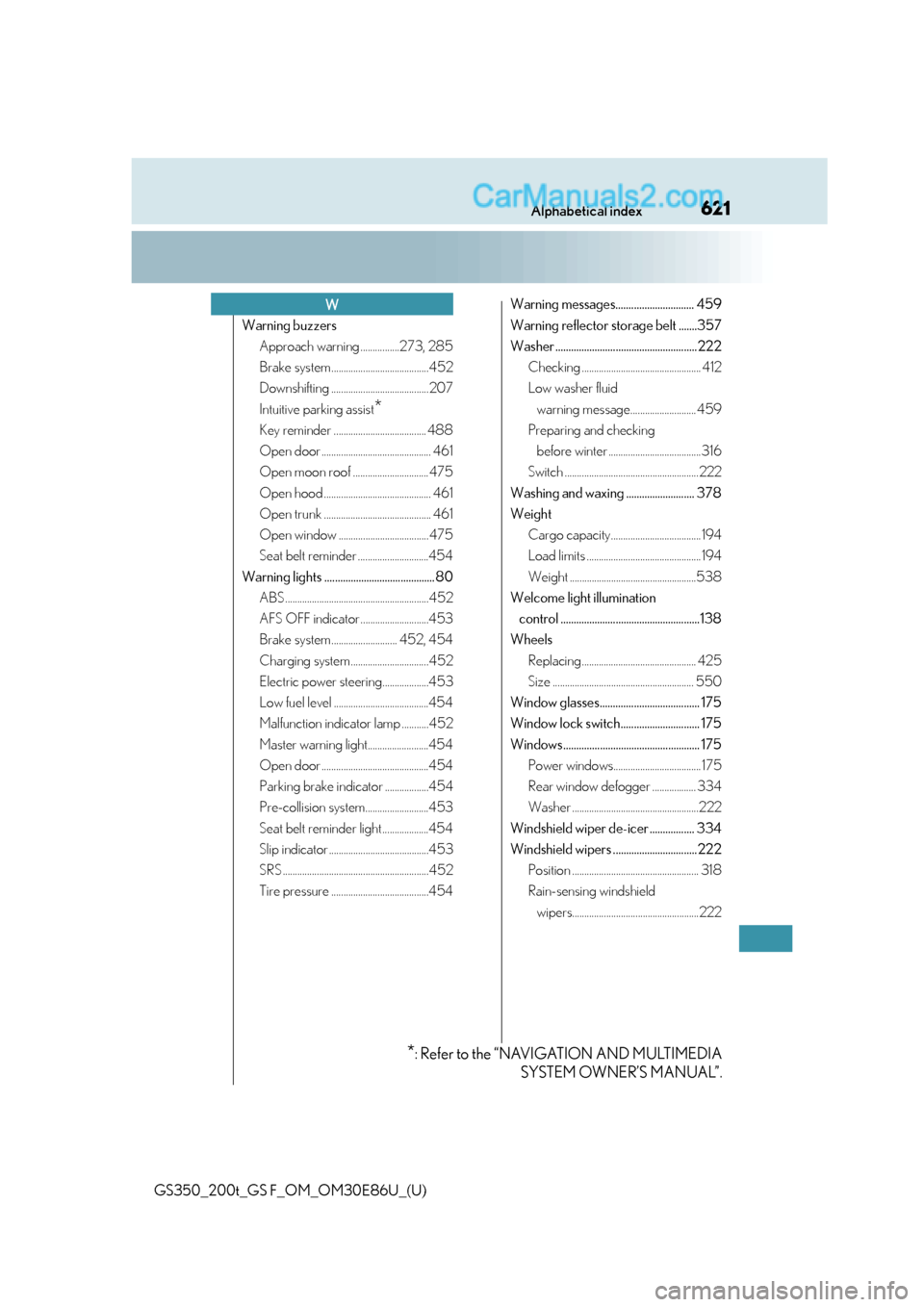
Warning buzzersApproach warning ................273, 285
Brake system........................................452
Downshifting ........................................207
Intuitive parking assist
*
Key reminder ...................................... 488
Open door ............................................. 461
Open moon roof ...............................475
Open hood ............................................ 461
Open trunk ............................................ 461
Open window .....................................475
Seat belt reminder .............................454
Warning lights .......................................... 80 ABS ...........................................................452
AFS OFF indicator ............................453
Brake system........................... 452, 454
Charging system................................452
Electric power steering...................453
Low fuel level .......................................454
Malfunction indicator lamp ...........452
Master warning light.........................454
Open door ............................................454
Parking brake indicator ..................454
Pre-collision system..........................453
Seat belt reminder light...................454
Slip indicator .........................................453
SRS ............................................................452
Tire pressure ........................................454 Warning messages.............................. 459
Warning reflector storage belt .......357
Washer ...................................................... 222
Checking ................................................. 412
Low washer fluid warning message........................... 459
Preparing and checking before winter ......................................316
Switch .......................................................222
Washing and waxing .......................... 378
Weight Cargo capacity.....................................194
Load limits ...............................................194
Weight ....................................................538
Welcome light illumination control .....................................................138
Wheels Replacing ............................................... 425
Size .......................................................... 550
Window glasses...................................... 175
Window lock switch.............................. 175
Windows.................................................... 175 Power windows.................................... 175
Rear window defogger .................. 334
Washer ....................................................222
Windshield wiper de-icer ................. 334
Windshield wipers ................................222 Position .................................................... 318
Rain-sensing windshield wipers....................................................222
W
*: Refer to the “NAVIGATION AND MULTIMEDIA SYSTEM OWNER’S MANUAL”.