wheel size Lexus GS350 2016 User Guide
[x] Cancel search | Manufacturer: LEXUS, Model Year: 2016, Model line: GS350, Model: Lexus GS350 2016Pages: 624, PDF Size: 15.29 MB
Page 418 of 624
418
GS350_200t_GS F_OM_OM30E86U_(U)6-3. Do-it-yourself maintenance
■Situations in which the tire pressure warning system may not operate properly
●In the following cases, the tire pressure warning system may not operate properly.
• If non-genuine Lexus wheels are used.
• A tire has been replaced with a tire that is not an OE (Original Equipment) tire.
• A tire has been replaced with a tire that is not of the specified size.
• Tire chains etc. are equipped.
• An auxiliary-supported run-flat tire is equipped.
• If a window tint that affects the radio wave signals is installed.
• If there is a lot of snow or ice on the vehicle, particularly around the wheels or wheel
housings.
• If the tire inflation pressure is extremely higher than the specified level.
• If wheel without the tire pressure warning valve and transmitter are used.
• If the ID code on the tire pressure warning valves and transmitters is not registered in the tire pressure warning computer.
●Performance may be affected in the following situations.
• Near a TV tower, electric power plant, gas station, radio station, large display, air- port or other facility th at generates strong radio waves or electrical noise
• When carrying a portable radio, cellular phone, cordless phone or other wireless
communication device
If tire position information is not correctl y displayed due to the radio wave conditions,
the display may be corrected by driving and changing the radio wave conditions.
●When the vehicle is parked, the time taken for the warning to start or go off could be
extended.
●When tire inflation pressure declines rapidly for example when a tire has burst, the
warning may not function.
■The initialization operation
●Make sure to carry out initialization af ter adjusting the tire inflation pressure.
Also, make sure the tires are cold before carry ing out initialization or tire inflation pres-
sure adjustment.
●If you have accidentally turned the engine swit ch off during initialization, it is not neces-
sary to manually restart the initialization agai n, as initialization will restart automatically
the next time the engine switch is turned to IGNITION ON mode.
●If you accidentally perform initialization when initialization is not necessary, adjust the
tire inflation pressure to the specified level when the tires are co ld, and conduct initial-
ization again.
■When initialization of the tire pressure warning system has failed
Initialization can be completed in a few minutes. However, in the following cases, the set-
tings have not been recorded and the system will not operate properly. If repeated
attempts to record tire inflation pressure settings are unsuccessful, have the vehicle
inspected by your Lexus dealer.
●The initialization message is not displayed on the multi-information display when per-
forming initialization.
●After carrying out the initialization procedure, the tire pressure warning light blinks for 1
minute then stays on after driving for 20 minutes.
Page 425 of 624
425
GS350_200t_GS F_OM_OM30E86U_(U)6-3. Do-it-yourself maintenance
6
Maintenance and care
Wheels
When replacing wheels, care should be taken to ensure that they are equivalent
to those removed in load capacity
, diameter, rim width and inset
*.
Replacement wheels are available at your Lexus dealer.
*: Conventionally referred to as “offset”.
Lexus does not recommend using the following:
●Wheels of different sizes or types
●Used wheels
●Bent wheels that have been straightened
●Steel wheels (2WD F SPORT models only)
●Use only Lexus wheel nuts and wrenches designed for use with your alumi-
num wheels.
●When rotating, repairing or changing your tires, check that the wheel nuts are
still tight after driving 1000 miles (1600 km).
●Be careful not to damage the aluminum wheels when using tire chains.
●Use only Lexus genuine balance weights or equivalent and a plastic or rubber
hammer when balancing your wheels.
■When replacing wheels
The wheels of your vehicle are equipped with tire pressure warning valves and transmit-
ters that allow the tire pressure warning system to provide advance warning in the event
of a loss in tire inflation pressure. Whenever wheels are replaced, tire pressure warning
valves and transmitters must be installed. ( P. 4 1 4 )
If a wheel is bent, cracked or heavily corroded, it should be replaced. Other-
wise, the tire may separate from the wheel or cause a loss of handling control.
Wheel selection
Aluminum wheel precautions
Page 426 of 624
426
GS350_200t_GS F_OM_OM30E86U_(U)6-3. Do-it-yourself maintenance
WA R N I N G
■When replacing wheels
●Do not use wheels that are a different size from those recommended in the Owner’s
Manual, as this may result in a loss of handling control.
●Never use an inner tube in a leaking wheel which is designed for a tubeless tire. Doing
so may result in an accident, causing death or serious injury.
●2WD F SPORT models: Do not install steel wheels.
The wheel contact surface could be damage
d, and the wheel could come off while
driving, which could lead to an accident resulting in death or serious injury.
■Use of defective wheels prohibited
Do not use cracked or deformed wheels.
Doing so could cause the tire to leak air during driving, possibly causing an accident.
NOTICE
■Replacing tire pressure warning valves and transmitters
●Because tire repair or replacement may affect the tire pressure warning valves and
transmitters, make sure to have tires servic ed by your Lexus dealer or other qualified
service shop. In addition, make sure to pu rchase your tire pressure warning valves
and transmitters at your Lexus dealer.
●Ensure that only genuine Lexus wheels are used on your vehicle.
Tire pressure warning valves and transmitte rs may not work properly with non-genu-
ine wheels.
Page 458 of 624
4587-2. Steps to take in an emergency
GS350_200t_GS F_OM_OM30E86U_(U)
WA R N I N G
■Maintenance of the tires
Each tire, including the spare (if provided), should be checked monthly when cold and
inflated to the inflation pressure recomm ended by the vehicle manufacturer on the
vehicle placard or tire inflation pressure la bel (tire and load information label). (If your
vehicle has tires of a different size than the size indicated on the vehicle placard or tire
inflation pressure label [tire and load in formation label], you should determine the
proper tire inflation pressure for those tires.)
As an added safety feature, your vehicle has been equipped with a tire pressure moni-
toring system (TPMS-tire pressure warning system) that illuminates a low tire pressure
telltale (tire pressure warning light) when on e or more of your tires is significantly
under-inflated. Accordingly, when the low ti re pressure telltale (tire pressure warning
light) illuminates, you should stop and check your tires as soon as possible, and inflate
them to the proper pressure. Driving on a significantly under-inflated tire causes the
tire to overheat and can lead to tire failure. Under-inflation also reduces fuel efficiency
and tire tread life, and ma y affect the vehicle’s handling and stopping ability.
Please note that the TPMS (tire pressure wa rning system) is not a substitute for proper
tire maintenance, and it is the driver’s resp onsibility to maintain correct tire pressure,
even if under-inflation has no t reached the level to trigger illumination of the TPMS low
tire pressure telltale (tire pressure warning light).
Your vehicle has also been equipped with a TPMS (tire pressure warning system) mal-
function indicator to indicate when the system is not operating properly. The TPMS
(tire pressure warning system) malfunction indi cator is combined with the low tire pres-
sure telltale (tire pressure warning light). When the system detects a malfunction, the
telltale will flash for approximately one minu te and then remain continuously illumi-
nated. This sequence will cont inue upon subsequent vehicle start-ups as long as the
malfunction exists. When the malfunction indicator is illuminated, the system may not
be able to detect or signal low tire pressure as intended.
TPMS (tire pressure warning system) malfun ctions may occur for a variety of reasons,
including the installation of replacement or alternate tires or wheels on the vehicle that
prevent the TPMS (tire pressure warning system) from functioning properly. Always
check the TPMS (tire pressure warning syst em) malfunction telltale after replacing one
or more tires or wheels on your vehicle to ensure that the replacement or alternate
tires and wheels allow the TPMS (tire pressure warning system) to continue to function
properly.
NOTICE
■To ensure the tire pressure warning system operates properly
Do not install tires with different specificatio ns or markers, as the tire pressure warning
system may not operate properly.
Page 500 of 624
5007-2. Steps to take in an emergency
GS350_200t_GS F_OM_OM30E86U_(U)
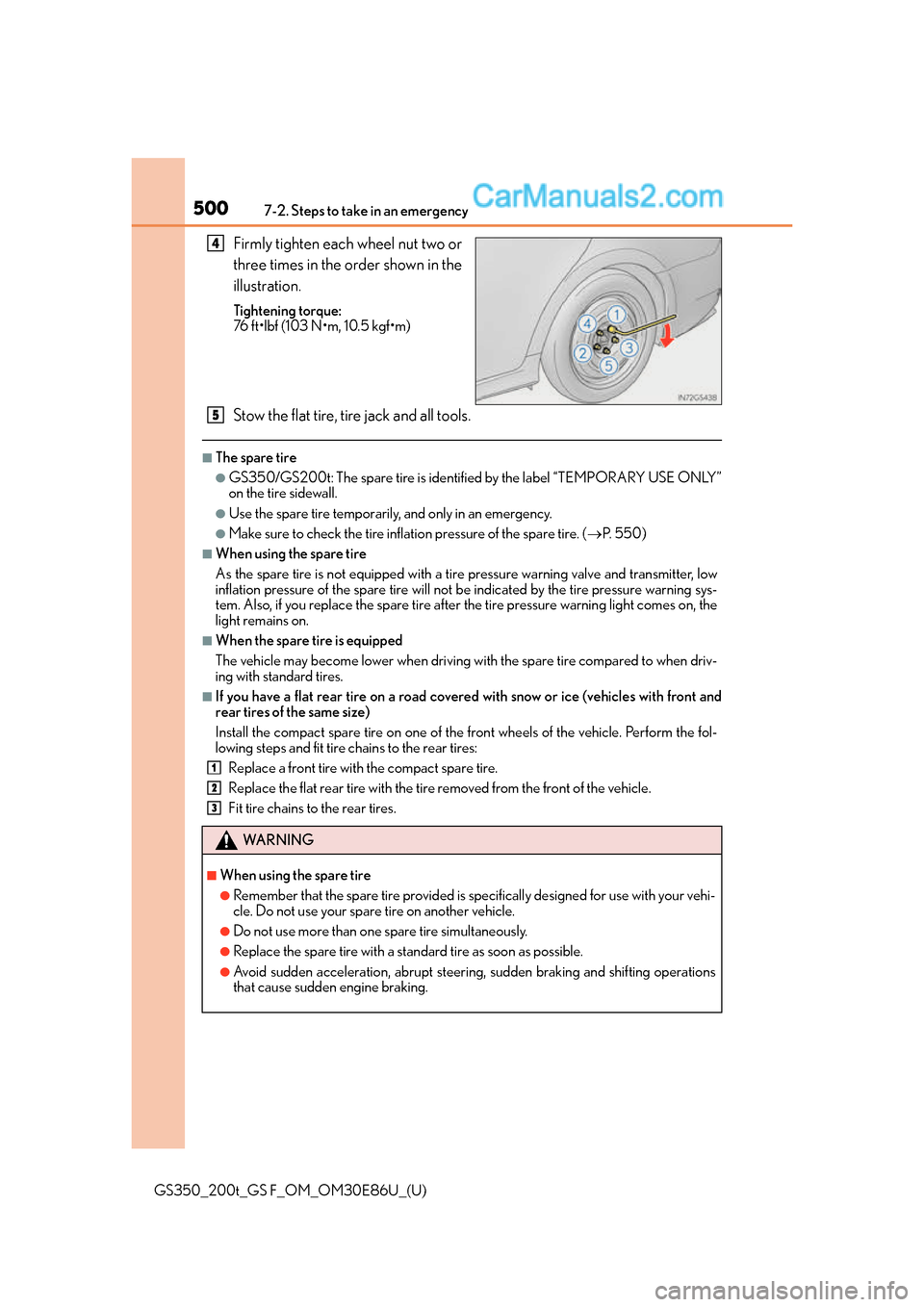
Firmly tighten each wheel nut two or
three times in the order shown in the
illustration.
Tightening torque:
76 ft•lbf (103 N•m, 10.5 kgf•m)
Stow the flat tire, tire jack and all tools.
■The spare tire
●GS350/GS200t: The spare tire is identified by the label “TEMPORARY USE ONLY”
on the tire sidewall.
●Use the spare tire temporarily, and only in an emergency.
●Make sure to check the tire inflation pressure of the spare tire. (P. 5 5 0 )
■When using the spare tire
As the spare tire is not equipped with a tire pressure warning valve and transmitter, low
inflation pressure of the spare tire will not be indicated by the tire pressure warning sys-
tem. Also, if you replace the spare tire after the tire pressure warning light comes on, the
light remains on.
■When the spare tire is equipped
The vehicle may become lower when driving with the spare tire compared to when driv-
ing with standard tires.
■If you have a flat rear tire on a road covered with snow or ice (vehicles with front and
rear tires of the same size)
Install the compact spare tire on one of the front wheels of the vehicle. Perform the fol-
lowing steps and fit tire chains to the rear tires:
Replace a front tire with the compact spare tire.
Replace the flat rear tire with the tire removed from the front of the vehicle.
Fit tire chains to the rear tires.
4
WA R N I N G
■When using the spare tire
●Remember that the spare tire provided is specifically designed for use with your vehi-
cle. Do not use your spare tire on another vehicle.
●Do not use more than one spare tire simultaneously.
●Replace the spare tire with a stan dard tire as soon as possible.
●Avoid sudden acceleration, abrupt steering, sudden braking and shifting operations
that cause sudden engine braking.
5
1
2
3
Page 512 of 624
5127-2. Steps to take in an emergency
GS350_200t_GS F_OM_OM30E86U_(U)
■Emergency tire puncture repair kit
●The sealant has a limited lifespan. The expiry date is shown on the bottle. The sealant
should be replaced before the expiry date. Contact your Lexus dealer for replacement.
●The sealant stored in the emergency tire puncture repair kit can be used only once to
temporarily repair a single tire. If the sealant has been used and need to be purchased,
contact your Lexus dealer.
●The sealant can be used when the outside temperature is from -40 F (-40 C) to
140 F (60 C).
●The repair kit is exclusively designed for size and type of tires originally installed on your
vehicle. Do not use it for tires that a different size than the original ones, or for any other
purposes.
●If the sealant gets on your clothes, it may stain.
●If the sealant adheres to a wheel or the surface of the vehicle body, the stain may not be
removable if it is not cleaned at once. Immediately wipe away the sealant with a wet
cloth.
●During operation of the repair kit, a loud operation noise is produced. This does not
indicate a malfunction.
●Do not use the emergency tire puncture repair kit to check or to adjust the tire pres-
sure.
■If the tire is inflated to more than the recommended level
Disconnect the hose from the valve.
Disconnect the hose from the valve, remove the air release cap from the hose and then
reconnect the hose.
Turn the compressor switch on and wait for several seconds, and then turn it off. Check
that the air pressure indicator shows the recommended level. ( P. 5 5 0 )
If the air pressure is lower than the recommended level, turn the compressor switch on
again and repeat the inflation procedure until the recommended pressure is reached.
■The valve of a tire that has been repaired
●After a tire is repaired with the emergency tire puncture repair kit, the valve should be
replaced.
●After a tire is repaired with the emergency tire puncture repair kit, even if the tire infla-
tion pressure is at the recommended level, the tire pressure warning light may come
on/flash.
■Note for checking the emergency tire puncture repair kit
Check the sealant expiry date occasionally.
The expiry date is shown on the bottle.
Do not use sealant whose expiry date has al ready passed. Otherwise, repairs conducted
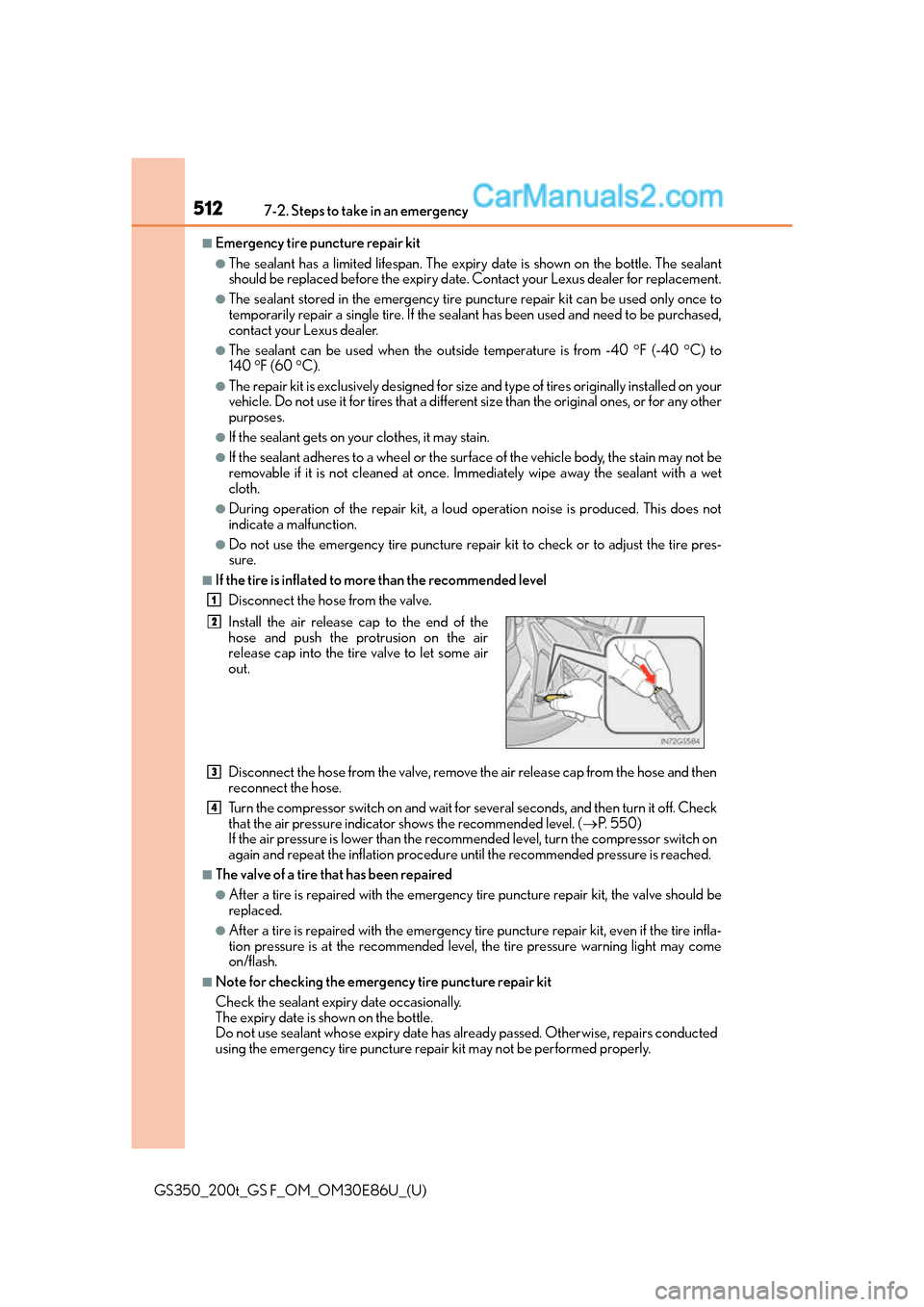
using the emergency tire puncture repair kit may not be performed properly. Install the air release cap to the end of the
hose and push the protrusion on the air
release cap into the tire valve to let some air
out.
1
2
3
4
Page 513 of 624
5137-2. Steps to take in an emergency
GS350_200t_GS F_OM_OM30E86U_(U)
7
When trouble arises
WA R N I N G
■Caution while driving
Observe the following precautions.
Failure to do so may cause an accident.
●The emergency tire puncture repair kit is made exclusively for your vehicle. Do not
use it on other vehicles.
●Do not use the emergency tire puncture repair kit for tires that are a different size
than the specified ones or fo r any other purpose. Doing so may cause the tires to not
be repaired properly.
■Precautions for use of the sealant
●Ingesting the sealant is hazardous to your health. If you ingest sealant, consume as
much water as possible, and then immediately consult a doctor.
●If sealant gets in eyes or adheres to skin, immediately wash it off with water. If discom-
fort persists, consult a doctor.
■When fixing the flat tire
●Stop your vehicle in a safe and flat area.
●Do not touch the wheels or the area around the brakes immediately after the vehicle
has been driven.
After the vehicle has been driven, the wheels and the area around the brakes may be
extremely hot. Touching these areas with hands, feet or other body parts may result in
burns.
●Connect the valve and hose securely wi th the tire installed on the vehicle.
●If the hose is not properly connected to the valve, air leakage may occur or sealant
may be sprayed out.
●If the hose comes off the valve while inflating the tire, there is a risk that the hose will
move abruptly due to air pressure.
●After inflation of the tire has completed, the sealant may splatter when the hose is dis-
connected or some air is let out of the tire.
●Follow the operation procedure to repair the tire. If the procedures not followed, the
sealant may spray out.
●Keep back from the tire while it is being re paired, as there is a chance of it bursting
while the repair operation is being perfor med. If you notice any cracks or deforma-
tion of the tire, turn off the compressor sw itch and stop the repair operation immedi-
ately.
●The repair kit may overheat if operated for a long period of time. Do not operate the
repair kit continuously for more than 35 minutes.
●Parts of the repair kit become hot during op eration. Be careful handling the repair kit
during and after operation. Do not touch the metal part connecting the bottle and the
compressor. It will be extremely hot.
●Do not attach the vehicle speed warning sticker to an area other than the one indi-
cated. If the sticker is attached to an area where an SRS airbag is located, such as the
pad of the steering wheel, it may preven t the SRS air bag from operating properly.
Page 550 of 624
550
GS350_200t_GS F_OM_OM30E86U_(U)8-1. Specifications
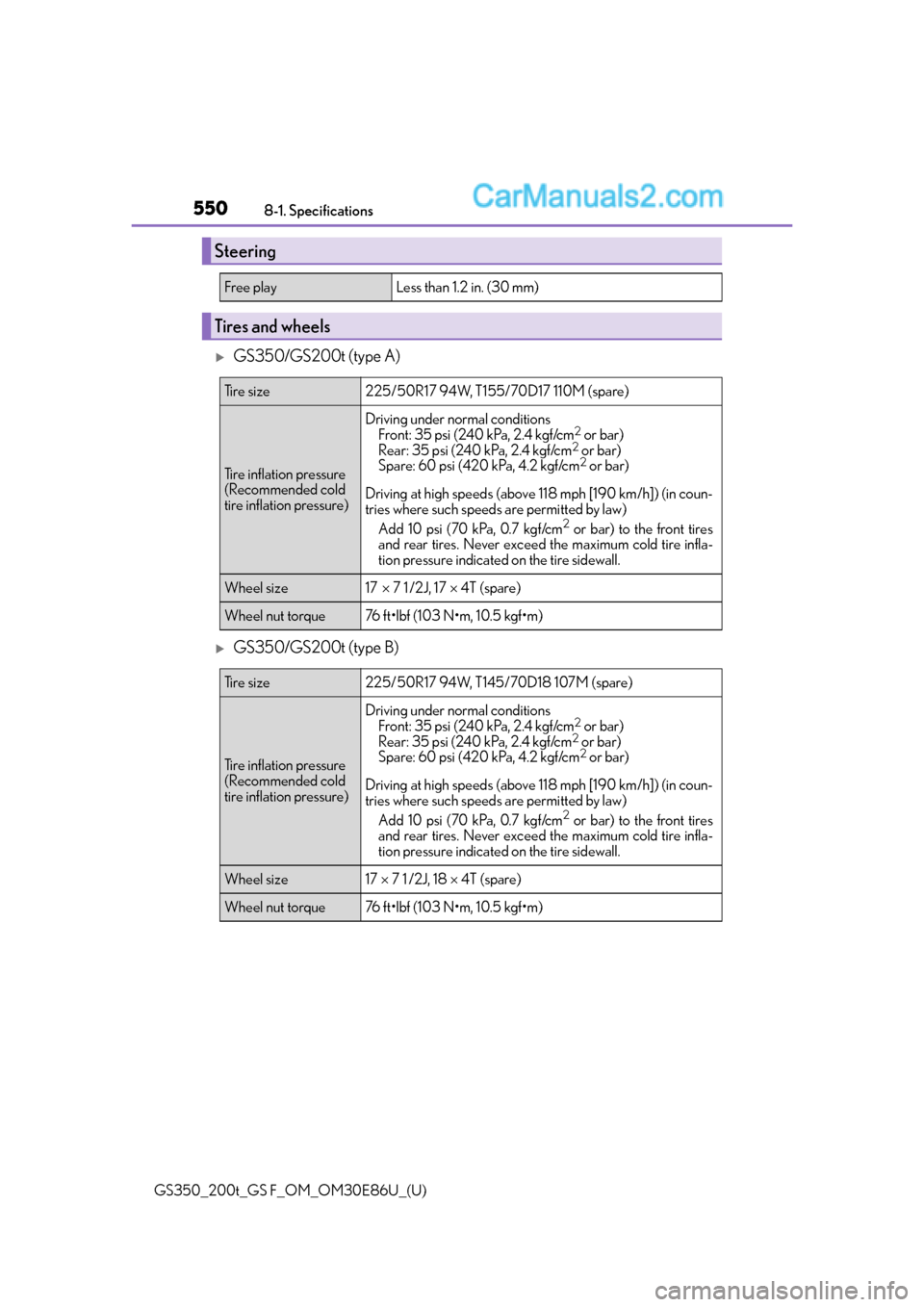
GS350/GS200t (type A)
GS350/GS200t (type B)
Steering
Free playLess than 1.2 in. (30 mm)
Tires and wheels
Ti r e s i z e225/50R17 94W, T155/70D17 110M (spare)
Tire inflation pressure
(Recommended cold
tire inflation pressure)
Driving under normal conditions
Front: 35 psi (240 kPa, 2.4 kgf/cm2 or bar)
Rear: 35 psi (240 kPa, 2.4 kgf/cm2 or bar)
Spare: 60 psi (420 kPa, 4.2 kgf/cm2 or bar)
Driving at high speeds (above 118 mph [190 km/h]) (in coun-
tries where such speeds are permitted by law)
Add 10 psi (70 kPa, 0.7 kgf/cm
2 or bar) to the front tires
and rear tires. Never exceed the maximum cold tire infla-
tion pressure indicated on the tire sidewall.
Wheel size17 7 1 /2J, 17 4T (spare)
Wheel nut torque76 ft•lbf (103 N•m, 10.5 kgf•m)
Ti r e s i z e225/50R17 94W, T145/70D18 107M (spare)
Tire inflation pressure
(Recommended cold
tire inflation pressure)
Driving under normal conditions
Front: 35 psi (240 kPa, 2.4 kgf/cm2 or bar)
Rear: 35 psi (240 kPa, 2.4 kgf/cm2 or bar)
Spare: 60 psi (420 kPa, 4.2 kgf/cm2 or bar)
Driving at high speeds (above 118 mph [190 km/h]) (in coun-
tries where such speeds are permitted by law)
Add 10 psi (70 kPa, 0.7 kgf/cm
2 or bar) to the front tires
and rear tires. Never exceed the maximum cold tire infla-
tion pressure indicated on the tire sidewall.
Wheel size17 7 1 /2J, 18 4T (spare)
Wheel nut torque76 ft•lbf (103 N•m, 10.5 kgf•m)
Page 551 of 624
GS350_200t_GS F_OM_OM30E86U_(U)
5518-1. Specifications
8
Vehicle specifications
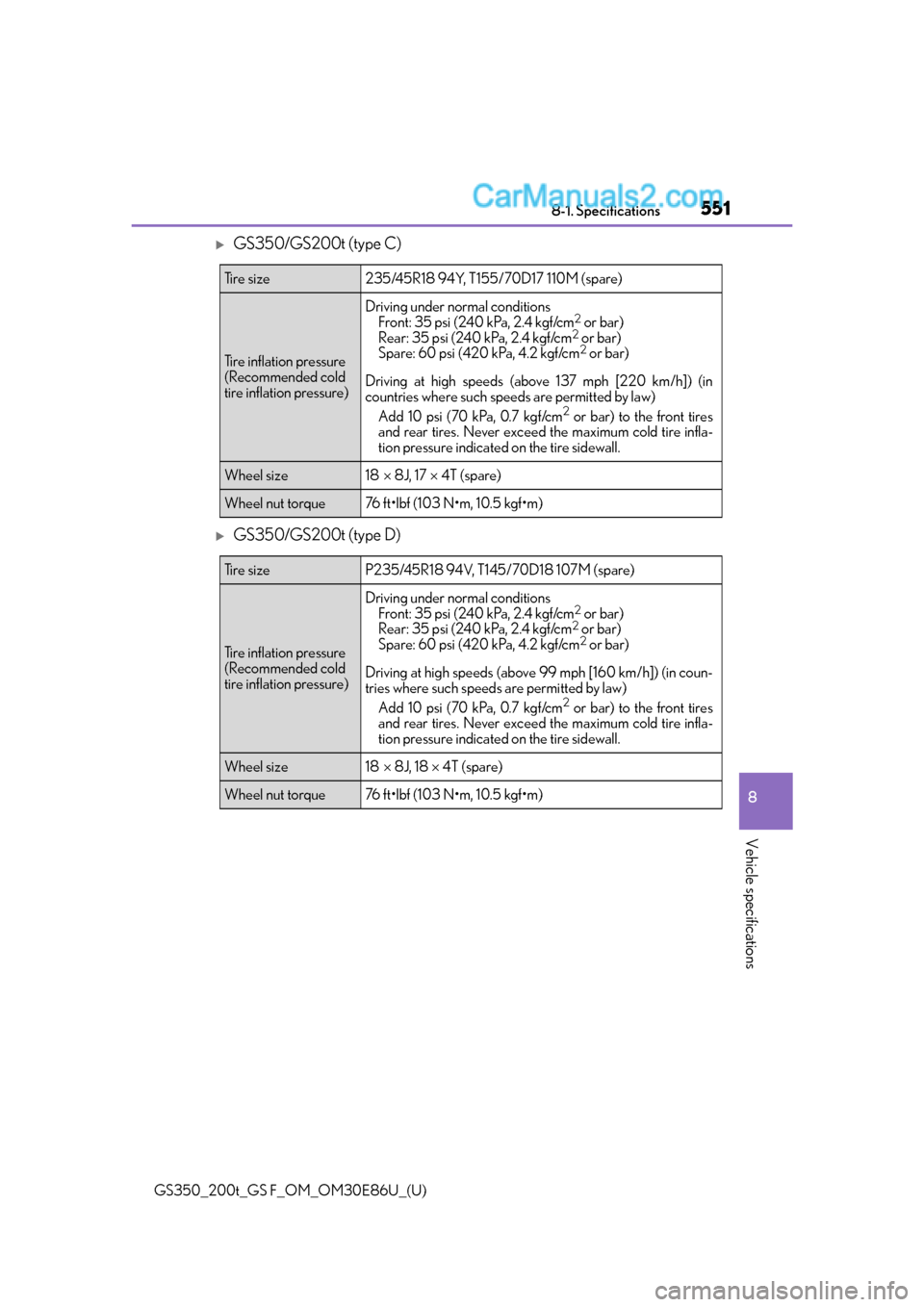
GS350/GS200t (type C)
GS350/GS200t (type D)
Ti r e s i z e235/45R18 94Y, T155/70D17 110M (spare)
Tire inflation pressure
(Recommended cold
tire inflation pressure)
Driving under normal conditionsFront: 35 psi (240 kPa, 2.4 kgf/cm2 or bar)
Rear: 35 psi (240 kPa, 2.4 kgf/cm2 or bar)
Spare: 60 psi (420 kPa, 4.2 kgf/cm2 or bar)
Driving at high speeds (above 137 mph [220 km/h]) (in
countries where such speeds are permitted by law)
Add 10 psi (70 kPa, 0.7 kgf/cm
2 or bar) to the front tires
and rear tires. Never exceed the maximum cold tire infla-
tion pressure indicated on the tire sidewall.
Wheel size18 8J, 17 4T (spare)
Wheel nut torque76 ft•lbf (103 N•m, 10.5 kgf•m)
Ti r e s i z eP235/45R18 94V, T145/70D18 107M (spare)
Tire inflation pressure
(Recommended cold
tire inflation pressure)
Driving under normal conditions
Front: 35 psi (240 kPa, 2.4 kgf/cm2 or bar)
Rear: 35 psi (240 kPa, 2.4 kgf/cm2 or bar)
Spare: 60 psi (420 kPa, 4.2 kgf/cm2 or bar)
Driving at high speeds (above 99 mph [160 km/h]) (in coun-
tries where such speeds are permitted by law)
Add 10 psi (70 kPa, 0.7 kgf/cm
2 or bar) to the front tires
and rear tires. Never exceed the maximum cold tire infla-
tion pressure indicated on the tire sidewall.
Wheel size18 8J, 18 4T (spare)
Wheel nut torque76 ft•lbf (103 N•m, 10.5 kgf•m)
Page 552 of 624
552
GS350_200t_GS F_OM_OM30E86U_(U)8-1. Specifications
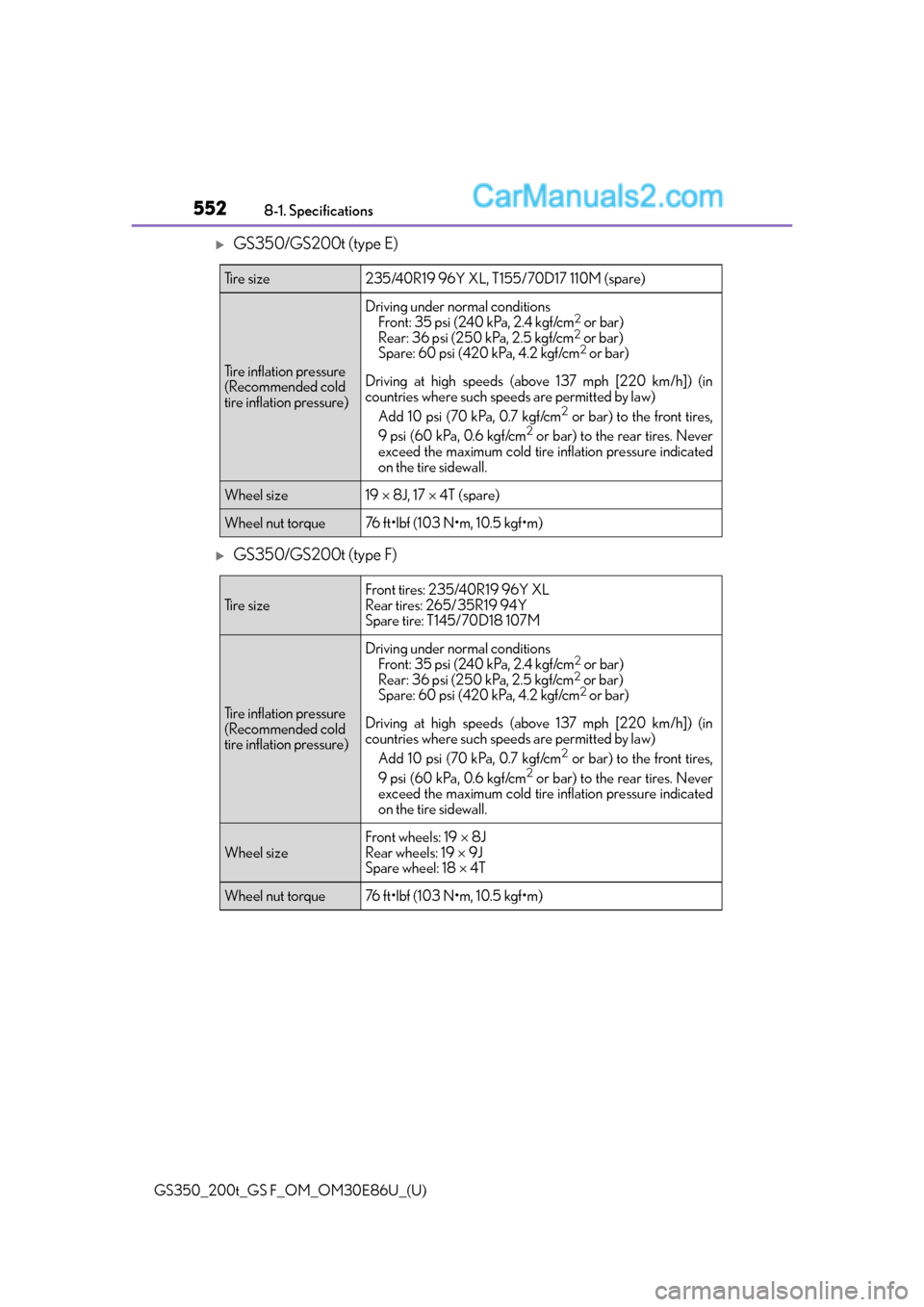
GS350/GS200t (type E)
GS350/GS200t (type F)
Ti r e s i z e235/40R19 96Y XL, T155/70D17 110M (spare)
Tire inflation pressure
(Recommended cold
tire inflation pressure)
Driving under normal conditions
Front: 35 psi (240 kPa, 2.4 kgf/cm2 or bar)
Rear: 36 psi (250 kPa, 2.5 kgf/cm2 or bar)
Spare: 60 psi (420 kPa, 4.2 kgf/cm2 or bar)
Driving at high speeds (above 137 mph [220 km/h]) (in
countries where such speeds are permitted by law)
Add 10 psi (70 kPa, 0.7 kgf/cm
2 or bar) to the front tires,
9 psi (60 kPa, 0.6 kgf/cm2 or bar) to the rear tires. Never
exceed the maximum cold tire inflation pressure indicated
on the tire sidewall.
Wheel size19 8J, 17 4T (spare)
Wheel nut torque76 ft•lbf (103 N•m, 10.5 kgf•m)
Ti r e s i z e
Front tires: 235/40R19 96Y XL
Rear tires: 265/ 35R19 94Y
Spare tire: T145/70D18 107M
Tire inflation pressure
(Recommended cold
tire inflation pressure)
Driving under normal conditions
Front: 35 psi (240 kPa, 2.4 kgf/cm2 or bar)
Rear: 36 psi (250 kPa, 2.5 kgf/cm2 or bar)
Spare: 60 psi (420 kPa, 4.2 kgf/cm2 or bar)
Driving at high speeds (above 137 mph [220 km/h]) (in
countries where such speeds are permitted by law)
Add 10 psi (70 kPa, 0.7 kgf/cm
2 or bar) to the front tires,
9 psi (60 kPa, 0.6 kgf/cm2 or bar) to the rear tires. Never
exceed the maximum cold tire inflation pressure indicated
on the tire sidewall.
Wheel size
Front wheels: 19 8J
Rear wheels: 19 9J
Spare wheel: 18 4T
Wheel nut torque76 ft•lbf (103 N•m, 10.5 kgf•m)